A house has no building management to make decisions for you: the roof, the drainage, the boundaries of the plot and the compliance of past works all become your decisions on the day you sign. This page brings together what you need to have checked before writing an offer, and then points to the market in each city.
Get the app
What nobody tells you.
Real prices, hidden costs and the traps to check before you commit.
What you are really buying when you buy a house
Scroll
What you are really buying when you buy a house
A house has no building management to make decisions for you: the roof, the drainage, the boundaries of the plot and the compliance of past works all become your decisions on the day you sign. This page brings together what you need to have checked before writing an offer, and then points to the market in each city.
These three gaps have one thing in common: they are either priced before the offer or absorbed after it.
In an apartment building, decisions are pooled and their cost is spread across dozens of owners. In a house there is nobody else. The roof, the boiler, the drainage and the fencing are yours alone, at the moment they fail, and rarely at a moment you would choose. The purchase price is therefore only part of the commitment — the part you negotiate, not the part that costs.
The price of the housevsThe budget for the next ten years
The roof, the windows and doors, the heating system and the drainage each have a lifespan. A well-kept house where everything reaches the end of its life at the same time costs more than an average house that has already been renovated.
The living areavsThe area you have to maintain
The garden, a pool and any outbuildings are not neutral extras: they add property tax, upkeep and time. They are often what decides how easily the house resells.
The house as it isvsThe house as it was declared
A conservatory, a loft conversion, an extension: a change made without permission remains a planning problem, and it becomes yours. The planning history and past permissions should be requested before the offer.
The viewing and the reports do not describe the same property
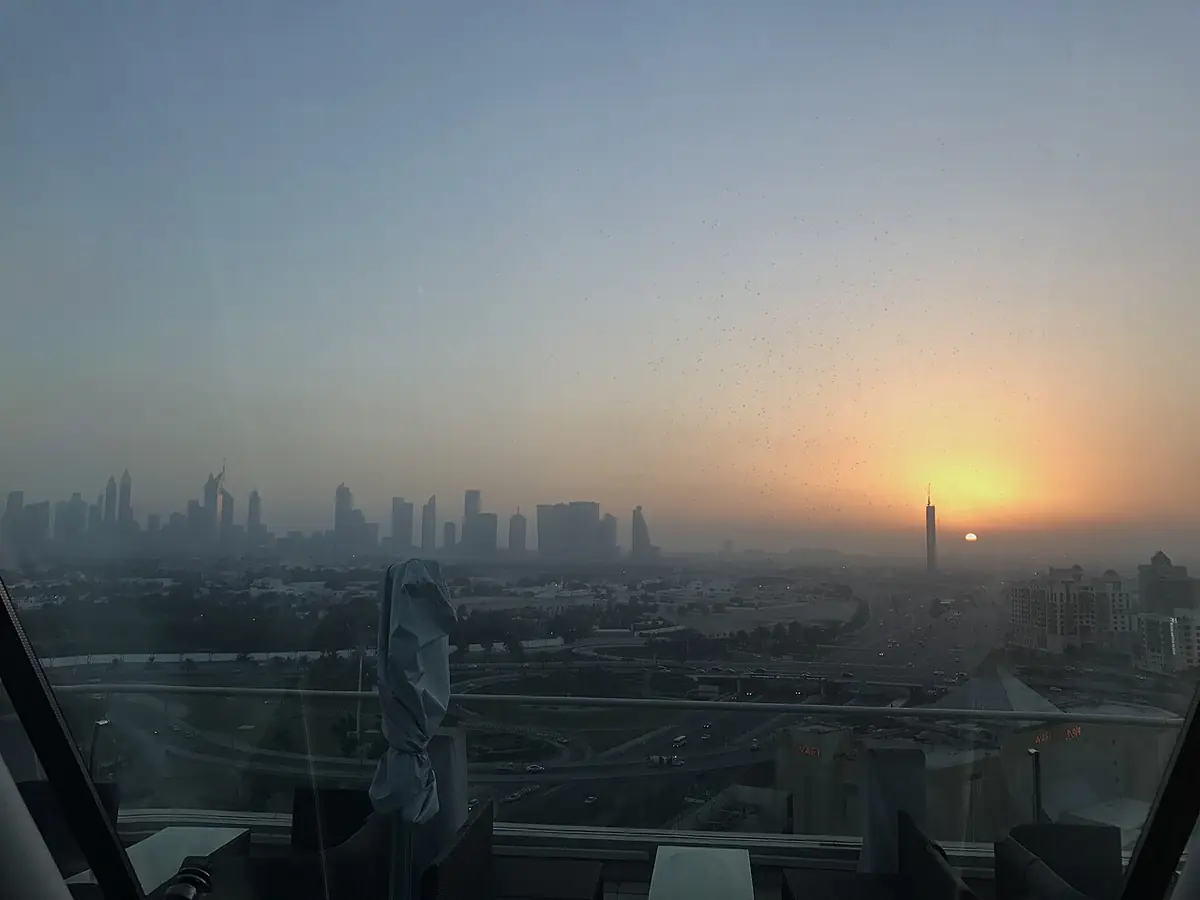
Dubai's skyline at sunset, a fitting close to the day — Photo: Lxs · CC BY 4.0 · Wikimedia Commons
None of these gaps is a hidden defect: it is available information that simply has to be read at the right moment.
The same house, described twice: once by a forty-minute viewing, once by the survey reports and the planning documents.
What the viewing shows
Space, light, a recent kitchen and a well-kept garden. A viewing tells you faithfully what it feels like to live there — and almost nothing about what the house is going to cost.
What it changesyou decide on comfort and discover the bill afterwards.
What the file shows
A poor energy rating, a private drainage system found non-compliant at its last inspection, an extension built without permission, a plot in a zone exposed to clay shrink-swell subsidence. Each of these points has a known cost and a known timescale.
What it changesyou negotiate on quotes rather than on an impression.
What never appears in a listing
Jumeirah Mosque, a well-known landmark in Dubai — Photo: ZI Jony · CC BY-SA 4.0 · Wikimedia Commons
These five points can be checked in advance, and each one is a negotiating argument you can put a figure on.
Five items decide the real cost of a house. None of them appears in a photograph; all of them can be checked before the offer.
The age and condition of the roof
It is the heaviest item and the least visible from the ground. The date of the last re-roofing, not the general appearance, is what tells you when the next one will be due.
The drainage system and its last inspection
Where a house is not on the mains sewer, many markets require an inspection report on the private system at sale. A non-compliant installation often has to be brought up to standard within a set period after the purchase, at the buyer's expense.
The planning compliance of past works
An extension or loft conversion built without permission can usually be regularised, but the paperwork falls to you. It is also what blocks a resale years later.
Natural and environmental risks
Flooding, ground subsidence, earthquake exposure, contaminated land: many markets require these to be disclosed, and they determine both whether the property can be insured and what the cover costs.
Property tax and the real running cost
Heating a larger space, maintaining the garden, insurance, property tax: the annual cost of a house rarely compares with that of an apartment bought at the same price.
The order a purchase actually runs in
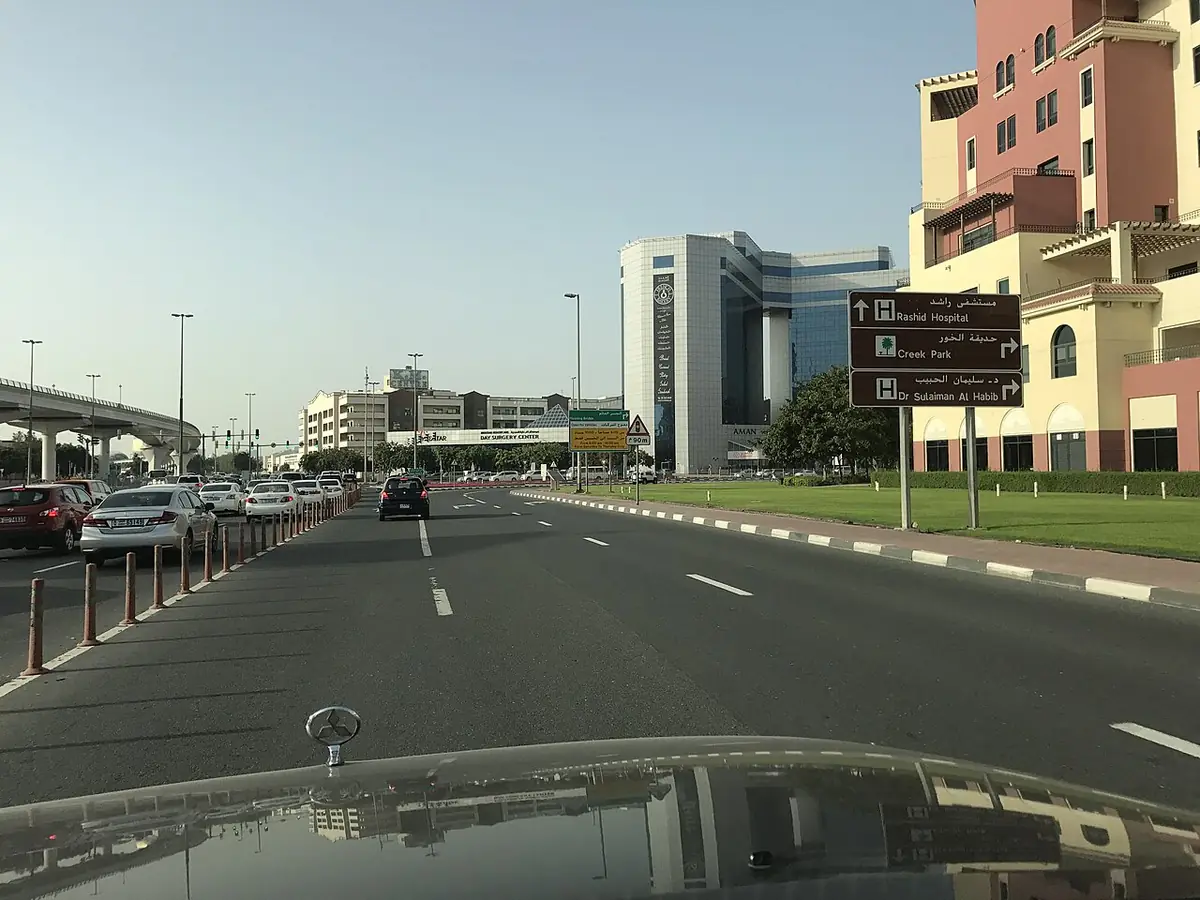
A typical Dubai street, wide and lined with modern buildings — Photo: Darvin.wilson · CC BY-SA 4.0 · Wikimedia Commons
Every step pushed later in the sequence costs you money or negotiating power.
Buying a house is a sequence, not a search followed by a signature. The order of the steps changes the final price.
YouSet the total budget, works includedThe price, purchase costs, property tax and a provision for the items reaching the end of their life. A budget expressed as a purchase price is wrong within the first year.
The bankGet a mortgage agreement in principle before viewingWith a house, timescales are rarely the sticking point — the credibility of the offer is. A file the lender has already assessed separates two buyers offering the same amount.
The sellerHand over the reports and the planning documentsThe energy rating, risk disclosures, the drainage inspection, pest reports where relevant, plus the permissions for any works carried out. These documents are read before the offer.
A professionalGet the roof and the heating pricedTwo quotes are enough to turn a negotiation based on impressions into one based on facts, and they cost less than a bad estimate.
The notary or conveyancerSign the preliminary contract, then the cooling-off periodWhere a cooling-off period exists, it protects your commitment; it does not replace the checks. What was not investigated before it will not be investigated any better during it.
The market is not decided at national level
The age of the housing stock, the type of ground, connection to mains drainage and the pressure on land vary from one town to the next. In some cities a house is a city-centre product; in others it means the outskirts, a car and a daily commute that weighs more heavily than the price per square metre.
Each city page takes these questions for one market in particular: neighbourhoods, the prices actually being paid, what living there is like and the specific things to watch in that local market.
Five agents, one call, before you commit to anything
No search filter will tell you whether the roof will last another ten years, whether the extension was declared, or whether the street is still quiet on a Saturday morning. These are things people know, not things a database contains.
So Ting starts with you: a sentence about your situation, then a group call with local agents who know these streets and these houses. Several opinions on the same market, at the same time, before you commit to anything.
Related questions
Which reports are required to sell a house?
It depends on the country, but the usual set covers the energy rating, a disclosure of natural and environmental risks, asbestos and lead depending on the year of construction, the condition of older gas and electrical installations, the plot boundaries or measurements, an inspection of any private drainage system and a pest report in areas affected by termites. Ask the seller for everything that applies locally before you make an offer.
What happens if the drainage is not compliant?
The sale can still go ahead: the inspection report is simply attached to the contract. Bringing the system up to standard then falls to the buyer, often within a set period after the purchase. It is a cost known in advance, and therefore a legitimate point of negotiation.
How do I check that an extension was properly declared?
By asking the seller for the corresponding planning permissions, and by checking with the local planning authority, which can confirm the planning history of the plot. Unauthorised construction does not prevent the sale, but it passes the regularisation file on to you and can block your own resale later.
Does a house cost more to maintain than an apartment?
Generally yes, at comparable value: there are no service charges, but every item they would cover still exists and arrives all at once. The difference is not the total amount; it is the absence of smoothing and of a shared schedule of works.
Should I commission a survey before buying?
It is not compulsory, and it is rarely wasted on an older house. A visit from a roofer and a heating engineer before the offer costs little compared with the items involved, and gives you real figures on which to discuss the price.
Property review of ting
No ting properties here yet
Be the first — share it on ting and it shows up right here.