Buying property successfully in Delhi means making sense of its complex neighbourhoods, the reality of its infrastructure and the rigour of its legal procedures. This independent guide takes you step by step through structuring your purchase with a clear head, away from received ideas and empty promises.
Get the app
What nobody tells you.
Real prices, hidden costs and the traps to check before you commit.
What you really get when you buy a house in Delhi
Scroll
What you really get when you buy a house in Delhi
Buying property successfully in Delhi means making sense of its complex neighbourhoods, the reality of its infrastructure and the rigour of its legal procedures. This independent guide takes you step by step through structuring your purchase with a clear head, away from received ideas and empty promises.
Written by the ting.ad editorial team ·
Delhi in Street View: drag to look around.
This split between your private space and the world outside feeds directly into the lifestyle you choose.
Buying a house in Delhi means steering between promises of luxury and the complex reality of a megacity that never stops changing. Between the historic residential neighbourhoods and the gated enclaves on the outskirts, urban space here does not follow the criteria you may be used to back home. Living space always comes with its own way of running a household, dependent on mains water and grid electricity or on private back-ups. Buyers quickly discover that comfort is measured as much by the quality of the build as by the neighbourhood's ability to absorb noise and disruption from outside. This constant tension between the wish for calm and the raw energy of the city redefines what owning property means in India's capital.
The illusion of a secluded, silent villa in the heart of a green capitalvsThe reality of lively urban density, where calm is something you win inside your own walls
The main roads and constant traffic mean accepting a level of urban noise higher than in most big cities elsewhere. Absolute silence barely exists in central areas and requires retreating to very specific sectors.
The promise of a huge living area for a budget comparable to what you would spend back homevsThe need to factor in regular costs for maintenance, security and bringing things up to standard
Owning a house (often a 'builder floor' or an 'independent house') means taking sole responsibility for the roof, the foundations and the water pumping systems, unlike shared ownership in a complex.
The apparent independence of a private walled plotvsDependence on the neighbourhood's infrastructure for water, electricity and access
No house is an island in Delhi; the strain on municipal networks means installing booster pumps, storage tanks and backup generators, all of them essential.
Does this place really suit your day-to-day life?
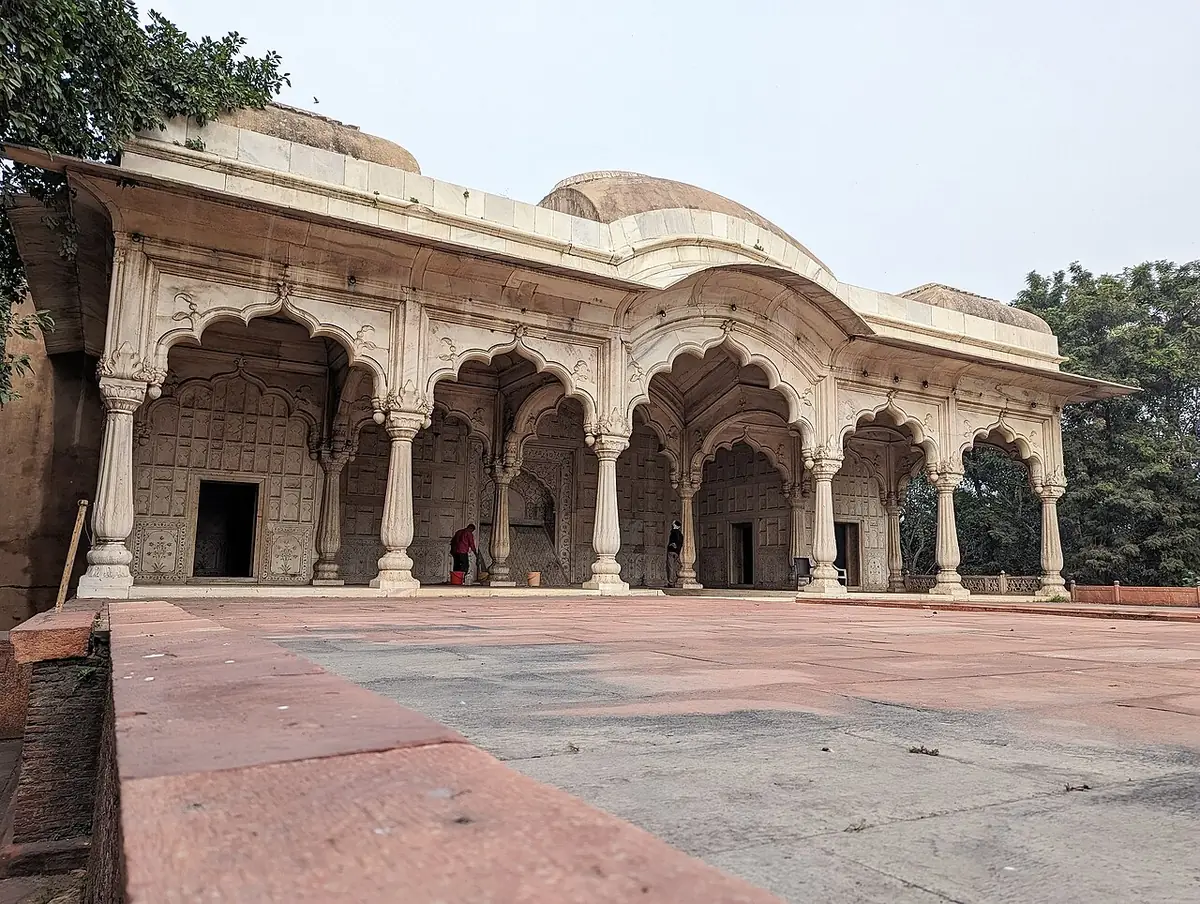
The Shah Burj pavilion inside the Red Fort in Old Delhi — Photo: Sourabh.biswas003 · CC BY-SA 4.0 · Wikimedia Commons
These daily demands take on particular weight when you compare this way of life with what you are used to back home.
Settling long term in a house in Delhi means testing your daily habits against a demanding subtropical climate and heavy traffic. The logistical constraints differ depending on whether you work locally, run a family life with children at school, or are looking for a base for alternating stays. Every kind of buyer has to weigh their expectations on mobility and local services against the geography of India's capital. Where you choose to live is paid for in commuting time and in direct access to healthcare and shops.
Looking for a secure residential haven
If you spend most of your days at home, you will lean towards the leafy neighbourhoods of South Delhi or the gated enclaves on the nearby outskirts. You will enjoy generous indoor space, ideal for setting up an office or entertaining, while accepting that day-to-day shopping and services are handed over to household staff or ultra-fast delivery apps. The relative calm of these areas makes up for the distance from the main business districts.
A tight trade-off between mobility and the road network
For working people whose meetings are spread between Connaught Place, Gurgaon and Noida, living in a house poorly connected to the main roads quickly becomes exhausting. Journey times can double at rush hour. In that case, targeting areas served by the metro or close to the main urban boulevards is essential to protect your work-life balance, even if it means slightly less floor space.
International and school networks come first
Your daily life will be shaped by proximity to international schools, leading medical centres and safe green spaces. Living in a house here means accepting rigorous logistics for school runs and after-school activities, while giving children a large, bright indoor living space.
Living there when you arrive from abroad: what changes radically
Once these reference points are reset, where you settle becomes the top priority of your search.
Leaving your familiar reference points behind to settle in a house in Delhi means dropping many administrative, social and practical reflexes. Your relationship with public space, managing household staff and the way time is perceived follow none of the rules an international buyer is used to. Understanding these cultural and structural gaps helps you avoid the disappointments of the first few months and approach the purchase with a clear view, free of romantic illusions.
From abroad
Centralised public services and uniform building standards back home
Delhi
A multitude of local regulations, informal neighbourhood associations and levels of amenity that vary enormously from one street to the next
Every utility connection, the state of the road and the legality of any extensions to the building need careful checking before you sign.
From abroad
An independent lifestyle where you handle routine upkeep and cleaning yourself
Delhi
A household naturally organised around permanent domestic staff and highly responsive neighbourhood services
Houses traditionally include service areas and dedicated circulation routes that you will need to learn to organise.
From abroad
A temperate climate with moderate, predictable seasonal changes
Delhi
Scorching summers requiring constant air conditioning and winter pollution peaks calling for air purifiers in every room
Thermal insulation and well-sealed windows and doors become crucial criteria for both health and running costs.
From abroad
A tightly regulated property market run by legally supervised professionals
Delhi
A market where transactions rely heavily on local networks, ancestral land titles and in-depth legal checks
Working with an independent lawyer who specialises in local land law is an unavoidable step to protect your money.
Which Delhi neighbourhood to target based on your buying priorities?
This geographic diversity translates into price ranges that need to be analysed with the greatest rigour.
Delhi's residential property market breaks down into micro-areas with radically different atmospheres and land rules. From the tree-lined avenues of Lutyens' Delhi to the well-established residential colonies of the south and the modern developments on the outskirts, each zone offers its own balance of price per square metre, accessibility and tranquillity. Identifying the neighbourhood that suits you avoids wrong turns in a metropolis where urban dynamics change from one block to the next.
The established residential colonies of South Delhi
An urban village atmosphere, with neighbourhood parks, lively local markets and moderate local traffic. The streets are lined with mature trees and home to a cosmopolitan community.
Suits
Buyers looking for a balance between walkable neighbourhood life, security and immediate proximity to cultural centres and quality shops.
Trade-off
The scarcity of available properties pushes prices to very high levels, and on-street parking is often limited.
The green institutional enclaves
Remarkable calm, wide airy avenues, a strong diplomatic presence and tight security reminiscent of other major world capitals.
Suits
Those who demand absolute quiet, large private green spaces and a highly secure institutional setting for their family.
Trade-off
The market is extremely closed, deals are often done privately within small circles, and the budgets required are among the highest in the city.
Residential sectors on the outskirts and nearby extensions
Modern gated residences with integrated infrastructure, private clubs, swimming pools and centralised management of the space.
Suits
Buyers wanting larger modern floor areas, turnkey amenities and a standardised lifestyle.
Trade-off
Distance from Delhi's historic neighbourhoods and total dependence on the major roads for everyday travel.
How much does buying a house in Delhi really cost?
Beyond the purely financial side, the legal nature of what you are buying deserves meticulous attention.
Setting a purchase budget in Delhi means looking past the headline price shown by agencies. Prices vary considerably with the exact location, the legal status of the land and the quality of new or renovated construction. On top of that, additional fees, local taxes and essential spending on security and water treatment weigh significantly on the overall budget. A clear-eyed look at the price ranges protects buyers from nasty financial surprises.
DelhiFor saleHouseestimate
Median price / m²₹93,480Half the apartments sell below this
Median price₹20.7mthe average is 14% higher — a few very large properties pull it up
Most common2 bedrooms46 % of listings
Average size210 m²
By number of bedrooms
Bedrooms
Share of market
Avg price
Price / m²
Avg size
2most common
46 %
₹18.1m
₹98,400
184 m²
3
39 %
₹23.7m
₹93,480 −5 %
254 m²
4
15 %
₹31.7m
₹90,528best value / m²
350 m²
Each row is an average, compared against the area average of ₹98,400 / m². These are indicative estimates of a typical local market, not a measured sample of live listings. Check current listings before relying on them.
What you can actually own: freehold versus long leasehold
These legal precautions come into their own when it is time to actually start paying money over.
The Indian land system has legal subtleties that differ radically from what many buyers know back home. Confusing a freehold title with a long lease or a shared right of occupation can compromise the future resale of your property or restrict your right to make architectural changes. Grasping exactly what kind of title you are about to sign is the surest defence against complex land disputes.
Freehold properties ('Freehold')
This legal status gives the buyer full and permanent ownership of the land and the building on it, subject to compliance with local planning rules and the municipal regulations in force. It offers maximum freedom to pass on, renovate or resell the property without needing the consent of any third-party authority.
What it changesYou hold a stable, fully transferable asset whose resale value is directly tied to the dynamics of the open land market.
Properties held on long leases ('Leasehold')
Very common in many planned sectors of the capital, these properties originally belong to public or semi-public bodies that grant use of the land for long periods (often 99 years). Any substantial alteration, extension or transfer of the lease requires formal approval and the payment of specific transfer charges to the supervising authority.
What it changesYou must have a legal adviser check the remaining term of the lease and the history of administrative payments before committing any money.
The golden rule to understand before paying any deposit
This strict sequence fits into an overall process that should be followed step by step.
In any property transaction in Delhi, the order of payments follows strict customary rules that leave no room for approximation. Paying any money before the full history of the title deeds has been validated exposes the buyer to major risks of financial loss. Checking the chain of title over several decades is the only guarantee of a smooth, legally watertight transaction.
Finding a property that matches your criteria and verbally negotiating the net price with the seller.
A rigorous audit of the chain of original title deeds over at least thirty years by an independent lawyer.
A careful check that there are no encumbrances, hidden mortgages or inheritance disputes pending before the relevant courts.
Signing a preliminary agreement setting out the conditions precedent and the exact schedule of deposit payments held in escrow.
Depositing funds into secure accounts or through traceable banking channels, in line with current financial regulations.
Official registration of the final sale deed with the relevant registration authorities and payment of transfer duties.
How a property transaction in Delhi works, step by step
Buying a house in Delhi follows a route marked out by successive involvement from key players: agents, legal advisers, technical surveyors and registration authorities. Knowing each party's role and the order of operations lets you stay in control of your purchase from the first viewing to the final handover of the keys.
The buyer and their adviserDefining the brief and targeting micro-neighbourhoodsThis first phase means filtering out misleading listings, visiting target areas at different times of day and confirming that the properties on offer are broadly compliant.
The technical expertStructural audit and detailed building inspectionAn independent engineer assesses the condition of the frame, foundations, plumbing and electrical installations to cost any work needed to bring them up to standard.
The specialist lawyerIn-depth checks on land titles and planning complianceThis crucial step confirms that the seller holds full rights to dispose of the property and that no planning rules have been breached.
The parties and the notarySigning the memorandum of understanding and paying the depositThe preliminary contract is signed, setting the penalties for withdrawal and strict deadlines for releasing funds and final signing.
The local tax authorityOfficial registration of the deed and payment of transfer dutiesThe transaction is publicly registered with the relevant state authorities, making your title enforceable against third parties.
The buyerTaking possession and setting up service contractsYou carry out the check-out inspection with the previous occupants, transfer the electricity and water accounts, and move into your new home.
House or apartment in Delhi: which suits your daily life?
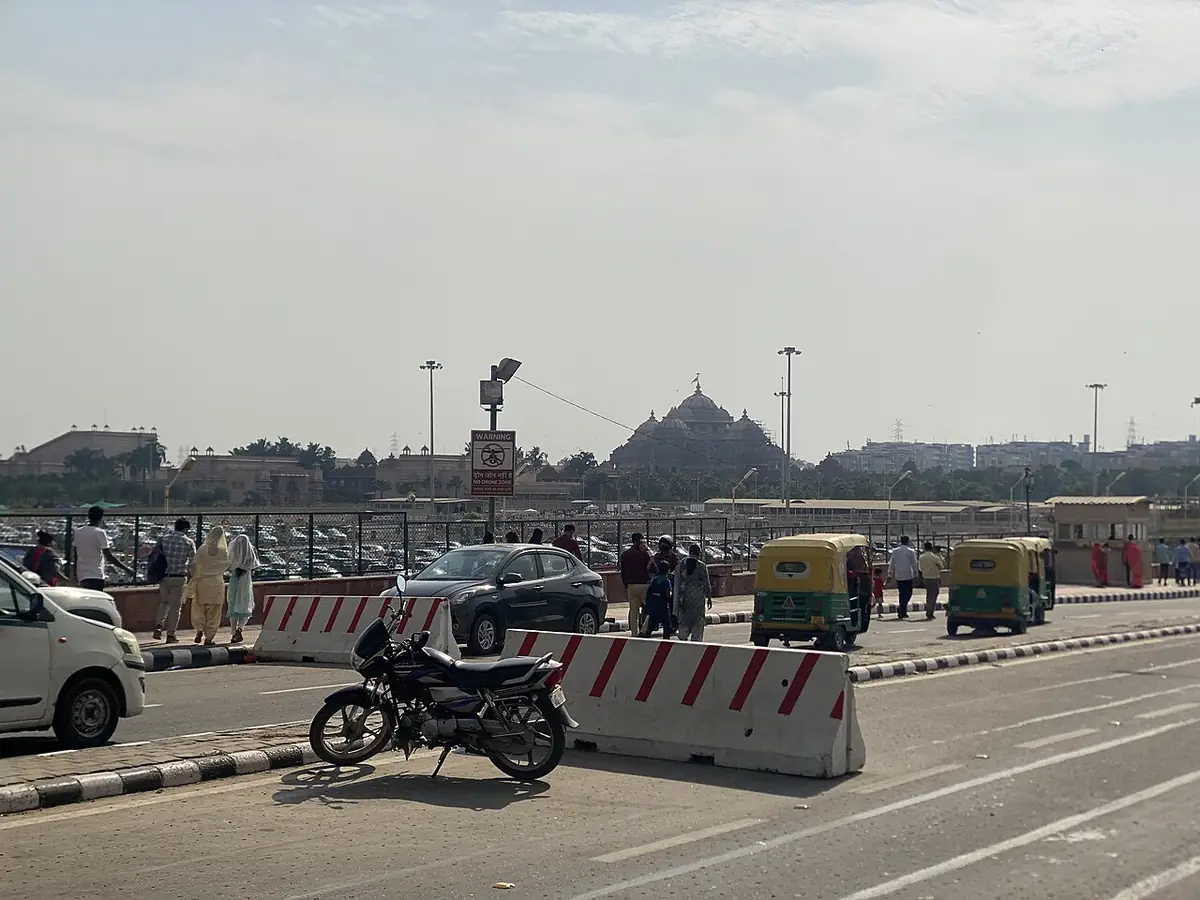
Everyday traffic on a wide Delhi road near Akshardham — Photo: Immanuelle · CC BY 4.0 · Wikimedia Commons
Once this structural choice is made, the central question of the overall budget immediately comes to the fore.
Buying property in Delhi starts with a fundamental trade-off between an independent house, often called a kothi or a builder floor, and an apartment in a gated complex within a modern residential tower. This decision is not just about aesthetic taste or the living space you hope for; it directly shapes your lifestyle, how you manage your time day to day and your relationship with security. Historic neighbourhoods such as South Extension or Greater Kailash favour low-rise buildings and private plots, while outlying zones and extensions such as Dwarka and the edges of Gurgaon favour high-rise living and large secure developments with integrated services.
Choosing a builder floor or a house in Delhi means accepting total independence, but also full responsibility for the building's structural upkeep, the water supply and dealing with power cuts. Choosing an apartment in a complex run by a professional management company, by contrast, frees you from the daily hassle of maintaining shared areas, security staff and backup generators, which are nonetheless essential during summer consumption peaks. However, this option comes with monthly charges that can be high and strict complex rules that may limit some freedoms in fitting out or using outdoor spaces.
Financially, the long-term appreciation path differs markedly between these two types of property in India's capital. Houses on independent plots benefit from the absolute scarcity of land in Delhi's most sought-after areas, underpinning sustained growth in land value even as the building ages and needs major renovation. Apartments, on the other hand, suffer steady depreciation of their physical fabric over the decades, although their liquidity on the resale market generally remains higher thanks to strong rental demand from young professionals and expatriates looking for immediate convenience.
Your final decision should therefore weigh the burden of day-to-day management against pure long-term capital growth. If you value the relative calm of a tree-lined street, architectural freedom and passing on a land asset, the independent house is the natural choice despite its maintenance demands. If you want the ease of a turnkey setting, built-in leisure facilities and tight security with no management effort, the apartment in a high-rise complex remains the most rational option for settling long term in Delhi's complex urban landscape.
What real budget should you plan to live comfortably in a property bought in Delhi?
Beyond the raw figures, it is an ordinary Tuesday that will reveal what your living environment is really like.
Drawing up a forecast budget for buying and living in a property in Delhi means including items of spending well beyond the headline price shown by agencies. Transaction fees, local taxes, private infrastructure costs and recurring complex charges radically change the initial financial equation. You need to anticipate these outgoings to avoid being financially squeezed six months after getting the keys.
Breakdown of purchase costs and recurring charges in Delhi
Cost item
Estimated range
Frequency and method
Registration fees and stamp duty (Stamp Duty)
5% to 7% of the declared value or market price
Paid once when the final sale deed is signed
Professional property brokerage fees
1% to 2% of the total transaction amount
Paid to agencies or brokers when the sale is concluded
Complex charges and maintenance (Maintenance Fees)
INR 3,000 to INR 15,000 per month depending on services
Paid monthly to the management association or the local RWA
Municipal property tax (Property Tax MCD/NDMC)
INR 10,000 to INR 50,000 per year depending on size and zone
Paid annually to Delhi's municipal authorities
Comprehensive home insurance and civil liability cover
INR 15,000 to INR 40,000 per year
Annual premium with a licensed insurer in India
These amounts vary considerably depending on the exact area within Delhi, with neighbourhoods under the NDMC having tax scales and service levels distinct from those managed by the MCD.
What does an ordinary Tuesday actually look like in your Delhi property life?
Yet this picture of a typical day hides realities on the ground that agency viewings try hard to conceal.
To judge whether your future location in Delhi really works, nothing beats walking through an ordinary working day hour by hour. Between heavy morning traffic, managing service deliveries, access to schools and possible utility outages, every hour tests how resilient your choice of home is. Here is how a typical day unfolds for a resident settled in the capital's central or residential neighbourhoods.
07:30 - 08:30Home and morning departureChecking the water levels in the storage tanks and that the generator is working in case of a mains outage. Leaving before the main roads are completely clogged by commuters.
08:30 - 09:15Commute to business hubs or school drop-offTravelling either on Delhi's dense metro network to avoid the chronic traffic jams, or by private car along the main urban boulevards under heavy traffic control.
09:30 - 13:00Work and remote managementWhile you work, home services (cleaning, grocery deliveries through local apps such as Blinkit or Zepto) are received and handled by the residence's security or caretaking staff.
13:30 - 15:00Lunch and local admin appointmentsDealing with neighbourhood matters and liaising with the Resident Welfare Association (RWA) to sort out minor issues with roads, street lighting or rubbish collection in the street or building.
16:30 - 18:30Heading home and end-of-day shoppingThe journey home is marked by a noticeable build-up of car and two-wheeler traffic. A stop at neighbourhood markets or shopping complexes for fresh produce.
19:30 - 21:30Evening at home and night-time calmRelaxing at home, checking the indoor air filtration system to counter seasonal pollution peaks and planning the logistics for the next day.
What the glossy sales brochures and listings will never tell you about Delhi
These grey areas explain why so many buyers regret their choice once the excitement of the first few months has worn off.
Delhi's property market dazzles with its shiny showrooms and promises of international-standard living. Yet behind the developers' polished renderings or the veneer of cosmetic renovations on older properties lie technical and administrative realities that sellers consistently fail to mention. Anticipating these critical points is the only way to avoid major financial setbacks after signing.
The real quality of the water and dependence on water tankers
Many Delhi neighbourhoods suffer from intermittent municipal supply, forcing residents to rely on private boreholes drawing on over-exploited groundwater or to order paid water tankers, whose water needs an industrial-grade and costly filtration system at home to be drinkable.
The opaque, informal running of RWAs (Resident Welfare Associations)
In areas of builder floors and residential colonies, residents' associations wield enormous but legally vague power. Their decisions on parking rules, permitted works or special levies often lack democratic transparency.
Small voltage fluctuations and an overloaded grid
Despite progress in electricity distribution in the capital, voltage fluctuations and untimely power cuts remain frequent during summer heatwaves. Significant investment in voltage stabilisers and powerful inverters is essential to protect your appliances.
Complex title deeds and inheritance histories
In Delhi's older neighbourhoods, many properties have passed through several generations without the land transfers being properly registered with the tax authorities, creating risks of inheritance disputes buried under fragile general powers of attorney (GPA).
The Delhi property-buying mistakes you only discover six months in
These disappointments lead to the ultimate question: is this market really for everyone?
Looked likeA golden opportunity to buy a large, freshly renovated builder floor with modern, luxurious finishes in a sought-after area.
Turned outA cosmetic cover-up hiding structural defects in the concealed plumbing and failing thermal insulation that turns the home into an oven in summer.
Would have caught itAlways hire an independent building engineer to carry out a full technical audit of the walls, foundations and networks before paying any booking deposit.
Looked likeAn extremely calm, peaceful neighbourhood during a viewing on a sunny Sunday morning.
Turned outA congested, noisy through-route on weekdays, or an area that becomes an informal street market blocking all car access from Tuesday to Saturday.
Would have caught itVisit the property at three strategic times of the week: a weekday morning at rush hour, a weekday evening after 8pm, and a busy weekend.
Looked likeA seller in a hurry offering a big discount in exchange for a partial cash payment (cash component) to 'simplify' the transaction.
Turned outAn illegal tax arrangement exposing the buyer to massive tax reassessments and making it impossible to justify the source of funds on a later resale.
Would have caught itInsist on total banking transparency, flatly refuse undeclared cash deals and have a specialist lawyer approve every line of the contract.
Looked likeA verbal promise from the estate agent guaranteeing that extension permits to add an extra floor to the building would come through soon.
Turned outA clear breach of the strict planning rules of the Delhi Development Authority (DDA), exposing the owner to demolition orders or heavy fines.
Would have caught itPersonally check compliance with the sanctioned plan in the municipal records and never rely on verbal promises about future layouts.
Who should definitely not buy property in Delhi right now?
If you recognise yourself in these profiles, it is time to make a calm decision about your plans.
Contrary to the prevailing narrative that casts Indian property as an absolute wealth-building El Dorado, buying in Delhi does not suit every lifestyle or every financial strategy. Committing to this metropolis without gauging the rigidity of the local market and the complexity of its environment can turn your investment into a liquidity trap. Here are the profiles for whom it is better to hold off or to rent instead.
The expatriate or mobile professional planning to stay less than four years
→Quickly buying an apartment to 'stop throwing money away on rent' as soon as they arrive in the capital.
Combined transaction costs (stamp duty, brokerage fees, exit taxes) easily reach 8% to 10% of the price, a cost impossible to recoup over such a short period against an abundant, flexible rental market.
The investor seeking a high, immediate net rental yield
→Buying an upmarket residential property in central Delhi in the hope of generating substantial passive income.
Gross rental yields in Delhi's smart neighbourhoods have traditionally hovered between 2% and 3% a year, well below borrowing costs and the returns on other asset classes in India.
The first-time buyer who cannot stand administrative uncertainty and delays
→Buying an older property that needs title regularisation or complex negotiations with local authorities.
Chronically slow administrative procedures, heavy bureaucratic paperwork and the risk of hidden disputes demand nerves of steel and a tolerance for stress that not everyone has.
So, are you really ready to go ahead with your property purchase in Delhi?
Reaching the end of this look at Delhi's property market shows that your plans go beyond a simple aesthetic crush and rest on mature thinking about wealth and logistics. Buying in India's capital is neither a blind gamble nor an exact science: it is a calculated commitment that requires reconciling the reality of your overall budget, the rigour of your legal checks and a clear-eyed acceptance of the daily compromises that come with life in a megacity of this scale. If you have factored in the hidden costs, audited the property's technical condition and confirmed that your time horizon makes sense, you now hold the essential keys to success.
Delhi's property market rewards patience, method and careful checking of the smallest contractual details. Steer clear of offers that seem too good to be true, refuse ambiguous financial arrangements and surround yourself with independent professionals — lawyers, engineers and tax advisers — who have no direct stake in the sale going through. Your future peace of mind and the safety of your capital depend entirely on this rigour, applied well before the final signing in front of the notary.
Ultimately, the decision to sign the purchase deed should feel like a harmonious meeting of your personal aspirations and the objective strength of the market facts. If the property you choose simplifies your journeys, protects your family from environmental hazards and fits calmly into your long-term vision, then the investment makes complete sense. Take the time to reread every clause, check every planning document and approach this major step certain that you have explored every side of your future home in Delhi.
Related questions
What additional costs should I budget for when buying property in Delhi?
Additional costs include stamp duty, usually between 5% and 7% of the property's value, the fees for registering the sale deed, agency fees of 1% to 2%, and any costs for a legal and technical audit of the building.
Can a foreigner or a non-resident Indian (NRI) buy property freely in Delhi?
Non-resident Indian citizens (NRIs) and persons of Indian origin (PIOs) enjoy very broad rights to buy residential and commercial property. Foreign nationals without any special status, on the other hand, face strict regulatory restrictions imposed by India's central bank (RBI).
How do I check that the title deeds for a house in Delhi are genuine?
Checking means tracing the chain of title back over at least thirty years, consulting the records of the Delhi Development Authority (DDA) or the municipal bodies, and having a specialist lawyer confirm there are no encumbrances or disputes.
What is the difference between a builder floor and an apartment in a gated complex?
A builder floor is generally a private floor within a low-rise building of three or four storeys built on an individual plot, whereas an apartment in a gated complex is part of a large integrated residential development with shared amenities and centralised management.
How is annual property tax calculated in Delhi?
Municipal property tax is calculated by the local authorities (MCD or NDMC) using specific criteria, including the living area, the year of construction, the location and whether the property is used for residential or commercial purposes.
Which Delhi neighbourhoods offer the best balance between peace and accessibility?
South Delhi neighbourhoods such as Greater Kailash, Defence Colony and Vasant Vihar, along with some well-established residential areas of Dwarka, offer a sought-after balance of green space, security and good links to the main transport routes.
Is it possible to get a mortgage from a bank in India as a buyer?
The major Indian and international banks offer home loans to residents and NRIs, generally covering up to 75% or 80% of the property's market value, subject to rigorous proof of income and a spotless credit history.
How does seasonal pollution affect the choice of property in Delhi?
Air quality in Delhi varies with the seasons, which leads many buyers to favour homes fitted with central ventilation systems using HEPA filtration, and to pay attention to orientation and how well the windows and doors seal.
What happens during a power cut in a building in Delhi?
Modern residences and good builder floors have automatic backup generators (power back-up) that take over within seconds, keeping essential equipment, lighting and basic air conditioning running.
Why is it strongly advised against including a cash payment in the transaction?
Using an undeclared cash payment (cash component) is illegal in India, weakens the legal traceability of the property, exposes the buyer to strict tax audits and heavily penalises the taxable value when the property is resold later.