Investing in property in Delhi calls for a close understanding of local realities, legal structures and the cultural particularities of India's capital. This practical guide walks you through the process step by step, so that a complex project becomes an informed and secure decision.
Get the app
What nobody tells you.
Real prices, hidden costs and the traps to check before you commit.
Why buying a house in Delhi makes you rethink your idea of space and security
Scroll
Why buying a house in Delhi makes you rethink your idea of space and security
Investing in property in Delhi calls for a close understanding of local realities, legal structures and the cultural particularities of India's capital. This practical guide walks you through the process step by step, so that a complex project becomes an informed and secure decision.
Written by the ting.ad editorial team ·
Valuation House Delhi in Street View: drag to look around.
This tension between apparent independence and complex technical management reshapes how you should assess everyday life there.
Investing in bricks and mortar in Delhi is not just about acquiring square metres in a fast-growing megacity. It means choosing a home that blends centuries of architectural history with the demands of a contemporary global metropolis. Between historic residential neighbourhoods and modern secure enclaves, the reality of owning property here shows striking contrasts. You need to look coolly at how properties are actually structured to understand what your investment really guarantees you day to day, far from marketing promises and tourist clichés.
The promise of generous, independent private spacevsThe reality of dense shared walls and neighbours who can always see in
Detached houses and independent villas are becoming rare in the most sought-after parts of India's capital. Most house purchases take the form of vertical structures or terraced properties, where managing views and privacy calls for specific layouts from the design stage onwards.
Complete independence from any shared ownership arrangementvsRunning the infrastructure and maintenance entirely yourself
Owning a house in Delhi means taking direct responsibility for water supply, power regulation and perimeter security. Unlike apartments in managed complexes, there is no management company pooling these services on your behalf.
A strong, lasting asset at the heart of the capitalvsStrict regulatory limits on structural changes
Buying property in Delhi's well-known neighbourhoods offers excellent long-term value stability. In return, the local authorities impose rigorous planning rules that limit building upwards or radically transforming façades.
The freedom to design a home over several levelsvsThe logistical complexity of air conditioning and moving between floors
Houses are generally spread over two or three levels, which increases the living space but creates significant energy costs to keep temperatures comfortable during summer heatwaves.
What kind of buyer are you, faced with Delhi's property realities?
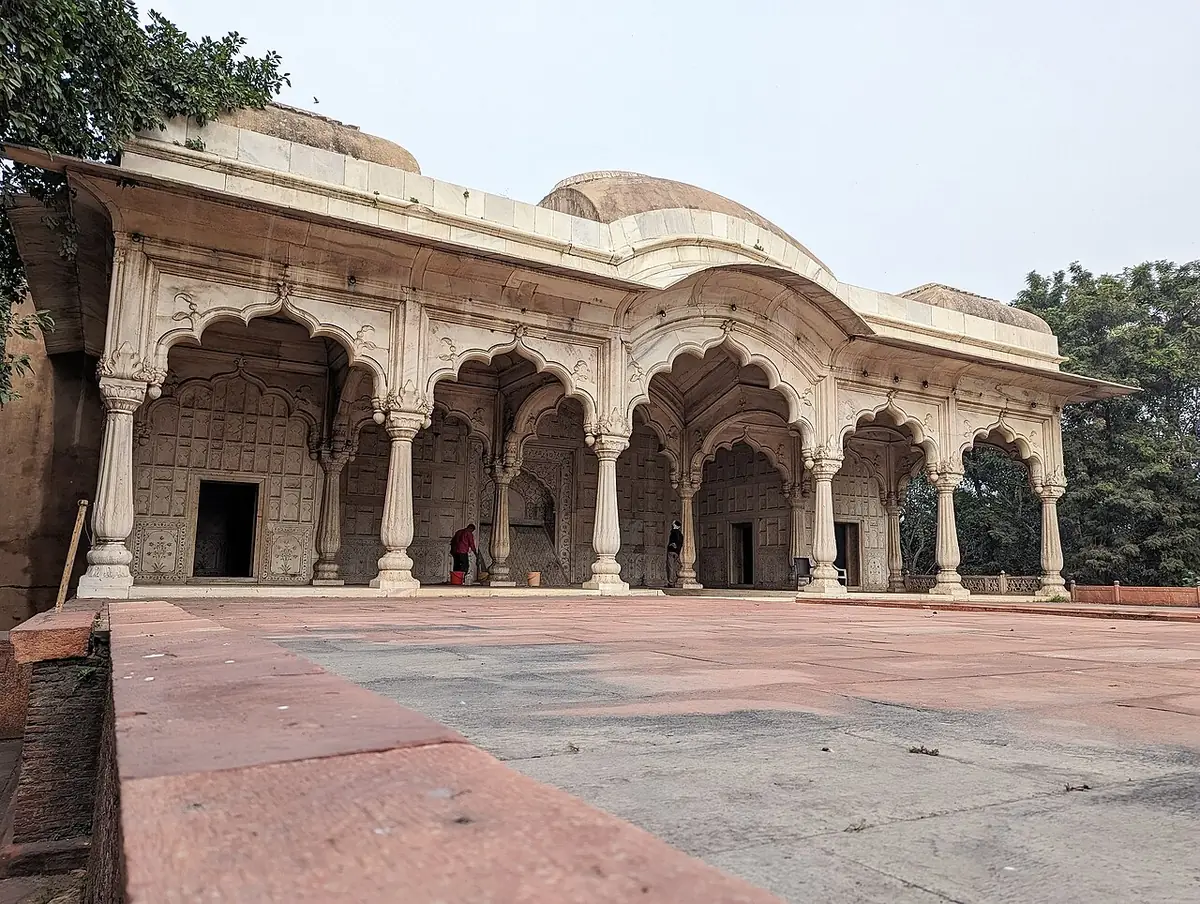
The Shah Burj pavilion inside the Red Fort in Old Delhi — Photo: Sourabh.biswas003 · CC BY-SA 4.0 · Wikimedia Commons
Once your profile is clearly identified, the next step is to measure exactly what separates the life you are used to from your new day-to-day reality.
Buying a house in Delhi is not for every type of investor or expatriate. The city demands a quick ability to adapt to a particularly intense environment in terms of noise, climate and social life. For your property project to become a lasting success rather than a daily source of frustration, it is essential to weigh your personal profile against the structural demands of India's capital.
The family putting down roots
For households with children, buying a house offers generous space and the chance to create a private outdoor area, which is extremely valuable in a dense metropolis. However, it means factoring into your daily equation the proximity of international schools, rush-hour journey times and a reliable network of domestic services to keep family life running smoothly.
The long-term wealth investor
If your main goal is capital growth and steady rental income, the detached house is a rare but demanding asset. Gross rental yields on townhouses are often lower than on apartments in secure complexes, but preserving land value in Delhi's most central areas more than makes up for that difference over a horizon of ten years or more.
The remote worker or freelancer
Setting up a home office in Delhi requires particular attention to soundproofing and the continuity of essential services. Occasional power cuts and the bustle of the street call for high-performance generators and redundant internet connections. Your house needs to become a genuine protective urban bunker if you spend most of your days there.
What really changes in your day-to-day life as a homeowner when you move from abroad to Delhi?
This cultural and logistical shift leads you straight to the fundamental question of choosing your exact location within the capital.
Moving from a regulated, predictable property market like those many buyers know back home to Delhi's dynamic ecosystem is a major cultural and practical shock. Legal reference points, building standards and the way homes are managed differ radically. Understanding these structural differences spares you the most common disappointments during your first months in the city.
From abroad
A highly protective, centralised legal framework overseen by notaries or conveyancers
Delhi
A fragmented land registration system that requires meticulous checks
Every property title must undergo a thorough legal audit by specialist local lawyers to make sure there are no family disputes or hidden mortgages.
From abroad
Regulated thermal and energy standards (energy ratings, double glazing)
Delhi
Temperature control built around intensive air conditioning and thick, heat-retaining walls
Energy bills for cooling a large house during the monsoon and the hottest months weigh heavily on your everyday running budget.
From abroad
Shared service charges and automated public services
Delhi
Personal responsibility for maintenance, security and utilities
You need to build up a contact list of trusted tradespeople and directly oversee the upkeep of your water filtration system and your generator.
From abroad
An orderly, predictable urban neighbourhood
Delhi
An intense mix of urban uses right on your doorstep
Complete peace and quiet exists only in very specific enclaves or in residential colonies closed off by gates and guarded day and night.
How do you choose between the different residential neighbourhoods to settle in?
Once you have narrowed down the area, it is essential to look at the financial reality of transactions to avoid being misled by appearances.
Delhi does not read as a single city, but as a patchwork of self-contained villages, diplomatic enclaves and large planned developments. Each sector has its own rhythm, level of security, greenery and proximity to employment hubs. Your choice of neighbourhood will determine ninety per cent of the quality of your residential experience there.
The historic central enclaves (South Delhi)
A leafy atmosphere, relative calm during the day, and immediate proximity to the capital's most upmarket cultural and shopping centres.
Suits
Families looking for prestige, greenery and quick access to high-end amenities without spending hours in transport.
Trade-off
Prices per square metre among the highest in the country and a chronic shortage of properties for sale.
The planned residential colonies (Greater Kailash, Defence Colony)
A layout structured in numbered blocks, very lively pedestrian neighbourhood markets and an active, secure community life.
Suits
Those who want to combine a European-style neighbourhood feel with local energy and every shop within walking distance.
Trade-off
The rapid densification of plots and recurring saturation of street-level parking.
The modern extensions and outlying business hubs
Ultra-modern infrastructure, major road links and gated residential complexes with every leisure facility built in.
Suits
Working professionals employed in the technology or financial hubs who want the polished comfort of a new build.
Trade-off
A marked distance from Old Delhi and a sense of urban artificiality if you are after historic charm.
What budget ranges should you expect when buying a property in Delhi?
Beyond the headline figures on agency boards, the exact nature of what you own deserves close scrutiny.
Delhi's property market follows complex valuation rules in which the land weighs far more heavily than the building itself. Prices advertised online reflect only part of the financial reality, as local taxes, legal fees and energy upgrades add to the overall budget. Here are the indicative ranges seen on the ground to guide your financial planning.
DelhiFor saleHouseestimate
Median price / m²₹93,480Half the apartments sell below this
Median price₹20.7mthe average is 14% higher — a few very large properties pull it up
Most common2 bedrooms46 % of listings
Average size210 m²
By number of bedrooms
Bedrooms
Share of market
Avg price
Price / m²
Avg size
2most common
46 %
₹18.1m
₹98,400
184 m²
3
39 %
₹23.7m
₹93,480 −5 %
254 m²
4
15 %
₹31.7m
₹90,528best value / m²
350 m²
Each row is an average, compared against the area average of ₹98,400 / m². These are indicative estimates of a typical local market, not a measured sample of live listings. Check current listings before relying on them.
Land ownership versus building rights: what do you really own?
This legal vigilance reaches its peak in strictly following the chronological steps of a secure transaction.
In the Indian legal system as it applies to urban property, the distinction between full ownership of the land and ownership of the built floors is a fundamental notion that foreign buyers often miss. Grasping this legal nuance protects you from unpleasant surprises when you later plan to resell or add storeys.
The full land ownership model (Freehold)
Buying a property on a 'Freehold' basis means you acquire both the building and the land it stands on. This title offers maximum legal security and gives you the absolute right to dispose of the property, pass it on or rebuild it in line with the planning rules in force. It is the most sought-after form of ownership and the one that holds its value best over the long term in the Delhi market.
What it changesYou keep full control of your land asset and benefit directly from any future capital gain driven by the scarcity of space in the capital.
The shared building rights model (Leasehold and Builder Floors)
Very common across many of Delhi's residential sectors, this system divides a large original plot into several vertical or horizontal units sold to separate owners. You buy the walls of your floor and an undivided share of the land. Major decisions about the building therefore require ongoing agreement with your co-owners, which can slow down large renovation or upgrade works.
What it changesYou must check that the co-ownership agreement is clear, and review the history of arrangements between neighbours, before making any financial commitment.
Which essential steps must you complete before paying any deposit?
Once these legal milestones are safely passed, what remains is to organise the practical timeline of your final move.
The property buying process in India follows a rigorous timeline in which haste is the buyer's worst enemy. Every document signed commits substantial sums and formalises an agreement with immediate binding legal force. Breaking the purchase down into clearly separated steps gives you complete peace of mind right up to the handover of the keys.
Finding the ideal property on the ground
Have an independent lawyer carry out a full audit of the property titles, tracing the history back thirty years
Sign a preliminary Agreement to Sell setting out the conditions precedent and the payment schedule
Pay the reservation deposit into escrow on the terms agreed between the parties and approved by your legal adviser
Register the sale deed officially with the relevant authorities and pay the applicable stamp duty
The actual handover of the keys and the final transfer of utilities
How does your transaction timeline actually unfold, from offer to moving in?
By following this rigorous method, your property investment in Delhi becomes a solid and lasting step for your future.
Running a property project smoothly in Delhi depends on close coordination between several key players: the registered estate agent, the legal adviser, the technical valuation experts and the local administration. Knowing each one's exact role at every stage of the timeline lets you steer your purchase like a true project manager.
The buyerSetting out your requirements and targeting areasYou set your priority criteria for location, maximum budget and the legal status you are looking for (preferably Freehold).
The estate agentShortlisting properties and arranging viewingsThe agent presents a selection of properties that strictly match your criteria and checks upfront how motivated the sellers really are.
The specialist lawyerTitle audit and verification of the chain of ownershipThe legal expert combs through the land records to certify that the seller holds undisputed rights to dispose of the property.
Both partiesNegotiating the terms and signing the preliminary agreementAgreeing the final price, completion deadlines and any late-payment penalties, and paying the initial deposit into a dedicated account.
The administrationPaying stamp duty and final registrationSettling the applicable government taxes and officially registering the deed transferring ownership in the buyer's name.
Detached house or secure villa in Delhi: choosing between independence and shared management
Everyday traffic on a wide Delhi road near Akshardham — Photo: Immanuelle · CC BY 4.0 · Wikimedia Commons
Once the type of property is settled, the next step is to analyse in detail the financial structure needed to make such a purchase happen.
Buying a detached house in historic neighbourhoods such as Civil Lines or Greater Kailash offers complete architectural freedom and valuable independence on your own land. However, that independence means managing water supply by tanker lorry yourself, maintaining the backup generators that are essential during regular power cuts, and looking after the physical security of your plot. Owners have to deal with complex municipal regulations and renovation costs that are often unpredictable in older buildings.
By contrast, choosing a villa or townhouse within a gated community, particularly popular in outlying areas and upmarket townships, frees the buyer from these daily logistical burdens. Security is provided around the clock by trained guards, water and electricity are managed centrally with high-capacity backup generators, and the green spaces and internal roads are maintained by a management company. The downside lies in monthly service charges that can be high, and in strict rules on changes to façades or on access times for visitors and domestic staff.
As a long-term asset, detached houses on their own land generally see faster and stronger land appreciation, because available land at the heart of India's capital is so scarce. Villas in shared developments, meanwhile, often offer better liquidity on resale, as they attract expatriates and senior Indian executives looking for a ready-made lifestyle without the hassle of managing a property alone. Your final choice should therefore flow from your tolerance for local operational stress and your ability to supervise outside contractors to look after your home.
An overall budget assessment for buying and maintaining a house in Delhi
Beyond the purely financial side, day-to-day life as a homeowner in Delhi is experienced through the local rhythm of life.
Buying a house in Delhi is not limited to the purchase price shown on property portals. You need to include all registration taxes, legal fees, security costs and recurring maintenance expenses to draw up a realistic, sustainable financing plan. Price differences per square foot are huge depending on whether you are targeting South Delhi or the outlying extensions.
Initial purchase costs and applicable taxes in Delhi
Cost item
Estimated rate or amount
Impact on the overall budget
Stamp duty
4% to 6% of the property value (reduced rate for women)
An immediate cash outlay that bank loans do not cover.
Transfer and legal fees
1% to 2% of the declared value
Essential for securing the property title and avoiding land disputes.
Estate agency commission
1% of the transaction amount
Paid to the local broker when the final Sale Deed is signed.
These initial costs must be paid from your own funds, as Indian banks generally do not finance taxes and ancillary fees.
Running costs and recurring annual charges
Type of charge
Estimated range in rupees (INR)
What is included
Municipal property tax (MCD)
INR 15,000 to INR 60,000 per year
Calculated according to floor area, land zone and the age of the building.
Maintenance and service charges
INR 5,000 to INR 25,000 per month
Only applies to villas in gated communities, covering security and shared areas.
Comprehensive home insurance
INR 20,000 to INR 50,000 per year
Covers fire and water damage, and sometimes natural disasters.
You should also set aside an annual provision for regular servicing of the air conditioning and generators.
Daily life up close: what an ordinary Tuesday looks like for a homeowner in Delhi
Even when daily life is well organised, many crucial aspects tend to slip past the property listing portals.
Living in a house in Delhi means navigating a set of small routines dictated by the climate, the city's infrastructure and the organisation of domestic staff. From the morning check on the water tank to school runs and handling deliveries, every part of the day has its own particularities that you need to anticipate to protect your quality of life.
07:00Checking the house's technical equipmentThe owner or caretaker checks the level of the underground water tank and that the pressure pump is working, while making sure the generator is ready in case of a morning power cut.
08:30Domestic staff arrive (maid and cook)The staff arrive for the daily cleaning of the marble floors, meal preparation and tidying. Daily coordination is needed to hand over the shopping list for the local market.
10:00Handling deliveries and neighbourhood servicesParcels ordered online arrive, and local tradespeople drop by for preventive maintenance on the air conditioners, which are essential for coping with the heat peaks of the Indo-Gangetic plain.
14:00Working hours and residential calmA quiet spell in the leafy residential streets of the authorised colonies, well suited to remote work or business meetings held from an air-conditioned home office.
17:30Children return and after-school activitiesThe journey back from international or local schools through Delhi's heavy traffic, often requiring a private driver or dedicated transport.
20:30Relaxing and securing the property for the nightClosing the outer gates, switching on the connected security cameras and checking the alarm system before enjoying a quiet evening in the family living room.
The hidden realities that Delhi property listings consistently leave out
These little-known subtleties lead straight to the classic mistakes made by foreign and first-time buyers.
Delhi's residential property market has unwritten codes and structural problems that flattering agency photos take care not to reveal. Understanding these grey areas helps you avoid massive financial setbacks and intractable administrative deadlock after the final deed is signed.
The complexity of property titles and family inheritances
Many older houses in Delhi are held in complex joint ownership between heirs. If a single family member refuses to sign or contests the sale, the transaction can be stuck for years in the Indian courts.
Strict height restrictions and Master Plan rules
The Delhi Development Authority (DDA) imposes tight limits on the number of storeys that can be built (FAR, Floor Area Ratio) and on commercial land use. Buying a house with the idea of adding an extra floor without permission exposes you to demolition orders.
Managing the water table and monsoon flooding
Some poorly drained areas of Delhi suffer from significant waterlogging during the intense monsoons of July and August. Checking the level of the street relative to the house's threshold is absolutely essential to protect the foundations.
Critical dependence on municipal water networks
Mains water supplied by the Delhi Jal Board is often intermittent and very hard. Budgeting for reverse osmosis (RO) filtration systems and large storage tanks is essential.
The neighbours and activity in adjoining shopping lanes
A residential street that is quiet during the week can turn into a chaotic parking area or host noisy neighbourhood markets on certain days. Observing the surroundings at different times of the week is essential.
The classic traps and buying mistakes people bitterly regret six months later
Even with these precautions, buying a house in Delhi does not suit every type of investor or resident.
Looked likeA golden opportunity with a price per square foot well below the local market average.
Turned outA property caught up in an old legal dispute, a hidden mortgage with a financial institution or large unpaid property tax bills owed to the municipality.
Would have caught itInsist on a full title check by an independent specialist lawyer (clear title over 30 years) and refuse to pay any deposit before obtaining a non-encumbrance certificate.
Looked likeA charming, picturesque old house in a green and peaceful colony in South Delhi.
Turned outA poorly insulated building with ageing pipework needing heavy structural renovation whose cost far exceeds the initial purchase budget.
Would have caught itHave an independent civil engineer carry out a full technical survey of the building before making any firm offer, so the upgrade works can be costed precisely.
Looked likeA quick verbal agreement with the owner to finalise the sale while avoiding cumbersome legal formalities.
Turned outBeing completely unable to resell the property later or to get an official connection to public utilities, because there is no registered Sale Deed.
Would have caught itFormalise every step with written contracts registered with the relevant Delhi sub-registrar, strictly respecting the share of the payment made by bank transfer.
Looked likeAn ideally quiet residential neighbourhood, sheltered from the frantic bustle of the metropolis.
Turned outA poorly connected enclave far from the main roads, making daily journeys to business hubs extremely time-consuming and complicated.
Would have caught itTest the rush-hour journey times (morning and evening) yourself between the house you want and your workplace or schools before signing the preliminary agreement.
Buyer profiles: who should definitely avoid buying a house in Delhi
Once you have passed these filters and confirmed your profile, the time has come to make the final decision with full awareness.
Residential property investment in Delhi demands a psychological flexibility and financial strength that not everyone has. Insisting on buying a house without accepting the local constraints inevitably leads to failure and a significant loss of capital in a rushed resale.
The expatriate or investor looking for completely passive, hands-off management
→Opting to buy an old detached house in the heart of the capital without a property manager.
Maintaining a detached house in India requires active supervision, the ability to negotiate with local tradespeople and a regular physical presence that an absent or busy owner cannot provide.
The buyer on a strictly fixed budget with no room for manoeuvre
→Buying at the very limit of their borrowing capacity with nothing set aside for the unexpected.
Additional costs (taxes, transfer fees, emergency repairs to electrical or plumbing systems) easily amount to 10% to 15% of the property's value, which would put an overstretched budget at risk.
The city dweller who cannot tolerate unreliable urban infrastructure and noise
→Investing in a dense, older Delhi neighbourhood hoping to find the absolute calm of the countryside.
Delhi is a vibrant, constantly changing metropolis where building sites, traffic and seasonal celebrations are an integral part of the everyday soundscape and environment.
Conclusion: are you really ready to go ahead with your property project in Delhi?
Buying a house in Delhi is a decision that goes well beyond simply building a property portfolio. It is a life choice that roots you in one of the most dynamic, contrasting and fascinating metropolises on the planet. If you have accepted that day-to-day management involves its share of logistical adjustments, and you have checked every legal aspect with the help of trusted local professionals, then the project makes complete sense and offers remarkable long-term prospects.
Take the time to weigh the independence of a detached house against the reassuring comfort of a gated community. Do not overlook any of the hidden costs, whether stamp duty, transfer fees or the energy upgrades needed to cope with the region's climatic extremes. A successful purchase in Delhi rests on careful preparation, no rushing whatsoever and a long-term view of your life in India's capital.
Ultimately, the success of your property purchase will depend on your ability to surround yourself with the right experts and to approach the market with clear eyes. If your motivations are clear, your financing plan includes a solid safety margin and you are ready to embrace Delhi's unique rhythm, you now have everything you need to take the final decision and sign the deed with complete peace of mind.
Related questions
Which are the most sought-after neighbourhoods for buying a house in Delhi?
The most highly rated areas are in South Delhi, notably prestigious residential sectors such as Vasant Vihar, Greater Kailash, Defence Colony and Hauz Khas. These neighbourhoods offer tree-lined streets, good-quality infrastructure and immediate proximity to business centres and embassies.
Can a foreign national or a non-resident Indian (NRI) buy a house in Delhi?
Non-resident Indians (NRIs) and Persons of Indian Origin (PIOs) enjoy very broad property acquisition rights, similar to those of local residents. Foreign nationals with no family connection to India, on the other hand, face severe restrictions governed by the central bank (RBI) and generally need specific government approvals.
How much is stamp duty in Delhi?
In Delhi, stamp duty generally ranges from 4% to 6% of the market or declared value of the property. The exact rate depends on the buyer's profile, with a reduction traditionally applied when the sale deed is registered in the name of one or more women.
Is it compulsory to use a lawyer to buy property in Delhi?
Although Indian law does not strictly require a lawyer to sign a sale deed, appointing one is strongly recommended. The lawyer researches the past title history (a 30-year title search) to make sure there are no family disputes or hidden mortgages whatsoever.
How does water supply work in detached houses in Delhi?
Mains water supplied by the Delhi Jal Board generally arrives intermittently, depending on the neighbourhood. That is why every house is fitted with an underground tank and a rooftop tank, combined with pressure pumps and reverse osmosis filtration to make the water drinkable.
What additional costs should you plan for when buying a house in Delhi?
On top of the net price paid to the seller, the buyer needs to budget for stamp duty (4% to 6%), municipal transfer fees (1% to 2%), the estate agency commission (around 1%) and any renovation work or upgrades needed to bring the building up to technical standards.
How long does a property transaction take on average in Delhi?
A standard property transaction generally takes between 4 and 8 weeks, from signing the preliminary Agreement to Sell to the final registration of the Sale Deed at the sub-registrar's office, provided the legal checks go through without a hitch.
Do Indian banks finance property purchases by expatriates?
Banks in India offer home loans to residents and to NRIs, subject to strict conditions on income and guarantees. For foreigners without NRI status, access to local bank lending is extremely limited, which usually means paying the full price from your own funds.
What is the FAR (Floor Area Ratio) in Delhi's planning rules?
The FAR (or FSI, Floor Space Index) sets the total floor area that can legally be built on a given plot of land. The Delhi Development Authority (DDA) sets strict ceilings that must be respected in any project to add storeys or rebuild.
How are detached houses in Delhi kept secure?
Most detached houses in Delhi have raised boundary walls, locked gates and connected CCTV camera systems, and they often use private security firms or neighbourhood watchmen to keep a continuous human presence day and night.