Putting a credible figure on a Glasgow apartment means looking past the reputation of a cheap market and reading a city that has been rebuilding itself for decades. Between the value locked up in older stone stock and the shared repair liabilities written into Scottish tenement law, this guide sets out what actually moves the estimate, how a chartered surveyor arrives at the Home Report figure, and how to sanity-check any number you are given.
Get the app
What nobody tells you.
Real prices, hidden costs and the traps to check before you commit.
Why valuing a Glasgow flat does not follow London, or conventional Scottish, logic
Scroll
Why valuing a Glasgow flat does not follow London, or conventional Scottish, logic
Putting a credible figure on a Glasgow apartment means looking past the reputation of a cheap market and reading a city that has been rebuilding itself for decades. Between the value locked up in older stone stock and the shared repair liabilities written into Scottish tenement law, this guide sets out what actually moves the estimate, how a chartered surveyor arrives at the Home Report figure, and how to sanity-check any number you are given.
Written by the ting.ad editorial team ·
Chalmers Gate, Glasgow in Street View: drag to look around.
That split between an attractive headline figure and the technical demands underneath shows up the moment you test it against the particular kind of flat you are valuing.
Valuing an apartment in Glasgow means reading a singular market, shaped by a dense industrial past and by urban renewal that has never really stopped. Unlike the cities of the south, where overheating prices dictate every transaction, Glasgow offers a far more measured relationship between habitable floor area and value. That gap is not an accident, though: it reflects a structural reality you have to look at coldly before you settle on a number. Between shared repair obligations peculiar to Scots law and rental demand sustained by a major university sector, every square metre here is priced by logic of its own, and it needs decoding without preconceptions.
An apparent affordability in the headline figurevsBringing-up-to-standard costs that are routinely underestimated
The attractive face value of older stock often conceals heavy structural work, particularly to the roof and to the red or blond sandstone frontages typical of the region. A valuation that ignores those items is not a valuation, it is an asking price.
Strong student and working-age demandvsTenant turnover that demands disciplined management
Several universities keep occupancy close to continuous, which supports the yield side of any estimate, but the summer void periods and the regular making-good between tenancies are a cost a valuer will net off.
A remarkable historic architectural inheritancevsStrict shared-ownership and listing constraints
Traditional tenement buildings force complex collective decisions between owners for the smallest piece of common maintenance, all of it framed by local law. Where consent is hard to obtain, the figure has to be adjusted for repairs that are visible but not yet agreed.
An economic pull that is still shiftingvsSharp disparities from one district to the next
Gentrification advances at very different speeds depending on the sector, which makes micro-local analysis essential: comparables drawn from two streets away can be worth several tens of thousands of pounds more or less than the flat in front of you.
Which kind of Glasgow apartment are you valuing, and what does that change?
Whichever category you are working in, the yardsticks come from a legal and cultural framework that will not match the ones you brought with you.
An estimate in Glasgow cannot rest on a single citywide average, because the market runs across very different property types, from the traditional Victorian tenement to new-build schemes along the banks of the Clyde. Each carries its own running costs, its own resale and letting profile, and its own set of comparables. To avoid the classic error of valuing a flat by how it looks, work out first which of these categories your property genuinely belongs to, then price it against stock of the same kind rather than against the city as a whole.
The studio or one-bedroom in a renovated older building
This stock is concentrated in the central districts and around the university campuses. It is liquid, comparables are plentiful, and rental demand runs through the academic year, so both a capital figure and a yield-based figure are usually available to cross-check each other. The counterweight sits in the common parts: in an older building you have to look hard at the reserve fund before you sign off a number. Check the state of the roof and the main pipework, because either can move the estimate materially.
Shared maintenance charges fluctuate with what the owners collectively decide, so any figure you settle on should carry an explicit allowance for major work that has been discussed but not yet paid for.
The generous through-lounge tenement flat
These properties stand out for their ceiling height, their volumes and the period detail that has survived. They attract buyers who want character and a firm footing in the sought-after residential districts of the West End or the Southside, and that character carries a real premium in the comparables. Against it, the thermal performance of these buildings often calls for substantial spending to reach a respectable energy rating, and that expected cost comes straight off the figure.
Collective management, whether run through a factor or by the owners themselves, is another thing a valuer reads closely: a building with an organised factor and a paper trail values more strongly than an identical one without.
The new-build apartment by the Clyde or in a low-energy development
Recent schemes are priced on contemporary specification, high insulation standards and parking that is often built in. They suit owners with neither the time nor the appetite for a renovation programme, and they value cleanly because the condition adjustments are close to zero. In exchange, the price per square metre is generally higher, and short-term capital growth can be capped by the sheer volume of new construction in the same areas, which is why the comparable set matters more here than anywhere.
It is also worth examining the initial service charges covering communal facilities and landscaping, since a high standing charge on a new development reduces what a buyer will pay for the flat itself.
Valuing here when you have come from abroad: what genuinely changes
A striking sandstone building with matching gothic-style gables in Glasgow — Photo: Michal Klajban · CC BY-SA 4.0 · Wikimedia Commons
Once those reference points are reset, the next task is the district, because in Glasgow the address moves the number more than the floor area does.
Arriving in Scotland with reflexes formed in another property market is a reliable way to misread a valuation. The legal system, the role your solicitor plays, and the way floor area and shared charges are counted all follow rules that are radically different from the ones you are used to. Ignoring those divergences produces delays, misunderstandings when offers are made, and unpleasant surprises when the additional costs fall due. A methodical inventory of local practice lets you approach the figure with the distance it deserves.
From abroad
A single central legal officer drafts the contract, and the value is discussed informally between the parties over an elastic timetable.
Glasgow
Solicitors act for each side, and interest and offers are formalised in writing through the missives.
In Scotland, once missives are concluded through the solicitors the agreement is legally binding, so the figure you name has to be right before you commit; stepping back afterwards is extremely difficult and financially penalising.
From abroad
Standardised compulsory technical surveys that state condition but stop short of naming a value.
Glasgow
A Home Report supplied by the seller, bundling a chartered surveyor's valuation with the energy assessment.
That document is the base figure for pricing and negotiation, but it needs careful reading: the works the independent surveyor recommends are the adjustments you apply to his own number.
From abroad
A legally certified floor-area measurement and clearly stated shares in the common parts.
Glasgow
A description by number of rooms and an overall valuation of the property with no strict guaranteed area.
Space is judged by eye and by how the rooms are laid out rather than by a bare price per square metre, so two flats with the same stated size can be valued well apart and you need to be exacting about real volumes.
From abroad
Outsourced, regulated management of shared buildings by a professional managing agent.
Glasgow
The factor system, or collective self-management among the owners in the building.
Collecting money for urgent roof or structural repairs rests on consensus or on title conditions that can be hard to enforce in court, so a valuation has to price in the risk that a needed repair simply does not happen.
How Glasgow districts price, and what each one does to your estimate
That geographic spread feeds straight into the benchmark figures you should be testing any estimate against.
Glasgow is a mosaic of districts with pronounced identities, where atmosphere, social make-up and price movement vary considerably from one street to the next. Working out what a flat is worth means understanding the trajectory of its particular sector, whether that is the tree-lined avenues of the West End, the creative energy of the central districts or the redevelopment of the old docks along the river. Each area strikes its own balance between transport, access to green space and long-term prospects, and each of those balances shows up in the comparables.
West End
A lively, intellectual and green atmosphere, set by the parks, the independent cafes and the university buildings in dressed stone.
Suits
Valuations that need a defensible floor: this is the closest thing Glasgow has to a safe-haven address, and comparables here are deep and consistent.
Trade-off
Acquisition prices well above the city average and fierce competition on good stock, which means recorded sale prices frequently overshoot the Home Report figure.
Southside (Govanhill, Strathbungo)
An urban village spirit on the rise, marked by busy neighbourhood life, community initiatives and dense residential architecture.
Suits
Estimates on characterful flats with generous volumes, where there is still visible headroom for values to move.
Trade-off
Sharp street-by-street disparities that make a careless comparable dangerous; you have to visit at different times of day before you trust the number.
Merchant City and the centre
The beating heart of the city, mixing warehouses converted into modern lofts, galleries, restaurants and heavily used shopping streets.
Suits
Valuing flats aimed at people who want to do everything on foot, and at strong rental demand from young professionals.
Trade-off
High urban noise levels, no private green space and shared charges that are often heavier, all of which a valuer nets off the headline figure.
Finnieston and Riverside
A contemporary, fashionable stretch between the centre and the West End, known for its food scene and its immediate closeness to the banks of the Clyde.
Suits
Estimates that lean on continuing regeneration, where recent sales support values above what the wider city average would suggest.
Trade-off
Strong upward pressure that compresses negotiating room and reduces the supply of family-sized flats, thinning the comparable set.
What benchmark figures should you check a Glasgow estimate against?
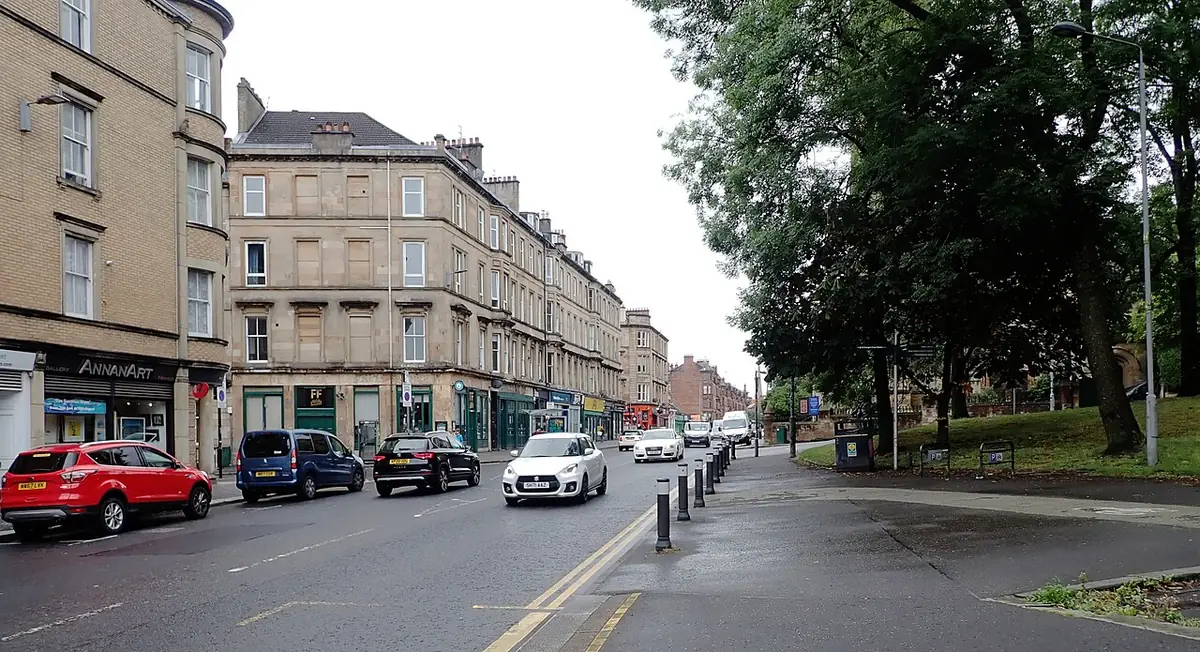
Streets like this, tenements over shops, are everyday Glasgow — Photo: habiloid · CC BY-SA 2.0 · Wikimedia Commons
The numbers give you a range. What narrows it is the legal shape of what you actually own.
Reading Glasgow prices reveals sharp contrasts that track the relative strength or discount of each district. There is no single price, but a cluster of sub-markets in which floor area, the technical state of the building and proximity to public transport decide the final figure. Data drawn from recent transactions gives you objective ranges, and those ranges are the first thing to hold any estimate against: a number that sits well outside the band for its size and district needs a documented reason before you accept it.
glasgowFor saleApartmentestimate
Median price / m²£2,185Half the apartments sell below this
Median price£160kthe average is 14% higher — a few very large properties pull it up
Most common2 bedrooms45 % of listings
Average size70 m²
By number of bedrooms
Bedrooms
Share of market
Avg price
Price / m²
Avg size
1
25 %
£119k
£2,645 +15 %
45 m²
2most common
45 %
£152k
£2,346
65 m²
3
25 %
£195k
£2,162 −6 %
90 m²
4
5 %
£238k
£2,070best value / m²
115 m²
Each row is an average, compared against the area average of £2,300 / m². These are indicative estimates of a typical local market, not a measured sample of live listings. Check current listings before relying on them.
Shared ownership and common parts: the liabilities a valuation has to absorb
That discipline in reading the technical and legal file carries directly into the order in which a value is established and tested.
Owning a flat in an older Glasgow building, and in the traditional tenements above all, comes with a very particular regime of shared responsibility. Here the upkeep of the roof, the foundations and the common stair rests on all the owners in the building, often with no professional factor appointed to drive the work. That decentralised arrangement demands close attention when you are reading the file, because a repair bill voted by the other owners will land on the flat regardless of who valued it, and any credible estimate has to carry a deduction for it.
Self-management and collective decisions between neighbours
In many older buildings, maintenance and repair decisions are taken directly by the owners meeting informally, or through an appointed factor. Costs are usually shared in proportion to floor area or according to historic rules written into the original title deeds. The absence of a centralised professional structure can slow decisions badly when the roof or the sandstone structure needs urgent attention, and a slow building is a discounted building.
What it changesAsk for the history of owners' meetings and check whether major works have been voted or provisioned for before you commit to a figure, because unrecorded liabilities are the single most common reason an estimate turns out wrong.
The financial and technical weight of structural upkeep
The city's older buildings need regular preventive maintenance, particularly to slate roofs, chimneys and rainwater goods. If one owner refuses to contribute to essential work agreed under the shared-ownership rules, recovery can be complex and slow. The Home Report gives you a first assessment of these risks, but a targeted inspection by an independent professional is often what turns a vague worry into a number you can subtract.
What it changesBuild a dedicated allowance for common repairs into any valuation you rely on, so that an unforeseen intervention on the fabric adjusts your budget rather than invalidating your figure.
How a value is established, tested and locked in under Scots law
Terraces like this crescent are some of Glasgow's most sought-after streets — Photo: habiloid · CC BY-SA 2.0 · Wikimedia Commons
Each of those stages brings in a specific professional whose exact role you need to know if you want to read the figure they produce.
Establishing and acting on a value in Scotland follows a strict sequence, formalised by the solicitors acting for both sides. Unlike markets where repeated withdrawals are common, Scots law rewards clarity and speed of commitment once the conditions are in place, which puts real weight on getting the number right early. Understanding the chain, from reading the Home Report through to concluded missives, is what stops you carrying an untested figure into a legally binding position.
Close reading of the Home Report valuation and a targeted technical viewing of the property.
Registering a formal note of interest through your solicitor, which signals your position on the property and puts you in line for any closing date.
Negotiating the suspensive conditions and the settlement timetable through formal correspondence between the solicitors, which is where a disputed valuation is argued.
Conclusion of missives, the pivotal step at which the agreed figure becomes legally binding on both buyer and seller.
Preparing the release of funds and having your adviser check the final title, including any burdens that bear on what the property is worth.
Settlement day, with the funds transferred at the agreed figure and the keys handed over.
Who produces, checks and challenges the figure in Glasgow
Arriving at a defensible figure for a Glasgow apartment takes several people with complementary skills. From the chartered surveyor who values the property and inspects its fabric to the solicitor who reads that valuation against the title, each professional shapes the number in a different way. Knowing what each of them is paid to do lets you see whose figure you are looking at at any given moment, and how much weight it deserves.
The surveyorProducing the Home Report and assessing the condition of the fabricA chartered surveyor states the market value of the property and inspects the major structural elements, providing the independent figure that everything else is measured against.
The solicitor (buyer's side)Reading the valuation against the title and the missivesYour legal adviser checks the soundness of the title, identifies burdens and shared liabilities that bear on value, and frames the offers that follow from the figure.
The mortgage brokerTesting the figure against what can actually be borrowedA broker identifies the lending best matched to your profile as a resident or non-resident, and shows you where the valuation, rather than the asking price, caps the loan.
The factor (where one is appointed)Documenting the upkeep record of the common partsA factor coordinates technical work in the building and collects contributions, and the statements and minutes held are the evidence a valuer uses to price the shared repair liability.
You, as owner or buyerAssembling the evidence and sanity-checking the numberYou gather the title deeds, the EPC, factoring statements, meeting minutes and receipts for recent work, then weigh the professional opinions against each other before accepting any figure.
Apartment or house in Glasgow: how the two are valued differently
Once the property type is settled, the figure still has to be extended into the full cost of holding it.
In Glasgow, any discussion of value starts with the split between the famous sandstone tenements and the detached or semi-detached houses a little further out. Older flats in the West End or Dennistoun offer generous volumes, big windows and undeniable architectural character, all of which the comparables reward, but they also mean sharing the management of the building with owners who can be hard to mobilise for roof or facade work. Running the common parts of an older Scottish building is governed by strict legal rules that demand rigorous collective organisation, and a building without that organisation is valued accordingly.
A house, whether a Victorian villa or a more recent property in outlying residential districts such as Bearsden or Clarkston, removes the shared-ownership constraint but transfers the whole maintenance burden onto one owner. Roof, foundations and garden call for constant spending and attention, especially under Scottish weather that puts materials through a hard test. That is a structural difference which shows up in the annual upkeep line of any valuation, not just in the headline figure.
In purely financial terms, the price per square metre for well-placed flats in the busier districts often rivals that of houses in the first ring, because rental and owner-occupier demand is so strong. Young professionals and couples without children overwhelmingly favour the central position of apartments to cut travel time, while families look for the security and private outdoor space of houses. So a flat is not simply worth less per square metre than a house here; it is priced by a different set of buyers, and you have to value it against the stock those buyers are comparing it with.
Liquidity on resale also varies considerably with the type chosen and its exact position in the city. A well-maintained flat in a sought-after district sells quickly, carried by a young and mobile population, whereas a well-placed family house benefits from structural demand from households looking to settle near the better schools. Speed of sale is part of value: an estimate that only holds if the property sits on the market for a year is not an estimate you can bank on.
What to add to the valuation before you call it a budget
To see how those costs land in practice, it helps to follow the rhythm of an ordinary day in the city.
Building a working budget in Glasgow means going well beyond the figure quoted by the agent or the monthly mortgage payment. Between the local property tax, the cost of maintaining the common parts and the energy bills the climate imposes, the monthly total contains items you cannot leave out. The tables below set out the orders of magnitude observed in the market, so that a valuation becomes the start of the arithmetic rather than the whole of it.
Observed price ranges by property type and district in Glasgow
Property type
Sought-after district
Observed price range
Market trend
One-bedroom apartment
West End / Finnieston
160,000 GBP - 210,000 GBP
Moderate rise
Two-bedroom apartment
Merchant City / centre
220,000 GBP - 300,000 GBP
Stable
Family house, 3+ bedrooms
Southside (Shawlands)
280,000 GBP - 420,000 GBP
Strong demand
These ranges reflect the Scottish closing-date system, in which properties frequently sell above the official Home Report valuation, so recorded prices sit above surveyors' figures more often than below them.
Recurring monthly and annual costs for a standard apartment
Cost item
Estimated average amount
Frequency
Explanatory note
Council Tax (local property tax)
130 GBP - 220 GBP
Monthly
Varies with the band applied to the property (Band B to E).
Energy bills (gas and electricity)
150 GBP - 250 GBP
Monthly
Directly driven by the insulation of older buildings.
Common repairs fund / factoring
40 GBP - 100 GBP
Monthly
Upkeep of the common parts and building insurance.
These amounts are indicative and depend on the actual energy performance of the property and on the heating system installed, both of which also move the valuation itself.
What an ordinary Tuesday in Glasgow looks like, and why a valuer cares
Detached villas like this show the grander end of Glasgow's housing stock — Photo: Michal Klajban · CC BY-SA 4.0 · Wikimedia Commons
Beyond that appealing routine, some hidden features of the Scottish market deserve your full attention before you trust a number.
Glasgow is not reducible to macroeconomic figures or tables of price per square metre. It is also a daily rhythm shaped by travel, changeable weather and access to local services, and those are exactly the things that make one street support a higher figure than the next. Walking through an ordinary Tuesday, from the morning alarm to the end of the day, is one of the more reliable ways to test whether a location premium in an estimate is real.
07:30Home, West End or SouthsideWaking in a flat full of light if you have the large windows typical of the older stock, with an immediate glance at the day's weather to work out what you need. Light and outlook are among the first things a surveyor adjusts for.
08:30The commute, by Subway or by bikeOnto the public transport network, notably the circular Subway known as the Clockwork Orange, or the cycle paths along the Clyde that make morning journeys easy. Proximity to a Subway station is one of the clearest premiums in the comparables.
12:30Lunch in Merchant CityInto the historic core for lunch in one of the many independent cafes that define a local food scene very much on the rise, and that push values in the surrounding streets.
17:00Local shops and servicesA stop at the neighbourhood shops for fresh produce, helped by the very pleasant pedestrian density of the busier shopping streets. A working high street within walking distance is a value the market pays for.
19:00Culture or sportA community activity, a visit to one of the city's free museums, or simply a walk in one of the great Victorian parks such as Kelvingrove Park. Park frontage is a documented premium in West End valuations.
The subtleties an agent's valuation will not put in front of you
Those particularities explain why some owners find their figure collapses shortly after the survey.
The Scottish market has legal and technical rules of its own that differ sharply from practice in England or on the continent, and several of them bear directly on what a property is worth. Ignoring them can leave you holding a figure nobody else will honour, or facing unforeseen costs at the point of sale. These are the determining factors that marketing brochures rarely spell out.
The compulsory Home Report
In Scotland the seller must provide a complete file containing an independent valuation, an energy assessment and a report on the condition of the building. Lenders use that document as the basis for the loan, which means nobody can bid blindly above the official figure without funding the difference themselves. In practice it makes the surveyor's number, not the asking price, the reference value.
The complexity of shared obligations under the Tenement Management Scheme
In older shared buildings, the law tightly governs how decisions on roof and structural repairs are made. If one owner refuses to pay their share for urgent work, recovery can take months and stall maintenance altogether, and a valuer who spots that risk will price it in as a deduction.
The state of the roof and the roof structure in older stock
The slate roofs of Victorian buildings need constant monitoring and regular attention from specialist roofers. A poorly maintained roof quickly produces destructive water ingress in top-floor flats, which is why top-floor valuations in unmodernised buildings carry a discount that surprises many owners.
Strict planning rules in protected areas (Conservation Areas)
If the property sits in a designated district of the West End or Pollokshields, replacing sash windows with modern double glazing or altering the external facade requires very restrictive consent. That caps what energy improvements can realistically be made, and therefore caps how far the EPC deduction can ever be recovered.
Where valuations most often turn out to have been wrong
Those traps lead naturally to the question of whether the figure you are chasing is worth pursuing at all.
Looked likeAuthentic Victorian character, high ceilings and beautifully preserved period mouldings, all of it valued at a full character premium.
Turned outAn enormous heating bill through the winter months, caused by poor thermal performance and by those same ceiling heights, and a figure that no longer stood once buyers priced the insulation work.
Would have caught itAlways check the energy performance certificate (EPC) and cost the targeted insulation work explicitly, then subtract it from the estimate rather than treating it as a detail.
Looked likeAn ultra-fashionable, lively central district, ideal for the nightlife and the restaurants, and comparables that supported a strong number.
Turned outRecurrent night-time noise at weekends and chronic difficulty parking at the door, both of which narrowed the pool of buyers and pulled the achievable price below the estimate.
Would have caught itVisit on a Friday or Saturday evening to gauge the real noise level, and discount any figure built on comparables from a quieter street two blocks away.
Looked likeAn informal, cheap arrangement between neighbours to look after the common parts, with barely any monthly charge showing in the file.
Turned outA total absence of communication and of any reserve fund to meet a plumbing or roofing emergency, so a repair bill landed with no provision behind it.
Would have caught itAsk for three years of owners' meeting records to confirm that collective management is functioning, and treat a missing paper trail as a deduction, not as a saving.
Looked likeAn offer accepted quickly at the asking price, apparently confirming that the valuation was accurate.
Turned outFierce competition that forced a bid beyond the value assessed in the Home Report, with the excess funded in cash and unrecoverable on resale.
Would have caught itSet a strict bidding ceiling anchored on the surveyor's figure, and refuse to be pushed past it by the pressure of a closing date.
When a Glasgow valuation is not the number you should be acting on
If you have worked through every stage and weighed each risk, it is time to turn the figure into a decision.
A valuation answers one question: what the property would fetch today. It does not tell you whether acting on it makes sense for you, and some personal or professional situations are far better served by renting. To avoid committing on the strength of a figure you should not be relying on, identify the profiles for which the number, however accurate, is the wrong basis for a decision.
The internationally mobile professional, or anyone in an uncertain career transition
→Renting in the private sector to keep complete freedom of movement from one year to the next.
Transaction costs and resale timescales in Scotland require a holding period of at least five years to absorb, so even a valuation that is exactly right will not be realised in time to matter.
The owner with no appetite for collective administration or hands-on maintenance
→Renting a modern flat run by an institutional agency, or buying a new-build house on the outskirts.
The upkeep of an older Glasgow building demands constant personal involvement in shared-ownership and maintenance problems, and a valuation that assumes that involvement will not hold if it never happens.
The household with very limited cash relative to market prices
→Waiting and saving further before entering the market, to avoid bidding above what the Home Report supports.
The Scottish system requires the gap between an offer and the surveyor's official valuation to be funded in cash, which means the valuation sets a hard ceiling on what you can safely bid.
So, do you now have a figure you can defend?
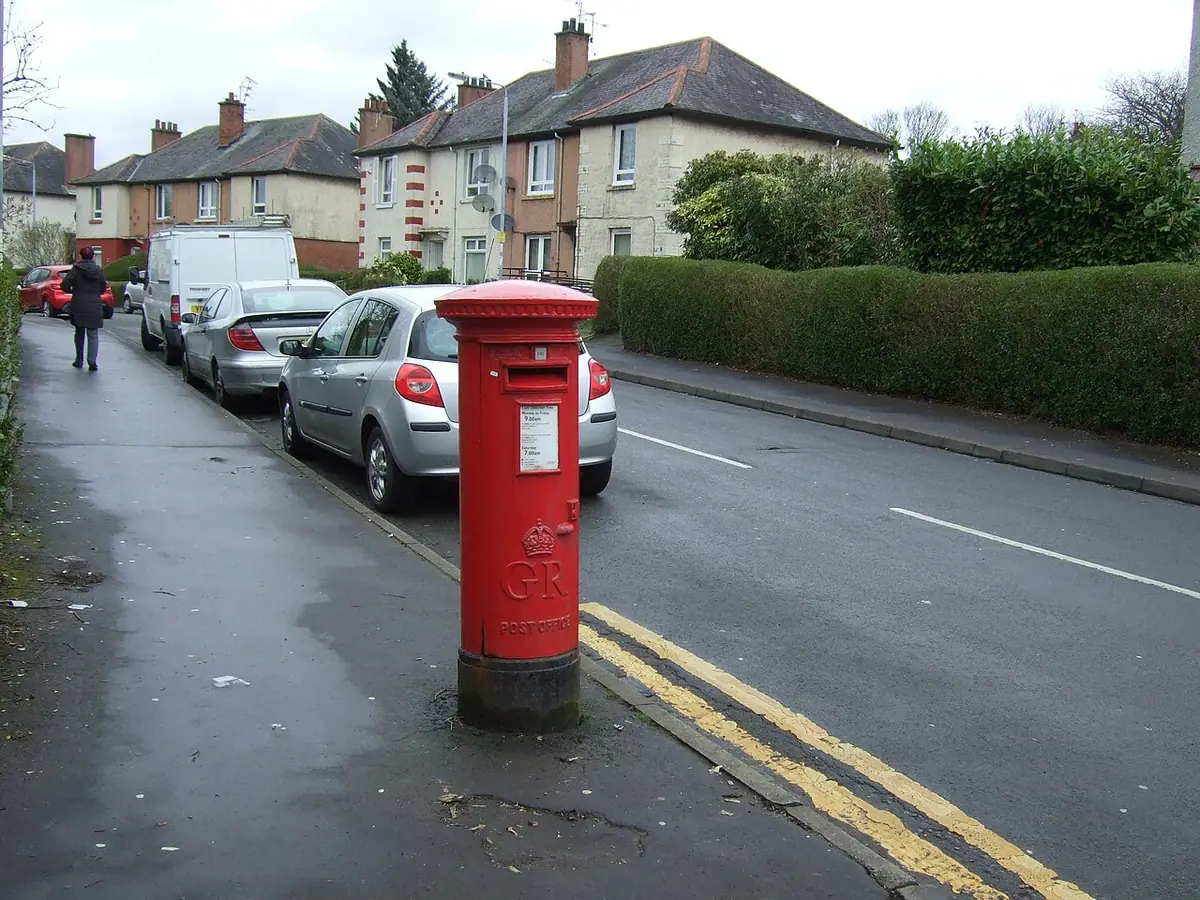
Quiet residential streets like this sit just off Glasgow's main roads — Photo: JThomas · CC BY-SA 2.0 · Wikimedia Commons
Reaching the end of this reasoning puts you in front of the number itself. Valuing an apartment in Glasgow is not a matter of instinct prompted by the charm of old stone; it is an exercise that combines the evidence in the Home Report, the comparables from the right sub-market and a clear-eyed reading of the condition adjustments. If you have taken in the reality of shared repair liabilities, understood how the closing-date system pushes recorded prices above surveyors' figures, and tested your estimate against the ranges above, you are holding a figure you can defend.
The Glasgow market rewards anyone who looks past appearances and reads the survey reports methodically. Whether the property sits in the cultural energy of the West End or in the quieter family streets of the Southside, the discipline is the same: start from the independent valuation, adjust it for condition, for the energy rating and for what the common parts will demand, then sanity-check the result against what comparable flats on that street have actually achieved. Take the time to reread your assumptions, consult local professionals openly, and treat any single number as a claim to be tested rather than a fact.
Related questions
How does the sealed-bid system (the closing date) actually work in Glasgow?
When a property attracts a lot of interest, the agent sets a deadline by which every interested buyer must submit their best written offer through their solicitor. Bids are not disclosed to the competition, and the seller normally takes the highest or the most secure proposal, with no later round of negotiation. For anyone valuing a flat, this matters: the recorded selling prices in a closing-date market sit above the surveyor's valuation more often than not.
What is the Home Report, and why is it compulsory in Scotland?
The Home Report is a complete file required by Scots law before any property is put on the market. It contains a survey of the general condition of the building carried out by a chartered surveyor, a valuation of its market worth and an energy performance certificate. That surveyor's figure is the independent valuation everything else on the page is measured against.
Which costs sit alongside the valuation figure for a Glasgow apartment?
Beyond the price itself you need to allow for the Land and Buildings Transaction Tax, Scotland's property transaction tax, your solicitor's fees for the legal work, and the cost of any further specialist inspections you commission on top of the Home Report.
Does shared ownership in an older tenement make a Glasgow flat harder to value?
It does, because the common parts are governed by the Tenement Management Scheme wherever the title deeds set no specific rules of their own. Roof and structural repairs depend on neighbours agreeing and paying, which can be slow, so a valuer has to make a judgement about liabilities that may be visibly due but nowhere recorded.
Which Glasgow districts carry the strongest values for apartments?
The West End around Byres Road and Finnieston are in heavy demand for their cultural energy and their closeness to the universities. Merchant City draws people who want industrial architecture converted into modern lofts, while the Southside, and Shawlands in particular, is increasingly popular with families for its quality of life. Those preferences show up directly in the figures each area supports.
How do lenders in Scotland treat the valuation?
Banks work strictly from the independent valuation set out in the Home Report. If a buyer decides to bid above that figure to win the property, the difference has to be found in cash, which is why the surveyor's number, rather than the asking price, is the one that governs what a flat is worth in practice.
How much does the energy performance certificate (EPC) affect value in Glasgow?
A great deal. Given the Scottish climate and the age of the housing stock, the EPC is a crucial indicator of what winter heating will cost. A poor rating usually implies significant insulation spending, and a valuer, like a buyer, will discount the figure by roughly what that work is expected to cost.
How long does it take between a valuation and a completed sale in Glasgow?
Once an offer is accepted, the legal process leading to settlement generally takes six to eight weeks. The length varies with the complexity of the chain and the speed of the solicitors' conveyancing, and a valuation more than a few months old should be revisited before you rely on it.
Can an overseas owner have a Glasgow property valued and sold?
There is no legal restriction preventing a foreign citizen from owning property in Scotland, and the Home Report requirement applies in exactly the same way. It is strongly advisable to instruct a local solicitor and to plan ahead for the tax and banking side of moving funds internationally.
What do Conservation Areas do to the value of an apartment?
If the flat sits in an area protected for its architectural heritage, every change visible from outside, including windows, roof and facade, needs strict consent from local planning officers, which rules out many modern materials. That cuts both ways in a valuation: the protection supports the character premium, but it raises the cost of the repairs the building will eventually need.
Property review of ting
No ting properties in Glasgow yet
Be the first — share it on ting and it shows up right here.