Investing in property in Glasgow calls for a close understanding of the local specifics, of the market in older tenement flats and of the rigour of Scots law. This complete guide walks you through structuring your purchase step by step and objectively, with no gloss and no empty promises.
Get the app
What nobody tells you.
Real prices, hidden costs and the traps to check before you commit.
What you actually get when you buy an apartment in Glasgow
Scroll
What you actually get when you buy an apartment in Glasgow
Investing in property in Glasgow calls for a close understanding of the local specifics, of the market in older tenement flats and of the rigour of Scots law. This complete guide walks you through structuring your purchase step by step and objectively, with no gloss and no empty promises.
Written by the ting.ad editorial team ·
Chalmers Gate, Glasgow in Street View: drag to look around.
To see whether that reality fits your own daily life, let us look at how your profile sits within the local urban fabric.
Buying an apartment in Glasgow is not simply a matter of signing the deed and picking up the keys. Behind the apparent appeal of the price per square metre and the cultural energy of Scotland's largest city sits a very particular technical and structural reality. The local market makes you understand straight away how traditional red sandstone buildings are put together, and what shared costs come with owning a flat in Scotland. Between the promise of an unmatched urban quality of life and the disciplined management of the common parts, the decision to buy calls for weighing every aspect before you commit. Here are the two readings you need to assess your Scottish property plan calmly, without falling for surface impressions.
A cultural and economic city on the risevsAn older housing stock that demands absolute technical vigilance
Glasgow's momentum attracts plenty of working professionals and investors drawn by its artistic and academic vitality. The average age of the buildings, though, means the roof, the timbers and the stonework all need a thorough audit before any offer goes in.
Prices more affordable than in other British citiesvsRenovation and common-parts maintenance costs that are often underestimated
The entry ticket stays comparatively moderate next to Edinburgh or London, but the Scottish rules on shared buildings, and factoring fees in particular, mean regular spending to keep the fabric of the property intact.
A strong, sociable neighbourhood way of lifevsA gradual smoothing out of some areas through gentrification
Every Glasgow neighbourhood keeps a strong identity, built around its independent shops and its green spaces. Even so, rapid change in some areas shifts the local balance and the make-up of the immediate neighbourhood.
A rental investment that can pay wellvsA strict letting framework and tighter energy obligations
Steady demand from students and working residents keeps occupancy rates high. In return, tenancy legislation and energy performance requirements call for professional, disciplined management.
Does this place really fit your way of life and your day-to-day expectations?
Judging how well your way of life matches the city also means understanding the cultural and practical gaps against wherever you are arriving from.
Settling in or investing in Glasgow means looking hard at your way of life, how you travel and what you want from an urban setting. The city offers radically different moods depending on whether you go for the cultural buzz of the West End, the shifting energy of the Southside or the historic centre. Every personal situation involves particular trade-offs on parking, noise, access to public transport and closeness to green space. To avoid disappointment once the keys have changed hands, it is essential to work out clearly which kind of resident you are. The profiles below set out what daily life really looks like in each case, to help you confirm where you should be buying.
Urban energy and closeness to the job market
You want an apartment that puts you in the middle of the events, the independent cafes and the music venues the city is known for. Your days will be shaped by walking and cycling, making use of a dense public transport network that does get crowded at peak times. The trade-off is accepting a potentially more compact home, often in an older building with no lift, where residential parking is restricted and charged for. In return you get an energising neighbourhood life straight away, without depending on a car day to day, which makes the logistics of your working week far simpler.
Looking for residential quiet and green space
Your absolute priority is a stable setting for your household, with extra bedrooms, a shared garden or direct access to large open spaces such as Kelvingrove Park or Queen's Park. That naturally points you towards areas a little further out from the strict centre, where homes have more generous floor areas and parking is easier. The trade-off is longer daily journeys into the city centre at peak times, along with more reliance on neighbourhood schools and on local shops for everyday errands.
An investment strategy and disciplined letting management
You are buying for the ability to generate regular income, driven by the constant presence of university students and young professionals looking for somewhere to live. Your attention goes to smaller units well served by the Subway or the suburban rail lines, easy to let and easy to maintain. The main challenge for you is keeping shared building costs under control and anticipating the regulatory obligations placed on landlords in Scotland. You need to factor in the cost of managed letting from the outset if you do not live locally, so that your investment holds up as the market moves.
Living here when you arrive from abroad: what changes most in your daily life
A striking sandstone building with matching gothic-style gables in Glasgow — Photo: Michal Klajban · CC BY-SA 4.0 · Wikimedia Commons
Once those administrative and cultural differences have sunk in, choosing the right area becomes the key step in the process.
Carrying your home-country property instincts straight into the Scottish context is the most common mistake international buyers make. The legal system, the conventions around shared building ownership, the way buildings are designed thermally and even the structure of an offer all follow fundamentally different rules here. In many countries, buying rests on a heavily protected statutory framework and on standardised professional building managers. In Glasgow, the culture of informal agreement, the central role of the solicitor and the self-management of older buildings by the owners themselves all take some quick learning. Working through these cultural and practical gaps will help you avoid missteps when you negotiate and when you later manage your property.
From abroad
In many countries, the rules on shared buildings and communal works are handled by a professional managing agent with a compulsory works fund.
Glasgow
In Glasgow, the common parts are usually run through factoring or by direct agreement between the owners (tenement management).
You have to get actively involved in the life of the building and check whether money is set aside for major roof or facade work.
From abroad
Elsewhere, an offer often comes with financing conditions attached and a cooling-off period once the preliminary contract is signed.
Glasgow
In Scotland, an offer formalised by a solicitor is legally binding as soon as it is accepted, with no conventional cooling-off period.
Your financing and your technical checks absolutely have to be settled before you put in a firm offer.
From abroad
Many countries measure the energy performance of homes with a national rating and impose a staged schedule of upgrade work.
Glasgow
In Glasgow, a great many older homes have their own particular thermal behaviour, because solid stone walls carry no external insulation.
Budget for the heating bill and look into internal improvements that are compatible with the heritage character of the building.
From abroad
In plenty of markets, agency and legal fees are clearly itemised and the advertised price is a ceiling you negotiate down from.
Glasgow
In Glasgow, the sealed-offer system with a closing date completely changes the financial strategy of a purchase.
The advertised price is often only a starting indication, and bidding above it may be what it takes to win the property you want.
Which Glasgow neighbourhood should you settle in or invest in?
Having identified the right neighbourhood, you can approach the money realistically and read the observed price ranges properly.
Glasgow is made up of sharply contrasting micro-markets, and every neighbourhood has its own character, its own social mix and its own property dynamic. Picking the right one depends not only on your starting budget but on your tolerance for noise, your need for green space and your long-term plans. Between the cultural and student energy of the West End, the artistic buzz and social mix of the Southside, and the centrality of the Merchant City, the atmospheres could hardly be more different. The comparison cards below pull together the fundamentals of the main residential areas to guide your choice of location.
West End
A lively neighbourhood, lined with leafy parks and independent cafes, with a large university and professional population.
Suits
People who want cultural life, young professionals, and investors after a highly liquid rental market.
Trade-off
Some of the highest prices per square metre in the city, and fierce competition whenever something comes up for sale.
Southside (Govanhill, Strathbungo)
A bohemian, creative atmosphere, set by committed local shops and a very active community scene.
Suits
Anyone after an urban village feel, alternative cultural spaces and better floor area for the money.
Trade-off
Marked differences from one street to the next, which calls for a close look at the condition of the buildings and at safety.
Merchant City and the city centre
A dense, hard-edged urban setting, characterised by former warehouses converted into lofts and contemporary apartments.
Suits
People who want to walk everywhere, who like industrial architecture and who value being right by the stations and theatres.
Trade-off
A higher cost of living, no private outdoor space, and the night-time noise that comes with the very centre.
North West and Kelvindale
A quiet, family-friendly and green residential compromise, along the River Kelvin with easy access to the centre.
Suits
Families and buyers after peace and quiet, good schools nearby and easy parking.
Trade-off
A steadier market but a less dynamic one for short-term capital growth, with fewer properties coming up.
What does an apartment in Glasgow really cost on today's market?
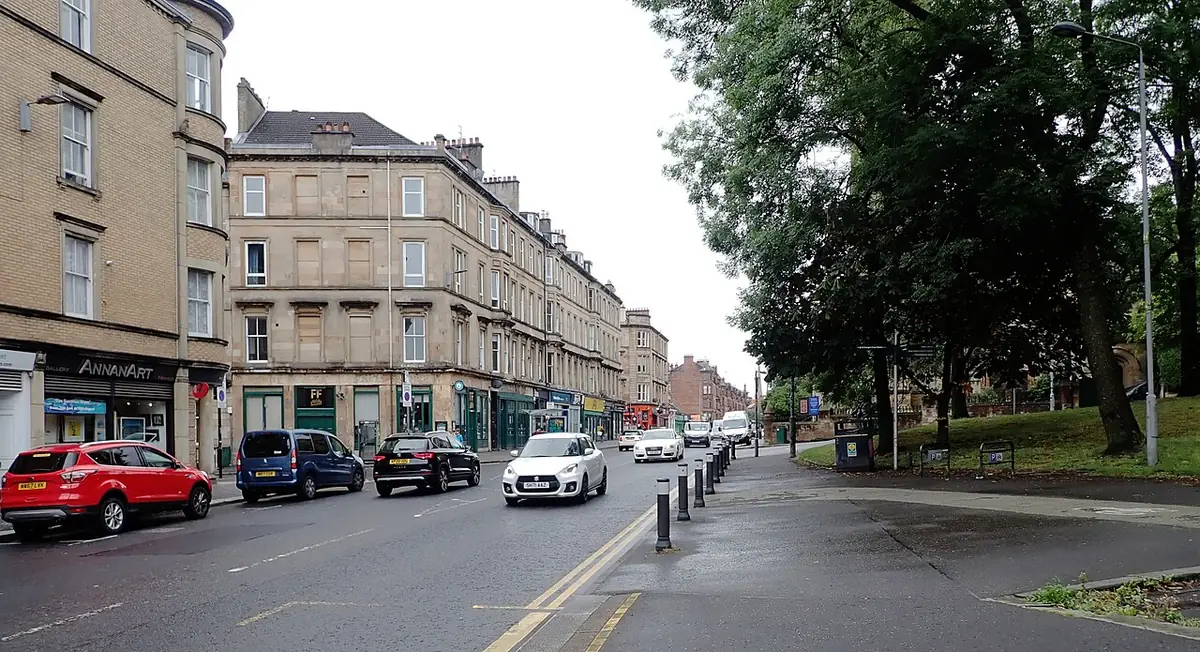
Streets like this, tenements over shops, are everyday Glasgow — Photo: habiloid · CC BY-SA 2.0 · Wikimedia Commons
Understanding these figures leads straight on to the legal nature of what you are about to buy here.
Working out the budget you need to buy a property in Glasgow means reading the market data from the official Scottish registers carefully. Contrary to the received wisdom, the city is not one homogeneous market: the price per square metre can double depending on the standing of the building, how far its energy upgrades have gone and exactly where it sits. On top of that, you should never forget to build the local purchase tax (LBTT), the solicitor's fees and any cost of bringing the common parts up to standard into your financing plan. The tables below pull together the price ranges observed by property type and by broad area, to give you a reliable reference point.
glasgowFor saleApartmentestimate
Median price / m²£2,185Half the apartments sell below this
Median price£160kthe average is 14% higher — a few very large properties pull it up
Most common2 bedrooms45 % of listings
Average size70 m²
By number of bedrooms
Bedrooms
Share of market
Avg price
Price / m²
Avg size
1
25 %
£119k
£2,645 +15 %
45 m²
2most common
45 %
£152k
£2,346
65 m²
3
25 %
£195k
£2,162 −6 %
90 m²
4
5 %
£238k
£2,070best value / m²
115 m²
Each row is an average, compared against the area average of £2,300 / m². These are indicative estimates of a typical local market, not a measured sample of live listings. Check current listings before relying on them.
What you can actually own: understanding Scottish property
Getting these legal points straight leads on to the local purchase procedure, which is particularly strict in Scotland.
The legal structure of property ownership in Scotland has historical quirks that bear directly on how freely you can manage your home and on what you are financially responsible for. Unlike a classic shared-ownership system governed by one uniform set of rules, Scots law draws a clear distinction between the ways land and shared buildings are held. Knowing whether you are buying outright or within a shared tenement arrangement changes your relationship with the property, and your obligations to your neighbours, completely. The two perspectives below set out what those legal choices mean in practice for protecting your investment over the long term.
Traditional tenement ownership
In an older tenement building you own your own flat and hold the foundations, the roof and the stairwell in common with everyone else in the building. Emergency repairs and routine upkeep run on the principle of collective, joint responsibility, often organised by a professional manager known as a factor. The system gives you a lot of local autonomy, but it demands constant attention to your neighbours' ability to pay and to the general condition of the structure.
What it changesYou absolutely have to read the survey reports and check the history of repair invoices before you commit any money.
Modern ownership in a recent residential development
New or recent developments come with more standardised management arrangements, run by institutional factoring companies that schedule the upkeep of the grounds, the lifts and the underground parking. Monthly or quarterly charges are generally higher, but they buy budget predictability and spread maintenance costs across a large scheme. This kind of property appeals to buyers who want operational calm and energy performance that meets the latest environmental standards.
What it changesYou get modern comfort straight away, in exchange for higher fixed structural costs that eat into the net return on your investment.
The absolute rule to understand before you pay a deposit or make an offer
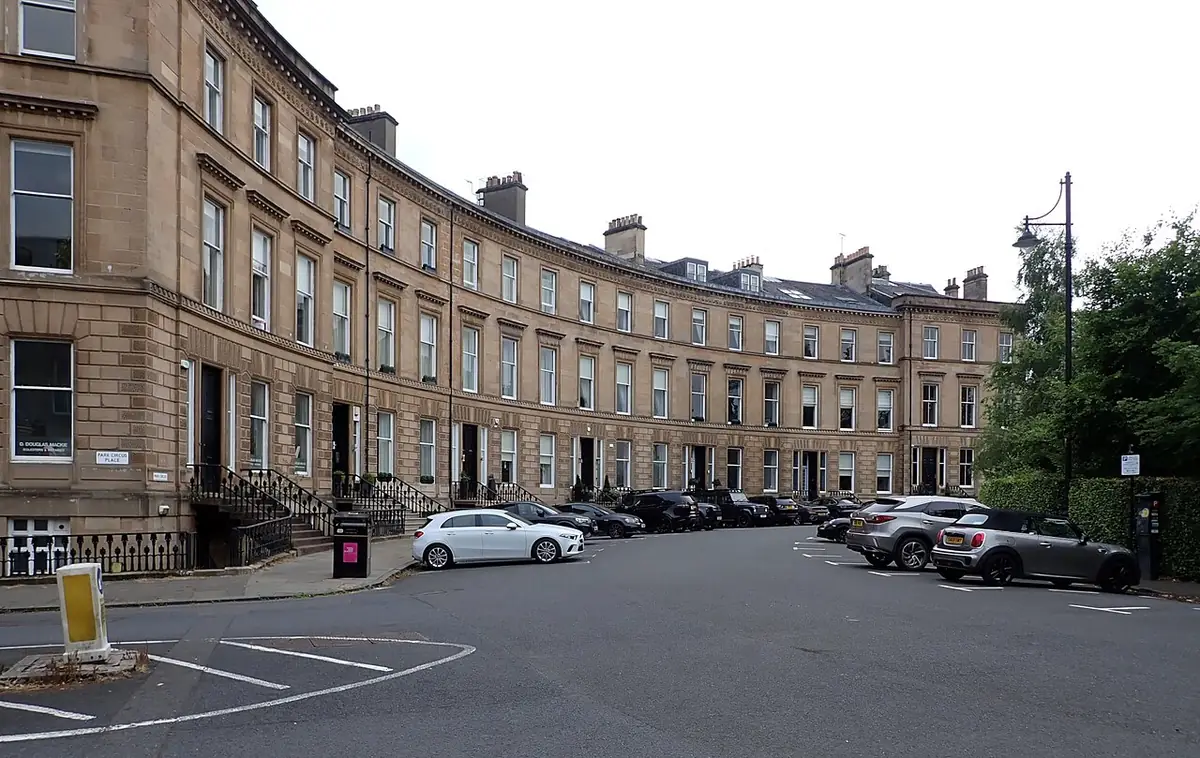
Terraces like this crescent are some of Glasgow's most sought-after streets — Photo: habiloid · CC BY-SA 2.0 · Wikimedia Commons
To run that legal sequence successfully, you need to know the role of every party involved in the transaction.
Buying a property in Scotland follows a strict legal formality that often catches out foreign buyers used to a looser system. Here, negotiation and commitment leave no room for approximation, because an offer accepted through your solicitor amounts to a firm and final contract. There is no cooling-off period once the formal missives are concluded, which means every technical, financial and planning check has to be done beforehand. The chain of events below sets out, in order, the steps you cannot skip if you want to see your transaction through safely.
You find a property that matches your criteria and read the Home Report supplied by the seller.
Your solicitor goes through the Home Report, which contains the market valuation, the energy certificate and the survey of the building.
You confirm your financing plan with your bank or your broker so that you have a firm and final mortgage offer.
Your solicitor puts an official written offer to the seller or the selling agent (a note of interest first, then the formal offer).
The seller may set a closing date for offers if several buyers are chasing the same property at the same time.
The parties exchange formal letters (missives) through their respective solicitors until the final legal agreement is reached.
The sale is legally concluded and irrevocable, leading to the date of entry and the actual transfer of the funds.
How a property transaction runs, step by step, in Glasgow
Follow this disciplined method and you will have every factual element you need to get your Glasgow property decision right.
Making a success of a property investment in Glasgow means coordinating several professionals whose roles differ noticeably from the ones you may be used to. From the surveyor who carries out the technical audit to the solicitor who orchestrates the legal side of the missives, each one secures a specific part of your project. The running order of roles below sets out clearly who does what, and at what point in the procedure, so you can steer your purchase rigorously and avoid confusing one professional's remit with another's.
The buyer (you)Defining the project and confirming the budgetYou set your geographical criteria, work out how much you can borrow and choose which properties to view, using the market data available.
The chartered surveyorProducing and analysing the Home ReportThey carry out the independent survey of the building, assess its official market value and assign the compulsory energy rating before it goes on the market.
The solicitorLegal negotiation and drafting the missivesThey represent your legal interests, submit the formal offers sealed or in writing, negotiate the contractual terms and carry out the essential title searches.
The broker or the bankSecuring the financing and the guaranteesThey confirm that your borrowing case stands up and release the funds needed to pay the purchase price in full on the agreed settlement date.
The factor (building manager)Passing on the shared-ownership informationThey provide the history of the charges and the detail of work coming up in the building, and handle the administrative handover of the common parts after the sale.
The solicitor and the land registerOfficially registering the ownershipYour title is entered definitively in Scotland's official land registers (Registers of Scotland), which is what makes the transaction official.
Apartment or house in Glasgow: which really holds up over the long run?
Once the type of property is settled, the central question of overall budget arrives immediately for any buyer.
Choosing between a city apartment and a suburban house in Glasgow shapes both the structure of your daily life and how predictable your future spending is. Apartments in the city centre or in the smarter parts of the West End put you right next to the transport network and the job market, but they bring shared building charges that can be heavy and a rigid regime for managing the common parts. You have to weigh the time saved on the daily commute against the absence of any genuinely usable private outdoor space.
Going the other way, towards a house in residential areas such as Shawlands or in the outer suburbs, changes the nature of your investment completely. Owning a house means total control over the fabric of the building, but it also puts the entire burden of maintaining the roof, the facades and the foundations on your finances alone. Unplanned maintenance costs often turn out higher for an older Scottish sandstone building than for a modern block where the common parts are shared out.
Life in Glasgow does not bend easily to uniform standards, because the housing stock varies enormously in age and design from one neighbourhood to the next. An apartment in a listed Victorian building is appealing for its proportions and its architectural character, but it demands absolute vigilance on thermal insulation and on the state of the shared roofs. Buildings run by professional factors offer better predictability on major works, whereas buildings self-managed by the resident owners can sometimes deadlock when urgent renovation needs deciding.
The financial side is not just the purchase price shown on the local property portals, because the local tax, known as council tax, varies significantly with the band assigned to the property. Compact apartments in high-density areas often sit in more favourable bands, but how easily you can sell on will depend strictly on the neighbourhood's momentum and on how well the building is managed. Taking the time to read the minutes of the last owners' meetings will spare you devastating financial surprises after you have signed.
In the end, your choice should rest on your tolerance for renovation risk and on how you see yourself occupying the home over a seven to ten year horizon. If you value geographic flexibility and being able to walk to Glasgow's cultural venues, the city apartment remains the more rational option. If you want total control over your immediate surroundings and an asset with a garden to pass on, the house makes its own case, whatever upkeep it involves.
What overall budget do you need to secure to settle for good in the Glasgow area?
To gauge what your future setting will really be like, it helps to look concretely at how a typical day in the city unfolds.
Buying a property in Glasgow is not just a matter of paying the net purchase price to the seller, because the Scottish legal system brings specific administrative and tax costs that have to be anticipated from the moment your search begins. The Land and Buildings Transaction Tax, which replaces traditional stamp duty in Scotland, applies on a progressive scale of bands that bears directly on the overall cash you need. On top of that, the fees of local solicitors, essential for validating offers and drawing up the transfer documents, are a fixed and unavoidable budget line that belongs in your initial financing plan.
Unavoidable cost items when buying an apartment in Glasgow
Cost item
Order of magnitude
How it is paid and its effect on the project
Scottish solicitor and conveyancing fees
1,500 GBP to 3,000 GBP
Payment for the legal advice on drafting the missives and checking the titles.
Property transaction tax (LBTT)
0% to 12% depending on the band
A progressive tax calculated on the total purchase price, payable on the date of entry.
Home Report survey
400 GBP to 800 GBP
A compulsory document supplied by the seller, essential for judging the technical condition and the market value.
Lender arrangement fee
300 GBP to 1,000 GBP
A flat or proportional amount charged by the lender for processing the mortgage application.
The amounts shown are averages observed in the Glasgow market for a standard two-bedroom apartment.
Recurring annual costs to plan for after the purchase
Type of cost
Average annual estimate
What goes into the calculation
Council tax (bands A to H)
1,200 GBP to 3,500 GBP
The local contribution paid to the council to fund neighbourhood public services.
Factoring fees
600 GBP to 1,800 GBP
Upkeep of the common parts, the block insurance policy and professional management of the shared areas.
Home contents and liability insurance
250 GBP to 500 GBP
Cover for your possessions and your personal liability, with the building itself usually insured through the factor.
Council tax depends directly on the assessment of the home made by the Scottish assessors.
What does daily life actually look like for a resident in Glasgow's neighbourhoods?
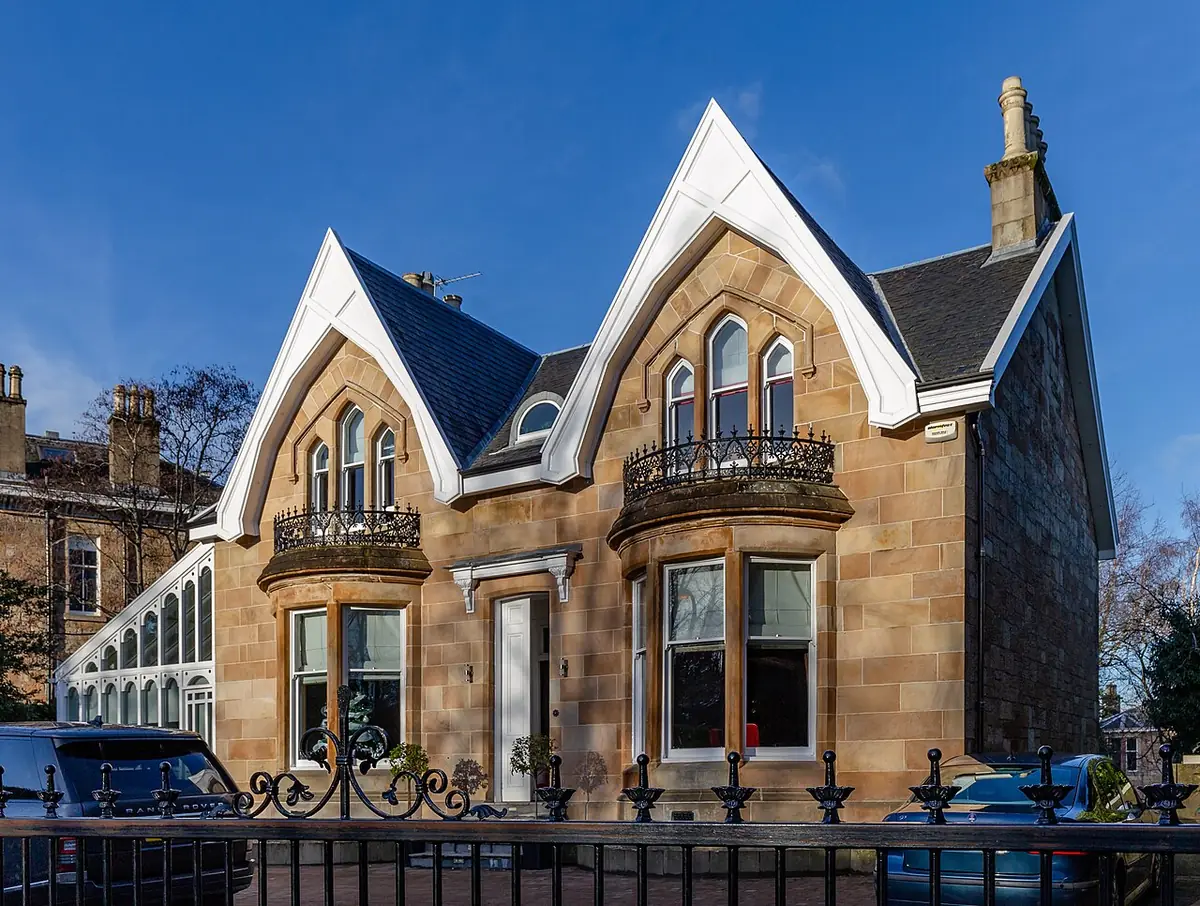
Detached villas like this show the grander end of Glasgow's housing stock — Photo: Michal Klajban · CC BY-SA 4.0 · Wikimedia Commons
Beyond that apparently smooth organisation, the Glasgow property market holds subtleties the sales brochures carefully leave out.
Mapping out a typical week in Glasgow shows how effective the local infrastructure is, whether that is the suburban rail links or the city bus network run by First Bus. Families have to work around where the strong schools sit, often near the large green spaces or the sought-after residential areas such as Hyndland or Pollokshields. Anticipating these daily journeys is what keeps you out of the peak-hour crush on the main routes across the River Clyde.
07:30Glasgow Central or Queen Street stationA heavy flow of commuters heading for the office districts of the city centre, with regular services to Edinburgh and the rest of Scotland.
08:30The neighbourhood schoolDropping the children at the local state primary schools, where places are strictly governed by the council catchment area.
12:30Local health centre (GP surgery)A routine appointment with the family doctor attached to NHS Scotland, available once you have registered.
15:30Municipal park (Kelvingrove or Queen's Park)The favoured place to unwind at the end of the day for families, with play areas and well-kept sports facilities.
18:00The shopping streets of Byres Road or Sauchiehall StreetEveryday shopping in the neighbourhood supermarkets and visits to the independent shops for daily supplies.
20:00Home and household adminChecking energy use and dealing with the practical side of the shared building or the upkeep of the house.
What technical and administrative realities do Glasgow property listings always leave out?
That watchfulness for hidden defects should go hand in hand with a clear-eyed look at the mistakes inexperienced buyers make along the way.
A close look at the Glasgow property market turns up a number of technical and legal subtleties that never appear in an agency's sales pitch. Buyers often discover far too late how much the planning rules on older buildings matter, or what constraints come with collective decision-making among owners. Getting on top of these blind spots will let you negotiate from a position of strength and avoid buying into structural defects you cannot see.
The condition of the shared roofs in older sandstone buildings
Scots law makes owners jointly responsible for maintaining the roof, which sets off recurring disputes over major repair work whenever one owner refuses to pay their share.
The compulsory Home Report and its condition ratings
The compulsory survey scores the building's condition from 1 to 3; a 3 on a structural element means immediate and expensive work is essential to stop damp getting in.
The strict restrictions attached to listed buildings
If you buy an apartment in a historic building in the centre or the West End, every external or internal change needs specific consent, which rules out even replacing the windows like for like without approval.
How demanding the sealed-offer system (closing date) is
The Scottish market often runs on a closing date for offers, where buyers submit their best proposal without knowing what the competition has bid, which frequently leads to bidding above the Home Report valuation.
How complicated fee collection by management companies can be
Some professional building managers charge high administrative management fees without necessarily responding quickly when there is a technical emergency on the water or electricity systems in the common parts.
Which misjudgements do people bitterly regret six months after moving to Glasgow?
With those disappointments avoided, it is worth deciding objectively whether the buyer's own profile really matches what this market demands.
Looked likeAn irresistible financial opportunity in a neighbourhood in the middle of regeneration.
Turned outAn isolated area with a chronic shortage of local shops and no reliable transport links in the evening.
Would have caught itVisiting the neighbourhood at different times of the day and night, and asking future neighbours what local life is actually like.
Looked likeA Victorian apartment full of character that only needed a fresh coat of paint.
Turned outAn old, badly insulated flat with damp-soaked walls, needing full internal insulation and new services throughout.
Would have caught itHaving the Home Report read by an independent building professional so the upgrade work can be priced precisely.
Looked likeAn aggressive offer slightly above the advertised price, to win the property quickly.
Turned outA significant overvaluation that the bank refused to fund, forcing the buyer to make up the gap in cash or lose the deposit.
Would have caught itStaying strictly disciplined about the maximum valuation set by the independent surveyor in the official report.
Looked likeA friendly self-managed building that saves you the cost of a professional factor.
Turned outComplete deadlock on voting through even basic facade repairs, because of deep disagreements between absent owners and residents.
Would have caught itInsisting on seeing three years of accounts and the minutes of owners' meetings before signing anything.
Which kind of buyer is the Glasgow property market absolutely wrong for?
With those filters in place, it is time to pull your approach together and go into your Glasgow purchase with confidence.
Investing in property in Glasgow calls for a degree of stability and a tolerance for local quirks that effectively rules some buyers out. Trying to apply investment templates that do not fit Scots law leads inevitably to financial dead ends or to lasting disappointment. It is better to recognise these incompatibilities up front than to be caught out by the constraints of a market whose rules differ profoundly from those of other European cities.
The investor after immediate rental yields with no hands-on management
→A quick purchase of small flats in run-down outlying areas, with no analysis of real rental demand.
The regulations governing tenancies in Scotland and the weight of shared building charges cut net margins sharply for unprepared landlords.
The buyer in a hurry with no patience for formal legal procedure
→An attempt to buy direct, without going through the qualified Scottish solicitor the process requires.
The system of property missives in Scotland is a strict, mutually binding contract that becomes irrevocable as soon as the written agreements are exchanged, leaving no room for improvisation.
The owner with no tolerance for shared-building constraints and communal works
→Buying a flat in an older stone building that has no reserve fund for major works.
Scots law obliges every owner to contribute to the structural repairs of the building, creating financial obligations you cannot get out of.
How do you take the step of buying in Glasgow with confidence and method?
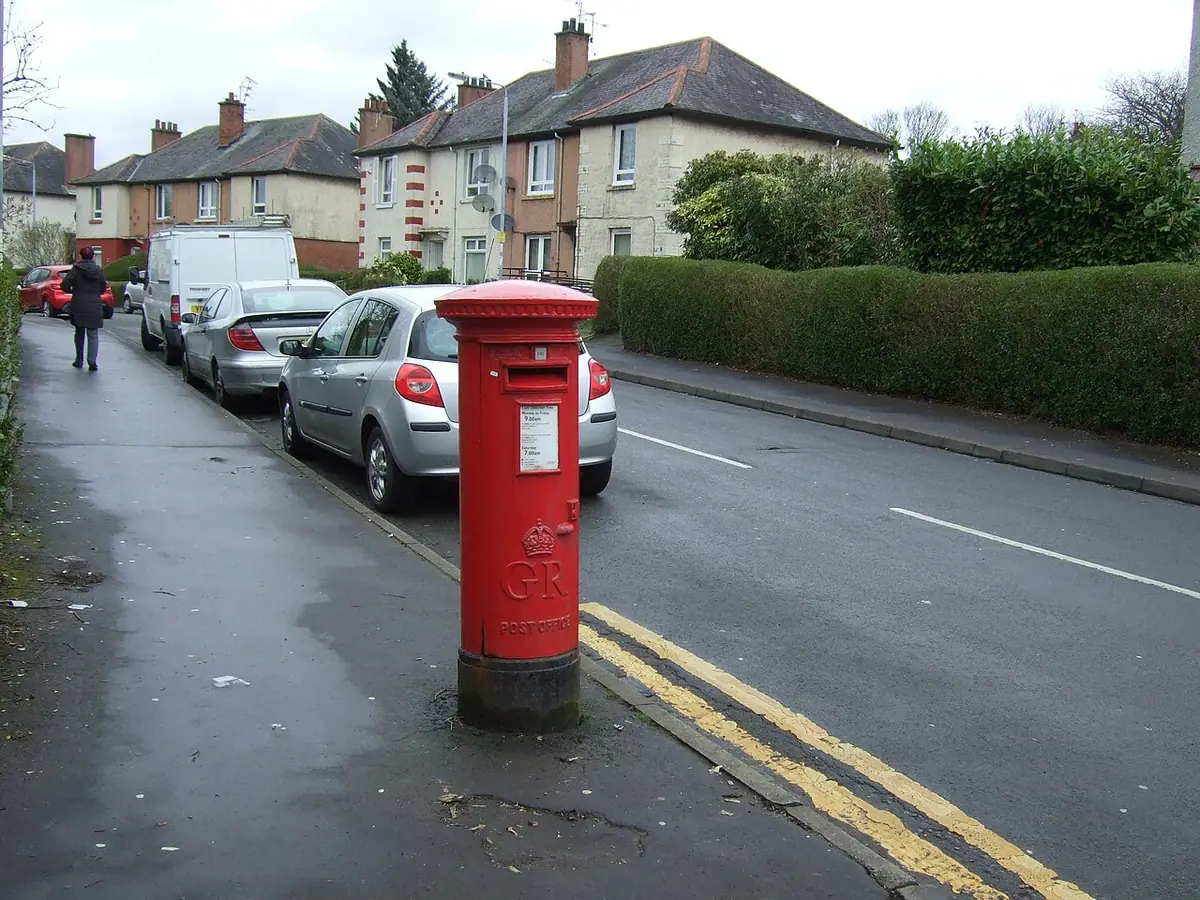
Quiet residential streets like this sit just off Glasgow's main roads — Photo: JThomas · CC BY-SA 2.0 · Wikimedia Commons
Your decision to invest in property in Glasgow should now rest on a clear-eyed reading of what you can genuinely afford and of how long you intend to hold. Everything gathered in this guide shows that success here owes nothing to luck: it comes from methodical preparation and an intimate knowledge of the Scottish rules. Once you have the Home Report, the shared building charges and the closing-date offer system straight, you have what you need to negotiate without buckling under pressure from sellers or intermediaries.
It is now up to you to confirm your financing with a bank or a specialist broker before you start viewing. Take the time to walk Glasgow's different neighbourhoods, test the journey times at peak hours and get a feel for the areas that appeal to you. Good properties are scarce in sought-after areas like the West End and the Southside, so you do need to move quickly, but that apparent urgency must never short-circuit a rigorous look at the technical and legal side of the home you want.
Instructing a capable local solicitor at the very start of the process will be your best protection against misjudgements and hidden defects. That legal professional will secure every stage of the transaction, from checking the titles through to the final registration of your purchase in the Scottish land register. Approach it with method, discipline and judgement, and you will turn your Glasgow purchase into a sound and untroubled investment for the decades ahead.
Related questions
Which neighbourhoods are most sought after for buying an apartment in Glasgow?
The West End around Byres Road, and the Southside, particularly around Strathbungo and Shawlands, draw the strongest demand, thanks to their cultural energy, the quality of their green spaces and the performance of the local schools.
How does the Home Report work when you buy a property in Scotland?
The Home Report is a compulsory pack supplied by the seller. It brings together an energy assessment, a survey of the building's technical condition carried out by a chartered surveyor, and an official estimate of the property's market value.
What is the Land and Buildings Transaction Tax in Scotland?
It is the tax collected by the Scottish tax authority on property transactions, and it replaces the stamp duty that applies in the rest of the United Kingdom. The amount is worked out in progressive bands based on the total purchase price.
What legal fees should you expect on a purchase in Glasgow?
In Scotland, transactions do not go through a civil-law notary but through a solicitor. Legal fees for drafting the missives and seeing the sale through generally run between 1,500 GBP and 3,000 GBP, depending on how complex the file is.
What is a closing date in the Scottish property market?
A closing date is the process by which the seller sets a deadline for receiving firm, sealed offers from every interested buyer. Each buyer puts forward their best proposal without knowing what the competing offers are.
How are common charges handled in shared buildings in Glasgow?
The common parts of a shared building, whether roofs or stairwells, are managed either by a professional manager known as a factor, or directly and collectively by all the resident owners in the building.
What does it mean to buy a listed building in Glasgow?
Buying a listed historic building means respecting strict architectural rules for any renovation work. Any change inside or out requires specific consent from the council before work can begin.
What impact does council tax have on a Glasgow resident's annual budget?
Council tax is a compulsory local tax worked out from the assessed value of the home and split into bands A to H. It funds all the local public services, from waste collection to the upkeep of infrastructure.
Can you buy a property in Glasgow without living in the United Kingdom?
Buying property is open to non-residents, but it means instructing a local solicitor to handle every legal formality and satisfying the identity checks required by anti-money-laundering legislation.
What types of property dominate the market in central Glasgow?
The city centre and the historic areas next to it consist mainly of apartments in Victorian and Edwardian buildings of red and blond sandstone, offering generous proportions but calling for particular attention to maintenance.
Property review of ting
No ting properties in Glasgow yet
Be the first — share it on ting and it shows up right here.