Buying a home in Scotland's largest city is an exciting move that rewards a clear understanding of how things are done locally. Between the architectural quirks of the historic districts and the precision of Scots property law, every decision deserves to be weighed methodically. This guide walks you through the process step by step so you can protect your investment and settle in with confidence.
Get the app
What nobody tells you.
Real prices, hidden costs and the traps to check before you commit.
Why buying a house in Glasgow means looking past the stonework
Scroll
Why buying a house in Glasgow means looking past the stonework
Buying a home in Scotland's largest city is an exciting move that rewards a clear understanding of how things are done locally. Between the architectural quirks of the historic districts and the precision of Scots property law, every decision deserves to be weighed methodically. This guide walks you through the process step by step so you can protect your investment and settle in with confidence.
Written by the ting.ad editorial team ·
Chalmers Gate, Glasgow in Street View: drag to look around.
Understanding these architectural tensions lets you judge more clearly how well the local way of living actually suits you.
Buying a home in Scotland's largest city puts you face to face with an exceptional built heritage, shaped by dressed stone and industrial history. Yet behind the pull of those Victorian frontages sit technical and structural demands you cannot wave away. Buyers often chase the period character without measuring the heat loss and the particular upkeep that this kind of older construction requires. It is a constant trade-off between the timeless charm of the residential districts and the practical reality of renovating under a demanding maritime climate.
The raw charm of blond and red sandstone Victorian frontagesvsThe frequent need to renovate the insulation and the roof
Older building fabric needs targeted investment to reach modern comfort without destroying the original architectural character.
The central position of the historic districtsvsRestricted parking and the constraints of protected areas
Living near the busy routes means giving up the immediate convenience of a car in favour of walking or leaning on public transport.
The prospect of long-term capital growthvsThe complexity of getting permission for any alteration
Planning rules strictly protect the consistency of the streetscape, which limits how freely you can change a home's exterior.
A lively and competitive housing marketvsThe need to move fast when offers are formalised through sealed bidding
The local buying system demands immediate financial readiness, so any hesitation costs you when the right property comes up.
Does this place really match your way of living and your day-to-day expectations?
Moving from your former habits into this new setting means measuring the cultural and practical contrasts precisely.
Every buyer arrives with different priorities, whether that is an intense cultural life, a green family haven or a functional base in the city. Glasgow's urban layout forces a choice between the buzz of the big thoroughfares and the residential calm of the outer rings. Looking honestly at how you actually spend your days helps you avoid the mistake of targeting an area purely for its apparent prestige, at the expense of your everyday comfort.
Central and urban option
You want immediate access to the galleries, the theatres and the well-known restaurants without depending on a car. Houses are scarcer here than flats, but a few pockets still hold architectural gems. Your days will be set to the rhythm of the city, with the benefit of excellent connections but the inevitable compromises on noise and on the absence of a large private garden. This is the choice of full cultural immersion at the heart of Scotland's busiest city.
Residential and family option
You will naturally look to the western districts or the slightly quieter outer rings with their large parks. Houses there offer generous floor areas, often with a useful outdoor space for children. Your routine will be built around well-regarded schools, Sunday walks and settled neighbours. The trade-off is a slightly longer journey into the business district at peak times.
Investment and renovation option
You are targeting the areas in transition where the price per m2 still leaves real room for uplift. Your plan involves running a modernisation programme to attract demanding working tenants. That choice takes patience and a good working knowledge of local trades to keep costs under control. In exchange, you build a solid asset in a university city that keeps reinventing its economy.
Living here when you have moved from abroad: what genuinely changes
A striking sandstone building with matching gothic-style gables in Glasgow — Photo: Michal Klajban · CC BY-SA 4.0 · Wikimedia Commons
Once you have absorbed these reference points, choosing the district becomes the decisive step in your purchase.
Moving to another country to buy a home means letting go of legal and cultural reflexes that run deep. Ownership, the relationship with neighbours and the way local public services are organised all follow their own rules here, and you need to pick them up quickly. Anticipating these gaps saves you frustration and makes it far easier to settle into the local community, whether the subject is paperwork or everyday good manners.
From abroad
A notary-centred system with long, tightly supervised deeds
Glasgow
Scottish solicitors who handle both the negotiation and the transfer of ownership
Transactions run to a different rhythm in which the solicitor's discipline comes first, and your offer becomes legally binding far earlier in the process.
From abroad
The weight traditionally given to regulated insulation standards and standardised condition reports
Glasgow
The local valuation and survey pack (the Home Report), prepared by an independent third party before the property goes on the market
You have a full report on the structure and the energy performance from the outset, which makes it much easier to price the work that has to be done.
From abroad
A formal relationship with neighbours and with the management of shared buildings
Glasgow
A direct and warm civic culture that is nonetheless strict about the shared rules of common ownership
Taking part in the collective upkeep of common parts and shared roofs (tenement management) calls for active, practical involvement.
From abroad
Centralised access to health services and to administrative formalities
Glasgow
Prompt registration with the local NHS practice and getting your local references set up for council tax
Plan these steps from the day you get the keys so that running your household is not held up.
Which district should you settle in and invest in for the long run?
With the area settled, it is time to look squarely at the financial reality of prices in this market.
The city is a patchwork of micro-districts with strong identities, running from student energy to the quiet of well-heeled residential streets. Each area strikes its own balance between accessibility, architectural quality and the vitality of local shops. Knowing what daily life is really like in these areas spares you a choice that does not fit your household or your working life.
West End
A bohemian, lively atmosphere set by university life, independent cafes and the wide green spaces opening onto the Kelvin.
Suits
Families who care about cultural life, academics, and anyone who loves well-preserved Victorian architecture.
Trade-off
Some of the highest prices per m2 in the city and very strong competition for every property that comes up.
Southside
A lively village feel around big parks such as Queen's Park, mixing local food shops with a strong sense of community.
Suits
Buyers after an excellent space-for-money ratio and a family setting without giving up proximity to the centre.
Trade-off
Gentrification has moved at uneven speeds in some areas, so you need to read the map street by street.
East End
A district in the middle of a creative revival, mixing repurposed industrial sites, artist spaces and modern urban projects.
Suits
Bolder buyers looking for high growth potential and unusual volumes to renovate.
Trade-off
Still marked differences between micro-districts in terms of services and immediate commercial life.
What does a property really cost across the different parts of the city?
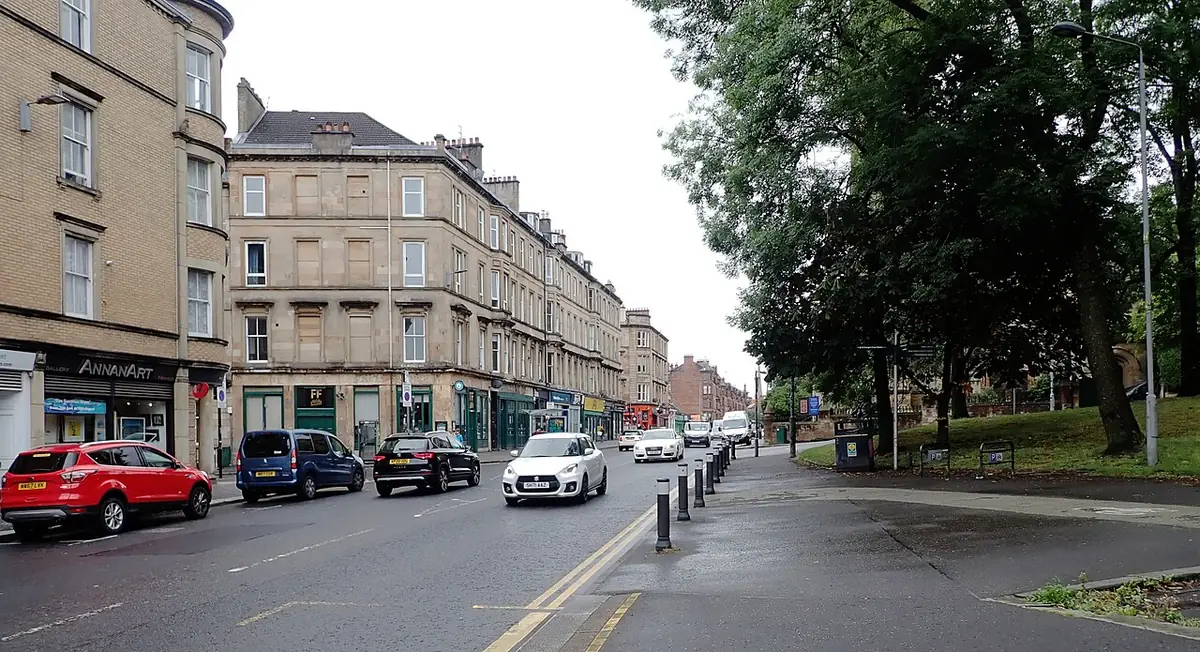
Streets like this, tenements over shops, are everyday Glasgow — Photo: habiloid · CC BY-SA 2.0 · Wikimedia Commons
Beyond the raw figures, the legal nature and the actual structure of what you are buying deserve your full attention.
Looking at the market data reveals wide differences that you need to work through methodically before making an offer. Advertised prices do not always reflect the final transaction value, which is shaped by the competitive offers system. A clear view of the price ranges by property type lets you build a realistic financing plan and negotiate from a position of strength.
glasgowFor saleHouseestimate
Median price / m²£1,792Half the apartments sell below this
Median price£231kthe average is 14% higher — a few very large properties pull it up
Most common2 bedrooms60 % of listings
Average size123 m²
By number of bedrooms
Bedrooms
Share of market
Avg price
Price / m²
Avg size
2most common
60 %
£219k
£1,924
114 m²
3
33 %
£279k
£1,773 −6 %
158 m²
4
7 %
£342k
£1,697best value / m²
201 m²
Each row is an average, compared against the area average of £1,886 / m². These are indicative estimates of a typical local market, not a measured sample of live listings. Check current listings before relying on them.
What you actually own: the legal structure of the property
With that legal footing secured, what remains is mastering the strict timetable of a local transaction.
Property ownership in Scotland rests on specific legal principles that differ noticeably from practice elsewhere. Understanding exactly what the deeds give you protects your investment against nasty surprises over common parts or rights of access. It is the careful reading of those clauses that keeps your ownership untroubled over the long term.
Outright ownership (heritable property)
You own the building and the land exclusively, with no heavy perpetual ground burden, which gives you complete freedom to decide on maintenance and improvement work. That status applies fully to most detached and terraced houses with their own direct access to the public road.
What it changesYou alone decide the pace of renovation and control your whole maintenance budget without having to talk round reluctant co-owners.
Ownership with shared costs or servitudes
Some residential developments and older houses involve sharing access, driveways or green space with neighbours, governed by strict title deeds and mutual obligations to contribute financially. Local law sets out precise rules for handling urgent repairs to a roof or a mutual wall between neighbours.
What it changesBefore you commit, you must check the history of the charges and the state of any reserve fund held by the factor or the other owners in the development.
The one rule to understand before you part with a deposit or make an offer
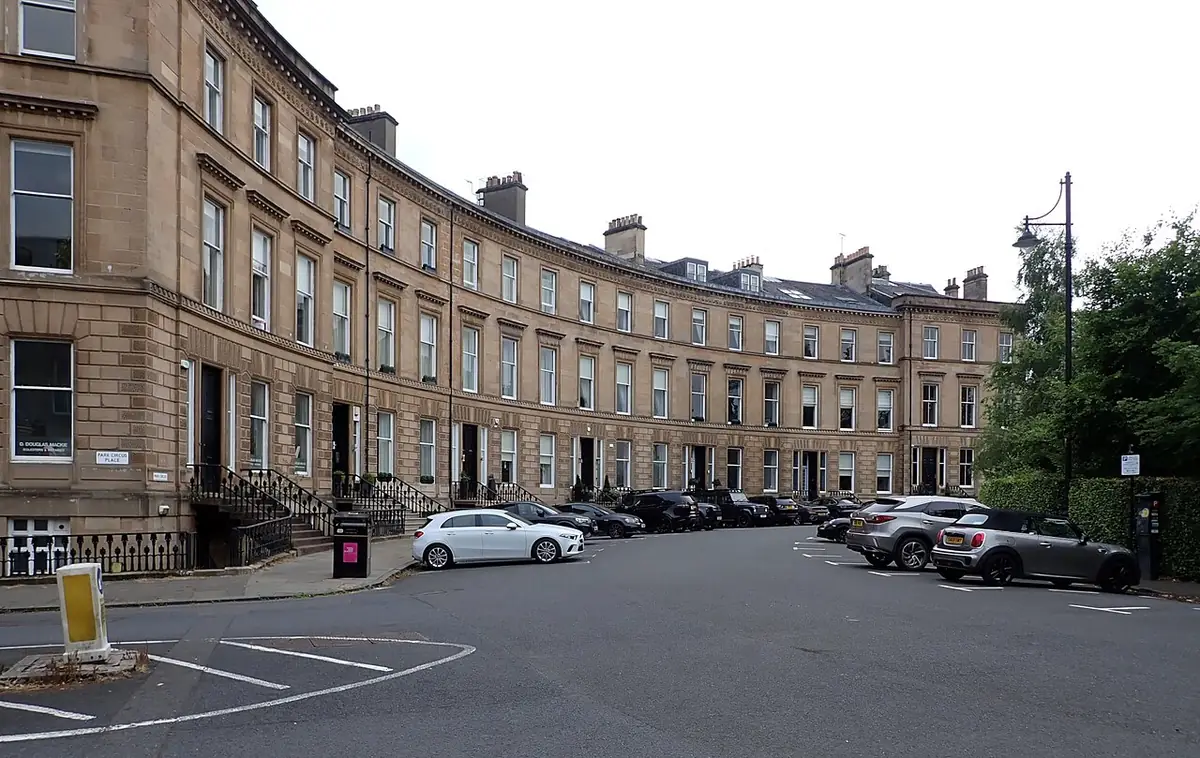
Terraces like this crescent are some of Glasgow's most sought-after streets — Photo: habiloid · CC BY-SA 2.0 · Wikimedia Commons
Once that crucial step is behind you, the transaction itself unfolds on a precise timetable.
The Scottish housing market runs on a sealed-bid mechanism that often catches overseas buyers off guard. When a property is marketed at 'Offers Over', that is not a floor price to be negotiated down but an invitation to bid above it against other candidates. Getting this fundamental rule straight prevents disappointment and makes sure your financial position is properly calibrated against the competition.
The property goes on the market with its official valuation and survey pack (the Home Report)
Your solicitor reads the Home Report closely to identify the work required and to judge the property's real market value.
A formal note of interest is lodged through your legal adviser, which keeps you informed of any fast-moving developments.
A firm and final offer is submitted by a closing date set by the seller, usually above the advertised figure.
The offers are opened and the seller picks one, creating a near-final legal agreement very early in the process.
Conclusion of missives, which makes the agreement irrevocable ahead of the date of entry.
How a property transaction unfolds, step by step
Master these steps and your purchase runs smoothly, firmly grounded in how things actually work in Glasgow.
Buying a property in Scotland follows a disciplined path, run by legal professionals who make each phase secure. Knowing the exact order of events lets you plan around the administrative timescales and organise your move without stress. Every party plays a defined role in turning an intention to buy into an unassailable title.
You and your agentViewings and a focused shortlistYou view the properties you have picked out and rule out any whose Home Report reveals major structural defects you are not prepared to take on.
Your solicitorHome Report analysis and formal stepsYour adviser reviews the legal position, checks the title deeds and lodges a formal note of interest with the seller.
You and your bankFinancing confirmed and a firm offerYou secure the final mortgage offer and instruct your solicitor to submit a properly drafted formal offer.
Both sides' solicitorsNegotiating the terms (missives)The legal advisers exchange formal letters (missives) to settle all the conditions and the terms of sale.
Your solicitorClosing the agreement (conclusion of missives)The agreement becomes legally binding on both sides, committing buyer and seller and setting the penalty for pulling out.
All partiesDate of entry (settlement day)Your solicitor transfers the funds, the keys are handed over and you officially become the owner of your house.
House or flat in Glasgow: weighing Victorian character against shared management
Once you have settled on the type of property, the question of the overall budget arrives immediately.
Choosing between a house and a flat in Glasgow means weighing up two ways of living in the city, both deeply rooted in its architectural history. On one side, the traditional Scottish tenements offer generous proportions, big windows and spectacular ceiling heights, often in lively districts such as Finnieston or Dennistoun. These properties do, however, come with shared ownership, usually run by a residents' association or a professional factor, where roof and stair maintenance has to be agreed among several owners. That arrangement calls for diplomacy and a shared financial reserve to face major repairs to the red or blond sandstone.
Conversely, terraced Victorian houses, suburban cottages and more modern builds out towards Cathcart or Newlands give you complete control over the fabric and direct access to a private garden. For families, or for owners who value the independence of their own plot, this removes the friction of joint decision-making. In exchange, exterior upkeep, insulating a whole building and the roof rest entirely on your own finances. Energy bills can also run higher in the large volumes of an unmodernised older house, especially against the hard weather of the west of Scotland.
Financially, the cost per m2 varies noticeably by property type and by exact location within Glasgow. West End flats carry high valuations because of constant demand from young professionals and from investors drawn by the universities. Houses, rarer in the immediate vicinity of the city centre, are easier to find as you move out towards the residential rings served by the suburban rail lines. Your final choice will therefore come down to your tolerance for shared costs on one hand, and your willingness to maintain an older structure single-handed on the other.
What total budget should you plan for buying and living in Glasgow?
Beyond the raw figures, it is the shape of a typical week that shows what local life is really like.
Buying a house or a flat in Glasgow does not stop at the price advertised on the property portals. You have to factor in the local charge known as Council Tax, whose band depends on the property's historic valuation, along with the purchase costs specific to Scotland's Land and Buildings Transaction Tax. Annual running costs also take in heating, which Scottish winters make necessary, and the building and contents insurance that is either required or strongly advised to protect the fabric against damp. A realistic financial picture protects your investment from surprises in the first years after you move in.
Upfront and recurring costs for a home in Glasgow
Budget item
Estimated range
Frequency / terms
Buying a standard property
GBP 180,000 - GBP 350,000
Initial purchase price
LBTT (purchase tax)
GBP 0 - GBP 15,000
One-off payment, settled through your solicitor
Council Tax (bands C to E)
GBP 1,400 - GBP 2,300
Paid annually
Buildings and contents insurance
GBP 300 - GBP 600
Annual premium
Amounts vary with the local tax band and the property's actual floor area.
Average budget for everyday running costs
Type of cost
Average monthly amount
What drives it
Electricity and gas
GBP 150 - GBP 250
Insulation and floor area
Water and waste water
GBP 40 - GBP 60
Scottish Water billing
Broadband
GBP 30 - GBP 50
Type of fibre connection
These estimates reflect the rates seen in the Scottish energy market for a standard household.
Health, schools, transport: what does an ordinary Tuesday in Glasgow look like?
Detached villas like this show the grander end of Glasgow's housing stock — Photo: Michal Klajban · CC BY-SA 4.0 · Wikimedia Commons
Daily life may look straightforward, but some hidden aspects of the Scottish housing market deserve your full attention.
Picturing a typical day in Glasgow shows you how your future address will affect your journeys and your family errands. Between the commute into the business district, access to state or faith schools, and how close you are to NHS health centres, every district sets its own rhythm. The public transport network, combining the Subway, buses and suburban trains, shapes the morning run. Anticipating these daily flows spares you the grind of queueing on the M8.
07:30Home and departureGetting ready and checking traffic conditions on the main routes across Glasgow.
08:15The local school runDropping off at the catchment primary school or at the secondary school for the area.
08:45The commuteTaking public transport, or the train from your local station into Glasgow Central or Queen Street.
12:30Neighbourhood life and errandsShopping locally with independent traders and a visit to the nearby NHS practice.
17:30Back homeThe return journey at peak time and sorting out the children's after-school activities in the parks.
20:00Winding down among neighboursA quiet evening in the district, with noise levels depending on how far you are from the main roads.
What property listings will never tell you about Glasgow
These technical subtleties lead straight to the valuation mistakes buyers make most often.
Marketing photographs play up the artificial light and the careful styling, but they hide the structural flaws that come with Glasgow's older building stock. Persistent damp, the true condition of old slate roofs and the regulatory constraints attached to category B and C listed buildings all demand constant vigilance. Ignoring these points at the first viewing exposes a buyer to heavy unplanned spending in the very first year.
The condition of tenement roofs
In a shared older building, renewing the roof is a pooled cost that can run to several thousand pounds per owner if no reserve fund was ever built up.
Insulation and damp
Glasgow's maritime climate combined with solid stone walls that have no external insulation encourages internal condensation and mould if ventilation is not sorted out.
The strict rules in conservation areas
If your house or flat sits in a protected area, replacing sash windows with modern double glazing or altering the frontage requires complex and costly planning consents.
Residents' parking restrictions
Getting a parking permit for your car in some central districts is subject to strict quotas and to annual charges that keep rising.
The buying mistakes you only discover after six months in Glasgow
Despite these traps, some buyers should think again about moving to this city at all.
Looked likeAn offer at the market figure after falling for a property on a guided viewing under a rare burst of sunshine.
Turned outA punishing heating bill and constant draughts through January, thanks to worn-out window frames.
Would have caught itAlways insisting on the full energy report (EPC), prepared by an independent surveyor, before you submit a formal offer.
Looked likeA busy central district with plenty of pubs and fashionable restaurants within walking distance.
Turned outUnbearable night-time noise on Thursday, Friday and Saturday evenings, making sleep difficult without heavy acoustic glazing.
Would have caught itVisiting the district you have in mind at several key moments of the week, in particular a Friday after midnight, to gauge the real noise level.
Looked likeA small self-managed building with no visible professional factoring fees, keeping monthly costs down.
Turned outComplete deadlock between the owners over funding urgent roof waterproofing after the winter storms.
Would have caught itReading the minutes of the last three owners' meetings to spot disputes between neighbours or work that has been put off.
Looked likeA suburban house that seemed quiet and set apart, with a direct road into the centre.
Turned outDaily gridlock on those roads at office hours, turning a theoretical twenty-minute trip into an hour of patience.
Would have caught itDriving the commute at the exact peak times on a weekday before you sign anything binding.
Who really should not buy a property in Glasgow?
Now is the moment to take stock and decide whether buying in Glasgow fits the life you want.
Buying property in Glasgow comes with structural and cultural particularities that do not suit every buyer, whether from overseas or from within the UK. If you are after an immediate rental yield with no active management, or if the administrative complexity of Scots property law puts you off, other British or European markets will give you an easier ride. Knowing your own limits as an investor keeps you out of a damaging commitment.
The investor looking for passive returns with no management
→To stay out of Glasgow and favour index funds or hands-off rental markets instead.
Running a tenement's shared ownership and meeting the energy standards required of Scottish homes both demand personal involvement and constant technical oversight.
The buyer who cannot cope with a maritime climate and dark winters
→To shift the search to more southerly parts of Europe or to the south of England.
Glasgow's rain and low winter light weigh heavily on residents who arrive unprepared for conditions in the west of Scotland.
The household on a strictly fixed budget with no contingency savings
→To keep renting while building a more robust financial cushion.
The age of Glasgow's housing stock means unplanned repair costs turn up almost without fail in the first year after moving in.
So, are you ready to buy a home in Glasgow?
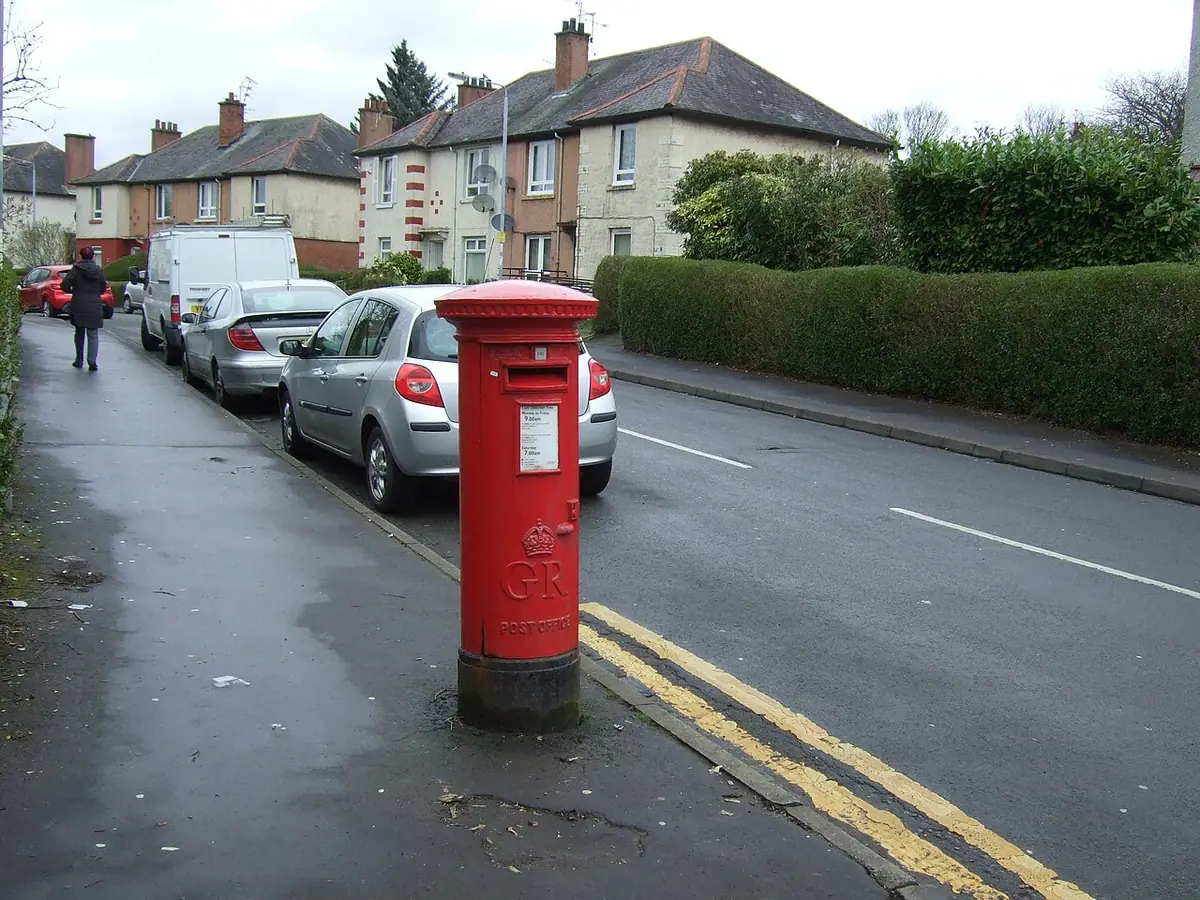
Quiet residential streets like this sit just off Glasgow's main roads — Photo: JThomas · CC BY-SA 2.0 · Wikimedia Commons
Buying property in Glasgow rewards careful preparation, financial clear-sightedness and an intimate grasp of how the local market works. Unlike the overheated markets of southern England, Glasgow still offers real scope for growth, provided you do not give in to a superficial infatuation. Whether you go for the stone character of a Victorian flat in the West End or the calm of a suburban house, each decision shapes your comfort for years to come.
Take the time to work out what savings you will still hold after the purchase, take on the requirements of Scots property law with the help of an independent solicitor, and visit your target districts several times in all weathers. If you accept that owning an older property means regular upkeep and an active part in the life of your street, Glasgow will give you a setting that is warm, culturally vibrant and genuinely easy to love.
Your purchase should sit within a long-term view, in step with your working and family life. Keep a cool head in the bidding that follows the Home Report valuation, surround yourself with rigorous local professionals, and your move to Scotland will turn into a lasting success.
Related questions
How does the Offers Over system work in Glasgow?
In Scotland, homes are usually marketed at an 'Offers Over' figure that reflects the minimum valuation set by the surveyor. Buyers submit sealed offers through their solicitor, often well above that base figure in a competitive market. Reading the Home Report carefully to work out the property's real value before you bid is therefore essential.
What is the mandatory Home Report in a Scottish property purchase?
The Home Report is a complete pack supplied by the seller. It contains a market valuation of the property, an energy performance report and a detailed survey of the structural condition carried out by a chartered surveyor. The document protects the buyer by revealing major defects before any formal offer is made.
How much purchase tax (LBTT) does a first-time buyer pay in Glasgow?
Land and Buildings Transaction Tax (LBTT) is the purchase tax charged in Scotland, taking the place of the transfer duties buyers know from other countries. Specific reliefs exist for first-time buyers, and they often take the transaction out of charge altogether for properties below the applicable threshold, generally set at around GBP 175,000.
Which districts are most sought after for buying a house in Glasgow?
The West End (around Hillhead and Kelvinbridge) and the South Side (particularly Shawlands and Strathbungo) draw the strongest demand thanks to their cultural life, their parks and the quality of their schools. Prices there are consequently well above those in the east or the north of the city.
Is it hard for a non-resident to get a mortgage from a Scottish bank?
Getting a mortgage depends on your overall financial position, on income you can evidence and on your deposit, which generally has to reach at least ten to twenty percent of the purchase price. British banks apply strict risk assessment criteria to borrowers whose income is not denominated in pounds sterling.
How are common charges handled in older tenement buildings?
The cost of maintaining a tenement's common parts and roof is split between the owners according to shares set out in the title deeds. Where no professional factor is appointed, the arrangement rests on a collective agreement between neighbours, which calls for easy communication and money set aside in advance.
How much does Council Tax add to an owner's annual budget in Glasgow?
Council Tax is a local charge calculated from the property's assessed 1991 rental value and split into bands from A to H. For a standard family home in Glasgow the annual figure generally falls between GBP 1,400 and GBP 2,300, payable over ten months of the year.
Do older Glasgow houses need specific insulation work?
Yes. Many Victorian and Edwardian houses suffer from inadequate original insulation. Fitting double glazing within the planning rules, insulating the loft and managing ventilation are all essential to cut energy bills and avoid damp problems.
How long does it usually take between an accepted offer and the keys in Glasgow?
Once the seller accepts your offer, the legal process (conveyancing) run by the solicitors generally takes between six and eight weeks. That period covers the legal checks on the title deeds and the final sign-off on your financing with the lender.
Should you budget for emergency repairs after buying an older property?
It is strongly advised to keep a safety cushion worth at least two to three percent of the property's value to cover the unforeseen repairs that come with Glasgow's older buildings, such as slates shifted by the wind or plumbing problems.
Property review of ting
No ting properties in Glasgow yet
Be the first — share it on ting and it shows up right here.