Buying property in San Antonio means looking clearly at how the Texas market actually works, from property taxes to the rules that govern shared ownership. This guide sets out the mechanisms that matter so you can plan your move with confidence.
Get the app
What nobody tells you.
Real prices, hidden costs and the traps to check before you commit.
What you actually get when you buy an apartment in San Antonio
Scroll
What you actually get when you buy an apartment in San Antonio
Buying property in San Antonio means looking clearly at how the Texas market actually works, from property taxes to the rules that govern shared ownership. This guide sets out the mechanisms that matter so you can plan your move with confidence.
Written by the ting.ad editorial team ·
West Commerce Street, San Antonio in Street View: drag to look around.
Beyond raw floor area, it is your day-to-day way of living that will decide whether this purchase makes sense.
Investing in an apartment in San Antonio is not simply a matter of acquiring living space in south Texas. The local property market follows contrasting urban dynamics in which the promise of an affordable cost of living runs up against very particular realities of taxation and shared-ownership management. Understanding what your capital genuinely buys means looking past the listing photographs and analysing the costs the Texas climate brings with it.
Generous floor area by the standards of large European cities.vsParticularly heavy energy bills through the long summer season.
Interior space is often paid for in intensive air conditioning use, which is what makes a home liveable from May to September. The saving on price per square metre thins out against those recurring energy costs.
Developments with very complete shared amenities (pool, gym, on-site security).vsMonthly HOA fees that rise steadily and weigh heavily on the budget.
Built-in services improve daily life but create a financial dependence on the health of the association's books. Poor collective management quickly translates into special assessments.
A location in lively neighbourhoods undergoing genuine urban renewal.vsDirect exposure to the nuisance of major road corridors and to heavily built-over ground.
San Antonio's layout favours the car, which means being close to the things you want to reach almost always comes with exposure to traffic and the noise that follows it.
Does this place really suit the way you live day to day?
For a buyer arriving from abroad, the cultural and regulatory gap with the market you know is another fundamental factor to take on board.
Life in Texas is shaped deeply by the scale of the territory and the sheer dominance of the car. Choosing an apartment in San Antonio means accepting very specific compromises of space and sociability, and which ones depend on whether you arrive alone, as a couple, or with a clearly defined professional plan.
The central city profile
Areas close to the River Walk or Southtown let you go out on foot and enjoy constant cultural activity. In exchange, you have to live with permanent tourist bustle, traffic noise, and often smaller floor areas for an equivalent purchase price. Parking is tighter too, which calls for careful daily organisation.
The suburban residential profile
Settling into a development in the northern or north-western neighbourhoods gives you a calmer setting, better-kept green space and generous parking. This option, however, leaves you completely dependent on your vehicle for every errand, whether that is the grocery run or dinner out. Street-level neighbourhood life barely exists, with most interaction happening inside private spaces or shopping centres.
The considered investor profile
Buying an apartment in a managed development means accepting the strict rules imposed by the homeowners association (HOA). You have to get sign-off on every exterior change and comply with tightly framed rules on short-term and long-term letting. Managing it takes emotional distance and a solid grasp of Texas property law if you want to avoid cash-flow dead ends.
Living here when you come from abroad: what changes radically
St. Mary's University, a Gothic Revival landmark in San Antonio — Photo: Larry D. Moore · CC BY 4.0 · Wikimedia Commons
Once those rules are understood, the choice of area becomes the cornerstone of your purchase.
Many property systems elsewhere rest on ideas of consumer protection, a centralised land register and a state-supervised officer who guarantees the deed, none of which has an exact equivalent in Texas. Transposing those assumptions to San Antonio leads inevitably to unpleasant surprises if you do not take the measure of local practice around transactions and ownership.
From abroad
A centralised, state-supervised deed with near-absolute legal certainty built in.
San Antonio
Reliance on title companies and on title insurance.
The buyer pays for a specific policy guaranteeing there are no hidden defects in the ownership history of the land, a step that has no counterpart in many other systems.
From abroad
Shared-ownership law tightly framed by statute, with mandatory annual general meetings of all owners.
San Antonio
The wide powers of homeowners associations (HOAs) and their draconian internal rules.
Collective management decisions are taken by a small board with near-policing powers over the appearance of your property, down to the colour of your blinds or where you park.
From abroad
Moderate property taxes, smoothed out within a broader national tax system.
San Antonio
Very high local property taxes, reassessed every year.
The recurring cost of ownership never stops when the mortgage is paid off; property tax is a substantial monthly line you absolutely have to budget for.
From abroad
Statutory cooling-off periods and standardised mortgage contingency clauses.
San Antonio
A purchase contract (the earnest money contract) with very strict option clauses negotiated case by case.
The deposit is paid as soon as the accepted offer is signed and can be kept by the seller if you exit the contract outside the negotiated option window.
Which San Antonio neighbourhood should you target for your priorities?
This map of the neighbourhoods translates directly into price realities that deserve a clear-eyed look.
San Antonio spreads across a vast territory with very distinct local identities. Each area offers a different balance between affordability, cultural energy and travel constraints. There is no ideal neighbourhood in the abstract, only a precise fit between the way you live and the character of the place.
Downtown and the River Walk
Constant urban buzz set by the flow of visitors and public-sector workers.
Suits
People who want to do everything on foot and want cultural and dining activity on the doorstep.
Trade-off
Higher prices per square metre, awkward parking and often reduced living space.
Southtown / King William
A creative, artistic village feel, lined with historic buildings and independent cafes.
Suits
Lovers of period architecture, art galleries and neighbourhood life on a human scale.
Trade-off
Very little apartment stock and prices trending upward on the back of strong demand.
The Pearl / Tobin Hill
A modern, upmarket urban hub built around food and restored public space.
Suits
Buyers after contemporary standing, modern finishes and a young, active set of neighbours.
Trade-off
A price level among the highest in the city and particularly heavy association dues.
Medical Center / Northwest
A functional, dense area turned entirely towards healthcare activity and the large university campuses.
Suits
Investors targeting strong demand from medical tenants, and working people who want to be near the main road corridors.
Trade-off
A hard, built-over streetscape dominated by road infrastructure and a real shortage of historic charm.
What does an apartment in San Antonio really cost?
Beyond the purely financial side, the structure of ownership itself raises fundamental legal questions about what you actually own.
Working out what a San Antonio property costs cannot stop at the headline price on the listing portals. Between local property taxes, home insurance exposed to weather risk and association dues, the total cost of ownership varies considerably from one area to another.
san-antonioFor saleApartmentestimate
Median price / m²US$1,852Half the apartments sell below this
Median priceUS$175kthe average is 14% higher — a few very large properties pull it up
Most common2 bedrooms42 % of listings
Average size90 m²
By number of bedrooms
Bedrooms
Share of market
Avg price
Price / m²
Avg size
1
40 %
US$146k
US$2,242 +15 %
65 m²
2most common
42 %
US$185k
US$1,950
95 m²
3
16 %
US$232k
US$1,852best value / m²
125 m²
4
2 %
US$287k
US$1,794 −8 %
160 m²
Each row is an average, compared against the area average of US$1,950 / m². These are indicative estimates of a typical local market, not a measured sample of live listings. Check current listings before relying on them.
What you can actually own: the legal structure of the property
That legal reality comes into its own the moment you put your offer in writing and hand over the first funds.
Telling the different forms of shared ownership apart is essential if you want to avoid nasty surprises to your assets. In the United States, the legal structure of your purchase determines not only your rights of use but also your liability for major work on the building.
The condominium regime
You own the interior of your apartment outright and an undivided share of the common areas and of the land the building stands on. The exterior envelope, the roof and the shared amenities are entirely the responsibility of the homeowners association (HOA), which levies compulsory monthly dues and can vote special budgets to cover major repairs.
What it changesYou can stop worrying about maintaining the structure, but you are subject to collective decisions and to the increases in dues the majority of owners vote through.
The townhome / PUD regime
In some townhome arrangements you buy both the structure of the building and the plot of land directly under and around your home. The neighbourhood association then mainly manages the shared green space, the internal roads and the communal leisure facilities, while you remain directly responsible for maintaining your own roof and exterior walls.
What it changesYou have far more autonomy over the upkeep of your property, but you carry the whole cost if something goes wrong outside or the exterior deteriorates.
The one rule to understand before you hand over a deposit
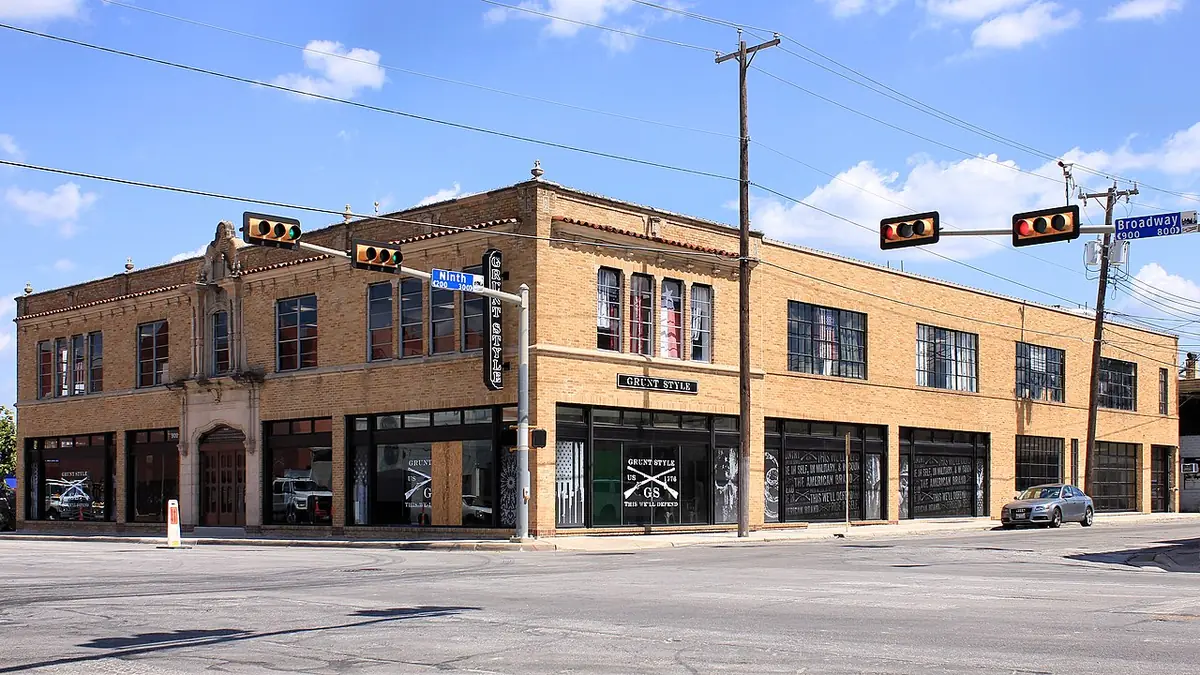
A century-old commercial building on a San Antonio corner — Photo: Larry D. Moore · CC BY 4.0 · Wikimedia Commons
Once that critical stage is behind you, the timetable speeds up through a precise sequence of parties.
Buying property in Texas is governed by standard-form contracts whose most critical mechanism is the option period. Never sign without having taken the exact measure of that initial financial commitment.
You sign a purchase contract and pay both an earnest money deposit and an option fee.
The earnest money is held in escrow by the title company as proof you are serious.
The option period (usually 7 to 10 days) begins immediately on signature.
You have an absolute right to terminate for any reason at all during that precise window.
If you decide to walk away after the deadline, you lose some or all of your deposit to the seller.
The transaction then moves on to the detailed technical inspection and to clearing the financing conditions.
How a property transaction unfolds, step by step
In short, buying well in San Antonio means making clear-eyed choices in the face of local particularities.
A Texas property transaction follows a strict timetable in which each party plays a well-defined technical role. Anticipating that sequence lets you avoid administrative hold-ups and secure your purchase in good time.
The buyerGetting pre-approved by a lenderNo serious offer can be made without a letter from an American financial institution or a specialist broker confirming how much you can borrow.
The real estate agentDrafting and signing the purchase contractThe standard Texas Association of Realtors contract is completed with your terms on price, financing deadlines and the option period.
The home inspectorCarrying out the building inspectionA detailed report sets out the condition of the plumbing, the electrics, the framing and above all the air conditioning, the critical point in the Texas climate.
The title companyTitle search and lien verificationThe title company makes sure the property is sold free of any hidden debt and prepares the title insurance required to complete the sale.
The buyer and the sellerSigning electronically or in person (closing)The remaining funds are wired to the title company's escrow account, the deed is recorded with the county and the keys are handed over.
Apartment or single-family house in San Antonio: which type of property suits your Texas lifestyle?
Choosing between an apartment in the heart of San Antonio and a single-family house in the suburban rings of Bexar County shapes both your daily life and your long-term budget. Buying an apartment, whether in a modern building in the historic King William district or along the River Walk, gives you dynamic city living, exterior maintenance handled entirely by the association, and immediate proximity to employment centres and the restaurants people are talking about. It is the natural option for working people without children, for investors chasing strong rental demand, or for buyers who value the time saved on yard work more than a larger floor plan.
Going the other way, a single-family house drops you into the spatial reality of Texas: more generous lots, planned subdivisions (with their HOAs) built around community pools, and complete architectural freedom. Neighbourhoods such as Alamo Heights, or the newer extensions north along Loop 1604, offer living space on an incomparable scale, an enclosed two-car garage and the private outdoor room that families and pet owners need. That independence comes with a heavier energy bill, though, particularly through the summer months when the air conditioning runs flat out, and with homeowners association dues that can be strict about how the outside of your property looks.
The financial question does not stop at the headline price per square metre, because running costs differ radically between the two. In an apartment, HOA fees cover insurance on the structure, security, and maintenance of the lifts and common areas, which simplifies monthly budgeting but represents a permanent, unrecoverable cost. With a single-family house you keep direct control of your maintenance spending but shoulder alone the unpredictability of roof, plumbing or air conditioning repairs, all crucial budget lines in the Texas climate.
How mobile you expect to be over the medium term should also weigh heavily on the decision. If you travel often, expect to move city for your career, or plan to let the property out after a few years, the urban apartment offers better liquidity and simpler letting management thanks to its central location. If you are settling down to start a family, want to put down roots in a well-regarded school district, and enjoy gardening or hosting a Sunday barbecue, the single-family house remains the cornerstone of the Texas dream.
What overall budget do you really need to live in San Antonio and own your home?
Becoming a homeowner in San Antonio means factoring in all the recurring costs that sit on top of your mortgage payment. The local market is marked by the absence of a state income tax in Texas, offset by some of the highest property taxes in the country. Working through those cost lines carefully is essential if you want to avoid a financial shock after closing at the title company.
Estimated purchase prices and property taxes by property type
Property type
Median price observed
Estimated annual property tax
Association or HOA fees (monthly)
Compact apartment (downtown / Pearl)
$220,000 to $320,000
2.2% to 2.8% of assessed value
$250 to $550
Standard single-family house (suburbs)
$300,000 to $450,000
2.3% to 2.9% of assessed value
$30 to $150
High-end property (Alamo Heights)
$600,000 to $950,000
2.4% to 3.0% of assessed value
$0 to $200
Property tax rates vary precisely by school district (independent school districts) and by the surrounding municipalities attached to Bexar County.
Energy costs and required insurance in south Texas
Cost line
Average monthly cost
Factors behind the variation
Impact on the overall budget
Electricity and air conditioning (HVAC)
$180 to $350
A sharp peak between June and September with the extreme heat.
Essential to keeping the home thermally comfortable.
Home insurance (homeowners insurance)
$150 to $280
Exposure to hail storms and to soil drought.
Required while a mortgage is outstanding.
Water, wastewater and waste collection
$70 to $120
Consumption tied to any lawn watering and to municipal rates.
Billed by the San Antonio Water System (SAWS).
Electricity costs can be optimised thanks to the deregulation of the Texas energy market, which lets you choose your supplier.
Health, schools and transport: what does an ordinary Tuesday in San Antonio actually look like?
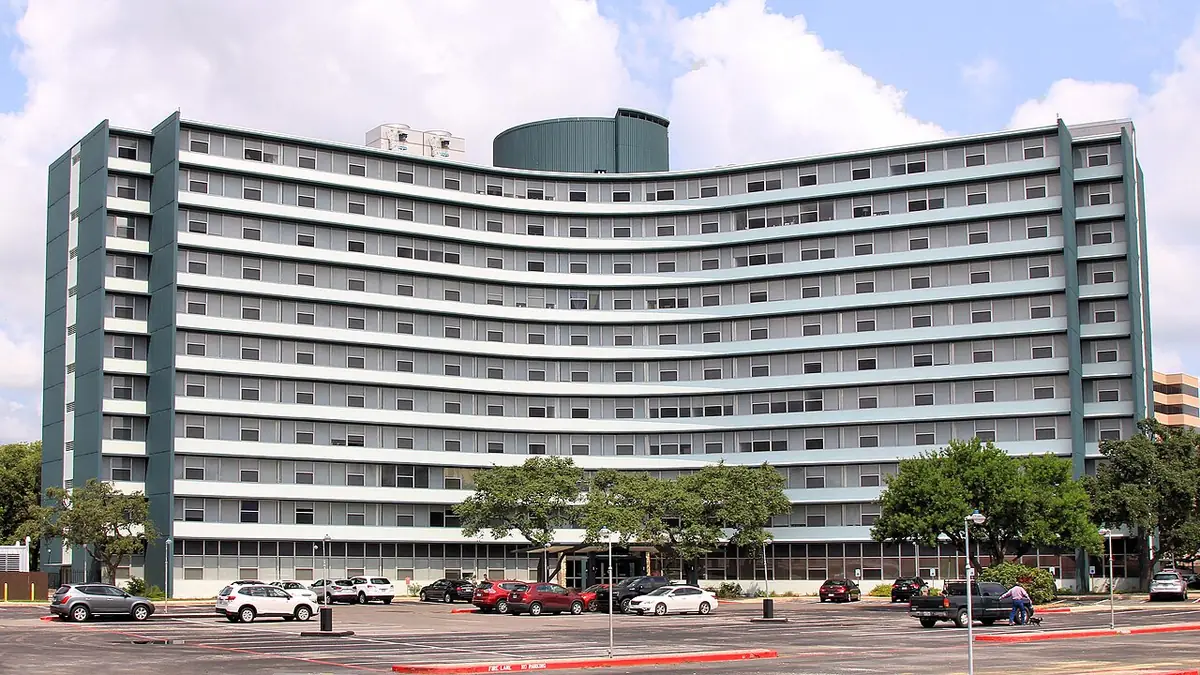
A mid-century apartment tower typical of San Antonio living — Photo: Larry D. Moore · CC BY 4.0 · Wikimedia Commons
Picturing a typical day in San Antonio helps you grasp the geographical reality of the seventh-largest city in the United States, defined by its spread and its reliance on the car. Between the morning run along the outer freeways, access to first-rate medical facilities and neighbourhood life, every stretch of the day reveals the trade-off between location and quality of life.
07:30Leaving home and the drive to workHeavy but moving traffic on the main corridors such as I-10 or Loop 410, which means allowing for the journey time out to the employment centres.
08:15Dropping the children at the neighbourhood schoolEnrolment within the North East Independent School District (NEISD), known for modern facilities and well-developed extracurricular programmes.
12:30Lunch break and local errandsA trip to a local H-E-B supermarket, a genuine Texas institution, for fresh produce and regional specialities.
16:00A medical appointment or a stop at the pharmacyClose proximity to the major health centres affiliated with Methodist Healthcare or the Baptist Health System, which means being seen quickly when you need to be.
18:00Outdoor time in a city parkA local signature: an active or restful late afternoon along the trails of Brackenridge Park or around the historic missions.
20:00Winding down at homeRunning the household, using the central air conditioning and getting ready for the next day in a quiet residential setting.
What the beautiful listing photographs leave out about San Antonio
Behind the sunlit postcard of San Antonio and the undeniable charm of its Spanish missions lie some crucial technical and environmental realities. Buyers arriving from other states or from abroad often discover too late what clay soils do to foundations, or what the summer energy bill looks like.
Expansive clay soils
During intense drought the Texas subsoil clay shrinks and produces ground movement that cracks concrete slab foundations. It is essential to have the house inspected by a structural engineer and to install a watering system around the foundations to keep the moisture level stable.
What the summer heat does to your equipment
Temperatures regularly pass 38 degrees Celsius from June to September, putting air conditioning (HVAC) systems under real strain. An ageing unit will give out at the worst possible moment, bringing immediate replacement costs of somewhere between $6,000 and $12,000 depending on the size of the property.
The strict rules of homeowners associations (HOAs)
In many newer subdivisions, what you may do with your property is tightly controlled. You cannot leave your pickup in the driveway too long, paint your front door a colour that is not approved, or let your lawn go yellow without risking recurring fines.
Total reliance on the car and the absence of heavy public transport
San Antonio has a bus network (VIA Metropolitan Transit) but remains a city built for the car. Living without a personal vehicle is close to impossible, and journey times can double at peak hours on the major freeways, which are under permanent widening work.
The classic traps San Antonio property buyers fall into
Looked likeA charming, affordable house in a reviving neighbourhood close to the centre.
Turned outAn area still facing high crime rates and hard to sell on because local gentrification is moving slowly.
Would have caught itStudying local police statistics block by block and visiting at different times of the day and night.
Looked likeA property advertised with an apparently attractive property tax rate at the first viewing.
Turned outA brutal reassessment of the taxable value by the Bexar Appraisal District the year after purchase, sending the monthly payment through the roof.
Would have caught itCalculating property tax from the actual purchase price, not from the seller's last assessment, which benefited from exemptions.
Looked likeA handsome property with a large yard shaded by magnificent century-old Texas oaks.
Turned outPowerful roots lifting the sewer lines, and a raised risk of the pathogenic fungus behind oak wilt taking hold.
Would have caught itInsisting on a thorough camera inspection of the underground pipework and a health assessment of the significant trees on the lot.
Looked likeA quick purchase made without a full inspection in order to beat other investors to it.
Turned outThe discovery of major hidden defects in the electrical system and a roof damaged by a hail storm that was never claimed on insurance.
Would have caught itNever waiving the inspection clause (the option period) and appointing an independent expert licensed by the state of Texas.
When should you postpone or abandon your plan to buy in San Antonio?
Home ownership is not always the wisest financial decision, particularly in a Texas market marked by fluctuating interest rates and high property taxes. Some buyers have every reason to put the plan off in order to protect their savings and their freedom to move.
The young professional with international or national career mobility
→Staying flexible as a tenant in Southtown or around The Pearl.
Transaction costs on the way in and on the way out (title, agency commissions, processing fees) absorb any potential gain if the property is sold before a minimum holding period of five to seven years.
The investor working with a small and fragile deposit
→Putting off the purchase of a rental property in the outlying areas.
Unpredictable rises in Texas home insurance premiums and the high cost of air conditioning repairs can put real strain on the cash position of an owner without a cushion equal to six months of costs.
The household after immediate, high rental yield with no management burden
→Looking instead at other financial asset classes or other American property markets.
The ratio between median purchase prices in San Antonio and the rents actually achieved no longer guarantees exceptional net returns once local property tax and insurance premiums are deducted.
San Antonio: are you genuinely ready to take the step and buy?
Reaching the end of your thinking about buying in San Antonio means weighing the hard numbers of the Texas market against your own long-term hopes. Buying property here is not a neutral financial placement: it is an anchoring in a distinctive community, proud of its multicultural heritage, of an economy driven by healthcare, tech and aerospace, and of a way of living that sits between Mexican influence and Texas tradition. If your finances absorb the unavoidable reality of property taxes and summer energy costs, local bricks and mortar offer remarkable stability.
Take the time to validate every stage of the purchase by surrounding yourself with straight-dealing professionals, whether that is a real estate agent who knows the subtleties of the different independent school districts or an independent home inspector. The San Antonio property market rewards patience, rigour in reading the inspection reports, and a fine understanding of the micro-markets, from the urban energy of the centre to the green calm of the northern suburbs.
Your final decision should rest on how certain you are that you want to invest yourself in local life for several years. If you are, buying in San Antonio becomes a real opportunity to build tangible wealth in one of the most dynamic metropolitan areas in Texas, where quality of life, combined with a cost of living still measured against the big coastal cities, keeps drawing new residents every year.
Related questions
What does property tax typically cost on an apartment in San Antonio?
Property tax in San Antonio and Bexar County generally runs between 2.2% and 2.9% of the assessed value each year. The rate is high because Texas levies no state income tax, which shifts the fiscal burden onto real estate.
Is home insurance covering hail storms mandatory in Texas?
The law does not directly require home insurance if you pay cash, but any lender will insist on it before releasing a mortgage. Given the local weather, it is strongly advisable to take cover that includes damage from hail and high winds.
How do HOA fees work in San Antonio developments?
HOA fees range from $30 to more than $500 a month depending on the standing of the building or subdivision. They cover maintenance of common areas, security, sometimes water or waste collection, and they fund the reserves for major structural work.
Which neighbourhoods are most sought after for buying an apartment in San Antonio?
The most prized areas include the historic King William district, the immediate surroundings of The Pearl along the river, and Downtown for buyers who want lively city living and easy commutes.
Why do house foundations in San Antonio need particular attention?
The ground in this region is made of expansive clays that swell with moisture and shrink during drought. Those soil movements can open significant cracks in concrete slabs if the moisture around the house is not kept steady.
Can you live in San Antonio without owning a car?
It is extremely difficult to live without a vehicle in San Antonio because of the city's urban sprawl and the layout of its major road corridors. The VIA Metropolitan Transit bus network serves the main routes but does not replace the independence a car gives you.
What is the option period in a Texas property transaction?
The option period is a negotiated window (usually 7 to 10 days) during which the buyer pays a small sum for the right to inspect the property thoroughly. The buyer can walk away for any reason at all and recover the initial earnest money deposit if serious defects come to light.
How much do school districts (ISDs) affect property prices in San Antonio?
The reputation of school districts such as North East ISD or Alamo Heights ISD feeds directly into property values. Homes in the highest-rated attendance zones show prices per square metre well above the city average.
How is the electricity market changing for San Antonio homeowners?
The Texas energy market is deregulated, which means owners can choose their electricity supplier and compare offers. That flexibility helps manage an electricity budget that runs particularly high in summer because of heavy air conditioning use.
How long does it usually take to close a property purchase in San Antonio?
The process, from the seller accepting your offer through to signing at the title company (closing), generally takes 30 to 45 days, subject to your loan being approved and the inspections being completed.
Property review of ting
No ting properties in San Antonio yet
Be the first — share it on ting and it shows up right here.