Valuing a house in San Antonio calls for a clear-eyed reading of local specifics, property taxation and Texan ways of living. This guide unpacks the mechanisms that decide the figure, so you can put a defensible number on a property with confidence.
Get the app
What nobody tells you.
Real prices, hidden costs and the traps to check before you commit.
What a San Antonio house valuation really measures, beyond first appearances
Scroll
What a San Antonio house valuation really measures, beyond first appearances
Valuing a house in San Antonio calls for a clear-eyed reading of local specifics, property taxation and Texan ways of living. This guide unpacks the mechanisms that decide the figure, so you can put a defensible number on a property with confidence.
Written by the ting.ad editorial team ·
West Commerce Street, San Antonio in Street View: drag to look around.
To read a figure properly, you first have to set your own situation and habits against the local realities of San Antonio.
Valuing a property in this large Texan city comes down to more than signing a deed or counting living area. Behind the promise of a sunlit quality of life sits a financial and architectural reality that any owner has to analyse methodically. Between the cost of the energy needed to cool large volumes and the constant movement of local taxation, the economic balance deserves weighing. Understanding those mechanisms is what keeps an estimate from drifting away from the price a buyer will actually agree to, the drift that catches out newcomers unprepared for the Texan market.
Generous living area and lots that are often largevsVery high cooling and outdoor upkeep costs in summer
Floor area lifts the headline figure, but it is paid for by sustained energy consumption during the hottest months of the year. Large volumes call for constant spending on insulation and on maintaining the cooling equipment, and a buyer prices that in, which is why square footage alone never settles a valuation.
Local taxation with no state income taxvsProperty taxes among the highest in the country to compensate
The absence of a state income tax draws many owners in, but the level of local property tax weighs heavily on the annual budget. That recurring charge sits on the assessed value the county appraisal district records, which is a separate number from market value and should never be mistaken for it.
An active market carried by the economic growth of TexasvsExposure to swings in interest rates and home insurance
Population growth supports property values, but the rise in insurance premiums tied to regional climate risk eats into the net figure. Comparables go stale quickly under those conditions, so an estimate leaning on sales more than a few months old needs treating with care.
Does a San Antonio valuation answer the question you are actually asking?
Moving from a European frame of reference to the Texan reality is worth spelling out, because it changes what the figures mean.
Everyone approaches the Texan housing market with expectations shaped by their own history and past experience, and that shapes what they want a valuation to tell them. Whether you are here for work, for the climate or in search of more living space, reading a local figure calls for a clear head. Driving everywhere, the structure of the neighbourhoods and the central place of air conditioning all feed into what a property is worth. Here are the typical profiles, and what each of them should ask a valuation to deliver.
The family weighing its options
Here you will find far larger built areas for a budget equivalent to that of the big coastal metros, and that comparison is exactly what a valuation has to capture. Houses generally have private yards and interior volumes designed for family life, so a figure that ignores lot size and layout will read low. Bear in mind that dependence on the car for every school run and after-school trip shapes what buyers will pay for a given address. Ask any estimate to show the commute assumptions it is leaning on.
The long-distance owner
The San Antonio market benefits from the constant arrival of new residents drawn by the economic momentum of Texas, which keeps demand for well-located single-family houses firm. That firmness makes recent comparables plentiful, which is the raw material of any credible estimate. Managing from a distance does mean surrounding yourself with people who understand local taxation and the specific regulatory constraints, since a figure produced without a site visit cannot carry a condition adjustment. High property taxes also make careful reading of the assessed value essential before you accept a number.
The newcomer from overseas
The main shock lies in the sheer size of the territory and the absence of dense pedestrian city centres of the kind found in Europe, and that reshapes which features carry value. Life is organised around large retail hubs and residential subdivisions linked by urban motorways, so proximity to a junction can matter more than proximity to a centre. Those who appreciate space and the straightforwardness of local administrative procedures adapt quickly to how estimates are built here. Adjusting to the subtropical climate and the omnipresence of the car takes time, and until it does, an outsider is poorly placed to sanity-check a figure alone.
Valuing a home here when you come from abroad: what changes in the way the figure is built
St. Mary's University, a Gothic Revival landmark in San Antonio — Photo: Larry D. Moore · CC BY 4.0 · Wikimedia Commons
Once those differences are absorbed, the choice of area becomes the cornerstone of any estimate.
Moving from a European frame of reference to that of a large Texan metro changes the way a property figure is put together. The spatial, administrative and contractual reference points a newcomer brings with them fall apart within the first few weeks. Between an urban layout built around the car and a contractual relationship that governs everything, the gap is real. Here is how those differences show up concretely for an owner trying to value a house.
From abroad
Dense housing and historic centres reachable on foot
San Antonio
Sprawling development where every local trip is made by car
You have to price the cost of buying and running one or more vehicles into the overall picture from day one, because walkability adds almost nothing to a figure here while commute time subtracts from it.
From abroad
Strong state welfare provision and progressive income tax
San Antonio
Local taxation built mainly on property tax and private insurance
The carrying cost of a property is redefined by the weight of local taxes on the asset, which is why the assessed value recorded by the county appraisal district has to be read alongside, and never confused with, the market figure.
From abroad
Leases and property transactions tightly framed by national law
San Antonio
Contractual rules set by the practices of the state of Texas and by HOAs
Reading the HOA or subdivision rules closely becomes vital, since restrictions on how a property may be used and altered feed directly into what a buyer will pay for it.
From abroad
An older housing stock that often needs heavy renovation
San Antonio
Newer timber-frame construction built to specific climate standards
Condition adjustments bear less on masonry than on the air conditioning, the frame and the thermal insulation that has to hold up against summer heatwaves, and those are the items an appraiser will price.
Which part of San Antonio a property sits in, and what that does to its figure
Having placed the property in its area, you can turn to the central question of the numbers themselves.
The geography of San Antonio is vast and uneven, with each area offering a distinct atmosphere, its own infrastructure and its own price levels. The north of the city has traditionally drawn buyers for its schools and its economic momentum, while the historic central areas appeal through their architectural character. That is why a comparable pulled from the wrong side of the city will mislead you: commute time, residential quiet and long-term resale value are not priced the same everywhere. Here are the main zones, and what each does to an estimate.
The north and the sought-after residential areas
A green, quiet setting dominated by large retail centres and well-regarded school campuses.
Suits
Estimates supported by deep comparable evidence, since demand from families seeking security, modern comfort and proximity to the main technology and medical employment corridors is steady.
Trade-off
Noticeably higher prices per square metre, and total dependence on the car for the smallest trip, both of which have to be stated explicitly rather than buried in the figure.
The historic and riverside neighbourhoods of the centre
Rich cultural activity, pedestrian streets along the river and remarkable older architectural character.
Suits
Properties whose value rests on character, authenticity and immediate proximity to the cultural and dining offer, none of which a purely automated figure captures well.
Trade-off
Often smaller properties needing substantial renovation budgets on reduced plots, so condition and lot adjustments here can swing an estimate by a wide margin.
The west and the fast-developing zones
New subdivisions coming out of the ground, rapid urban expansion and infrastructure still under construction.
Suits
Owners tracking a potential uplift, where a favourable area-to-price ratio means recent new-build sales are the most useful comparable set.
Trade-off
Longer daily journeys towards the heart of the conurbation and a streetscape that is sometimes still a building site, which makes figures here move faster than elsewhere.
What the market actually records for a house in San Antonio
Beyond the raw numbers, the legal nature of the ownership deserves close attention, because it moves the figure too.
Putting a figure on a house in this Texas metro means more than reading the asking prices posted on listing portals. A credible valuation folds in everything that follows the sale price, from the property tax specific to Texas to home insurance premiums that move with climate exposure. The figures below set out the orders of magnitude recorded on the market, so you can benchmark an estimate without blind spots.
san-antonioFor saleHouseestimate
Median price / m²US$1,519Half the apartments sell below this
Median priceUS$252kthe average is 14% higher — a few very large properties pull it up
Most common2 bedrooms70 % of listings
Average size158 m²
By number of bedrooms
Bedrooms
Share of market
Avg price
Price / m²
Avg size
2most common
70 %
US$266k
US$1,599
166 m²
3
27 %
US$332k
US$1,519 −5 %
219 m²
4
3 %
US$412k
US$1,471best value / m²
280 m²
Each row is an average, compared against the area average of US$1,599 / m². These are indicative estimates of a typical local market, not a measured sample of live listings. Check current listings before relying on them.
What is actually being valued: full ownership and the constraints that sit on top of it
That legal setup shows up directly in how a valuation is produced in practice.
Owning a detached house in North America often comes with strict collective rules laid down by owners' associations, the well-known HOAs. You may hold your land and your walls outright, yet your freedom to alter the exterior is not total. Understanding that split between full ownership and regulatory servitudes is essential, because a valuation that ignores it will overstate what a buyer is really acquiring.
Full ownership of the building and the land
You own the whole structure along with the plot it sits on, which gives you complete freedom over the interior layout and the decorative choices. You handle your own renovation and extension work while observing the municipal planning codes in force, and improvements made under those codes are what an appraiser can credit you for.
What it changesYou also carry the entire structural maintenance burden with no possibility of sharing it with co-owners, so deferred maintenance shows up as a straight deduction on any serious estimate.
The binding framework of neighbourhood associations (HOAs)
Most recent subdivisions and managed residential neighbourhoods fall under a Homeowners Association that imposes strict rules on the exterior appearance of houses, paint colours, lawn upkeep and vehicle parking. Those rules keep a street visually consistent, which is precisely what makes comparables within one subdivision unusually reliable.
What it changesFailure to observe them can lead to substantial fines and restrict your day-to-day use despite your title, so both the monthly dues and the restrictions belong in the comparison between two otherwise similar properties.
The rule to understand before you accept a figure for your property
A century-old commercial building on a San Antonio corner — Photo: Larry D. Moore · CC BY 4.0 · Wikimedia Commons
Now let us see how the operational sequence of a valuation actually unfolds from end to end.
Property transactions in Texas follow a strict contractual formalism in which every stage carries precise deadlines, and each of those stages can move the number. The purchase offer (Earnest Money Contract) commits the buyer financially as soon as the seller accepts it, subject to carefully negotiated contingencies. Knowing that sequence is what lets an owner tell a headline estimate from the figure that survives inspection and lender review. Here is the chain of events that tests a valuation.
The first estimate, drawn up by your agent from market comparables
The good-faith deposit (Earnest Money) is placed in a third-party escrow account once both sides accept the offer, which is the first sign the market agrees with the figure.
The technical inspection window (Option Period) opens, allowing an independent professional to audit the property and produce the condition findings that adjust the figure.
The financing contingency is lifted (Loan Approval) after the lender signs off, which in practice means a licensed appraiser has confirmed the property supports the amount.
Ownership records are checked by the title company to confirm there is no outstanding dispute, since an encumbrance found here can reduce what the property is genuinely worth.
The final signature at closing and the transfer of funds, which turns an estimate into a recorded comparable
How a San Antonio property gets valued, step by step
In short, a sound figure for a San Antonio property rests on careful anticipation of local specifics.
Arriving at a defensible figure in San Antonio calls for a rigorous method involving several specialists. From the mortgage broker through to the closing table, each participant plays a precise role that Texan practice frames tightly, and each one either confirms or corrects the number. This full overview of the stages gives you the visibility needed to steer the process without rushing or missteps.
The ownerGathering the file before any estimateAssembling the tax statements, the assessed value recorded by the county appraisal district, insurance history and receipts for work done, so the figure rests on evidence rather than memory.
The real estate agentComparative market analysisAnalysis of market comparables and inspection of the property in the chosen areas, weighted for living area, condition and address to produce an agent's opinion of value.
The home inspectorFull audit of the structureClose examination of the roof, the foundations, the plumbing and the air conditioning system to identify hidden defects, each of which becomes a condition adjustment on the figure.
The licensed appraiserFormal appraisal for the lenderAn independent valuation ordered by the lender, adjusting the comparables for lot size, age and foundation condition, and the one figure a bank will actually lend against.
The title company and closing agentLegal checks and closingIn-depth research on the property history to guarantee a title free of prior debt or mortgage, then reconciliation of the prorated accounts (property taxes, charges) that turn a gross figure into net proceeds.
House or apartment in San Antonio: how the property type changes the estimate
With the property type settled, the next step is the full set of figures the estimate has to account for.
Whether a house or an apartment holds its figure better in San Antonio depends above all on how much outdoor upkeep a buyer will tolerate and on their relationship with the car. Outlying residential neighbourhoods offer large floor areas and private gardens, but they impose total dependence on the road network for the smallest daily trip, and that shows up in what people will pay for a given address. Between air conditioning that is essential for much of the year and lawn care under a fierce sun, space has to be earned, and an estimate that credits square footage without discounting the upkeep will read high.
Turning instead to apartment blocks or the gated condominiums of the centre and the fringes of the River Walk changes the logistics entirely, and with them the way the figure is built. Association dues generally cover maintenance of the shared green space, the pool and security, relieving the owner of those practical burdens and making running costs easier to forecast for a prospective buyer. That said, the format involves compromises on privacy, restrictions on exterior alterations, occasional friction with immediate neighbours and the frequent absence of an enclosed garage, all of which pull the figure the other way.
For families looking to settle in the region for the long term, the detached house remains the safest store of value, offering a smooth resale and strong community roots in the leafy suburbs. Single professionals and couples without children tend to prefer the flexibility of urban condominiums, where locking up and travelling requires no particular logistical preparation. The valuation question therefore comes down to weighing freedom of action on your own land against the peace of mind that delegated collective management brings, and the local market prices both.
It is also worth folding the likely evolution of your household over the next ten years into the reading. A house bought today for its large garden can become a maintenance burden once the children leave, while a well-located apartment keeps a formidable liquidity on the local market, and liquidity is itself part of what a property is worth. Taking the time to analyse your real habits rather than your ideal aspirations will spare you both financial and practical disappointment from the first year in central Texas.
Which figures make up the full picture for a San Antonio property?
Beyond the raw numbers, it is the rhythm of a typical week that reveals what an address is really worth.
The value of a property in San Antonio is not summed up by the price shown on the listing portals. You have to fold in the specific local taxation of Texas, marked by the absence of an income tax but offset by property taxes among the highest in the country. Running costs, home insurance against climate risk and association dues weigh heavily on the real monthly figure a household can carry, and buyers price all of it in. Anticipating those lines is what keeps an estimate anchored to what the market will actually pay.
Acquisition costs and initial charges for a house or an apartment
Cost line
Low end
High end
Effect on the valuation
Median sale price
250,000 USD
550,000 USD
Sets the borrowing and the 20% down payment a buyer needs to find.
Annual property tax
2.1%
2.8%
Recalculated each year from the assessed value placed on the property.
Title and closing fees
1%
2%
Closing costs covering agency fees and title insurance, netted off the seller's proceeds.
Home insurance
1,800 USD
3,500 USD
Varies sharply with the flood zone and exposure to storms.
Property tax rates vary precisely according to the school district and the exact municipality the property sits in.
Monthly budget for the running costs attached to the home
Type of charge
Estimated amount (Apartment)
Estimated amount (House)
Explanatory comment
Electricity and air conditioning
120 USD
250 USD
Consumption peaks very high during the scorching summer months.
Association dues (HOA)
200 USD
50 USD
Covers upkeep of shared areas or neighbourhood amenities.
Maintenance and repairs
50 USD
200 USD
A necessary provision against climatic and structural surprises.
These amounts assume standard use and can double during exceptional heatwaves.
What an ordinary Tuesday looks like, and why it moves the figure
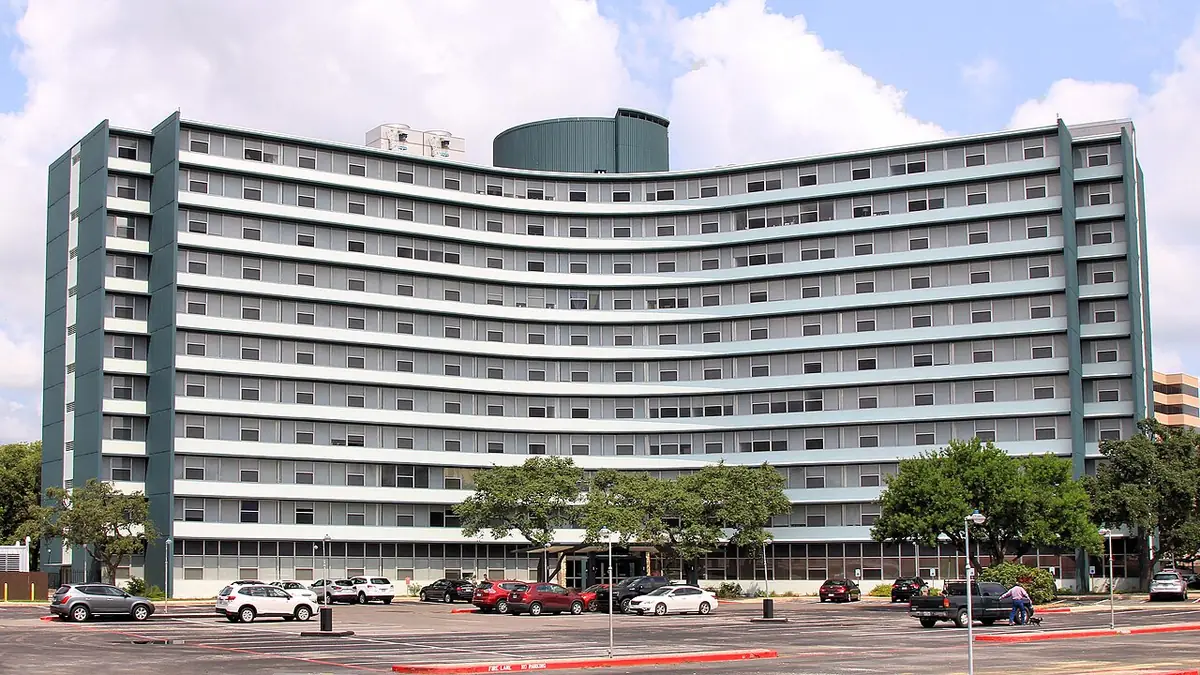
A mid-century apartment tower typical of San Antonio living — Photo: Larry D. Moore · CC BY 4.0 · Wikimedia Commons
That well-oiled routine nonetheless hides legal and structural realities that estimates often leave out.
Living in San Antonio means building the car into every minute of your day, and buyers price that in. The urban sprawl, structured around the major ring motorways such as the I-410 and Loop 1604, sets a rhythm in which peak-hour commuting absorbs a significant share of your free time. Understanding how those traffic flows hit a daily timetable is the key to reading why two houses of the same size, in different parts of the city, do not carry the same figure.
07:15Leaving homeTraffic starts to build on the slip roads onto the main motorways towards the business district, and drive time is one of the first things a comparable has to be adjusted for.
07:45School drop-offQueues lengthen quickly outside the public schools of the sought-after residential neighbourhoods, whose catchment is a well-known support for local values.
08:30Arrival at workParking is generally included in the outlying business zones and more complicated in the historic centre, which is part of why central properties price differently.
12:30Local lunch breakA short drive to reach the nearby retail zones or neighbourhood restaurants, the kind of everyday convenience buyers notice and pay for.
17:30End-of-day food shoppingHeavy use of the large regional stores for the household's weekly restocking, so distance to them is a small but real factor in an address.
18:45Home and downtimeThe main jams on the ring motorways clear and the subdivisions settle down, and it is this evening quiet that owners in the outer areas are effectively buying.
What brochures and photographs will never tell you about a San Antonio valuation
Overlooking these technical points leads straight to the regrets many owners admit to six months on.
Behind the postcard of the River Walk and the charm of the historic missions sit technical and regulatory constraints specific to Texas, and each of them can move a figure by more than a renovation would. Clay soils subject to strong moisture swings, the power of neighbourhood owners' associations and the management of flash flood risk demand extreme vigilance before you rely on any estimate or sign a deed at closing.
Clay soil movement under the foundations
The geology of the ground causes shrinkage and swelling that are destructive to concrete slabs. Without a close foundation inspection by a specialist engineer, you risk discovering levelling bills running to tens of thousands of dollars, and foundation condition is the single largest adjustment an appraiser applies here.
The discretionary power of owners' associations
In almost all recent subdivisions, HOAs impose strict rules on the colour of your exterior paint, the planting tolerated and vehicle parking. Failure to observe them brings heavy and repeated fines, and the restrictions themselves cap what a buyer will pay for the property.
The vulnerability of the electricity network to extreme weather
The independent Texan grid shows signs of strain during winter polar cold snaps or extreme summer heatwaves. Installing a backup generator is an additional cost worth anticipating, and its presence or absence is a genuine differentiator between two otherwise identical listings.
Strict rules on managing protected trees
Felling or pruning certain century-old oaks on your plot requires complex and chargeable municipal permits. Ignoring those local rules exposes owners to considerable environmental fines, and it also means mature planting on a lot cannot simply be treated as removable.
The disappointments owners discover six months after trusting a figure
Given those demands, it matters just as much to know whether this market really suits your profile.
Looked likeEfficient, modern central air conditioning seen during a spring viewing
Turned outAn electricity bill that tripled within the first weeks of summer heat because the thermal insulation was inadequate, a gap no headline figure had reflected
Would have caught itRequiring a detailed energy assessment and the full electricity billing history for the last twelve months before accepting any estimate as final.
Looked likeA smooth commute tested on a sunny Sunday afternoon
Turned outA daily forty-five minute traffic nightmare on the main ring motorway at peak times, which is exactly the factor that had made the comparable look generous
Would have caught itSimulating the real journeys at the precise weekday departure and arrival times before you accept an area-based figure.
Looked likeA quiet, family neighbourhood with no apparent constraints on how a property could be used
Turned outAn outright ban under the association rules on parking a work van or a trailer outside the house, a restriction that narrowed the pool of buyers
Would have caught itReading the HOA rules in full and asking the neighbours directly how far the association board tolerates exceptions.
Looked likeA beautiful, lush green lawn that seemed to need little effort
Turned outSevere municipal watering restrictions during drought and an eye-watering water bill, so the landscaping that lifted the estimate proved a liability
Would have caught itFavouring drought-resistant local planting and checking that the automatic irrigation system actually works before it is credited in a figure.
Which owners should treat a San Antonio figure with the most caution?
The time has come to take an objective view of your own situation and reach a final decision calmly.
Not every owner or investor is well served by the urban and fiscal model of San Antonio, and the same figure means very different things to different people. The absence of a high-capacity public transport network, local taxation resting on the assessed value of the property and the need for rigorous maintenance all create deep mismatches with certain urban or mobile ways of living, and each of them can make a headline estimate misleading.
The committed user of walking, cycling and public transport
→Discount any figure that leans on a central, walkable address
The city is built around the private car and the absence of a dense metro or tram network means the walkability premium found in other markets simply is not present in the comparables here.
The owner who expects a high, immediate rental yield to justify a valuation
→Test the figure against net rather than gross returns
The high level of local property taxes significantly erodes the net margins produced by letting standard residential property, so a value supported by gross yield will not hold.
The owner who resents rules and association regulations
→Read the HOA restrictions before accepting a subdivision comparable
The power of residents' associations imposes rigid aesthetic and behavioural constraints, and a property valued as though those constraints did not exist is being valued as something it is not.
The owner on a very tight budget with no contingency savings
→Wait until a firmer financial cushion is in place
The combination of moving property taxes and the high cost of climate-related repairs can turn a comfortable-looking figure into a stretched one within a single year.
So, are you ready to put a number on a San Antonio property?
Valuing a property in San Antonio is a more demanding exercise than signing a loan agreement. Between the reality of urban sprawl, the unavoidable weight of local property taxes and the need to make peace with the Texan climate, every element of the calculation deserves thought. If you accept assumed car dependence and have provisioned for the household's fixed charges, the local market offers a stability and a quality of life that make figures here unusually readable over the long term.
Your success will depend directly on your ability not to be dazzled by the immediate appearance of the properties presented in agency windows. By methodically checking the state of the foundations, testing real journey times at peak hours and reading every line of the association rules, you turn a soft number into a defensible one. Take the time to visit several neighbourhoods at key moments of the day before you settle on a figure.
In the end, San Antonio rewards owners who are patient, pragmatic and financially prudent. The opportunities to build a fulfilling life here are real, provided you approach the market with clear eyes and method. If the structural demands of the region match your family or professional plans, all that remains is to check your estimate against the comparables and act on it in the heart of Texas.
Related questions
How much does property tax typically add up to for a house in San Antonio, and how does it affect the valuation?
Property tax in San Antonio generally runs between 2.1% and 2.8% of the value the county appraisal service puts on the property. That high rate reflects the absence of a state income tax in Texas, which shifts a large share of public service funding onto real estate, and it is why a carrying cost line belongs in any honest estimate.
Does the need for a car change what a house here is worth?
Living in San Antonio without a personal vehicle is extremely difficult given the considerable urban sprawl and the way the road infrastructure is laid out. The bus network exists but mainly serves the central corridors, so commute exposure is a real driver of buyer demand and therefore of the figure a valuation lands on.
Which neighbourhoods carry the strongest values?
The most sought-after areas sit traditionally in the north and north-west of the city, such as Alamo Heights, Monte Vista or the newer subdivisions near Stone Oak. Those areas offer well-regarded school infrastructure and a very quiet residential setting, which is why comparables drawn from them sit above the citywide median.
How do clay soils affect a foundation, and what does that do to an estimate?
The clay soils of the region swell and shrink significantly with moisture, which puts considerable pressure on the concrete slabs of buildings. A rigorous foundation inspection by an independent professional is therefore essential, because a condition adjustment for foundation movement is one of the largest single deductions applied to a valuation here.
What summer electricity budget should be assumed when weighing running costs?
During the hottest months the air conditioning runs continuously and can push the monthly electricity bill to between $250 and $400 depending on floor area and the quality of thermal insulation. Factoring that seasonal swing in is prudent, because insulation quality shows up in what informed buyers will pay.
What is an HOA and how does it weigh on a property's value?
An HOA (Homeowners Association) is a neighbourhood owners' association that enforces strict internal rules on the exterior appearance of houses, garden layout and parking. Its decisions bind every resident on pain of financial penalties, so its dues and its restrictions both belong in the comparison between two otherwise similar properties.
Are San Antonio values stable compared with the rest of Texas?
The San Antonio housing market has traditionally shown greater stability and more accessible median prices than those recorded in the neighbouring metros of Austin or Dallas. That relative moderation attracts many buyers looking for more house per dollar, and it means comparables here age more slowly than in hotter Texan markets.
How should flood risk be treated when estimating a property?
Some parts of San Antonio crossed by watercourses or sitting in topographic dips are exposed to flash flooding during violent storms. Consulting the official Flood Zone Map is mandatory, and specific insurance must be taken out where the property falls inside one, a cost that feeds straight back into what the property is worth.
How does the public school system feed into value?
The public education system is divided into independent school districts whose quality and reputation vary noticeably from one area to another. The neighbourhood a house sits in directly determines which public school its occupants attend, which is why two similar houses in different districts do not carry the same figure.
What closing costs should be netted off the headline figure?
Closing costs, covering agency fees, transfer taxes, title insurance and loan processing charges, generally represent between 1% and 2% of the total purchase price. They are paid in cash on the day the deed is signed with the title company, so an owner reading an estimate should treat the gross figure and the net proceeds as two different numbers.
Property review of ting
No ting properties in San Antonio yet
Be the first — share it on ting and it shows up right here.