Putting a credible figure on an apartment in San Antonio means understanding the Texas market, its tax particularities and its condominium rules. This guide walks you through what actually drives the number, how to build a comparable set, and how to sanity-check any valuation you are handed before you rely on it.
Get the app
What nobody tells you.
Real prices, hidden costs and the traps to check before you commit.
What you are really measuring when you value an apartment in San Antonio
Scroll
What you are really measuring when you value an apartment in San Antonio
Putting a credible figure on an apartment in San Antonio means understanding the Texas market, its tax particularities and its condominium rules. This guide walks you through what actually drives the number, how to build a comparable set, and how to sanity-check any valuation you are handed before you rely on it.
Written by the ting.ad editorial team ·
West Commerce Street, San Antonio in Street View: drag to look around.
To read those dynamics properly, the next step is to match the valuation method to why you need the figure at all.
Valuing an apartment in San Antonio is not a matter of multiplying the floor area by a district average. The figure sits on a market shaped by steady population growth, strong tourist pull around the River Walk and a spread of districts running from the historic centre to the residential suburbs. The gap that matters is between the headline number a listing carries and the value a buyer will actually defend once carrying costs are on the table. Every sector strikes its own balance between affordability, condominium charges and the prospect of appreciation, and each of those balances moves the number. Weighing them carefully is what keeps a valuation from being undone by hidden costs or by the seasonal swing in demand.
Values supported by the economic and population growth of Bexar County.vsTraditionally high local property taxes that weigh on what a buyer will pay.
Texas levies no personal income tax but compensates with some of the highest property taxes in the country. That tax structure changes the arithmetic behind any valuation, because the recurring cost of holding the property is part of what a buyer is bidding on.
A rental market underpinned by military bases and an expanding technology sector.vsSharper competition in some condominium segments run by inflexible homeowners associations.
Restrictions imposed by homeowners associations can limit short-term letting and push monthly charges up unpredictably over the years. Both belong in the adjustment column when you compare a unit against otherwise similar comparables.
An appealing setting that blends Texan and distinctively Hispanic influences.vsHome insurance costs rising steadily because of regional climate risk.
Drought episodes, summer heatwaves and the risk of sudden storms call for close attention to the structural condition of the building and to what the insurance policy actually covers. Both feed directly into the condition adjustments that separate two units with the same floor area.
Which kind of valuation does your situation actually call for?
Whichever route you take, arriving from another property market means adjusting some legal and cultural reference points first.
The right way to value an apartment in San Antonio depends closely on what the number is for, whether that is a sale you are preparing, a refinancing, a tax protest or simply keeping track of what you own. The city offers radically different settings depending on whether the unit sits in the walkable bustle of the centre or the quieter, greener outer sectors, and the depth of evidence available differs with it. Each owner has to weigh what precision costs against what an approximate figure risks. An honest reading of your own purpose will keep you from paying for rigour you do not need, or relying on a number that will not hold up.
Owner testing the water
An agent's comparative market analysis is the usual starting point, and it is normally free because the agent hopes to win the listing. It draws on recent sales in your immediate area, adjusted for floor area, floor level, condition and view. Read it knowing the incentive: ask which comparables were used, how far away they sold and what adjustments were applied, and treat any figure quoted without that working as an opinion rather than a valuation.
Owner who needs a defensible number
This is where a licensed appraiser earns the fee. The report documents the comparable set, states the adjustments line by line and reaches a value a third party can audit. It costs money and takes time, but it is the only version that survives scrutiny from a lender's underwriter or from the Bexar Appraisal District during a protest. For a condominium unit, the appraiser will also read the association's finances, because unfunded reserves are a genuine deduction.
Owner keeping an eye on the number
Automated online estimates are the cheapest option and they are useful for spotting a trend, but they lean heavily on public records and district averages. They cannot see that your unit was renovated, that it faces a car park, or that the association just levied a special assessment. Use them as a sanity check on other figures rather than as the figure itself, and expect the widest error precisely where the local stock is most varied.
Valuing here after owning property elsewhere: what genuinely changes
St. Mary's University, a Gothic Revival landmark in San Antonio — Photo: Larry D. Moore · CC BY 4.0 · Wikimedia Commons
Once those reference points are in place, the district a unit sits in becomes the single largest input into its value.
Property in the United States, and in Texas in particular, is valued under rules that sit some distance from what owners arriving from other markets expect. From the central role of agents and title records to the way charges and taxes are structured, the local system asks for a quick adjustment. Understanding those differences keeps you from misreading the paperwork behind a valuation and from taking a figure at face value when it rests on assumptions that do not travel.
From abroad
A valuation confirmed by a state-supervised legal officer at the point of sale.
San Antonio
A transaction handled by title companies working from standardised Texas contracts.
The verification role that a public officer plays in many countries is performed here by specialist firms whose job is to confirm the legal standing of the property and that no defect attaches to prior title. Their search does not produce a value, so the valuation itself comes from an agent's comparative market analysis or a licensed appraiser, and you have to commission it separately.
From abroad
Moderate property taxes and a progressive, centrally collected income tax.
San Antonio
No state income tax, offset by high local property taxes.
Because holding the property carries a recurring tax charge every year regardless of any mortgage, buyers deduct it mentally from what they will bid. Any valuation that ignores the assessed value published by the Bexar Appraisal District is missing one of the largest inputs into local pricing.
From abroad
Condominiums administered by professional managing agents under a national statute.
San Antonio
Buildings run by homeowners associations under their own strict rule books.
Associations hold wide powers to set aesthetic rules, levy special assessments and approve changes to common or private parts. Their dues, their reserves and their assessment history are all valuation adjustments, which is why the association's accounts belong in the file before you name a figure.
From abroad
Strong administrative centralisation and standardised technical surveys.
San Antonio
A contract-led approach in which the general home inspection is the pivot of the negotiation.
The buyer has a defined window, the option period, to have the property inspected thoroughly and then ask for repairs or withdraw without penalty. In practice this is where a valuation gets tested: what the inspector finds becomes the evidence for the condition adjustments that move the final figure.
Which district your apartment sits in, and why it moves the figure
Those geographic differences translate into price gaps large enough that they deserve to be read against actual market figures.
San Antonio is a mosaic of districts with distinct identities, each answering to particular expectations around setting, budget and the prospect of appreciation. Whether it is the artistic energy of the King William Historic District, the modern pace of River North or the residential calm of Alamo Heights, each area strikes its own balance. For valuation this is the practical rule that follows: comparables have to come from the same district, because a unit of identical size can carry a materially different value a few streets away.
Downtown and River North
An intense urban rhythm, strong cultural activity and immediate connection to the business and leisure districts.
Suits
Valuations that lean on rental evidence, since short and medium-term letting demand is a visible part of what buyers pay for here.
Trade-off
Higher prices per square metre, limited parking and condominium charges that are often substantial in the residential towers, all of which pull against the headline figure.
Southtown and King William
A bohemian, creative atmosphere, streets lined with mature trees and a very active artistic community.
Suits
Properties whose value rests on historic charm and architectural authenticity, where condition and period detail carry more weight than floor area.
Trade-off
An older housing stock that sometimes needs significant renovation, and a structurally limited supply that leaves you with fewer genuine comparables to work from.
Alamo Heights and the northern sectors
A calm residential environment, well-kept green space and a strong reputation for safety and schools.
Suits
Valuations built on long-term stability, where school catchment and low turnover support the number more than any single feature of the unit.
Trade-off
An acquisition budget well above the metro average and marked dependence on daily car use, so parking provision becomes a real line in the adjustments.
What the market figures say an apartment in San Antonio is worth
Beyond the purely financial picture, the legal shape of ownership deserves particular attention, because it changes what is being valued.
The San Antonio market remains broadly more affordable than the large American coastal metros, but district differences and the quality of the finish weigh heavily on any figure you put on an apartment. Reading these ranges only gets you to a starting point: a defensible valuation then layers in the recurring costs a buyer will price in, notably local property taxes and monthly homeowners association dues. Treat the ranges below as the baseline you adjust from, not as the answer.
san-antonioFor saleApartmentestimate
Median price / m²US$1,852Half the apartments sell below this
Median priceUS$175kthe average is 14% higher — a few very large properties pull it up
Most common2 bedrooms42 % of listings
Average size90 m²
By number of bedrooms
Bedrooms
Share of market
Avg price
Price / m²
Avg size
1
40 %
US$146k
US$2,242 +15 %
65 m²
2most common
42 %
US$185k
US$1,950
95 m²
3
16 %
US$232k
US$1,852best value / m²
125 m²
4
2 %
US$287k
US$1,794 −8 %
160 m²
Each row is an average, compared against the area average of US$1,950 / m². These are indicative estimates of a typical local market, not a measured sample of live listings. Check current listings before relying on them.
What is actually being valued: the unit, the share and the legal limits
With the object of the valuation settled, the order in which evidence is gathered is what makes the resulting figure defensible.
Valuing an apartment in San Antonio means being precise about what the number covers: the interior space, an undivided share of the common parts, and a set of rights that are narrower than outright freehold ownership. The rules governing use of common areas, letting restrictions and the powers of the association differ noticeably from practice in other markets, and each of them can move the figure. Reading those limits before you fix a value is what stops a headline number from quietly overstating what a buyer is acquiring.
The private unit and the rules that bound it
You own the interior of your apartment plus an undivided share of the common parts of the building and the land. The governing documents, the CC&Rs, dictate precisely what you may change, from the colour of blinds visible from outside to the hours the pool or the gym may be used. Every one of those restrictions narrows the pool of buyers, and a narrower pool shows up as a lower value.
What it changesRead the association's rules in full before you commit to a figure, so you can identify restrictions on pets or on short-term letting of the Airbnb type. Where a restriction rules out a use a buyer would have paid for, the valuation has to come down to match.
The discretionary power of the homeowners association
Homeowners associations hold considerable authority to vote extraordinary budgets, require facade upgrades or change monthly dues without any individual owner holding an absolute veto. For a valuation, this means the association's balance sheet is part of the property: thin reserves imply a special assessment that a well-advised buyer will discount for in advance.
What it changesCheck the association's financial health and the history of its dues increases carefully. Dues and reserves are among the cleanest adjustments available to you, because they are documented, comparable between buildings and easy to defend when someone challenges your number.
The sequence that turns an opinion into a defensible valuation
A century-old commercial building on a San Antonio corner — Photo: Larry D. Moore · CC BY 4.0 · Wikimedia Commons
It is worth seeing precisely how the different professionals fit into that sequence and what each one contributes to the number.
A valuation in Texas is only as good as the evidence behind it, and that evidence is assembled in a fairly strict order. From the first comparable pulled to the final reconciled figure, controlling what goes into the file is the best protection against a number that collapses the moment a lender, a buyer or the appraisal district looks at it closely.
Assembling the documents an owner controls: the deed, the floor area, the renovation history and the association's accounts.
Pulling recent sold comparables from the same district and the same building type, close enough in date that market movement does not have to carry the adjustment.
Adjusting each comparable line by line for floor area, floor level, outlook, parking, condition and the level of monthly association dues.
Checking the assessed value published by the Bexar Appraisal District against your working figure, and understanding any gap rather than ignoring it.
Testing the condition assumptions with an inspection where the stakes justify it, since foundation movement and roof age are the adjustments that move the figure most.
Reconciling the adjusted comparables into a single figure, stated as a range with the reasoning attached rather than as a bare number.
How a valuation is produced, step by step
Valuing an apartment in San Antonio draws on several people with well-defined roles, from the agent to the inspector to the title company. Knowing the order in which they contribute lets you steer the process calmly and understand which part of the final figure each of them is actually responsible for.
The owner and their agentBuilding the comparable setSelecting apartments that genuinely match the subject and analysing recent sold prices in the local market rather than asking prices.
The agentProducing the comparative market analysisApplying adjustments for floor area, condition and association dues, and stating the resulting range with the reasoning attached.
The inspectorEstablishing the true condition of the propertyChecking the state of the plumbing, the electrics, the roof and the air conditioning system, which is what condition adjustments rest on.
The title companyConfirming what is actually being valuedSearching for prior debts, easements or mortgages attaching to the property, any of which reduce what a buyer can pay for it.
The licensed appraiserIssuing the formal valuationDocumenting the comparables and adjustments in a report a lender's underwriter or a tax protest can audit line by line.
All partiesTesting the figure against the marketComparing the valuation with the offers actually received, and revising the number where the market disagrees with it consistently.
Apartment or single-family house: why the two are valued on different logic in San Antonio
With that distinction understood, the next thing to price precisely is the running cost that sits behind every figure.
Valuing an urban condominium apartment and valuing a single-family house in San Antonio are two different exercises, because the inputs that move each figure are not the same. The Texas market, with its urban sprawl and dense road infrastructure, has historically favoured individual housing, but the inner city and the newer districts along the River Walk and around Southtown have seen sought-after vertical residential schemes appear. An apartment is valued largely on its floor area, its floor level, the condition of the building and the state of the association that maintains it, which is why two units of identical size in the same block can be some way apart. Association dues cut the other way: they buy delegated exterior maintenance and walkable proximity to services, but a high monthly charge is money the buyer cannot put towards the price, and it comes straight off the value.
A single-family house, whether in the mature streets of Alamo Heights or the newer developments to the north towards Stone Oak, is valued on a wider set of variables: plot size, roof age, the state of the slab, the air conditioning system and the layout, all of which the owner controls alone. That independence is worth something in the market, and land in San Antonio has historically appreciated well over the long run. It also means the condition adjustments are larger and less predictable, because nothing is shared and nothing is maintained collectively. Families pay for enclosed gardens, easy parking in front of the garage and the freedom to renovate or extend, so those features carry real weight in a house valuation and almost none in an apartment one. Set against that, distance from the main employment corridors and near-total dependence on the car pull the figure back down for anything too far out.
The financial arbitration does not stop at the headline price, because Texas property taxes, calculated on the value assessed by the Bexar Appraisal District, weigh proportionally more heavily on houses with a large footprint. Apartments often benefit from that tax being spread and from a lighter insurance bill, since the building structure is covered by the association's master policy, and both of those show up as support under an apartment's value. Resale of a single-family house is nonetheless generally smoother, given the steady structural demand from local families and from newcomers drawn by the county's economic growth, and that liquidity is itself part of what the market pays for. Which logic applies to you depends on what you own, and applying the wrong one is the most common reason a valuation misses.
The costs that sit behind every valuation figure in San Antonio
To see how those costs are actually felt, it helps to walk through an ordinary day in the city.
A credible valuation in San Antonio needs a full financial picture, because a buyer is not only pricing the property, they are pricing the cost of holding it. Between the distinctly Texan property tax rate, storm insurance and the structural charges, the true cost of ownership deserves proper modelling. The tables below set out the essential budget lines observed in the local market for a typical apartment and a standard house, and each of them is a line you can adjust a comparable against.
Acquisition and annual ownership cost structure in San Antonio
Cost line
Apartment (condo)
Single-family house
Effect on the valuation
Observed median price
$180,000 to $260,000
$280,000 to $450,000
Sets the starting range before any adjustment is applied
Property tax
1.8% to 2.2% of assessed value
1.8% to 2.5% of assessed value
No income tax in Texas, so the burden sits on property and buyers price it in
Monthly charges / HOA dues
$250 to $500 per month
$30 to $100 per month
Covers upkeep of common parts or landscaping; high dues cut what a buyer will pay
Home insurance
$800 to $1,200 per year
$1,500 to $2,800 per year
Rising with Texan hail and drought risk; poor insurability drags the figure down
The figures shown rest on median averages observed through the San Antonio Board of Realtors and reflect the local tax rules in force.
Estimated running and maintenance costs a valuation should account for
Cost line
Average monthly budget
Main sources of variation
Air conditioning / energy
$150 to $350
Intense summer heat requiring continuous use of air conditioning
Maintenance and repairs
1% to 2% of the property value per year
Ageing of clay-borne foundations and upkeep of roofs
Title and closing costs
2% to 4% of the purchase price
Title company fees, agency commission and transfer taxes
Because Texas levies no state income tax, the fiscal burden shifts onto property, which makes the property tax assessment central to any valuation.
Health, schools and commuting: the ordinary Tuesday that valuations are really pricing
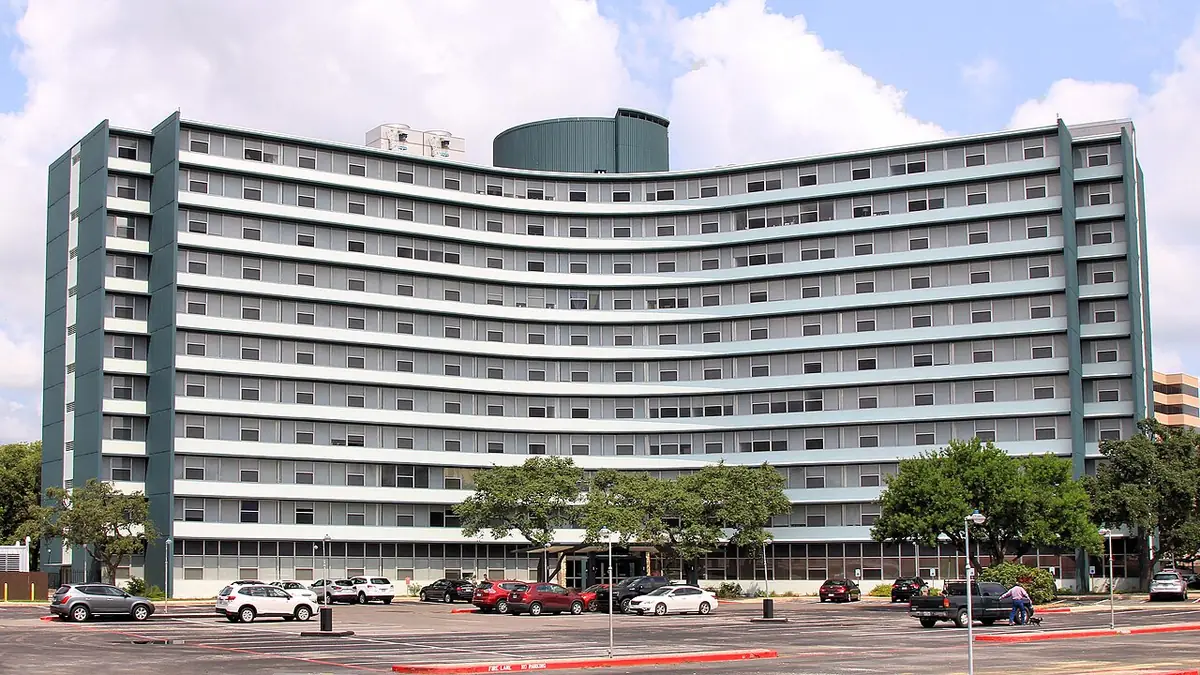
A mid-century apartment tower typical of San Antonio living — Photo: Larry D. Moore · CC BY 4.0 · Wikimedia Commons
Beyond that well-worn routine, some realities of the local market rarely appear in the brochures or in an automated estimate.
Living in San Antonio means absorbing the traffic rhythms of a fast-growing Texan metro. Daily organisation depends heavily on whether you settle in the historic centre, along the ring roads or in the well-served residential suburbs. The timeline below traces the high points of an ordinary day, and it is worth reading as a valuation input: proximity to these fixed points is exactly what a buyer pays a premium for.
07:30Loop 410 or Interstate 10Heavy but moving traffic compared with other Texan metros. Drivers head towards the employment centres of the Medical Center or downtown, and access to these routes is a measurable part of a unit's value.
08:30Neighbourhood school (North East ISD)Children dropped at modern campuses with first-rate sports facilities, marking the real start of the working day in the residential districts. School catchment is one of the most durable supports under local values.
10:00South Texas Medical Center or affiliated clinicsA vast tertiary health hub employing thousands of professionals. Access to advanced care is exceptionally quick for local residents, and the employment it generates underpins prices in the surrounding sector.
13:00Historic downtown (Downtown / River Walk)Lunch in the heart of the tourist and business district. Local professionals use the shaded pedestrian stretches along the river, and walkability of this kind carries a clear premium in the central market.
17:30Shopping centres and local markets (HEB)The weekly or daily shop at emblematic local chains such as H-E-B, genuine institutions of Texan food retail. Distance to one of them is a small but real factor in what buyers will pay.
19:30Residential districts and neighbourhood parksA quiet return to the developments or urban blocks, where families use the mild evening temperatures to visit the public parks. Park frontage and quiet streets both show up as positive adjustments.
What the beautiful listing photographs leave out of a San Antonio valuation
These technical points explain why certain misjudgements recur so often once the figure is put to the test.
Sales catalogues and virtual tours foreground the light in the rooms, the modernity of the fitted kitchens and the appeal of the outdoor space. Yet several structural factors specific to Texan ground conditions and to the way San Antonio is built escape an untrained eye entirely, and each of them is a genuine downward adjustment. These are the elements to establish before you accept any figure as final.
Clay soils and foundation movement
San Antonio ground contains expansive clays that swell with moisture and shrink through intense drought. The phenomenon regularly causes cracking in load-bearing walls and sometimes requires costly stabilising piers beneath the foundations. Documented movement is one of the largest single deductions an appraiser will apply, and an undocumented one is the risk hiding under an optimistic valuation.
The real cost and availability of multi-risk insurance
With destructive hail and windstorms becoming more frequent across Bexar County, home insurance premiums have risen dramatically. Some carriers now refuse to insure roofs more than fifteen years old without prior replacement at your expense. A property that cannot be insured at a normal premium is worth less, and roof age is therefore a valuation input rather than a maintenance detail.
Strict restrictions imposed by homeowners associations
More than 80% of recently built properties in San Antonio sit under a homeowners association. These bodies dictate exterior paint colour, prohibit parking a commercial vehicle in the driveway and regulate the height of your lawn on pain of steep fines. Every restriction narrows the buyer pool, and a narrower pool is a lower figure.
Rapid saturation of the secondary road network
Continued urban sprawl creates major bottlenecks on secondary roads at peak times. Valuing an outlying property without checking how freely it reaches the highways overstates it, because the buyers who would pay the district average are the ones who will discover the commute first.
Managing air conditioning through the summer heat
Through the summer months temperatures frequently exceed 35 degrees Celsius for weeks at a time. A worn or undersized central air conditioning system can double the monthly electricity bill and need an urgent replacement costing several thousand dollars, which is exactly the sort of near-term cost a buyer subtracts from their offer.
The valuation mistakes owners only discover six months later
Some owners, in fact, would be better served by not relying on a self-produced figure at all.
Looked likeA charming period house full of character in a leafy historic district close to the centre, valued off neighbouring sales.
Turned outA money pit for thermal insulation, with an obsolete electrical system that no longer meets current standards and corroded cast iron pipework, none of which the comparables carried.
Would have caught itCommissioning a full technical inspection from an independent TREC-certified expert and building 15% of the price into the figure as a compliance allowance before you call it a valuation.
Looked likeA brand new development on the northern edge offering absolute quiet and generous green space, priced off the builder's own list.
Turned outA permanent building site for several years, social isolation far from shops and disproportionate travel times to the business district, so resale evidence came in well under the list figures.
Would have caught itChecking the city's zoning and development plans and visiting the sector at different hours, evenings and weekends included, so the figure reflects the area as it will actually be lived in.
Looked likeAn affordable apartment with apparently low charges inside a small condominium, valued straight off its floor area.
Turned outNo reserve fund at all for major works, leading to a large special assessment to redo the roof, a liability the valuation had never accounted for.
Would have caught itReading the minutes of the association's last three meetings and its financial statements closely, and deducting any foreseeable special assessment from the figure rather than hoping it does not land.
Looked likeA quick investment valuation based on the district's headline rental yield with no study of actual local demand.
Turned outProlonged vacancy against fierce competition from neighbouring new schemes with better shared pools and gyms, which meant the income the valuation assumed never materialised.
Would have caught itRunning a comparative study of the rents genuinely achieved in the exact block and validating the net yield after property taxes before the income feeds the figure.
Looked likeA valuation accepted at the asking price of comparable listings during a tight market.
Turned outA clear overvaluation against recent comparable transactions in the same sector, which made any short-term resale loss-making and left the lender's own appraisal short.
Would have caught itRequiring your agent to produce a detailed comparative market report built on completed sales from the last four months in the district, not on what neighbours are asking.
Who should not be relying on their own valuation in San Antonio right now
It is time to draw these threads together into a figure you can stand behind.
Working out what a property is worth is often presented as a simple lookup, but the current Texan context does not lend itself to that for every owner. Between high property taxes, fluctuating interest rates and demanding maintenance costs, some situations expose an owner to serious error if the figure is not produced properly. These are the cases where paying for a professional valuation, or holding off entirely, is the wiser decision.
The owner whose plans are uncertain over the short term
→Fixing a value from an automated estimate and making a decision to sell within three years on the strength of it.
Closing costs, agency commission and the initial property tax absorb the whole of any short-term gain, so an estimate that is a few percent optimistic is enough to turn a sale that looked worthwhile into a loss.
The owner of an older unit with no cash reserve
→Valuing the property as if it were in average condition without commissioning an inspection.
Hidden defects, foundation problems or an unexpected special assessment can each move the figure by more than the inspection costs, and an owner without liquidity has no way to absorb the gap once a buyer's inspector finds it first.
The owner relying on a district average for an atypical property
→Applying a headline price per square metre to a unit whose parking, outlook or association differs from the local norm.
San Antonio values swing sharply with car access and highway proximity, and averages smooth away exactly the features that separate one unit from another. The more atypical the property, the wider the error an average will produce.
So, can you put a figure on your San Antonio apartment with real confidence?
Valuing a property in San Antonio is not a matter of arithmetic alone, nor of a feeling about a handsome limestone facade of the sort Texas does so well. It calls for a realistic financial view married to a proper grasp of local specifics, whether that is property taxation, the nature of the ground or the constraints of getting around. A figure that ignores the recurring cost of ownership is not a valuation, it is a listing price, and the difference tends to surface at exactly the wrong moment. The opportunities this growing metro offers remain exceptional for anyone willing to cost ownership coldly and refuse the comfort of headline numbers.
What makes a valuation hold is preparation: a comparable set drawn from the right district, adjustments you can state out loud, the association's accounts read rather than skimmed, and independent professionals capable of finding the defects before a buyer's inspector does. Sanity-check any figure you are given against the assessed value published by the Bexar Appraisal District and against completed sales rather than asking prices, and treat a wide gap as a question to answer rather than noise to ignore. Take the time to walk the comparables, cost every ancillary line and express your conclusion as a range with reasons attached: a valuation you can defend is worth considerably more than a number you merely like.
Related questions
How much does property tax add to a San Antonio valuation?
Property tax in San Antonio generally runs between 1.8% and 2.5% of the value assessed by the Bexar Appraisal District. Because that tax replaces state income tax in Texas, buyers price it into what they will pay, so the assessed value and the effective rate belong in any valuation you build.
Does hail insurability affect what an apartment is worth here?
It does in practice. Cash buyers face no formal requirement, but lenders make a mortgage conditional on a multi-risk homeowners policy covering the windstorms and hail that are frequent in the region. A property that is hard or expensive to insure values lower, so the insurance quote is worth gathering before you settle on a figure.
How do homeowners associations affect the value of a unit in a newer development?
Homeowners associations govern recent developments with strict rules on exterior architecture, landscaping upkeep and parking. They levy compulsory monthly or annual dues to fund shared amenities, and those dues are a direct adjustment: a high monthly charge reduces what a buyer will pay for an otherwise identical unit.
Which San Antonio districts hold their value best?
The most sought-after areas include Alamo Heights for its residential character and well-regarded schools, Southtown for its artistic energy close to the centre, and the north of the city towards Stone Oak for families looking for newer builds. Values differ enough between them that comparables must come from the same area, not the city average.
Do foundation problems show up as a valuation adjustment in Texas?
Yes. Because expansive clay soils are widespread across Bexar County, ground movement can weaken concrete slabs. A dedicated foundation inspection is strongly recommended, and a documented movement issue is one of the largest single downward adjustments an appraiser or agent will apply.
What effect does the South Texas Medical Center have on values nearby?
The Medical Center is one of the largest employment centres in the city, generating steady rental and residential demand from healthcare professionals. That sustained demand supports prices in the surrounding sector, which is why the distance from it belongs among the factors you weigh.
Should summer cooling costs be reflected in a valuation?
Yes, indirectly. Summer temperatures regularly pass 35 degrees Celsius for several consecutive months, so air conditioning runs continuously and represents a significant line in monthly electricity bills. An old or undersized system is a running-cost problem buyers discount for.
What closing costs should be netted off a headline valuation?
Closing costs in Texas generally represent between 2% and 4% of the total purchase price. They cover the title company's fees, transfer taxes and lender file charges. An owner working out net proceeds should subtract them from the valuation rather than treat the headline figure as cash in hand.
Does a lack of transit access change what a San Antonio apartment is worth?
It is a genuine factor. Living in San Antonio without a personal vehicle is extremely difficult because of the urban sprawl and the layout of the road network, and public transport is limited compared with metros that have heavy rail. Parking provision and highway access therefore carry real weight in a local valuation.
How long does it take for a valuation to be tested by an actual sale?
Once a seller accepts an offer, the standard closing process generally takes between 30 and 45 days, during which the technical inspections happen and the loan conditions are lifted. That window is where an optimistic valuation is usually exposed, either by the inspection or by the lender's own appraisal.
Property review of ting
No ting properties in San Antonio yet
Be the first — share it on ting and it shows up right here.