Valuing an apartment in Los Angeles calls for a clear grasp of how the local market sets prices, how condominium ownership is structured and what California law adds to the picture. This guide walks you through the process step by step, so you can arrive at a figure you can defend, well away from received wisdom and sales talk.
Get the app
What nobody tells you.
Real prices, hidden costs and the traps to check before you commit.
What a valuation of a Los Angeles apartment really measures
Scroll
What a valuation of a Los Angeles apartment really measures
Valuing an apartment in Los Angeles calls for a clear grasp of how the local market sets prices, how condominium ownership is structured and what California law adds to the picture. This guide walks you through the process step by step, so you can arrive at a figure you can defend, well away from received wisdom and sales talk.
Written by the ting.ad editorial team ·
West 1st Street, Los Angeles in Street View: drag to look around.
To judge whether a figure fits the property in front of you, the next step is to match the way the apartment is used day to day against the realities of the city.
Valuing an apartment in Los Angeles is not a matter of multiplying square metres by a citywide rate. Behind the imagery of wide palm-lined boulevards sits a demanding market, governed by strict planning rules and marked by sharp differences between neighbourhoods. Taking the exercise seriously means accepting that value rests as much on the precise location as on the legal structure of the building's ownership. You have to appraise what is being valued beyond the living area, factoring in the infrastructure and the local dynamics that a comparable two streets away may not share.
A headline figure from a lifestyle promisevsA dense urban and administrative reality behind it
The initial appeal of the climate and the Californian atmosphere often masks the complexity of local planning rules, rent control law and the constraints of running a homeowners association in the county, all of which a serious estimate has to price in.
The private space you can measurevsThe strict obligations of the HOA
Homeowners associations run the common areas, set monthly dues that are sometimes high and impose strict rules on exterior renovation and short-term letting, so two apartments of identical size can carry very different values.
An asset treated as liquid on papervsA market driven by American economic cycles
Movements in Federal Reserve interest rates and the state of the local economy feed directly into valuations and into how quickly a property in the metropolitan area can actually be sold at the estimated figure.
Which comparables fit the apartment you are valuing?
That reading of the local setting takes on another dimension for an owner arriving from a very different property system abroad.
In a metropolitan area as vast as Los Angeles, where the apartment sits decides which sales it can honestly be compared with. Whether the property serves working life, quiet residential living or immediate access to cultural centres, the figure will be shaped by travel times and by how neighbourhood services are organised. Each valuation has to test the property's real setting against the constraints of Californian urban mobility, where the car remains central and often time-consuming, because that is exactly what a local buyer prices.
Valuing on centrality and density
Proximity to the workplace is the dominant driver here, because it removes hours otherwise spent in daily congestion, and buyers pay for it. Set against that, the estimate has to absorb higher urban density, reduced outdoor space and the noise typical of major metropolitan arteries. Comparables should be drawn from the same walkable radius: sales a few blocks away that lose the cultural offering reachable on foot or by the emerging public transport links will understate the figure.
Valuing the residential compromise
Semi-residential areas strike a middle ground between quiet and access, and their values behave accordingly. Buildings are on a human scale, often with shared pools and interior green space, and those amenities carry a measurable premium as long as the dues supporting them are reasonable. Parking is generally less fraught than in the very centre, and neighbourhood life is organised around local shops reachable without crossing the city. Expect a narrower spread between comparables here than in the centre.
Valuing space and interior quality
Where commuting is sporadic, buyers accept distance from the core in exchange for a more spacious, brighter home with higher-specification finishes, and the estimate has to reward those attributes rather than location alone. What the property trades away is immediate proximity to activity, in return for a calmer setting and longer journeys to the economic hubs when travel is unavoidable. Interior condition, light and finish quality carry more weight in the adjustment here than anywhere else in the city.
Valuing here when you come from abroad: what fundamentally changes
Once those differences in practice are absorbed, the neighbourhood becomes the single most structuring variable in your figure.
The American property system, and the Californian one in particular, works to legal and practical conventions that sit a long way from those of most other countries. Carrying over the reference points you know without adapting them leads to a figure that will not survive contact with a local buyer or lender. Whether the question is financing, guarantees or the structure of recurring charges, each element asks you to take on a new set of administrative and cultural assumptions.
From abroad
A market where the borrower is tightly protected and timetables are set by statute
Los Angeles
A process built on standardised contracts, rigorous inspections and funds held by specialist escrow companies
Your valuation has to be read alongside local agents and lawyers, because the figure only becomes real once every contingency has been cleared and the escrow and title companies have confirmed the terms.
From abroad
Collective ownership governed by national statute and highly formalised general meetings
Los Angeles
Management by HOAs (homeowners associations) with wide powers over appearance, house rules and one-off special assessments
A careful review of the association's accounts, its reserve study and the minutes of recent years is essential, because an underfunded reserve or a pending assessment cuts directly into what the apartment is worth.
From abroad
A local tax based on a municipal rateable value and national allowances
Los Angeles
A property tax indexed to the original purchase value but capped by Proposition 13, alongside specific federal and state income taxes
Never mistake the county assessor's assessed value for a market valuation: the two diverge steadily under Proposition 13, and only the market figure tells you what the apartment would fetch today.
From abroad
Construction standards built on stone, concrete or brick
Los Angeles
A predominance of wood-frame construction, calling for closer attention to sound insulation and regular upkeep
The home inspection report becomes the central document for the condition adjustments in your estimate, since structural defects invisible on a listing are exactly what moves the final figure.
How each neighbourhood reads in a valuation
These neighbourhood dynamics translate straight into money, with price ranges that deserve to be examined rigorously.
The geography of Los Angeles is a mosaic of neighbourhoods with sharply contrasting identities and property dynamics. There is no single market, but a multitude of micro-markets where prices, safety, cultural offering and general atmosphere change completely within a few kilometres. Picking the right comparable set means weighing urban energy, residential calm and long-term potential, and being honest about which of the three the apartment in front of you actually offers.
Downtown / Financial District
Vertical energy, high-rise towers, co-working space and a dense cultural offering reachable on foot.
Suits
Comparables among renovated industrial lofts and tower units, valued on urban living and immediate access to major transport links.
Trade-off
A more mixed street environment at night, reduced outdoor space and constant urban noise, all of which pull the estimate down against an otherwise identical unit further west.
Westside (Brentwood, Westwood)
Green avenues, pronounced residential calm, university campuses and upmarket shopping centres.
Suits
Comparables aimed at families, academics and executives, valued on safety, proximity to the beaches and a protected setting.
Trade-off
A cost per square metre among the highest in the metropolitan area and dense traffic at peak hours, so a small error in the rate per square metre translates into a large error in the total.
Mid-Wilshire / Koreatown
Constant multicultural energy, an exceptionally rich food scene and eclectic architecture.
Suits
Comparables with character, valued on a central position and steady commercial activity that supports demand.
Trade-off
Recurring parking difficulties and heavy traffic density on the main boulevards, which show up as a discount on units without a dedicated space.
What an apartment in the metropolitan area is actually worth
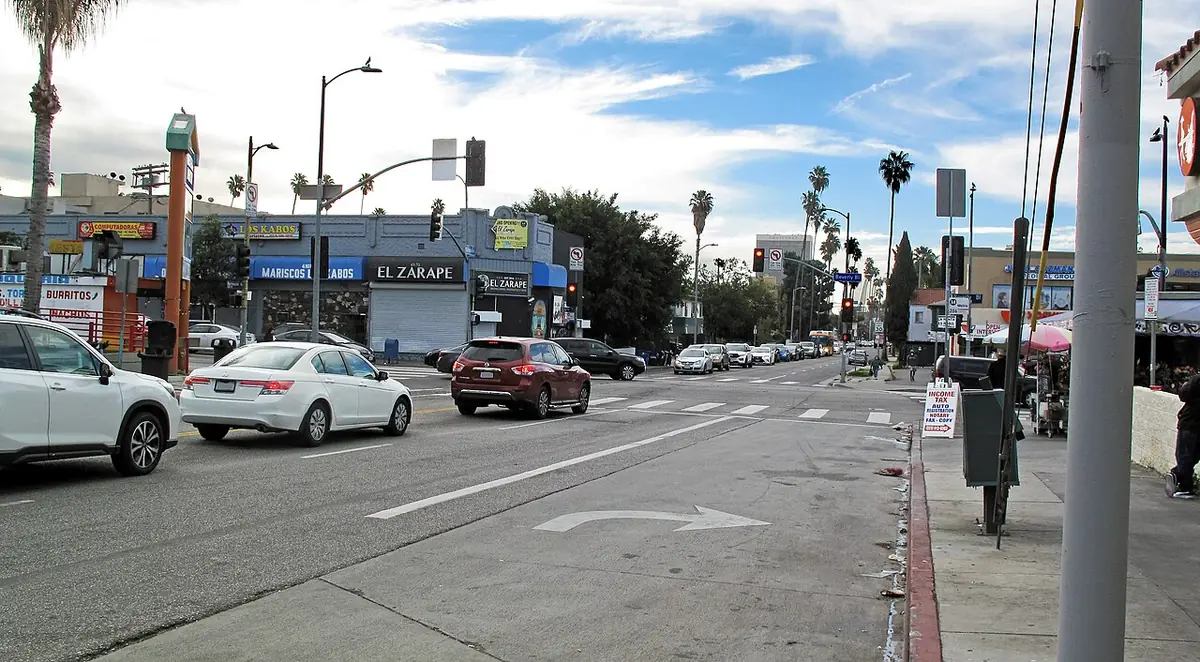
A lively corner of Los Angeles, shops and traffic side by side — Photo: Downtowngal · CC BY-SA 4.0 · Wikimedia Commons
Beyond the purely financial figures, the legal nature of what is being valued deserves particular attention.
Anchoring a valuation for a Los Angeles apartment takes more than the advertised asking price of the nearest listing. You have to work in the associated costs, the local taxes and the recurring charges that weigh on ownership, because a buyer nets them off before deciding what to pay. Market data shows wide dispersion depending on the standing of the building, its age and the exact location within the county, which is why a single citywide rate per square metre is never enough.
los-angelesFor saleApartmentestimate
Median price / m²US$6,175Half the apartments sell below this
Median priceUS$620kthe average is 14% higher — a few very large properties pull it up
Most common2 bedrooms40 % of listings
Average size95 m²
By number of bedrooms
Bedrooms
Share of market
Avg price
Price / m²
Avg size
1
32 %
US$473k
US$7,280 +12 %
65 m²
2most common
40 %
US$618k
US$6,500
95 m²
3
22 %
US$772k
US$6,175best value / m²
125 m²
4
6 %
US$988k
US$6,175best value / m²
160 m²
Each row is an average, compared against the area average of US$6,500 / m². These are indicative estimates of a typical local market, not a measured sample of live listings. Check current listings before relying on them.
What is actually being valued: condominium or cooperative
That legal distinction explains why the steps used to verify a figure matter as much as the figure itself.
The American legal system offers different forms of collective ownership, and they change your rights, your obligations and the future resale of the home in ways that show up directly in a valuation. The local structures known as condos and co-ops answer to very strict governance logic, and an estimate that treats them as interchangeable will be wrong before it starts.
The condominium (condo)
You own your private volume (the apartment) outright, together with an undivided share of the common areas (roof, lifts, pool, gardens). You hold an individual deed that you can mortgage, let or sell on, subject to the rules set by the association.
What it changesFor a valuation this is the straightforward case: recorded sales of comparable condos give a defensible figure, provided you deduct the weight of the monthly HOA dues a buyer will inherit.
Cooperative housing (co-op)
You are not buying real estate directly but shares in a company that owns the whole building. In exchange for those shares you receive a long-term proprietary lease entitling you to occupy a specific apartment in the building.
What it changesThe co-op board has discretion to accept or refuse any incoming purchaser, which protects the community but restricts liquidity, and a valuation has to reflect that narrower buyer pool with a discount against a comparable condo.
The rule to understand before you trust a figure
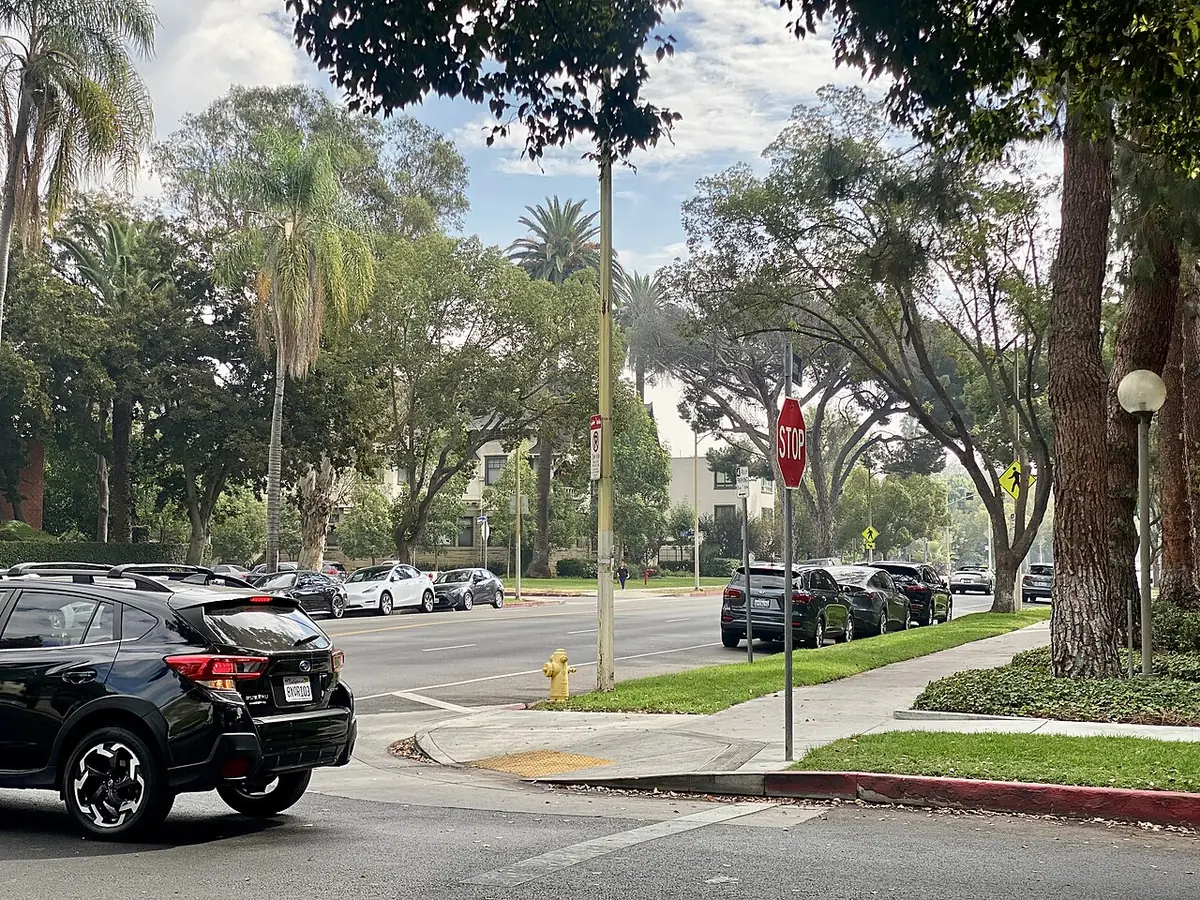
A quiet, palm-lined street in the University Park neighbourhood — Photo: EEJCC · CC0 · Wikimedia Commons
Once those checks are cleared, the people who produce and test the figure each play a precise and separate role.
Testing a valuation in California follows a strict timetable and a set of conditional protections. Accepting a figure, or letting a buyer pay a deposit against it, before every contingency has been worked through exposes both sides to a costly correction later. Understanding the chain of legal verifications is what turns an opening estimate into a number you can rely on.
An agreed figure written into an accepted purchase agreement, itself built on the agent's comparative market analysis.
The opening of the escrow account with a neutral third party responsible for holding the funds and the legal documents, which fixes the terms the figure will be measured against.
The physical inspection window, during which an expert assesses the structural, electrical and plumbing condition and supplies the basis for every condition adjustment.
The lender's appraisal and the release of the loan contingency, confirming that an independent licensed appraiser supports the figure the parties agreed.
The final review of the HOA disclosures, the reserve study and the local natural hazard statement, each of which can move the number before closing.
Closing and the official transfer of title at the county registry, at which point the recorded price becomes the comparable that will anchor the next valuation on the street.
Who produces the figure, step by step
Establishing and confirming a value in Los Angeles draws on an ecosystem of independent experts whose roles are strictly bounded by Californian law. Rather than one office centralising the paperwork, the procedure spreads responsibility across agents, escrow and title companies, inspectors, lenders and licensed appraisers, and each of them touches a different part of the number.
The real estate agent (buyer's or seller's agent)Comparative market analysisThe agent assembles recent recorded sales, adjusts them for size, floor, condition and view, and produces the comparative market analysis that opens the conversation on price.
The escrow officerHolding the terms the figure rests onA neutral, independent third party, the escrow officer makes sure every condition of the contract is met before funds are released and the sale is recorded, which is what makes the final price verifiable.
The home inspectorFull technical auditThe inspector goes through the systems, the plumbing, the roof and the foundations to produce a detailed report on the real condition of the property, supplying the deductions that separate a generic figure from a specific one.
The title companyLegal guarantee of ownershipIt checks the history of title to make sure no dispute, hidden mortgage or lien sits against the property, since an encumbrance nobody spotted can wipe out a large part of the value.
The mortgage broker or lenderTesting the figure against financeThe lender builds the credit file, assesses solvency against American criteria and will only advance funds against a value it accepts, which puts a practical ceiling on what the market can pay.
The licensed appraiserIndependent estimate of market valueInstructed by the bank, the appraiser confirms the objective value of the property to make sure it matches the amount of the loan being granted, and their report is the closest thing to a formal valuation in the process.
Single-family house or apartment in Los Angeles: why the two are valued differently
With that distinction settled, it is worth turning to the concrete figures behind a valuation and the costs that sit under them.
A single-family house and an apartment in Los Angeles are priced by different buyers, and a valuation that ignores this will land wide of the mark. Detached houses, particularly sought after in residential neighbourhoods such as Sherman Oaks or West Los Angeles, offer valuable private space but come with heavy maintenance obligations and greater dependence on the car. A buyer accepts spending considerable time driving for the smallest errand, because the urban structure is built for sprawl, and that acceptance is priced into what they will pay. For families looking for relative quiet and a plot of land the appeal is obvious, but the acquisition and upkeep budget is substantial, and many owners underestimate it when they first arrive.
An apartment, whether in a mid-century building in Santa Monica or a modern tower in the heart of Downtown LA, is valued against a different set of expectations. Association dues generally include maintenance of the pool, the gym and the shared outdoor space, which removes tedious chores and shows up as a premium in the estimate when the dues are proportionate. This is the option favoured by working buyers who want denser urban life, where some services and shops stay reachable on foot. Against that, the valuation has to reflect shared walls, potential noise from neighbours and association rules that are sometimes strict on pets or on Airbnb-style letting.
The financial comparison never stops at the headline price shown on the property portals. A single-family house generates high energy bills for cooling large volumes and property taxes indexed to market value that rise steadily. An apartment carries monthly HOA fees that can be very high in buildings with extensive amenities, weighing heavily on a recurring budget regardless of any mortgage. A credible valuation therefore looks at total cost of ownership over ten years, folding in these invisible charges that weigh as much as the loan instalment itself, because that is precisely what the buyer will do.
Tolerance for the daily commute also carries real weight in the number. Moving to a large house on the periphery to gain square metres often means two hours a day on the brakes along congested motorways such as the I-405 or the I-10. A well-located apartment, even a more modest one, gives that time back, and buyers pay for it in a way that no rate per square metre captures on its own. Location adjustments in a Los Angeles valuation are, in the end, adjustments for time.
The figures that sit behind a valuation for a Los Angeles apartment
With those figures set out, it helps to understand what an ordinary day in this urban environment really looks like, because that is what a buyer is paying for.
Valuing an apartment in Los Angeles demands a whole-picture view of the money involved, far beyond the face price displayed by agencies. Between local property tax, monthly association dues and the insurance made necessary by natural hazards, the monthly envelope is often surprising, and every dollar of it is netted off by a buyer weighing your asking price. Data gathered from local market participants allows a realistic grid of the unavoidable cost lines to be drawn up. Applying that rigour to the future cash flows is what stops a valuation from unravelling once escrow opens and the title company circulates the closing statement.
Reference figures for valuing a standard apartment
Line item
Estimated range in USD
What it tells the valuation
Median transaction value
$600,000 - $900,000
Applies to a two-bedroom apartment in the sought-after neighbourhoods on the west side of the city, and sets the bracket your comparables should fall into.
Deposit a lender expects
$120,000 - $180,000
Generally 20%, to avoid PMI mortgage insurance and reassure Californian banks, which is why the appraisal has to support at least the remaining loan amount.
Closing costs
$12,000 - $25,000
Include transfer taxes, title company fees and bank arrangement fees, and have to be deducted to turn a market value into net proceeds.
Closing costs in California are traditionally split or negotiated between buyer and seller, so leave a margin of safety when you translate a valuation into what you would receive.
Recurring monthly charges that shape what a buyer will pay
Nature of the charge
Average monthly amount
Effect on the estimate
Association dues (HOA)
$400 - $900
Varies sharply with the presence of a doorman, a pool and the age of the building, and high dues discount the achievable price against an otherwise identical unit.
Property tax
$600 - $1,000
Based on the local effective rate of around 1.1% to 1.2% of the original purchase value, so the assessed base can sit well below today's market figure.
Home and hazard insurance
$100 - $250
Essential, and often including an extension for the seismic risks specific to the region, which is a standing deduction from what a buyer will offer.
HOA dues rise almost every year to meet the growing cost of maintaining the infrastructure, and a thin reserve study is a warning sign for any valuation.
Health, schools and transport: the ordinary Tuesday your valuation is really pricing
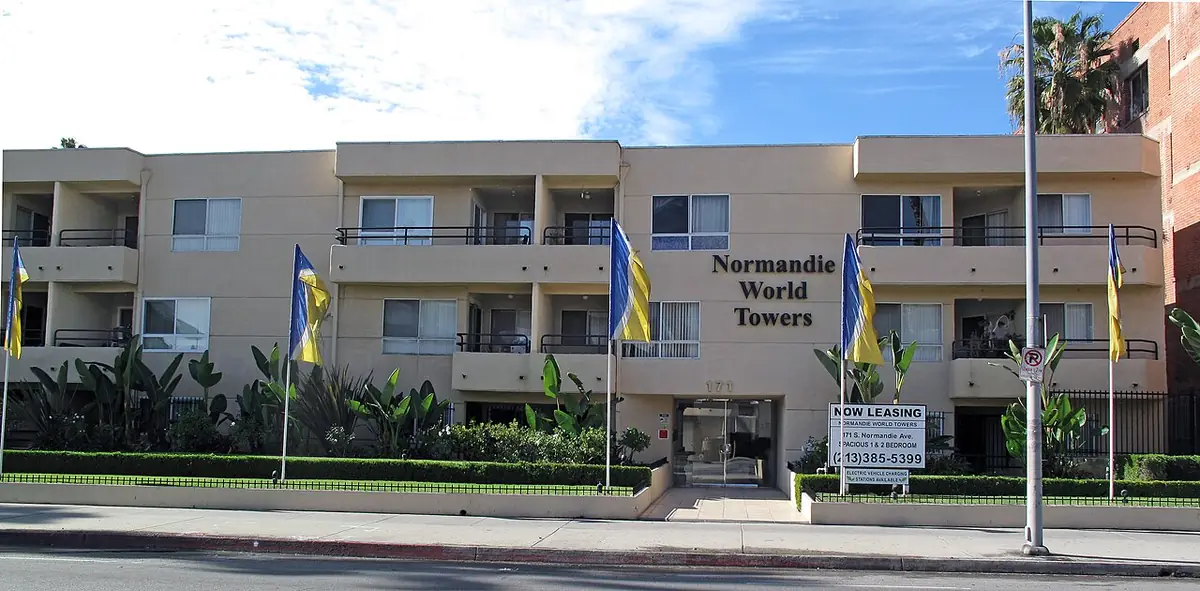
An apartment tower typical of Koreatown's housing stock — Photo: Downtowngal · CC BY-SA 4.0 · Wikimedia Commons
Beyond that well-worn routine, several crucial factors escape owners entirely when they first put a figure on their home.
To understand what an apartment is worth, you have to read the daily rhythm that the geography of Los Angeles imposes. Far from the fixed postcard image, local life is set by managing distance, optimising the morning journey and reaching health or education facilities. This timetable for an ordinary Tuesday illustrates the friction and the ease a resident will inevitably experience. It is that logistical friction which determines, in large part, the real value and the long-term desirability of the address you are valuing.
07:30Leaving the garage and joining the motorwayThe morning journey starts with a look at navigation apps to avoid the major jams on the main arteries such as the I-10 or the US-101. How smoothly that first transition goes is exactly the kind of everyday detail that separates two apartments priced alike on paper.
08:45Arriving at the office in Century City or DowntownParking is often handled by the employer or through an expensive monthly subscription in a secure underground garage. A deeded parking space in the building being valued is worth real money against a comparable without one.
12:30Lunch break and local errandsA good moment to use the local neighbourhood outlets or pick up food quickly at places such as Whole Foods or Trader Joe's reachable on foot from work. Walkable everyday retail near the building is one of the few amenities that shows up consistently in comparable sales.
17:30The journey home and a stop for healthcareA check-up at a medical centre affiliated to a recognised network such as UCLA Health or Cedars-Sinai. Medical provision is excellent in density but requires booking many months ahead, and proximity to these networks supports values in the surrounding blocks.
19:30Back at the building and dealing with the associationUsing the shared facilities, checking the secure mail and a quick word with the building manager about common area maintenance or garage security. The state of those common parts is one of the first things an appraiser records.
What no automated estimate will tell you about Los Angeles apartments
These blind spots show how far a badly built figure can drift, and how that drift turns into lasting regret a few months later.
The bright photographs on the property portals, and the automated estimates built on them, deliberately leave out the structural and regulatory constraints that define ownership in Los Angeles. Between the subtleties of local condominium law, the real state of ageing infrastructure and the planning rules, the legal reality is far more complex than it appears. To avoid signing off on a figure blind, you have to hunt for the signals that never appear in a commercial description. Here are the four dimensions sellers, and algorithms, are least likely to surface.
Live litigation inside the association (HOA litigation)
Many buildings face legal proceedings involving the original contractor, or large arrears of dues from other owners. Such disputes block conventional mortgage lending from the major banks, forcing buyers towards costlier alternative finance or out of the deal altogether, and any valuation that ignores them is overstated by a wide margin.
The absence of central air conditioning in older buildings
The architectural charm of the 1950s often hides obsolete electrical installations incapable of supporting modern air conditioning units. During summer heatwaves the lack of a central system turns the apartment into a furnace, and the heavy works needed, subject to complex association approval, are a deduction an automated estimate will never make.
Future construction projects within your line of sight
The pace of development in Los Angeles means a vacant lot or a modest neighbouring bungalow can be demolished to make way for a five-storey building. That densification removes natural light, destroys the view and generates construction noise for years with no recourse, and it can undo the view premium your comparables were carrying.
Severe restrictions on short-term letting
The city applies extremely strict rules against Airbnb-style letting, drastically limiting the ability to let the property while you are away. Any valuation that leans on assumed short-term rental income is building on ground that municipal fines can remove overnight.
The valuation mistakes owners discover six months later in Los Angeles
Given how easily a figure can mislead, it is fair to ask who really needs a formal valuation and who can work with something lighter.
Looked likeA remarkable figure for a spacious home in an up-and-coming neighbourhood, well below the citywide rate per square metre.
Turned outAn area suffering from unsuspected night-time noise and street-level crime that deters anyone from walking out in the evening, which is precisely why the comparables were cheap.
Would have caught itVisiting the property at different times of day, notably late on a Friday evening, and asking several neighbours directly in the local shops before you trust the discount.
Looked likeModerate association dues, suggesting a building whose common areas and pool were being maintained cheaply.
Turned outChronic under-funding of the association's reserves, followed by an abrupt vote for a special assessment of several tens of thousands of dollars per owner, wiping out the assumed value overnight.
Would have caught itInsisting on a full review of the reserve study and the minutes of the last three years of general meetings by a specialist agent or a legal adviser before you fix a figure.
Looked likeA reasonable commute to work, tested by driving the route on a Sunday afternoon.
Turned outA road trap from Monday to Friday, turning every journey into an ordeal and cutting the owner off socially, with the price paid reflecting a convenience that did not exist.
Would have caught itTesting the exact journey at real peak times, between 07:30 and 09:00 and again between 17:00 and 18:30, before treating location as a positive adjustment.
Looked likeAdequate sound insulation in a building with careful, freshly repainted interior finishes.
Turned outVery thin plasterboard partitions that let through the slightest noise from adjoining neighbours, making remote work or daytime rest difficult and undermining the premium paid for the refurbishment.
Would have caught itAsking for a period of complete silence during a second viewing to test the real acoustic behaviour of the walls and the floors between units.
Who genuinely needs a full valuation in Los Angeles, and who can do without one
It is time to draw these parameters together and help you decide how far to take your own estimate.
Putting a formal figure on a home in the city of angels is by no means a universal necessity. The local economic structure, the volatility of the market and the weight of the financial commitments involved demand a proper fit between your situation and the constraints of the region. Some owners get real value from a full professional appraisal, while others would be spending money to confirm what a free tool already tells them well enough. Reading these profiles honestly helps you place your own needs.
The mobile young professional in transition on the west coast
→To rely on an automated online estimate and an agent's informal opinion rather than pay for a full appraisal.
With no near-term intention to sell, and with high exit costs on a quick resale (agency commissions of around 5% to 6%) that would consume any paper gain in a market that could still move, precision beyond a broad bracket buys nothing useful.
The couple with settled careers and a long-term view
→To commission a full comparative market analysis from a local agent, checked against a licensed appraiser's report.
Their financial stability lets them absorb market swings and smooth out association dues, and a documented figure is what allows them to capitalise on the historic land scarcity in this sought-after part of the city rather than guess at it.
The overseas investor expecting an immediate, effortless rental yield
→To insist on an independent licensed appraisal before committing, or to redirect the capital elsewhere.
The combined weight of property taxes, hazard insurance and association dues eats into net returns, so a headline figure that ignores them is actively misleading for a distant owner unfamiliar with Californian detail.
So, do you have a figure you can actually stand behind in Los Angeles?
At the end of this analysis you can see that valuing an apartment in Los Angeles is not an aesthetic judgement but a structured piece of work. Between the complexity of association dues, the reality of travel times and the deductions a buyer will make before offering, the Californian market does not forgive a rough approximation. If you have measured all of these frictions and your comparables genuinely match your property, then the economic fundamentals of the region will support the number you have arrived at.
Your figure should now rest on a relentless check of the evidence and on the help of honest local professionals. Never give in to the artificial pressure of a tight market, which pushes owners into accepting a number too quickly and on too little documentation. Take the time to go through every accounting document from the association and to test your estimate against several years of recorded sales, allowing for foreseeable rises in rates and taxes.
Valuing in Los Angeles means accepting the rhythm of a metropolis that is unique in the world, vibrant and demanding at once. If the property and its setting are ones you know well, build your estimate on rigour and patience. That, and financial clear-headedness, is what turns a number on a page into a decision you can act on.
Related questions
How much does property tax weigh on the value of an apartment in Los Angeles?
The local property tax generally runs at around 1.1% to 1.2% of the original purchase value of the home. That rate is governed by California's well-known Proposition 13, which caps annual increases in the assessed base for as long as the property does not change hands, so the county assessor's assessed value can sit far below what the apartment is worth on the open market.
Can a non-resident foreign owner have a property in Los Angeles valued?
Yes. California law does not bar foreign investors from owning real estate, and nothing restricts who may commission a valuation. Local banks do apply stricter financing files, with a down payment often above 30%, and specific tax rules apply on resale, which is why an owner abroad usually wants a figure documented well before listing.
How exactly do HOA dues in Los Angeles condominium buildings affect a valuation?
HOA fees are the monthly dues paid to the building's homeowners association. They cover maintenance of the common areas, cleaning, security, insurance on the structure and sometimes water or waste collection. Because a buyer treats them as a fixed monthly cost, high dues pull the achievable price down even where the apartment itself is identical to a cheaper comparable.
Does earthquake cover change what an apartment is worth?
Standard home insurance in California does not cover damage caused by major earthquakes. A specific extension or a dedicated policy (such as the one offered by the public CEA authority) has to be taken out on top, which raises the annual insurance budget noticeably and, like any recurring cost, is weighed by buyers when they decide what they will pay.
What closing costs should be netted off a valuation figure?
Closing costs generally represent between 1% and 2% of the total purchase price. They include the title company's fees, the fees for recording the deed and the local transfer taxes charged by the municipality. Subtracting them from your headline figure is what turns a market value into the amount you would actually walk away with.
Why do public schools matter when an apartment is valued in Los Angeles?
The public education system depends largely on the local school districts and on the property taxes collected in the geographic area. The reputation of the schools directly and strongly influences the value of the surrounding apartments and houses, which is why a valuation that ignores the attendance boundary can be out by a wide margin.
How long does it take to confirm a valuation through an actual sale in California?
Once the seller has accepted an offer, the closing process (the escrow period) generally takes between thirty and forty-five days. That window allows for thorough technical inspections, for the contingencies to be released and for final loan approval, and it is also when the lender's appraisal either supports the agreed figure or forces the parties back to the table.
Could apartment values fall in the region in the short term?
The Los Angeles property market is structurally supported by a severe scarcity of buildable land and by constant demographic demand. High interest rates may slow the rise in prices, but a sharp fall has historically been unlikely in the most sought-after neighbourhoods, which is why valuations there tend to move in narrow steps rather than jumps.
What does a home inspection contribute to the estimate?
The inspection is a crucial stage carried out by an independent professional who examines the state of the plumbing, the electrics, the roof and the structure of the apartment. The detailed report is what turns a generic figure into a condition-adjusted one, letting the parties negotiate a lower price or ask for repairs before the contingencies are released.
Why do American agents play such a central role in valuing a property?
The North American system rests on tightly controlled shared databases (the MLS) and on separate representation for buyer and seller. An experienced agent is essential to read the price history of the neighbourhood, select the comparables that genuinely match your apartment and produce a comparative market analysis that stands up in a competitive market.