Buying a home in Los Angeles takes a disciplined method if you want the process to stay calm from start to finish. This guide sets out the realities of the local market, the legal specifics of shared ownership, and the steps you cannot skip if the purchase is going to work under the California sun.
Get the app
What nobody tells you.
Real prices, hidden costs and the traps to check before you commit.
What buying an apartment in Los Angeles really commits you to over the long run
Scroll
What buying an apartment in Los Angeles really commits you to over the long run
Buying a home in Los Angeles takes a disciplined method if you want the process to stay calm from start to finish. This guide sets out the realities of the local market, the legal specifics of shared ownership, and the steps you cannot skip if the purchase is going to work under the California sun.
Written by the ting.ad editorial team ·
West 1st Street, Los Angeles in Street View: drag to look around.
Before you commit, it is worth measuring whether your buyer profile fits what this particular market demands.
Buying property in Los Angeles is not simply a matter of acquiring square meters under the California sun. Each neighborhood sets its own rules on returns, management, and access to services. You have to weigh urban energy against residential quiet, while factoring in strict regulatory constraints and ancillary costs that buyers from abroad routinely underestimate. The market rewards a cold reading of local dynamics and punishes the buyer who skips it.
The promise of a fast rise in valuevsThe reality of a highly cyclical market
Prices can stall for long stretches depending on Federal Reserve policy rates and how local property taxation evolves.
The myth of simple rental managementvsThe weight of shared-ownership dues and HOAs
Owners' associations hold broad powers and can impose heavy special assessments for building works.
The appeal of central city livingvsThe daily reality of getting around and parking
Owning a home does not exempt you from the traffic, or from the physical distance between the metro area's separate centers of activity.
Which kind of buyer are you, measured against what the Los Angeles market demands?
The cultural and regulatory shift is total for a buyer arriving from abroad with a different set of legal reference points.
How well your home fits your way of living decides whether a Los Angeles purchase works out. An investor chasing immediate rental yield will not follow the same strategy as someone relocating for the year or someone after a seasonal base. The constraints of use, upkeep, and regulation differ sharply depending on your personal situation and your medium-term goals for the asset.
Primary residence
Your first priorities are the quality of the school infrastructure, proximity to employment centers, and how well the road network flows for your daily commute. Buying an apartment means accepting how American shared-ownership works, including house rules that can be strict. Your decision will rest on the stability of the neighborhood and its capacity to hold its residential appeal over a decade or more.
Rental investment
Focus on rent ceilings, the historical occupancy rate for the area, and the exact figure for the recurring dues paid to the association. The rules governing short-term furnished letting in Los Angeles demand faultless administrative compliance, and the financial penalties for getting it wrong are heavy. Your choice of property manager on the ground then becomes the pivot on which your net return turns.
Pied-a-terre
You have to weigh long vacancy while you are away against the fixed costs that keep running regardless. Building security, an on-site doorman, and how easily the property can be shut up and left matter more than floor area. You also need a plan for handling technical incidents or maintenance visits remotely.
What changes fundamentally between the property system you know abroad and the one in Los Angeles
Once those reference points are in place, choosing the right geographic area becomes the cornerstone of your search.
Carrying the buying instincts you formed in another country onto the Los Angeles market leads, without fail, to misjudgments. From the shape of an offer to the roles the professionals play, and through the central importance of the title and the insurance around it, the procedures follow a highly formalized common-law culture. Understanding those structural divergences is essential to carrying a transaction through without an unpleasant surprise.
From abroad
A sale agreement signed before a public officer, with a statutory cooling-off period protecting the buyer
Los Angeles
The standardized Purchase Agreement, negotiated by agents and administered through escrow
Your contingencies have to be drafted with extreme precision so that you can walk away without losing your deposit.
From abroad
A single public official who secures the whole legal and tax chain from end to end
Los Angeles
The escrow company and the title insurance company
No single officer plays that role here; legal certainty rests on a thorough check of the property's history and on confirming that prior mortgages have been cleared.
From abroad
Transfer fees and registration taxes that are uniform and moderate across the country
Los Angeles
Local property taxes reassessed on the purchase value, plus variable transfer taxes
The long-term cost of holding the property includes significant local taxes that feed straight into your annual budget.
From abroad
Shared ownership governed by protective national statute, with rules that are the same everywhere
Los Angeles
Internal shared-ownership rules (CC&Rs) administered independently by each HOA board
You need to go through the association's financial health and any live litigation before releasing your purchase contingencies.
How to find your way among the main residential areas of Los Angeles
Looking at the prices being paid across these areas lets you frame the budget you actually need.
The geography of Los Angeles is vast, fragmented, and marked by urban atmospheres that shift dramatically from one neighborhood to the next. Each area answers a specific set of expectations around quality of life, accessibility, and economic energy. Knowing what daily life in these districts is really like keeps the postcard image from colliding with the everyday.
Downtown Los Angeles
A vertical buzz set to the rhythm of office towers, cultural venues, and the flow of professionals during the day.
Suits
Buyers who want a dense, current urban life close to the major transport infrastructure.
Trade-off
A sharp change of character at night on some streets, and a property market exposed to strong rental volatility.
Westside (Santa Monica / Brentwood)
A carefully held balance between the ocean a few blocks away, busy shopping avenues, and a firmly residential calm.
Suits
Those who prize sea air, green space, and a highly rated urban setting.
Trade-off
Prices per m2 among the highest in the metro area, and fierce competition between buyers.
Mid-Wilshire / Koreatown
A dense, multicultural crossroads with a rich food scene and a strategically central position.
Suits
Investors and residents who want a central base from which to reach the whole Los Angeles basin.
Trade-off
Recurring parking difficulties and strong architectural inconsistency from one street to the next.
The budget orders of magnitude to expect when buying an apartment
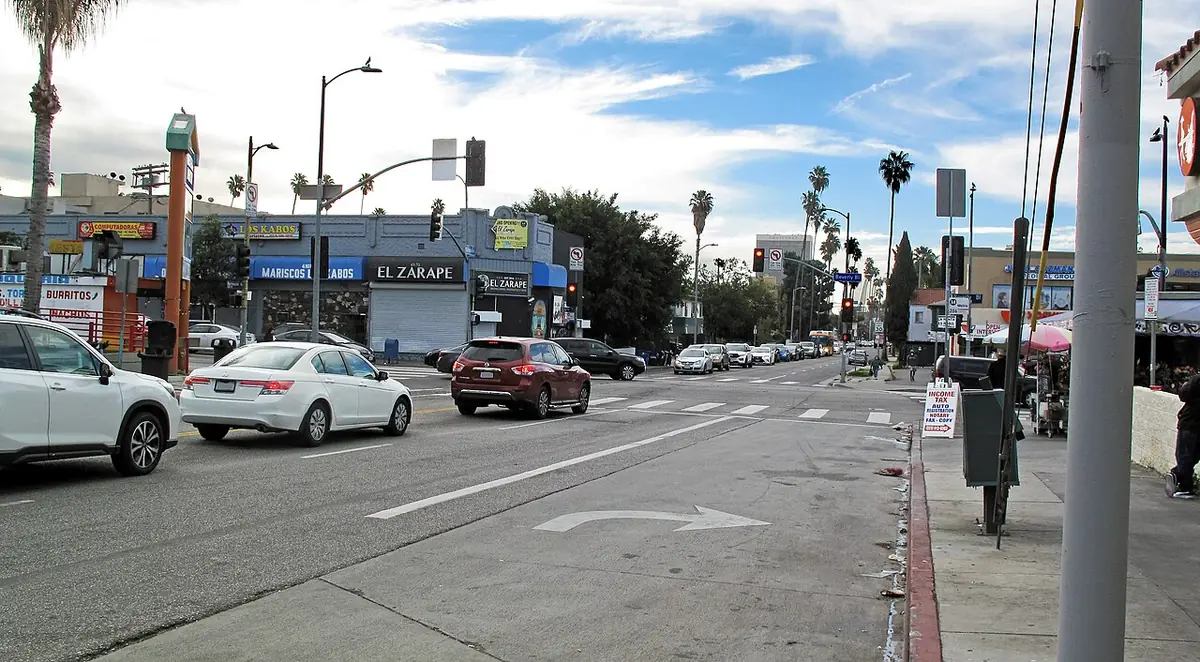
A lively corner of Los Angeles, shops and traffic side by side — Photo: Downtowngal · CC BY-SA 4.0 · Wikimedia Commons
Beyond the raw figures, the legal nature of what you own deserves very close attention.
Buying property in Los Angeles calls for a whole-of-budget view that takes in the headline price, transaction costs, local taxes, and recurring dues. The ranges vary considerably with the age of the building, the amenities on offer, and the exact location. The figures below reflect the trends observed in the market and are there to help you structure your financing plan.
los-angelesFor saleApartmentestimate
Median price / m²US$6,175Half the apartments sell below this
Median priceUS$620kthe average is 14% higher — a few very large properties pull it up
Most common2 bedrooms40 % of listings
Average size95 m²
By number of bedrooms
Bedrooms
Share of market
Avg price
Price / m²
Avg size
1
32 %
US$473k
US$7,280 +12 %
65 m²
2most common
40 %
US$618k
US$6,500
95 m²
3
22 %
US$772k
US$6,175best value / m²
125 m²
4
6 %
US$988k
US$6,175best value / m²
160 m²
Each row is an average, compared against the area average of US$6,500 / m². These are indicative estimates of a typical local market, not a measured sample of live listings. Check current listings before relying on them.
Shared ownership: what you legally hold, and where it stops
That legal structure sits inside a tightly mapped transaction process that has to be followed step by step.
Shared ownership in the United States carries fundamental legal subtleties that differ from European practice. Understanding the distinction between the private units, the common areas, and the land status of the building itself prevents serious disappointment at resale or when the owners collectively vote through major works.
The standard condominium regime
You own your apartment outright within its walls and hold an undivided share of the common areas and of the land the building sits on. That structure gives you a vote at general meetings and direct influence over how the association is run, through the elected board.
What it changesYou take part directly in the financial decisions and you carry the increases in dues voted collectively to preserve the shared asset.
The share-ownership regime (Co-op)
Rarer in Los Angeles but present in certain specific developments, here you are not buying real property directly but shares in a company that owns the building, paired with an exclusive occupancy lease. That structure lets the cooperative keep strict control over who may buy in and on what terms a unit may be let.
What it changesResale and letting are both subject to the board's discretionary approval.
The critical sequence to master before you hand over a single dollar
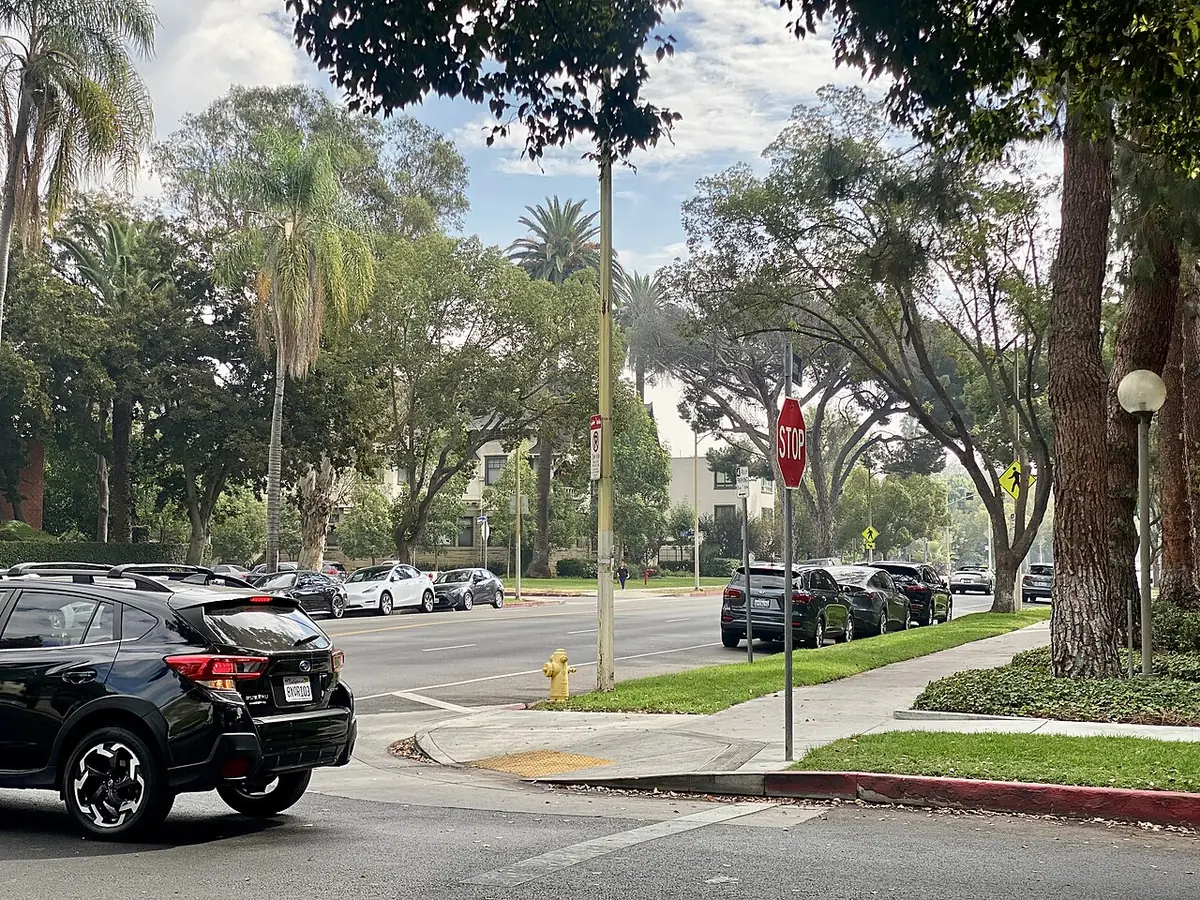
A quiet, palm-lined street in the University Park neighbourhood — Photo: EEJCC · CC0 · Wikimedia Commons
Orchestrating that timeline takes a coordinated set of qualified professionals.
Securing a property transaction in Los Angeles rests on a rigorous chronological sequence in which each stage either releases or suspends the parties' commitments. Missing a contractual deadline, or being careless in checking the technical documents, can cost you your initial deposit.
Your agent drafts and submits the formal offer to purchase
The seller accepts the offer and the earnest money deposit is placed into a dedicated escrow account.
The due diligence and inspection period formally opens, generally set at 17 days.
The independent technical inspections are carried out: pest report, structure, plumbing, electrical, and the compliance of the shared-ownership documents.
The loan contingency is released once your mortgage has been definitively approved.
Final signature of the transfer at closing, and public recording of the title.
Who does what along your purchase in Los Angeles
The California property market runs on an ecosystem of specialists with strictly defined roles. Rather than concentrating most of the process in the hands of one official, as several other countries do, an American transaction spreads responsibility across independent parties whose combined work delivers the legal and financial security of your purchase.
The buyer's agentAdvice and negotiationThey represent your interests alone while you search and while the offer is drafted, and are paid through a commission shared out of the seller's side.
The escrow companyNeutral stakeholderA neutral, independent third party, it holds the funds, collects the legal documents, and orchestrates the final transfer of money and title.
The title insurance companyLegal certaintyIt reviews the property's full history to guarantee that no hidden mortgage or ownership claim will land on your purchase.
The independent home inspectorAudit of the buildingThey write a thorough report on the real condition of the apartment and its systems, which gives you grounds to renegotiate or to withdraw.
The mortgage broker or bankFinancingThey put your loan file together, taking account of your tax status and your country of tax residence.
Apartment or single-family house: which one really wins in Los Angeles?
Once that fundamental choice between collective and individual living is settled, the crucial question of the financial reality and the budgets needed to settle in the metro area for good still stands.
Choosing between buying an apartment under shared ownership and buying a single-family house in Los Angeles is not a matter of aesthetic preference; it is a deep trade-off between lifestyle, time management, and long-term financial structure. On one side, an apartment in a dense area such as Downtown, Koreatown, or West Hollywood puts you within reach of employment centers, transport, and a crowded cultural life, while cutting the burden of physical upkeep and yard work dramatically. On the other, the individual house with its own plot, more easily found in the San Fernando Valley or the South Bay, guarantees complete independence from immediate neighbors and an architectural autonomy that families in search of space value highly. That apparent freedom, however, carries a considerable financial and logistical cost that weighs on the day-to-day budget. Buyers have to assess coldly how much urban noise they can tolerate against their capacity to absorb daily commutes that are often long and draining on the metro area's congested freeways.
Los Angeles condominium buildings, usually run by owners' associations known as HOAs (Homeowners Associations), impose strict rules that govern residents' daily lives. Monthly dues can be high and unpredictable, rising regularly to fund facade repairs, seismic retrofits, or the resurfacing of shared pools. In exchange, those dues cover security, upkeep of the outdoor areas, and sometimes even water or gas, freeing the occupant from any heavy maintenance duty. For a buyer who travels often, or who works long hours in the city's technology or legal sectors, that turnkey arrangement is an undeniable operational comfort. The major risk lies in an HOA that is financially badly run, which can drag down the value of the property and impose sudden special assessments that an unprepared buyer discovers far too late, at the closing table.
Buying a single-family house in Los Angeles, by contrast, puts the entire maintenance burden on the owner's shoulders. Whether it is repairing a roof worn down by relentless sun, bringing foundations up to code, or running an automatic irrigation system to keep a lawn alive through a drought, every intervention is a direct and often very high cost, because skilled labor in California is both scarce and expensive. In exchange, the individual house has historically been the more resilient asset and offers far greater freedom to alter the property, allowing for instance the addition of an ADU (Accessory Dwelling Unit) to generate extra rental income or house family members. It is therefore a long-term investment choice that demands not only a larger initial capital outlay but also a permanent reserve of attention and money to deal with the surprises inherent in California construction.
In the end, the decision between these two types of property in Los Angeles turns above all on your stage of life and your tolerance for geographic compromise. If you value centrality, compactness, and being able to walk into a lively neighborhood, the apartment makes its own case despite its binding rules and recurring charges. If privacy, room for a growing family, and independent ownership of your land sit at the top of your list, you will have to accept a longer daily commute and the obligation to maintain the property yourself. Neither choice is universally better; they simply answer radically different visions of how to live in the sprawl of the City of Angels, where every square meter is paid for dearly.
What budget should you really plan for housing and living in Los Angeles?
Once the budget is settled, it helps to picture a typical day concretely and see what distances and infrastructure do to your quality of life.
Buying an apartment in Los Angeles is not simply a matter of paying the price shown on the listing portals. You have to take in a whole cost structure: local property tax, home insurance that runs high because of fire risk, HOA dues, and the unavoidable expenses of daily life. Data compiled by California's professional real estate associations shows spectacular disparities from one part of the city to another, which forces the buyer to calibrate a financing plan with absolute rigor to avoid defaulting partway through the loan.
Purchase price ranges and associated charges by major area
Area
Median apartment price
Estimated property tax
Monthly HOA dues
Downtown / Koreatown
$550,000 - $850,000
1.1% - 1.25%
$450 - $900
Westside (Santa Monica, Westwood)
$900,000 - $1,600,000
1.1% - 1.25%
$600 - $1,200
San Fernando Valley
$450,000 - $700,000
1.1% - 1.25%
$300 - $650
Property taxes in California are constrained by Proposition 13, which caps their annual increase, but the gross base rate sits around 1.1% to 1.25% of the initial purchase value depending on the municipality and any specific local obligations.
Estimated monthly budget for a two-person household living in an apartment
Main expense category
Low end
High end
Context
Food and groceries
$800
$1,400
Organic chains and local markets weigh heavily on the food budget.
Transport (fuel, insurance, tolls)
$400
$900
Daily use of a personal vehicle is unavoidable for most journeys.
Insurance and healthcare
$600
$1,500
Car and medical insurance premiums in California are among the highest in the country.
These figures exclude repayment of the mortgage itself as well as HOA dues; they represent only the money needed to live decently day to day in the metro area.
Health, schools, and transport: what does an ordinary Tuesday in Los Angeles look like?
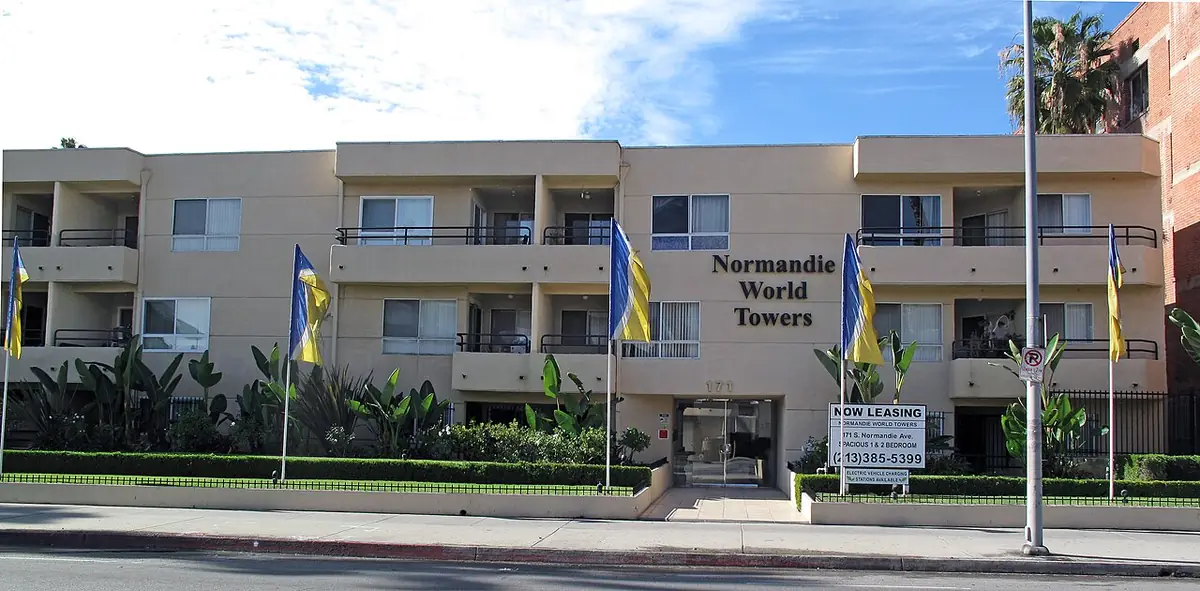
An apartment tower typical of Koreatown's housing stock — Photo: Downtowngal · CC BY-SA 4.0 · Wikimedia Commons
Beyond that timed routine shared by every resident, buying property in Los Angeles carries hidden subtleties that agencies carefully leave out of their brochures.
An ordinary day in Los Angeles is dictated by the sprawling geography of the city and by the legendary density of its car traffic. For an apartment owner, managing the commute to work is the central variable on which personal balance depends. Between medical appointments spread across specialist clinics, school runs, and the absolute constraint of driving on the freeway network, every hour of the day is finely timed to dodge the worst of the congestion.
07:30 - 08:30Commute on the freeway (for example the I-405 or the I-10)The most delicate moment of the day, when traffic flow is completely unpredictable and a fifteen-kilometer drive turns into an hour-long test of patience.
08:30 - 12:30Working morning at the office or in a coworking spaceProfessional activity concentrates in the business hubs of Century City, Downtown, or Silicon Beach, with a quick lunch grabbed on the move.
12:30 - 13:30Business lunch or a local grocery runA window to stock up at local supermarkets such as Whole Foods or Trader Joe's sitting at the foot of the residential buildings in the denser neighborhoods.
15:30 - 17:00School pickup and after-school activitiesFamily obligations handled across public school districts or private institutions, which means crossing neighborhoods with very complicated traffic patterns.
18:00 - 19:30Home again, and building mattersArriving back at the apartment, checking the mail, catching the building manager about shared services, and dealing with delivered parcels.
20:00 - 22:00Local downtime and rest in the neighborhoodMaking use of what is within walking distance of the building for dinner or a short walk before getting the next day ready.
What the polished listings will never tell you about Los Angeles
Those hidden physical realities lead straight into the strategic mistakes most commonly made by buyers from abroad or from outside the region.
Marketing photographs of Los Angeles apartments show, without exception, light-filled interiors, pared-back kitchens, and uninterrupted views of the ocean or the green hills. The daily reality of living there runs into structural and environmental constraints that the sales material skillfully erases. Understanding these undocumented aspects is essential if you want to avoid a painful disappointment, psychological and financial, after the purchase.
The impact of permanent urban noise
Many buildings along the major traffic arteries carry high decibel levels day and night, and standard double glazing does not always damp it effectively, which disrupts occupants' sleep over the long term.
The legal complexity of parking rules
Owning an apartment does not automatically come with a comfortable private parking space, and street parking is subject to rigorous weekly street-cleaning restrictions that carry steep fines and a frequent risk of being towed.
The strict restrictions on short-term rentals
The city of Los Angeles enforces a severe regime on platforms like Airbnb, banning short-term letting of your property if it is not your permanent primary residence, which wipes out any hope of flexible rental income.
The hidden wear in the building's internal infrastructure
Several buildings put up during the property booms of past decades suffer from aging pipework and obsolete electrical systems that will sooner or later require very expensive compliance works, voted through at a general meeting.
Micro-climate variation and air pollution
The bowl-shaped geography of Los Angeles regularly traps fine particles, and some inland neighborhoods go through episodes of heavy smog and stifling heat that make constant air conditioning unavoidable.
The buying mistakes you only discover after six months in Los Angeles
Those disappointments lead naturally to a question about who should simply give up on the idea of buying here at all.
Looked likeAn ideal rental investment, easy to manage from a distance, in a fashionable part of the city.
Turned outA financial sinkhole run by a rigid owners' association that bans short leases and keeps issuing unplanned assessments to redo the facade.
Would have caught itGoing through the minutes of the HOA's last three general meetings line by line and checking the exact state of the reserve fund before signing any binding offer.
Looked likeA charming, quiet, affordable building right beside the main routes to work.
Turned outA permanent acoustic ordeal, thanks to the constant passage of emergency vehicles and heavy traffic on the neighboring boulevard from first light.
Would have caught itVisiting the property at different times of day, especially during the morning and evening peaks, with the windows open, to measure the real noise level objectively.
Looked likeA spacious apartment with fast resale potential and a gain guaranteed in the short term by the momentum of the California market.
Turned outA property hard to resell at the hoped-for price because of a noisy retail zone nearby and a lack of green space within walking distance.
Would have caught itAnalyzing the full history of recent transactions on the same street and testing the neighborhood's real liquidity with independent agents who earn nothing on the sale.
Looked likeA purchase with no major surprises, thanks to the standard inspection report the seller provided before the transaction closed.
Turned outThe quick discovery of hidden structural defects inside the walls and chronic damp problems the original inspector never flagged.
Would have caught itAlways hiring your own independent building inspector, one who specializes in seismic standards and in the weatherproofing of California apartment buildings.
Who should absolutely not buy an apartment in Los Angeles right now?
With those warnings set out, it is time for the final reckoning on whether your plan to buy in Los Angeles is ready.
Buying property in Los Angeles is often presented as the ultimate personal and financial achievement. Yet for certain profiles, taking on a long-term loan and carrying the constraints of California shared ownership is a serious strategic mistake. Set against the soothing pitch of the developers, a cold look at the buyers who struggle shows that it is sometimes far wiser to stay a tenant and keep your financial and geographic flexibility.
The young mobile professional in tech or entertainment
→Putting off any purchase and sticking to flexible month-to-month renting.
Job volatility and the chance of having to move quickly to another American city make buying an apartment financially absurd once you count the closing costs and the penalties of selling again early.
The overseas investor chasing immediate rental yield
→Staying out of Los Angeles property and placing the capital in international financial instruments instead.
Heavy local shared-ownership dues, the specific tax treatment of non-residents, and rent caps in certain zones cut the net return to levels that are simply not attractive.
The household with a down payment that just barely covers it and no safety savings
→Continuing to rent while building a solid emergency fund before contemplating any purchase.
Without a financial cushion to absorb an HOA special assessment or an unplanned repair inside the apartment, the path leads straight to personal bankruptcy.
So, are you ready to take the step and buy in Los Angeles?
At the end of this hard look at the realities of Los Angeles property, the decision to buy is no longer a matter of impulse or of an idealized California dream, but a lucid and methodical choice. You now know that each neighborhood has its own micro-climate, its formidable traffic constraints, and its strict shared-ownership rules governing daily life. Far from the postcard imagery, the reality of the City of Angels demands financial solidity that holds up under pressure, a proven tolerance for geographic compromise, and the ability to anticipate the hidden costs that arrive without fail once the keys change hands.
If your plan rests on a long-term view of ten years or more, if your professional income is firmly anchored in the metro area, and if you accept the constraints that come with shared ownership, then buying an apartment is a powerful and rewarding way to build an asset. California property has historically rewarded the patience and rigor of methodical investors, offering a setting that is hard to match to those who integrate into the local urban fabric rather than chasing a quick speculative win.
If, on the other hand, you feel the slightest doubt about your job stability, your aversion to unplanned charges, or your deep need for absolute quiet and complete architectural freedom, take the time to wait. Choosing not to buy today is not a failure; it is a sound decision that preserves your freedom and your peace of mind. Renting in Los Angeles offers exactly that saving flexibility while you go on watching a market that is complex, absorbing, and unforgiving.
Related questions
Can a foreign national buy an apartment in Los Angeles easily?
Yes. California state law places no specific restriction on the nationality of property buyers. International buyers do, however, need a US taxpayer identification number (ITIN), a local bank account, and a clear plan for the complexities of estate taxation and cross-border transfers of funds.
What exactly is an HOA, and how much real power does it have over my apartment?
An HOA (Homeowners Association) is the owners' association for a building or development. It manages the common areas, sets the internal rules, and collects mandatory monthly dues. Its rule-making power is broad: it can regulate the color of your blinds, whether you may keep pets, and it can ban short-term letting outright.
How does property tax work on real estate in Los Angeles?
Property tax is calculated on the initial purchase value of the property and generally runs between 1.1% and 1.25% a year depending on the district. Under Proposition 13 of the California constitution, that assessed base cannot rise by more than 2% a year for as long as the property is not resold, which shields owners from runaway assessments.
What closing costs and transaction fees should you budget for when buying?
There is no notary in the European sense in California; transactions are handled by title companies and escrow agents. Ancillary transaction costs generally represent between 1% and 2% of the total purchase price, split between buyer and seller according to local custom.
Is a technical inspection compulsory before buying an apartment?
The law does not formally require one, but going without would be extremely unwise. A physical inspection by an independent professional reveals hidden defects, the state of the plumbing and the electrical system, and the general condition of the property before you release your contingencies.
Which Los Angeles neighborhoods suit a first apartment purchase?
First-time buyers frequently look at lively, relatively affordable areas such as Koreatown, Downtown, or parts of the San Fernando Valley. These neighborhoods offer a reasonable balance between purchase price per m2, the density of everyday services, and medium-term potential for the value to rise.
Can you list your apartment on Airbnb after buying it in Los Angeles?
In the large majority of Los Angeles condominium buildings, the internal rules formally prohibit short-term rentals. On top of that, the city enforces its Home-Sharing Ordinance, which strictly forbids listing a property on the platforms if it is not your permanent primary residence.
How does road traffic affect an apartment's property value?
Accessibility and distance from the main employment centers dictate values directly in Los Angeles. An apartment right beside a freeway on-ramp or a recent metro line suffers from noise, but it holds a resale liquidity that an isolated property never matches.
How large a down payment do you need to get a mortgage in the US?
For a permanent resident, a down payment of 10% to 20% is generally required to obtain the best lending terms. For non-resident foreign buyers, US banks most often demand a substantial down payment, somewhere between 30% and 40% of the purchase price.
What happens if you fall behind on HOA dues?
Owners' associations hold very powerful legal remedies in California to recover unpaid dues. They can record a lien on the apartment and, in extreme cases of prolonged non-payment, start foreclosure proceedings to sell the property at auction and recover what is owed.