Investing in residential property in Melbourne calls for a close understanding of local specifics, neighbourhood dynamics and Victorian property law. This guide sets out the essential mechanisms for carrying out your purchase with full transparency.
Get the app
What nobody tells you.
Real prices, hidden costs and the traps to check before you commit.
What buying a house in Melbourne really means for your day-to-day life
Scroll
What buying a house in Melbourne really means for your day-to-day life
Investing in residential property in Melbourne calls for a close understanding of local specifics, neighbourhood dynamics and Victorian property law. This guide sets out the essential mechanisms for carrying out your purchase with full transparency.
Written by the ting.ad editorial team ·
Melbourne in Street View: drag to look around.
Beyond the physical features of the building, how well your profile fits the local urban fabric deserves close examination.
Investing in bricks and mortar in Melbourne is not just about acquiring square metres or a renovated Victorian facade. It means choosing a very particular urban and suburban way of life, shaped by dense infrastructure and strong rental demand. Between the pull of the central neighbourhoods and the appeal of the more open outer suburbs, every property decision redefines your access to amenities and your daily commute. You have to weigh the charm of older homes against the thermal performance of a recent build.
The charm of historic Victorian housesvsThe maintenance and insulation constraints
Heritage-listed facades and high ceilings immediately win over buyers looking for authenticity. In return, these properties need substantial renovation budgets to meet today's energy standards and get rid of chronic damp.
Space and greenery in the outer suburbsvsDistance from employment hubs and tram networks
Buying a large block of land offers an exceptional family setting with a garden and parking. However, you become entirely dependent on the car, and travel times to the Central Business District lengthen considerably at peak hours.
The quick resale of small, well-located homesvsReduced living space for a very high price per square metre
Terraced houses or townhouses close to shopping streets resell easily thanks to strong structural demand. You do, however, have to accept cramped outdoor space, often limited to a small paved courtyard.
Does Melbourne really match your situation and your life plans?
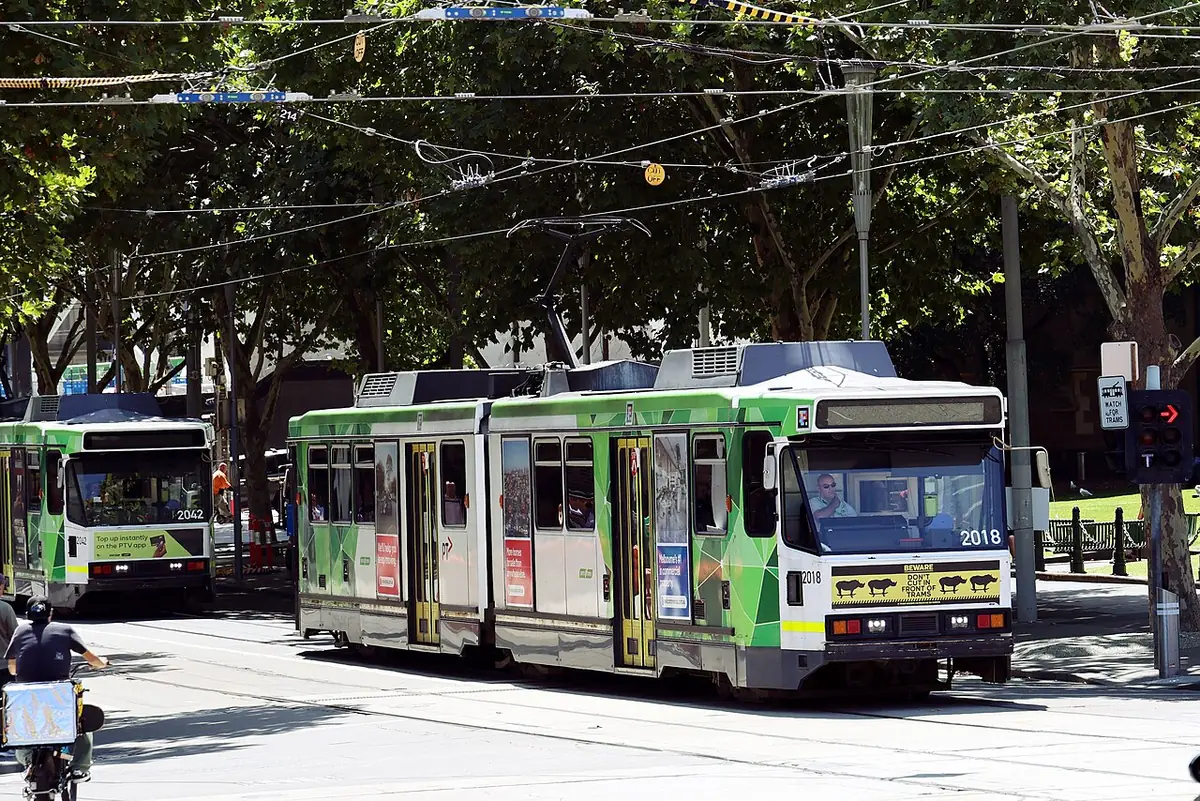
Green trams under the trees on Swanston Street — Photo: Bhullargraphic · CC BY-SA 4.0 · Wikimedia Commons
Understanding these local dynamics also means measuring how far you have come from the reference points you know back home.
Every buyer's path comes with its own imperatives, whether it is a long-term professional move, a career change or a cautious wealth strategy. Melbourne's property market dynamics play out differently depending on whether you are buying to live in straight away or to build an income-producing portfolio. Assessing your situation clearly will spare you financial disappointment and lifestyle compromises that become untenable in the medium term.
Expat or new arrival
Your top priority is to get to grips quickly with school zones and the main public transport networks, such as suburban trains and trams. It is best to rent at first so you can pinpoint the micro-neighbourhood that will suit your pace of life. Buying too early, without knowing the local specifics of land taxes and planning easements, exposes you to costly wrong turns. Take the time to compare local councils before committing your capital.
Wealth investor
Melbourne's residential market offers recognised legal stability but imposes strict regulatory constraints on non-residents through the Foreign Investment Review Board. You need to factor capital gains tax and property management fees into your net return model. Properties close to university campuses or major hospital hubs traditionally show minimal rental vacancy. Do not be tempted by the unrealistic yield promises some developers advertise.
Permanent resident seeking stability
Your attention should go first to the quality of surrounding public facilities, proximity to parks and the reputation of the secondary schools. Detached houses with a garden require a heavier initial outlay but ensure better capital preservation over the long term. Anticipate how your family's needs will change over ten years to avoid a premature resale weighed down by high transfer costs. How firmly you put down local roots depends directly on the community vitality of the neighbourhood.
Living there when you come from abroad: what fundamentally changes in your property reference points
This vast and varied urban layout leads naturally to the question of which neighbourhood to settle in.
Moving to Australia after owning property elsewhere upsets many legal, architectural and financial certainties. The Anglo-Saxon property system rests on transaction mechanisms and contractual responsibilities that are very different from the civil-law notary systems many buyers know. From block sizes to heating methods and owners corporation fees, every detail requires you to reset your buying reflexes. Anticipating these cultural gaps will let you approach negotiations with far more peace of mind.
From abroad
Centralised notary protection and a single authenticated deed back home
Melbourne
Systematic use of conveyancers or specialist solicitors for each party
Checking titles and easements relies entirely on the expertise of your own adviser. You need to commission independent inspections well in advance to avoid hidden defects that are not covered.
From abroad
Double glazing and efficient central heating as standard
Melbourne
Historic buildings that are often poorly insulated and single-glazed
Melbourne winters, mild as they may seem, prove damp and penetrating inside older homes. Always set aside a budget for reverse-cycle air conditioning and modern insulation.
From abroad
Rental leases tightly regulated by law and the state
Melbourne
Owners corporation and agency management rules with highly formalised practices
Relations between owners and occupants follow strict codes of conduct overseen by state regulators. Entry and exit condition report procedures must be followed with absolute rigour.
From abroad
Very dense historic city centres with centuries-old buildings
Melbourne
A grid-based urban layout stretching across vast leafy suburbs
Urban sprawl completely redefines your relationship with space, the car and public transport. Your daily commute becomes the first criterion that determines the real value of your investment.
Which Melbourne neighbourhood should you target for your budget and lifestyle?
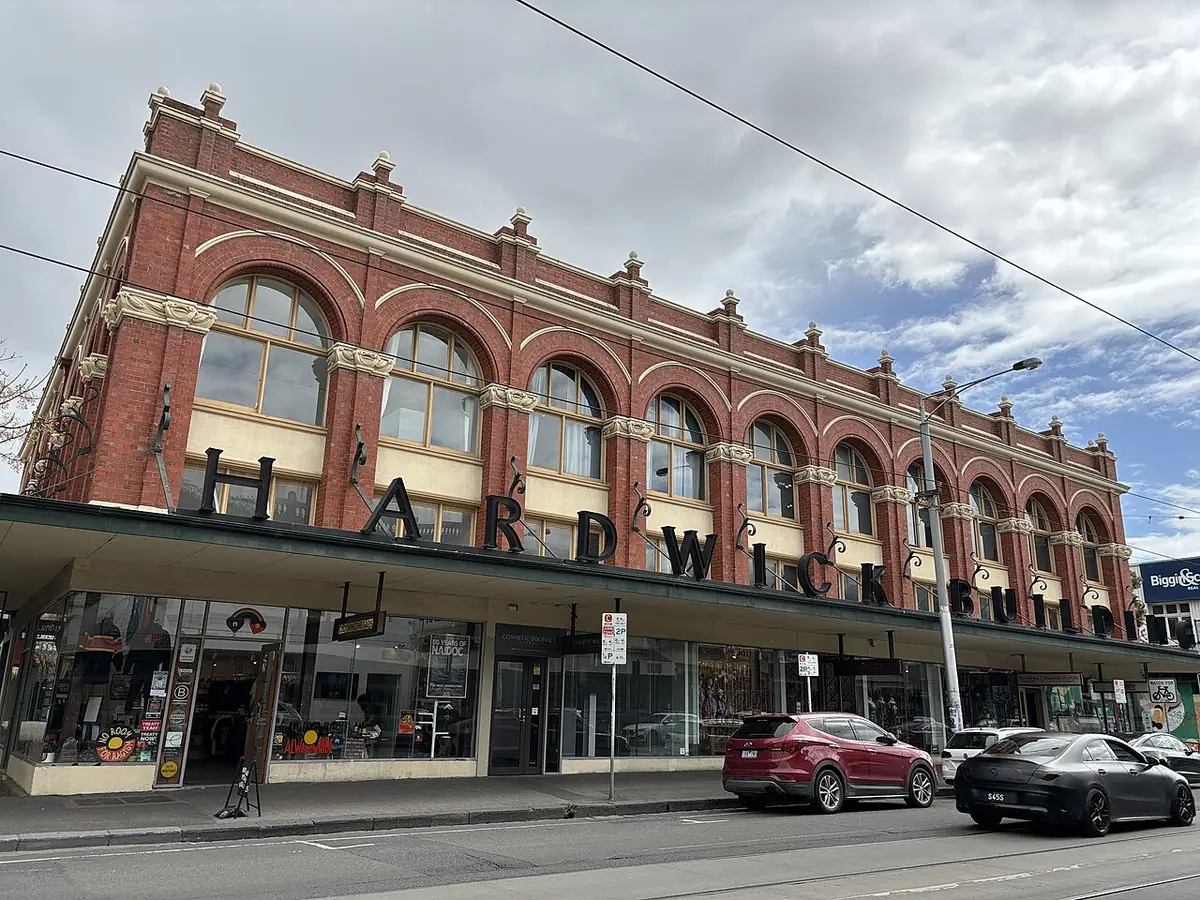
The red-brick Hardwick Building and its shopfronts in Brunswick — Photo: Nick-D · CC BY-SA 4.0 · Wikimedia Commons
Once you have picked your area, the crucial question of market prices and budgets comes to the fore.
Greater Melbourne is a mosaic of suburbs with sharply defined cultural and economic identities. Choosing where to live is not a simple matter of taste but a precise trade-off between accessibility, commercial vibrancy and residential calm. Historic inner areas sit alongside neighbourhoods in full gentrification and large outer suburban housing estates. Each area offers its own compromise, which should be weighed against your daily priorities.
Inner North (Fitzroy, Brunswick)
An intensely creative and artistic atmosphere, set to the rhythm of independent cafés, galleries and busy bike lanes.
Suits
Young professionals, couples without children and lovers of lively urban cultural life.
Trade-off
Extremely high prices per square metre for often limited space, and very difficult street parking.
Inner East (Kew, Hawthorn)
Affluent residential calm, lined with mature trees, landscaped parks and prestigious schools.
Suits
Established families looking for safety, large green spaces and proximity to the best schools.
Trade-off
A very competitive market where family homes with character are scarce and snapped up at tense public auctions.
Bayside (Brighton, Elwood)
A bright seaside lifestyle of foreshore walks, sea swims and a relaxed atmosphere.
Suits
Those who value the quality of the natural environment and being right by the beach without leaving the city.
Trade-off
Maximum financial exposure and greater vulnerability to maintenance costs caused by salt spray.
Outer Suburbs (Outer East & North)
Modern, spacious residential areas centred on regional shopping centres and major roads.
Suits
First-home buyers looking to maximise living space and the number of bedrooms on a controlled budget.
Trade-off
Total dependence on the car and very long daily commutes to the business district.
What does buying a house in the Melbourne area really cost?
Beyond the raw financial outlay, the legal nature of what you own deserves careful examination.
Melbourne's property market reflects the demographic and economic pressures of a fast-growing city. Prices shown in public listings are often only a starting point, as public auctions regularly bring surprises on the upside. You must include all local taxes, transfer duty and compulsory professional fees in your financing plan. A careful reading of historical price ranges protects your investment against overpaying.
MelbourneFor saleHouseestimate
Median price / m²A$6,310Half the apartments sell below this
Median priceA$1.16mthe average is 14% higher — a few very large properties pull it up
Most common2 bedrooms46 % of listings
Average size175 m²
By number of bedrooms
Bedrooms
Share of market
Avg price
Price / m²
Avg size
2most common
46 %
A$930k
A$6,642
140 m²
3
36 %
A$1.27m
A$6,310
201 m²
4
18 %
A$1.76m
A$6,111best value / m²
289 m²
Each row is an average, compared against the area average of A$6,642 / m². These are indicative estimates of a typical local market, not a measured sample of live listings. Check current listings before relying on them.
What you can really own: understanding land title and strata
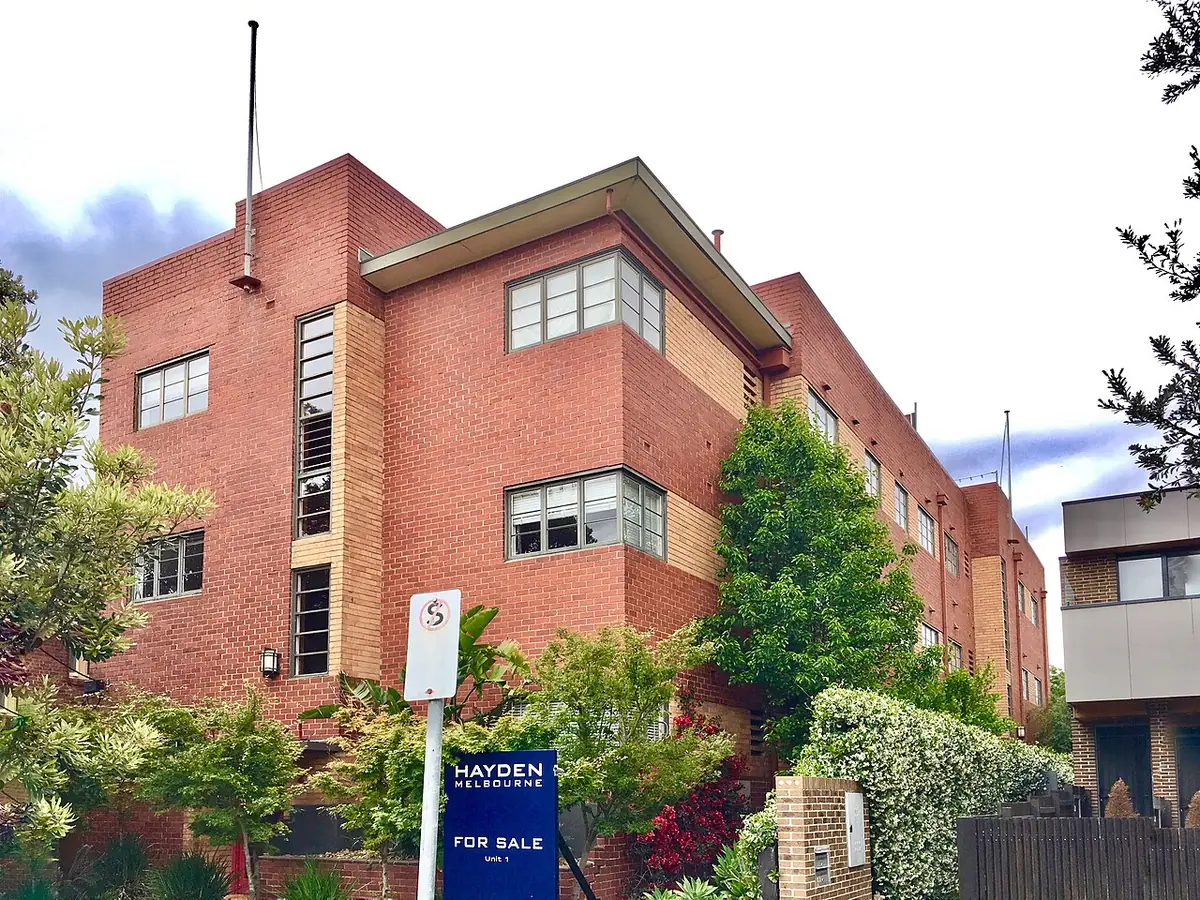
A red-brick apartment block in St Kilda West — Photo: Rohanstorey · CC BY-SA 4.0 · Wikimedia Commons
This legal rigour reaches its peak in the contractual mechanics of the local property transaction.
Under Australian property law, the distinction between full ownership of the land and sharing common infrastructure radically changes your freedom to make alterations. Contrary to some assumptions, many houses in middle-ring areas are governed by complex shared-ownership rules or Owners Corporation structures. Grasping these legal subtleties spares you disputes with neighbours and unexpected spending on common property maintenance. Your freedom to renovate depends directly on this status.
Independent full ownership (Freehold / Torrens Title)
You own both the building and all of the land it stands on, with no levies and no owners corporation to consult about exterior works. This arrangement gives you complete autonomy and ensures the land appreciates as fully as possible over the decades. In return, the cost of maintaining the roof, foundations and drainage falls entirely on your shoulders.
What it changesYou keep complete freedom of action but carry all the technical and financial risks associated with the building.
Horizontal or shared-wall ownership (Owners Corporation / Strata)
Your property shares party walls, common access or landscaped infrastructure with other owners within a single land entity. You must pay regular levies that feed a sinking fund for major shared works. Any visible change to the exterior of your house requires prior approval from the owners corporation committee.
What it changesYou benefit from shared general maintenance costs but accept lasting restrictions on your freedom to make alterations.
The golden rule to understand before paying a deposit on a Melbourne property
Once these legal principles are clear, it is worth mapping out the practical course of your purchase in order.
Buying property in the state of Victoria follows strict procedural rules that leave no room for guesswork. Unlike practices elsewhere, the public auction is the dominant method of sale, involving a firm and immediate commitment with no finance condition. Understanding how these steps fit together protects you against losing substantial deposits and falling into contractual traps. Every signature seals a legal agreement with definitive financial consequences.
The stage of identifying the property and closely examining the legal documents supplied by the seller.
Your conveyancer's careful review of the vendor's statement (Section 32 Statement) to identify easements, local taxes and planning restrictions.
Commissioning independent building and pest inspections to detect any hidden defects or termite damage.
Bidding at the public auction or submitting a formal written offer with a deposit held in trust (generally 10%).
Satisfying the inspection conditions and securing final bank finance approval when buying by private sale with a cooling-off period.
Payment of the balance of the price and official transfer of title at the state land registry.
How a property transaction actually unfolds, step by step
Completing a property purchase in Melbourne means coordinating many professionals on a precise timetable. From your loan pre-approval to handover of the keys on settlement day, every party plays a decisive role. Knowing the exact order of operations lets you anticipate administrative delays and avoid last-minute tension. Here is the step-by-step roadmap for your purchase.
You and your brokerGet bank pre-approvalEstablish your maximum borrowing capacity with an Australian lender so you can target your market search effectively.
Your conveyancerReview the Section 32 and titleExamine encumbrances, title plans, historical restrictions and any debts attached to the land before making a firm offer.
The independent inspectorCarry out the building inspectionCheck the condition of the structure, the presence of asbestos in older buildings and the absence of destructive termite infestation.
The estate agent and youNegotiate or bid at auctionPlace your bid at the public auction on the day or formalise your purchase offer with a deposit payable immediately.
Your solicitor or conveyancerPrepare for settlement dayCoordinate the final fund transfers, payment of transfer duty (stamp duty) and electronic registration of the title.
YouDo the final inspection and move inVisit the property just before handover to confirm it is in the agreed condition, then set up your energy contracts.
House or apartment in Melbourne: weighing independence against urban convenience
Once this fundamental choice between house and apartment is made, the crucial question of financing and budget reality comes straight to the fore.
Choosing between a detached house and an apartment in Melbourne immediately raises the question of how you want to live day to day. Suburban areas such as those in the eastern or southern belt offer private blocks of land, generous living space and an architectural independence that families appreciate. However, this option means regularly maintaining a garden that is often demanding because of the local climate, as well as greater dependence on the car for daily trips to employment areas.
Conversely, opting for an apartment, whether in the modern towers of the CBD, in Southbank or in the characterful buildings of Fitzroy, radically redefines your relationship with the city. Being right next to tram networks, iconic cafés and cultural centres frees residents from the logistics of parking and long commutes. Owners corporations handle structural maintenance and common areas, sharing the costs but in return imposing strict rules and monthly fees that can be high.
Financially, long-term capital growth differs noticeably between these two property types in Melbourne. Detached houses traditionally benefit from a structural scarcity of land that supports rising land values, while apartments are sometimes hit by waves of new construction that shift the balance of supply. Market analysis shows that buyers must weigh freedom to alter and land appreciation on one side against time saved and energy efficiency on the other.
Your final decision will therefore depend on your time horizon and your tolerance for commuting in this sprawling city. If you value calm, space for the children and the ability to personalise every corner of your home, the suburban house remains the benchmark. If you want to plug straight into urban energy while reducing your logistical footprint, the city apartment is the obvious strategic choice.
What real budget should you plan for living and housing in Melbourne?
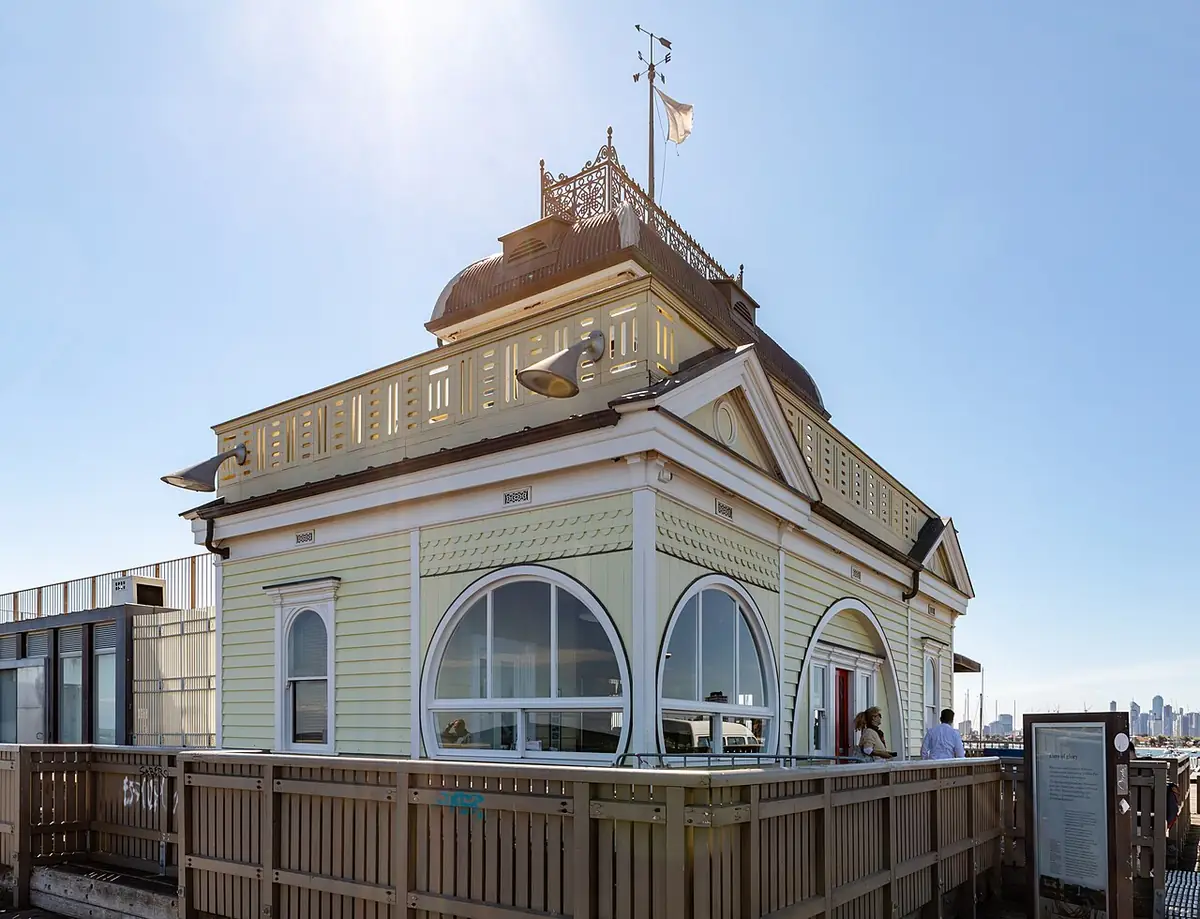
The Melbourne skyline seen across the bay from St Kilda — Photo: Sourabh.biswas003 · CC BY-SA 4.0 · Wikimedia Commons
With the budget framework in place, it is essential to understand what a typical week actually looks like for a Melbourne resident.
Buying a property in Melbourne is not just about the purchase price shown on listing portals. You need to factor in all the additional costs, local taxes and the cost of living to avoid financial surprises. This table sets out the unavoidable expenses every buyer faces in Victoria's capital.
Expenses and running costs for a homeowner in Melbourne
Budget item
Typical amount or range
Impact on the overall budget
Transfer duty (Stamp Duty)
5% to 6% of the purchase price
A major upfront cost to plan for in your deposit at the time of purchase.
Owners corporation fees (Strata fees)
$3,000 to $7,000 per year
Varies widely depending on the building's facilities (lift, pool, security).
Council rates
$1,500 to $3,000 per year
Compulsory for all owners, indexed to the estimated land value of the property.
Home insurance (Building & Contents)
$1,200 to $2,500 per year
Essential to cover climate risks and structural damage specific to the region.
The amounts shown are averages observed on the Melbourne market and depend directly on the exact location and standard of the property.
Health, schools and transport: what does an ordinary Tuesday look like in Melbourne?
Beyond the visible aspects of daily life, property listings often leave out fundamental structural realities that are worth uncovering.
Getting a real feel for a Melbourne neighbourhood means watching the daily rhythm of its residents. Between tram commutes, access to well-regarded schools and proximity to health services, every hour reveals how smoothly local infrastructure works or where it grinds. This ordinary Tuesday illustrates the practical side of where you choose to live.
07:30Local tram stopThe start of the morning commute on Melbourne's tram network, known for its reach but prone to slowdowns on the main roads at peak hour.
08:30Neighbourhood schoolDropping the children at the local public or zoned school, a decisive factor that directly influences property values in the surrounding streets.
12:30Local medical centre and pharmacyAccess to primary healthcare (General Practitioner), essential for booking regular appointments without crossing the whole city.
17:30Supermarket or local marketEnd-of-day shopping at local stores or historic markets to pick up fresh produce after work.
19:00Local park or green spaceEvening downtime in one of the many landscaped parks that underpin Melbourne's reputation for liveability.
What glossy Melbourne property listings leave out
These blind spots inevitably lead to the regrets some buyers express after living in the property for a few months.
Professional photographs and glowing descriptions from Melbourne estate agents showcase space and light, but leave major technical and regulatory constraints in the shadows. To make a lasting investment, you must identify these unmentioned factors that directly affect comfort and resale value.
Thermal orientation and insulation
Many older homes in Melbourne suffer from poor thermal insulation, leading to excessive heating and cooling bills because of the region's marked climate swings.
Heritage area restrictions (Heritage Overlay)
Buying a heritage-listed property severely limits any plans to renovate, extend or alter the facade, making works subject to very strict and costly approvals.
Proximity to heavy traffic routes
Some seemingly quiet neighbourhoods suffer significant noise and air pollution at peak hours because of congested arterial roads right on their edge.
Future urban development projects
Failing to check the local planning scheme can leave you facing future high-rise construction opposite your home, ruining your view, your sunlight and the value of the property.
The pitfalls and disappointments discovered six months after moving in to Melbourne
Given these risks, it is just as important to know whether this market and this kind of location really suit your profile.
Looked likeA trendy neighbourhood, buzzing in the evening with vibrant nightlife.
Turned outA source of constant noise, difficult night-time parking for guests and a relative feeling of insecurity at weekends.
Would have caught itVisit the sought-after neighbourhood at different times of night and check the soundproofing of the windows at the first viewing.
Looked likeAn affordable investment opportunity in a booming suburb with strong potential.
Turned outAn area poorly served by fast public transport, considerably lengthening the daily commute to the business district.
Would have caught itTest the commute yourself at peak hour on a Monday morning before signing the final purchase offer.
Looked likeA characterful older house with authentic and unique Victorian charm.
Turned outA money pit of electrical upgrades, rising damp treatment and replacement of outdated plumbing.
Would have caught itAlways have a thorough building and structural inspection carried out by an independent expert before any conditions are lifted.
Looked likeA modern strata complex with moderate fees and full leisure facilities.
Turned outPoor management by the strata manager, significant unpaid levies among owners and unfunded extraordinary facade works.
Would have caught itAsk to see the minutes of the last three owners corporation annual general meetings to assess the building's financial health.
Buyer profiles: who should seriously sit out the Melbourne market
Now it is time to lay the groundwork for your own conclusion and gauge how ready you are for this project.
General enthusiasm for Melbourne property should not hide the fact that this market does not suit every investor or household. The rigid entry costs and the particular layout of the city demand a close fit between your life plans and local reality. Here are the profiles for whom buying in this region represents a major strategic risk.
The investor seeking high, immediate rental returns
→Looks at other regional Australian markets offering higher gross yields.
Melbourne's net rental yields are traditionally moderate and largely eaten up by high land taxes and owners corporation management fees.
The very short-term buyer (horizon under three years)
→Opts for flexible renting to preserve geographic and financial freedom.
The combined weight of transfer duty (Stamp Duty) on purchase and agent commission on resale wipes out any potential capital gain over such a short period.
The household determined to avoid any regulatory or climatic constraint
→Explores regions with more stable climates and more flexible planning rules.
Melbourne's changeable climate and complex heritage renovation regulations demand a great deal of adaptability from owners.
Decision check: are you really ready to go ahead with your Melbourne project?
Committing to buy property in Melbourne is a defining decision that shapes your financial and personal future for many years. Having looked at the property types, unpacked the budget reality, examined the rhythm of an ordinary Tuesday and weighed the hidden pitfalls of listings, it is time to take stock of your deeper motivations and your financial readiness.
The strength of your approach rests on absolute clarity about your time horizon and your ability to absorb market ups and downs. If you have confirmed your deposit, factored in local taxes, checked the structural condition of the properties you are targeting and accepted the particularities of local life, you have everything you need to complete your purchase in the best possible conditions.
Never forget that a good property purchase in Melbourne is one that aligns closely with your life plans, not a passing speculative opportunity. Take the time to visit, question independent experts, cross-check objective data and never give in to haste or the artificial pressure created by some market players.
Your next step is to formalise your financing plan with a qualified local broker and begin your targeted search on the ground with peace of mind. Melbourne's property market always rewards methodical preparation, strategic patience and the financial clear-sightedness of those who refuse to commit blindly.
Related questions
What are the main costs to plan for when buying property in Melbourne?
On top of the purchase price, the buyer must budget for transfer duty (Stamp Duty), which generally ranges between 5% and 6% of the price, as well as conveyancing legal fees, compulsory home insurance and any owners corporation fees.
Should you favour buying a house or an apartment in the metropolitan area?
The choice depends mainly on your lifestyle and long-term goals. A house offers land ownership and private outdoor space in the suburbs, while an apartment guarantees a central urban location, immediate access to transport and shared maintenance costs.
How does the school zoning system work when buying a house in Melbourne?
The Australian public education system is closely tied to where you live. Being inside the school zone of a well-regarded school adds considerable value to a property, but you need to check the exact zone boundaries carefully with the education authorities.
What are the risks with properties under a Heritage Overlay in Melbourne?
Properties under heritage protection (Heritage Overlay) are subject to very strict architectural restrictions. Any change to the facade, major renovation or extension requires special approval from the council, which lengthens timelines and pushes up the cost of the works.
What real impact does Melbourne's climate have on the condition of homes?
Melbourne is known for having four seasons in a single day and marked temperature swings. Many older homes suffer from poor insulation, which drives up heating needs in winter and cooling needs in summer, hence the importance of auditing a property's energy efficiency.
Can you buy property in Melbourne as a non-resident?
Yes, foreign investors can buy property in Melbourne, but they must first obtain approval from the Foreign Investment Review Board (FIRB) and pay specific surcharges on transfer duty and local land taxes.
How can you find out about future planning projects around a property you are targeting?
It is strongly recommended to consult the council's planning scheme and look into building permits under way in the immediate neighbourhood, to avoid unpleasant surprises such as future buildings blocking your view or sunlight.
How important is the building inspection before the purchase is finalised?
A building and pest inspection carried out by an independent professional is essential to detect hidden defects, termites, damp problems or major structural faults that could undermine the property's value and your budget.
How long does it usually take to complete a property transaction in Melbourne?
The buying process, from signing the Contract of Sale and satisfying any conditions through to final settlement and handover of the keys, generally takes 30 to 90 days depending on what the seller and buyer agree.
What role does a conveyancer or solicitor play in the purchase?
The conveyancer or specialist solicitor is the legal professional who checks the title, drafts or reviews the terms of the sale contract, makes sure there are no hidden encumbrances and handles all the administrative and financial steps of the transfer of ownership.