Valuing an apartment in Melbourne means putting a figure on a lot held under an owners corporation, in a market where the price is often discovered at auction, where the agent must publish comparable sales and where the bank applies its own reading of value. This guide is for the owner who wants to know what their property is worth before deciding whether to sell, keep, refinance, divide an estate or insure it, whether they live in Victoria or manage the apartment from abroad: comparables by suburb, the role of the valuer and the lender, the effect of the legal title and the costs that come off the figure.
Get the app
What nobody tells you.
Real prices, hidden costs and the traps to check before you commit.
What a valuation of a Melbourne apartment is really measuring
Scroll
What a valuation of a Melbourne apartment is really measuring
Valuing an apartment in Melbourne means putting a figure on a lot held under an owners corporation, in a market where the price is often discovered at auction, where the agent must publish comparable sales and where the bank applies its own reading of value. This guide is for the owner who wants to know what their property is worth before deciding whether to sell, keep, refinance, divide an estate or insure it, whether they live in Victoria or manage the apartment from abroad: comparables by suburb, the role of the valuer and the lender, the effect of the legal title and the costs that come off the figure.
Written by the ting.ad editorial team ·
Valuation Apartment Melbourne in Street View: drag to look around.
These gaps between the hoped-for figure and real value are not read the same way depending on what you intend to do with the property.
Valuing an apartment in Melbourne is not a matter of recovering the price once paid, nor of applying the city median to your floor area. A valuation measures the price an informed buyer would pay today for this particular lot, in this building, with its fees, its legal title and its position in the street. Several figures circulate around the same property: the agent's, hoping for a listing; the bank's, protecting its loan; the council's, calculating rates; and the valuer's, who carries professional responsibility for it. Understanding what each of them measures stops you from taking an opinion for a value.
The price paid a few years ago, sometimes off the plan from a developervsThe price a buyer would pay today for a comparable apartment already lived in
A new apartment bought off the plan carried the developer's margin and marketing costs, which the resale market does not pay back. Many owners in recent towers discover a value below the price they paid, even after holding the property for several years.
The Melbourne median, all apartments taken togethervsRecent sales in your building, your street or a block of the same generation
The median mixes investor studios in the CBD, older walk-up flats and premium riverside developments. It gives a trend, not the value of your lot, which depends first on comparables close in location, size and building quality.
The figure quoted by the agent who wants to win your listingvsThe value adopted by a certified valuer or by a future buyer's lender
The agent has an interest in an attractive number, whereas the valuer and the bank have an interest in caution. The gap between the two often indicates the real room for negotiation and the risk of a property that sits unsold for months.
The value shown on the council rates notice or used for land taxvsMarket value, that is the price agreed between a willing seller and a willing buyer
A statutory valuation exists to apportion local taxation and follows a mass-appraisal method at a fixed reference date. It can sit well away from the market in either direction and should never be used on its own to set a price.
Which reading of value fits what you plan to do with your Melbourne apartment?
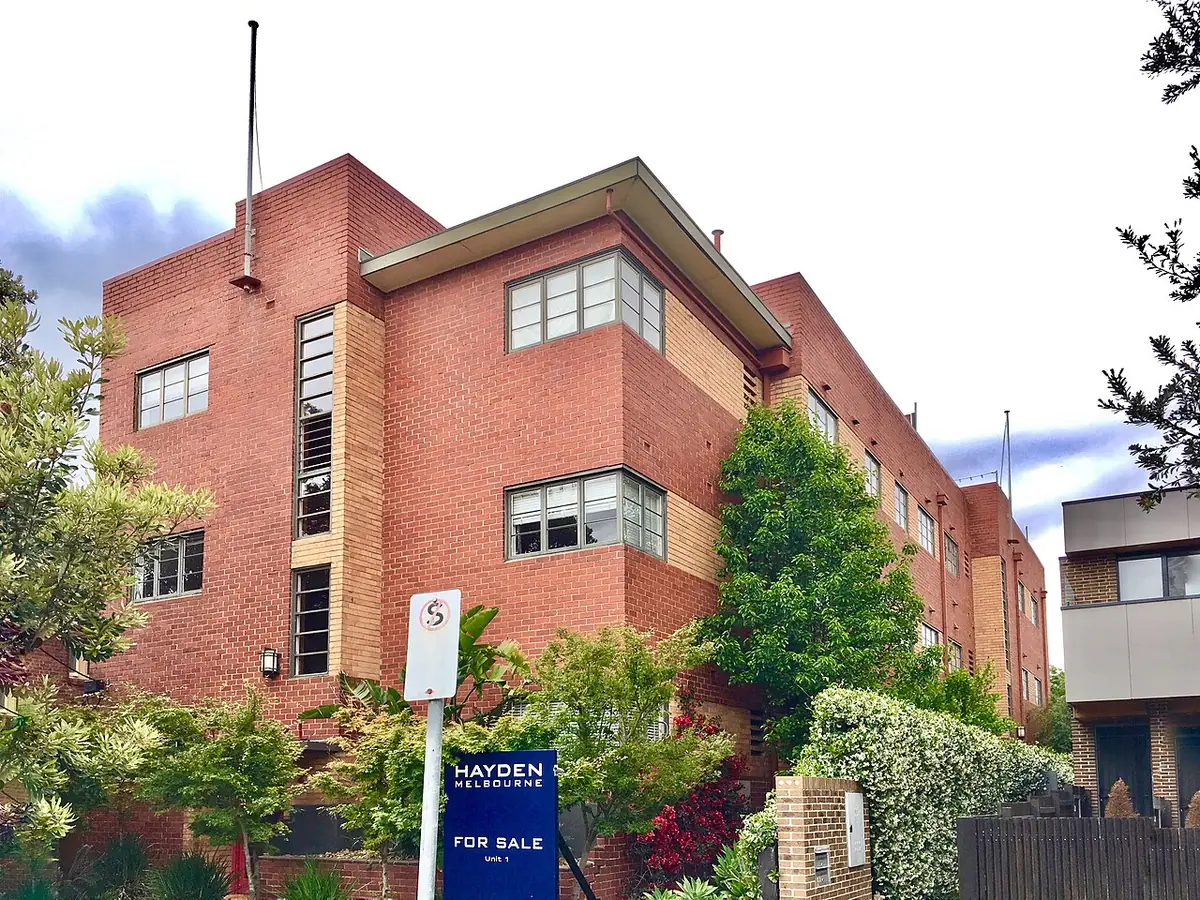
A red-brick apartment block in St Kilda West — Photo: Rohanstorey · CC BY-SA 4.0 · Wikimedia Commons
Whatever your goal, valuing a Melbourne property from another market means setting aside a few deeply held reflexes.
The value of an apartment is not a single figure: it depends on the question you are asking. An owner thinking about selling is looking for a realistic market price and for the net amount that will be left, while an owner who is keeping the property cares about the figure the bank adopts and the rent the apartment can carry. An estate or a property settlement calls for a dated, defensible value that will stand up in front of beneficiaries, a lawyer or a tax authority. Identifying your situation tells you which professional to instruct and which document to ask for.
Prospective seller
Your question is the price the apartment will genuinely achieve, within a reasonable time, and what will be left afterwards. Ask two or three agents active in your suburb for a written appraisal and read above all the comparable sales they cite: in Victoria, the agent must state their estimate in the authority and give buyers a statement of information with comparable sales. An agent who promises markedly more than the others without solid comparables leaves you with a property that fails to find a buyer.
Complete that market price with a calculation of net proceeds: commission, marketing costs, the conveyancer's fees, repayment of the loan and capital gains tax. For a non-resident owner, the withholding applied at settlement changes available cash significantly, even though it is later credited against the tax due. It is that net figure, not the advertised price, that should drive the decision to sell now or wait.
Owner keeping or refinancing
For a refinance, the figure that counts is the bank's, which orders its own valuation, sometimes done on file or through an automated model without an inspection. That value sets the ratio between the loan and the property, and therefore how much you can borrow without lender's mortgage insurance. Banks often adopt a cautious number, particularly for small apartments in recent towers, and some apply minimum floor areas below which they lend less.
If you are keeping the property to let it, value can also be read through the yield: annual rent net of fees, council rates, land tax and management, measured against market value. A yield far below that of neighbouring apartments may signal a property overvalued in your own mind, or a rent sitting under the market. Have the market rent confirmed by a local managing agent before drawing any conclusion.
Estate, division or declaration
In these situations an agent's opinion is not enough: you need a dated valuation, written by a certified valuer, stating the purpose of the instruction, the valuation date adopted and the comparables used. Australia levies no inheritance tax, but the value of the property at the date of death can matter later for the calculation of a capital gain. Where the deceased was tax resident in another country, the Melbourne apartment will usually enter the estate declared there and must be taken at its market value.
A solid valuer's report limits disputes between beneficiaries or former partners and answers the questions a tax authority will ask. Ask the valuer for a value at the exact date required, which may fall before the inspection, and keep the supporting documents. Have the way that value will be used in your home country confirmed by the lawyer handling the estate and, where needed, by a tax adviser.
Valuing a Melbourne apartment from abroad: what works differently here
These differences in method take on their full meaning at suburb level, which supplies the comparables the figure rests on.
An owner used to a European market arrives with benchmarks that do not transfer directly to Melbourne. Price sources, the way a value is advertised, the measurement of floor area and the role of building reports all follow a logic specific to Victoria. Some familiar tools do not exist, while others have an equivalent that behaves differently. Spotting those gaps before reading a valuation stops you comparing figures that are not measuring the same thing.
From abroad
A freely searchable public database of sale prices, plus valuations from notaries or agents
Melbourne
Statistics published by the state, sale prices relayed by commercial portals and comparables supplied by agents
The data exists, but it often passes through intermediaries: check the date, the exact address and the nature of every sale quoted, and treat portal estimates with caution, since they know little about the interior or the building.
From abroad
Mandatory reports such as an energy performance certificate, which feed directly into value and negotiation
Melbourne
No mandatory energy rating on sale in Victoria, and vendor disclosure built instead around the vendor's statement
Condition and energy performance still weigh on price through the inspections a buyer commissions; a defect found late turns into a renegotiation or a lost buyer, which a valuation ought to anticipate.
From abroad
An advertised price negotiated downwards, with agency fees clearly stated
Melbourne
An indicative range or a guide price, framed by the rules against underquoting, and auctions where the final price is discovered on the day
The advertised figure is neither a ceiling nor a floor: the agent's written estimate and the statement of information, with its comparables, are more reliable benchmarks than the listing itself.
From abroad
A certified internal floor area that serves as the basis for a price per square metre
Melbourne
No equivalent legal measurement: internal areas, balconies and car spaces appear on the plan of subdivision or in the marketing material
A price per square metre only means something if areas are measured the same way; in Melbourne people reason far more in bedrooms, bathrooms and car spaces than in square metres.
From abroad
Service charges voted at a general meeting, with a works fund framed by statute
Melbourne
Owners corporation fees set according to lot entitlement, with maintenance obligations that vary with the size of the scheme
The level of fees, the state of the maintenance fund and the works voted are all part of value: two identical apartments can sell at different prices depending on the financial health of their building.
Which Melbourne suburb sets the comparables for your apartment?
These differences between suburbs show up in the market figures, which should be read as value benchmarks rather than as a price.
In Melbourne, the value of an apartment is built first at suburb level, and sometimes at building level. Each area has its own buyer pool, its own housing stock and its own volume of sales, which determines the quality of the comparables available. A two-bedroom apartment in a Southbank tower does not compare with a two-bedroom in a small older block in Fitzroy, even at the same floor area. The cards below set out what the buyer is paying for in each area, which apartments find solid reference points there and what can weigh on the figure.
Central Business District (CBD), Southbank and Docklands
The buyer is paying for the walk to the office, the free tram zone, the view and the tower's facilities, often with a view to letting to students or young professionals.
Suits
Apartments in large towers where sales are frequent, which supplies precise comparables, sometimes from within the same building.
Trade-off
An abundant supply of similar homes, high fees and some lenders' caution on small floor areas pull values down and make capital growth uncertain.
Carlton, Fitzroy and Collingwood
The buyer is paying for neighbourhood life, proximity to the University of Melbourne and the Parkville hospitals, the cafes, the Victorian streets and the converted warehouses.
Suits
Apartments with character or small blocks sought by owner-occupiers, whose scarcity supports value over time.
Trade-off
A very mixed stock, in which genuinely identical comparables are hard to find, and heritage constraints that limit value-adding works.
South Yarra, Prahran and Windsor
The buyer is paying for Chapel Street, the Botanic Gardens and the Yarra nearby, South Yarra and Prahran stations, and an address that remains in demand.
Suits
Well-located older apartments, particularly in small blocks from the 1930s to the 1970s, along with recent quality developments with parking.
Trade-off
The gap is wide between quiet streets and busy roads, and between well-kept blocks and buildings with heavy fees, which makes the local median misleading.
Footscray and the western suburbs
The buyer is paying for a lower entry price, closeness to the centre by train, multicultural markets and a neighbourhood in full renewal.
Suits
Recent family-sized apartments, whose value follows the transformation of the area and improving transport links to the centre.
Trade-off
Reference points that shift quickly and vary from street to street, and many new projects competing directly with resale apartments.
What an apartment in Melbourne is worth today: reading the figures as a value benchmark
These benchmarks assume you know exactly what you hold, because the legal title of the lot shifts value too.
The figures below are estimates drawn from listings and from trends observed across the Melbourne apartment market: they help you place a valuation, they are not a value for your property. A median of around 790,000 Australian dollars and an average of roughly 8,100 dollars per square metre describe a very stretched market, in which small apartments show a higher rate per square metre than large ones. If the valuation you are offered sits well away from the line matching your number of bedrooms, ask for the comparables that justify it: location, floor level, view, car space or the condition of the building. Bear in mind too that advertised prices come before negotiation or the auction, and can differ from the price finally achieved.
MelbourneFor saleApartmentestimate
Median price / m²A$7,695Half the apartments sell below this
Median priceA$790kthe average is 14% higher — a few very large properties pull it up
Most common2 bedrooms36 % of listings
Average size100 m²
By number of bedrooms
Bedrooms
Share of market
Avg price
Price / m²
Avg size
1
22 %
A$455k
A$8,748 +8 %
52 m²
2most common
36 %
A$648k
A$8,100
80 m²
3
28 %
A$885k
A$7,695 −5 %
115 m²
4
14 %
A$1.23m
A$7,452best value / m²
165 m²
Each row is an average, compared against the area average of A$8,100 / m². These are indicative estimates of a typical local market, not a measured sample of live listings. Check current listings before relying on them.
What you actually hold in Melbourne, and what that does to the value
The Melbourne skyline seen across the bay from St Kilda — Photo: Sourabh.biswas003 · CC BY-SA 4.0 · Wikimedia Commons
Once the legal status of the property is settled, one simple rule remains before you treat any figure as established.
Two apartments of the same size, in the same street, can be worth different amounts because their owners do not hold the same thing. In Victoria, the great majority of apartments sit within a subdivision of lots managed by an owners corporation, but some older buildings still operate as company shares. That regime determines who can buy, how lenders finance the transaction and which collective rules bind the owner. A valuer takes it into account explicitly, and so does an informed buyer.
Lot in a subdivision (strata title)
This is the usual regime for Melbourne apartments, old and new alike. You hold a lot defined on the plan of subdivision, sometimes with a car space or a storage cage, plus an entitlement in the common property. The owners corporation manages the building, sets the fees and decides on works, and its accounts, maintenance fund and any proceedings under way are disclosed to the buyer on a sale.
What it changesValue compares easily with that of other lots, and lenders finance the regime without particular difficulty. On the other hand, everything affecting the building flows through to your lot: high fees, major works, a dispute over building defects or restrictive rules on pets or short-stay letting all shrink the buyer pool and therefore the figure.
Company share title
This structure turns up in some older buildings, notably from the 1920s to the 1960s in suburbs such as South Yarra or St Kilda. You do not hold a land title but shares in a company that owns the building, giving you the right to occupy a particular apartment.
What it changesThe board can vet incoming owners, and many lenders will advance less against this title or decline it altogether, which reduces the number of buyers able to finance the transaction. These apartments therefore tend to trade at a discount to comparable strata lots; a valuer should look for sales under the same regime rather than adopting the prices of neighbouring strata buildings.
The rule to understand in Melbourne before you treat a figure as established
The rule is tested by following the path along which a figure is built, from one party to the next.
In Melbourne, until a buyer has signed a contract, a value remains an opinion, more or less well supported. An agent's appraisal, a portal's estimate, the bank's figure and a valuer's report are steps of increasing solidity, but none of them equals a price actually paid. Victorian rules require the agent to support their estimate with comparable sales, which gives you a way of testing every figure. The method consists of working back from opinion towards facts, one step at a time.
A figure is put to you, by an agent, an online portal, a neighbour or a bank, and you have to decide whether it is reliable enough to act on.
Ask for the appraisal in writing, with at least three recent, nearby and genuinely similar sales: the statement of information given to buyers in Victoria rests on exactly this logic.
Check every comparable: the same kind of building, the same number of bedrooms, a similar floor level and outlook, a car space or not, a comparable level of fees and a recent sale date.
For an important decision or an official process, commission a valuation from a certified valuer who inspects the property, states the valuation date and carries professional responsibility for it.
Set the result against the value a lender adopts and against the statutory valuation, explaining every gap rather than keeping whichever figure flatters you most.
The only figure that is no longer open to argument is the price in a contract signed unconditionally and paid at settlement: every valuation is simply a reasonable forecast of that price.
How the valuation of a Melbourne apartment is built, step by step
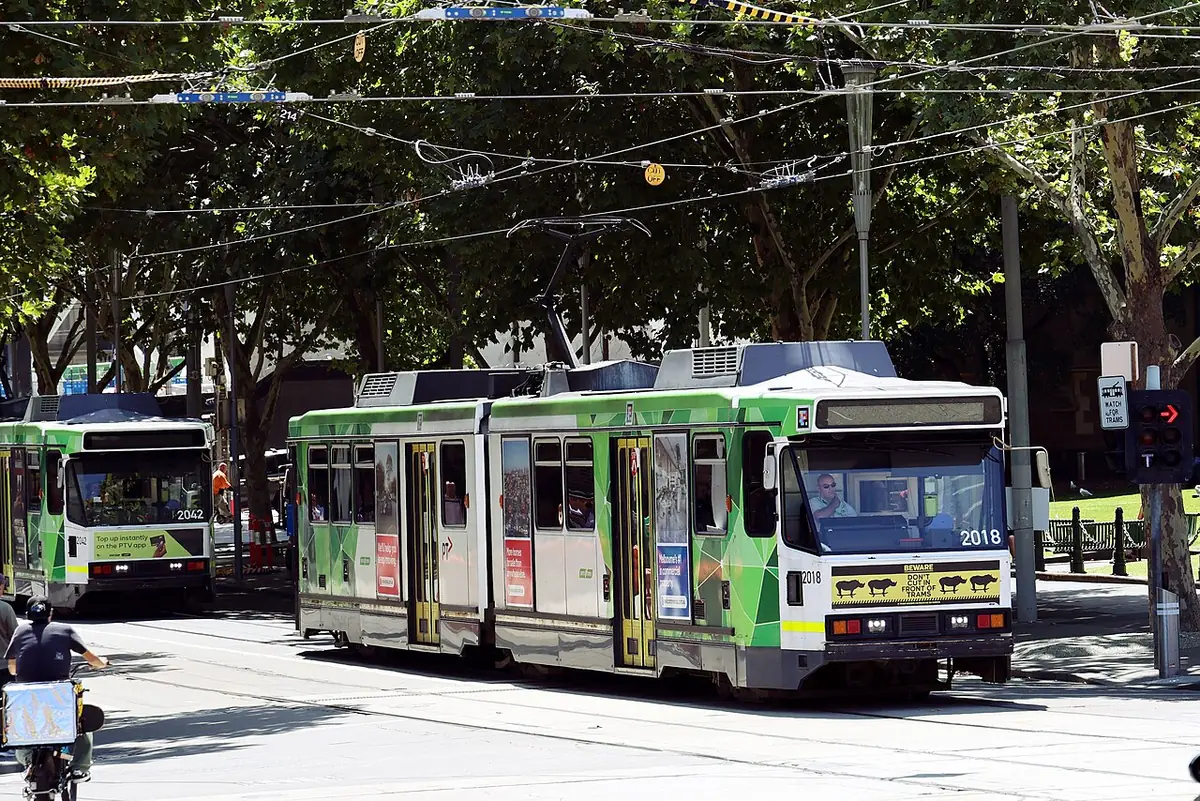
Green trams under the trees on Swanston Street — Photo: Bhullargraphic · CC BY-SA 4.0 · Wikimedia Commons
The process applies to every property, but an apartment and a house do not defend their value the same way in Melbourne.
A reliable valuation does not come out of a single conversation with an agent: it is built by crossing several sources, each with its own role and its own bias. The owner supplies the documents, the agent brings knowledge of the buyers, the valuer formalises the method, the bank applies its caution and public data acts as a guard rail. The market, finally, settles the matter through recent sales and auction results. Following that order lets you know, at each stage, how much confidence the figure deserves.
You (the owner)Gather the documents and state the purpose of the valuationCollect the title, the plan of subdivision, the owners corporation certificate, the council rates notice and invoices for works. Say clearly whether you want to sell, refinance, divide or declare, because the instruction and the document expected depend on it.
The estate agentMarket appraisal and comparable salesThe agent inspects the property and proposes a range based on recent sales and on the buyers they are meeting. Ask for their comparables in writing and compare appraisals from several agents rather than keeping the highest.
The certified valuerFormal valuation reportThe valuer inspects the apartment, checks the title and the building, then writes a report stating the valuation date, the method and the caveats. This paid document is the one a court, a lawyer, an accountant or a government body will expect.
The bankValuation for a loan or a refinanceThe lender orders its own valuation, sometimes without an inspection, to protect the amount advanced. Its figure is often cautious and can differ from the agent's, particularly for small apartments or buildings with known problems.
State land services and the councilStatutory valuation and public checksThe Valuer-General oversees the valuations used for council rates and land tax, and land services provide property reports and planning rules. This data does not give market value, but it reveals the easements, zoning and heritage protections that move it.
The market: buyers and comparablesTesting against real salesAuction results, properties passed in and days on market show how buyers are reacting right now. A valuation that ignores a run of lower recent sales in your own building will not survive a real offer.
Apartment or house in Melbourne: how each type of property holds its value
This difference between building and land shows up concretely in the price levels to measure your apartment against, and in the costs that come off the figure.
In Melbourne, the question of what an apartment is worth cannot be asked without comparing it with a house, because the two types of property do not follow the same trajectory. The value of a house rests largely on the land it occupies, a scarce resource in well-served suburbs that tends to appreciate over time even as the building ages. The value of an apartment, by contrast, rests mainly on the structure and on a small share of land divided among many lots. Buildings wear, equipment ages and new developments come to compete with existing stock, which is why apartment growth across the metropolitan area has on average been slower and more uneven than growth in houses. That general observation does not condemn apartments, but it does mean this type of property has to be valued on criteria of its own.
Not all apartments face that logic in the same way. The small older blocks of Carlton, Fitzroy, South Yarra or St Kilda, with few lots, a larger share of land and a character that is hard to reproduce, often hold their value better, because they attract owner-occupiers rather than investors. Apartments in the big towers of the CBD, Southbank or Docklands, built in volume and often bought off the plan, face direct competition from neighbouring projects and caution from lenders on small floor areas. For those properties, a valuation has to rely on sales in the same tower or in comparable towers, not on suburb averages that mix very different buildings. A valuer will also look at the floor level, the aspect, whether the view is protected or under threat, the presence of a car space and the level of fees.
Holding costs count in a valuation as well. A house owner carries the upkeep of the roof, the garden and the exterior, but decides alone on works and their timing. An apartment owner pays fees to the owners corporation, which fund maintenance of the common property, insurance of the building and sometimes expensive facilities such as a pool or a gym. High fees reduce what a buyer is willing to pay, because they are folded into the total cost, especially where the purchase is for letting. A special levy voted for a facade, cladding or waterproofing can therefore take more off your lot than the share of the works itself, because of the unease it creates among buyers.
To value your apartment realistically, start from what it is: a lot in a particular building, compared with other lots sold recently in buildings of the same generation, size and standard of management. Do not transfer to it the spectacular rises recorded on houses in your suburb, and equally do not take fright at an average dragged down by investor studios if your apartment is family-sized and well placed. If the question is whether to keep the apartment or sell it to reinvest elsewhere, compare its likely growth, its net rental yield and its future fees with those of other investments, and have the calculation checked by an independent professional. The valuation is then no longer just a figure, but a decision-making tool.
Which price levels to measure your Melbourne apartment against, and which costs to take off
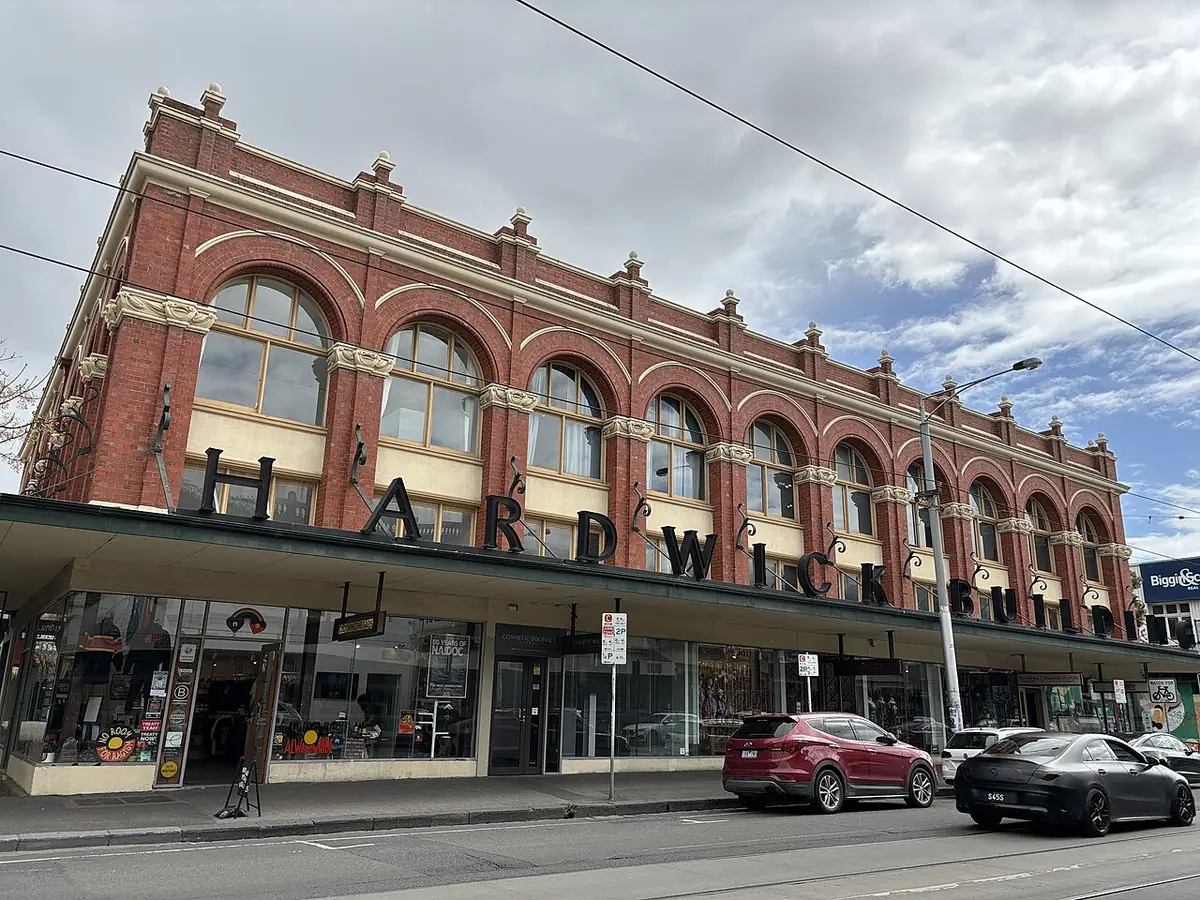
The red-brick Hardwick Building and its shopfronts in Brunswick — Photo: Nick-D · CC BY-SA 4.0 · Wikimedia Commons
These amounts take on meaning against the everyday life a buyer is purchasing with the apartment, which enters the value too.
A valuation is read in two ways: against the prices at which comparable apartments sell, and then against what will be deducted if you act on it. The first table sets out reference price ranges to place your property by size and area, together with the rules that frame how a price may be advertised in Victoria. The second lists the costs that separate market value from the amount actually received: commission, marketing, legal fees and tax. These ranges are indicative, vary with the property and the provider, and should be confirmed by written quotes and by a tax adviser before any decision.
Reference price levels for placing the valuation of an apartment
Comparison benchmark
Range or order of magnitude (AUD)
How to use it in your valuation
One-bedroom apartment (inner Melbourne)
$450,000 - $600,000
Stock in the CBD, Southbank or Docklands; compare first with sales in the same tower or in towers of the same generation, since supply there is abundant.
Two-bedroom apartment (inner and middle ring)
$650,000 - $900,000
The most traded format, which offers the most comparables; a car space, a second bathroom and the floor level explain most of the spread.
Average price per square metre
Roughly $7,700 to $8,700 depending on size
A useful benchmark only if areas are measured the same way; small apartments show a higher rate per square metre than large ones.
Range advertised by the agent
No more than 10% between the bottom and the top of the published range
In Victoria an advertised price must not be below the agent's estimate or the vendor's asking price; check the current rules with Consumer Affairs Victoria.
These ranges describe the market as a whole; only recent sales of genuinely comparable properties can place your apartment precisely.
Costs that come off the value if you sell
Item
Estimated amount or mechanism
What it does to the net value
Estate agent's commission
A negotiable percentage of the price, often in the order of 1.5% to 2.5% depending on the property and the agency
Paid out of the sale proceeds at settlement; compare the rate, the base and the conditions before signing an authority.
Marketing, photography, auction costs and preparation
A few thousand dollars depending on the campaign
Often paid up front by the vendor and due even without a sale under the authority; they come straight off the net proceeds.
Legal and settlement fees
$1,500 - $3,500
The fee of the conveyancer or solicitor who prepares the vendor's statement and the transfer, plus discharge of any mortgage.
Capital gains tax and withholding
Withholding of 15% of the price for a foreign resident seller without a clearance certificate; the gain taxable according to tax residence
A non-resident loses most of the Australian exemptions, and an owner tax resident elsewhere may also declare the gain at home under the applicable treaty, which is worth checking with an adviser.
If you keep the property, owners corporation fees (often $3,000 to $7,000 a year) and council rates (often $1,500 to $2,500 a year) also weigh on value, because buyers fold them into their own calculation.
Healthcare, schools, transport: the ordinary Melbourne Tuesday a buyer is paying for
Behind these visible strengths, several details nobody mentions at an inspection also move the value of an apartment.
A buyer is not only paying for square metres: they are paying for the day they will be able to live from the apartment, or the day their tenant will live. Commuting time, access to healthcare, schools, shops and green space feed directly into prices, sometimes within a few streets. Following an ordinary Tuesday helps you identify what supports value in your location and what limits it. It is also the framework a valuer uses when adjusting comparables to your property.
07:30The morning trip by tram or trainProximity to a frequent tram line or a metropolitan railway station is one of the first criteria for apartment buyers. A property a few minutes' walk from a well-served stop compares favourably with a neighbouring one that depends on a car.
08:30Arriving at the office in the CBDThe centre concentrates a large share of skilled jobs, and the CBD free tram zone makes central apartments attractive to workers without a car. That advantage supports rental demand, but it is shared by a great many similar homes, which limits its effect on the value of any one lot.
12:30Health services in the neighbourhoodGP practices, pharmacies and the big public hospitals, such as those in the Parkville medical precinct, draw clinical staff, researchers and students. For an apartment in Carlton or North Melbourne, that steady pool of tenants and occupiers supports value.
17:00The stop at school or childcareIn Victoria, the local government school generally depends on your address, and the zones of sought-after schools influence prices for family homes. For a two or three-bedroom apartment, being inside the right zone can widen the buyer pool to families and improve the value.
18:15Shopping at the market or the supermarketBeing close to Queen Victoria Market, South Melbourne Market or a supermarket within walking distance is among the arguments that get paid for in central suburbs. It counts all the more because many apartments have only one car space, or none.
20:00The evening in a local cafe or parkThe culture of cafes, restaurants and parks makes the reputation of suburbs such as Fitzroy or South Yarra and feeds into prices. It has a flip side, though: an apartment exposed to noise from bars or a busy road usually trades below its quieter neighbours.
What a headline figure will never tell you about your Melbourne apartment
These blind spots explain most of the valuation mistakes owners only discover after the event.
A median or an automated estimate sees neither the inside of your apartment nor the life of your building. Yet several elements invisible in a listing shift value significantly, upwards as well as downwards. They are precisely the ones a buyer and their conveyancer will uncover at the time of a sale, and that a serious valuer checks before settling on a figure. Knowing them lets you correct an over-optimistic valuation before a real offer does it for you.
Planning rules and neighbouring projects (planning overlays)
A developable site next door, a permit lodged for a tower or a change of zoning can remove a view or daylight and take part of the value of your apartment away; conversely, a durably protected outlook supports it. This information appears in planning schemes and public property reports.
The financial health of the owners corporation and the levies to come
A maintenance fund too thin for planned works on the roof, the lifts or the facade signals special levies ahead. Buyers read the owners corporation certificate and the minutes, and they deduct those amounts from their offer, sometimes with an extra margin for caution.
Combustible cladding and building defects
A building facing cladding replacement, water ingress or a dispute with the builder carries a discount until the situation is resolved. Some lenders restrict their lending on these buildings, which reduces the number of buyers and weighs on the price achieved.
Heritage protections (heritage overlay)
In a protected area, external works, windows and solar panels require approval. That constraint limits the improvements possible, but it also protects the character of the street, which some buyers pay more for.
The car space, the storage cage, the aspect and noise
A car space attached to the title, a storage cage, a bright aspect or the absence of traffic noise create wide gaps between apparently identical apartments. Check on the plan of subdivision what genuinely forms part of your lot before comparing yourself with a neighbour.
The Melbourne valuation mistakes that surface six months later
These mistakes also show that, in certain situations, it is better not to act straight away on a valuation.
Looked likeAn agent's appraisal well above those of their competitors
Turned outAn authority signed on that figure, an apartment left on the market for months or passed in at auction, then sold below the more cautious initial appraisals, after marketing costs spent for nothing.
Would have caught itAsking every agent for their comparable sales in writing and keeping the best-supported appraisal, not the highest.
Looked likeThe off-the-plan price paid taken as the starting value of the apartment
Turned outA bank valuation far below it at refinance time, because the resale market does not pay the developer's margin and faces a great many similar new apartments.
Would have caught itValuing the property only from resales of comparable apartments already lived in, in the same tower or in towers of the same generation.
Looked likeThe rise in suburb prices reported in the local press
Turned outGrowth driven by houses and family properties, while apartments in the building had stalled, leaving the owner with an unrealistic price expectation.
Would have caught itReading statistics specific to apartments and sales within the building rather than the overall median for the area.
Looked likeA building with modest fees and no visible works
Turned outA special levy for facade defects disclosed in the minutes, which every prospective buyer deducted from their offer, pushing the price achieved down.
Would have caught itReading the minutes and the owners corporation maintenance plan before settling on a figure, and flagging these points to the agent or the valuer.
Who should not act right now on the valuation of a Melbourne apartment?
With those situations set aside, what remains is to measure how much confidence the figure in your hands deserves.
A valuation is a useful starting point, but it does not always justify an immediate decision. Some situations make the figure provisional, either because the building is going through an uncertain period or because the intended use calls for a stronger document. In other cases it is the gap between market value and net proceeds that should encourage patience. Recognising these cases stops you selling, borrowing or dividing on the basis of a value the facts will contradict.
The owner whose building is in dispute over defects or in the middle of a cladding replacement
→Waiting until the works are funded or completed, and gathering the documents that prove it, before setting a price.
While the outcome remains uncertain, buyers and lenders apply the maximum discount. Once the situation is resolved and documented, value often returns to the level of comparable buildings, which can more than repay the wait.
The beneficiary or former partner who has to divide or declare the apartment
→Commissioning a formal valuation from a certified valuer, at the date required, rather than relying on an agent's appraisal.
An undated commercial opinion is easy to challenge between beneficiaries, before a court or in front of a tax authority. The cost of a valuer's report is small against the sums involved and the disagreements it heads off.
The owner planning to refinance on the strength of a flattering agent's appraisal
→Obtaining the bank's own figure first, or a cautious valuation, before committing to a new project.
A lender advances money only against its own valuation, which is often lower, especially for small apartments. Building a project on an agent's figure exposes you to a reduced loan or to unexpected lender's mortgage insurance.
The non-resident thinking of selling without having costed the tax
→Having the net amount calculated after withholding, capital gains tax and any tax due in their country of residence before deciding to sell.
Market value can look satisfying while the amount actually kept is far below what the owner imagined. Keeping the property and letting it may then make more sense than a sale decided on the headline price alone.
So how much confidence should you place in the valuation of your Melbourne apartment?
A valuation of a Melbourne apartment deserves your confidence when it meets three conditions: it rests on recent sales of genuinely comparable properties, it takes account of what sets your lot and your building apart, and it matches the use you are going to put it to. A figure that cites sales in your tower or in buildings of the same generation, that takes in the fees, the car space, the floor level and the financial state of the owners corporation, and that was produced by the right professional for the right question, is a solid benchmark. An isolated valuation, undated, without comparables or markedly higher than all the others, should be treated as an assumption to be tested, not as a value.
The safest approach is to cross-check sources. Compare written appraisals from several agents, read their comparables, then set them against statistics specific to apartments, against the figure a lender adopts and, where the stakes justify it, against a certified valuer's report. When those figures converge, you can act with reasonable confidence. When they diverge, the gap is itself information: it often points to a defect in the building, a floor area badly compared, a market that is turning or an over-optimistic agent, and it deserves an explanation before any decision.
Finally, remember that a valuation is dated and that the Melbourne market reacts to interest rates, to the supply of new apartments and to the life of each building. If you are considering a sale, translate market value into a net amount, after commission, legal fees and tax in Australia as well as in your country of residence. If you are keeping the property, revisit the valuation regularly and after every significant event in the owners corporation. A well-built figure does not guarantee a price, but it lets you decide with your eyes open, and recognise a fair offer when one arrives.
Related questions
What is the difference between an agent's appraisal and a certified valuer's report in Melbourne?
An agent's appraisal, usually free, is a commercial opinion designed to win the listing: it rests on recent sales, but the agent has an interest in quoting an attractive figure. A valuer, normally a member of the Australian Property Institute holding Certified Practising Valuer status, produces a paid, dated report that states the purpose of the instruction, the comparables selected and the caveats attached. It is that second document which is expected for an estate, a property settlement, a dispute or a tax filing. For a simple decision about whether to sell, several agents' appraisals weighed against each other are often enough, provided you read the comparables behind them.
How do owners corporation fees weigh on the value of an apartment?
Buyers think in terms of the total cost of ownership: at the same price, an apartment whose annual fees are markedly higher than those of the building next door sells for less. Fees depend on the lot entitlement and on the building's facilities, such as lifts, a pool, a gym or a concierge. A well-funded maintenance fund reassures buyers, whereas an empty one signals special levies ahead, which a buyer will take off their offer. Before settling on a figure, compare your apartment with sales in buildings whose fee levels are close to your own.
Can a non-resident owner have a Melbourne apartment valued remotely?
Yes, a valuation does not require your presence: an agent or a valuer can inspect the property with the managing agent, the sitting tenant or someone you trust. Prepare the title, the plan of subdivision, the latest owners corporation certificate, the council rates notice and the current lease if there is one. Non-resident status does not change what the property is worth, but it changes what will be left after a sale, mainly because of foreign resident withholding and the capital gains rules. Have the market value established on one side, then the net proceeds on the other, with an accountant.
Which Melbourne suburbs give the most reliable comparables for an apartment?
Comparables are more reliable where sales are frequent and the stock is homogeneous. In the CBD, Southbank or Docklands, sales within the same tower are common, which gives precise benchmarks, although the abundant supply also drags prices down. In Carlton, Fitzroy or South Yarra the stock is far more varied, spanning walk-up blocks, converted warehouses and recent developments, so comparables have to be chosen with care. In the west, around Footscray, new projects and urban renewal move the reference points faster than elsewhere.
Do school zones affect the value of an apartment in Melbourne?
In Victoria, enrolment at a government school generally depends on your residential address, and the zones of the most sought-after schools can be checked online. For houses the effect is well documented; for apartments it exists too, but it is weaker, because the buyer pool includes many investors and young professionals. A two or three-bedroom apartment inside the zone of a popular school attracts families and can hold a premium over neighbouring stock outside it. Check the zone for the current year, as boundaries can change.
Why does an auction result matter so much as a value benchmark in Melbourne?
Auctions are very common in Melbourne, and a property sold under the hammer shows what competing buyers actually agreed to pay on the day. A property passed in, by contrast, signals that the vendor's reserve was above what the market offered that morning. The clearance rates published each week give a general temperature, but they do not replace an analysis of sales genuinely comparable to yours. For a valuation, a recent auction result in your own building counts for more than a metropolitan statistic.
Do building defects or combustible cladding reduce the value of an apartment?
Yes, and sometimes sharply: buildings put up during periods of intense construction have revealed problems with waterproofing, facades and combustible cladding. Until the works are funded or completed, buyers apply a discount and some lenders become more cautious, which shrinks the pool of possible buyers. The owners corporation minutes and the certificate issued during a sale usually reveal any proceedings under way. A serious valuer will mention the point in the report and reflect it in the figure adopted.
How do Reserve Bank of Australia rates change the value of an apartment?
RBA decisions act on household borrowing capacity, and therefore on the amount buyers can put on the table. When rates rise, the number of bidders falls and apartment prices, especially those aimed at investors, tend to stall or slip back. When they fall, demand returns, but often on houses and family properties first. A valuation is therefore always dated: a figure obtained a year ago has to be reread in the light of current credit conditions.
Does the owners corporation maintenance fund form part of the value of my apartment?
The maintenance fund is not paid back to you on a sale: it stays with the owners corporation and benefits the next owner. It still affects value indirectly, because an informed buyer compares the balance available with the major works set out in the building's maintenance plan. A fund that is too thin for a roof, lifts or a facade needing attention signals levies to come, which the buyer will deduct from their price. A building with sound finances, by contrast, holds up better in negotiation.
Which documents should I gather for a reliable valuation of my Melbourne apartment?
Collect the certificate of title and the plan of subdivision, which sets out your lot, your entitlement and any car space or storage cage attached to it. Add the owners corporation certificate, the latest accounts and minutes, the council rates notice, invoices for works carried out inside the apartment and, if it is let, the lease with the current rent. If a sale is in prospect, the vendor's statement (Section 32) prepared by the conveyancer will then list mortgages, easements and planning rules that apply. The fuller the file, the fewer assumptions the valuer has to make, and the more defensible the figure.