Putting a credible figure on an apartment in Liverpool means reading local dynamics closely, understanding the legal features of English property, and knowing how individual neighbourhood markets actually behave. This guide sets out every parameter you need to build, test and defend your own valuation with confidence.
Get the app
What nobody tells you.
Real prices, hidden costs and the traps to check before you commit.
What a valuation of a Liverpool apartment really tells you
Scroll
What a valuation of a Liverpool apartment really tells you
Putting a credible figure on an apartment in Liverpool means reading local dynamics closely, understanding the legal features of English property, and knowing how individual neighbourhood markets actually behave. This guide sets out every parameter you need to build, test and defend your own valuation with confidence.
Written by the ting.ad editorial team ·
High Street, Liverpool in Street View: drag to look around.
To judge whether a given figure fits your own situation, look at how your circumstances sit within the local urban fabric.
Valuing an apartment in Liverpool is not a matter of multiplying square metres by a city-wide rate in a busy port city. Behind the appeal of a successful industrial reinvention sits a market of sharply contrasting sub-markets, where long-term growth potential coexists with demanding management realities that any honest estimate has to price in. Understanding what a figure actually represents means analysing the structure of supply, the condition of the housing stock and the reality of yields across the metropolitan area's different neighbourhoods.
A headline yield that flatters the apparent valuevsService charges and management costs that are routinely left out of the estimate
Listings frequently advertise attractive returns, but once maintenance costs on historic blocks and management fees are folded in, the net margin, and with it the price a well-informed buyer will pay, falls significantly.
An asset anchored in a city with genuine cultural momentumvsLiquidity that varies by property type and by exact location
Large modern schemes near the docks find buyers quickly and so support confident valuations, while older stock in outlying areas needs a far more patient exit and a wider margin of error around any figure.
Entry prices clearly below London or ManchestervsA need for close legal and technical work before the number can be trusted
The low apparent cost of bricks and mortar in Liverpool attracts international owners, some of whom discover only late how heavily structural findings and long-lease terms weigh on what a property is genuinely worth.
Strong rental demand driven by the universities and the professional job marketvsHigh tenant turnover that eats into the income a valuation is built on
Students and young professionals constantly renew demand for small furnished units, which supports value but imposes standards of comfort and maintenance responsiveness that an owner must fund before the income assumption holds.
Does this market suit the reason you need a figure?
Moving from a general view of value to a concrete number means understanding the local administrative and cultural reference points.
Every owner comes to the Liverpool market with a different reason for wanting a figure, whether that is releasing capital, rebalancing a portfolio or preparing a base for future stays in the United Kingdom. How useful your valuation turns out to be depends on the fit between the effort you can put in, your tolerance for uncertainty and the operational reality of the neighbourhoods concerned.
Remote owner
Valuing an apartment in Liverpool from abroad is workable, but it means relying on an agent or a surveyor whose local judgement you cannot easily check. Build the cost of that reliance into your expectations from the start. Automated tools will give you a bracket in seconds from sold-price records at HM Land Registry, yet they cannot see condition, aspect, noise or the state of the common parts, so they systematically miss the adjustments that separate two flats in the same block. Your position therefore rests on commissioning at least one physical inspection and on choosing a central location where comparable evidence is dense enough to keep the bracket narrow.
Future resident
Valuing a flat you plan to occupy rather than let changes which factors you weigh. You will give more attention to sound insulation, immediate transport links and neighbourhood amenities than to gross yield, and those same features are exactly what a local agent prices when comparing your flat against recent sales. Living in Liverpool means adapting to the rhythm of a lively port city, where cultural energy comes with very active street life. Visiting at different times of the week is worth doing precisely because it tells you whether the premium an agent has attached to the location is real.
Cautious holder
Holding property in England offers a useful alternative to conventional investments, provided you master the local legal detail that drives value. Pay particular attention to the nature of the lease, especially the distinction between freehold and leasehold, which governs ownership of flats and can move an estimate by tens of thousands of pounds on its own. Reading the building's accounts carefully lets you anticipate major works on the facade or the roof voted through by the other owners, and price them as a deduction rather than discovering them as a surprise once a buyer's surveyor finds them for you.
Valuing here when you come from abroad: what changes in your reference points
Strawberry Field's gates are one of Liverpool's best-known landmarks — Photo: Robertoalonsomen · CC BY-SA 4.0 · Wikimedia Commons
With those methodological reference points in place, micro-location becomes the decisive element in any figure you produce.
Coming to Liverpool from almost any other property system confronts an owner with legal and administrative practices that reshape how value is established. The structure of transactions, the nature of leases on flats and the relationship with professionals all require a complete reset of the assumptions you arrive with.
From abroad
A block of flats owned outright, with a single collective manager
Liverpool
A leasehold system with a managing agent and variable ground rents
You are not necessarily valuing perpetual ownership of the land and structure, but a long occupation right whose remaining term and renewal conditions have to be checked carefully, because both feed straight into the figure.
From abroad
A single official who drafts the deed and fixes the transfer value
Liverpool
The central role of independent conveyancing solicitors acting for each side
The transaction rests on an exchange of contracts followed by a completion date, an adversarial process in which every detail of title is tested by specialist lawyers, and in which title defects surface as price reductions.
From abroad
A seller's pack of mandatory technical reports supplied up front
Liverpool
The caveat emptor rule, under which the buyer commissions their own experts
The seller has no far-reaching duty of proactive disclosure; it falls to you or your conveyancing solicitor to ask the precise questions and to order detailed surveys, and an owner who values without that evidence is guessing at condition.
From abroad
Rents and rent increases tightly framed by statute
Liverpool
A more flexible private rental market, with specific rules on tenancy deposits
Rental income can be adjusted to market conditions with real contractual agility, which makes income-based valuations more responsive here, provided deposits are lodged with an approved scheme exactly as required.
Which Liverpool neighbourhood does your apartment sit in, and what does that do to the figure?
Looking at the prices actually achieved in these different areas is what turns a neighbourhood judgement into a realistic number.
Liverpool's urban geography is built around districts with very distinct identities, running from ultra-connected waterfront business quarters to quieter Victorian residential areas. Which one your property sits in directly conditions how quickly it would sell and how stable its income is, and those two things are what an estimate is really measuring.
The Docks and Baltic Triangle
An ultra-modern, fashionable and busy atmosphere, set by coworking spaces, specialty coffee shops and inventive cultural projects.
Suits
Owners who need a fast, well-evidenced figure, because comparable sales here are plentiful and recent.
Trade-off
Some of the highest per-square-metre prices in the city, alongside service charges on recent blocks that are heavy enough to pull an estimate back down.
Georgian Quarter and Hope Street
A prestigious and well-preserved architectural setting, marked by fine Georgian facades, theatres and tree-lined streets.
Suits
Period stock where character carries a genuine premium and long-term value holds up well.
Trade-off
Thin supply makes comparables scarce, while strict conservation constraints and heavy renovation costs on listed buildings widen the range any honest valuation has to quote.
Sefton Park and Lark Lane
A green, family-minded village feel, backing onto one of the city's largest parks, with a lively independent retail scene.
Suits
Flats whose value rests on quiet, space and a settled local community rather than on rental churn.
Trade-off
The relative distance from the strictly financial core means regular use of public transport for commuting, and apartment comparables are sparse in an area dominated by houses.
What do apartments actually achieve across the city's different areas?
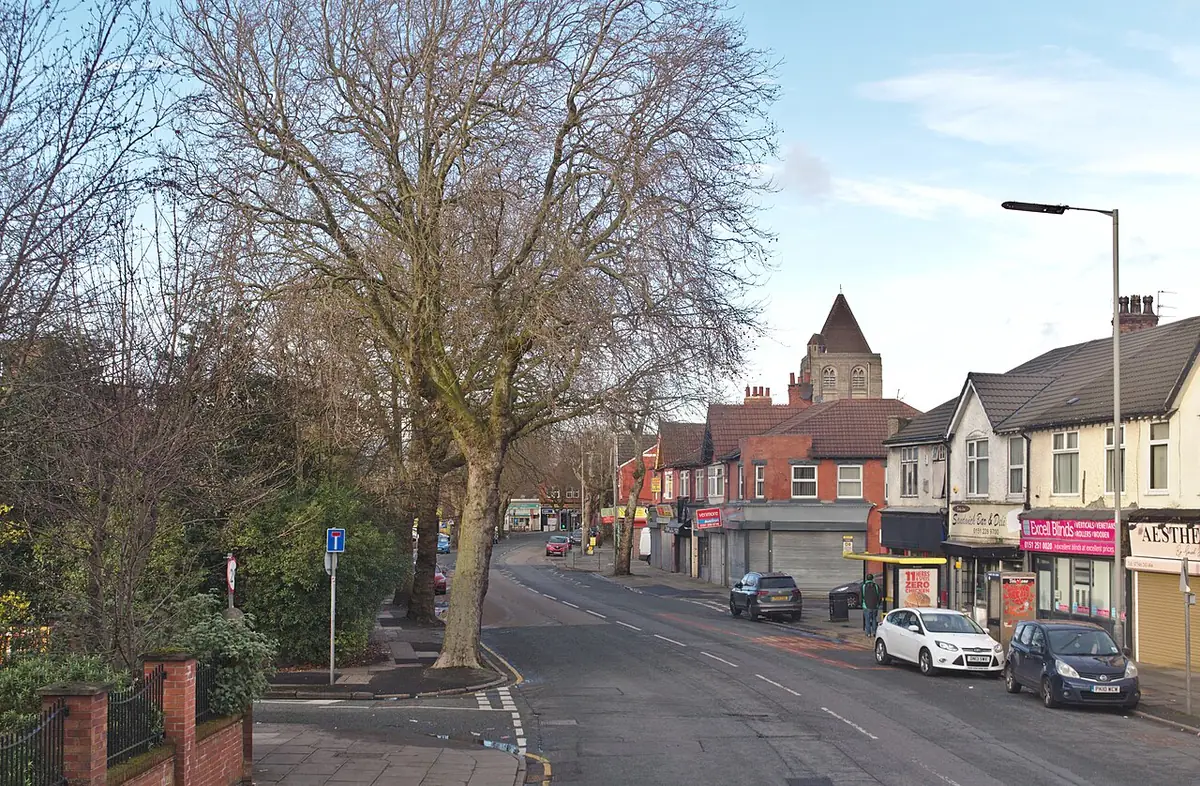
Streets like this mix shops and terraced homes under the trees — Photo: Rodhullandemu · CC BY-SA 4.0 · Wikimedia Commons
Beyond the headline financial picture, the exact legal nature of what is being valued deserves full attention.
Valuing an apartment in Liverpool means separating high-specification new schemes from older units in need of work. The ranges below reflect averages observed in recent transactions, excluding conveyancing solicitor fees and broker costs, and they are the starting bracket against which an individual flat is then adjusted.
liverpoolFor saleApartmentestimate
Median price / m²£2,280Half the apartments sell below this
Median price£168kthe average is 14% higher — a few very large properties pull it up
Most common2 bedrooms43 % of listings
Average size70 m²
By number of bedrooms
Bedrooms
Share of market
Avg price
Price / m²
Avg size
1
32 %
£130k
£2,712 +13 %
48 m²
2most common
43 %
£168k
£2,400
70 m²
3
19 %
£212k
£2,232 −7 %
95 m²
4
6 %
£270k
£2,160best value / m²
125 m²
Each row is an average, compared against the area average of £2,400 / m². These are indicative estimates of a typical local market, not a measured sample of live listings. Check current listings before relying on them.
What is actually being valued: understanding the ownership structure
With those legal foundations understood, the way a valuation is actually produced follows a recognisable sequence.
Owning an apartment in the United Kingdom means becoming familiar with specific legal concepts that govern ownership of land and buildings. The distinction between full ownership of the land and a time-limited interest in a built volume changes the nature of the asset, and therefore the arithmetic of any estimate.
Leasehold (a long lease of the property)
You own the right to occupy the apartment for a fixed period, often 125, 250 or 999 years, granted by the owner of the land (the freeholder). Each year you pay a ground rent and a share of the cost of maintaining the common parts through service charges.
What it changesThe number of years left on the lease has to be checked before any figure is fixed; a lease falling below 80 years makes resale and local mortgage lending considerably harder, and the discount buyers apply from that point on is steep and well documented.
Share of freehold (a stake in the land)
Under this arrangement, the owners of the individual apartments in the block collectively own the company that holds the land and the structure of the building. That structure gives greater autonomy in running the building and in deciding how maintenance money is spent.
What it changesAlthough rarer in large new schemes, this arrangement removes disputes over unilateral ground rent increases and gives occupiers direct control of communal costs, which is why comparable flats with a share of freehold routinely value above their plain leasehold neighbours.
The rule to understand before you accept a figure for your apartment
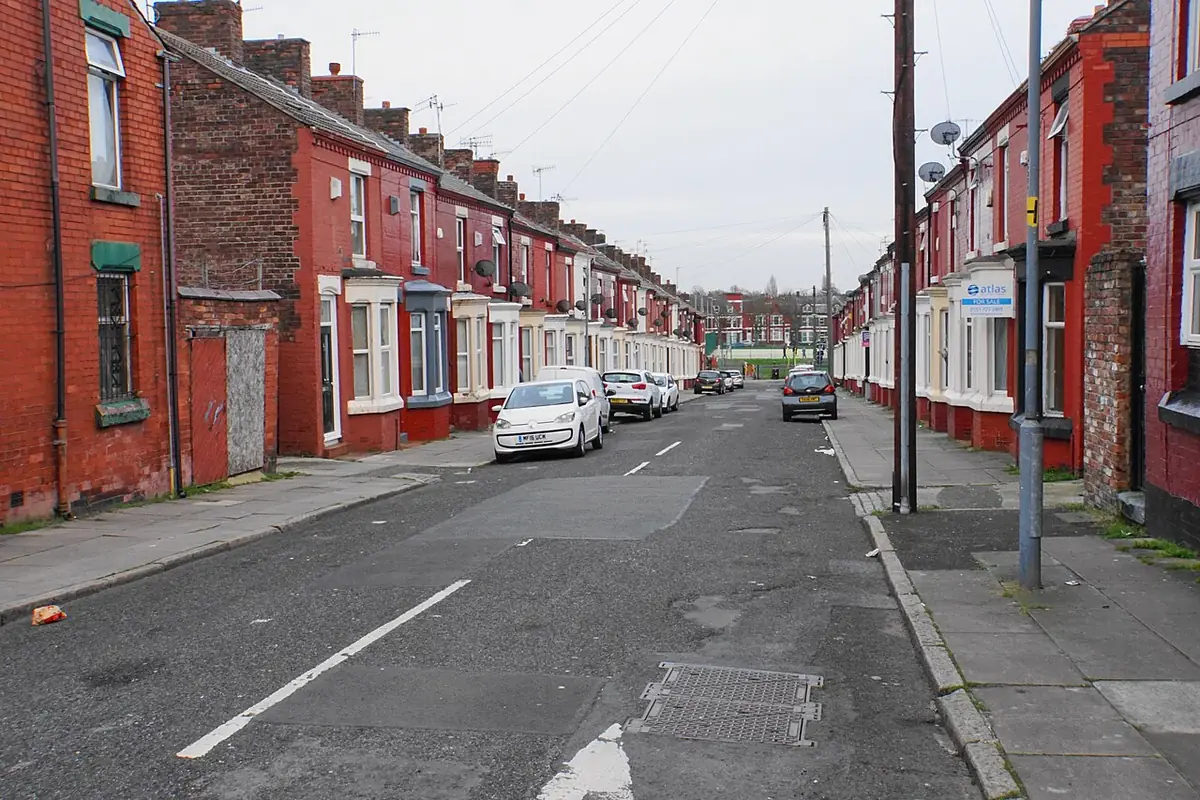
Terraced rows like this are the backbone of Liverpool's housing — Photo: Bill Boaden · CC BY-SA 2.0 · Wikimedia Commons
To follow that sequence without stumbling, it helps to see each stage of the process and who is responsible for it.
Property transactions in the United Kingdom involve a long period of legal uncertainty between the offer being accepted and contracts being exchanged. Neither party is legally bound during that phase, which means an agreed price is not yet evidence of value and can still be renegotiated on findings that emerge along the way.
The seller accepts the offer through the estate agent, and the figure everyone has been working to becomes the number that now has to survive scrutiny.
The conveyancing solicitor orders the official local searches, which can reveal planning schemes or hidden easements that materially change what the property is worth.
The surveyor inspects the property and reports on damp, structure or roof defects, each of which converts directly into a condition adjustment against the agreed figure.
The solicitor reads the restrictive terms of the lease, particularly future ground rent increases and sub-letting rules, both of which lenders price into their own valuation.
Exchange of contracts makes the deal legally binding and triggers a non-refundable ten per cent deposit, which is the moment the figure stops being an estimate and becomes the price.
How a valuation is produced in Liverpool, step by step
Arriving at a defensible figure for an apartment in Liverpool follows a structured path involving several professionals, coordinated either by you or by your legal representative. Following each stage properly is what turns an opening opinion into a number you can rely on.
OwnerGathering the evidence packPulling together the lease, recent service charge accounts, the EPC, the Council Tax band and any works records, then reading comparable sold prices for the immediate streets.
Estate agentsMarket appraisals from local agentsInviting two or three local agents to inspect and quote a figure, then interrogating the comparables each of them used rather than taking the highest number offered.
Automated toolsCross-checking against an automated estimateRunning the address through an online model built on HM Land Registry sold prices, and treating the output as a bracket that ignores condition, floor level, aspect and lease length.
SurveyorIndependent inspection and condition adjustmentsA detailed inspection of the apartment to assess structure and insulation and to identify future works, each of which is deducted from the headline figure.
Conveyancing solicitorLegal review of what is being valuedExamining title, checking the remaining lease term and ground rent clauses, and running the statutory searches that can shift the number in either direction.
LenderThe mortgage valuation and the final reconciliationThe lender's own cautious figure is compared against the agent appraisals and the survey findings, and the gaps between them are what tell you how solid your valuation really is.
Apartment or house in Liverpool: how the two are valued, and why the methods differ
With that distinction understood, what remains is to price the running costs that any figure has to absorb.
Comparing an apartment in the heart of Liverpool with a house in the outer residential districts involves far more than a question of taste, because the two are valued by different routes. New waterfront schemes, particularly around the docks, attract attention for their immediate access to cultural venues and office employment. Those same buildings, however, carry service charges that can be substantial and sit directly in the path of a very busy city centre, and both factors are deducted from the per-square-metre figure a buyer will accept.
Turning instead to a Victorian or Edwardian house in areas such as Wavertree or Mossley Hill brings more living space, private outdoor access and complete structural independence from a managing agent. These homes usually require immediate renovation budgets to meet current thermal standards, which is why a house valuation leans so heavily on the condition report: two houses on the same street can differ by a five-figure sum on roof and insulation alone.
The structure of the local market shows that apartment values move within a tighter band, which makes them easier to estimate from comparables, while family houses show notable resilience through regional economic cycles but a wider spread around any average. Owners looking at gross rental yield traditionally turn to urban blocks, where income evidence is abundant, whereas first-time buyers and families seeking stability favour the anchoring that a house with its own garden provides.
Local taxation and recurring maintenance costs also have to be weighed for each property type before a figure is settled. An older house calls for closer scrutiny of the roof, the timbers and the original insulation, all heavy budget lines that do not press with the same force on a recent apartment maintained collectively through a properly run block.
In the end, the figure you arrive at should follow from a realistic projection of how the property will be used over the next ten years. If flexibility and centrality dominate, the urban apartment values on income and location; if space and a long-term family asset dictate the choice, the suburban house remains the steadier store of value across Merseyside.
Which costs a valuation has to absorb before the figure means anything
With those figures on the page, it is worth seeing how a typical weekday actually unfolds for someone living in the city.
Working out what an apartment in Liverpool is worth cannot stop at the headline asking price. It has to take in the unavoidable transaction costs, the local taxes specific to the United Kingdom, and the running expenses needed to hold the property steadily, because every one of them is priced by the next buyer. Market data shows notable variation depending on exactly where the apartment sits among the city's postcodes.
Acquisition and holding costs that shape an apartment valuation in Liverpool
Cost line
Estimated range (GBP)
Comment and effect on the figure
Sale price (two-bedroom apartment)
GBP 130,000 - GBP 220,000
Varies sharply between the historic centre, the regenerated docks and the outlying neighbourhoods.
Transfer tax (Stamp Duty Land Tax)
GBP 0 - GBP 3,500
Subject to the thresholds in force for main residences and to first-time buyer relief.
Legal and broker fees
GBP 1,500 - GBP 3,000
Mandatory conveyancing costs plus the lender's arrangement fee on the mortgage.
Annual service charges
GBP 1,200 - GBP 2,500
Covers maintenance of the common parts, security and sometimes heating in recent blocks, and is capitalised into the price a buyer will pay.
The amounts shown exclude any works needed to meet current standards or to refresh the interior, both of which are separate deductions from the estimate.
Indicative monthly running costs for a two-person household in Liverpool
Cost category
Average monthly cost
What the figure includes
Council Tax (local property tax)
GBP 130 - GBP 200
Depends on the band (Band A to H) assigned to the home by the council, which itself signals an official view of value.
Energy and utilities (water, gas, electricity)
GBP 150 - GBP 250
Liable to significant seasonal swings depending on how well the building is insulated, which is what the EPC rating measures.
Public transport (Merseytravel, bus, train)
GBP 100 - GBP 180
Monthly season tickets for commuting into the city centre.
Food and everyday essentials
GBP 350 - GBP 500
Weekly shopping in local chains and neighbourhood markets.
These estimates reflect averages observed for a standard way of life without discretionary spending.
Health, schools and transport: what an ordinary Tuesday in Liverpool says about location value
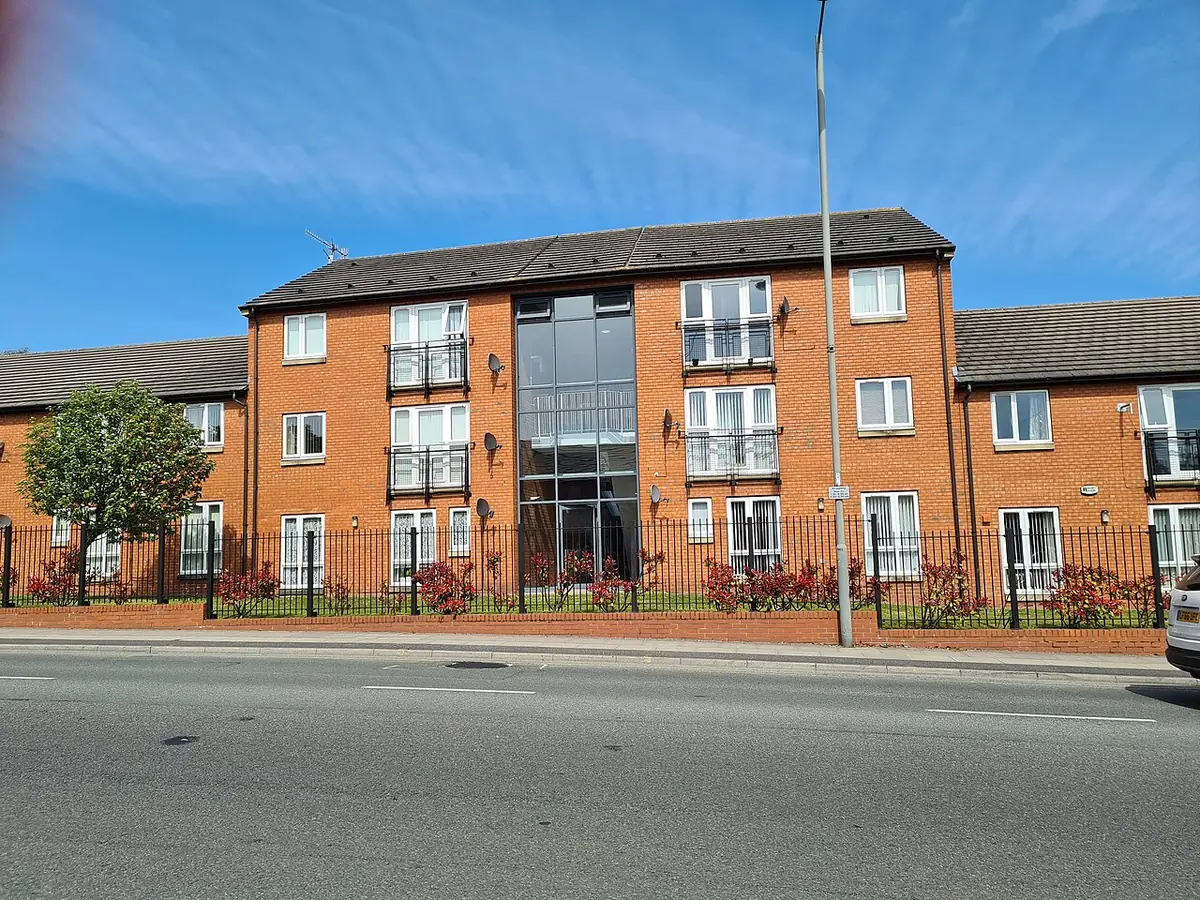
Newer apartment blocks like this add to Liverpool's housing mix — Photo: Frombowen · CC BY-SA 4.0 · Wikimedia Commons
Beyond that well-oiled routine, certain realities of the local market deserve close attention before you commit to a figure.
Nothing tests a location premium better than walking through a typical weekday hour by hour. In Liverpool, how easily you move depends closely on whether you use the Merseyrail network or the city bus routes, and buyers price that difference street by street. Local health facilities and schools also impose a disciplined approach to morning travel times to avoid peak-hour congestion, and proximity to both is one of the clearest observable value drivers in the city.
07:30The residential street you start fromMorning preparation and the walk to the nearest stop, with the distance on foot to the Merseyrail station being one of the first things an agent notes.
08:15Moorfields or Lime Street stationNoticeable crowding on the platforms heading for the central business district, a sign of how well the urban rail network serves commuters and why nearby addresses hold their value.
09:00Arrival at the office or workspaceSettling into the heart of Liverpool, surrounded by administrative services and the professional amenities of the metropolitan area.
12:30Lunch break near Bold StreetLocal shops and independent places to eat, the cultural and social vitality that supports centre-city apartment prices.
17:00A stop at the school or the health centreFamily and medical commitments, with GP surgeries often requiring appointments well in advance, and catchment quality feeding directly into what family buyers will pay.
18:30Home again, with a stop for a few thingsA neighbourhood convenience store for the evening shop, drawing on the dense retail network present across most parts of the city.
What agents and listings consistently leave out of a Liverpool price
Knowing these blind spots is what stops the classic disappointments that owners discover a few months in.
Marketing material highlights bright living rooms, close transport links and how cheap the property looks against London or Manchester. It frequently omits the technical and regulatory points that most directly govern comfort and future resale value. These are the checks to run before you accept any figure, whoever produced it.
The legal status of the lease (leasehold or freehold)
The large majority of apartments in Liverpool are sold leasehold, meaning what is owned is a right to occupy for a fixed term. Checking the years remaining and the level of ground rent is essential, because a lease under 80 years makes mortgage lending considerably harder and depresses the value by an amount that grows every year the lease runs down.
The record of major works in the building
Minutes of the last three years of owners' meetings reveal whether exceptional spending on the roof, the facade or lift replacement has been voted through or is imminent. Ignoring them leaves an owner exposed to unexpected demands of several thousand pounds, and leaves the valuation overstated by exactly that sum.
Real exposure to noise and urban disturbance
An apartment close to nightlife streets or major roads can seem quiet during a scheduled daytime viewing on a weekday. A careful check of sound insulation and double glazing is essential, and where it is lacking, buyers discount heavily for a problem they only discover after moving in.
The building's real energy performance (EPC)
Many older Liverpool buildings carry mediocre Energy Performance Certificate ratings, leading to high heating bills in winter. Pricing in the cost of insulation work is essential both to meet coming British rules on letting and consumption and to explain why two similar flats can be valued several thousand pounds apart.
The valuation regrets owners most often discover six months later
Given those risks, it is just as important to recognise the profiles for whom this market simply does not work.
Looked likeAn unmissable bargain, with a per-square-metre figure far below the cities of southern England.
Turned outEnergy compliance costs and service charges that had been left out of the estimate absorbed the entire apparent saving.
Would have caught itInsisting on a full building survey and reading the managing agent's detailed accounts before treating any headline figure as real.
Looked likeAn ultra-central location where everything is walkable without a car, and priced accordingly.
Turned outChronic difficulty parking nearby and night-time noise that no valuation had discounted for.
Would have caught itVisiting the surroundings at different times, particularly Thursday, Friday and Saturday evenings, to test whether the location premium survives contact with reality.
Looked likeA move-in-ready apartment needing no decoration or structural work, valued as such.
Turned outRecurring damp problems skilfully hidden at viewings behind fresh paint and poor ventilation in the wet rooms.
Would have caught itCommissioning an independent inspection by a chartered surveyor to detect condensation or hidden defects before the condition adjustment is settled.
Looked likeA guaranteed high-yield investment promised by local developers in a scheme still being delivered.
Turned outSignificant delivery delays and difficulty finding reliable tenants, because too many similar units came to the same area at once.
Would have caught itTesting genuine rental demand in the neighbourhood with independent agents and never valuing on a seller's optimistic yield projection.
Unusual profiles: who should not rely on a Liverpool apartment valuation right now?
It is now time to draw the conclusion and decide whether your own figure is ready to stand up.
A valuation is not a universal answer suited to every personal or professional situation. In a market in transition like Liverpool's, some owners rely on a figure that cannot carry the weight they place on it. Recognising whether you fall into one of these categories avoids acting prematurely on a number that will not hold.
The internationally mobile professional with an uncertain horizon
→Acting quickly on a headline valuation of a leasehold flat, with no prior experience of the local market.
Transaction costs (legal fees, taxes, the discount a rushed resale attracts) cancel any gain the figure suggested if the property changes hands before a minimum of five to seven years.
The passive owner looking for income without active management
→Relying on an automated estimate for a leasehold flat run by third-party managers based far away.
Opaque management fees, unpredictable charge increases and occasional void periods demand the kind of close monitoring that no model captures and no distant owner supplies.
The household that wants nothing to do with communal obligations
→A modern city-centre apartment or a highly structured residential complex, valued on its amenities.
The strict rules on pets, internal works and short lets generate daily frustrations for independent-minded owners, and the amenity premium in the figure only pays off for those who actually use it.
So, is your figure for a Liverpool apartment ready to stand up?
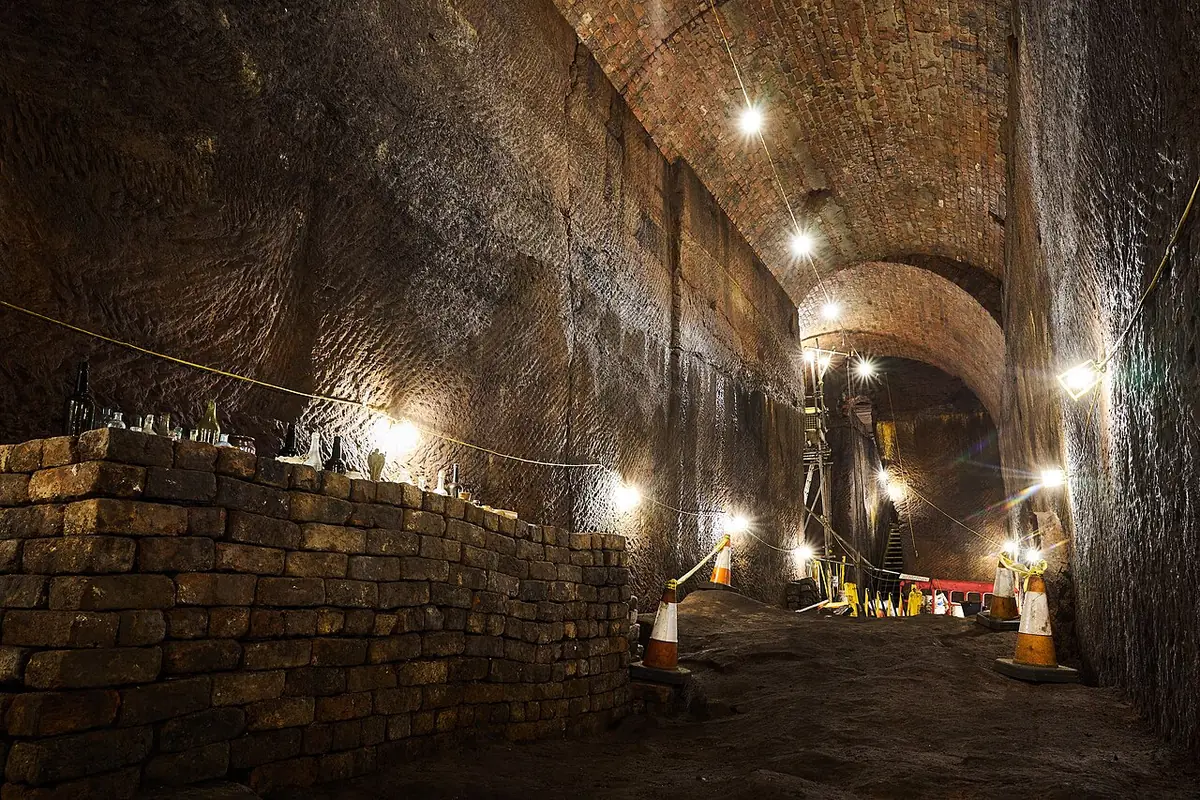
The Williamson Tunnels' brick passage, mid-restoration — Photo: Kyle J May · CC BY-SA 4.0 · Wikimedia Commons
At the end of this analysis, valuing an apartment in Liverpool shows itself for what it is: an exercise that tolerates no approximation, because every shortcut shows up later as a renegotiation. If you have measured the reality of service charges, absorbed the particular features of the leasehold system and tested your figure against what comparable flats actually sold for, you hold the essentials for reading the local market calmly.
Liverpool's strength lies in offering strikingly different settings, from the cultural energy of the regenerated docks to the green quiet of the outer residential districts. Each of those settings carries its own price logic, whether that comes from the building's energy performance, proximity to public transport, or the major maintenance the block has yet to fund.
Taking the time to look at several property types, to consult the sold-price records at HM Land Registry and to surround yourself with independent professionals (surveyors, brokers and specialist lawyers) is the best defence against a figure that flatters. Your estimate should sit within a long-term view, consistent with how you intend to use the property in this dynamic city in the north-west of England.
In the end, a valuation is credible not because the market feels buoyant, but because the evidence behind it is solid and your reasons for wanting the number are clear. If the comparables agree, the survey is clean and the lease is long, the figure you are holding can be trusted, and used.
Related questions
Does a lender's own valuation of a Liverpool apartment differ from an estate agent's estimate?
Yes, and the gap matters. A mortgage valuation is a short, cautious exercise carried out for the lender to confirm the property covers the loan, while an estate agent's appraisal is a marketing figure aimed at what a buyer might realistically pay. Lenders often lean conservative on leasehold flats, and where the mortgage valuation lands below the agreed price the buyer is expected to bridge the difference, so an owner should treat both numbers as separate readings rather than one truth.
What is Council Tax and how does the band affect the value of an apartment in Liverpool?
Council Tax is a local charge collected by Liverpool City Council to fund local public services (waste collection, policing, road maintenance). It is calculated from the estimated value of the property on 1 April 1991, split into eight bands running from letter A (the lowest) to letter H (the highest). The exact amount must be checked for each individual home, because a band that looks high for the size of the flat depresses what buyers will offer.
What is the fundamental difference between leasehold and freehold in Liverpool, and how is each valued?
Freehold means you own both the building and the land it stands on in perpetuity, which mainly concerns individual houses. Leasehold means you own only the right to occupy the home for a fixed term set by a lease (often 125, 250 or 999 years), while the land belongs to a freeholder to whom an annual charge called ground rent is due. Two otherwise identical flats can be valued very differently once the remaining lease term and the ground rent clause are read.
How long does a property transaction (conveyancing) usually take in Liverpool, and why does that affect a valuation?
A standard transaction in the United Kingdom generally takes between three and five months from the seller accepting the offer to final completion. That delay comes from the legal checks run by each side's solicitors, including land searches, environmental audits and title validation. Because a valuation is a snapshot, a figure produced at offer stage may need revisiting if the market moves during those months.
Which Liverpool neighbourhoods carry the strongest values for apartments?
The highest-rated areas take in the Waterfront and the regenerated docks (such as Albert Dock and Wapping Dock) for modern schemes with water views, and the historic City Centre around Ropewalks and Bold Street for its intense cultural life. For a greener, more residential setting, buyers look to areas such as Sefton Park or Mossley Hill, although supply there leans more towards houses, which makes apartment comparables in those areas thinner and the resulting estimate less certain.
What are service charges in Liverpool blocks, and how do they change a valuation?
Service charges are annual contributions demanded by the managing agent or the landowner to cover maintenance of the common parts, cleaning, security, building insurance and lift operation. The amount can rise each year with inflation and with major works voted through, so past accounts need rigorous analysis. A high or volatile service charge is treated by buyers and agents as a direct deduction from the price a flat can command.
Do you need a surveyor before putting a value on an older apartment?
Although English law does not formally require a building survey, commissioning one is strongly advised when the figure matters. An independent surveyor's report brings to light hidden defects, damp problems, roof faults or electrical non-compliance that would otherwise sit outside the estimate. Each of those findings is a condition adjustment: a valuation built without them is optimistic by exactly the cost of putting them right.
How is a new-build apartment bought off-plan in Liverpool valued before it exists?
Buying off-plan involves paying a non-refundable reservation deposit (generally between GBP 1,000 and GBP 5,000) to hold the property. Contracts are then exchanged within 21 to 28 days with a further ten per cent of the sale price, the balance falling due when construction is actually completed. Because there is nothing to inspect, the value rests entirely on the developer's specification and on completed comparables nearby, which is why off-plan figures need the closest sanity-checking of all.
What legal fees should be factored in around a valuation in the United Kingdom?
There is no notary in the continental sense in the United Kingdom. The legal side of a sale is handled by conveyancers or conveyancing solicitors. Their fees generally run between GBP 1,000 and GBP 2,500 excluding tax and disbursements (administrative search and land registration costs at HM Land Registry). These are transaction costs rather than value drivers, but they shape the net figure an owner actually keeps.
Does short-let potential add value to an apartment bought in Liverpool?
Short-term letting of the Airbnb type is tightly controlled in Liverpool, particularly in leasehold blocks whose rules often explicitly forbid short sub-lets. Local restrictions also apply to whole-home lets beyond a certain number of nights a year without specific planning permission. Any valuation that leans on short-let income should therefore be treated with suspicion until the lease and the planning position have been read.
Property review of ting
No ting properties in Liverpool yet
Be the first — share it on ting and it shows up right here.
Sources
HM Land Registry - UK House Price Index Liverpool Official monthly data on property price trends and transaction volumes in the Liverpool area, and the sold-price record used to check any estimate.