Buying an apartment in Liverpool means decoding a housing market with rules of its own, where rental yields sit alongside firm legal requirements. This guide sets out how to choose your area, master the details of leasehold, and secure every stage of the purchase without unpleasant surprises.
Get the app
What nobody tells you.
Real prices, hidden costs and the traps to check before you commit.
What you actually get when you buy an apartment in Liverpool
Scroll
What you actually get when you buy an apartment in Liverpool
Buying an apartment in Liverpool means decoding a housing market with rules of its own, where rental yields sit alongside firm legal requirements. This guide sets out how to choose your area, master the details of leasehold, and secure every stage of the purchase without unpleasant surprises.
Written by the ting.ad editorial team ·
High Street, Liverpool in Street View: drag to look around.
That tension between affordability and technical demands reshapes how you should assess your own purchase, depending on your profile.
Buying residential property in Liverpool means looking past the Victorian facades and the converted dockside blocks. On one side, the city offers gross yields and entry prices per square metre well below those in London or the larger cities of southern England. On the other, that affordability hides demanding technical realities that deserve analysis before you sign. Understanding the paradox stops you mistaking a sound long-term asset for a trap of unforeseen service charges.
An attractive entry pricevsThe cost of bringing a property up to standard
Asking prices let you buy generous floor areas, but the older housing stock often needs heavy investment in insulation, roofing and the upgrading of water and electrical systems.
Strong rental demand from students and young professionalsvsRapid turnover of occupants
Several universities and technology hubs support the rental market, but that same dynamic brings seasonal voids and more frequent refurbishment costs between tenancies.
A remarkable historic building stockvsStrict building management rules
Buying in a listed building or within a protected heritage area carries undeniable charm, but subjects every external or internal alteration to slow and costly consents.
Immediate affordabilityvsResale liquidity that varies by micro-neighbourhood
Well-located properties sell quickly, but some outlying areas or those poorly served by public transport can sit on the market for months, weighing on the overall return.
Does this place fit your way of life and your investment goals?
Once your profile is clear, the next step is to measure precisely how the British market differs from what you are used to.
How well a property purchase fits a local market cannot be measured by the yield printed on a brochure alone. Every type of buyer faces particular regulatory, tax and practical constraints when settling in Merseyside. Whether you are buying a main home, a professional base or a pure rental investment, the criteria for choosing the property and the neighbourhood diverge sharply with your priorities.
City-centre main home
By targeting central or immediately adjacent neighbourhoods such as the Baltic Triangle or Ropewalks, you put transport, cultural venues and employment within easy reach. That choice means accepting less living space for the same money, along with the noise that comes with nightlife and with the urban regeneration works under way. Service charges tend to be higher here because of the amenities included in new-build or converted schemes.
Targeted buy-to-let
Your absolute priority is gross yield and the durability of rental demand. You should look at the property types sought by young professionals and students, while reading the building's rules closely for any restrictions on short-term letting. Managing at a distance means entrusting the property to a rigorous local agency, whose fees must be built into your financing plan from the outset.
A future relocation
You buy today a property you will let for a few years before moving in yourself. That strategy calls for areas in transition but with solid fundamentals in schools, healthcare and transport. The property has to appeal to demanding tenants now and match your own comfort standards later, particularly on natural light and sound insulation.
Living here when you arrive from abroad: what changes in buying and ownership
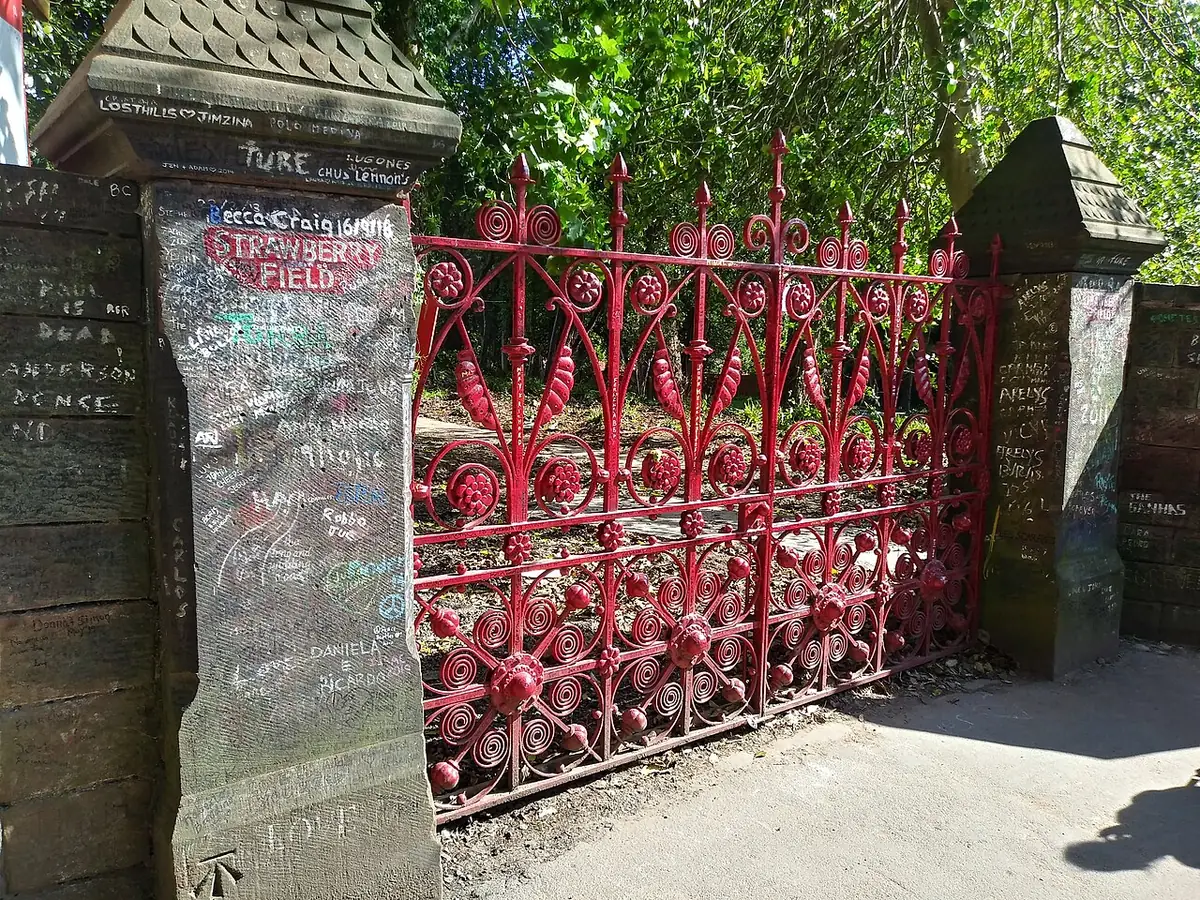
Strawberry Field's gates are one of Liverpool's best-known landmarks — Photo: Robertoalonsomen · CC BY-SA 4.0 · Wikimedia Commons
Those structural differences show up at street level too, where each part of the city has its own investment dynamic.
Taking on a property transaction in the United Kingdom holds plenty of surprises for a buyer arriving from abroad, legally and practically alike. The British system rests on contractual and common-law principles that differ sharply from the codified systems most overseas buyers know. From the very notion of land ownership to the time it takes to complete, each stage upsets familiar reflexes and demands close attention to the parts of the deal you cannot see.
From abroad
The familiar idea of shared building ownership and outright ownership of the land
Liverpool
The fundamental split between freehold (outright ownership) and leasehold (a long lease)
The great majority of apartments are sold leasehold, which means you buy the right to occupy the property for a fixed term while paying a ground rent to the owner of the land and a service charge towards maintenance. Always check how many years of the lease remain.
From abroad
Tight supervision and a public official involved from the moment an offer is made
Liverpool
The central role of solicitors and contractual freedom until contracts are exchanged
In the United Kingdom an offer made subject to contract has no binding legal force until the solicitors on both sides have exchanged formal contracts. Until then, buyer or seller can walk away with no financial penalty, which sometimes leads to gazumping.
From abroad
Immediate disclosure through a compulsory pack of technical inspections
Liverpool
The rule of caveat emptor (let the buyer beware) and a thorough survey
The seller is under no legal duty to provide a technical dossier as complete as buyers from many other countries expect. It falls to you, through your own independent survey, to uncover hidden defects, the condition of the roof, the presence of asbestos or problems with damp.
From abroad
Local taxes based on land and occupancy charges
Liverpool
The council tax band system and specific taxes on second homes
The local tax bill depends on the property's estimated 1991 value and can amount to a substantial annual sum. If the property is not your main home, anticipate the surcharges that apply to non-residents and investors.
Which neighbourhood should you settle in or invest in?
Choosing the neighbourhood leads straight to the prices actually being paid for apartments in Liverpool.
Picking the right area in Liverpool depends closely on your way of life and your tolerance for risk. Between the busy central districts, the former docks reborn as a cultural quarter, and the leafy residential streets a little further out, the offer is far from uniform. Each micro-market has its own rhythm, its own resident profile and its own long-term growth potential.
The Docks and Baltic Triangle
A lively, fashionable and artistic atmosphere set by co-working spaces, craft breweries and old port structures turned into bright lofts.
Suits
Young professionals, people who want city life at full volume, and investors chasing strong demand for furnished lets.
Trade-off
Some of the highest prices per square metre in the city, heavy service charges, and recurring noise at night.
Ropewalks and the city centre
The commercial and historic heart, with busy pedestrian streets, independent shops and period buildings put to new uses.
Suits
Those who want to do everything on foot and reach theatres, universities and stations without a car.
Trade-off
Little private green space, dense development, and parking that is extremely difficult and expensive.
Sefton Park and Lark Lane
A green residential setting shaped by superb Victorian parks, independent cafes and a village feel inside the city.
Suits
Families, buyers after quiet and more space, and investors betting on steady long-term value.
Trade-off
A relative distance from the immediate business district, which makes public transport necessary for the daily commute.
What does an apartment in Liverpool cost, area by area?
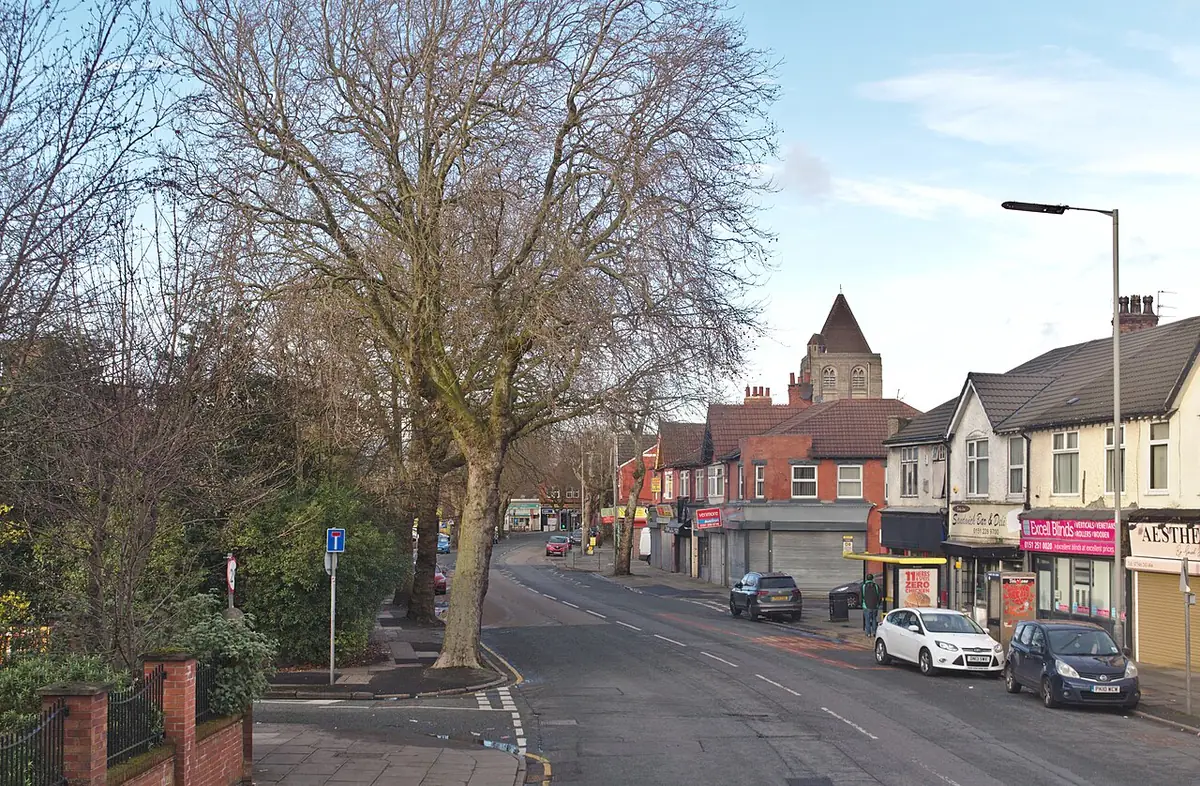
Streets like this mix shops and terraced homes under the trees — Photo: Rodhullandemu · CC BY-SA 4.0 · Wikimedia Commons
Beyond the figures, the legal nature of the title you are acquiring deserves your full attention.
Budgeting for a property purchase in Liverpool goes well beyond the headline price on the agency listing. You have to include every associated cost: Stamp Duty Land Tax, your solicitor's conveyancing fees, the survey, and the recurring service charge. The ranges below reflect the trends observed for properties of ordinary standard and comfort.
liverpoolFor saleApartmentestimate
Median price / m²£2,280Half the apartments sell below this
Median price£168kthe average is 14% higher — a few very large properties pull it up
Most common2 bedrooms43 % of listings
Average size70 m²
By number of bedrooms
Bedrooms
Share of market
Avg price
Price / m²
Avg size
1
32 %
£130k
£2,712 +13 %
48 m²
2most common
43 %
£168k
£2,400
70 m²
3
19 %
£212k
£2,232 −7 %
95 m²
4
6 %
£270k
£2,160best value / m²
125 m²
Each row is an average, compared against the area average of £2,400 / m². These are indicative estimates of a typical local market, not a measured sample of live listings. Check current listings before relying on them.
What you can actually own: leasehold and share of freehold explained
That legal rigour applies equally to the sequence of the transaction itself, which follows strict procedural rules.
The structure of property ownership in the United Kingdom differs deeply from what buyers elsewhere take for granted. When you buy an apartment in Liverpool, you very rarely acquire outright ownership of the land and of the building's structure. Grasping the legal distinction between a long lease and a shared holding of the freehold is the key to avoiding serious financial disappointment when you resell or carry out works.
Standard leasehold: a right to occupy for a limited term
You buy the right to occupy the home for a defined period (often 125, 250 or 999 years). Each year you pay a ground rent to the owner of the land, the freeholder, and a service charge towards the upkeep of common parts. If the remaining lease falls below 80 years, the property's value drops quickly and extending the lease becomes complicated and very expensive.
What it changesInsist that your solicitor checks the exact start date of the lease and the ground rent review clauses before you confirm any final offer.
Share of freehold: collective control of the building
In this arrangement the owners of the individual apartments jointly hold the freehold of the land and building through a dedicated management company. The structure gives more autonomy over maintenance works, cuts external management costs, and removes the risk of a speculative third-party freeholder.
What it changesFavour this arrangement where you can, while checking that the owners actually get along well enough to reach decisions.
The rule to understand before you pay a deposit or make an offer
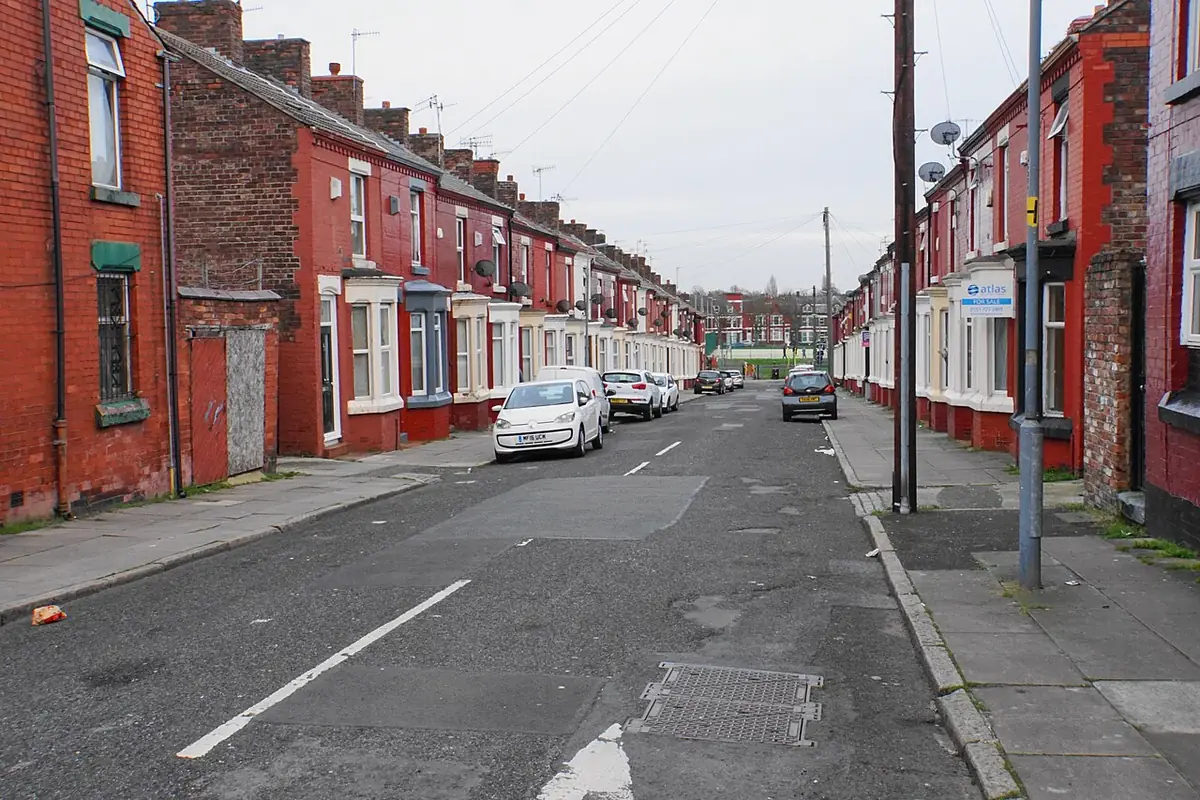
Terraced rows like this are the backbone of Liverpool's housing — Photo: Bill Boaden · CC BY-SA 2.0 · Wikimedia Commons
Carrying that complex timeline through calls for a coordinated team of qualified local professionals.
The British transaction system is marked by an apparent flexibility that can catch out an unprepared buyer. Between the seller accepting your offer and the actual transfer of ownership, many weeks pass with no firm commitment binding either party. Understanding that chain of responsibilities lets you get through the negotiation phase without panicking or running up costs you cannot recover.
You find a property and put a written offer to the estate agent, stating that it is subject to contract.
The seller accepts your offer, which starts the legal work, without in any way taking the property off the market in a legally binding sense.
You instruct an independent solicitor to examine the title, put questions to the local planning authority and raise the specific enquiries.
You commission a thorough survey (a HomeBuyer Report or a Building Survey) to identify hidden defects, damp problems or structural faults.
The solicitors finalise every contractual term and confirm that your mortgage financing is definitively approved and in place.
Exchange of contracts takes place: the purchase becomes legally binding, a deposit is paid, and completion follows.
How a property transaction unfolds, step by step
Follow that method carefully and your Liverpool purchase rests on solid, lasting foundations.
Completing a purchase in Liverpool means synchronising several professionals at once: the estate agent, the solicitor, the surveyor and the mortgage broker. Unlike markets where the roles are centralised in one office, the British system rests on a strict division of tasks. Knowing the sequence and each party's role lets you steer your purchase calmly and see the sticking points coming.
The buyerGetting a decision in principle from a lenderThis preliminary step proves your ability to borrow to agents and sellers, and positions you as a serious, responsive buyer.
The estate agentTargeted viewings and a formal offerYou view the properties on your shortlist and put your offer in writing, setting out your financing arrangements and your expected timescale.
The solicitorLegal checks and title searchesYour legal adviser examines rights of way, local planning rules and the property's history, and confirms that the lease and building rules are in order.
The independent surveyorCarrying out the surveyThe surveyor inspects the home to assess the structure, the roof and the plumbing and electrical installations, and produces a detailed report.
Both sides' solicitorsFormal exchange of contractsThis is the pivotal stage where the agreement becomes legally binding. A deposit, usually 10%, is paid into the solicitor's client account.
All partiesCompletion of the saleThe remaining funds are transferred, the balance of the price is paid to the seller, and you collect the keys to your new Liverpool apartment.
Apartment or house in Liverpool: choosing to suit your way of life
Once that fundamental choice is settled, the task is to match your budget to the city's actual price levels.
Choosing between an apartment in the heart of Liverpool and a Victorian house further out raises the basic question of your relationship with time and urban space. Recent schemes along the docks or in the Baltic Triangle offer efficient floor plans, often with amenities such as a gym or a concierge, which appeal to young professionals and to investors who want a property that lets quickly. These homes need little immediate maintenance, which greatly simplifies day-to-day management for owners who work long hours or spend part of the year away. In exchange, the service charge weighs heavily on the annual budget, and resale depends closely on the general health of the new-build market across Merseyside.
Turning instead to a terraced house in residential areas such as Wavertree or Sefton Park offers complete autonomy and far greater long-term growth potential. Owning your walls and your patch of ground frees you from any building management company, but shifts full responsibility for roofing, insulation and plumbing onto your shoulders. Buyers regularly underestimate the structural condition of older properties in the region, where damp and recurring roof problems demand substantial renovation budgets in the very first year. The choice therefore comes down to more than arithmetic: it is about whether you accept the burdens of old brick or prefer the comfortable predictability of a new build.
Your family situation and how you expect it to change over the medium term weigh heavily in this balance. A couple without children working in media or tech will be well served by a converted industrial loft near Ropewalks, enjoying the cultural life with no commute at all. As soon as a family is on the horizon, the need for a private garden, schools within walking distance and easy parking pushes the city-centre apartment behind the residential suburbs. Map out your next five years precisely before you sign, because transaction costs in the United Kingdom punish an impulsive purchase followed by an early resale.
Finally, how easily a property sells varies radically by type in Liverpool's current market. Well-located family houses find a buyer within weeks, against demand that structurally exceeds the supply available. City-centre apartments, though much sought after by first-time buyers, face competition from the many new schemes that keep coming out of the ground along the Mersey. That reality should push you to prioritise location above all if you buy in a block, or structural soundness if you set your heart on an older property.
What budget do you really need to buy and live in Liverpool?
To see how those costs fit into your week, look at how an ordinary day unfolds.
Setting a budget for Liverpool means going well beyond the price the agency advertises. Local taxes, service charges and routine upkeep change the financial picture substantially. The structure below reflects the sharp contrasts between the historic neighbourhoods and the areas gentrifying quickly across Merseyside.
Median prices and purchase costs by property type in Liverpool
Property type
Median purchase price
Conveyancing costs and Stamp Duty
Estimated annual charges
One-bedroom apartment (city centre)
GBP 130,000 to GBP 160,000
GBP 0 to GBP 1,500 (depending on first-time buyer status)
GBP 1,200 to GBP 2,500 (service charge)
Two-bedroom apartment (docks)
GBP 190,000 to GBP 250,000
GBP 1,400 to GBP 2,500
GBP 1,800 to GBP 3,500
Three-bedroom house (inner suburbs)
GBP 220,000 to GBP 300,000
GBP 2,100 to GBP 5,000
GBP 800 to GBP 1,500 (insurance and upkeep)
The figures include up-to-date local market estimates for leasehold flats and for houses.
Unavoidable living costs for a resident household
Cost item
Average monthly amount
Variation by neighbourhood
Impact on the overall budget
Council tax (bands B to D)
GBP 140 to GBP 220
Depends on the council and the size of the property
Compulsory, uprated every year
Energy (gas and electricity)
GBP 150 to GBP 250
Tied to the property's energy rating (EPC)
Highly volatile by season
Transport (bus and Merseyrail)
GBP 70 to GBP 130
Depends on how far you live from the city centre
Essential for working households without a car
These figures correspond to a standard household in a medium-sized home in the wider urban area.
Health, schools and transport: what does an ordinary Tuesday in Liverpool look like?
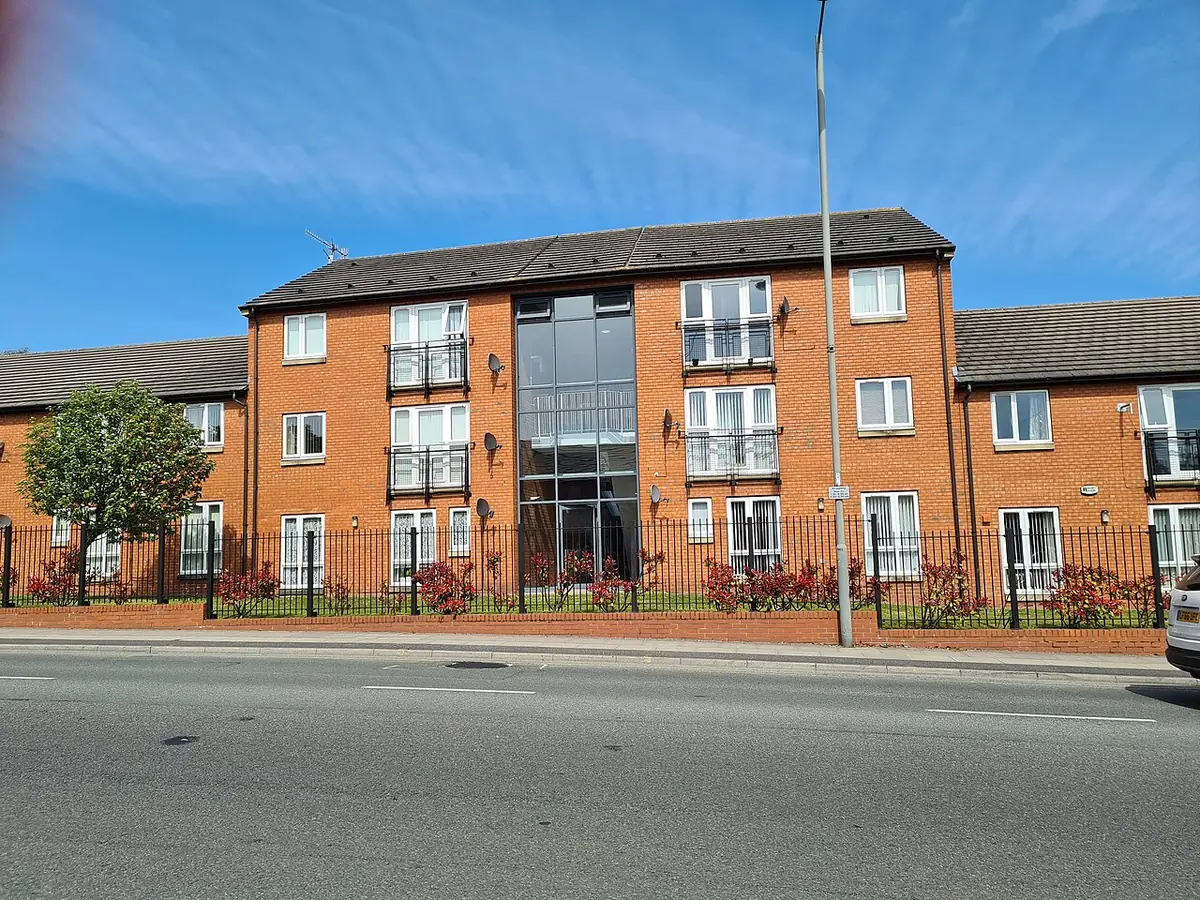
Newer apartment blocks like this add to Liverpool's housing mix — Photo: Frombowen · CC BY-SA 4.0 · Wikimedia Commons
Beyond that well-oiled routine, some hidden features of the property market deserve your full attention before you sign.
Daily life reveals the true value of a location far better than any brochure. Between commutes to the business districts, visits to public health services and proximity to well-regarded schools, every minute counts. This hour-by-hour account brings out the real flows that shape residents' days across the port city's neighbourhoods.
07:30Merseyrail station or main bus stopThe morning flow towards the employment areas in the city centre and along the waterfront begins. Trains run to time, but you need to leave early to avoid the eight o'clock crush.
08:30Local school or nurseryChildren are dropped at local primary schools rated Good or Outstanding by Ofsted. Traffic around the school gates thickens sharply.
12:30Local shop or marketThe lunch break goes on quick errands at neighbourhood shops or the food halls in the centre. Immediate access to fresh produce varies noticeably by area.
17:30Health centre or late-opening pharmacyRoutine health appointments. You register with a local GP as soon as you move in, with waiting times that vary depending on how stretched the local practice is.
19:00Park or residential streetHome again, and time to unwind in city parks such as Sefton Park or Princes Park. The calm contrasts sharply with the bustle of the main roads earlier in the day.
What the property listing will never tell you about Liverpool
Those blind spots lead straight to the regrets buyers most often voice six months after moving in.
Sales particulars systematically flatter the reality in order to move properties faster. Behind the superlatives sit technical, planning and environmental constraints that only long-standing residents know well. Understanding them will spare you costly disappointment after you take the keys.
The real effect of orientation and sea air
The closeness of the Irish Sea brings prevailing winds heavy with moisture that attack poorly insulated facades. West-facing properties need regular attention to window seals and treatment against salt damp, which initial inspections often play down.
The strict rules of Conservation Areas
Buying in a designated historic area sharply restricts what you may change architecturally. Replacing windows or fitting solar panels means complex planning consents and approved materials that come at a premium.
The reality of leasehold
Many apartments and some houses in Liverpool are sold leasehold with ground rents that sometimes escalate. The cost of buying the freehold, or dealing with a nitpicking or absent freeholder, is an underestimated financial risk.
Development schemes and noise
Liverpool's momentum comes with permanent works to regenerate the docks and the main roads. A quiet piece of empty ground today can become a major building site, or a noisy night-time destination, within two years.
The traps and regrets buyers discover six months after buying in Liverpool
Faced with those technical and financial demands, it matters just as much to know whether this purchase is genuinely right for you.
Looked likeA charming Victorian house full of character, with original floorboards and period fireplaces.
Turned outA poorly insulated home that devoured heating and was eaten away by rising damp, needing the foundations dealt with in full.
Would have caught itInsisting on a thorough survey (a Level 3 Building Survey) and reviewing the actual energy bills for the past twelve months before making a firm offer.
Looked likeA modern apartment with an uninterrupted view over the docks and a concierge service included.
Turned outA service charge rising 15% a year with no improvement in service, and a managing agent who could not be reached when the lift failed.
Would have caught itGoing through the accounts and minutes of the last three owners' meetings to spot arrears and structural works on the horizon.
Looked likeA peaceful, leafy residential area, ideal for bringing up children in calm surroundings.
Turned outOn-street parking completely full from seven in the evening, and poor street lighting on some of the side roads.
Would have caught itVisiting the area at different times, especially on weekday evenings and at weekends, to see the parking and the quiet for yourself.
Looked likeA profitable rental investment guaranteed by a very persuasive developer.
Turned outA long void period caused by an oversupply of similar schemes in the same central area.
Would have caught itChecking real rental demand with independent local agencies and treating promised net yields far above the market average with suspicion.
Who should definitely not buy in Liverpool right now?
It is time to lay the groundwork for your decision by weighing both sides calmly.
Buying is never a universal answer, and can be entirely counterproductive depending on where your life is heading. The rigidity of the British market and its transaction costs punish decisions taken in haste or without a long view. Some buyers clearly gain by deferring their plans or renting instead.
The young professional moving between countries for work
→Buying an apartment straight away so as not to throw money away on rent.
Stamp Duty and legal fees, combined with agency fees on resale, absorb any potential gain over a holding period of less than four years.
The speculative investor with no cash reserve
→Buying a property to renovate while borrowing to the maximum.
The smallest structural surprise, or an unexpected three-month void, is enough to choke the cash flow and force a sale at a loss.
The first-time buyer unsure of how they want to live
→Buying an outlying house for more space at the cost of a longer commute.
Quickly finding themselves cut off from cultural and professional life leads to daily exhaustion and a wish to resell quickly into a falling market.
So, are you ready to take the plunge and buy in Liverpool?
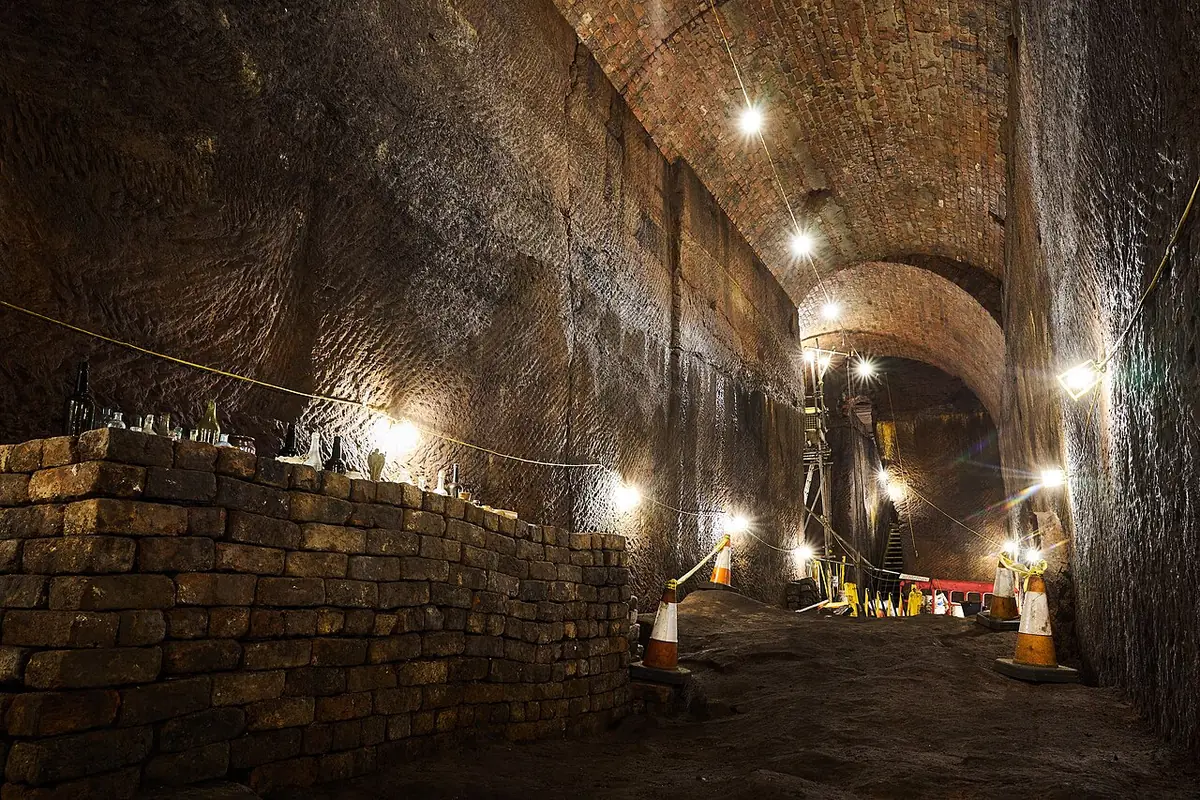
The Williamson Tunnels' brick passage, mid-restoration — Photo: Kyle J May · CC BY-SA 4.0 · Wikimedia Commons
At the end of this analysis, buying property in Liverpool shows itself for what it is: a demanding long-term decision that forgives neither guesswork nor haste. The Merseyside city offers a lively setting and undeniable prospects for growth, provided you look past the marketing arguments of developers and agencies. Every neighbourhood has its own rhythm, its concealed constraints and its promises for the future, and it falls to you to test them against your own daily reality.
Take the time to revisit the areas that caught your eye, walking the streets in all weathers and talking to residents who have lived there for years. Check the state of the infrastructure, ask managing agents about the financial health of the buildings, and calculate your margin of safety with every local tax included. If your investment horizon runs beyond five years and you accept the burdens of an older property or the strict rules of a shared building, the signals are green.
If not, there is no shame in extending a tenancy while you learn the ground better or wait for more favourable conditions. Liverpool's property market will still be there tomorrow, with its red brick, its regenerated docks and its singular cultural energy. Your financial peace of mind, meanwhile, deserves the time it takes to build a plan that is solid, well documented and properly aligned with what you actually want.
Related questions
What extra costs should I budget for when buying a property in Liverpool?
Beyond the purchase price itself, you must budget for your conveyancing solicitor's fees on the legal side, the cost of a technical inspection (a Building Survey), and Stamp Duty Land Tax on the transaction, whose rate varies with your residency status and whether you are a first-time buyer. Together these costs usually represent between 3% and 7% of the total transaction.
Can a non-resident foreign buyer purchase a property in Liverpool?
Yes, buying property in the United Kingdom is open to international buyers with no major restriction on nationality. Non-residents do, however, face a specific Stamp Duty surcharge, along with tighter checks on the source of their funds under the anti-money-laundering rules in force.
What is the fundamental difference between freehold and leasehold in Liverpool?
Freehold means you own both the building and the land it stands on, which is the norm for most houses. Leasehold, very common for apartments, means you buy the right to occupy the property for a fixed term (often several decades or several centuries), while paying a ground rent to the owner of the land.
How does council tax work for a home in Liverpool?
Council tax is an annual local tax collected by the city council to fund local public services. The amount is calculated from the property's estimated value on 1 April 1991, sorted into bands running from A (the lowest) to H. It is payable by whoever occupies the home, owner or tenant.
Which Liverpool neighbourhoods are most popular for a first purchase?
Young professionals traditionally favour the city centre, Ropewalks and the Baltic Triangle for their cultural life and easy access to transport. Families tend to look instead at residential areas with green space and good schools, such as Sefton Park, Mossley Hill or outlying areas well served by the Merseyrail network.
How long does a property transaction usually take in Liverpool?
Once the seller accepts your offer, expect three to five months to complete the whole transaction in the United Kingdom (the conveyancing process). That timescale reflects the legal checks carried out by each side's solicitors, the title searches, and final confirmation of your mortgage offer.
Do older Liverpool properties need significant insulation work?
Yes. A large share of Liverpool's older housing stock, and Victorian brick houses in particular, performs poorly on energy (rated EPC D or below). Insulating the loft, replacing glazing or fitting a modern heating system carries a real cost that you should factor in from the moment you make your offer.
How do I find out about planning schemes that could affect a property?
Before you commit, your solicitor must carry out an official Local Authority Search. It reveals future construction schemes, planned road changes, public rights of way, and whether the area is designated a Conservation Area.
Do I have to use a mortgage broker in the United Kingdom?
Using a broker is not strictly compulsory, but it is strongly recommended, particularly for non-residents or first-time buyers. An independent broker can access the full range of UK lender products and negotiate rates suited to your financial profile, while simplifying the paperwork.
What are the long-term prospects for capital growth in Liverpool?
Liverpool benefits from extensive regeneration schemes along its docks and transport corridors, which supports solid underlying demand. Yields and capital growth vary sharply from one micro-location to the next, however, which makes a close reading of the specific neighbourhood essential rather than a blanket bet on the city as a whole.
Property review of ting
No ting properties in Liverpool yet
Be the first — share it on ting and it shows up right here.