Buying well in the New York metropolitan area means understanding the local administrative and financial machinery first. This guide walks you through the ownership structures, the choice of neighbourhood and the mechanics of the purchase process.
Get the app
What nobody tells you.
Real prices, hidden costs and the traps to check before you commit.
Why buying an apartment in New York means looking past the facade
Scroll
Why buying an apartment in New York means looking past the facade
Buying well in the New York metropolitan area means understanding the local administrative and financial machinery first. This guide walks you through the ownership structures, the choice of neighbourhood and the mechanics of the purchase process.
Written by the ting.ad editorial team ·
Park Avenue, New York in Street View: drag to look around.
Understanding those structural trade-offs lets you look clearly at the different ways of living in the city.
Buying a home in this city is not simply a question of floor area and the view from the windows. Every purchase here commits the buyer to a complex administrative system in which a building's internal rules often dictate daily reality. Between restrictions on use and variable maintenance charges, buyers discover quickly that square footage is only one variable in the wider financial equation. You have to weigh the historic charm of older buildings against the predictability of costs in newer construction.
The prestige of a classic doorman buildingvsVery high monthly maintenance charges
Full-service buildings demand a constant financial contribution to keep the infrastructure in good order, and that weighs heavily on the annual budget.
The apparent freedom of a modern condominium apartmentvsA purchase process gated by strict committees
Even in the structures described as flexible, close scrutiny of financial files by the board filters profiles hard before any final approval.
The appeal of a neighbourhood in the middle of changevsUncertainty about how local services and property taxes will evolve
Settling in an emerging area offers real potential for the value to grow, but comes with significant volatility in the associated costs over the medium term.
How to tell whether this kind of home fits your daily rhythm
Those lifestyle choices take on a particular weight once you measure the cultural and practical gaps against the norms you arrived with.
Urban life in New York demands constant adaptation to constraints of space, noise and mobility. Whether you are self-employed, working from home or looking for a pied-a-terre, the ideal apartment answers very different functional demands. Studying transport flows and the proximity of everyday amenities turns out to be decisive if you want to avoid logistical exhaustion after a few months.
Close to fast transport links
You want the shortest possible commute, even if that means accepting a smaller apartment and a higher level of ambient noise. In this scenario the value lies in pure location and immediate connection to the main subway lines. The trade-offs are interior space and the absence of private outdoor space, offset by the energy of the city right at your door.
Looking for quiet and a flexible interior layout
Your absolute priority is to carve out a workable office while still getting enough natural light to spend long hours indoors. You will naturally look at quieter residential neighbourhoods where the floor areas let you set up a permanent desk without sacrificing comfort. The counterweight is a slightly longer journey when you need to reach the heart of the city.
Remote management and built-in services
You want a secure property that needs no heavy logistical attention when you are away for several weeks or months at a time. Buildings run with permanent concierge services then become the most rational option despite significant fixed costs. This formula buys peace of mind but limits your freedom to make structural changes or to let the place out temporarily.
Which assumptions to leave behind when you arrive from another country
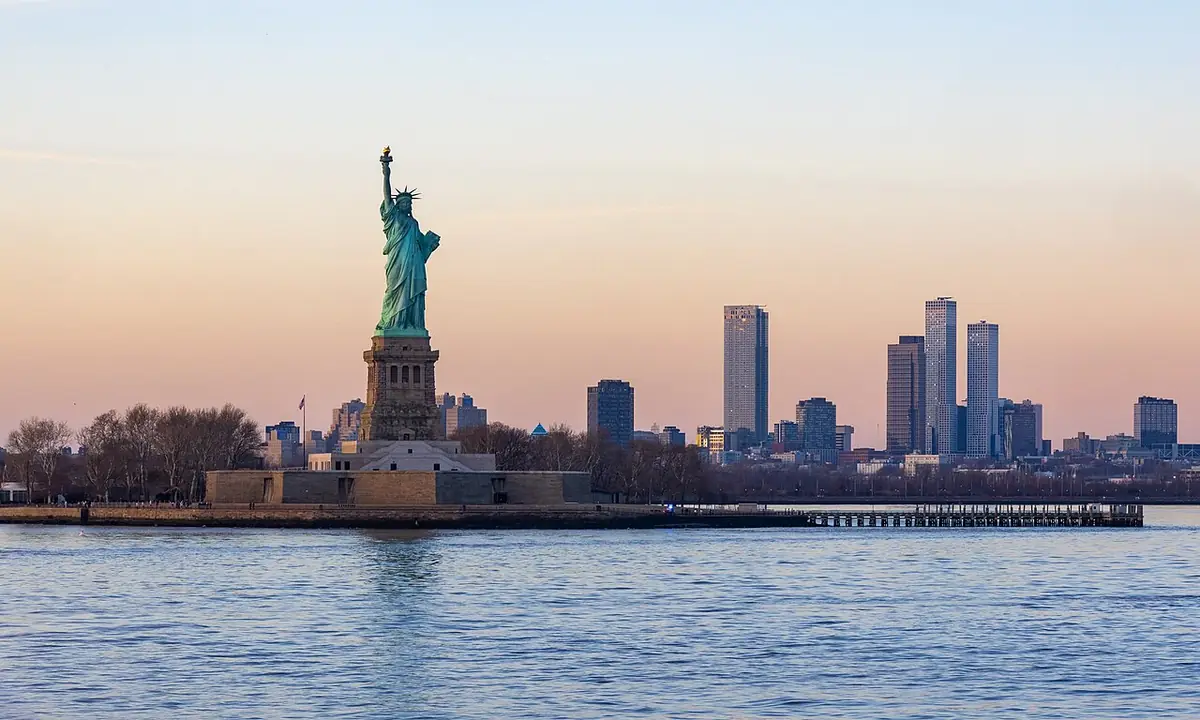
The city's most famous view, Liberty and the skyline together at dusk — Photo: Dillan Payne · CC BY-SA 4.0 · Wikimedia Commons
Once those reference points are reset, choosing the borough or the neighbourhood becomes the central step in your buying strategy.
Moving here, or investing here from overseas, puts the buyer in front of legal and cultural norms that are deeply different from the ones they know. The very idea of collective ownership, the way floor area is stated, and the role of whoever manages the building bear little resemblance to what buyers from most other markets expect. Anticipating those gaps saves a lot of unpleasant surprises when the first contractual documents are signed.
From abroad
Living area measured to one strict national standard, with rooms fixed in function
New York
Floor areas usually stated in gross square feet, with open, adaptable spaces
You have to relearn how to judge the real volume of a home, setting aside movable partitions and circulation space.
From abroad
Tightly regulated rents and protective letting procedures
New York
A fast-moving market governed by each building's own rules and by what the market will bear
Potential yield and lease management call for a flexibility and a legal vigilance well beyond what many buyers are used to.
From abroad
A neutral professional managing agent handling the building
New York
Building boards holding broad discretionary power
Whether your purchase application is accepted depends directly on how your future neighbours judge your financial strength.
From abroad
Local taxation based mainly on a single conventional property or residence tax
New York
A structure combining local property taxes, state taxes and specific monthly charges
The long-term cost of ownership brings in several moving parts that are worth modelling precisely before you make any offer.
How to choose between neighbourhoods when you decide where to settle
Those local dynamics feed straight through into price levels and the cost structure of a purchase.
The city is a patchwork of micro-neighbourhoods with strongly marked identities, where the atmosphere changes radically from one avenue to the next. Choosing where to buy means weighing historic centrality, cultural energy and residential calm against one another. Each area imposes its own travel constraints and offers a distinct architectural profile.
Central Manhattan and the historic districts
Constant activity, dense traffic and an impressive vertical density of buildings.
Suits
Buyers who want absolute centrality and values that have historically held up well.
Trade-off
Some of the highest prices per m2 on the market and interiors that are often cramped.
Residential Brooklyn and the western waterfront
A steadier pace, tree-lined streets, a village atmosphere and low-rise buildings.
Suits
Those who put floor area, family neighbourhood life and nearby green space first.
Trade-off
Longer daily journeys to reach the Manhattan business districts.
Changing neighbourhoods and redeveloped waterfronts
Construction under way, modern infrastructure and an architectural mix of industrial past and contemporary design.
Suits
Investors betting on long-term development of services and the emergence of new centres of gravity.
Trade-off
An urban transition that can be noisy, and a neighbourhood character still taking shape.
What budget ranges should you expect on this market
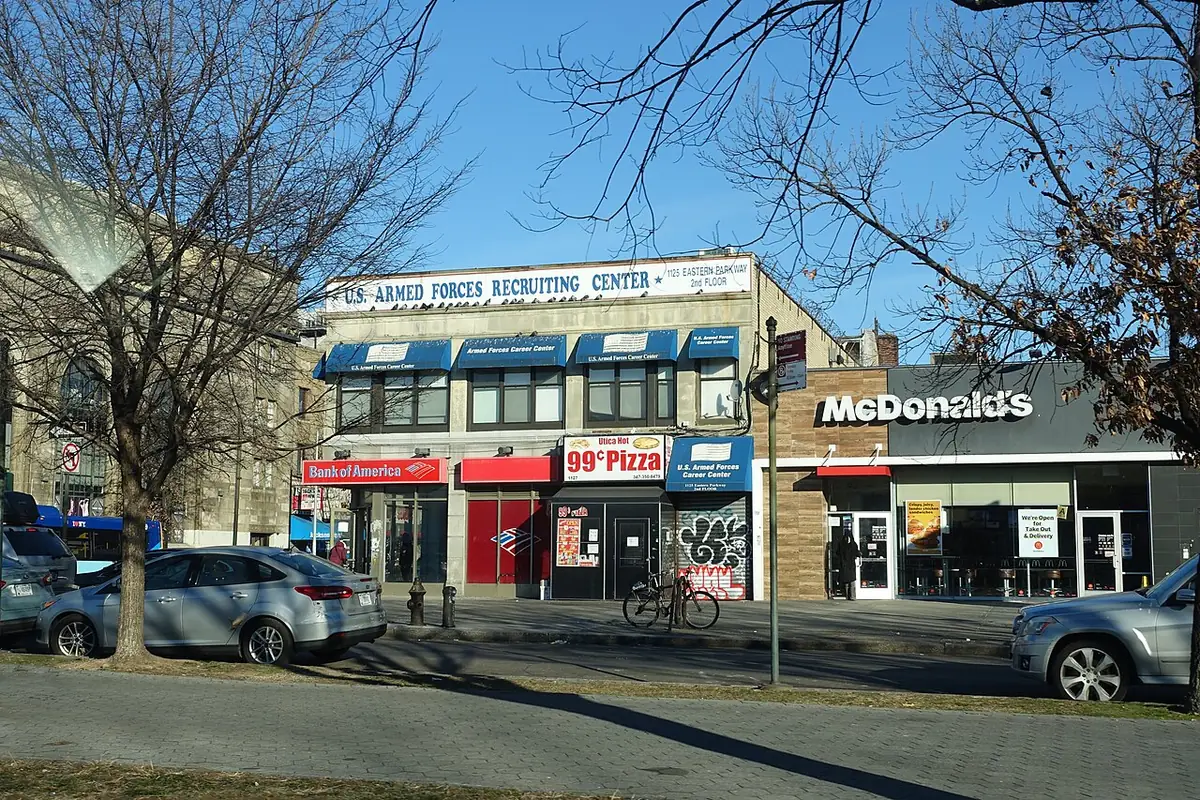
Avenues like this carry the daily mix of shops New Yorkers rely on — Photo: Tdorante10 · CC BY-SA 4.0 · Wikimedia Commons
Beyond the purely monetary side, the legal structure of property ownership holds some fundamental distinctions.
Working out the budget you need to buy here means separating the initial purchase price from the recurring costs of ownership. Monthly charges, property taxes and transaction fees form a financial package you cannot compress, and it weighs heavily on the financing plan. The macroeconomic data shows considerable variation by exact location and by the type of building.
new-yorkFor saleApartmentestimate
Median price / m²US$9,500Half the apartments sell below this
Median priceUS$800kthe average is 14% higher — a few very large properties pull it up
Most common2 bedrooms36 % of listings
Average size80 m²
By number of bedrooms
Bedrooms
Share of market
Avg price
Price / m²
Avg size
1
34 %
US$610k
US$11,500 +15 %
53 m²
2most common
36 %
US$760k
US$10,000
76 m²
3
22 %
US$979k
US$9,500best value / m²
103 m²
4
8 %
US$1.48m
US$10,000
148 m²
Each row is an average, compared against the area average of US$10,000 / m². These are indicative estimates of a typical local market, not a measured sample of live listings. Check current listings before relying on them.
What is the fundamental difference between the forms of ownership available
That administrative rigour applies just as much to the first practical steps of the purchase itself.
The New York property market divides mainly into two distinct legal categories that dictate ownership rights and the conditions of resale. Grasping exactly what each status means saves you from looking at the wrong properties. Each model reflects a philosophy of collective management that directly affects the occupant's freedom.
Outright ownership (condominium)
You hold a real deed to your share of the building along with an interest in the common areas, with more flexibility to rent the unit out or resell it to a third party. Board approval is generally faster and less intrusive than under the other legal structure.
What it changesThis formula offers the best freedom of use but comes with higher purchase prices and often higher taxes for an equivalent property.
The housing cooperative (co-op)
You buy shares in the corporation that owns the entire building, which gives you an exclusive right to occupy your home, expressed through a proprietary lease. The board has an absolute say over who the buyers are and can refuse a transaction without having to give written reasons.
What it changesThis system protects the stability of the building and limits short-term speculation, but imposes a heavy administrative burden on any sale.
The critical sequence to follow before you put down a deposit
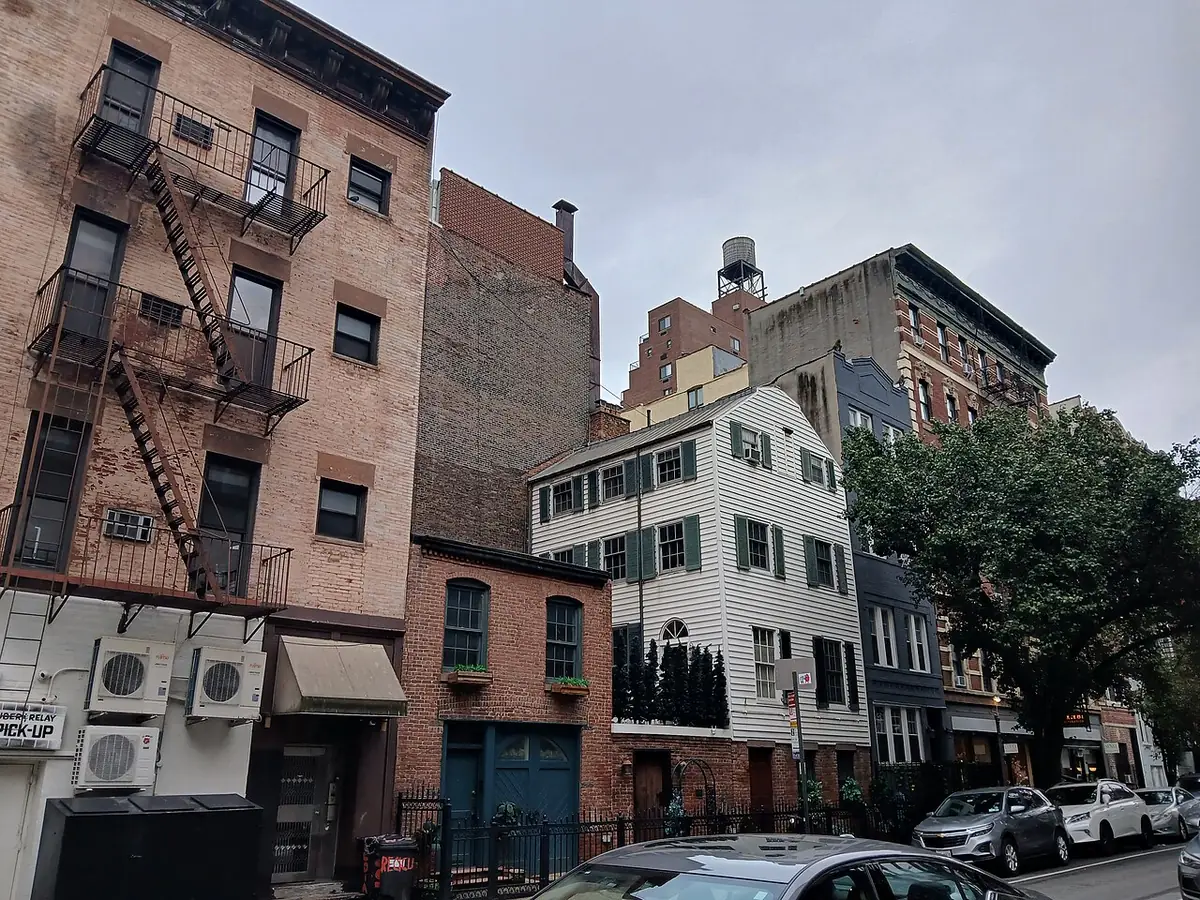
Fire escapes and brick walk-ups like these define classic New York blocks — Photo: Epicgenius · CC BY-SA 4.0 · Wikimedia Commons
To see that journey through, the coordinated involvement of several professionals is essential.
Securing a property transaction in this city follows a strict sequence in which each step engages the legal and financial responsibility of the parties. Skipping ahead, or neglecting to check the building's financial statements, exposes the buyer to major risks in the event of hidden defects or collective liabilities. Procedural discipline is the best protection against disputes here.
The initial selection phase and a thorough viewing of the property you have identified.
Submitting a written offer setting out the financial terms and the conditions the buyer proposes.
Careful review of the building's financial statements and of the minutes of recent board meetings by a specialist adviser.
Signing the contract of sale and paying the deposit into escrow with the seller's attorney.
Assembling and filing the complete board package with the board of directors or the building's managing agent.
Formal approval, which lets you schedule the closing date.
How a property transaction unfolds, step by step
Buying property involves several actors whose roles have to mesh properly if the process is to run smoothly. From the first valuation to the handover of the keys, each one secures a specific link in the legal, financial or technical chain. Knowing who does what lets you steer your project with confidence.
The buyerSetting criteria and arranging financingThey confirm their borrowing capacity and available funds with a bank or a specialist broker before viewing anything.
The real estate agentFinding properties and negotiating termsThey guide the search, select properties that match the brief and structure the initial offer to the seller's side.
The real estate attorneyLegal due diligence and drafting the contractsThey check that title is in order, work through the building's governing documents and draft or approve every contractual clause.
The building boardReviewing and approving the purchase applicationIt assesses the financial strength and the standing of the future occupants through an interview and a thorough study of the package submitted.
The building inspectorTechnical inspection of the apartmentThey carry out a full assessment of the structure, the electrical installations and the plumbing to identify any hidden work needed.
The closing attorney or title agentCompleting and recording the deedThey orchestrate the final transfer of funds, make sure taxes are settled and see that the transaction is officially recorded with the authorities.
Apartment or house in New York: how do you decide, given the way you live?
Once that framework is settled, the unavoidable question of the overall budget comes sharply into focus.
Buying property in New York forces a structural choice straight away between two radically different architectural and legal worlds: the apartment held as a condo or a co-op, and the single-family house, the latter being particularly rare and precious in dense boroughs such as Manhattan or the historic parts of Brooklyn. That choice is not simply an aesthetic preference for old parquet or high ceilings; it shapes your entire daily life, from how you spend your free time to your ability to absorb unplanned expenses. The urban apartment pools costs and offers concierge services that simplify life for busy people, while the house gives you complete autonomy, free of the fussy rules that New York boards so often impose.
New York buildings, whether they are condos or cooperatives (co-ops), run on strict administrative rules that can surprise international buyers. The board has an absolute say over buyers and demands financial disclosure so complete that many people describe it as intrusive. In exchange, that collective governance guarantees the upkeep of the facades, the security of the common areas and the long-term health of the building, without you personally having to supervise roof work or the main plumbing. It is a choice in favour of logistical calm, and it suits professionals whose schedules leave no room for weekend domestic emergencies.
Choosing a single-family house or a townhouse in residential neighbourhoods such as Park Slope, Riverdale or parts of Queens removes every layer of bureaucracy but shifts the entire operational load onto your shoulders. There is no superintendent here to take in your parcels or fix the boiler in the middle of winter. Every repair, from the facade to waterproofing the basement, falls squarely on you, financially and organisationally. That independence usually comes with more living space and private access to outdoor space, a supreme luxury in a city of concrete where every square metre is fought over.
The financial trade-off between the two options goes well beyond the headline price per square foot and takes in recurring costs that behave very differently. In an apartment, the building charges, known as common charges or maintenance, inevitably rise each year to keep up with labour costs and the building's overall property taxes. In a house, those costs are directly under your control, but you carry the risk of funding a major structural repair entirely on your own if something fails. Your profile as an occupant, your tolerance for administrative constraint and your long-term view of your life in New York should guide this fundamental decision before you look at a single listing.
What budget do you really need to house yourself and live in New York?
Beyond the raw figures, it is the shape of an ordinary day that shows you what your investment really means.
Buying property in New York is never just the asking price shown on the listing portals. The up-front transaction costs, combined with recurring property taxes and building charges, form a complex financial ecosystem that deserves careful analysis. Anticipating these lines saves you from budget disappointment in your first year in the city.
Estimated purchase costs and recurring charges in New York
Cost item
Indicative range
Impact on the overall budget
Median purchase price per square foot
$1,200 to $2,200
Varies considerably by borough and by the quality of the building's amenities.
Closing costs and transfer taxes
2% to 4% of the purchase price
Includes the mansion tax and the transfer taxes specific to New York State on higher-value properties.
Monthly building charges
$800 to $2,500 per month
Rise steadily to cover staff wages and the upkeep of shared equipment.
Annual property tax
1% to 2% of assessed value
Calculated by the city using an assessment system specific to residential property.
The figures shown are averages observed on the New York market and depend closely on the neighbourhood you choose.
What does an ordinary Tuesday actually look like when you live in a home you own in New York?
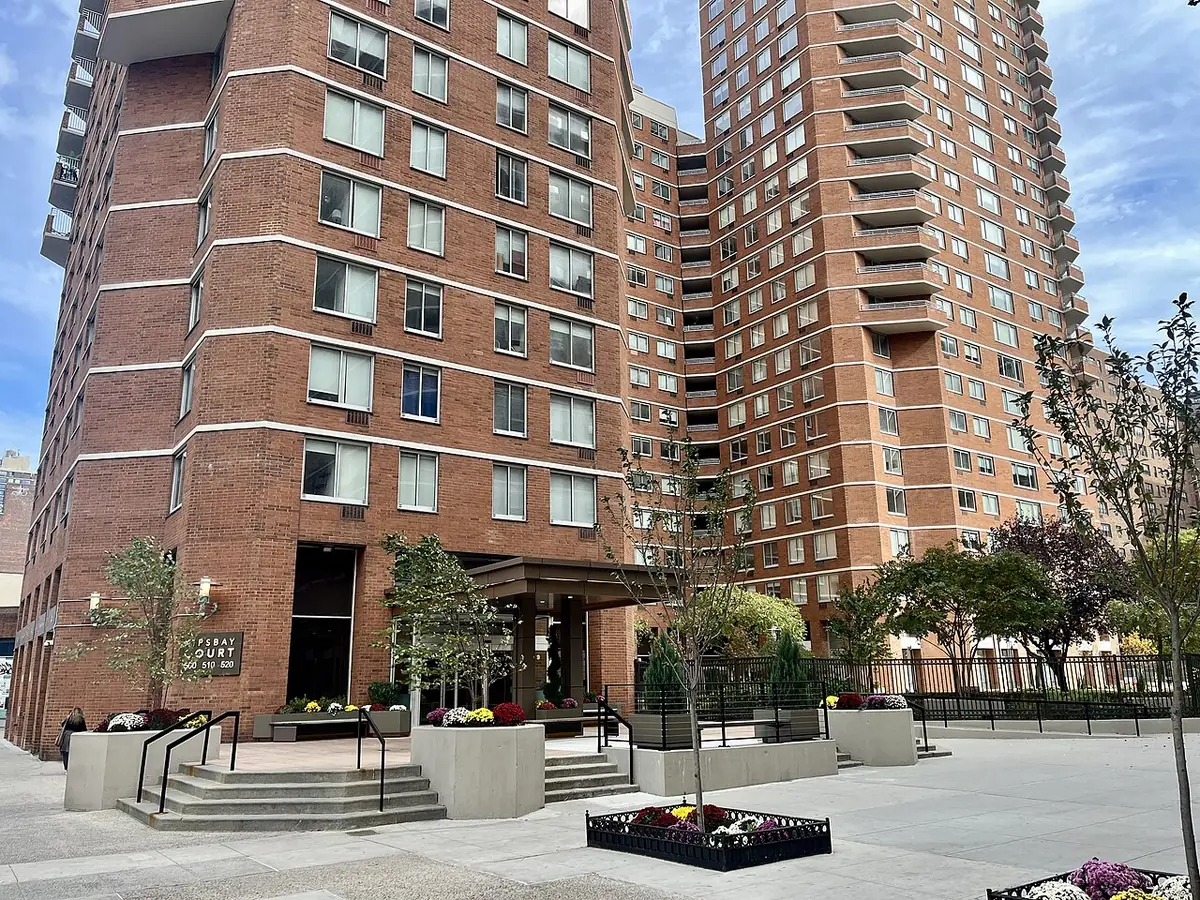
Tower complexes like this are a major part of the city's housing stock — Photo: Transpoman · CC BY-SA 4.0 · Wikimedia Commons
But behind that apparent smoothness sit subtleties the sales brochures leave out every time.
Living in an apartment you own in New York changes your relationship with time and with urban space. Between the morning subway ride, dealing with the building's services and reaching neighbourhood amenities, every hour is set to a New York tempo. This sample day shows how working life and being rooted in a neighbourhood fit together.
07:30The residential streets around the buildingAn early start for a neighbourhood coffee, with a nod to the doorman already taking in the day's first parcels.
08:45The local subway stationQuick access to express lines to reach the Manhattan business district without any real traffic constraint.
12:30Workspace or officeLunch in a public green space or a neighbourhood cafe, taking in the constant vitality of the city.
18:30Local shopsLast-minute shopping at the independent local grocers who know the habits of long-standing residents.
20:00Home and the common areasBack to the quiet of the apartment, checking on building matters through the managing agent's app if needed.
What the sales brochures will never tell you in New York
Those grey areas explain why some buyers sour on the deal within months of closing.
The New York property market has its own codes, often opaque to buyers who do not know them. Sales documents flatter reality by glossing over technical or regulatory constraints that weigh heavily on long-term comfort. Knowing about these undisclosed aspects lets you approach every viewing with a sharper critical eye.
The real state of the building's finances
A building with unusually low charges often hides an underfunded reserve, which points to heavy assessments as soon as roof work or compliance upgrades have to be voted through.
Strict rules on subletting and use
Many co-ops flatly prohibit renting your unit out, or impose deterrent internal transfer fees that kill off any plan to let it in future or to use it flexibly.
Structural and external noise
Sound insulation in older or attached buildings often leaves much to be desired, and construction under way or planned on the street or the neighbouring lot can turn your daily quiet into a permanent acoustic nightmare.
Nearby development plans nobody mentions
A future obstruction of your view, or noisy infrastructure arriving close by, permanently changes both the value and the comfort of your purchase, and the seller has no legal duty to warn you about it unprompted.
The classic traps new owners discover six months after closing
Given those technical and financial demands, it is fair to ask whether this market really suits everyone.
Looked likeAn exceptional financial opportunity, with building charges that looked very attractive at first.
Turned outLax financial management of the building, leading to a vote for a brutal 35% increase in charges within the first six months.
Would have caught itInsisting that an independent expert review the minutes of the last three board meetings before you make a firm offer.
Looked likeA fashionable, fast-rising neighbourhood with lively nightlife right outside the door.
Turned outUnbearable night-time noise at weekends, making sleep impossible without reinforced double glazing and permanent air conditioning.
Would have caught itVisiting the property at different times of the week and of the night to judge the street's real sound environment objectively.
Looked likeAn apartment ready to move into, with no visible renovation work needed.
Turned outDefects hidden behind recent cosmetic paintwork, notably chronic damp and worn-out plumbing inside the walls.
Would have caught itAlways hiring a certified independent inspector to carry out a full audit of the structure and the internal systems.
Looked likeTotal freedom of use, with the tacit promise that you could easily let the place on platforms such as Airbnb.
Turned outDraconian building rules banning any short-term letting, backed by severe fines from the City of New York.
Would have caught itReading the building's internal rules and the municipal laws on letting second homes before you commit.
Who is the New York property market really for, and who should stay away?
It is time to lay the ground for your final decision by weighing all of these factors together.
Buying property in New York demands solid financial depth, psychological flexibility in the face of local bureaucracy and a long-term view of the asset. This is an unforgiving market and it does not suit every plan. Identifying clearly which profiles face a major risk here helps avoid irreversible mistakes in how you allocate your money.
The investor chasing immediate, high rental yield
→Looks to other American cities with lower entry prices and less demanding cost structures.
High property taxes and rent caps across many segments make net rental yield in New York relatively modest compared with other major cities.
The short-term buyer planning to resell within five years
→Prefers a long-term rental to preserve liquidity in the face of the up-front transaction costs.
Closing costs, transfer taxes and resale commissions absorb a considerable share of any potential gain over too short a period.
The household that wants to avoid administrative constraint altogether
→Settles in suburban areas or in more relaxed buildings where day-to-day management weighs far less on the individual.
The complexity of the packages New York boards demand and the rigidity of the internal rules create constant stress, incompatible with a need for absolute freedom.
So, are you really ready to go ahead with buying in New York?
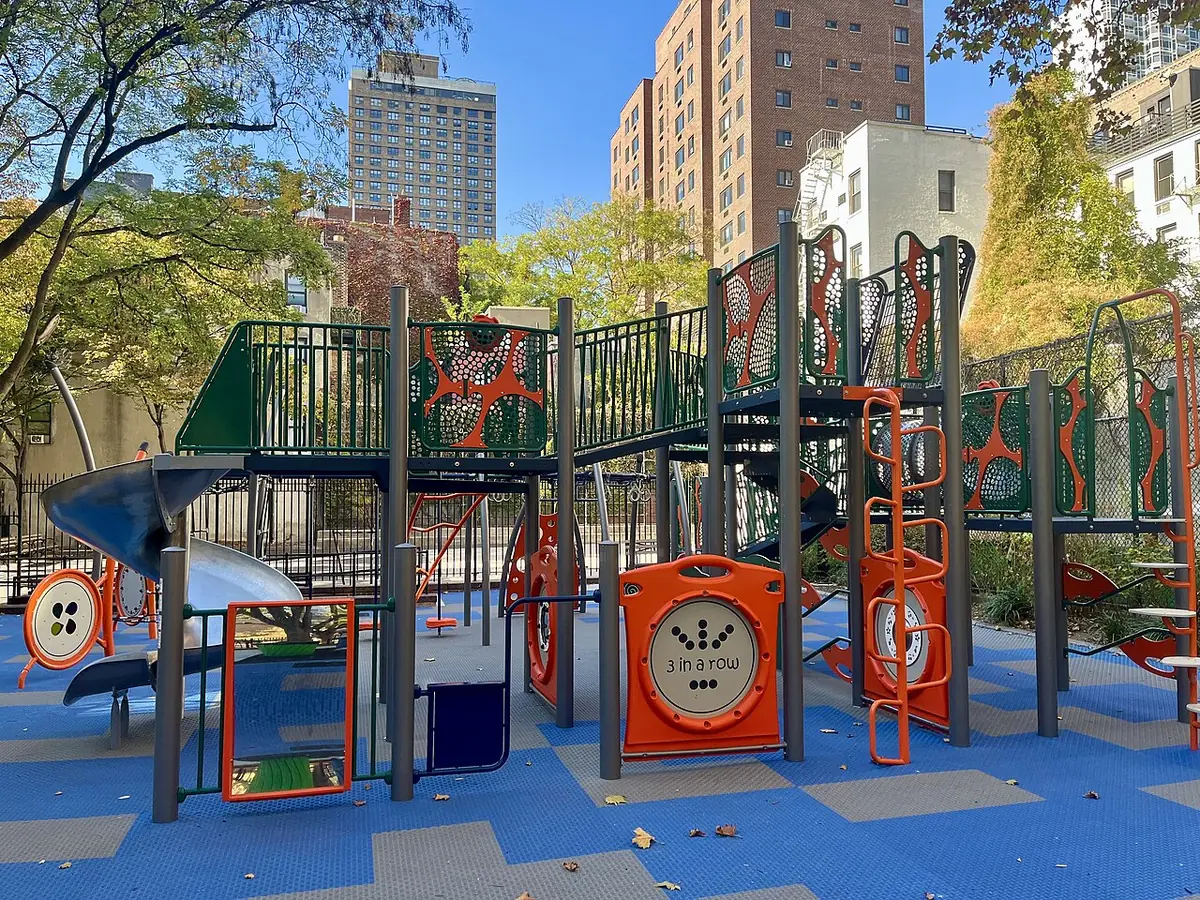
Playgrounds tucked between buildings like this are part of everyday city life — Photo: Transpoman · CC BY-SA 4.0 · Wikimedia Commons
Committing to a property purchase in New York is a decision that goes beyond a financial transaction and becomes a genuine choice about where and how you live. If you have measured the reality of the recurring charges, accepted the strictness of the building rules and confirmed your long-term investment horizon, then the foundations of your project are solid. The city rewards those who approach its market with method, clarity and impeccable financial preparation, far from impulses driven by emotion or by the artificial urgency of the agencies.
The success of your plan now rests on your ability to surround yourself with the right local experts, whether that is a New York real estate attorney, an independent broker or an uncompromising inspector. Every document has to be examined closely, every clause of the house rules read with care, and every estimate of charges tested against the building's own history. That, plus strategic patience, is what turns the purchase of an apartment or a house in this singular city into a lasting success.
Take the time to visit several neighbourhoods, to compare price dynamics per square foot and to confirm your borrowing capacity with banks familiar with local practice. The New York market offers extraordinary opportunities to anyone who can decode its subtleties and anticipate its hidden constraints. Your decision should come from genuine conviction and rigorous analysis of the numbers, so that settling in the city brings nothing but calm and satisfaction for the years ahead.
Related questions
What additional costs should you budget for when buying an apartment in New York?
Closing costs include local transfer taxes, the fees of the real estate attorneys, the cost of a technical inspection of the property and the brokerage commission. Budget roughly 2% to 4% of the total purchase price to cover all of these mandatory up-front expenses.
What is the fundamental difference between a condo and a co-op in New York?
In a condominium you buy real property with an individual deed, which gives you a great deal of freedom to resell or rent out. In a co-op you buy shares in the corporation that owns the building, which gives you a right of occupancy but comes with very strict approval rules set by the co-op board.
Can a non-resident buy property in New York?
Yes, international buyers can acquire property in New York with no major restriction at national level. Local banks, however, often require larger down payments, typically in the range of 40% to 50% of the purchase price, before granting a mortgage to a non-resident.
How are property taxes calculated on a New York apartment?
Property taxes are calculated by the City of New York on an assessed value that does not necessarily match the real market price. They vary significantly from borough to borough and according to the legal status of the residential building.
How long does a New York property transaction usually take?
The full process, from acceptance of the offer through to closing and handover of the keys, generally takes between two and four months. That timeline often stretches for co-ops, because of the time needed to assemble a board package and have the board approve it.
What are maintenance charges or common charges?
These are the monthly amounts each owner pays to cover the building's collective expenses, including upkeep of the common areas, the wages of staff such as doormen, and the overall cost of heating and general management of the building.
Do you have to use an attorney when buying property in New York?
Although the law does not strictly require it in every case, the settled practice in New York is that each side is represented by its own real estate attorney. That legal support is essential to secure the drafting and negotiation of the contract of sale.
Which New York neighbourhoods offer the best compromise for a first purchase?
Parts of Brooklyn such as Park Slope or Williamsburg, along with certain residential neighbourhoods in Manhattan and Queens, offer the balance many buyers look for between cultural energy, public transport access and long-term potential for the value to hold up.
How do banks assess a buyer's financial strength in New York?
Lenders look closely at your declared income, your credit history in the United States or abroad, and the reserves you still hold after the purchase. Many co-ops also require you to keep the equivalent of several months to two years of charges and mortgage payments in liquid assets.
Can you negotiate the asking price of an apartment or a house in New York?
How much room you have depends closely on market conditions, how long the property has been listed and how attractive it really is. In a balanced or buyer-friendly market, an offer 5% to 10% below the asking price is worth considering, provided you can back it up with recent comparable sales.