Moving to New York and renting an apartment takes careful preparation in a dense, fiercely competitive housing market. This guide sets out the essentials, from choosing a neighbourhood to the finer points of the lease, so you can make the move with confidence.
Get the app
What nobody tells you.
Real prices, hidden costs and the traps to check before you commit.
What renting an apartment in New York actually gets you
Scroll
What renting an apartment in New York actually gets you
Moving to New York and renting an apartment takes careful preparation in a dense, fiercely competitive housing market. This guide sets out the essentials, from choosing a neighbourhood to the finer points of the lease, so you can make the move with confidence.
Written by the ting.ad editorial team ·
Park Avenue, New York in Street View: drag to look around.
Weighing those financial and spatial trade-offs leads naturally to a hard look at your own way of living against what the city demands.
Renting an apartment in New York is not simply a matter of signing a lease and setting down your bags. The rental market in this city runs on iron rules that weigh heavily on the daily reality of what you pay for. Between floor areas that are often small by European standards and running costs you may not see coming, working out what you actually get helps you lay the groundwork for an informed choice. You need to understand the real value of the space you are renting before committing in a market this dense and this competitive.
A smaller living areavsA strategic location
High rents are first and foremost a price paid for a central address and transit right on the doorstep, at the expense of square metres. You are choosing between a large place far out and a compact studio that is superbly connected.
High building chargesvsQuality services included
New York buildings often come with upscale amenities such as a doorman, a laundry room or a gym. Those conveniences are billed monthly and feed straight into your overall budget.
Strict application paperworkvsLegal and tenancy security
Landlords and brokers ask for very detailed proof of means that can be laborious to assemble. In return, the legal framework gives both parties to the lease solid protection.
Does New York really suit the way you live day to day?
Running your own habits through that filter reveals sizeable gaps with the reference points you were used to.
Living in a city as fast-moving as New York means constant compromises on pace, noise and the management of space. Whether you arrive alone, as a couple or with specific professional demands, the experience of renting changes completely. It is essential to examine how your daily routine fits into the urban fabric before settling on a particular neighbourhood.
The urban professional
If your overriding priority is to cut commuting time and live in the thick of it, the dense neighbourhoods are for you. You accept smaller rooms in exchange for immediate access to business districts and places to socialise. The pace is fast and demanding, but perfectly suited to a career on the rise in the centre of the city.
The residential and family profile
For those who value quiet, green space and tree-lined streets, the outer neighbourhoods and parts of Brooklyn offer a welcome alternative. You give up the immediate buzz of the main thoroughfares to gain living space and everyday comfort. It is a considered choice that means accepting a slightly longer trip into the centre.
The independent, mobile profile
Flexible workers particularly appreciate the range of cafes, the coworking spaces and the creative energy that runs through the city's different neighbourhoods. You do not need a fixed desk and can use the city itself to structure your days. That way of living calls for real adaptability in a demanding and constantly shifting rental market.
Renting here after arriving from abroad: what changes most
The city's most famous view, Liberty and the skyline together at dusk — Photo: Dillan Payne · CC BY-SA 4.0 · Wikimedia Commons
Once those cultural markers are absorbed, the choice of neighbourhood becomes the central strategic decision of your move.
Arriving in New York from abroad upends most of your assumptions about housing, contracts and the relationship between tenant and landlord. Local practice differs deeply from what renters are used to in many other countries, both in how applications are screened and in how buildings are run day to day. Anticipating those cultural and administrative gaps will spare you serious disappointment in your first weeks on the ground.
From abroad
A rental application resting mainly on pay slips and a personal guarantor
New York
A strict requirement of annual income equal to 40 times the monthly rent, plus thorough bank checks
Prepare impeccable financial documents and plan for the possible need of an institutional guarantor if your local income falls short.
From abroad
Long leases with notice periods tightly framed by national law
New York
Contracts usually standardised on a one-year term, renewable, with exit clauses that can be rigid
Read the early termination terms closely so you are not trapped if your work situation changes unexpectedly.
From abroad
A formal move-in inspection governed by national legislation
New York
An inspection that is often quick, where the tenant has to document the initial condition themselves to head off later disputes
Take plenty of photographs of every room the moment you get the keys and put every existing defect in writing.
From abroad
Agency fees capped by law to protect tenants
New York
Broker or letting fees that can sometimes fall entirely on the tenant
Build those broker fees into your overall moving budget from the start to avoid unpleasant financial surprises.
Which neighbourhood should you settle in when renting in New York?
Mapping the neighbourhoods leads directly to the central question of the budget your move will need.
Every part of New York has its own identity, its own rhythm and its own advantages as a place to live. The neighbourhood you choose determines your rent, your commute and how quickly you feel at home in the city. It is worth comparing the options honestly so your search matches what you actually want.
Manhattan (Midtown / Downtown)
Constant activity, towering high-rises and the best possible connections to every business district.
Suits
Working renters who want the shortest possible commute and the raw energy of the city.
Trade-off
Extremely high rents for often modest floor areas, and noise that never really stops.
Brooklyn (Williamsburg / Park Slope)
A mix of creative energy, tree-lined streets and a calmer, friendlier neighbourhood life.
Suits
Renters looking for a fair balance of cultural life, green space and slightly roomier homes.
Trade-off
Prices that have risen sharply, and journeys into Manhattan that can take longer.
Long Island City (Queens)
Modern residential towers with spectacular views and quick access to the subway.
Suits
Renters after modern comfort, recent fittings and a little more space for a comparable budget.
Trade-off
An atmosphere some find impersonal, with less historic character than the older neighbourhoods.
What does renting an apartment in New York really cost?
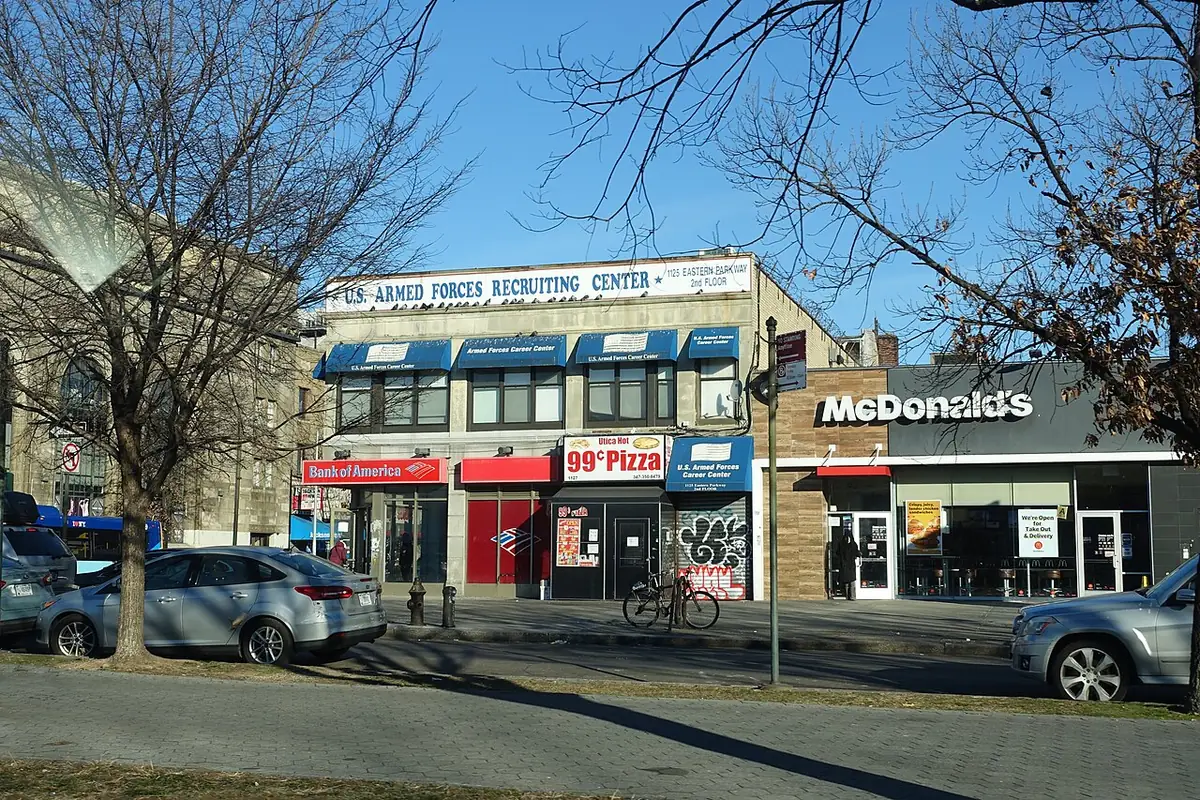
Avenues like this carry the daily mix of shops New Yorkers rely on — Photo: Tdorante10 · CC BY-SA 4.0 · Wikimedia Commons
A clear view of the costs makes it easier to face the crucial question of what you can realistically sign.
The New York rental market is marked by heavy pressure on prices, which vary considerably with location and the standing of the building. Setting a realistic budget means looking beyond the headline rent shown in the listing. Building charges, any applicable taxes and the up-front move-in costs change the overall financial picture appreciably.
new-yorkTo rentApartmentestimate
Median price / m²US$46Half the apartments sell below this
Median priceUS$3.8kthe average is 14% higher — a few very large properties pull it up
Most common2 bedrooms36 % of listings
Average size80 m²
By number of bedrooms
Bedrooms
Share of market
Avg price
Price / m²
Avg size
1
34 %
US$2.93k
US$55 +15 %
53 m²
2most common
36 %
US$3.65k
US$48
76 m²
3
22 %
US$4.7k
US$46best value / m²
103 m²
4
8 %
US$7.1k
US$48
148 m²
Each row is an average, compared against the area average of US$48 / m². These are indicative estimates of a typical local market, not a measured sample of live listings. Check current listings before relying on them.
What you can actually sign, and what it gives you as a tenant
A firm grasp of those contractual points leads straight to the administrative golden rule to settle before you hand over a cent.
Signing a lease in New York commits you to a very precise contractual framework that is worth understanding thoroughly. Between rent stabilised leases and free market leases, the terms for renewal and rent increases differ radically. Knowing exactly what kind of agreement you are entering protects your interests over the long run.
The free market lease
This type of contract covers the majority of listings in newer buildings and in homes not subject to the city's long-standing rent regulations. The landlord sets the starting rent freely, along with the renewal terms when the annual term expires.
What it changesExpect a possible rent increase at every renewal, and negotiate as hard as you can at the outset.
The rent stabilised lease
These homes benefit from strict legal protection that caps annual rent increases at rates voted by a dedicated city board. They are generally in buildings put up before a certain date that meet specific criteria.
What it changesSuch homes are rare and much sought after; landing one of these leases offers considerable financial security over the medium and long term.
The rule to understand before you put money down in New York
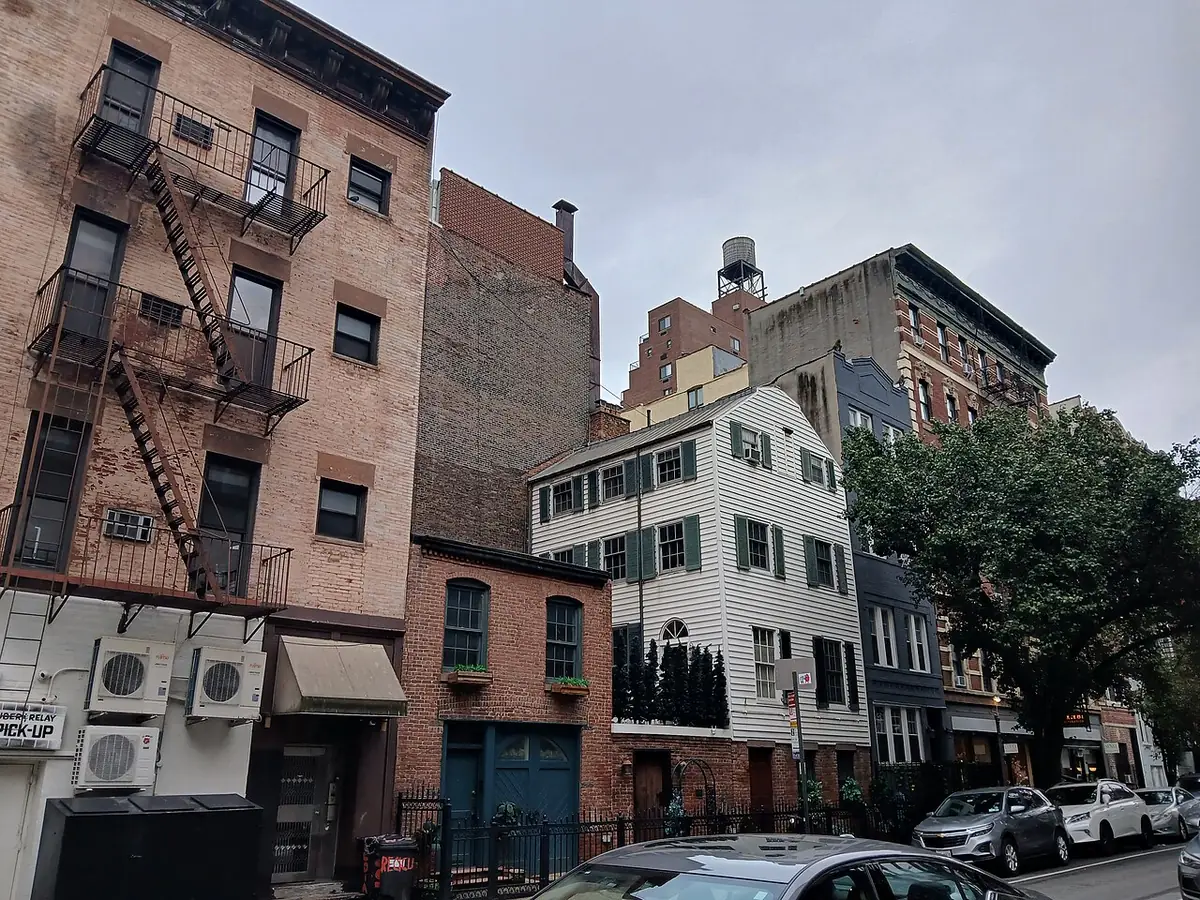
Fire escapes and brick walk-ups like these define classic New York blocks — Photo: Epicgenius · CC BY-SA 4.0 · Wikimedia Commons
Once that critical step is under control, all that remains is to sequence the transaction itself.
In the rush of a search in a market as tight as New York's, it is tempting to hand over money quickly to hold a rare apartment. That is precisely the moment when the risk of error is highest if the usual checks have not been carried through. Understanding the chain of safeguards protects you from outright financial loss.
You find an apartment that fits your criteria and the broker asks for an immediate deposit to hold it for you.
Verify exactly who the landlord or the official managing agent of the apartment is, to rule out any risk of a fraudulent listing.
Insist on seeing the full lease and read every clause about the security deposit and the terms for its return.
Make sure the deposit goes into a secure escrow account and not straight into a personal account.
Get written confirmation setting out the holding agreement and any conditions attached to it before the funds move.
You secure your rental on transparent terms, confident that the money you have put in is legally protected.
How a rental deal unfolds, step by step
Working through each of those steps methodically means you start your New York life on solid ground.
Seeing a New York rental through demands a rigorous, ordered method. Everyone involved, from the broker to the managing agent to you, plays a precise part at each stage. A clear view of that sequence is what makes a move in go smoothly.
The tenantAssembling the applicationGather every proof of income, employment letter and bank reference that local brokers require.
The brokerageViewings and choosing the homeArrange targeted viewings and formally submit your complete application to the building's management.
The landlordReviewing and approving the applicantAssess your means and the strength of the guarantees offered before approving the tenancy.
The tenantPaying the up-front moneyPay the first month's rent and the security deposit into the escrow account named by the landlord.
The managing agentSigning the leaseFinalise the legal terms, sign all the required documents and set the move-in date.
Renting an apartment or a single-family house in New York: how do you decide?
Now that you have settled on the kind of home you want, let us look at the financial reality of moving in.
Choosing between a city apartment and a single-family house in New York rests on far more than looks or money. It is a structural decision that shapes your daily routine, how tired the commute leaves you and how much noise you can live with. Buildings with services in Manhattan or in the livelier parts of Brooklyn put express subway lines within immediate reach, cutting the hours you spend travelling each week. In return you have to accept communal living, building rules that can be strict, and a more compact home for the same budget.
Renting a detached or attached house instead, which is easier to find in the residential parts of Queens, on Staten Island or in the neighbouring counties on Long Island, changes the New York experience entirely. You get private outdoor space, dedicated parking and a level of quiet that does not exist in the middle of Manhattan. That independence is paid for with a heavier reliance on congested roads, markedly longer trips to the business districts, and the time and money that keeping up a whole building and its grounds takes, even as a tenant.
For newcomers, the question of lifestyle usually outweighs raw floor area. Renting an apartment in New York means taking on the city's restless rhythm, treating the street as an extension of your living room and enjoying what is happening around you without logistical planning. It is the choice of pure urban efficiency, where everything you need is less than ten minutes on foot away, from the wine shop to the dry cleaner to a subway station that runs around the clock.
Families with children and people working from home part of the week, on the other hand, gravitate naturally towards roomier arrangements. The single-family house then becomes a refuge from the constant agitation of the city. The trade-off is a more regimented routine, set by commuter train timetables or parking constraints, but rewarded with greater comfort at home and a welcome stability over the length of the lease.
What monthly budget do you really need to live comfortably in New York?
With the budget settled, it helps to see how a typical week in the city actually fits together.
Drawing up a monthly budget for New York means looking well beyond the rent shown on the listing portals. Landlords and brokers generally demand strict proof of income, often equivalent to forty times the gross monthly rent. On top of that come building charges, the transit pass you cannot do without, and utilities, which are billed separately and swing considerably with the seasons and the insulation of the building. Anticipating these lines keeps the first months of a tenancy from turning into a financial squeeze.
Estimated monthly living costs for a household in New York
Cost item
Low end (USD)
High end (USD)
Context
Monthly rent (1 bedroom)
$2,800
$4,500
Varies sharply with the neighbourhood and whether the building has an elevator or a doorman.
Transit (unlimited MetroCard)
$132
$200
Covers the monthly MTA pass plus the occasional taxi or ride-hailing trip.
Food and groceries
$600
$1,100
Depends on how much goes on local supermarket shopping versus eating out.
Utilities and internet
$150
$350
Electricity bills run high in summer because of heavy air conditioning use.
The figures shown reflect market averages for regular rentals and do not account for seasonal variation.
What does an ordinary Tuesday actually look like for a New York resident?
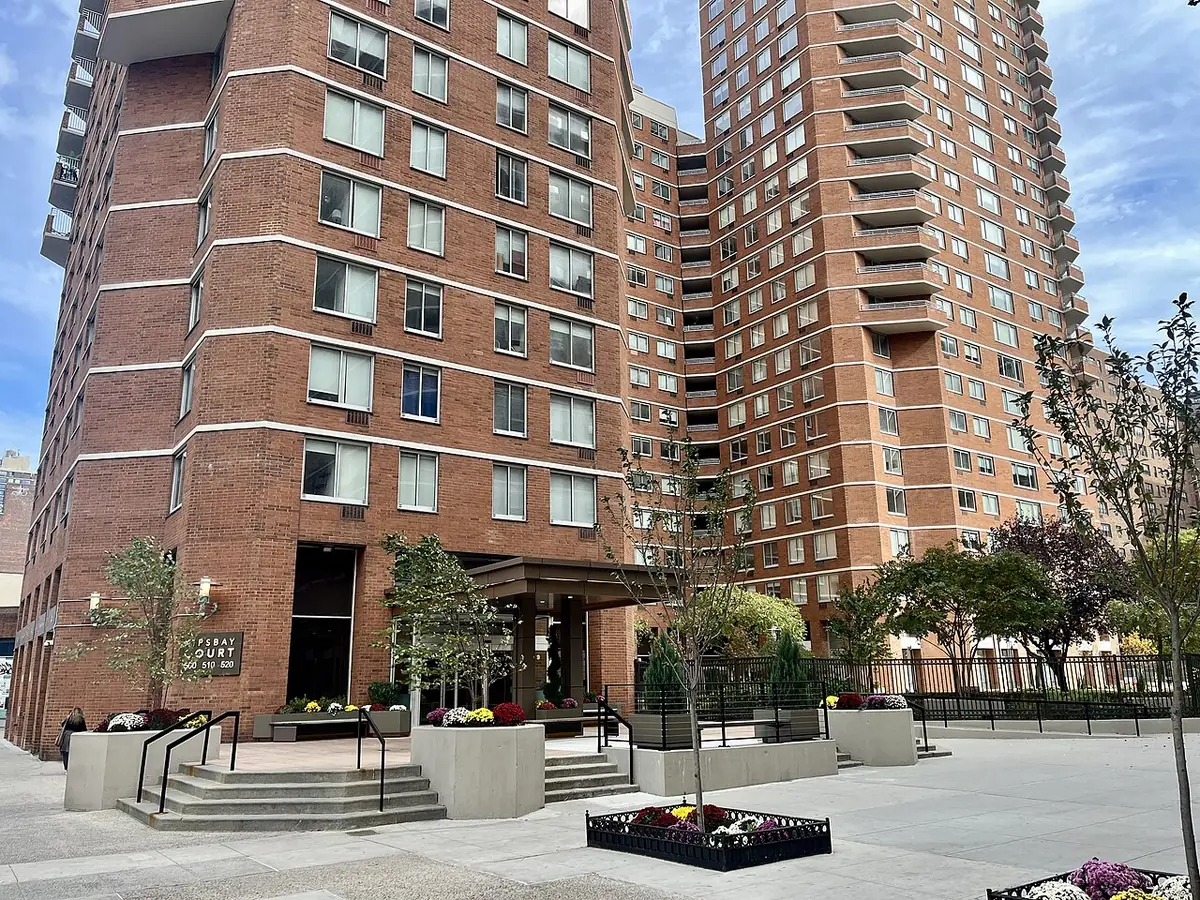
Tower complexes like this are a major part of the city's housing stock — Photo: Transpoman · CC BY-SA 4.0 · Wikimedia Commons
Beyond that well-drilled routine, several realities of the rental market escape newcomers entirely.
Living in New York profoundly changes how you perceive time and space, through daily journeys timed to the minute and a tightly organised routine. From the first morning crush on the subway platform to a last-minute run to a late-opening corner store, every hour is put to use. An ordinary Tuesday shows the fine synchronisation between work demands, heavy use of public infrastructure and the constant search for a moment to breathe in the middle of the noise.
07:30HomeEarly start, a quick check of MTA service alerts on the app and straight out to the nearest subway station.
08:15Express subway stationA packed but efficient commute towards Midtown Manhattan, punctuated by automated announcements and the endless flow of riders.
09:00Workplace or officeArrival at the office, settling in at the desk and the first team check-in of the morning, coffee ordered from the place on the corner.
13:00Lunch nearbyA salad or a quick meal from a street counter, eaten fast on a public bench or in a leafy square.
18:30Deli or supermarketThe obligatory stop at local shops to pick up fresh food for dinner, New York kitchens being notoriously cramped.
19:45HomeBack to the apartment, work switched off, and a quiet moment enjoying the skyline through the window.
What rental listings in New York deliberately leave out
Those frequent omissions lead straight to misjudgements that many tenants regret bitterly six months later.
The New York rental market is known for how fast it moves and for how little it says about certain practical aspects of a building. Marketing photographs use wide-angle lenses that turn cramped rooms into airy lofts, while the descriptions often omit major structural constraints. Knowing about these blind spots protects you from financial disappointment and nasty surprises once the lease is signed and the boxes are unpacked.
No elevator in older buildings
Plenty of four to six storey walk-up buildings have no elevator. Carrying your groceries up to the fifth floor quickly becomes a real physical test after a long day at work.
Night-time noise and vibration
Being right next to a subway entrance, a major traffic artery or a municipal refuse collection point produces continuous noise that passes straight through windows that are often only single glazed.
Heat control and steam radiators
Building-wide heating often runs to strict city rules in winter, producing a dry heat you cannot turn down and that forces you to keep windows open even in freezing weather, wasting energy.
Possible urban pests
New York's density encourages insect and rodent infestations, which makes it essential to check the building's pest history and how responsive the property management is.
The renting mistakes you only discover six months after moving in
For all those pitfalls, this way of living does not suit everyone: here are the profiles who should think again.
Looked likeA lively neighbourhood with fashionable restaurants at the foot of the building, ready for a night out any evening.
Turned outA permanent source of night-time noise, early morning delivery trucks and near impossible parking or driving.
Would have caught itVisiting the neighbourhood you have in mind on a Friday at ten in the evening to judge the real noise level and night-time atmosphere before you sign.
Looked likeA compact but cleverly laid out apartment at a rent that looked very attractive for the area.
Turned outA living space that felt stifling in winter because of poor ventilation, and completely without built-in storage, so clutter was constant.
Would have caught itMeasuring every corner during the viewing and asking for an inventory of the storage available, including any basement or utility space.
Looked likeA direct, fast subway line putting Manhattan less than fifteen minutes away.
Turned outEndless maintenance work on the line at weekends, turning journeys into long slogs on replacement buses.
Would have caught itChecking MTA performance reports and the renovation work planned on the line that serves your street.
Looked likeA flexible, friendly landlord at the first viewing of the apartment.
Turned outA property manager who was absent or unreachable the moment an urgent plumbing or air conditioning repair was needed.
Would have caught itTalking directly to other tenants in the building to find out how quickly management actually responds when something breaks.
Who should absolutely avoid renting in New York?
It is time to take stock and decide whether you should take the plunge now.
New York's universal appeal can obscure the fact that the city demands unusual psychological flexibility and unusual financial resilience. Some people burn out quickly under the pace, the hidden costs and the constant pressure of the local housing market. Recognising that this life is not for you before committing to a twelve month lease is a sign of healthy clear-headedness.
People who want real quiet and large green spaces
→Looking instead to mid-sized cities or calm suburban areas.
The constant noise, the density of people and the scarcity of private greenery create a chronic stress that is incompatible with a need for peace.
Newcomers on a budget that just balances, with no emergency savings
→Waiting until they have built a cushion equivalent to six months' rent.
The slightest currency swing, a sudden job loss or an unexpected medical bill can lead very quickly to insolvency.
People working fully remotely with no need for the city itself
→Picking a region where the cost per square metre buys a dedicated office.
Paying top price per square metre in New York without using the cultural and social advantages of the city makes no economic sense.
So are you really ready to take on renting in New York?
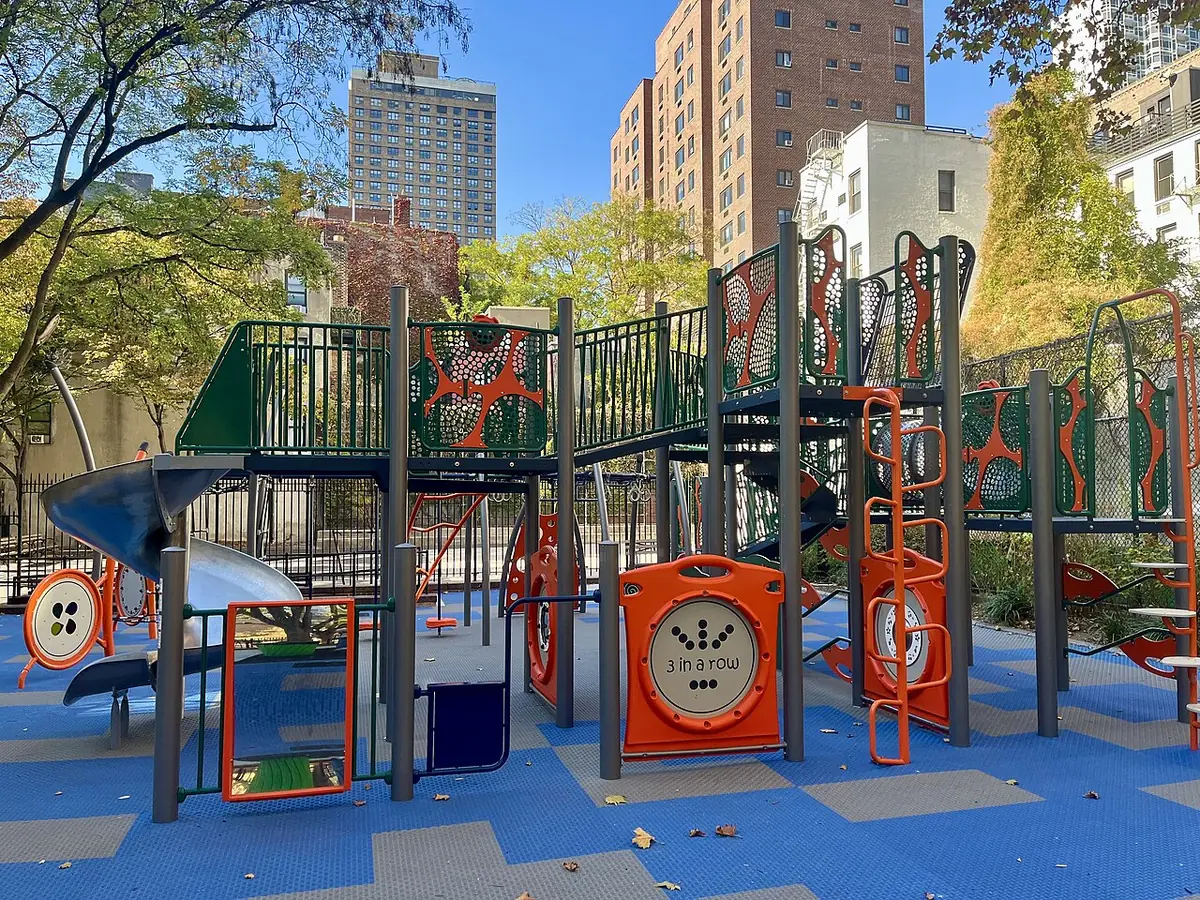
Playgrounds tucked between buildings like this are part of everyday city life — Photo: Transpoman · CC BY-SA 4.0 · Wikimedia Commons
Moving to New York tolerates neither loose arithmetic nor sentimental hesitation. If you have worked through the real costs beyond the headline rent, accepted the constraints of urban space and taken on board the reality of public transit, you have what you need to make the transition work. The city rewards those who approach it with clear eyes and method, and punishes decisions taken in a hurry or on the strength of a pretty apartment.
Take the time to revisit your priorities, to check your financial file against what New York landlords demand and to test your own tolerance for noise and density. The local rental market gives nothing away to those who arrive late, but in return it offers a stimulating and incomparable experience to anyone who approaches it with rigour and pragmatism.
Your final decision should rest on a genuine fit between your professional ambitions, what you can really afford and the life you want. If all those dials read green, get your documents together, set up your alerts and start viewing, confident that you have looked into every hidden corner of this remarkable city.
Related questions
What paperwork do you need to rent an apartment in New York?
Landlords generally ask for a signed employment letter, your last three pay stubs, recent tax returns, full bank statements and references from previous landlords in order to approve your application.
What is the forty times the rent rule in New York?
It is the standard financial test applied by most New York agents: your gross annual income must be at least forty times the monthly rent for you to qualify without a guarantor.
Do you have to go through a broker to find a home?
You can search on your own through online listing platforms, but the New York rental market is so tight that brokers handle a large share of the available homes, which often means a broker fee payable by the tenant.
Which neighbourhoods are most sought after for a first move?
Areas such as Williamsburg in Brooklyn, Long Island City in Queens or certain parts of Manhattan attract newcomers for their balance of cultural energy, safety and transit access.
How does heating work in New York apartments?
City law requires landlords to heat homes between 1 October and 31 May whenever outdoor temperatures fall below set thresholds, often through traditional and famously noisy steam radiators.
Should you budget for a large security deposit at signing?
New York State law now caps the security deposit at the equivalent of one month's rent for most residential leases, protecting tenants from excessive demands.
How do local taxes affect a tenant's budget?
Tenants do not pay property tax directly, but asking rents already build in those high tax costs, as do the state and city sales taxes that apply to everyday purchases.
Is it easy to sublet your apartment during a long absence?
New York building rules and leases regulate subletting very tightly, and in a co-op a sublet also needs board approval. Written consent from the landlord is a legal requirement, and going without it can mean eviction.
How do you sign up for and get the most out of the MTA subway?
The network runs twenty-four hours a day with contactless OMNY payment or the traditional MetroCard, allowing unlimited transfers in the same direction across the system.
When in the year is the best time to find a good rent?
The rental market peaks in pressure and price between May and September. Searching over the winter months, from November to February, sometimes leaves more room to negotiate.