Buying a house in Abu Dhabi is a major commitment that calls for a close understanding of the local rules. This guide sets out the realities of the capital's market, from choosing a district to the legal procedures you cannot skip.
Get the app
What nobody tells you.
Real prices, hidden costs and the traps to check before you commit.
Why floor area changes your budget so sharply when buying a house in Abu Dhabi
Scroll
Why floor area changes your budget so sharply when buying a house in Abu Dhabi
Buying a house in Abu Dhabi is a major commitment that calls for a close understanding of the local rules. This guide sets out the realities of the capital's market, from choosing a district to the legal procedures you cannot skip.
Written by the ting.ad editorial team ·
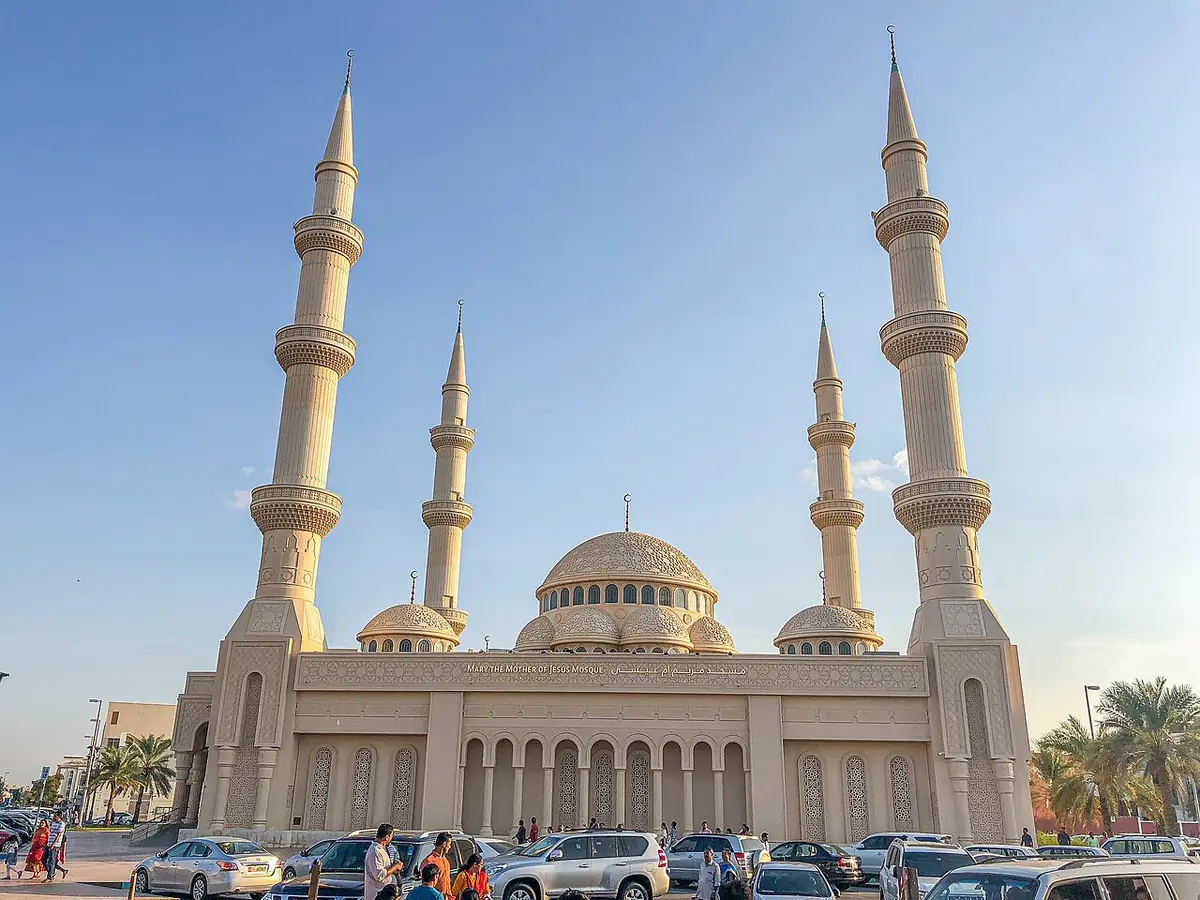
The minarets and courtyard of Mary, Mother of Jesus Mosque in Abu Dhabi — Photo: Clintonrebeiro · CC BY-SA 4.0 · Wikimedia Commons
Beyond raw floor area, daily life depends entirely on which district you choose.
Buying a house in Abu Dhabi is not simply buying floor area and walls. The emirate's market follows strict planning logic in which each district sets its own rules on land, on community charges that are easy to overlook, and on distance from where you will actually spend your day. Understanding what you are buying means separating the headline value of the property from the structural constraints that come with it.
A spacious villa on the outskirtsvsSignificant daily travel
Outer residential districts such as Khalifa City or Mohammed Bin Zayed City offer considerable space at a far more accessible price per square metre. In exchange you take on dense peak-hour traffic to reach the business district.
A townhouse close to the centrevsA small plot and a limited garden
Moving nearer the coast or the main islands such as Saadiyat or Reem puts infrastructure and amenities on your doorstep. The compromise falls on plot size, which is often reduced to the minimum.
Buying inside a gated communityvsHigh maintenance and management fees
Secure developments provide excellent shared facilities — pools, parks, permanent security. Those advantages arrive as fixed annual charges whose long-term effect has to be measured properly.
Does this location match your working life and your rhythm?
Arriving from another country redefines your assumptions about housing completely.
Choosing a house in Abu Dhabi depends closely on how you actually live. Whether you are settling with school-age children, living as a working couple, or looking for residential calm, each district answers a different set of criteria and deserves an honest assessment.
Suburban residential life
Families generally favour the large villas in suburban districts for the quiet, the international schools nearby and the secure outdoor space. That means accepting regular car journeys for after-school activities and work commitments. The larger developments usually include their own parks and community facilities, which makes settling in considerably easier for new arrivals. Plan around congestion on the main roads at the start and end of the school day.
Close to the business districts
For people working in the centre of the capital or in the financial free zones, a townhouse on the adjacent islands cuts travel time sharply. The trade-off is more limited outdoor space, often a terrace or a courtyard. It suits households who want immediate access to the city's cultural and dining life. Parking pressure and urban density are more pronounced here than further out.
Positioning for the rental market
Buying a house to let follows yield rules specific to Abu Dhabi. Tenants look above all for properties that are easy to maintain, inside communities run by established developers and equipped to a modern standard. How liquid the asset proves depends on its appeal to an expatriate population with demanding expectations on cooling and insulation. Scrutinise the community charges closely, or they will erode the margin you were counting on.
What changes between buying at home and buying a house in Abu Dhabi
With those principles absorbed, choosing the right district is the decisive next step.
Transferring your habits as a buyer to the Abu Dhabi market exposes some notable cultural and regulatory differences. Financing, contract structure and how private ownership is managed follow distinct legal traditions that are worth absorbing from day one.
From abroad
Near-automatic reliance on a conventional bank mortgage
Abu Dhabi
A market where cash and staged payment plans agreed with developers play a central role
Obtaining a local mortgage as a non-resident calls for strict evidence of income and a larger deposit than you may be used to, which advantages buyers with funds readily available.
From abroad
A notary at the centre of securing the sale and the money
Abu Dhabi
Transactions registered directly with the municipal land authorities
Transfer is handled centrally by the administration, which speeds the process considerably while shifting much of the legal verification onto your own advisers and agents.
From abroad
Shared ownership governed by long-standing statute
Abu Dhabi
Strict community rules issued by private or semi-public developers
External alterations to your house, landscaping and rules about neighbours are governed by private charters that are highly prescriptive and worth reading closely before you sign.
From abroad
Recurring property taxes and varied local taxation
Abu Dhabi
No income tax and no annual property tax, offset by up-front registration fees
The absence of an annual charge changes the long-run return calculation, but the entry cost is concentrated into registration duty paid once, at transfer.
Which districts suit your way of living?
To move from preference to plan, set your expectations against what the market actually costs.
Abu Dhabi is a mosaic of districts with strong individual identities, from exclusive coastal islands to large inland residential developments. Each offers a different balance of accessibility, standard of infrastructure and character of neighbourhood.
Saadiyat Island
A refined cultural atmosphere, a protected coastal setting and high-end homes full of light.
Suits
Buyers wanting prestige, proximity to world-class museums and direct access to natural beaches.
Trade-off
Among the highest prices per square metre in the emirate, and detached houses are scarcer here than apartments.
Khalifa City
A large residential suburb, calm and family-oriented, paced by schools and local shops.
Suits
Families wanting substantial floor area, large gardens and a more measured purchase budget.
Trade-off
A marked distance from the historic centre, and heavy traffic on the main routes at peak hours.
Yas Island
Constant activity, between theme parks, sports venues, marinas and open-air leisure.
Suits
Investors and active buyers who value a setting built around entertainment and modern facilities.
Trade-off
That constant activity works against the quiet some residents are specifically looking for.
What price ranges should you expect for a house in Abu Dhabi?
Beyond the headline value, the legal nature of your ownership deserves particular attention.
Working out the budget for a house in Abu Dhabi means reading market trends by location and by standard of property. Advertised prices do not always reflect the compulsory additional costs, and those belong in your calculation from the outset.
abu-dhabiFor saleHouseestimate
Median price / m²AED 10,127Half the apartments sell below this
Median priceAED 2.24mthe average is 14% higher — a few very large properties pull it up
Most common2 bedrooms54 % of listings
Average size210 m²
By number of bedrooms
Bedrooms
Share of market
Avg price
Price / m²
Avg size
2most common
54 %
AED 2.05m
AED 10,660
193 m²
3
31 %
AED 2.84m
AED 10,127best value / m²
280 m²
4
14 %
AED 4.1m
AED 10,660
385 m²
Each row is an average, compared against the area average of AED 10,660 / m². These are indicative estimates of a typical local market, not a measured sample of live listings. Check current listings before relying on them.
Freehold or a right of use: the fundamental distinction
Securing the purchase also means following the procedural stages rigorously.
Freehold ownership for foreign nationals follows a precise legislative framework that must be understood before committing. The market divides between specific zones where ownership is absolute and alternative legal regimes that need to be told apart clearly.
Designated investment zones (freehold)
Within areas precisely delimited by the emirate's government, foreign nationals acquire full ownership of the property together with the associated land title, with no time limit. The status provides complete legal security and aligns with international standards on inheritance and resale.
What it changesYou hold an asset that can be passed on and sold on the same terms as a national would, which supports its value over the long term without legal ambiguity.
Long leases and usufruct rights
Outside those designated zones, access to property can take the form of long leases or renewable usufruct rights, generally granted for periods between 30 and 99 years. These arrangements govern how the property may be used and whether it can pass to heirs.
What it changesCheck the original expiry date and the renewal terms carefully, or the value of the investment will erode as the term approaches.
The legal rule to understand before paying any deposit
The transaction then follows a clear sequence with clearly identified parties.
Paying a deposit on a property in Abu Dhabi binds both parties legally from the moment the preliminary agreement is signed. Unlike markets where conditional clauses protect a buyer automatically, the contractual rigour here calls for real care.
Agreeing terms and preparing to place a deposit.
Careful verification of the seller's identity and of the validity of the official title at the land registry.
Drafting the preliminary contract, including conditions covering financing and technical inspection.
Placing the deposit into an approved, secured escrow account rather than directly with the seller.
Obtaining the No Objection Certificate from the developer or community management to clear the final obstacles.
Registration of the transfer and issue of the new title in your name.
How a transaction runs, step by step
Buying a house in Abu Dhabi follows a formal process involving several institutional and professional parties. Knowing each role, and the order of events, keeps the purchase moving.
The estate agentSelecting the property and negotiatingThey take you through properties matching your criteria and negotiate the financial terms of the initial offer with the seller.
The legal adviserAuditing the contract and the chargesThey check that the preliminary contract is sound and confirm there is no dispute or undisclosed mortgage over the house.
The escrow providerHolding the funds securelyThey guarantee your deposit stays in a blocked account until the administrative checks are genuinely complete.
The developer or managerIssuing the No Objection CertificateThis confirms the current owner is up to date on community charges and authorises the change of ownership.
The land authorityRegistering the transferThe municipal service cancels the previous title and issues the new certificate of ownership in your name.
House or apartment in Abu Dhabi: the real trade-offs
Buying in Abu Dhabi forces one fundamental choice: the detached house, typically in an outer community such as Khalifa City or Al Reef, against the waterfront apartment on Reem or Al Maryah Island. This is not a matter of taste alone; it commits you to a very different daily life. A house gives generous floor area, a private garden and no shared walls — a rare luxury in any major city. It also brings heavier structural maintenance, near-total dependence on a car, and growing distance from the business districts and the cultural life of Saadiyat and the Corniche.
An apartment redefines centrality, placing you within reach of the office towers, the better clinics and the international schools, with shared facilities — pools, well-equipped gyms, concierge and round-the-clock security. The constraints are the absence of genuinely private outdoor space, an owners' association governing works and neighbourly conduct, and annual service charges calculated per square foot that weigh heavily if the building is poorly managed.
For families intending to settle for years, a house offers spatial stability where children can grow up freely, while working professionals and investors chasing gross rental yield consistently favour a well-placed apartment. Abu Dhabi does allow for something between the two: terraced townhouses combining the advantages of both, with two or three storeys and a small garden inside a collectively managed community. Judge the surrounding infrastructure ahead of the raw floor area the developer advertises, because long-term resale value depends above all on the quality of the roads, how easily you get in and out, and how close the municipal parks are.
Finally, the regulatory position deserves particular attention depending on the district. Some areas are reserved for local citizens or GCC nationals, while the official investment zones allow foreign nationals to hold freehold title. Establishing exactly what kind of title is on offer before signing any preliminary agreement gives you complete legal security and protects the value of the asset. The final choice should follow a realistic projection of your life over the next five to ten years, accepting the compromises inherent in each type of home in this climate and this city.
What total budget should you plan for?
Buying a home in Abu Dhabi is not the headline figure on the sale contract. You have to include every compulsory additional cost, from local administrative fees to the recurring cost of maintenance and community services. A transparent financial view avoids unpleasant surprises and lets you size your financing accurately.
Initial acquisition costs
Cost
Rate or estimated amount
Nature of the obligation
Land registration fee (Department of Municipalities and Transport)
2 per cent of the purchase price
Compulsory; often shared between buyer and seller, but negotiable
Estate agency fee
2 per cent of the purchase price, excluding VAT
Market standard for handling the transaction
Bank arrangement and valuation fees
Between AED 2,500 and AED 5,000
Required where a local mortgage is used
Home insurance and lender's life cover
Varies with profile and value
Required by local financial institutions
Traditional notary fees do not exist here in the European sense; direct registration with the municipal department serves the same function.
Recurring annual costs for a resident owner
Cost
Annual scale
What it covers
Community service charges
AED 10 to 25 per square foot
Upkeep of common areas, security, pool, cooling of shared spaces
Utilities — water, electricity, cooling (ADDC)
AED 8,000 to 18,000
Personal consumption, heavily dependent on summer air-conditioning use
Preventive maintenance and minor repairs
AED 5,000 to 10,000
Annual maintenance contract for air-conditioning and sanitary equipment
Community charges should be checked carefully before purchase, since developments with luxury facilities carry markedly higher costs per square foot.
An ordinary Tuesday for an owner living in Abu Dhabi
Settling in Abu Dhabi reshapes how you organise time and travel. To get a feel for how the day flows, here is an ordinary Tuesday, from the early start through to the end of the evening.
06:30The residential district — Al Reem Island or Khalifa CityThe morning starts in bright light. Temperature sets the pace, and the still-mild early air is the moment for a short walk or for getting the family organised indoors.
07:45The school runChildren are dropped at schools working to international standards. Traffic is heavy but moves well on a road network built for it, provided you avoid the congested approaches to the main bridges at peak times.
09:00The office or co-working space — Al Maryah Island or the CornicheA modern working environment with connected, functional space. Morning meetings run in bright towers with generous underground parking and integrated services.
13:00LunchMidday is a chance to sample the range of food in the city, from a hotel restaurant to a café at the foot of the residential towers, with consistently good service.
17:00End of the working day, and shoppingThe journey home takes in a mall or a local supermarket. Supply of fresh produce from around the world is reliable, through high-quality international supermarkets.
19:00Family time or exerciseThe evening continues around the community pool or a walk along the landscaped Corniche, in notably safe and calm surroundings.
What the brochures leave out
Behind the photographs of sunsets over the Gulf and promises of spectacular returns, the Abu Dhabi market has operational and regulatory subtleties that matter. Knowing them lets you approach the purchase with a clear head.
What summer cooling does to the bills
Through the hottest months, June to September, air-conditioning runs day and night. Electricity and water bills can triple against winter, and that is an unavoidable line in the household's annual running costs.
Build quality varies by year of completion and by developer
Acoustic and thermal insulation differ considerably. Some properties built early in the boom need waterproofing or façade work sooner than expected, which can mean an exceptional levy voted by the owners' association.
Strict limits on structural changes and external alterations
Whether you buy a villa in a gated community or an apartment, the community guidelines tightly control exterior paint, pergolas, satellite dishes and internal partitions, and all of it needs formal approval first.
Inter-island connections are excellent but congest
Abu Dhabi is an archipelago linked by wide bridges and motorways. The network is among the most modern anywhere, but certain crossings jam chronically at office hours, which changes your real journey time depending on exactly where you live.
What owners discover six months after moving in
Looked likeAn exceptional deal, at a price per square foot well below the district average
Turned outVery high community charges, unpaid by many owners, which stalled the maintenance the development actually needed.
Would have caught itAlways ask for the minutes of the last three general meetings and check the financial health of the reserve fund the management holds.
Looked likeA calm, developing district, ideal for raising young children away from the noise
Turned outPersistent early-morning noise from adjacent construction that was never mentioned at the viewing.
Would have caught itConsult the official municipal master plan to identify every plot still available for development around the property.
Looked likeA central location putting anywhere in the city within ten minutes by car
Turned outNo local shops reachable on foot, so every small errand meant getting back in the car.
Would have caught itWalk the area yourself at different hours to assess whether there are shops, pharmacies, usable pavements and shade.
Looked likeAn uninterrupted view over the waterfront and the mangroves
Turned outA new tower built opposite, permanently blocking both the view and the natural light.
Would have caught itCheck the legal status of the plot opposite and the maximum height permitted there under the local planning framework.
When buying here is the wrong decision
Abu Dhabi offers real stability and a sound basis for building an asset, but it is not a universal answer. Some buyers would do better renting flexibly and keeping their financial and personal agility intact.
Someone on a short posting, or whose contract is uncertain within three years
→A flexible annual tenancy rather than buying outright
Acquisition costs of roughly 4 to 5 per cent cannot be recovered in under four or five years of ownership, so an early sale loses money once commissions and local fees are counted.
A buyer with a small deposit relying on maximum borrowing
→Not to borrow to the limit of their capacity
Movements in interest rates, combined with changing community charges and unplanned maintenance, can destabilise a household budget badly if income dips even temporarily.
An investor wanting liquidity and short-term speculative returns
→International financial markets rather than physical property here
Property in the capital is a long-term rental-yield and capital-appreciation market, with a time to sell that requires patience and a considered strategy.
So are you ready to buy in Abu Dhabi?
Deciding to buy in Abu Dhabi is a significant turn in how you manage your finances and your family's future. On this analysis, success rests on three things: clarity about how long you intend to stay, rigour in a budget that includes every hidden cost and recurring charge, and a careful choice of location measured against how you actually live. If you intend to settle here for the long term, ownership is a genuinely attractive alternative to renting indefinitely, offering an exceptional setting, recognised legal security and the chance to build value in a regulated and active market.
It does require setting aside the marketing and engaging with the technical and financial reality. Reading the community accounts, checking the municipal master plan and budgeting properly for summer cooling turns an emotional purchase into a solid long-term asset. The opportunities are there, whether you choose a contemporary apartment on the residential islands or a spacious villa in one of the greener outer communities — provided you never rush, and you use independent professionals to validate each stage.
Buying here is ultimately a considered bet on a city that combines global economic momentum with a remarkable quality of family life. If your professional position is stable, your horizon runs beyond five years and you fully understand what maintaining a property in the Gulf commits you to, the conditions are right. Take the time to see several properties, compare districts demandingly, and go in having examined every side of the local market.
Related questions
Can foreign nationals own property outright in Abu Dhabi?
Yes. Foreign nationals can acquire freehold property, but only in investment zones officially designated by the emirate's government, such as Reem Island, Saadiyat Island and Al Raha Beach.
What administrative costs apply when buying?
The buyer principally pays a land registration fee, generally 2 per cent of the purchase price, to the Department of Municipalities and Transport, plus the customary agency fee set at 2 per cent excluding VAT.
Can a non-resident expatriate get a mortgage in the UAE?
Several local banks offer mortgage financing to non-residents, though the conditions generally require a larger deposit, frequently between thirty and forty per cent of the property's value.
How are annual community charges calculated?
Service charges are calculated per square foot of floor area. They cover upkeep of common areas, security, lifts and cooling of shared spaces, managed by the development's administration company.
Is there tax on capital gains when reselling?
There is currently no income tax and no capital gains tax on property in Abu Dhabi, which makes it particularly attractive for building and passing on an asset over the long term.
What are the main differences between buying a villa and an apartment?
An apartment offers urban centrality and shared facilities such as a pool or gym, but carries recurring service charges. A villa gives spatial independence and a private garden, but places full structural maintenance on the owner alone.
How much does air-conditioning really affect an owner's budget?
Given very high summer temperatures, cooling is the largest element of household electricity use. Water and electricity bills can triple between the cooler season and the height of summer.
Do I have to use a licensed estate agent?
While it is technically possible to deal directly with a private seller, using an agent registered with the local authorities gives legal security to the reservation contract and keeps the procedure compliant.
What should I check about nearby construction?
Consult the official municipal master plan held by the Department of Municipalities and Transport to establish whether vacant plots immediately nearby are earmarked for development that could affect your view or your quiet.
How long does a transaction take?
A cash purchase can complete in two to four weeks. Where a bank mortgage is involved, the full process generally takes six to eight weeks to allow for the required valuations.