Buying a house in Birmingham is a significant opportunity to settle in one of the UK's most dynamic cities. This practical guide takes you through analysing the market, choosing a district and understanding the legal particularities of buying here.
Get the app
What nobody tells you.
Real prices, hidden costs and the traps to check before you commit.
What you actually get buying a house in Birmingham
Scroll
What you actually get buying a house in Birmingham
Buying a house in Birmingham is a significant opportunity to settle in one of the UK's most dynamic cities. This practical guide takes you through analysing the market, choosing a district and understanding the legal particularities of buying here.
Written by the ting.ad editorial team ·
Avenue Road, Birmingham in Street View: drag to look around.
Buying a house in Birmingham is not a matter of acquiring square metres and signing. It is entry into a dense British market marked by highly varied property types and by a legal process that behaves quite differently from what most overseas buyers expect.
More generous living space than London for an equivalent budgetvsRenovation costs frequently underestimated on older stock
Buyers regularly find that the saving on purchase has to be reinvested quickly into energy and structural upgrades on Victorian or Edwardian property. Audit the thermal envelope well before making a firm offer.
Direct access to the economic corridors and employment centres of the West MidlandsvsVariable exposure to noise, and dynamism that changes street by street
Proximity to the main roads or suburban stations gives excellent mobility but brings traffic with it. Each micro-district has its own balance, worth observing at different hours.
Long-term capital potential supported by major infrastructure projectsvsLocal fluctuations driven by Bank of England interest rate policy
Regeneration supports value over years rather than months, and monthly costs move with rates in a way that matters more here than in cash-dominated markets.
Does this match your life and what you expect day to day?
Choosing a house in the West Midlands means accepting a pace and a logistical organisation particular to Britain's large regional cities. Whether you work locally, remotely or travel regularly changes what you should be looking at.
The mobile urban professional
Your priority is reducing daily journeys to hubs such as New Street or Moor Street. You will naturally look at terraced houses or townhouses in the intermediate rings, well served by buses and suburban trains. On-street parking and traffic density require organisation, but you get instant connection to the city's services and cultural life without the financial pressure of a first-tier city.
A household wanting space
You will look first at the outer residential districts or the bordering areas with parks and well-regarded schools. Detached and semi-detached houses with private gardens are more attainable there, and the trade is a longer journey into the centre at peak times.
The landlord
Family houses near good schools attract stable, long tenancies, which reduces voids and re-letting costs. The regulatory burden on UK landlords is significant and increasing, particularly around energy performance, so budget for compliance rather than treating it as optional.
Living here when you come from abroad
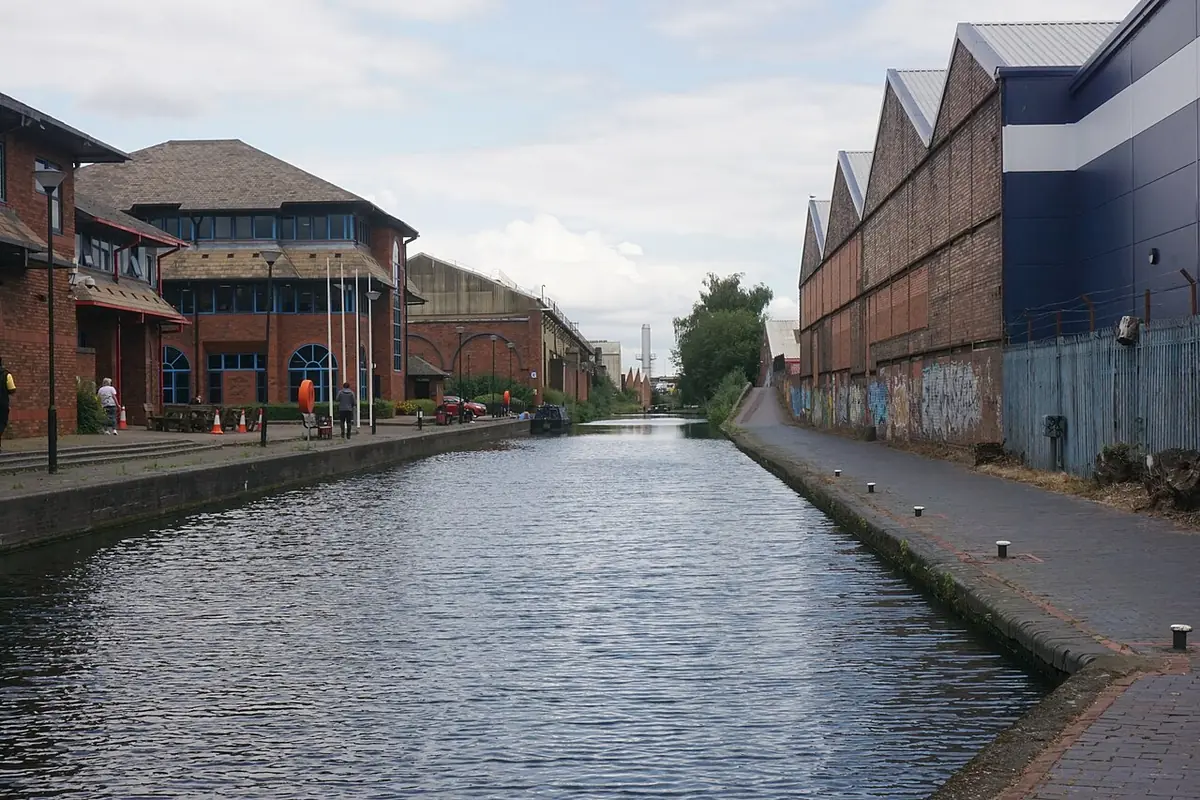
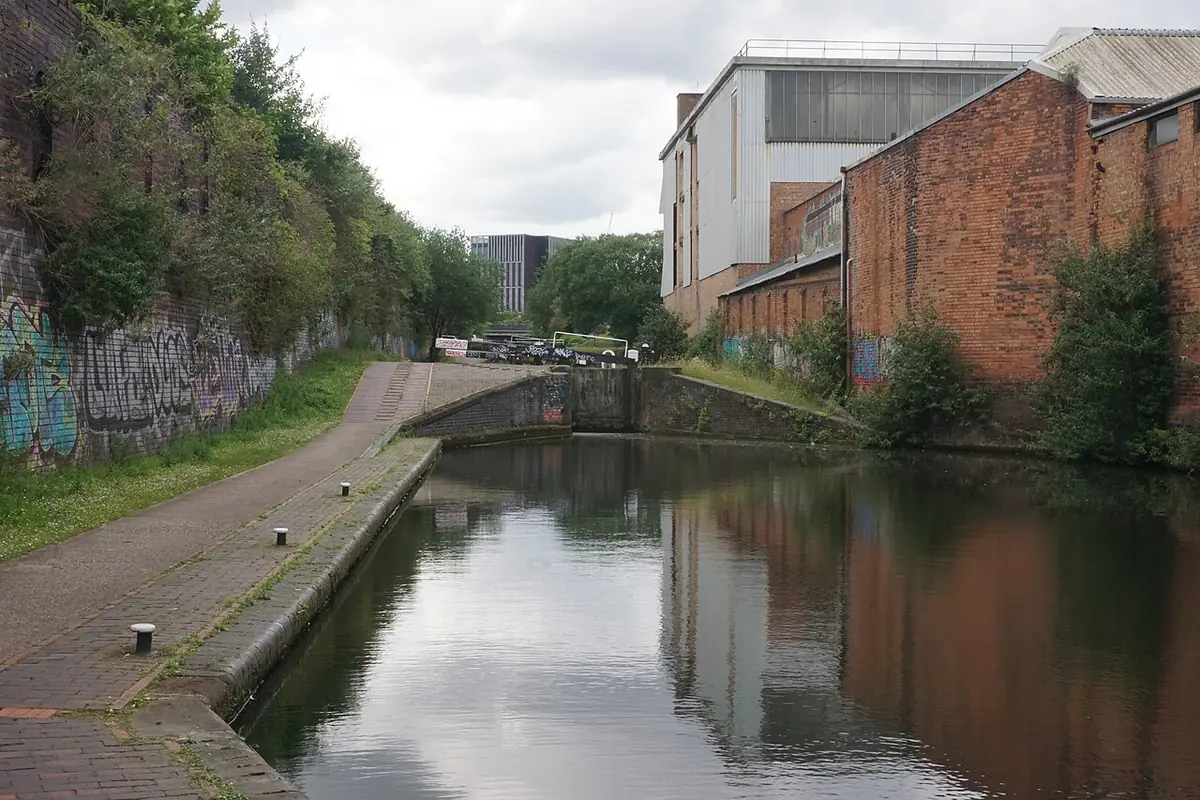
The canal towpath near Aston, part of daily life around the city's waterways — Photo: Bill Boaden · CC BY-SA 2.0 · Wikimedia Commons
Settling in the UK means abandoning a number of well-established legal, tax and cultural reference points. The British property system has its own rules, from how ownership is held to how a transaction actually completes.
From abroad
A notary at the centre, with an immediately binding deed
Birmingham
Conveyancers, and a long delay before contracts are exchanged
The transaction rests on specialist solicitors negotiating each technical clause. Your commitment is only legally firm at exchange of contracts, which leaves a margin of uncertainty requiring constant attention from your adviser.
From abroad
Recent, demanding thermal performance standards
Birmingham
Older stock frequently on a low EPC rating and needing work
Many houses perform poorly on insulation, glazing and heating. Budget the upgrade from the outset if you want to control your future energy bills.
From abroad
A single property tax based on cadastral rental value
Birmingham
Council Tax, banded locally and funding municipal services
This recurring local tax varies noticeably between areas and sits on top of your other running costs. It belongs in the calculation from the start.
From abroad
Compulsory seller-provided technical surveys
Birmingham
Caveat emptor, with the buyer commissioning their own survey
You carry the responsibility for establishing the property's condition, which makes a RICS survey a necessity rather than a formality.
Which part of Birmingham suits your priorities?
Birmingham is a mosaic of districts with contrasting identities, from dynamic urban areas mid-gentrification to calm, green residential suburbs. Each offers a different compromise.
Harborne and the western residential districts
A smart village atmosphere with independent shops, busy cafés and well-kept green space.
Suits
Families and professionals wanting the balance between pleasant neighbourhood life and proximity to the medical and university district.
Trade-off
Prices per square metre among the highest in the city, and strong competition for good property.
Sutton Coldfield and the green northern ring
An exceptional semi-rural setting, marked by vast natural parks and a strongly residential feel.
Suits
Those who need real space, a preserved natural environment for children and excellent schools.
Trade-off
The distance from the business district means longer journeys at peak hours.
Moseley and Kings Heath in the south
A bohemian, artistic and alternative feel, paced by local markets, good pubs and an active community life.
Suits
Buyers wanting character housing and a genuine local scene within reach of the centre.
Trade-off
Parking pressure, and Victorian stock that frequently needs work.
Edgbaston
Established, leafy streets close to the hospitals, the university and the cricket ground, with a settled and quiet character.
Suits
Households wanting proximity to the centre without its noise, and steady long-term demand.
Trade-off
Prices reflect that reputation, and larger period houses carry substantial maintenance.
What does buying a house here actually cost?
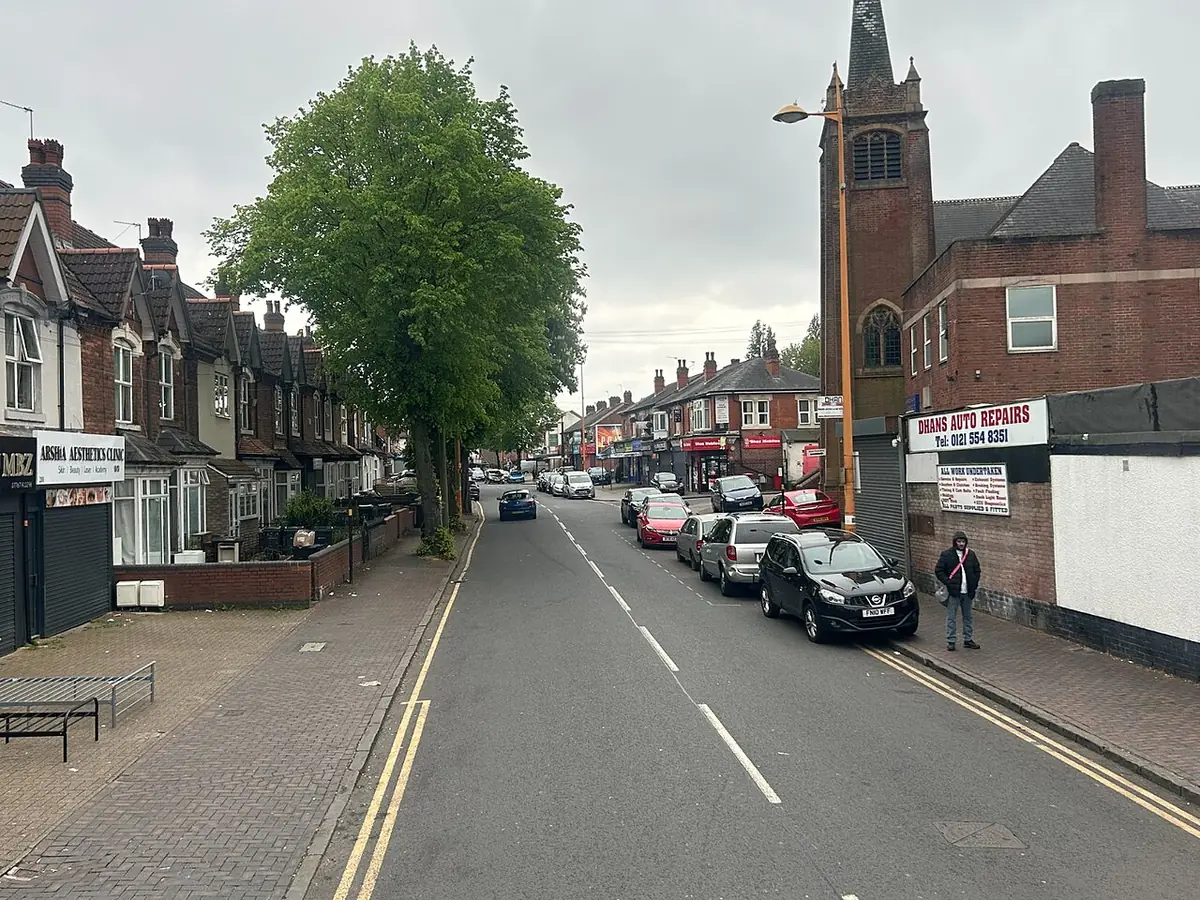
A typical Handsworth high street, shops below flats and houses nearby — Photo: Philip Halling · CC BY-SA 2.0 · Wikimedia Commons
Birmingham's market spans a wide range of prices that varies considerably with the precise location, the size and the general condition of the property. Unlike the capital, first-time buyers and families find realistic opportunities here, provided they read the price ranges carefully.
birminghamFor saleHouseestimate
Median price / m²£2,337Half the apartments sell below this
Median price£280kthe average is 14% higher — a few very large properties pull it up
Most common2 bedrooms69 % of listings
Average size114 m²
By number of bedrooms
Bedrooms
Share of market
Avg price
Price / m²
Avg size
2most common
69 %
£280k
£2,460
114 m²
3
26 %
£356k
£2,312 −6 %
154 m²
4
6 %
£455k
£2,263best value / m²
201 m²
Each row is an average, compared against the area average of £2,460 / m². These are indicative estimates of a typical local market, not a measured sample of live listings. Check current listings before relying on them.
What you can actually own: understanding the legal structure
The security of your investment rests on the clarity of the tenure. In the UK, the distinction between absolute ownership and the limited or shared forms carries significant implications.
Freehold
You own both the building and the land it stands on, with no time limit and no ground rent payable to anyone. It is the most sought-after and the most secure basis for buying a conventional detached or terraced house, because it gives you complete autonomy over management and works.
What it changesYou decide on maintenance and alterations without answering to a landowner or paying unpredictable ground rents.
Leasehold and shared ownership
You buy the use of the building for a fixed, usually long period, while a third party retains ownership of the land or the common parts. This arises on some new-build house schemes and integrated residential estates, and requires regular service charge payments.
What it changesCheck the remaining lease term and the level of the associated charges carefully, or you will watch the property's value erode as the term shortens.
The rule to understand before committing
Buying property in the UK is a sequential process where your legal commitment becomes irrevocable at one precise point. Knowing that mechanism stops you panicking at the delays and tells you where the real risk sits.
Your offer is accepted.
Instructing a conveyancer or specialist solicitor to begin the initial legal searches on title.
Commissioning an independent survey to identify hidden defects or structural problems.
Finalising your mortgage offer by supplying full evidence of income and deposit.
Exchanging contracts, which makes the transaction legally binding on both sides, with a deposit paid.
Completion, and the keys.
How a transaction runs, step by step
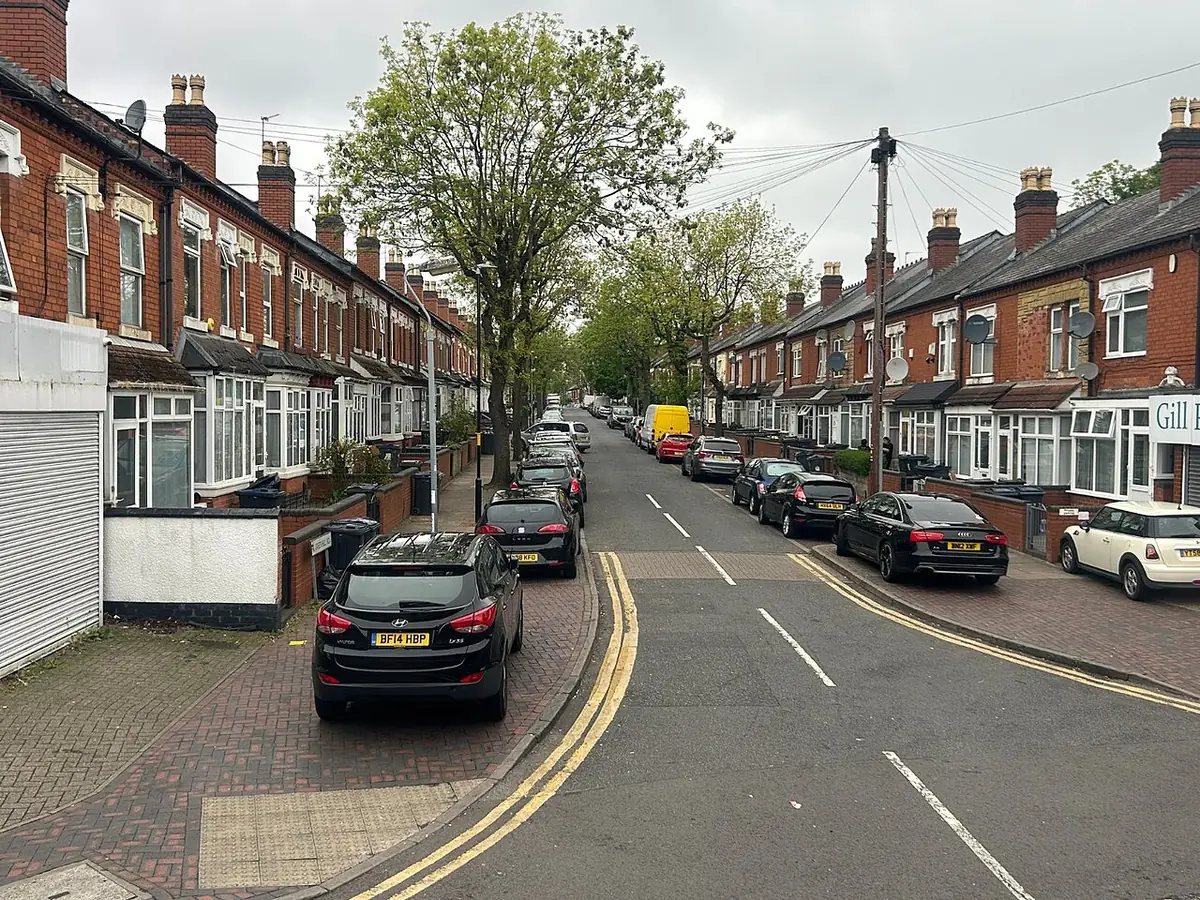
Terraced streets like this are the everyday housing stock across Birmingham — Photo: Philip Halling · CC BY-SA 2.0 · Wikimedia Commons
A successful transaction rests on rigorous coordination between several professionals with well-defined roles. From the agent negotiating the initial terms to the conveyancer securing the legal side, each acts at a specific point.
The estate agentNegotiation and introductionThey present the property, put your offer to the seller and act as intermediary in setting the terms before the lawyers become involved.
The mortgage brokerArranging the financingThey assess your position, select the best available offers in the UK market and manage your application with the lenders.
The surveyorAssessing the structural conditionThey inspect the house in detail and report on the roof, the walls, damp and the installations, which also gives you grounds to renegotiate.
The conveyancerLegal checks and draftingThey examine title, raise enquiries with the land registry and local authority, prepare the contracts and orchestrate the transfer of funds on completion day.
YouDecisions at each stageYou approve the survey findings, the mortgage offer and the contract before exchange, which is the point of no return.
House or apartment in Birmingham: deciding by how you live
Choosing between a Victorian house with a garden in Birmingham's residential districts and a modern flat in the centre redefines your daily life here entirely. Single-family houses offer complete independence and better long-term retention of land value, but they require a larger initial investment and regular attention to the roof and the outdoor space.
A city-centre flat reverses that. You get a walk to the station and the office, external maintenance handled by the building, and lower entry costs. You accept service charges, building rules and — critically in the UK — a lease rather than freehold, with everything that implies for value as the term shortens.
The financial logic differs sharply. A freehold house carries no ground rent and no service charge, but every repair. A leasehold flat carries predictable annual charges that can nonetheless rise steeply, and a lease term that is itself a depreciating asset unless extended.
The honest test is your horizon and your tolerance for maintenance. Settling for years with a family, the house is the sounder purchase and holds value better. Buying for flexibility or to let, a well-located flat with a long lease does the job with far less involvement.
What budget do you need to live comfortably in Birmingham?
Buying in Birmingham does not stop at the price on the portals. You have to anticipate the local taxes, the English equivalent of notary fees and the recurring charges.
Initial and acquisition costs for a typical property
Cost
Estimated amount or range
Effect on your budget
Average price, 3-bedroom house
£250,000 to £320,000
Depends heavily on the district and proximity to good schools
Average price, 2-bedroom flat
£170,000 to £230,000
Frequently includes annual service charges
Stamp Duty Land Tax (main residence)
£0 to £3,500
Varies with the relief available to first-time buyers
Conveyancing and survey
£2,000 to £4,500
Essential to validate title and the condition of the building
These figures assume standard property in good general condition, excluding property needing substantial thermal renovation.
Recurring charges and annual taxes for a household
Cost
Average observed
Frequency
Council Tax (bands B to D)
£1,400 to £2,100 a year
Annual, spread over 10 to 12 months
Service charge (for a flat)
£1,200 to £2,500 a year
Payable quarterly or annually
Buildings and contents insurance
£350 to £600 a year
Annual premium, compulsory or strongly advised
Energy bills (gas and electricity)
£1,800 to £2,600 a year
Varies with floor area and the EPC rating
Council Tax varies precisely with the local authority and the band the property sits in, so check the specific address rather than assuming an average.
Health, schools and transport: an ordinary Tuesday living here
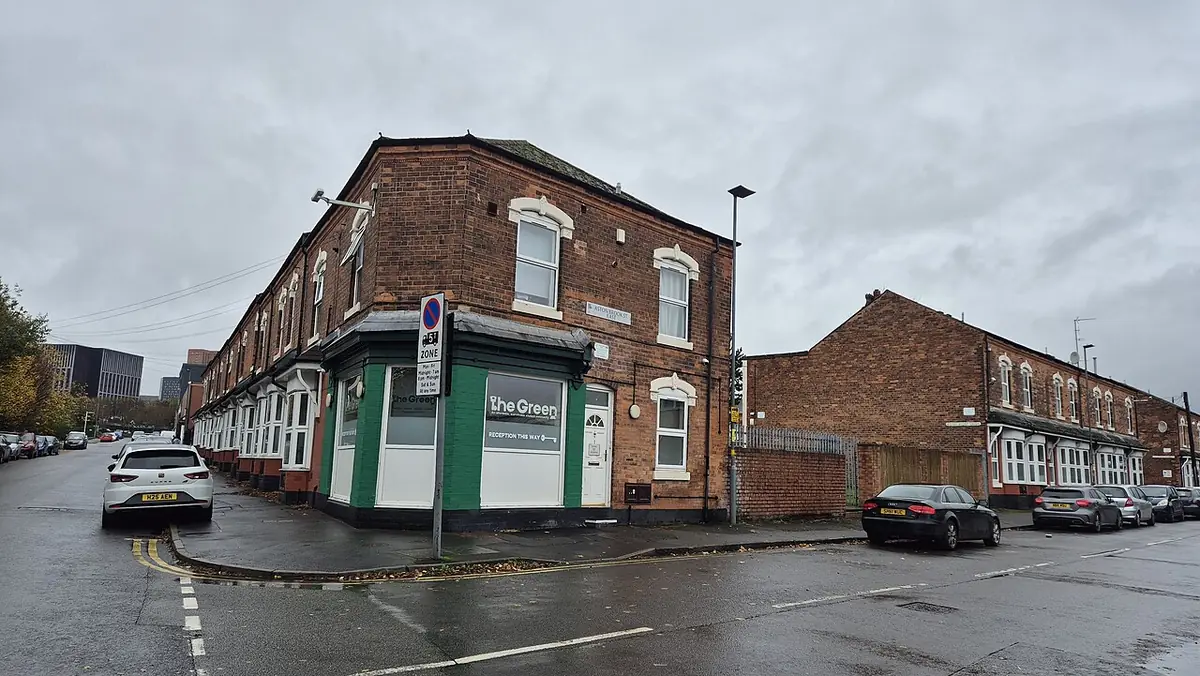
Corner pubs and terraced rows like this define Aston's streets — Photo: Paul Collins · CC BY-SA 2.0 · Wikimedia Commons
To judge whether a move works, nothing replaces walking through a typical weekday — the morning journey to work, the school run, and how easily you reach the everyday services.
07:30A residential district such as HarborneAn early start to avoid peak congestion on the arterial roads into the centre.
08:15The local primary schoolDropping the children at the neighbourhood school, whose Ofsted rating almost certainly shaped which area you bought in.
08:45New Street or Snow Hill stationTrain or West Midlands Metro into the office, using a dense and well-connected public transport network.
12:30The business district or BrindleyplaceLunch in a busy quarter, which is where the economic vitality of the UK's second city is most visible.
17:30The local GP surgeryA quick routine appointment or a prescription collection, made straightforward by registering with a local practice on arrival.
18:30The high streetLast-minute shopping at the local shops before heading home for the evening.
What the listing will not tell you about the area
Portal descriptions paint an idyllic picture of every property. The reality of a Birmingham neighbourhood emerges instead through planning subtleties and local conditions nobody advertises.
The Clean Air Zone boundary
If your vehicle does not meet the environmental standards in force in central Birmingham, every trip will incur a daily charge. Check exactly where the zone boundary sits relative to your future address.
Night-time noise, which depends on orientation
Streets that are quiet by day can fill at weekends because of nearby pubs or through-routes. A Friday evening visit is the only reliable way to test the glazing and the future quiet of the bedrooms.
Planned development and major works nearby
Continuing expansion of transport lines, cycle routes and adjacent construction can transform your setting and affect value, temporarily or lastingly. The local planning register is where you find out.
Clay soils and the condition of underground services
Several parts of Birmingham sit on clay subject to seasonal movement, which can weaken the foundations of older buildings. A full structural survey is strongly advisable on period property.
What buyers discover six months in
Looked likeAn exceptional opportunity in a district gentrifying rapidly.
Turned outAn isolated area with a marked lack of local shops and poor transport in the evening.
Would have caught itDo proper fieldwork at different times of the week and talk directly to prospective neighbours about what local life is actually like.
Looked likeAn older property with irresistible character and obvious renovation potential.
Turned outAn unplanned financial drain, from chronic damp and electrical and plumbing installations that met no current standard.
Would have caught itAlways commission a RICS Level 3 survey before satisfying your conditions and committing.
Looked likeA city-centre flat with very modest service charges.
Turned outNo sinking fund at all, producing large exceptional levies as soon as the first façade works were voted.
Would have caught itInsist on a full analysis of the last three years of building accounts and the recent meeting minutes.
Looked likeA location ideally close to the main roads for easy travel.
Turned outPermanent exposure to air pollution and constant heavy-goods noise from dawn.
Would have caught itCheck which way the living rooms face and the quality of the acoustic glazing on the exposed elevations.
Who should not be buying in Birmingham right now
Every market has structural contraindications. Buying in Birmingham serves a particular life strategy and is entirely counterproductive for some households.
A younger professional moving internationally on a regular basis
→Buying a large house on the outskirts quickly.
The initial transaction costs — Stamp Duty and legal fees — combined with the time it takes to resell in the UK market, destroy any financial return if the property is sold before five to seven years of ownership.
An investor wanting immediate, effortless rental income
→Buying older stock without auditing how the building is managed.
The growing regulatory complexity around EPC standards and the strict framework governing UK tenancies demand rigorous technical oversight and constant investment, both of which weigh on the net margin.
A household with no appetite for maintenance at all
→A Victorian or Edwardian period property.
Houses of that character require careful attention and an unavoidable annual preventive maintenance budget, which owners who dislike dealing with contractors experience as permanent stress.
So are you ready to buy in Birmingham?
Canal walks like this are part of daily routines near Aston — Photo: Bill Boaden · CC BY-SA 2.0 · Wikimedia Commons
Buying property in Birmingham is more than a financial transaction: it is putting down roots in a British city in real economic and cultural change. Between the variety of its districts, the depth of its employment base and the historic solidity of its housing stock, the city offers genuine prospects for methodical buyers who have measured each factor.
What it asks in return is rigour on three fronts: a proper survey before you exchange, a clear reading of the local tax and running costs, and a horizon long enough to absorb Stamp Duty and legal fees — realistically five years or more.
Get those right and Birmingham is a sound purchase offering space and connection at prices London cannot match. Get them wrong, particularly the survey on period property, and the saving on purchase disappears into the first year of works.
Related questions
How long does buying a house in Birmingham take?
Generally three to five months between your offer being accepted and completion. The delay reflects the detailed legal enquiries carried out by both sides' conveyancers and the compulsory land searches.
What is the chain?
The chain describes the interdependence of several transactions, where each buyer is also selling. If one link withdraws or hits a financing problem, every associated sale and purchase is immediately delayed or threatened.
Is a survey compulsory?
Not formally, but a RICS Level 2 or 3 survey is strongly advised. It identifies major hidden defects such as damp or roof problems before you are legally committed.
How does Council Tax work?
It is an annual local tax collected by Birmingham City Council to fund local services such as waste collection and roads. The amount depends on the property's assessed value as at 1 April 1991, placed in bands from A to H.
What is the difference between freehold and leasehold?
Freehold means you own both the building and the land indefinitely. Leasehold means you own the right to occupy for a fixed term while a third party owns the land, with service charges and a lease term that shortens over time.
What are the total costs of buying?
Beyond the price: Stamp Duty Land Tax, conveyancing and survey fees of roughly £2,000 to £4,500 combined, and any mortgage arrangement fees.
When does the purchase become binding?
At exchange of contracts, not when your offer is accepted. Before exchange, either party can withdraw without penalty, which is why most failed purchases collapse in that window.
What should I know about clay soils here?
Several parts of Birmingham sit on clay subject to seasonal movement, which can affect the foundations of older buildings. A full structural survey is the way to establish whether a specific property has been affected.
What is the Clean Air Zone?
A charging zone in central Birmingham for vehicles that do not meet the required emissions standards. Check the boundary against your address, because it affects daily driving costs directly.
How long should I plan to own before selling?
At least five years, and ideally longer. Transaction costs on both purchase and sale need that long to be absorbed by any growth in value.
Property review of ting
No ting properties in Birmingham Gb yet
Be the first — share it on ting and it shows up right here.