Buying a house in Chicago calls for a fine grasp of local dynamics, architectural quirks and the legal machinery of Illinois. This practical guide walks you through structuring your purchase step by step, with your eyes open.
Get the app
What nobody tells you.
Real prices, hidden costs and the traps to check before you commit.
What you are really buying when you buy a house in Chicago
Scroll
What you are really buying when you buy a house in Chicago
Buying a house in Chicago calls for a fine grasp of local dynamics, architectural quirks and the legal machinery of Illinois. This practical guide walks you through structuring your purchase step by step, with your eyes open.
Written by the ting.ad editorial team ·
South State Street, Chicago in Street View: drag to look around.
Buying a house in metropolitan Chicago means looking past the postcard skyline of the Loop and reading the residential neighborhoods for what they are. Unlike hyper-dense markets where space comes down to vertical studios, here brick and a lot line redefine what ownership feels like day to day. The stock mixes nineteenth-century structures with deep contemporary renovations, and you have to accept the tension between the city's architectural heritage and the technical demands of winter insulation. Working out exactly what you are buying is how you avoid the disappointment that comes from hidden structural upkeep costs.
Living space and land of your ownvsThe maintenance load that a continental climate imposes
Owning a single-family house in Chicago buys you floor area and a plot that stay rare in a dense urban setting. In exchange, hard winters and wide summer temperature swings demand constant attention to the roof, the foundations and the heating system if the property is to hold its value.
A real foothold in a neighborhoodvsRelative rigidity when you want to resell quickly
Chicago's residential neighborhoods work like self-contained villages with their own shops, schools and local rhythms. That guarantees a stable quality of life, but it also means the liquidity of a single-family house depends heavily on the local economy and on the property taxes attached to that sector.
The long-term value of Chicago brickvsThe high cost of bringing energy performance up to standard
Traditional brick facades give a timeless look and a robustness proven against lakefront weather. Insulating those thick walls, however, often calls for complex and expensive work before the building reaches today's energy performance standards.
Architectural freedom and full autonomyvsNo pooling of major works with anyone else
Unlike buying into a condominium, where roof or facade decisions are voted on collectively, here you carry the entire financial and logistical responsibility for every intervention. Each renovation decision rests on your choices alone and on what you can afford to invest.
Does the house you are considering match the way you actually live?
What a Chicago house is worth to you depends directly on how far it sits from your work and on how you handle hard winters. The city runs on a dense but demanding transit network, and commute times change completely depending on whether you lean on the elevated train lines or on a car. Every buyer profile can find an answer somewhere in the vast urban grid, provided the search targets a sector chosen against real priorities. Reading a candidate neighborhood through mobility and everyday services is how you rule out the areas that would never suit you. Here is how three common buying profiles play out on the ground in the Windy City.
The residential compromise of the north side neighborhoods
You want a balance between concentrated working days at home and time outdoors, without losing hours in transit. Buying on Chicago's north side, in areas near Lincoln Square or Albany Park, puts houses with a genuine garden within reach while keeping you connected to the CTA network. You get a quiet environment that suits focused work, and you keep the option of reaching the business district in under half an hour for the meetings that have to happen in person.
The trade-off in this purchase is giving up the immediate buzz of the fashionable central districts in favor of a quieter, more family-oriented neighborhood life. Local shops replace the big chains, which supports a rhythm anchored in the neighborhood fabric and kept to a human scale.
Buying into a well-regarded school catchment
Your first filter is the quality of the local public schools or the proximity of after-school facilities for your children. Buying in sectors such as North Center, or in parts of the west side, secures access to stable infrastructure and a very active network of local associations. Daily movement is planned around school hours and sports activities, which makes walking or cycling essential if you want to avoid rush-hour congestion.
That stability has a direct price on the market: properties are more heavily contested and the property taxes are among the highest in the state of Illinois. You therefore need to build that recurring charge into your overall financing plan from the very first viewing.
The renovation bet in transitional neighborhoods
You treat the purchase as a long-term project that combines somewhere to live with value created through targeted renovation. Sectors such as Logan Square, or parts of Pilsen, offer real transformation potential for buyers ready to run substantial building works. You accept temporary disruption and uncertainty about the immediate surroundings in exchange for potential appreciation and a foothold in areas going through rapid cultural change.
This route demands a detailed grasp of the local market and of the City of Chicago's planning rules, so that permit applications do not go wrong. Rigorous supervision of local trades becomes the keystone of whether the purchase works out financially.
Buying here when you are coming from abroad: what fundamentally changes
The Chicago skyline rising beyond the lakefront Adler Planetarium — Photo: Sea Cow · CC BY-SA 4.0 · Wikimedia Commons
These administrative and technical differences call for a quick adjustment in how you assess the properties on offer.
Moving from a purchase at home to an acquisition in Illinois unsettles most of your legal, financial and cultural reference points. Many countries protect buyers through a single public officer and a centralised deed, a reassuring but rigid framework, whereas the American system rests on title insurance and on direct negotiations handled by brokers and attorneys. Property sizes, construction materials and the structure of recurring taxes bear little relation to what you are used to. Anticipating these structural differences is what keeps the signing of a purchase offer free of misunderstandings. The table below sets out the main gaps between the habits you arrive with and how a purchase actually works on the ground.
From abroad
A single centralised deed handled by one public officer or notary
Chicago
A closing run by a title company alongside specialist agents and attorneys
You need to check every title insurance clause with extreme care to protect yourself against any dispute over prior ownership of the land.
From abroad
Moderate property tax, smoothed against old cadastral values
Chicago
High property tax, reassessed regularly against market value
The recurring cost of ownership weighs heavily on the annual budget and has to be provisioned precisely in your long-term cash plan.
From abroad
Concrete or stone construction under strict performance rules
Chicago
Wood frame construction, or older brick that will need work
Managing the winter energy bill and inspecting the state of the structure in detail become essential before you commit definitively.
From abroad
A standardised, mandatory energy performance certificate
Chicago
An independent home inspection report commissioned by the buyer
Negotiating the price or the repairs rests entirely on what that technical expert concludes, which makes the inspector central to the transaction.
Which Chicago neighborhood fits the purchase you have in mind?
Choosing the right sector in Chicago decides not only your immediate surroundings but also how well the purchase holds up over time. Each sector has its own identity, its characteristic architecture and its own level of access to the economic center. Buyers have to arbitrate between the cultural energy of the fashionable areas and the muted calm of the residential enclaves to the north and west. The cards below summarise the main options so you can structure the geographic side of your search without getting lost in the complexity of the city map.
Lincoln Square
A preserved village feel, with pedestrian squares, independent shops and a strong sense of community.
Suits
Families and buyers who want residential calm without giving up direct access to public transport.
Trade-off
A housing stock of older houses that often needs a substantial renovation budget to meet current standards.
Logan Square
Constant artistic energy, set to the rhythm of specialty coffee shops, landscaped linear parks and a creative working population.
Suits
Younger buyers and investors betting on urban transformation and medium-term appreciation.
Trade-off
Sharper competition for the good properties and steadily rising prices per square meter, which narrows the room to negotiate.
Beverly
Rolling streets, generous lots, pronounced Victorian architecture and a feeling of being far from the metropolis.
Suits
Buyers who need real floor area, a large private garden and a leafy suburban atmosphere within the city limits.
Trade-off
A longer trip into the Loop business district and a greater dependence on the suburban rail lines (Metra).
West Town
The meeting point between the city's industrial tradition and contemporary food and cultural trends.
Suits
Buyers who want intense urban life and who value neighborhood character alongside immediate access to the main routes out.
Trade-off
A high price level and heavier car traffic at peak hours on the large boulevards that cut through the area.
What buying and then holding a house here really costs
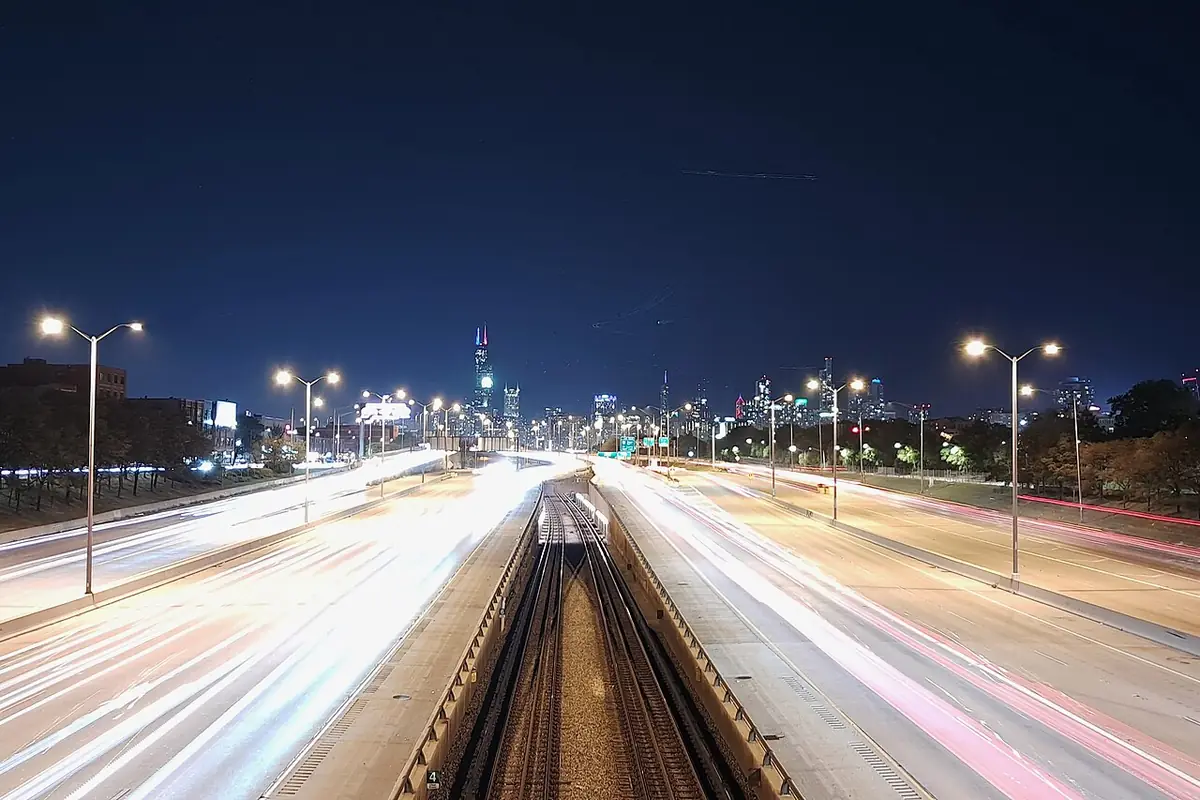
Chicago's expressways stay busy well into the night — Photo: AlphaBeta135 · CC BY 4.0 · Wikimedia Commons
Once those financial realities are absorbed, the next step is to look closely at the exact nature of the properties you can buy.
Budgeting a Chicago house purchase does not stop at the price displayed on the listing portals. Local property taxes, home insurance priced against climate risk and closing costs all move the overall financial equation appreciably. To orient you without invented figures, the table below sets out the orders of magnitude observed on the market for the essential lines of spending. These ranges let you calibrate how much you can borrow and anticipate the recurring outflows that come with ownership in Illinois.
chicagoFor saleHouseestimate
Median price / m²US$2,804Half the apartments sell below this
Median priceUS$460kthe average is 14% higher — a few very large properties pull it up
Most common2 bedrooms61 % of listings
Average size156 m²
By number of bedrooms
Bedrooms
Share of market
Avg price
Price / m²
Avg size
2most common
61 %
US$465k
US$2,952
158 m²
3
32 %
US$613k
US$2,804best value / m²
219 m²
4
8 %
US$878k
US$2,952
298 m²
Each row is an average, compared against the area average of US$2,952 / m². These are indicative estimates of a typical local market, not a measured sample of live listings. Check current listings before relying on them.
What you can actually buy: historic brick or modern structure
The Chicago market is built around a few very specific construction types, inherited from the city's rapid growth around the turn of the twentieth century. Understanding the physical nature of what you are about to buy protects you against hidden defects and excessive energy spending. The two broad models open to you follow radically opposed logics of upkeep and of value creation. Weighing them against each other lets you narrow the search according to your tolerance for building works and your requirements for thermal comfort.
The traditional brick house, the Chicago Bungalow type
Built in series at the start of the last century, these houses stand out for their apparent structural robustness, their original hardwood floors and their convertible attics. They offer undeniable architectural character and a rationalised layout that has proved itself over the decades. In exchange, their stone or early concrete foundations and their original insulation demand a rigorous inspection and often substantial work on the plumbing and electrical systems before they meet current safety and comfort standards.
What it changesYou buy a property with a strong cultural identity and land of your own, but you have to budget from the outset for bringing thermal performance up to standard and for replacing the aging components.
The contemporary townhouse or recent build
These recent or fully rehabilitated properties are designed from the start around modern requirements: energy efficiency, high-performance double glazing and kitchens opening onto undivided living space. The layout favors natural light and limits heat loss thanks to recent composite materials and sealed flat roofs. However, these builds often sacrifice part of the private plot and sometimes sit inside developments governed by condominium rules or a homeowners association (HOA) with strict requirements.
What it changesYou get immediate comfort with no heavy works to plan for in the short term, but you accept shared constraints and a smaller outdoor space.
The legal rule to understand before you put money down
A landmark corner in Chicago's Ukrainian Village neighbourhood — Photo: w_lemay · CC BY-SA 2.0 · Wikimedia Commons
Once that legal and procedural framework is understood, what remains is to orchestrate the operational stages of the transaction.
In Illinois, signing a purchase offer is not a casual act: it commits you financially straight away if the conditions are not drafted carefully. The American system gives a central role to the negotiations conducted by each side's attorney after the initial offer is accepted. That period of legal and technical review protects your interests, provided you keep strictly to the deadlines. Mastering this sequence is what stops you losing your earnest money if a major defect turns up in the property.
You find a house that matches your criteria and instruct your broker to draw up a formal purchase agreement, backed by an initial earnest money deposit.
The seller accepts the offer, which triggers an attorney review period generally set at five or ten business days.
Your attorney and the seller's attorney examine the terms of the contract, adjust the specific clauses and negotiate any points of legal disagreement.
At the same time you commission a full home inspection of the building by a certified, independent professional.
The inspection results reveal the repairs that are needed, which lets your attorney ask for a price reduction or for the work to be carried out before final signing.
With the conditions satisfied and the title verified by the specialist company, the final closing takes place and the transfer of ownership is officially recorded with the county.
How a purchase unfolds, step by step
Completing a purchase in this American metropolis means coordinating several professionals whose roles are strictly defined by local law. Unlike systems where a single public officer centralises every stage, Chicago distributes responsibility between the real estate broker, the specialist attorney, the home inspector and the title company. Each of them plays a precise part in guaranteeing that your purchase is regular and secure, from the first day through to the handover of the keys. The chronology below spells out what each actor does along the way.
The real estate agentSelecting properties and drafting the initial offerThe agent walks the neighborhoods with you, analyses comparable prices on the local market and drafts the purchase offer to the standards in force in the state of Illinois.
The real estate attorneyLegal review and protection of the contract clausesThe attorney negotiates the terms during the review period, confirms there is no outstanding litigation and validates the legal conformity of the transaction to protect your financial interests.
The home inspectorAssessing the structural and energy condition of the buildingThe inspector goes through the roof, the foundations, the plumbing, the electrics and the heating system to produce a detailed report that becomes the basis for any renegotiation.
The mortgage lenderProcessing the financing file and ordering the valuationThe lender assesses your mortgage application, confirms your creditworthiness and instructs an independent expert to produce an appraisal of the property's market value.
The title companyVerifying the chain of title and organising the closingIt researches past mortgages and liens, issues the title insurance the deal depends on, and organises the final signing along with the transfer of funds.
House or apartment in Chicago: the big call every buyer has to make
Once that fundamental choice between house and apartment is settled, it becomes essential to examine in detail the budget reality that underpins buying in Chicago.
Choosing between buying a single-family house and buying an apartment in metropolitan Chicago commits you for years on lifestyle, maintenance budget and geographic flexibility. Residential neighborhoods such as Lincoln Square or Beverly are full of single-family houses with private plots, offering intimate living space, a garden and complete structural independence. That formula means shouldering every maintenance charge alone, from redoing the roof to clearing snow around the property, tasks that are particularly demanding under the hard continental climate of Illinois. Upfront costs and property taxes are generally higher too, which weighs heavily on the long-term financial picture.
Buying an apartment instead, whether in a converted historic graystone or in a modern condominium building in the Loop or River North, completely redefines the everyday equation. The price per square meter can be comparable, but pooling shared costs through condominium fees considerably simplifies the management of collective equipment and security. You delegate exterior upkeep, the concierge function and the running of the common areas to a homeowners association, which frees up valuable time. In exchange, you have to live with stricter rules about neighbors, the absence of direct private green space, and fixed monthly charges that sit on top of your mortgage repayment.
Chicago's urban structure sharpens the split by clearly separating the low-density zones from the vertical corridors served by the CTA network. If you want quiet neighborhood life, immediate proximity to well-regarded schools and generous space for raising a family, the house is the natural purchase despite its maintenance demands. If you are buying for centrality, shorter daily journeys to the Loop business district and a home you can lock up without worry while you travel, the urban apartment stays the more rational answer. Each option reflects a specific view of what putting down roots in the American Midwest should look like.
Financially, resale and liquidity follow distinct dynamics for the two property types. Well-located single-family houses in sought-after sectors hold their value very solidly because land inside the city limits keeps getting scarcer. Condominium apartments are more directly exposed to interest rate movements and to sometimes rapid increases in association fees, which can slow a quick resale. Before committing, it is worth analysing the financial health of the condominium in detail, looking at the reserve funds and the works already voted through, so no budget surprise lands on you in the medium term.
In short, this arbitration is not a matter of aesthetic or architectural preference but a strategic choice. It means assessing honestly your capacity to run heavy building works, your tolerance for collective rules and your priorities on location. By taking the time to weigh each formula against your own plans, you secure a purchase that lasts and that fits the reality of the Chicago market.
A detailed look at purchase costs and running budget in Chicago
Once the budget framework is solidly established, it is worth projecting yourself into an ordinary weekday to gauge what your future location would really be like.
Building a rigorous budget for a Chicago purchase cannot stop at the headline price displayed on the listing portals. You have to fold in every mandatory ancillary cost, including local property taxes, the specific insurances and the legal and transaction fees. The Illinois tax structure is marked by property tax rates among the highest in the country, which substantially changes the real monthly cost carried by the borrower. Anticipating these lines of spending carefully is what makes the purchase viable over the long term.
Estimated upfront purchase costs in Chicago
Cost line
Estimated range
Analytical comment
Recommended down payment
15% to 25% of the price
A substantial down payment secures better interest rates and avoids having to take out mandatory private mortgage insurance.
Closing and legal fees
2% to 4% of the purchase price
These fees cover attorney charges, title insurance, local recording taxes and the lender's file processing charges.
Home inspection
$400 to $800
Essential for identifying hidden defects and the condition of the roof, the foundations and the plumbing and electrical systems.
Initial condominium reserve contribution
1 to 3 months of fees
An amount often required by the association at the transfer of ownership to top up the building's working capital.
The amounts shown are averages observed on the Cook County market and can vary with the value of the property you target.
Annual running budget for a resident owner
Type of charge
Average annual cost
What makes it move
Property taxes
1.5% to 2.5% of assessed value
These taxes are reassessed regularly by the county and vary widely between municipalities and between neighborhoods of the city.
Homeowner insurance
$1,200 to $2,500
The amount depends on floor area, the age of the building, its location and the cover taken out against winter weather damage.
HOA fees
$250 to $800 per month
Applicable to apartments only; they cover upkeep of the common areas, sometimes central heating, and the building's insurance.
Preventive maintenance and upkeep
1% to 2% of the property value
An essential provision for unplanned repairs, equipment replacement and the regular servicing of installations.
It is strongly advised to build a dedicated cash reserve for unforeseen property expenses to keep your household secure.
Testing a Chicago address before you buy: an ordinary weekday, hour by hour
Navy Pier, a lakefront gathering spot minutes from downtown — Photo: Moses8910 · CC BY-SA 4.0 · Wikimedia Commons
Beyond that well-oiled routine, many crucial aspects never reach the sales brochures and deserve your full attention.
Judging the quality of a given Chicago sector before you commit means walking through an ordinary weekday there rather than trusting the listing. Morning journeys on the CTA network, access to schools for families and the density of everyday services all tell you something a viewing at noon will hide. The urban rhythm imposes tight organisation, dictated by how smoothly transit runs and by the distance between the property and where you work. Use the timeline below as a checklist on your next visit to a neighborhood you are considering buying into.
07:30 - Early departureResidential street and access to transportTime the walk from the door of the property to the nearest station (Brown Line or Blue Line) and ride it into the center. How reliably transit runs at that hour is a decisive criterion, and one you can only test on site before you make an offer.
08:30 - School drop-offNeighborhood schoolCheck whether the local public or private school sits within walking distance or a short municipal bus ride. The quality of local school infrastructure directly influences both resale value and how attractive the sector stays to future buyers.
09:00 - Settling in to workEmployment center or remote working spaceArrival at work, whether in the office towers of the Loop or in a shared workspace in West Loop. How smoothly the morning transit ran is what tells you whether the commute attached to this address is one you can live with for years.
12:30 - Midday breakLocal shops and foodThe lunch break is your chance to test what the neighborhood offers day to day, from fresh produce in a local grocery to an independent coffee shop. This everyday texture is a large part of what you are paying a premium for in the price.
18:00 - Return and errandsSupermarket or neighborhood marketOn the way back, stop at the retail streets you would use for the weekly shop. Retail density and how safe the pedestrian routes feel as night falls are parameters worth verifying before you sign anything.
20:00 - Evening and community lifeThe home itself and local cultural facilitiesThe evening shows you how quiet the property really is and what community activity exists, from neighborhood meetings to cultural venues. Acoustic calm at that hour is something no listing photograph can demonstrate.
What Chicago sales brochures leave out
That vigilance about what goes unsaid leads naturally to the classic mistakes buyers make along the way.
Every purchase comes with quiet pieces of information that turn out to be decisive for protecting your investment and your peace of mind. Behind the attractive agency presentations sit technical, administrative and environmental realities specific to the city of Chicago. Knowing them in advance saves you from major financial disappointment and lets you negotiate from a position of strength. Here are the factors sellers frequently leave out of a viewing.
The real age of the underground infrastructure and the water service line
Several older sectors of Chicago still have lead pipes supplying drinking water. Replacing the private portion of those lines is a considerable cost that falls entirely on the owner, and it calls for a thorough technical check before you sign anything definitive.
Strict condominium rules on short-term rentals of the Airbnb type
Many condominium associations flatly prohibit or severely limit short-term seasonal letting. If you were counting on that income to offset part of your monthly payment, the lack of regulatory flexibility can undermine your financial balance.
The noise and vibration from the CTA elevated train lines
Living immediately beside the elevated tracks gives excellent accessibility but generates regular noise and vibration you can feel through the structure of older buildings, which degrades sleep quality.
How winter is managed and the obligation to clear snow
Municipal law requires owners to clear the sidewalks along their lot promptly or face fines. On top of that, the informal system for claiming on-street parking spaces after a snowstorm creates recurring tension between neighbors.
Planned development and roadworks in the immediate area
Permission to build new residential complexes, or heavy reconstruction of major roads near you, can lastingly change your light, your quiet and the market value of the property in the medium term.
Common traps and regrets: what buyers discover six months after moving in
These hard-won lessons underline how much it matters to ask whether committing to a purchase suits your profile at all.
Looked likeAn irresistible offer on an older apartment with exceptional architectural character in a rapidly gentrifying sector.
Turned outAn exorbitant energy bill caused by deficient insulation and obsolete steam radiators, coupled with recurring water ingress through the porous brick facade during heavy rainstorms.
Would have caught itAlways insisting on a thermal inspection with an infrared camera and reviewing the last twelve months of energy bills before submitting a firm purchase offer.
Looked likeAn ultra-central location, ideal for reducing the daily commute to the business district to almost nothing.
Turned outUnbearable night-time noise from the major roads and emergency vehicles, making it impossible to open the windows for most of the summer.
Would have caught itViewing the property at several key moments of the week, particularly at peak hours and in the evening, to judge objectively the real noise level and the acoustic feel of the neighborhood.
Looked likeNotably low, attractive monthly condominium fees that would protect the household budget.
Turned outA completely inadequate reserve fund, which forced the association to vote a massive special assessment of several thousand dollars per owner to fund urgent roof repairs.
Would have caught itGoing through the minutes of the last three association meetings with an attorney or a specialist broker to identify deferred works and the financial health of the building.
Looked likeA spacious single-family house with a large convertible basement for the family in a quiet residential sector.
Turned outRecurring damp and basement flooding during the intense rainfall episodes typical of Midwest summers, requiring the costly installation of a sump pump.
Would have caught itChecking that a functioning perimeter drainage system is in place, inspecting the foundations and asking neighbors precisely about the history of water damage on the street.
Who should absolutely not buy property in Chicago right now
After this rigorous look at what is involved, the moment has come to decide whether you are ready to go ahead.
Ownership is often presented as the inevitable end point of a life plan, yet it is a poor financial strategy for plenty of profiles. The rigidity of the Chicago market, combined with high transaction costs and heavy local taxation, demands a long holding horizon before a purchase pays off. If your personal or professional situation carries certain kinds of instability, committing to a purchase can turn into a financial sinkhole. Recognising honestly that you belong to one of the groups who should postpone or drop the idea is a service to yourself.
The young professional in a period of career or geographic transition
→Continuing to rent a flexible apartment by the month or by the year.
The legal and closing costs incurred on a purchase generally require a minimum holding period of five to seven years to be absorbed by potential appreciation and saved rent. If a job takes you to another city quickly, a rushed sale will expose you to a clear net loss.
The household with too thin a cash buffer
→Keeping a secure reserve of liquid savings in an accessible account.
Owning in Chicago means shouldering urgent repairs alone, whether that is the boiler in midwinter or redoing the roof. Without a solid financial cushion equal to several months of charges, a single technical incident can push you into critical over-indebtedness.
The investor looking for immediate, easy rental yield
→Turning to other financial asset classes or other geographic markets.
High property taxes in Illinois and strict rules on rents in certain Chicago sectors significantly reduce the net margins produced by letting residential property, which makes the operation complex for an inexperienced investor.
The buyer with no patience for administrative and regulatory constraints
→Preferring the contractual flexibility of being a tenant.
Managing a property in the United States is governed by fussy municipal regulations, rigid condominium rules and strict legal obligations on safety and upkeep, all of which demand a considerable personal investment of time and energy.
Strategic conclusion: are you genuinely ready to buy in Chicago?
A quiet close to the day at the Chicago Harbor Lighthouse — Photo: Dicklyon · CC BY-SA 4.0 · Wikimedia Commons
After this close look at how the Chicago market works, the final decision is yours and it tolerates no vagueness. Buying here is not an impulse driven by the look of a gray brick facade or by the buzz of a fashionable neighborhood. It is a heavy long-term commitment that demands a clear view of your professional and personal future over the next ten years. If you have measured the reality of property taxes, anticipated winter maintenance costs and accepted the compromises that come with urban life, you hold the keys you need to buy well.
Chicago's strength lies in the extraordinary diversity of its neighborhoods, from the shores of Lake Michigan to the busy streets of the residential sectors to the west and north. Each micro-market has its own rules, its own price dynamics and its own logistical advantages, none of which an algorithm can fully reconstruct for you. That is why your approach has to rest on methodical viewings, careful verification of the technical and legal aspects of the property you want, and support from professionals who are straight with you and independent of any commercial pressure.
Never give in to the false urgency some market participants cultivate, claiming that opportunities will vanish within hours. The market always rewards patience, analytical rigor and the financial solidity of the file behind the purchase. If your personal situation has gray areas, or if your cash reserve is too thin, be willing to step back for now or to rent instead, with no sense of regret. Financial wisdom means being able to say no to the wrong property so you can take the right one when it appears.
Ultimately, becoming an owner in Chicago should be the result of a controlled equation in which the pleasure of living somewhere meets the security of a sound asset. By structuring your approach around the concrete facts set out here, from the structure of ongoing charges to the hidden traps of condominium life, you turn a complex choice into an informed and durable decision. Take the time to validate every stage, surround yourself with competent experts to audit the buildings, and move forward knowing you have made the right call for your future and for the people around you in this great Midwestern city.
Related questions
Which Chicago neighborhoods are most sought after by buyers?
The most prized sectors are generally concentrated along the lake and on the North Side, in neighborhoods such as Lincoln Park, Lakeview, the Loop and West Loop. These areas benefit from excellent transport infrastructure, a rich cultural offer and well-regarded schools, which durably supports property values despite prices per square meter well above the metropolitan average.
How do property taxes work in Chicago and Cook County?
Property taxes in Illinois are calculated from the assessed value set by the Cook County Assessor's Office, multiplied by a local tax rate that varies between municipalities. These taxes are among the highest in the United States and represent a significant annual budget line that must be built into any calculation of what you can afford to repay each month.
Do you have to use an attorney for a property transaction in Chicago?
Although Illinois state law does not strictly require legal assistance to sign a sale contract, the constant and strongly recommended practice on the Chicago market is to instruct an attorney specialising in real estate. That expert drafts and negotiates the purchase agreement, analyses the inspection reports and secures every conditional clause through to the day of the final closing.
What precautions are essential when inspecting an older building?
A thorough technical inspection by a certified professional is an absolutely unavoidable step for detecting hidden defects tied to aging electrical installations, lead water pipes, the roof or the foundations. That detailed report is also a primary lever for negotiating a reduction in the purchase price or requiring the seller to carry out corrective work beforehand.
How does bank financing work for a non-resident or expatriate buyer?
Obtaining a mortgage from an American bank as an international or expatriate buyer is entirely feasible but comes with specific conditions. Lenders generally require a larger down payment, often between 30% and 40% of the purchase price, along with a verifiable financial history and proof of stable income based either in the United States or abroad.
What real impact do HOA fees have on the budget for an apartment?
The monthly contributions paid to the condominium association cover upkeep of the common areas, waste collection, insurance for the building and sometimes heating or a doorman. It is crucial to examine the history of increases in those fees and the financial health of the reserve fund, so you are not hit by unforeseen and massive special assessments.
What are the rules on short-term rentals and Airbnb restrictions in condominiums?
The great majority of condominium associations in Chicago write strict prohibitions, or quotas that drastically limit Airbnb-style short-term letting, into their bylaws. Ignoring those provisions exposes owners to severe fines from the association and undermines the return hoped for from a rental investment.
How do Chicago's harsh winters affect the condition and upkeep of property?
Freezing temperatures, snowstorms and repeated freeze and thaw cycles put building envelopes, roofs and foundations through a hard test. Regular preventive maintenance is essential to avoid water ingress, the formation of ice dams on roofs and the premature deterioration of exterior materials.
How long does it usually take between the first viewing and the closing in Chicago?
The full purchase process in Chicago, from signing the initial offer through to the official closing day, generally runs over a period of 30 to 45 days. That window allows for the technical inspection, the finalisation of the mortgage file with the lender and the completion of the legal searches on the title.
What are the key criteria for judging the quality of a school catchment in Chicago?
Assessing the public and public charter schools (CPS) rests on analysing the official academic ratings, the extracurricular programs and exam pass rates. The reputation of a sector's schools is one of the main drivers of long-term property values and directly influences demand from families.
Property review of ting
No ting properties in Chicago yet
Be the first — share it on ting and it shows up right here.