Finding a house to rent in Chicago means reading the Midwest housing market methodically. Between choosing a neighborhood, facing up to real budgets and understanding the local legal framework, this guide walks you through the decision step by step. Take charge of your move with confidence.
Get the app
What nobody tells you.
Real prices, hidden costs and the traps to check before you commit.
Renting a house in Chicago: what you actually get when you sign here
Scroll
Renting a house in Chicago: what you actually get when you sign here
Finding a house to rent in Chicago means reading the Midwest housing market methodically. Between choosing a neighborhood, facing up to real budgets and understanding the local legal framework, this guide walks you through the decision step by step. Take charge of your move with confidence.
Written by the ting.ad editorial team ·
South State Street, Chicago in Street View: drag to look around.
That tension between available space and where you can practically settle shows up as soon as you look at the different tenant profiles.
Renting a house in Chicago is not simply about finding a roof in the shadow of the skyscrapers, it means accepting a permanent trade off between space and access to city life. Residential neighborhoods offer generous square footage, often with a yard and a basement, but they ask for longer journeys to the main centers of activity in return. You have to weigh the comfort of a home of your own against the climate reality of a Midwest with hard winters, where every trip has to be planned. That tension shapes the local rental market and sets the real value of each part of the city.
The space and the quiet of residential neighborhoodsvsThe distance from major transit routes and from professional life
Single family houses offer volume and outdoor space that are rare in dense areas, but they cut the tenant off from the fast train lines, stretching the daily commute into the center.
The architectural charm of historic constructionvsThe upkeep costs and thermal insulation of an older building
Traditional homes have a character all their own, with their woodwork and exposed brick, but their energy performance calls for a substantial heating budget through the winter months.
Having a garage or a private parking spacevsThe constraints of snow clearing rules and local street regulations
A garage in Chicago makes daily life far simpler when the weather turns, but it often limits your options to the higher budgets in the most sought after areas.
Being right next to the parks and the shores of Lake MichiganvsDirect exposure to prevailing winds and abrupt shifts in the weather
Settling near open green space clearly improves everyday quality of life, while leaving you more exposed to storms and to dramatic drops in temperature.
Does renting a house in Chicago really fit the way you live?
These practical criteria take on a particular weight once you compare the habits people bring with them from other countries.
Chicago's rental market offers a very wide range of housing types, but not all of them suit every tenant profile. Between families looking for school stability, remote workers who need a dedicated room and mobile professionals who care about quick transit connections, choosing a house involves precise trade offs. Looking honestly at your daily routine is what keeps you from signing a lease that does not match the geography and the climate of the city.
Family and schooling
Families tend to favor houses with several bedrooms and an enclosed yard, often in areas served by well regarded schools. This choice guarantees a stable, reassuring setting, but it means accepting a high rent and a quieter neighborhood life, far from the buzz of the Loop. Daily journeys need to be planned so that after school activities work without running into rush hour traffic.
Remote work and space
Renting a whole house lets you set up a genuine office away from household distractions, a luxury that is hard to find in city apartments. This arrangement suits people whose work does not require them to be in an office every day. In exchange, you need to check the quality of the broadband connection and accept that maintaining the indoor and outdoor spaces is on you.
Professional mobility
For someone who travels a great deal, a single family house is often a heavier logistical load than a managed apartment building. Looking after the grounds, securing the property during long absences and the distance from the main air and rail hubs all complicate day to day organization. It is usually better to focus on very well connected areas, or to reconsider the type of home altogether.
Pets and outdoor space
Having a dog or several pets changes the picture completely on the American rental market, and particularly in Chicago. Houses with a private yard remove the need for obligatory walks in a dense urban setting and reduce friction with building rules. That said, landlords often ask for additional financial guarantees and carry out a strict move out inspection of floors and fencing.
Living here when you arrive from abroad: what really changes about renting
The Chicago skyline rising beyond the lakefront Adler Planetarium — Photo: Sea Cow · CC BY-SA 4.0 · Wikimedia Commons
Once these administrative reference points are clear, the question of where exactly to live becomes pressing.
Renting property in the United States follows legal and practical rules that are often very different from the ones newcomers are used to. Where many national systems protect the tenant with long leases and tightly framed conditions, the American market runs on contractual negotiation, thorough background checks and a great deal of freedom in setting terms. In Chicago the city adds its own layer, the Residential Landlord and Tenant Ordinance. Understanding these gaps saves you from dead ends when you put your application together.
From abroad
Long leases with tightly regulated rents and notice periods
Chicago
One year renewable leases, with contractual freedom framed by Illinois state law and by Chicago's Residential Landlord and Tenant Ordinance
The tenant has to negotiate the early termination clauses carefully and should expect the rent to be adjusted to local market conditions at each renewal.
From abroad
An application built around payslips and a named personal guarantor
Chicago
A systematic credit check (credit score) and income verified over several years
Newcomers with no local credit history often have to provide substitute guarantees, such as a larger security deposit or several months paid in advance. The RLTO in turn sets strict rules on how that deposit is held and returned.
From abroad
Service charges rolled into the rent or settled once a year against receipts
Chicago
Paying for every service directly: electricity, gas, water, internet and upkeep
The real monthly budget runs well above the advertised rent, because of the cost of the energy needed to heat a house through a Midwest winter. The same logic applies to labor: clearing the sidewalk after a snowfall is usually the tenant's job, and the lease will say so.
From abroad
A move in inspection carried out jointly and prescribed by law
Chicago
A detailed photographic inventory and strict rules on the return of the security deposit
Being thorough on the day you move in is essential if you want to avoid a dispute when the time comes to get your money back, because landlords apply the terms of the contract to the letter.
Which Chicago neighborhood should you target to rent a house, given your priorities?
These geographic differences translate directly into price realities that deserve a clear eyed look.
Chicago is a mosaic of neighborhoods with strong identities, and the supply of single family houses varies considerably from one to the next. From the cultural energy of the north side to the greener, more residential feel of the outer areas, each zone sets its own rhythm and its own price level. Choosing where to live determines not only the look and feel of your daily life, but also how well you are connected to the main employment centers.
Lincoln Park and Lakeview
A lively, walkable, busy feel, shaped by being right next to the lake and the parks.
Suits
Working people who want a polished urban setting with quick access to cultural amenities.
Trade-off
Single family houses are scarce here, and rents are among the highest in the whole metropolitan area.
Hyde Park
A distinctive academic and historic atmosphere, shaped by the University of Chicago and some remarkable architecture.
Suits
Academics, researchers and families who value cultural diversity and calm.
Trade-off
Relative isolation from the institutional downtown (the Loop) once you are away from the rail lines.
North Center and Lincoln Square
The authentic face of an urban village, with tree lined streets and independent local shops.
Suits
Families looking for generous space, neighborhood parks and excellent schools.
Trade-off
Extremely strong rental demand, which leaves a narrow window to close on a listing.
Beverly
The complete calm of a leafy residential suburb, while still officially inside the city limits.
Suits
Anyone who needs a large lot, total quiet and a tightly knit neighborhood community.
Trade-off
Long daily journeys to reach Chicago's business district.
What does renting a house in Chicago really cost?
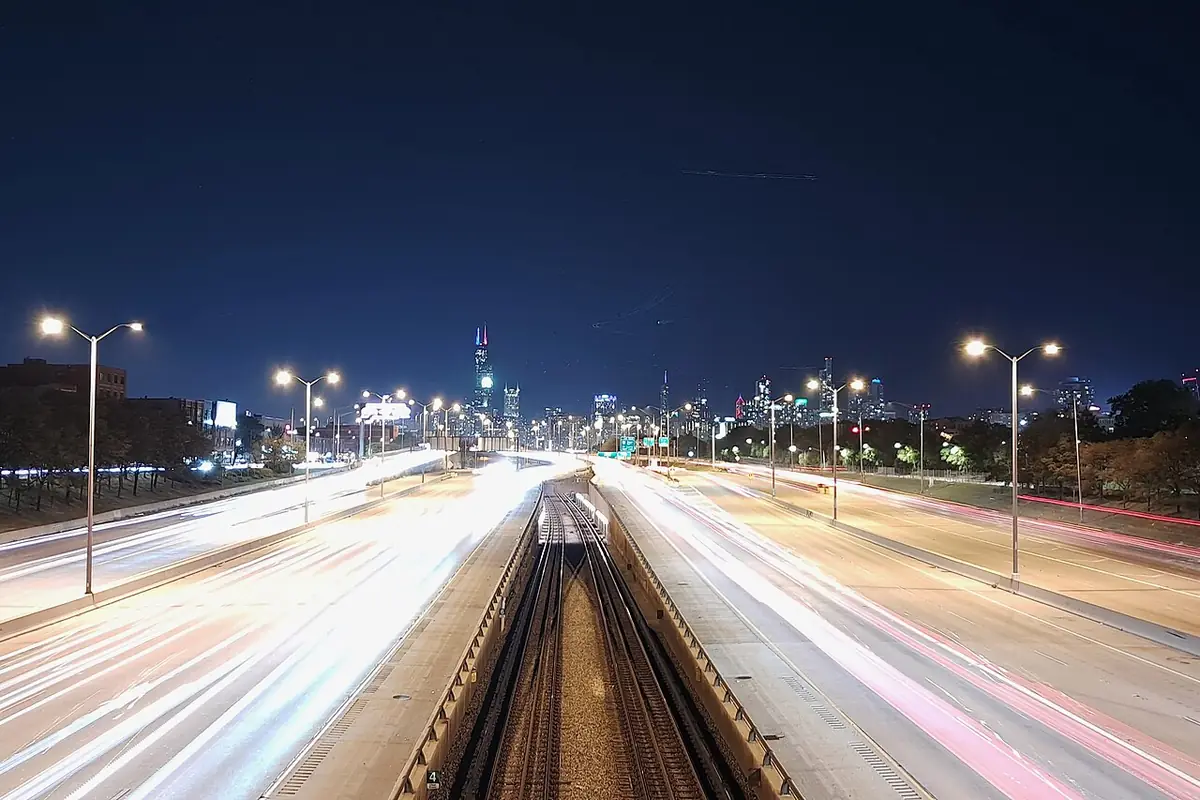
Chicago's expressways stay busy well into the night — Photo: AlphaBeta135 · CC BY 4.0 · Wikimedia Commons
Beyond the money involved, the way property itself is structured locally sets out some specific legal reference points.
Working out the budget you need to rent a house in Chicago cannot stop at the headline monthly rent. Running costs, the insurance you are required to carry and the seasonal swings in energy bills change the financial picture noticeably. The figures below set out the orders of magnitude observed on the market, to guide your budget planning.
chicagoTo rentHouseestimate
Median price / m²US$17Half the apartments sell below this
Median priceUS$2.81kthe average is 14% higher — a few very large properties pull it up
Most common2 bedrooms61 % of listings
Average size156 m²
By number of bedrooms
Bedrooms
Share of market
Avg price
Price / m²
Avg size
2most common
61 %
US$2.84k
US$18
158 m²
3
32 %
US$3.75k
US$17best value / m²
219 m²
4
8 %
US$5.37k
US$18
298 m²
Each row is an average, compared against the area average of US$18 / m². These are indicative estimates of a typical local market, not a measured sample of live listings. Check current listings before relying on them.
What you can actually hold and sign for in a Chicago lease
That contractual rigor applies from the very first step of the financial negotiation and the transfer of funds.
American rental law and the City of Chicago's own ordinances protect the landlord and the tenant alike, but they balance the two in a very particular way. Knowing exactly what your contract says and what you are committing to is what prevents nasty surprises during the tenancy or when you hand the property back. Clear legal responsibilities are the best protection against disputes.
The landlord's strict obligations on habitability
The landlord is legally required to keep the property up to habitability standards, which includes a working heating system, freedom from pests and compliance with the City of Chicago building codes.
What it changesIf something fails in winter, the tenant has specific legal remedies to demand immediate repairs or, under strict conditions, to withhold the sums involved.
Limited freedom to alter the property or sublet it
The tenant may not sublet the property under any circumstances, even partly and even through a platform such as Airbnb, without the landlord's express written consent set out clearly in the terms of the original lease.
What it changesBreaking that rule exposes the signatory to immediate termination of the tenancy and to financial claims for wrongful breach of the agreed terms.
The rule to understand before you pay a deposit on a house in Chicago
A landmark corner in Chicago's Ukrainian Village neighbourhood — Photo: w_lemay · CC BY-SA 2.0 · Wikimedia Commons
Once that critical stage is cleared, the practical side of the transaction unfolds on a precise timetable.
Reserving a rental property in the United States follows a strict sequence in which every payment binds the parties legally. Before you sign a single document or transfer funds to a landlord or an agency, several checks are essential to rule out any risk of fraud or of a hidden defect in the contract. Compressing that sequence exposes a prospective tenant to losing the deposit for good.
A thorough viewing of the property, in person or virtually, and confirmation that you meet the financial criteria.
Verify the exact identity of the landlord or of the property manager licensed by an official body in Illinois.
Insist on receiving a complete copy of the lease including every required disclosure and attachment on known risks.
Submit your financial information and wait for the formal review of your application by the screening services.
Transfer the initial funds (security deposit and first month's rent) only into a dedicated, secure escrow account.
Signing the final contract, electronically or by hand, and the formal handover of the keys at the move in inspection.
How a rental transaction unfolds in Chicago, step by step
Securing a house rental in Chicago means coordinating several people to a schedule that is often tight. Between letting agents, property managers and screening services, each party plays a precise role in confirming that your application is in order. Following this sequence carefully is what makes for a calm move into your new home.
The prospective tenantAssembling the full applicationGather proof of income, references from previous landlords and the identity documents the landlord will want to see.
The letting agentViewings and shortlistingIdentify the available houses across the metropolitan area that match the client's location and budget criteria.
The property managerFinancial screeningReview the credit score, check the financial history and confirm the strength of the application submitted.
Both partiesNegotiating and signing the leaseSet the move in dates, agree any specific clauses and sign the tenancy agreement under local law.
The tenantPaying the initial fundsPay the first month's rent and the security deposit into the designated escrow account.
The landlordMove in inspectionCarry out a careful inventory of the condition of the property and its fittings before the keys are formally handed over.
The tenantTurning on the utilitiesTransfer the electricity, gas and internet accounts into your own name to complete the move.
Renting in Chicago: apartment or house with a yard, how do you decide?
Once that fundamental choice is made, it is worth looking hard at the financial reality of the move.
Choosing to rent a single family house in Chicago rather than an apartment in a shared building shapes your entire daily life and redraws your relationship with the city. Chicago's residential neighborhoods, whether you are looking at the classic bungalows of the Northwest Side or more contemporary construction, offer a privacy and a floor area that the big buildings of the Loop or River North struggle to match. You gain raw space and quiet, but you immediately lose centrality and urban spontaneity.
The question of upkeep and day to day management arrives very quickly in the equation when you rent a house in Chicago. Unlike a managed apartment building, where the building association looks after the roof, the common areas and the snow clearing, renting a single family house often means taking on more responsibility yourself, sometimes written into the lease. Between mowing the lawn in summer and the mandatory clearing of sidewalks during those famous Illinois winters, the physical and logistical effort is far from trivial for a city tenant.
Financially, renting a house in Chicago usually comes with higher running costs than an equivalent apartment. Heating a detached, multi storey structure through January and February is a significant line in the budget, all the more so because insulation in older houses can be uneven. You therefore need to factor in the real cost of energy and of services that are not shared with anyone before you sign the lease, or you risk seeing your monthly budget knocked seriously out of balance.
In the end, choosing a house in Chicago makes sense mainly if you want residential stability, private outdoor space for children or pets, and real immersion in neighborhood life. If your days are spent in the heart of the business district and you value being able to move around freely, the city apartment remains the more rational option. Each formula answers a very specific way of living in this large American city.
What real monthly budget should you plan for to rent a house in Chicago?
With the financial frame in place, it is time to look at how your days actually unfold in the city.
Drawing up a working budget to rent a house in Chicago cannot stop at the rent shown on the listing platforms. You have to include all the unavoidable costs that come with occupying a detached home in this city. Price differences between neighborhoods are considerable, reflecting proximity to transit, the quality of public services and how safe an area feels. Planning these cash flows carefully avoids unpleasant surprises in your first months in Illinois.
Indicative monthly rent ranges for a house in Chicago, by area
Area
Type of house
Estimated monthly rent range
Outer residential neighborhoods (North and Northwest)
Bungalow or small semi detached house
$1,800 to $2,800
Sought after neighborhoods (Lincoln Square, Lake View)
Renovated house or townhome
$3,000 to $4,500
Premium areas (Lincoln Park, Gold Coast)
Spacious town house or larger property
$5,000 and up
These figures exclude running costs and depend heavily on floor area and on the general condition of the property.
Estimated monthly additional costs for a single family house
Cost item
Estimated budget impact
What makes it vary
Electricity and gas (heating and air conditioning)
$150 to $400
Floor area, insulation, how hard the winter is
Water, sewer and waste collection
$60 to $120
Personal consumption and city regulations
Broadband internet and subscriptions
$70 to $130
Provider and speed, fiber or cable
The heaviest air conditioning months (July and August) and the heaviest heating months (January and February) push these items up significantly.
What does an ordinary Tuesday actually look like between work, schools and transit in Chicago?
Navy Pier, a lakefront gathering spot minutes from downtown — Photo: Moses8910 · CC BY-SA 4.0 · Wikimedia Commons
Behind that apparent smoothness lie realities of daily use that promotional photographs carefully leave out.
Living in a house in Chicago means fitting into the rhythm of local infrastructure, whether that is the CTA transit network or the morning traffic. An ordinary Tuesday starts early in residential neighborhoods, where the street wakes to the sound of snowploughs in winter or of gardeners in the warmer months. How smoothly your day runs depends directly on how well you have anticipated the journey to work and coordinated the family schedule.
07:15Kitchen and morning preparationsAn early start in the house means dealing with the heating or the air conditioning depending on the season, before the family gets ready. Generous living space makes the breakfast routine easier before everyone leaves.
08:15The walk to school or to the CTA stationA brisk walk through residential streets to reach the neighborhood school or the train station (Brown Line or Blue Line depending on your area). Chicago's cool air sets the tone for the morning.
09:00Arriving at the office or coworking spaceSettling in at work after a journey of thirty to forty minutes on public transit, time you can use to read or catch up on work messages.
13:00Lunch break in the business districtA quick lunch somewhere in the Loop or the business district, enjoying the city buzz before diving back into the afternoon's work.
17:30The trip home and local shoppingA strategic stop at a neighborhood store (Jewel-Osco or Trader Joe's, say) to restock on fresh food, then back to your residential street.
19:00A quiet evening in the houseRelaxing in the living room or the yard, dealing with the chores that come with a single family house and getting ready for the next day in peace.
What Chicago house rental listings systematically leave out
These frequent omissions sometimes lead to rapid disappointment, which is better identified before you commit.
The Chicago rental market follows well practised marketing conventions in which photographs emphasize light and recent renovations. Yet many practical aspects of daily life in a single family house are never mentioned in the sales copy. Knowing about them in advance lets you approach a viewing with a critical eye and ask the landlord or the agent the right questions.
The real condition of the central heating and air conditioning
Many older houses have ageing furnaces whose energy performance is poor. That translates into eye watering energy bills during Illinois cold snaps and into thermal comfort that is questionable at best.
The strict and complicated rules on street parking
Having a house does not always mean having a private garage. In some dense neighborhoods, finding a space in the evening is a battle, and winter snow clearing restrictions lead to frequent tickets.
Exactly how outdoor maintenance duties are split in the lease
Some leases require the tenant to handle all the landscaping, fence repairs and thorough clearing of the sidewalks, with formal notice if they do not, which represents a real cost in equipment and time.
Sound insulation and shared walls in dense neighborhoods
Town houses and closely spaced construction in some areas carry more noise than you would expect. Traffic on nearby arteries or the activity of immediate neighbors can disturb the quiet you were looking for.
The traps and disappointments you only discover after six months of renting in Chicago
These hard lessons show that this way of living does not suit every working person or every family.
Looked likeA charming older house full of character in a leafy residential neighborhood.
Turned outRecurring damp problems in the basement during heavy spring rain, and insulation that simply does not work.
Would have caught itAsking for two years of energy bills and inspecting the cellar and the foundations closely during the viewing.
Looked likeAn attractive rent for a very generous floor area with a large enclosed yard.
Turned outA daily commute of more than an hour and a half because of awkward transit connections.
Would have caught itRunning the exact journey at rush hour on a weekday before signing the final lease, to measure how far out you really are.
Looked likeA calm, peaceful neighborhood with no excessive activity or noise.
Turned outBeing right under a flight path or beside an elevated train line, producing regular vibration and noise.
Would have caught itVisiting the surrounding streets at different times of the day and night to spot the noise sources that do not show up on a map.
Looked likeA self managed tenancy where the landlord promised to respond quickly to any breakdown.
Turned outA distant or unresponsive landlord when something went wrong, leaving essential repairs to drag on through the winter.
Would have caught itChecking the manager's reputation, favoring a professional agency and writing the maintenance obligations clearly into the contract.
Who should definitely avoid renting a single family house in Chicago?
With those trade offs clear, it is time to take a final view of your plans.
The romantic appeal of a house with a yard in a big American city like Chicago sometimes hides deep incompatibilities with certain ways of living. Settling into a residential home requires logistical availability and a tolerance for geographic constraints that not everyone has. Recognizing these warning signs helps you avoid a heavy lease commitment that becomes a daily source of frustration.
The professional working unusual hours in the heart of the Loop
→A central apartment or an urban loft instead
The distance out to residential neighborhoods and the thinner late evening transit service turn the journey home at night into an exhausting logistical exercise.
The tenant with no appetite for upkeep and odd jobs
→A managed building with services included
Mowing, clearing snow from around the property and handling the small failures that come with a single family house weigh heavily on a busy schedule when you have no taste for maintenance.
The restless city dweller who wants spontaneity and nightlife
→An ultra central neighborhood such as River North or the West Loop
Life in Chicago's outer residential neighborhoods imposes a more homebound rhythm and cuts you off from immediate cultural energy.
So are you really ready to take the plunge and rent a house in Chicago?
A quiet close to the day at the Chicago Harbor Lighthouse — Photo: Dicklyon · CC BY-SA 4.0 · Wikimedia Commons
At the end of this analysis, the decision to rent a house in Chicago is no longer a matter of falling for a pretty facade, but a considered choice about how you want to live. Between the generous space and quiet of residential neighborhoods on one side, and the logistical, budgetary and climatic constraints on the other, the equation demands complete clarity. If you have measured the real impact of hard winters on your energy bills and the personal effort that upkeep requires, you have what you need to make the move work.
Chicago's housing market always rewards people who know what they are looking for and who accept the compromises that come with North American city life. Do not look for the house that is perfect in every respect, look for the one whose flaws match what you can personally tolerate. Whether you favor the greenery of a north side neighborhood or being close to a fast train line, each choice shapes your daily life for years to come.
Take the time to view several properties on weekdays, to test the transit connections at rush hour and to go through every clause of your lease before you sign. Renting a house in Chicago is a rewarding adventure that offers a quality of life hard to match, provided you approach it with method, realism and complete financial clarity.
Related questions
What is the best time of year to find a house to rent in Chicago?
Chicago's rental market peaks sharply between spring and the end of summer, offering the widest choice of homes but also the stiffest competition. The winter months bring a narrower selection because of the climate, but they sometimes let you negotiate better terms with landlords who want to fill a property quickly.
Do you need a local guarantor to rent a house in Chicago?
Most landlords and letting agencies expect a solid US credit history and income equal to roughly three times the monthly rent. If you are arriving from abroad or have no credit history, you will often be asked to pay a larger deposit or to provide a certified guarantor.
Which Chicago neighborhoods are best known for renting a house with children?
Areas such as Lincoln Square, Edison Park and Beverly are especially popular with families for the quality of their public schools and the safe feel of their tree lined residential streets.
How does sidewalk snow clearing work for tenants in Chicago?
The City of Chicago legally requires the occupant of a property to clear snow and ice from the sidewalks next to it within hours of a snowfall. For a single family house, that responsibility almost always falls on the tenant.
Are pets easily accepted in Chicago rental houses?
Having a house with a yard makes life with an animal far easier, but many landlords apply restrictions on size or breed, and they generally require a specific pet deposit.
Should you budget for agency fees when signing a lease in Chicago?
Unlike some other big cities, the Chicago market frequently involves application fees and sometimes broker fees where an intermediary is involved, although some homes are let directly by their owners.
What is the standard length of a residential lease in Illinois?
The standard residential lease in Chicago runs for one calendar year and is renewable. Long term furnished rentals are rare for single family houses, since the great majority of homes are offered unfurnished.
How can you check that an older Chicago house is properly insulated?
It is worth asking the landlord for detailed energy bills covering the last twelve months, inspecting the condition of the windows (double glazing) and checking for recent insulation in the attic and the basement.
What recourse do you have in a dispute with a landlord in Chicago?
Chicago has tenant protection legislation (the RLTO, or Residential Landlord and Tenant Ordinance) that tightly regulates security deposits and the grounds for eviction. If you disagree with your landlord, it is advisable to consult the city's tenant advocacy organizations.
Can you sublet your house in Chicago while you are away?
Unauthorized subletting is expressly forbidden by almost every lease in Chicago. Listing the property on a platform such as Airbnb requires the landlord's explicit written consent, on pain of immediate termination of the contract.
Property review of ting
No ting properties in Chicago yet
Be the first — share it on ting and it shows up right here.