Buying property in Chicago means reading its landmark neighbourhoods correctly and respecting a legal framework that is stricter than it looks from a distance. This guide unpacks how the market actually works so you can carry your purchase through with clear eyes.
Get the app
What nobody tells you.
Real prices, hidden costs and the traps to check before you commit.
What you are actually buying with an apartment in Chicago
Scroll
What you are actually buying with an apartment in Chicago
Buying property in Chicago means reading its landmark neighbourhoods correctly and respecting a legal framework that is stricter than it looks from a distance. This guide unpacks how the market actually works so you can carry your purchase through with clear eyes.
Written by the ting.ad editorial team ·
South State Street, Chicago in Street View: drag to look around.
That tension between urban upside and local constraint shows up the moment you look at your own situation.
Buying property in Chicago is not simply a matter of acquiring square metres in the middle of Illinois. It means choosing a mature market that is sharply segmented between the towers of the Loop and the residential streets of the North Side. The city offers useful liquidity, but it demands a close reading of condo fees, which are often heavy in older buildings. Understanding that paradox is what stops the first year of ownership from disappointing you.
The promise of a large, dynamic metropolisvsThe reality of a market with a heavy tax load
Property taxes in Chicago are among the highest of any major American city. That recurring cost weighs on net returns and forces you to price the tax burden precisely before you sign anything.
The appeal of period buildings with real charactervsThe need to budget seriously for building work
Those handsome grey brick buildings need frequent facade repairs and energy upgrades that owners sometimes vote through at a special meeting. Repair costs are carried collectively, but they land on you immediately through special assessments.
A recognised way to diversify your assetsvsDirect exposure to the local economic cycle
The Chicago property market reacts strongly to regional employment and to city policy on transport. Contrary to the received wisdom, values do not climb in a straight line from one year to the next.
Does this city fit your life and your buying plans?
Those trade-offs take on a different shape again when you arrive from another property system entirely.
Buying in Chicago answers to very different priorities depending on whether you want an urban base, a long term rental investment or a permanent family home. Each buyer profile has to weigh immediate access to transport against residential calm. The decisive criteria shift radically from one neighbourhood to the next, which makes an honest audit of your daily priorities essential before you start viewing.
The active city buyer
You are looking at areas such as River North or Streeterville, where the towers come with built-in services and fast connections into the Loop. Your days will be paced by the elevated train and by short professional journeys. In exchange, you give up private outdoor space and accept a very high population density. Street noise and traffic are part of what you are buying, not an afterthought.
The family buyer or long-horizon investor
You will gravitate naturally towards the quieter North Side neighbourhoods such as Lincoln Park or Lakeview. The rhythm changes here: tree-lined streets, parks within walking distance, and a local life built around neighbourhood shops. Your purchase is aimed at long term appreciation and reliable rental demand. Living space is more generous, but the entry ticket is distinctly higher.
The considered investor
You are targeting areas in transition or close to the big university campuses and hospital clusters. Your strategy rests on steady rental demand from students and young professionals. You have to accept more hands-on management and faster tenant turnover. The headline yield still has to be set against vacancy risk and the maintenance demands of older condo buildings.
Buying here when you come from abroad: what changes completely
The Chicago skyline rising beyond the lakefront Adler Planetarium — Photo: Sea Cow · CC BY-SA 4.0 · Wikimedia Commons
Once those rules are clear, the choice of neighbourhood becomes the most structural decision of your whole purchase.
Buying property in Chicago from abroad holds several legal and cultural surprises. The American system rests on contractual and tax mechanics that sit a long way from the single-official, state-supervised conveyancing most overseas buyers grew up with. Understanding the divergences keeps you from making fundamental misjudgements about ownership, running costs and buyer protection.
From abroad
A single public official who secures the whole transaction
Chicago
Real estate agents working alongside specialist lawyers (Real Estate Attorney)
In the United States, the attorney appointed by the buyer checks title and negotiates the clauses of the contract. There is no equivalent of a state conveyancing official, which makes your own legal adviser essential if you are not to sign one-sided terms.
From abroad
A moderate property tax folded into general local taxation
Chicago
A high Property Tax calculated on the assessed value of the home
The local property tax can amount to a substantial annual budget on top of your mortgage payments and condo fees. It varies sharply between municipalities and counties, permanently changing the real cost of owning the property.
From abroad
Strict statutory tenant protection and rigid planning rules
Chicago
Contractual freedom framed by condo rules (HOA / Condo Association)
Owners' associations hold enormous power to set rental rules, ban pets or mandate works. The building's own rulebook sometimes weighs more heavily on your day to day use of the property than city law does.
From abroad
Standardised technical surveys mandated by the state
Chicago
An independent physical inspection paid for by the buyer (Home Inspection)
It is on you to hire an inspector to go through the plumbing, the electrics, the roof and the structure. That inspection report is your main tool for negotiating the price down or demanding repairs before the contingencies are released.
Which Chicago neighbourhood should you buy in?
Those geographic contrasts translate directly into the price bands you need to plan for.
Chicago is made up of dozens of neighbourhoods with very distinct identities, forming a cultural and architectural mosaic you will not find elsewhere. From the residential calm near Lake Michigan to the ultra-modern towers of the business district, each area offers a different compromise between price per square metre, accessibility and quality of life. Assessing them properly means looking past the postcard views to the daily reality of each micro-market.
The Loop & Near North Side
An intense urban tempo, set by the elevated trains passing overhead and the traffic of the office towers.
Suits
People working downtown, anyone who wants culture on the doorstep, and buyers who intend to walk everywhere.
Trade-off
High prices per square metre, a shortage of intimate green space, and an atmosphere that thins out noticeably at weekends.
Lincoln Park & Lakeview
An elegant residential atmosphere of leafy parks, handsome brick homes and busy cafes.
Suits
Families looking for good schools, proximity to the lake and a secure setting.
Trade-off
A fiercely competitive market where good stock sells fast and at full price.
Wicker Park & Bucktown
A creative, fashionable mood mixing independent shops, art galleries and a lively night scene.
Suits
Young professionals, creative workers and investors betting on rapidly gentrifying areas.
Trade-off
Prices climbing fast enough to squeeze out first-time buyers, and neighbours who can be noisy at night.
South Loop & West Loop
Former industrial sites converted into modern lofts, alongside new and stylish residential complexes.
Suits
Buyers who want unusual volumes, generous interior space and a celebrated food scene.
Trade-off
Plenty of construction still under way nearby, and condo fees that can be heavy in the larger complexes.
What does a property in Chicago really cost?
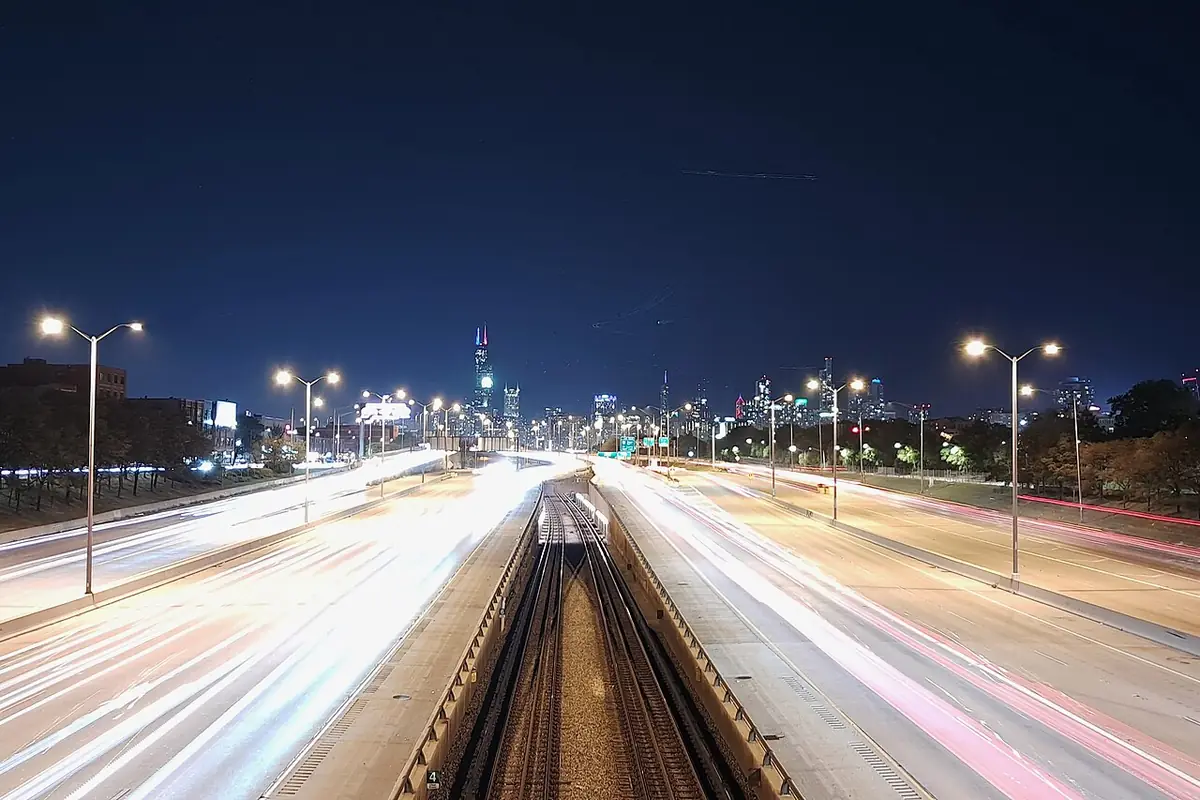
Chicago's expressways stay busy well into the night — Photo: AlphaBeta135 · CC BY 4.0 · Wikimedia Commons
Beyond the money, the legal nature of what you are buying deserves your full attention.
The Chicago property market shows wide price variation depending on location, the age of the building and the amenities the condo association provides. Building a realistic budget means allowing not only for the asking price but for the full set of unavoidable extra costs specific to Illinois. The tables below set out the orders of magnitude observed in the market to guide your own financial modelling.
chicagoFor saleApartmentestimate
Median price / m²US$3,420Half the apartments sell below this
Median priceUS$320kthe average is 14% higher — a few very large properties pull it up
Most common2 bedrooms40 % of listings
Average size89 m²
By number of bedrooms
Bedrooms
Share of market
Avg price
Price / m²
Avg size
1
34 %
US$242k
US$4,032 +12 %
60 m²
2most common
40 %
US$324k
US$3,600
90 m²
3
21 %
US$428k
US$3,420best value / m²
125 m²
4
5 %
US$612k
US$3,600
170 m²
Each row is an average, compared against the area average of US$3,600 / m². These are indicative estimates of a typical local market, not a measured sample of live listings. Check current listings before relying on them.
What you can actually own: condominium or independent title
That legal caution earns its keep the moment you enter the buying process itself.
In Chicago the most common ownership form for an apartment is the condominium, which brings strict rules of collective governance with it. It is vital to grasp the distinction between owning your own walls and sharing the management of common areas. That legal structure directly shapes how freely you can alter the home and what you pay every month.
The condominium model (standard co-ownership)
You own your apartment outright plus an undivided share of the common areas. An owners' association (HOA) runs the building, votes the maintenance budgets and enforces the house rules. That arrangement keeps shared infrastructure properly maintained, but it limits what you can change on the outside of the building.
What it changesYou should go through the association's accounts and the minutes of recent owners' meetings line by line to spot any major works that have not yet been funded.
The townhouse or small independent building model
Some properties are closer to stacked townhouses or to buildings with only a handful of owners. Governance there is often more flexible, which reduces the weight of collective bureaucracy. On the other hand, responsibility for the roof and the structure is sometimes shared on an informal basis.
What it changesYou gain autonomy over decisions but lose the benefit of a large pooled reserve fund if something serious goes wrong.
The rule to understand before you pay a deposit in Chicago
A landmark corner in Chicago's Ukrainian Village neighbourhood — Photo: w_lemay · CC BY-SA 2.0 · Wikimedia Commons
To run that sequence smoothly, it helps to see exactly what each party does and when.
Buying property in Chicago follows a strict contractual timeline in which every commitment carries weight. Paying a deposit before the essential contingencies are in place exposes the buyer to straight financial loss. Knowing the chain of responsibilities protects your purchase from the first days of negotiation.
Your agent drafts the formal offer to purchase (Purchase Agreement).
Negotiating the financial terms and setting the initial deposit (Earnest Money)
Signing the preliminary contract and sending the file to each side's attorney
Carrying out the full technical inspection (Home Inspection) within the contractual window
Releasing the financing contingency once the mortgage is definitively approved
Signing the final documents (Closing) and the official transfer of title.
How a property purchase unfolds, step by step
A successful purchase in Chicago rests on tight coordination between several professionals with clearly defined roles. Unlike systems where a single public official handles everything, here the attorney and the title company are central to securing both the funds and the deeds. Here is the chronological order of who steps in, right through to the handover of the keys.
The buyer and their agentSearching for and selecting the propertyTargeted viewings, a comparative analysis of the local market, and drafting the opening offer to suit current conditions.
The specialist attorneyContract review (Attorney Review)A critical window of five to ten business days in which the standard contract clauses can be amended and the contingencies adjusted.
The home inspectorFull technical audit of the propertyA careful check of the structure, the electrical installation and the plumbing to bring hidden defects to light.
The lender or mortgage brokerProcessing and approving the mortgageAssembling the financing file, the independent appraisal the lender requires, and issuing the final loan commitment.
The title companyTitle search and preparation for ClosingA search back through the record to confirm there are no hidden liens or mortgages on the property before the final signature.
Apartment or house in Chicago: which should you buy?
Now that you have a sense of which type of property fits your life, it is worth looking hard at the financial reality of the purchase.
Choosing between an apartment in a condo building and a single-family house in Chicago is not simply a question of floor area or architectural taste. Condominiums, often in residential towers along Lake Michigan or in dense neighbourhoods such as the Loop and River North, come with impressive built-in amenities: concierge services, gyms, roof terraces and exterior maintenance handled entirely by the owners' association. Those advantages arrive with substantial monthly charges, known as HOA fees, which can rise unpredictably over the years and weigh heavily on your long term budget, quite apart from the strict rules the board sets on renting out or on keeping pets.
Buying a single-family house or a classic bungalow in residential neighbourhoods such as Lincoln Square, Beverly or Portage Park gives you total freedom over landscaping, renovation and the way you run your own space, with no board and no shared walls to answer to. That independence carries a direct and immediate cost: the roof, the central heating through hard Illinois winters and the snow clearing around the property fall entirely to you, which demands real money and real time if the asset is to hold its value over the decades.
Chicago's tax structure also plays a decisive part in the choice between vertical and horizontal ownership. Property taxes in Cook County are among the highest in the United States and can vary considerably from one neighbourhood to another, depending on municipal assessments and the funding needs of local public schools. House owners carry that burden directly and it can be crushing, while apartment owners share it across the building, even though tax increases feed inevitably into the monthly condo charges the association votes through.
Your professional and personal mobility over the next few years should ultimately settle the question between these two very different kinds of purchase. If you expect to travel often, to move city for your career, or simply to prefer a lean urban life with no weekend maintenance, a secure condo apartment is a far more fluid option and much easier to resell or let while you are away. If instead you want to anchor a household in a stable community with private outdoor space for a family, the Chicago house remains the classic store of value despite the logistical weight of keeping it up.
What is the full budget for buying and living in a Chicago apartment?
Once the budget is under control, it is worth understanding what an ordinary week actually looks like in the area you are buying into.
Buying an apartment in Chicago means looking well beyond the asking price shown on the listing portals. The total cost of ownership takes in the mortgage repayment, local property taxes, the compulsory monthly condo fees and a full home insurance policy. Planning those lines realistically is what keeps you from being trapped by an over-tight budget in your very first year in the Windy City.
Estimated monthly costs for a standard Chicago apartment
Cost line
Low end
High end
Notes
Mortgage repayment
$1,800
$3,200
Based on a 20 percent down payment and a 30 year fixed rate.
Condo fees (HOA)
$350
$950
Varies with the services included, such as a doorman, a pool or a gym.
Monthly property taxes
$300
$800
A direct function of the Cook County assessment and of the neighbourhood.
Home insurance
$60
$150
Covers the interior and liability, and is essential in a dense urban setting.
These figures are indicative estimates based on Chicago market averages for a two bedroom apartment.
Upfront costs to plan for at purchase
Type of cost
Estimated percentage
Indicative amount
Practical detail
Down payment
10% to 20%
$40,000 to $100,000
Needed to secure competitive loan terms from a lender.
Closing costs
2% to 4%
$8,000 to $16,000
Cover transfer taxes, attorney fees and lender processing charges.
Condo reserve contribution
1 to 3 months of HOA
$500 to $2,500
Requested by some associations when new owners move in.
Always keep an additional cash reserve outside the purchase budget to absorb the unexpected.
Health, schools and transport: what an ordinary Tuesday tells a buyer in Chicago
Navy Pier, a lakefront gathering spot minutes from downtown — Photo: Moses8910 · CC BY-SA 4.0 · Wikimedia Commons
Behind the postcard of transport links and parks sit realities that estate agents often forget to mention.
Living in Chicago means living to the rhythm set by the CTA transport network and by the changeable weather off Lake Michigan. Walking through an ordinary Tuesday is the fastest way to test a shortlist of addresses: it shows you what each location will really cost you in time, in fatigue and in daily convenience once you own there. Run this timeline in every neighbourhood you are considering before you make an offer.
07:30CTA station (Brown Line or Red Line)The day starts with a timetabled run into downtown, an efficient alternative to the car and to the monumental jams on the Kennedy Expressway. Check the real walk from any building you are considering to the nearest station.
08:30Office or coworking space in the LoopArrival in the historic business district, surrounded by the landmark skyline and the commercial energy of the metropolis. Door to desk time is one of the clearest tests of whether an address is worth its price.
12:30Neighbourhood lunch and a quick shopA break in a local cafe or one of the food halls nearby, which is where the city's cultural and culinary range shows itself. Everyday amenities within walking distance support resale value as much as they support daily life.
16:00Local school or nurseryPicking up children from a neighbourhood public school or a local private one, a moment that depends entirely on the reputation of the catchment you buy into.
18:00A walk along the Chicago Riverwalk or in the parkWinding down at the end of the day along the water or in a neighbourhood green space before heading home. Proximity to these is one of the features buyers consistently pay for.
20:00Dinner and local life in your own neighbourhoodA quiet end to the day in a local restaurant or at home, away from the churn of the tourist districts downtown. Visiting at this hour tells you far more about a building than a midday viewing does.
What the listing will never tell you about your future Chicago apartment
Those unspoken details lead straight to the regrets buyers voice once the excitement of the purchase has worn off.
Property listings are skilful at showcasing the light through the apartment, the polished floors and the freshly fitted kitchen. What they deliberately leave out are the structural and contextual facts that will define your life as an owner. Knowing what goes undisclosed will spare you both financial and neighbourly grief after the deal has closed.
The real financial health of the condo association
A building with unusually low fees is often a building with badly depleted reserves for the major works still to come. You risk a special assessment running to several thousand dollars in your first year to replace the boiler or repair the facade.
The noise and vibration from the elevated train lines
The picturesque charm of the elevated train, the famous L, comes with a serious level of noise and with vibration you can feel in apartments right beside the tracks. Viewing on a quiet Sunday gives you no idea of the racket on a weekday at rush hour.
Severe restrictions on short-term letting and subletting
Many Chicago condo associations ban Airbnb-style letting outright or impose strict quotas on annual leases. If you were counting on offsetting the cost while you travel, the association rules may leave you with no option at all.
How hard street parking becomes in winter
Buying an apartment with no deeded parking space condemns you to circling for a place all winter. The local custom of dibs, where residents mark a cleared space with lawn chairs, is a permanent source of friction between neighbours.
The buying mistakes you only discover six months in
Knowing those mistakes leads to the final question: is this purchase really right for you?
Looked likeA charming period apartment with high ceilings in a fashionable neighbourhood
Turned outA poorly insulated place with punishing heating bills through January and February
Would have caught itAlways asking for the last three years of energy bills and having the windows and insulation checked by an independent inspector.
Looked likeAn excellent financial deal, well below the market price per square metre
Turned outA badly run building facing live legal proceedings and large unpaid condo fees from other residents
Would have caught itReading the minutes of the last three owners' meetings closely before you release your contingencies.
Looked likeA supposedly convenient location right beside the main road arteries
Turned outA daily ordeal of constant fumes and non-stop traffic that blocks any exit from the neighbourhood in the morning
Would have caught itVisiting the area at different times of day and days of the week, especially at the morning and evening peaks.
Looked likeA heart-over-head purchase with no private parking, because the street looked easy
Turned outNo chance of parking within ten minutes' walk when you come home late, particularly during city snow clearing
Would have caught itMaking your offer strictly conditional on buying or renting a secure parking space at the same time.
Who should definitely not buy an apartment in Chicago right now?
It is time to pull all of this together so you can make your final decision clearly.
Buying is often presented as the natural endpoint of financial maturity, but in some personal and professional situations it is a serious trap. Taking on long term debt without the stability to carry it can wipe out your savings and drastically limit your freedom to move. Here are the buyer profiles who would do better to hold off and rent for now.
The professional on an international posting or between careers
→Putting any Chicago purchase on hold and staying a tenant
Reselling an apartment inside five to seven years almost always ends in a net loss once transfer taxes, agent commissions and unavoidable closing costs are counted.
The household with too thin a cash reserve
→Continuing to rent while building a solid financial cushion
Chicago's high property taxes and the brutality of winters on buildings demand cash you can reach immediately for unplanned emergency repairs.
The first-time investor looking for immediate, effortless rental yield
→Investing in other American markets with a lighter tax load
High property taxes in Cook County and the regulatory weight of condo rules eat sharply into the net margins of landlords who have not done their homework.
So are you really ready to buy in Chicago?
A quiet close to the day at the Chicago Harbor Lighthouse — Photo: Dicklyon · CC BY-SA 4.0 · Wikimedia Commons
Deciding to buy an apartment in Chicago calls for unflinching honesty about your long term plans and your tolerance for financial risk. If you have worked through the real level of condo fees, absorbed the weight of Cook County property taxes and accepted the logistical constraints of an Illinois winter, then you have the maturity the purchase demands in this fascinating city.
Never let your timetable be dictated by manufactured urgency from an agency, or by the fear of missing a supposed bargain. The Chicago market has enough depth and variety for any methodical buyer to find the property that matches their life, provided you put the quality of the location and the financial health of the building ahead of passing aesthetic fashions.
Your investment in this Midwest metropolis should be treated as a durable place to live rather than a short term speculative product. Approaching every viewing with a sharp critical eye, and reading every line of the condo documents, is what turns a complex purchase into one of the firmest foundations of your personal and financial life.
Related questions
Which neighbourhoods are most sought after for buying an apartment in Chicago?
The most in demand areas for apartment purchases include Lincoln Park, Lakeview, River North and the Loop, which offer excellent access to public transport and sit within easy reach of the Lake Michigan shoreline, although prices per square metre there run well above the metropolitan average.
How do property taxes work for owners in Chicago?
Property taxes depend on the assessment carried out by Cook County and are notably high compared with other American metros, often making up a significant annual budget line that you need to plan for with real care.
Do you have to buy a parking space along with your apartment in Chicago?
It is not a legal requirement, but buying or renting a secure parking space is strongly recommended in Chicago because street parking becomes extremely difficult through the winter months and city snow clearing rules add another layer of constraint.
What additional costs should you budget for when buying property in Illinois?
Closing costs generally represent between 2 percent and 4 percent of the total purchase price and cover property transfer taxes, the fees of a specialist attorney and the lender's loan processing charges.
Can condo association fees rise unpredictably?
Yes. Condo association fees, known as HOA fees, can be raised each year by the board to absorb rising maintenance costs or to rebuild the reserve fund ahead of major structural work on the building.
What is the typical term of a mortgage in the United States?
The standard and most common option for a primary residence is the thirty year fixed rate mortgage, although fifteen year options exist for buyers who can carry a higher monthly repayment.
Do you really need a lawyer for a property transaction in Chicago?
In Illinois, having a specialist real estate attorney on both the buyer's side and the seller's side is standard practice and strongly advised, because it is the attorney who secures the drafting of the contract and the verification of title.
How do you assess the financial health of a condo building before buying?
You need to go through the reserve study in detail, read the minutes of the last few owners' meetings, and confirm that there are no large arrears or ongoing legal proceedings against the association.
What kinds of loans are available to foreign buyers in Chicago?
Non resident and foreign buyers can access American mortgage finance, but they are generally asked for a larger down payment, often between 30 percent and 40 percent of the property's value, along with a certified international credit file.
How does the Chicago climate affect the upkeep of an apartment?
Illinois winters are hard on facades, roofs and building heating systems, which means condo associations need regular inspections and substantial preventive maintenance budgets.
Property review of ting
No ting properties in Chicago yet
Be the first — share it on ting and it shows up right here.