Finding an apartment to rent in Chicago means understanding how the neighbourhoods are built, what the costs really come to, and how American rental law works. This practical guide walks you through the decision step by step so that your move to Illinois's largest city rests on facts rather than on received ideas or comfortable promises.
Get the app
What nobody tells you.
Real prices, hidden costs and the traps to check before you commit.
What renting an apartment in Chicago actually gets you
Scroll
What renting an apartment in Chicago actually gets you
Finding an apartment to rent in Chicago means understanding how the neighbourhoods are built, what the costs really come to, and how American rental law works. This practical guide walks you through the decision step by step so that your move to Illinois's largest city rests on facts rather than on received ideas or comfortable promises.
Written by the ting.ad editorial team ·
South State Street, Chicago in Street View: drag to look around.
Beyond the physical features of the home, it is your daily routine that will decide whether the move works.
Renting an apartment in Chicago means looking carefully at what the American market puts behind facades that can be misleading. Between nineteenth-century brick and very contemporary glass towers, the reality of floor space and running costs varies a great deal from one neighbourhood to the next. The figure written on the lease almost always hides substantial extra costs, from shared heating to automated concierge services. Understanding how that works keeps the budget from unravelling in your first months in Illinois.
The charm of the historic red brick buildingsvsWeak insulation and ageing building services
The older buildings around Lincoln Park and Lakeview have undeniable architectural character, with bay windows and period floorboards. In exchange, their gas or steam radiator heating makes its own distinctive noises and the thermal insulation often falls short against a hard Chicago winter.
The convenience of modern residential towers with built-in amenitiesvsHigh running costs and interchangeable layouts
The large residential developments in the Loop and River North offer a very high standard of amenity, including a gym, a roof terrace and a front desk staffed twenty-four hours a day. Those comforts, however, show up as building charges folded into the rent, and the apartments themselves are often smaller and more standardised.
The generous space of homes further out in the residential neighbourhoodsvsDistance from the main transit routes and the job centres
Moving away from the centre of Chicago towards quieter areas lets you rent apartments of remarkable size for a much lower rent per square metre. The trade-off is the daily commute and the near necessity of owning a vehicle for ordinary errands.
The apparent flexibility of short residential leasesvsBreak fees and strict affordability requirements
The American rental market is built around renewable annual leases that are notably complicated and expensive to break early. Landlords also demand rigorous financial guarantees, including a local credit history that new arrivals generally do not have.
Does this place actually match the way you live?
Settling in also means measuring the practical and cultural gap between where you are coming from and how renting works in America.
Choosing to settle in Chicago means testing your daily habits against the way the third largest city in the United States is organised. The city runs at contrasting speeds, swinging between the professional intensity of the financial district and the residential calm of the streets near Lake Michigan. Your working life and your personal priorities point directly to the part of the map where your rental search should start.
The busy urban profile
Your days will run mostly through the business district, where office towers stand alongside residential high-rises. You will lean towards a compact apartment a few minutes on foot or by train from work, making full use of the cultural and dining options on your doorstep. That choice means accepting constant city noise and less living space than you would find further out. In exchange you cut the commute to nothing and sit on top of the CTA network reaching the whole metropolitan area.
The family residential profile
Your attention will turn naturally to the North Side neighbourhoods, known for their tree-lined parks, well-regarded schools and village feel. You will find spacious apartments in small buildings there, along with terraced houses with several bedrooms. That setting does require planning your daily journeys around road routes that are often saturated at peak times. Daily life revolves around the neighbourhood, the local markets and the vast green spaces along the lake, which is a fair balance between city living and quiet.
The mobile and creative profile
The changing neighbourhoods west of the centre, such as West Loop and Wicker Park, fit you well if you enjoy artistic energy and open loft spaces. You will find a remarkable concentration of independent cafes, shared workspaces and galleries in former industrial warehouses. Working from home in those areas does mean paying close attention to how well the apartments are sound insulated and to the real speed of the internet connections on offer. The cultural energy more than makes up for the swings in rents seen in areas this popular with young professionals.
Renting here when you are arriving from abroad: what changes
The Chicago skyline rising beyond the lakefront Adler Planetarium — Photo: Sea Cow · CC BY-SA 4.0 · Wikimedia Commons
Once you know how the system works, the choice of neighbourhood is what will shape your daily life and your journeys.
Moving to Chicago from another country produces a sharper practical shock than the surface similarity of Western city life would suggest. The American administrative system, the unwritten rules of a managed building and the day-to-day running of a rented home rest on legal and social logic that works differently. Anticipating those structural differences saves a great deal of confusion when you sign the lease and for the whole length of your tenancy.
From abroad
Rental markets where national law caps rent increases and gives tenants strong standing by default
Chicago
Illinois tenancy law built on freedom of contract, with the specific rules of the City of Chicago layered on top
Landlords have wider latitude to set lease conditions, to ask for varying security deposits and to apply rent increases, subject to precise local rules that are protective but less far-reaching than many European regimes.
From abroad
Applying with a conventional paper file of payslips and a named personal guarantor
Chicago
The near absolute requirement of a US credit history and a FICO score the agencies can verify
New arrivals from abroad run into this administrative barrier almost every time and usually have to offer substantial alternatives, such as an increased security deposit or several months of rent paid in advance.
From abroad
Homes that routinely come with a fitted and basically equipped kitchen
Chicago
Apartments let with standard appliances that are sometimes old, with day-to-day upkeep falling on the tenant
Check carefully at the viewing that the refrigerator, oven and dishwasher are there and in working order, because some homes are let without a complete kitchen and you would have to buy the equipment yourself.
From abroad
Using traditional letting agencies paid on a regulated scale of fees
Chicago
Brokers who appear frequently and are paid through complex commissions split between landlord and tenant
Using an agent to find an apartment in Chicago is common practice, but you must establish from the outset who pays the brokerage fee so that it does not surface as a surprise at signing.
From abroad
Building service charges broadly included in, or fixed within, the gross rent
Chicago
Separate billing for the essentials: electricity, gas, internet and sometimes water
Your monthly budget has to include those fluctuating energy costs, which run particularly high in winter because of the heating demand created by Chicago's continental climate.
Which Chicago neighbourhood suits your priorities?
Once the neighbourhood is settled, the decisive question of budget and the real cost of renting deserves close attention.
Chicago is built out of a great many neighbourhoods with strong individual identities, each answering a different set of expectations about daily life. From the cultural buzz of the lakefront areas to the quieter residential streets to the west, the range of atmospheres means most people can find a balance that works. Weighing the advantages and the compromises of each area is the quickest route to your future address.
The Loop and River North
Constant activity, set to the rhythm of the elevated trains and the intense working life of the towers.
Suits
Professionals who want to cut the commute entirely and live inside the economic and cultural centre.
Trade-off
Smaller living space, a high noise level and an atmosphere that quietens down considerably at the weekend.
Lincoln Park and Lakeview
A green and peaceful setting alongside the vast beaches and parks that run along Lake Michigan.
Suits
Families and working people looking for a workable balance between city energy and residential quiet.
Trade-off
Rents among the highest in the city and strong competition for the better apartments when they come up.
West Loop and Fulton Market
A creative, current mood inside former industrial warehouses turned into lofts and sought-after restaurants.
Suits
Food lovers, creative workers and the self-employed looking for surroundings that keep them going.
Trade-off
Very strong pressure on the market that pushes prices up, and redevelopment that can get noisy.
Hyde Park
A distinctly intellectual and academic atmosphere, shaped by the presence of the University of Chicago.
Suits
Researchers, academics and anyone who values generous architecture and being close to the campus.
Trade-off
Relative isolation from the busy city centre and neighbourhood dynamics that are very specific and worth understanding first.
What does an apartment in Chicago really cost to rent?
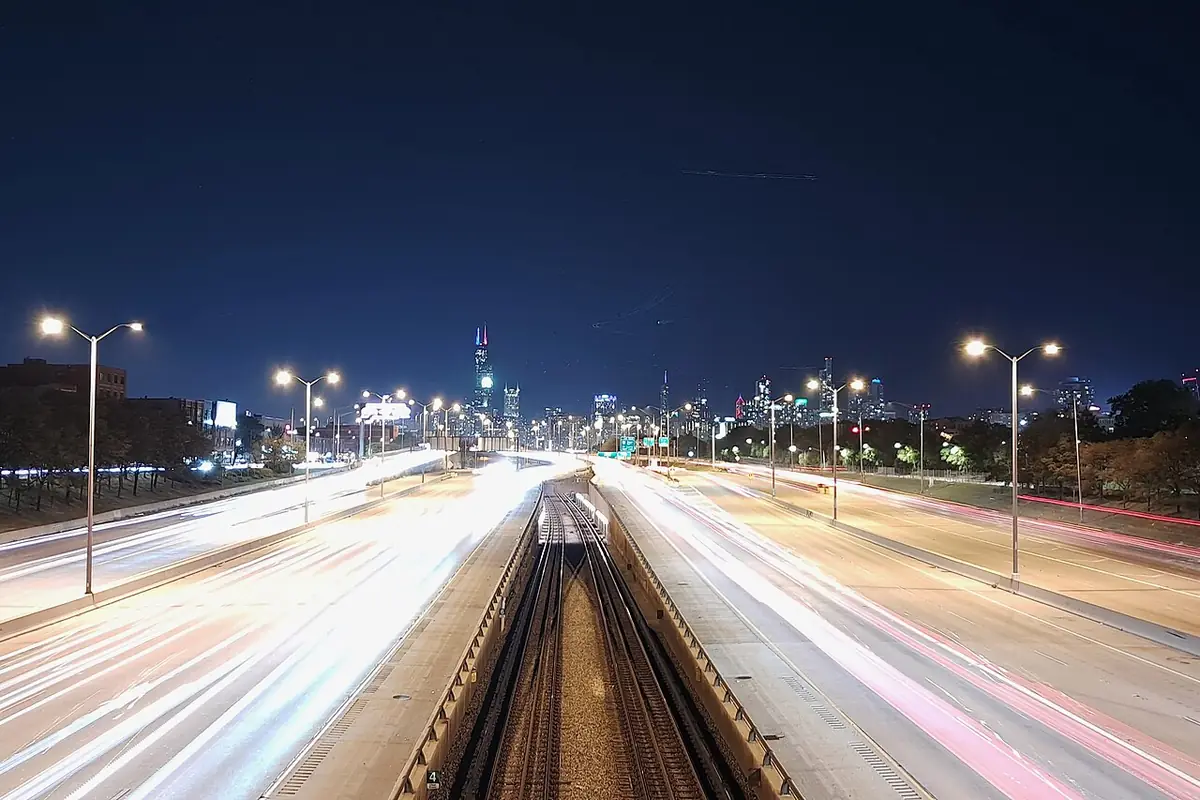
Chicago's expressways stay busy well into the night — Photo: AlphaBeta135 · CC BY 4.0 · Wikimedia Commons
Beyond the money, the legal nature of what you are renting deserves the closest possible reading.
Working out the cost of renting in Chicago goes well past the base monthly rent. The local market follows strict pricing conventions in which utilities, taxes and application fees weigh heavily on the overall budget. Having a clear view of the price ranges by property type and by area lets you size your plans without any risk of falling behind.
chicagoTo rentApartmentestimate
Median price / m²US$21Half the apartments sell below this
Median priceUS$1.95kthe average is 14% higher — a few very large properties pull it up
Most common2 bedrooms40 % of listings
Average size89 m²
By number of bedrooms
Bedrooms
Share of market
Avg price
Price / m²
Avg size
1
34 %
US$1.48k
US$25 +14 %
60 m²
2most common
40 %
US$1.98k
US$22
90 m²
3
21 %
US$2.61k
US$21best value / m²
125 m²
4
5 %
US$3.74k
US$22
170 m²
Each row is an average, compared against the area average of US$22 / m². These are indicative estimates of a typical local market, not a measured sample of live listings. Check current listings before relying on them.
What you really hold as a tenant in Chicago
Getting to the keys depends on following an exacting administrative procedure to the letter.
Being a tenant in the United States confers precise rights but also imposes firm contractual responsibilities you need to master. Between the standard clauses the City of Chicago requires and the particular conditions landlords set, the room for negotiation is often narrow. Knowing the exact extent of your legal position protects you against abuse and keeps the relationship with your landlord calm for the whole term of the lease.
Tenant protections and the municipal rulebook
Chicago applies a strongly protective ordinance covering rental conditions, with tight rules on returning security deposits, on notice for rent increases and on the landlord's duty to keep the home habitable. Any deduction from your deposit has to be justified with itemised invoices within a set legal window, and a landlord who misses it faces financial penalties.
What it changesYou have a protective local legal framework behind you, provided you put every exchange in writing and record the exact condition of the property the day you move in.
Restrictions on use and the building rules that apply to you
The house rules of Chicago residential buildings, often run by very exacting owners' associations, impose strict constraints on noise, on the use of shared spaces, on parking and even on keeping pets. Breaking those rules can produce fines that the management company charges straight to your tenant account.
What it changesYou must read and sign the building rules before you commit, because they bind you with the same force as the main clauses of the lease itself.
The rule to understand before you pay any money in Chicago
A landmark corner in Chicago's Ukrainian Village neighbourhood — Photo: w_lemay · CC BY-SA 2.0 · Wikimedia Commons
To get moved in on the best possible terms, it helps to follow the sequence of a tenancy step by step.
Signing a lease in Chicago and handing over the first funds leaves no room for approximation, because the money can be impossible to recover. The market occasionally attracts unscrupulous operators who target new arrivals unfamiliar with local practice. Learning the safe order in which a rental transaction happens is your best protection against fake lease scams.
Spotting an attractive rental listing on a specialist online platform.
Confirm the property genuinely exists by carrying out a thorough physical viewing, guided either by a licensed professional or by yourself.
Insist on seeing the official documents proving that the person or agency showing you round has legal title to the property.
Refuse, every time, to hand over money in cash, by money order or by unsecured transfer before the lease has been formally signed.
Make sure the security deposit will be held in a separate, interest-bearing escrow account as the City of Chicago rules require.
The final signature on the lease and the formal handover of the keys to your apartment.
How a rental goes through, step by step
Getting into a rented home in Chicago follows a structured process with several successive phases, from the first search to the housewarming. Each party, from the landlord to the building manager by way of the broker, plays a defined role that has to be coordinated methodically. Following that sequence carefully gives you a smooth move that meets what the American market expects.
The prospective tenantAssembling and preparing the affordability fileGather every piece of income evidence and your reference letters from previous landlords, and prepare the documents that show your financial standing so as to reassure the landlord.
The broker or agentShortlisting properties and arranging targeted viewingsSelect the apartments that strictly match your location and budget criteria, then go to the viewings paying particular attention to the general condition of the fittings.
The applicantSubmitting the application and the background checkSend in your complete file together with the credit check fee that American agencies charge, which starts the standard affordability and background enquiry.
The landlord or managerReviewing the file and drafting the leaseThe landlord examines your credit score and your financial guarantees before drawing up the standard lease containing all the clauses Illinois requires.
Both partiesSigning the lease and paying the initial fundsSign the lease and pay the first month's rent along with the security deposit into the secure account the agency designates.
The tenantThe move-in inspection and the move itselfCarry out a meticulous move-in inspection, photographing every existing defect, then put the utility accounts into your own name before you move in.
Renting an apartment or renting a house in Chicago: which suits your life?
With the type of home settled, it is worth working through every monthly cost you should expect.
Renting in Chicago forces a structural choice between the large high-rise buildings of the Loop and River North and the houses, detached or terraced, found in residential neighbourhoods such as Lincoln Square or Beverly. The decision is not simply about taste: it is about a practical and thermal reality particular to this Midwestern city. Hard winters and humid summers change your daily comfort and the running costs your lease will leave on your shoulders.
Renting inside a professionally managed building gives you better security, built-in services such as a gym or a door attendant, and snow clearance handled for you as a matter of course. It also means strict communal rules, restrictions on pets, and in some buildings high management charges that the landlord passes on inside the monthly rent. Sound insulation between floors varies considerably with the year of construction, and older brick structures deserve particular attention at the viewing.
Renting a house or a classic Chicago bungalow, by contrast, gives you private outdoor space, nobody living directly above you, and often a garage or private parking included in the tenancy. In exchange, maintenance, garden work and sometimes clearing snow from the pavement and the driveway fall entirely to the tenant, depending on what the lease says. Heating bills for an older single house can also run a good deal higher than in a modern apartment with recent double glazing.
For young professionals working in finance or technology downtown, an apartment high up remains the more rational choice, because of the closeness of the transit lines and the shorter daily journey. Families with children, and anyone with a large dog, tend towards the outer residential neighbourhoods for the roomier parks, the well-regarded schools and the quieter evenings.
What total budget do you need to live comfortably in Chicago?
Once the budget stands up, the next thing is to understand how daily life actually runs: transport, schools and healthcare.
Building a budget for Chicago means looking well past the rent figure shown on the listing platforms. Electricity, gas for heating, internet and the specific taxes of the State of Illinois all add weight to the monthly total. Landlords also generally require solid guarantees, including application fees and a security deposit often equal to a month's rent. Anticipating those lines keeps your finances from tightening in the first months in the Windy City.
Average monthly rent ranges by property type in Chicago
Type of home
Central neighbourhoods (Loop, River North)
Residential neighbourhoods (Lakeview, Lincoln Park)
Outer neighbourhoods (Logan Square, Uptown)
Studio
$1,600 - $2,200
$1,300 - $1,700
$1,000 - $1,400
One-bedroom apartment
$2,200 - $3,200
$1,700 - $2,400
$1,300 - $1,800
Two-bedroom apartment
$3,200 - $5,000
$2,400 - $3,600
$1,800 - $2,600
House (3+ bedrooms)
Not available
$4,000 - $7,000
$2,500 - $4,500
Prices vary a great deal with parking, central air conditioning and whether the building has a staffed front desk.
Estimated regular monthly running costs for a two-person household
Cost item
Low budget (efficient apartment)
High budget (large home)
Electricity and gas (Commonwealth Edison / Peoples Gas)
$80
$250
High-speed internet (fibre)
$50
$90
Public transport (CTA monthly pass per person)
$75
$150
Renter's insurance
$15
$40
Energy bills rise considerably from December to March because of the heating.
What does an ordinary Tuesday look like for transport and services in Chicago?
Navy Pier, a lakefront gathering spot minutes from downtown — Photo: Moses8910 · CC BY-SA 4.0 · Wikimedia Commons
Beyond these visible practicalities, plenty of decisive details never appear in a rental listing.
Picturing your week is the way to measure what distances and connections on the Chicago transit network really cost you. Whether you are taking the elevated train known as the 'L' or fitting in a medical appointment at one of the city's large teaching hospitals, every minute counts. Winter weather also means building a safety margin into your daily working journeys.
07:30Home neighbourhoodLeaving home and walking to the nearest CTA station, checking live service status on the transit app on the way.
08:15CTA network (Brown Line or Red Line)The commute into the Loop business district or out to an outlying office cluster, often combined with a short walk or a bus leg.
09:00Arrival at the office or coworking spaceSettling in at work, going through the files and preparing the morning meetings in a busy, connected environment.
12:30Lunch in the neighbourhoodA quick meal or a work catch-up in one of the many restaurants and indoor markets within walking distance.
17:30The way home and local servicesA stop at a local grocery store for the week's food shopping and picking up parcels from a secure collection point nearby.
19:00Downtime or exerciseA session at a local gym or a walk along the landscaped Lake Michigan shoreline when the weather allows.
What does a rental listing never mention?
With those technical traps in the open, it is just as important to identify the strategic mistakes new arrivals make.
Listings advertise the light, the polished floorboards and the fitted kitchen, but deliberately leave out the structural constraints tied to the age of the building or to what surrounds it. In Chicago, particular weather patterns and particular city rules can turn a tenancy into a source of administrative and financial trouble. Knowing those blind spots lets you walk into a viewing with a critical eye and put the questions straight to the landlord or the agent.
Shared heating versus individual heating
Many older buildings run on period steam radiators whose temperature the tenant cannot finely control. That often produces stifling heat in winter and windows left ajar to compensate, which wastes energy and pushes the bills up.
How the Winter Parking Ban is enforced
Between December and April, Chicago bans overnight parking on more than 100 kilometres of main roads as soon as snow reaches a set depth. Without a private parking space or a garage, every snowstorm becomes a logistical nightmare.
Urban pest infestations
Because of its urban density and its hard winters, Chicago deals with significant rodent populations looking for shelter in building basements. It is essential to ask how regularly the building takes out pest control contracts.
The real quality of the sound and thermal insulation
The red brick construction typical of Chicago often carries undeniable architectural charm but performs poorly on sound insulation between adjoining apartments. Hearing the footsteps of the neighbours above is a standard feature of unrenovated buildings.
Strict rules about pets
Owning a dog in Chicago is common, but many buildings impose strict weight limits, ban certain breeds considered aggressive, or require sizeable non-refundable pet deposits.
What do new tenants regret six months into the lease?
For all the city's genuine appeal, some people should seriously postpone or rethink the move.
Looked likeA very lively neighbourhood with fashionable bars and a busy nightlife at the foot of the building.
Turned outA permanent source of night-time noise, weekend parking difficulties and litter on the pavement in the morning.
Would have caught itVisiting the property on a Friday or Saturday at eleven at night to judge the real noise level and the mood of the street.
Looked likeAn unusually low rent for a large, bright apartment in a sought-after area.
Turned outEither a fake online listing scam or a property in an area with recurring safety problems.
Would have caught itAlways viewing the apartment in person and refusing to hand over any money before a proper lease is signed.
Looked likeA home advertised as close to transport with quick access to downtown.
Turned outA station that is actually a fifteen-minute walk away, along streets that go uncleared in winter and are poorly lit at night.
Would have caught itTesting the exact journey at peak time and after dark before you commit to the lease.
Looked likeA very accommodating landlord offering a verbal agreement or relaxed terms with no formal inspection.
Turned outNo recourse at all in a dispute over urgent repairs, water ingress or the return of the security deposit.
Would have caught itInsisting on a written, detailed lease that complies with the tenant protection laws of the State of Illinois.
Who should not be renting in Chicago right now?
Now is the moment to take stock and decide whether your plan for Chicago is fully thought through.
Moving to Chicago is a logistical and financial challenge that does not suit every stage of life. Between the severity of the winter, the cost of urban living and what the local rental market demands, some people are exposed to quick disappointment. Naming those mismatches clearly is what prevents a rushed move followed by an expensive, exhausting reversal.
People looking for a mild, sunny climate all year round
→Heading instead for Sunbelt cities such as Phoenix, Atlanta or Miami.
Chicago has particularly long, dark, freezing winters with very low wind chill, which weighs on morale and requires both proper clothing and a serious heating budget.
Freelancers with very irregular income and no financial cushion
→Preferring mid-sized cities where median rents and landlords' affordability requirements are more flexible.
Agencies and landlords in Chicago rigorously require income evidence equal to three times the monthly rent and examine credit scores in detail.
Committed drivers who flatly refuse to use public transport
→Choosing less dense metropolitan areas or purely suburban locations with less congested highways.
Traffic in the Loop and on the main routes is heavy, street parking is scarce and expensive, and winter snow clearance complicates daily use of a private vehicle.
Households on an extremely tight budget with no margin
→Waiting until their finances are steadier before taking on the rental market of a major American city.
The unexpected in a big city (higher energy bills, healthcare costs, repairs) weighs heavily on a budget calculated to the last dollar and creates a fast route into debt.
So, are you ready to take the step and move to Chicago?
A quiet close to the day at the Chicago Harbor Lighthouse — Photo: Dicklyon · CC BY-SA 4.0 · Wikimedia Commons
Deciding to rent an apartment in Chicago takes a mixture of financial realism and practical preparation for what is particular about this city. Between a rigorous look at your real budget, heating and transport included, and picking the neighbourhood that matches your pace of life, every step counts. Demanding winters and a demanding rental market reward the people who organise themselves in advance rather than in a hurry.
If you have checked your affordability, measured the real distance to your workplace and taken in the climate and the city rules, you have everything you need. Take the time to view several properties, to ask landlords the right questions about insulation and running costs, and to sign a lease knowing exactly what is in it. Chicago offers an exceptional cultural and professional quality of life to anyone who approaches it with method and realism.
Related questions
What income do Chicago landlords usually require before they will rent to you?
The large majority of landlords and letting agencies in Chicago require the tenant's gross annual income to be at least three times the total annual rent. Many also ask for a solid US credit score, although there are workable routes for new arrivals from abroad, usually through a bank guarantee or a larger security deposit.
Can you rent an apartment in Chicago without a US credit score?
Yes, and it is done all the time by people arriving from abroad, but it normally means producing strong alternative evidence. Landlords may ask for an official offer of employment stating your salary, bank statements from recent months showing sufficient funds, or several months of rent paid up front.
Which neighbourhoods do young professionals look at first in Chicago?
Young professionals often favour lively areas such as River North, West Loop, Lakeview or Lincoln Park for their closeness to the business districts, the train lines and a very deep cultural and restaurant scene. Those same areas carry some of the highest rents in the city.
How does heating work in Chicago's older rental buildings?
Many buildings put up in the last century run on shared steam radiators controlled by the landlord or the building manager. City law sets minimum indoor temperatures through the winter, but tenants often have little direct control over the intensity, which is why people end up cracking a window open to regulate the heat.
What extra costs come with signing a lease in Chicago?
On top of the first month's rent you will normally pay a security deposit worth one or two months' rent, application fees for the background check, and sometimes move-in fees charged by the building to reserve the service elevator.
Do you need a car to live and work in Chicago?
Not at all if you live and work in the central neighbourhoods or anywhere served by the CTA elevated train network and the bus routes. A vehicle becomes useful, and sometimes necessary, if you settle in certain outlying neighbourhoods or if your work regularly takes you outside the city.
How do you avoid fake rental listings and deposit scams?
Never hand over money (a holding fee, a security deposit or a viewing charge) before you have physically visited the apartment with the landlord or an accredited agent. Be wary of listings advertising unusually low prices for high-end features in the city centre.
What do Chicago winters really do to a tenant's budget?
Energy bills for electricity and gas rise sharply between December and March because the heating runs hard. You should also budget for proper winter clothing suited to sub-zero temperatures and the cold wind coming off Lake Michigan.
Are pets easily accepted in Chicago rentals?
Chicago is a very pet-friendly city, but the rules vary a great deal from one building to the next. Many buildings accept cats and dogs in exchange for an additional monthly charge (pet rent) or a specific pet deposit, sometimes with weight restrictions attached.
What can a tenant do about a dispute with a landlord in Chicago?
The city has a strongly protective set of rules called the Chicago Residential Landlord and Tenant Ordinance (RLTO). It sets out precisely the grounds for ending a tenancy, the conditions for returning a security deposit, and the repair obligations that fall on the landlord when something stops working.
Property review of ting
No ting properties in Chicago yet
Be the first — share it on ting and it shows up right here.