Buying a property in Chicago calls for a methodical read of the neighbourhoods, the building stock and the local legal rules. This guide sets out the essential mechanics for getting your purchase right with a clear head, from costing the project to picking up the keys.
Get the app
What nobody tells you.
Real prices, hidden costs and the traps to check before you commit.
What you actually get when you buy a house in Chicago
Scroll
What you actually get when you buy a house in Chicago
Buying a property in Chicago calls for a methodical read of the neighbourhoods, the building stock and the local legal rules. This guide sets out the essential mechanics for getting your purchase right with a clear head, from costing the project to picking up the keys.
Written by the ting.ad editorial team ·
South State Street, Chicago in Street View: drag to look around.
Beyond the physical characteristics of the building, it is your day to day life that dictates which area you should settle in.
Buying property in Illinois's largest city means looking past the floor area to understand the reality of the structure and its upkeep. Every Chicago neighbourhood strikes its own balance between transport links, the type of construction on offer and the cost of condominium assessments or individual maintenance. Accepting those trade-offs from the outset is what keeps the climate and the age of the building stock from producing financial surprises. The question is what your investment genuinely guarantees in terms of thermal comfort, outdoor space and durability over the long run. Owners have to live with harsh winters and pronounced summers, which feeds directly into energy consumption and renovation choices.
Generous space and historic charactervsDated insulation and heating costs
Single-family houses built in the early twentieth century offer remarkable volumes and the architectural detail buyers look for. Bringing them up to modern thermal standards, however, takes a substantial and recurring budget if you want to face down the local winters without watching your energy bills explode.
Immediate access to main roads and parksvsNoise exposure and parking constraints
Settling near major traffic arteries and parks makes daily journeys easier but leaves you exposed to regular noise. On-street parking also becomes a complicated subject as soon as urban density picks up around your plot.
Quiet, leafy residential areasvsLonger journeys into the business district
Outlying neighbourhoods guarantee a calmer setting, with tree-lined streets and larger plots. In exchange, journey times into the Loop, whether by public transport or by car, rise noticeably at peak hours.
Does this place suit your way of life and your habits?
Leaving your familiar bearings behind to settle in this city means measuring the cultural and practical gaps against your home country.
Where you settle in Chicago changes radically depending on whether you want a lively neighbourhood life or the quiet of a well connected suburb. Every buyer profile faces logistical constraints that deserve to be anticipated before you sign anything. Between managing the daily commute, reaching green space and looking for an active community, those trade-offs shape your everyday routine. Transport infrastructure, whether the elevated train lines or the major highways, redefines the real distance between your home and the places you need to be. It is worth setting your current habits against the geography and the climate of the city to identify the right zone.
Close to heavy transit
For someone in Chicago's central business district every day, being close to a rapid transit station is a decisive criterion. Neighbourhoods along the train lines let you sidestep chronic congestion while still enjoying a balanced residential setting. You do have to accept higher prices per square metre and sometimes more compact floor areas to keep that level of access.
Residential areas and parks
Families generally favour areas with direct access to large parks, cultural facilities and well regarded schools. These neighbourhoods are marked by a supportive local community, safe streets and houses with their own gardens. The compromise lies in a larger up-front investment and longer journeys to reach the nightlife districts.
Neighbourhoods in cultural transition
Some transitional parts of Chicago offer interesting scope for appreciation for buyers ready to get involved in local life. These zones combine a fast growing retail offer, artistic initiatives and prices that are still measured compared with the historic enclaves. In exchange, the reliability of public services and the quality of the urban environment can vary noticeably from street to street.
Living here when you arrive from abroad: what really changes
The Chicago skyline rising beyond the lakefront Adler Planetarium — Photo: Sea Cow · CC BY-SA 4.0 · Wikimedia Commons
Choosing the neighbourhood is the next step towards pinning down the kind of house that will meet your expectations.
Moving from another country's property market to Chicago's brings fundamental differences in taxation, financing and contractual relationships into view. Ideas about ownership, guarantees and the management of shared buildings or neighbourly relations follow legal and cultural codes that sit a long way from what most newcomers are used to. Understanding those mechanics avoids nasty surprises when you assemble your financing file and reach the closing table. Urban organisation, the role of the car and the weight of local property taxes completely redraw your overall cost of ownership. The transition demands a quick adaptation to local practice, particularly around the regular upkeep that American homes expect.
From abroad
A centralised notarial system and slow timelines
Chicago
Title companies handling fast transactions in Chicago
Legal checks and the transfer of ownership are run through specialist agents called title companies, which secure the transaction in a matter of weeks.
High property taxes funding local services directly
The annual property tax bill is a decisive budget line that weighs heavily on the calculation of what you can afford to repay over the long term.
From abroad
Shared-building rules set tightly by national statute
Chicago
Homeowners associations with strict internal rules (HOA)
Condominiums run on rigorous internal rules that vote on works, set the monthly dues and control the external appearance of the buildings.
From abroad
Relatively standardised technical surveys
Chicago
Thorough and expected property inspections
Using an independent inspector before you buy produces a full list of hidden defects, from the roof to the foundations, and gives you the basis for negotiating the final price.
Which neighbourhood suits your profile and your expectations?
Once the area is settled, looking at the price ranges lets you frame your budget precisely.
The variety of Chicago's neighbourhoods amounts to as many micro-markets, each with its own atmosphere and its own dynamics. Choosing where to live depends on your priorities between the shores of Lake Michigan, the calm of the tree-lined suburbs and the cultural energy of the dense urban zones. Every neighbourhood has its own retail fabric, its parks and its infrastructure, and all of that feeds directly into your daily quality of life. Comparing the different zones lets you adjust your budget against the prospects for appreciation and the quality of public transport access. A sound choice rests on walking the streets thoroughly at different moments of the week.
The north side and the areas near the lake
A lively atmosphere set by the lakefront parks, the cycle paths and a high density of local shops. Residents enjoy quick access to the beaches and a very active neighbourhood life.
Suits
Buyers looking for the ideal compromise between urban nature, cultural energy and efficient transport into the centre.
Trade-off
Some of the highest prices per square metre in the city and fierce competition for the good properties.
The residential neighbourhoods of the west
Quiet streets lined with historic houses, a pronounced family feel and a strong local community life. Neighbourhood parks are where residents gather.
Suits
Families and buyers after space, quiet and generous plots without cutting themselves off from the city entirely.
Trade-off
A longer daily journey into the business district and a less fluid property market.
Regeneration zones in the south and south-west
A creative energy carried by architectural rehabilitation projects, a pronounced cultural mix and grassroots initiatives.
Suits
Bold investors and first-time buyers on a measured budget who want to build value in their asset.
Trade-off
Marked differences from one street to the next in public services and in perceived safety.
What a property costs here: a look at the ranges
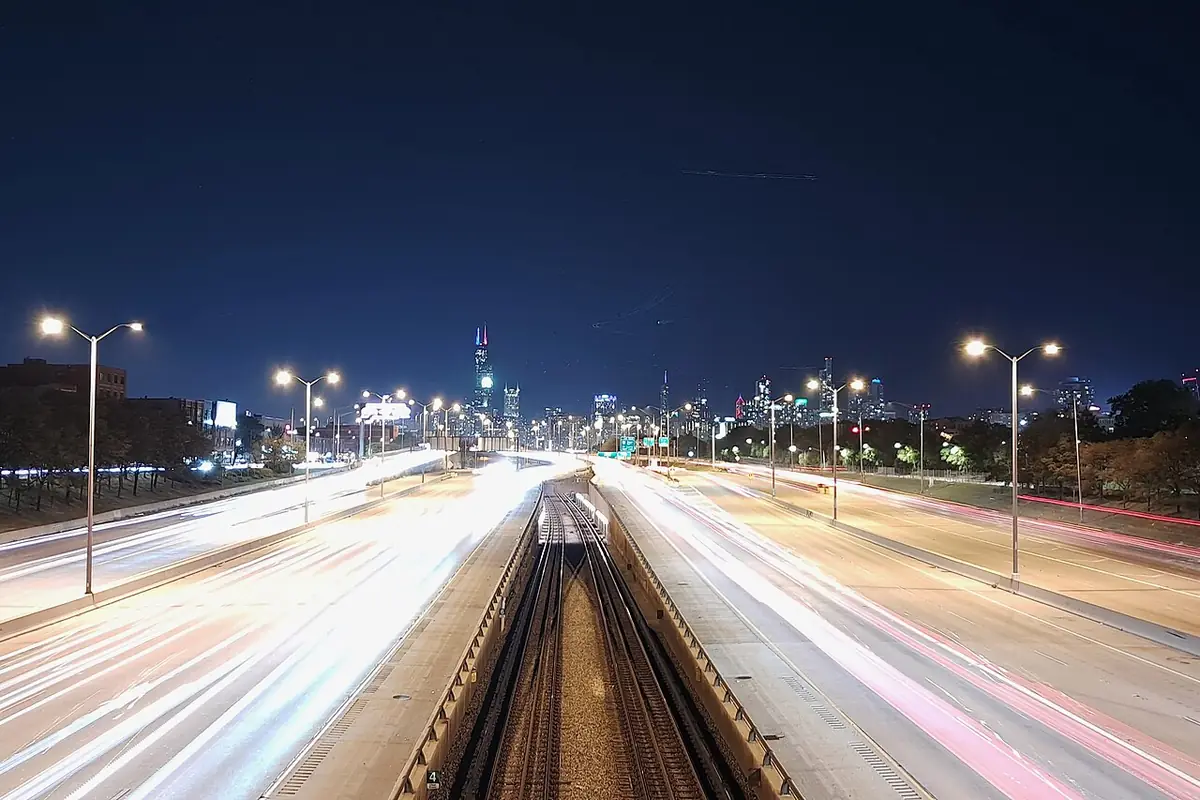
Chicago's expressways stay busy well into the night — Photo: AlphaBeta135 · CC BY 4.0 · Wikimedia Commons
Beyond the financial side, the legal nature of what you own deserves very particular attention.
Chicago's property market is marked by significant price gaps depending on location, structural condition and year of construction. It is essential to fold every ancillary cost into your financing plan, including local property taxes and any thermal upgrade work. Market data shows prices stabilising in the established neighbourhoods, while transitional zones offer opportunities for methodical buyers. Looking at recent transactions gives you a realistic reference grid, a long way from the fanciful estimates sometimes passed around on online platforms. Your borrowing capacity has to reflect the reality of prevailing interest rates in the United States.
chicagoFor saleHouseestimate
Median price / m²US$2,804Half the apartments sell below this
Median priceUS$460kthe average is 14% higher — a few very large properties pull it up
Most common2 bedrooms61 % of listings
Average size156 m²
By number of bedrooms
Bedrooms
Share of market
Avg price
Price / m²
Avg size
2most common
61 %
US$465k
US$2,952
158 m²
3
32 %
US$613k
US$2,804best value / m²
219 m²
4
8 %
US$878k
US$2,952
298 m²
Each row is an average, compared against the area average of US$2,952 / m². These are indicative estimates of a typical local market, not a measured sample of live listings. Check current listings before relying on them.
What you can actually hold: full ownership versus condominium
Getting a purchase over the line follows a rigorous sequence that is worth mastering.
American property law draws a clear line between holding a single-family house outright (fee simple) and buying a unit inside a condominium run by an association (HOA). That distinction changes not only your maintenance responsibilities but also your fixed monthly outgoings and your freedom to alter the building. Understanding these rules protects you from unpleasant financial surprises voted through at owners' meetings. Buyers arriving from abroad need to absorb the fact that local planning rules and association bylaws often take precedence over whatever you had planned to change.
Outright ownership of a single-family house
You own the building and the land it stands on, with no external decision-maker in between. That set-up gives you complete autonomy to undertake renovation work, change the internal layout or extend the living space, subject to Chicago's municipal building and zoning codes.
What it changesYou carry the whole financial and practical weight of maintenance, from the roof to the foundations, with no way of sharing those costs with neighbours.
Condominiums and homeowners associations
Buying inside a collective structure means compulsory membership of an association that manages the common areas, the building envelope and the shared green space. Regular monthly dues are required to fund those services and to build a reserve fund for major works.
What it changesYou have to live with strict rules limiting what you can change externally, and you need to guard against the risk of special assessments if the structure is poorly managed financially.
The rule to understand before you put money down on a house
A landmark corner in Chicago's Ukrainian Village neighbourhood — Photo: w_lemay · CC BY-SA 2.0 · Wikimedia Commons
To run this purchase calmly, the chronology of the transaction has to be mapped out precisely.
In the United States, signing an offer binds the buyer legally as soon as the seller accepts, framed by a deposit held in escrow (earnest money). The process rests on specific contingencies, notably the technical inspection and final confirmation of bank financing. Skipping those steps, or waiving the contingencies too quickly, can cost you your deposit if you pull out without good cause. Administrative rigour is therefore the foreign buyer's best ally in protecting their capital. Every document handed over deserves careful analysis with the support of qualified local professionals.
A precise definition of your maximum budget and validation of your profile by a local lending institution.
Drafting and submitting a written offer to purchase that includes the essential contingencies.
Acceptance of the offer by the seller and payment of the deposit into a dedicated escrow account.
A thorough technical inspection of the building by an independent professional.
Any renegotiation of the price or of the work to be done in light of the inspection report.
Release of the contingencies and signature of the final transfer of ownership before the title company.
How a property transaction unfolds, step by step
In short, buying a house in Chicago takes method, financial discipline and a solid grasp of local practice.
Buying a property in Chicago runs to a precise calendar involving several specialist actors, from the real estate broker to the title company. Anticipating each phase avoids administrative hold-ups and keeps you inside the contractual deadlines set in the offer. Respecting that chronology is what makes the move from decision to moving day a smooth one. Each party plays a well defined technical role in protecting your legal and financial interests throughout. Transparency and responsiveness are the keys to a successful transaction in Illinois.
Buyer and brokerActive search and shortlistingWalking the target neighbourhoods, analysing market comparables and identifying the houses that match your brief.
Broker and attorneyDrafting the offer to purchaseSetting out the financing, inspection and title contingencies in formal terms.
Building inspectorFull technical inspectionA careful examination of the structure, the plumbing, the electrics and the insulation to detect any defects.
Mortgage lenderUnderwriting and loan approvalAssembling the financing file, an independent appraisal of the property's value and issuing the final loan commitment.
Title companyVerification of titleHistoric searches on the parcel to confirm there are no liens, debts or live legal disputes attached to it.
All partiesClosing and signatureConfirming the final financial statements, transferring the funds and formally handing over the keys to your new house.
House or apartment in Chicago: the big trade-off
Choosing between a single-family house and an apartment in Chicago shapes your daily life, your long-term budget and your relationship with the city in a deep way. Chicago's vast residential neighbourhoods, whether on the North Side or closer to the parks in the south, are home to those famous brick bungalows and timber-frame houses that demand constant upkeep but give you complete independence with nobody living above your head. Every house owner deals directly with the roof, a heating system that is often old and the foundations, which is a real mental and financial load through a rigorous Midwest winter.
Going for an apartment instead, whether in a historic courtyard building or in a modern tower in the Loop or River North, changes the terms completely on the shared-ownership side. The monthly charges, known as assessments, cover maintenance of the common areas, snow clearance and sometimes even the heating, but they can rise unpredictably if the association votes major facade or energy upgrade works. You gain peace of mind on external maintenance, but you accept living under a board whose rules on renting out or on pets can be strict.
The very structure of the city drives this choice sharply, depending on your family and professional situation. Families looking to settle for the long haul and access the best public or private schooling turn naturally to the houses of Lincoln Square or Beverly, where private outdoor space and a detached garage make daily logistics far easier. Younger professionals and investors instead favour the centrality and security of a well insulated apartment that holds its heat and puts them within reach of the CTA elevated lines, without having to clear snow off a driveway at seven in the morning.
The financial side of this decision goes well beyond the asking price shown on the listing portals. A single-family house in Chicago tends to carry higher property taxes because of the size of the plot, while an apartment stacks the mortgage on top of assessments that generate no direct return. You have to weigh the cost of autonomy against the comfort of delegation carefully, bearing in mind that any future resale will depend directly on how the chosen neighbourhood's demographics evolve and on the general state of the surrounding municipal infrastructure.
What overall budget do you need to live comfortably in Chicago?
Building a realistic budget for a Chicago purchase goes well beyond the down payment and the mortgage approval. Cook County property taxes are among the highest in the country and weigh heavily on every monthly payment. You also need to anticipate the specific costs tied to a harsh continental climate, to condominium assessments and to home insurance covering the raised risk of water damage and winter storms.
Monthly and annual cost lines for a Chicago homeowner
Cost line
Estimated amount or range
Impact on the overall budget
Property tax
1.5% to 2.5% of market value per year
Reassessed by the county every three years, which creates noticeable variation between municipalities.
Condominium assessments
$300 to $1,200 per month depending on services
Cover general maintenance, the building insurance and sometimes the heating, but are subject to increases.
Homeowners insurance
$1,200 to $2,500 per year
Varies with the age of the building, the type of heating and the distance to fire hydrants.
Energy bills (gas and electricity)
$150 to $400 per month depending on the season
A significant peak in winter for gas heating and in summer for the central air conditioning you cannot do without.
These estimates assume standard properties and should be adjusted for the insulation and the exact age of the construction.
Ancillary purchase costs and forecast maintenance
Type of cost
Average estimate
Management tip
Closing costs
2% to 4% of the purchase price
Cover transfer taxes, attorney fees and bank arrangement charges.
Reserve fund for works
1% to 2% of the property value per year
Essential for coping with roof, plumbing or facade repairs.
Pre-purchase inspection
$400 to $800 per visit
Reveals hidden defects, the presence of lead and the true condition of the concrete foundations.
Never skip the technical inspection: Chicago winters test the weathertightness of a building severely.
Health, schools and transport: what does an ordinary Tuesday look like?
Navy Pier, a lakefront gathering spot minutes from downtown — Photo: Moses8910 · CC BY-SA 4.0 · Wikimedia Commons
Living in Chicago means a disciplined logistical routine set by the CTA network and the density of urban traffic. An ordinary Tuesday starts early to avoid the jams on major arteries such as the Kennedy Expressway or Lake Shore Drive. Between the school run, medical appointments and work trips into the Loop, every minute counts in keeping life balanced.
07:15Residential neighbourhood and departureGetting ready and checking road conditions or delays on the CTA lines so the journey can be planned.
08:00The local schoolDropping the children at the local public or private school, often within walking distance or a short ride on the yellow school bus.
08:45Journey into the Loop on the Brown or Red LineTravelling on the elevated or underground trains, a good moment to watch the city come alive in the morning.
12:30Lunch break and local servicesUsing local shops, the pharmacy or a medical practice within ten minutes' walk of the workplace.
17:30Home again and the food shopA stop at a neighbourhood grocery for the fresh produce needed for dinner, before the winter darkness sets in.
19:00A quiet evening at homeTime to unwind with the family, homework with the children and getting ready for the next day in a safe setting.
What the listing will never tell you about Chicago
The superb marketing photographs and the glowing agency descriptions regularly forget to mention certain physical and administrative realities specific to Chicago. Knowing about them avoids post-purchase disillusion and lets you anticipate costs or constraints that will reshape your life as an owner.
The noise and vibration from the elevated train lines
Buying a charming period apartment right beside the CTA tracks guarantees undeniable architectural character, but it also exposes you to regular vibration and a high noise level every few minutes. Even with good double glazing, getting used to it takes time and it can complicate a future resale to buyers who want absolute quiet.
The tangled business of parking during snowstorms
During heavy snowfall, the local custom of 'dibs' officially or tacitly allows residents to reserve the parking space they have cleared using chairs and assorted objects. If your property has no garage or assigned space, finding somewhere safe for your vehicle becomes a daily struggle.
The real condition of the water pipes and the lead service lines
Chicago has a high number of lead water service lines connecting homes to the city main. Although the water is treated at source, buying an older property often means checking the state of the internal pipework and budgeting for a full replacement to guarantee genuinely safe water.
Strict condominium restrictions on short-term letting
Many Chicago buildings formally ban or heavily restrict Airbnb-style letting in their bylaws. If you were counting on offsetting part of your monthly payments with short-term rental income, you are exposing yourself to severe fines from the board.
The traps and mistakes you only discover six months after moving in
Looked likeA magnificent brand new central air conditioning system installed in a tastefully renovated older building.
Turned outAn undersized installation unable to cope with the stifling heat and humidity of July and August, producing exorbitant electricity bills.
Would have caught itInsisting on a full thermal check by an independent technician and reviewing the last twelve months of energy bills before you sign.
Looked likeAn extremely calm and peaceful neighbourhood during the inspection viewing on a sunny Sunday morning.
Turned outA very noisy road during the week because of the constant delivery lorries and the immediate proximity of a fire station whose sirens sound day and night.
Would have caught itVisiting the property several times at strategic hours, especially at peak times and on weekdays, to judge the real feel of the neighbourhood.
Looked likeA condominium advertising unusually low and attractive monthly charges for the area.
Turned outA completely empty reserve fund and no collective savings at all to pay for the imminent replacement of the central boiler and the building's roof.
Would have caught itReading the minutes of the last three years of owners' meetings closely, to spot deferred works and the true state of the association's finances.
Looked likeA basement nicely fitted out as a playroom and a spacious, bright home office.
Turned outRecurring damp and water ingress into the foundations during heavy spring rain, requiring the costly installation of sump pumps.
Would have caught itCommissioning a building expert to inspect the weathertightness of the below-ground walls and check for hidden mould behind the drywall.
Poor fits: who really should not buy in Chicago right now?
Owning property in Chicago requires financial stability, a tolerance for the weather and a long-term outlook that do not suit every profile. Committing to bricks and mortar without those conditions in place exposes a buyer to major financial disappointment and to a loss of geographic mobility that is hard to bear.
The mobile young professional whose international or national career is moving fast
→Continuing to rent a flexible apartment rather than committing to a short-term purchase.
The legal fees, transfer taxes and agency commissions that come with buying and quickly reselling a Chicago property wipe out any return if you sell before a minimum of five to seven years.
The investor with no appetite for regulatory constraints or tax surprises
→Directing their savings towards more liquid and less demanding financial investments.
The complexity of Illinois residential tenancy law, combined with the volatility of the property taxes set by Cook County, calls for the involvement of a seasoned manager, which not everyone is.
The household with a down payment that only just covers it and no safety savings
→Waiting to build up a financial cushion before taking the plunge.
Having no reserve for an urgent roof repair, a boiler failure in the depths of winter or a sudden rise in condominium charges can lead straight to foreclosure.
So, are you ready to take the step and buy in Chicago?
A quiet close to the day at the Chicago Harbor Lighthouse — Photo: Dicklyon · CC BY-SA 4.0 · Wikimedia Commons
Deciding to buy a property in Chicago is not a matter of simple arithmetic or of perfect timing on the financial markets. It is above all a life commitment that reflects your intention to put down roots in one of the country's most dynamic and culturally rich cities. If you have taken the measure of the harsh winters, absorbed the weight of the property taxes and accepted the constraints that come with maintaining an asset in the Midwest, you already have the mental foundations you need to make the project work.
Chicago's property market offers a range of homes and neighbourhoods that rewards the patience and the rigour of anyone who takes the time to examine every detail before signing. Whether you are after a bright apartment in a historic building or a family house with a garden in a peaceful residential area, the choice should be guided by how you actually live rather than by short-term speculation. Surround yourself with professionals you trust, from the specialist attorney to the independent inspector, to secure every stage of this major transaction.
Ultimately, becoming an owner in Chicago means agreeing to take an active part in the life of your community, to support local businesses and to build a lasting home at the heart of a city in constant evolution. If your professional and personal plans fit that medium to long-term horizon, the moment has come to turn the search into reality and your vision into a place of your own.
Related questions
Which neighbourhoods are most sought after for buying a house in Chicago?
North Side neighbourhoods such as Lincoln Square, Andersonville and Edison Park are particularly popular for their family houses, their green space and the quality of their schools and transport links.
How are property taxes calculated in Cook County, Chicago?
Property taxes depend on the official assessed value set by the Cook County Assessor's Office, combined with the specific tax rates voted by the various local and school authorities in your area.
Is a lawyer required for a property transaction in Illinois?
Yes. Legal and conveyancing practice in Illinois almost always calls for a real estate attorney to represent each party when the purchase contract is drafted and signed.
What help is available for first-time buyers in Chicago?
The City of Chicago regularly runs assistance programmes and grants designed to cover part of the down payment or the closing costs for eligible first-time buyers.
How long does a purchase usually take from signing to handover of the keys?
Allow roughly thirty to forty-eight days between the seller accepting your offer and the final signing at the attorney's office, which is the time needed to secure loan approval and complete the surveys.
What does a technical inspection of an older Chicago building involve?
A certified inspector goes carefully through the structure, the roof, the electrics, the plumbing and the heating system to identify hidden defects or any upgrade work that will be unavoidable in the short term.
Can condominium assessments rise sharply from one year to the next?
Yes. If a building's reserve fund is too thin to pay for unplanned major repairs, the association can vote a special assessment or raise the monthly dues significantly for every owner.
Is it easy to resell a Chicago property quickly?
How liquid a property is depends directly on its location, its price relative to the local market and its general condition. Homes in lively, well connected neighbourhoods find a buyer faster.
What precautions apply to buying in a flood-prone area near Lake Michigan?
It is essential to consult the official flood risk maps and to take out specific water damage cover, because cellars and basements close to the lake can be vulnerable during heavy storms.
How does parking work on Chicago's residential streets?
Parking on residential streets often requires buying an annual permit sticker tied to your specific zone from the city, which keeps you clear of fines and makes parking your vehicle far easier.
Property review of ting
No ting properties in Chicago yet
Be the first — share it on ting and it shows up right here.
Sources
Cook County Assessor's Office Official data on property assessment and how real estate taxes are calculated in the county.