Investing in Houston property means understanding local dynamics, the character of individual neighborhoods and the legal rules specific to Texas. This guide walks you through the decision step by step, so you can anticipate the real costs and secure every stage of the purchase without a misstep.
Get the app
What nobody tells you.
Real prices, hidden costs and the traps to check before you commit.
What do you actually gain by putting down roots in Houston?
Scroll
What do you actually gain by putting down roots in Houston?
Investing in Houston property means understanding local dynamics, the character of individual neighborhoods and the legal rules specific to Texas. This guide walks you through the decision step by step, so you can anticipate the real costs and secure every stage of the purchase without a misstep.
Written by the ting.ad editorial team ·
Memorial Drive, Houston in Street View: drag to look around.
That tension between space and mobility reshapes how you think about daily life at home.
Investing in a house in Houston is not simply a matter of acquiring square meters under the Texas sun. The shape of the city forces you to weigh living space against distance from the economic centers. Between the room you get and the absolute dominance of the car, the trade-off requires looking past the appealing surface of the local market.
Remarkable space for a moderate cost per square meter.vsDaily transport costs and complete dependence on a car.
The initial promise of a big house with a yard quickly runs into the reality of distances and highways that clog at peak hours.
A lively neighborhood life with a good spread of local services.vsConstant exposure to summer weather swings and humidity.
Outdoor structures demand rigorous, regular upkeep, which changes the first impression of quiet residential ease.
Easy integration into a welcoming, multicultural community.vsA vast property market where valuation gaps between areas demand sharp expertise.
Every neighborhood has its own valuation dynamics, which do not necessarily mirror the broader trends across the Texas metro.
How do you know whether this mix of urban and suburban living suits you?
These lifestyle choices also mean measuring the cultural and practical gaps against the reference points you arrive with.
Where you settle in Houston changes radically with your professional profile and your personal priorities. Between the centrality of the historic neighborhoods and the sheer scale of the single-family suburbs, each option imposes its own constraints on travel and daily organization. Looking honestly at your actual habits prevents disappointment after the purchase.
Choosing the urban core
Picking areas close to the center drastically limits the time you spend behind the wheel each morning. The properties available there are often more compact, but they give you immediate access to cultural venues and transport links. This route suits buyers who value walking and spontaneous social contact over large private outdoor space.
Choosing the residential suburbs
Settling in the outer rings guarantees generous volumes and the quiet families look for. In exchange, daily life is organized around unavoidable car trips for every errand or activity. You have to accept time on the freeways to reach the metro's centers of activity.
Choosing mixed and transitioning neighborhoods
Some in-between areas are going through deep changes that will redefine their appeal over the medium term. Buying in these zones calls for extra vigilance on build quality and on how the surrounding development is evolving. The upside potential is strong, but the immediate environment can shift quickly as new projects arrive.
What actually changes when you settle here from abroad?
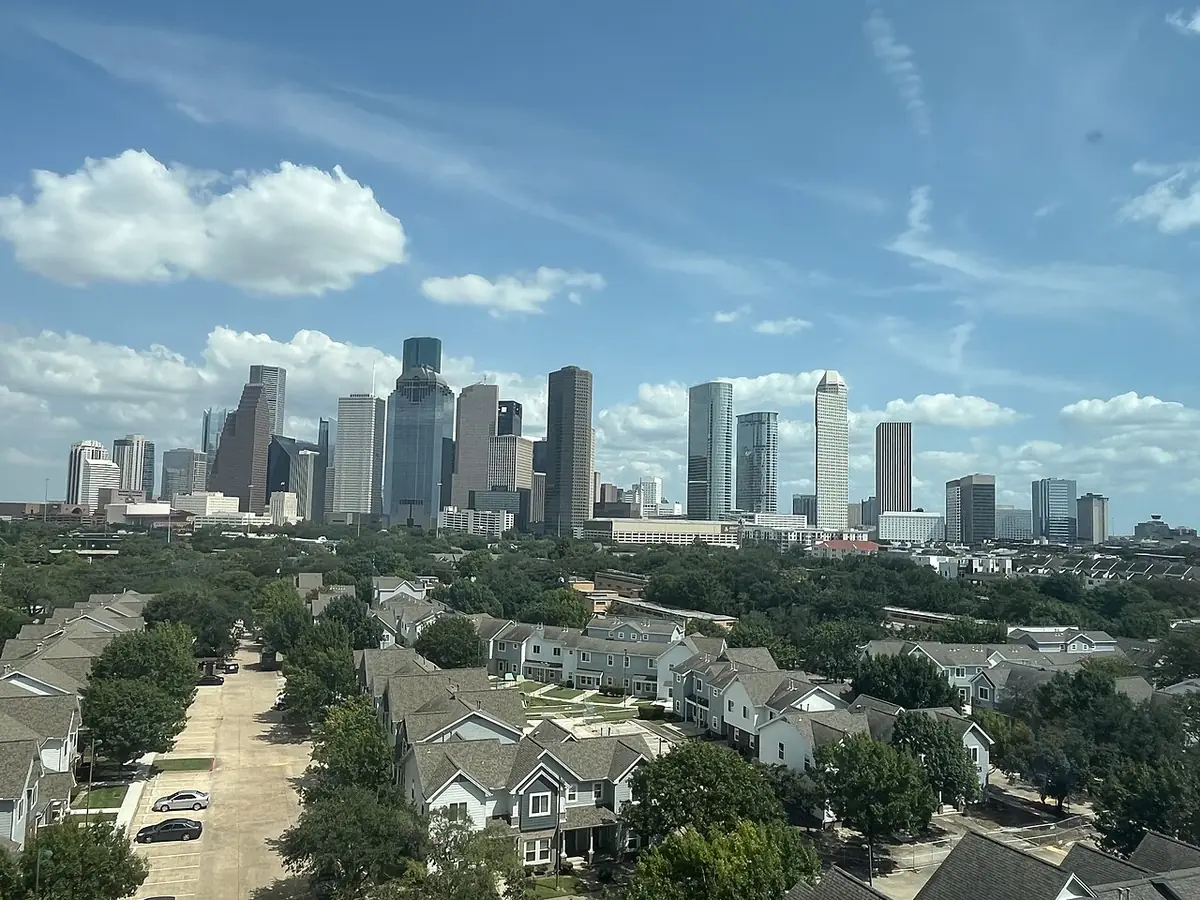
Houston's skyline seen past the rooftops of a nearby neighbourhood — Photo: JAFactsDude · CC0 · Wikimedia Commons
Once those reference points are in place, choosing the neighborhood becomes the next decisive step.
Moving from abroad to buy a house in Houston unsettles habits built over decades. The organization of space, the way public services are delivered and the texture of everyday relationships all differ sharply from what most newcomers are used to. Understanding these invisible mechanics lets you anticipate the friction in your first months here.
From abroad
Public services and shops concentrated within walking distance.
Houston
A city laid out entirely around the car, with commercial activity grouped into zoned districts.
Every trip has to be planned by car, turning the idea of proximity into a question of driving time.
From abroad
Dense, often older housing protected by strict architectural rules.
Houston
Recent, adaptable construction governed by homeowners associations with rigorous rulebooks.
Complying with the subdivision's covenants matters more than any absolute freedom to alter the outside of your property.
From abroad
A centralized administrative system with heavily formalized contracts.
Houston
A pragmatic local contract culture where the guarantees rest on insurance policies and specific inspections.
Bringing in licensed professionals (inspectors, agents, title company officers) becomes essential to secure every transaction.
From abroad
A social life set by public space, terraces and the street.
Houston
Sociability centered on the home, private clubs, landscaped parks and air-conditioned indoor venues.
Building social ties takes an active effort through organized clubs and community groups.
Which Houston neighborhood best matches your plans?
That geographic variety translates into budget realities worth analyzing carefully.
Houston is a mosaic of neighborhoods with sharply contrasting identities and property dynamics. Choosing your area depends as much on your budget as on your tolerance for daily commuting. Each zone strikes its own balance between local life, accessibility and the type of housing stock.
The Heights
A historic-village atmosphere, with tree-lined streets, independent shops and plenty of foot traffic.
Suits
Buyers looking for architectural character, neighborhood life and relative proximity to the center.
Trade-off
Distinctly higher prices per square meter and lots that are often small.
Montrose
A creative, eclectic and energetic area mixing fashionable restaurants, art galleries and varied housing.
Suits
Those who put cultural life, diversity and central location ahead of absolute quiet.
Trade-off
Strong competition for what comes to market and heavy traffic at peak hours.
Sugar Land and the southwest suburbs
Quiet, secure residential subdivisions with excellent schools and well-kept green space.
Suits
Families looking for generous volumes, leafy surroundings and strong schools.
Trade-off
A marked distance from central Houston, meaning long daily drives.
Spring Branch
An area in the middle of an urban transition, where older construction is giving way to modern townhouses.
Suits
Investors and first-time buyers looking for a strategic compromise between purchase price and access.
Trade-off
An architectural character still taking shape, and temporary disruption from construction sites.
What does buying a house in Houston really cost?
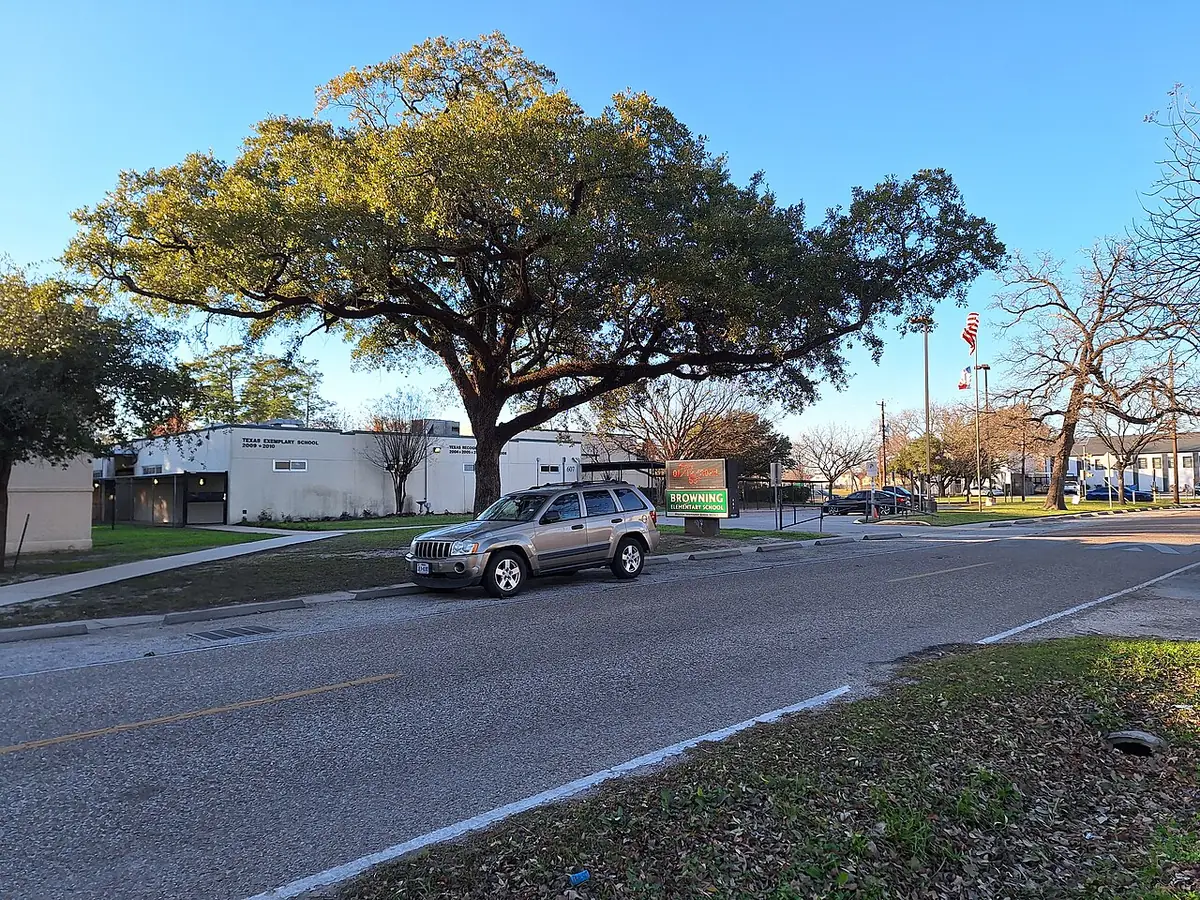
A shaded street in Houston, oak trees overhead — Photo: WhisperToMe · CC0 · Wikimedia Commons
Beyond these figures, the legal nature of the property and local ownership rights hold some specifics of their own.
Working out your purchase budget goes well beyond the headline price shown on the listing portals. Local property taxes, homeowners association dues and maintenance costs weigh heavily on the total cost of ownership. Looking at the observed ranges lets you structure your financing plan with clear eyes.
houstonFor saleHouseestimate
Median price / m²US$1,870Half the apartments sell below this
Median priceUS$331kthe average is 14% higher — a few very large properties pull it up
Most common2 bedrooms68 % of listings
Average size168 m²
By number of bedrooms
Bedrooms
Share of market
Avg price
Price / m²
Avg size
2most common
68 %
US$344k
US$1,968
175 m²
3
27 %
US$437k
US$1,850 −6 %
236 m²
4
5 %
US$511k
US$1,771best value / m²
289 m²
Each row is an average, compared against the area average of US$1,968 / m². These are indicative estimates of a typical local market, not a measured sample of live listings. Check current listings before relying on them.
What can you actually own and control on your lot?
That legal control over the property is won through a transaction process you have to follow rigorously.
Buying property in the United States means understanding exactly which rights change hands at the sale. Between outright ownership of the land and the collective rules imposed by the neighborhood, your freedom to alter the property is bounded by strict standards. Separating those two dimensions prevents disputes later.
Freehold ownership of the land and surface rights
In most cases you buy both the building and the land it stands on, with clearly established subsurface and surface rights. That full ownership gives you complete legal autonomy over your own walls, subject to the City of Houston's development rules.
What it changesYou decide on structural work inside and on renovations, while carrying full responsibility for maintenance against the weather.
Restrictions imposed by homeowners associations (HOAs)
Almost every recent subdivision and horizontal community is run by an HOA with broad rule-making powers. These associations set the aesthetic rules, the permitted exterior paint colors, lawn upkeep and bans on parking certain vehicles on the street.
What it changesYou have to submit any exterior change for approval first, or face significant financial penalties voted by your neighbors.
What is the one rule to understand before you put money down?
A quiet garden path, a green pause in Houston — Photo: Safety Cap · CC BY 4.0 · Wikimedia Commons
Once those stages are cleared, the transaction itself unfolds on a well-established calendar.
Buying property in Texas rests on strict contractual mechanics in which every stage carries a precise deadline. Putting money down without mastering the inspection clause or the terms for walking away exposes a buyer to losing those funds for good. Understanding the chain of responsibilities protects your money.
Signing an offer that the seller accepts starts a rigorous legal countdown.
Paying the earnest money (a good-faith deposit) into an escrow account held by a title company.
Opening an option period, typically 7 to 10 days, bought with a flat non-refundable fee.
Having a thorough home inspection carried out by a certified professional to identify hidden defects or urgent repairs.
Negotiating repairs, or withdrawing legally without penalty if the defects found are deal-breakers for the buyer.
Contingencies are lifted and the transaction is locked in through to the final signing at the title company.
How does the transaction unfold, step by step, from choosing a property to signing?
Carrying a Houston purchase through to completion means coordinating a number of participants with well-defined roles. From mortgage pre-approval to the handover of keys, each one secures a different facet of the deal. Following this chronological road map keeps the process free of missteps.
The buyerGetting pre-approved for financingConfirming your borrowing capacity up front with a local lender so that your offer carries credibility.
The real estate agent (Realtor)Shortlisting properties and targeted viewingsIdentifying the opportunities that match your criteria and running a comparative market analysis for the neighborhood in question.
The home inspectorFull structural auditA careful check of the roof, the foundation, the plumbing and the electrical systems by an independent expert.
The title companyTitle search and legal protectionVerifying the ownership history to confirm there are no hidden debts or liens attached to the property.
The insurerPutting the homeowners insurance in placeSetting up the cover you cannot do without against the climate risks specific to the Texas region.
The buyer and the sellerFinal signing and closingSigning the final documents, wiring the funds and formally recording the title with the county.
A single-family house in Houston or a condo tower: deciding by lifestyle and day-to-day upkeep
Once the type of property is settled, the central question of total budget and running costs comes sharply into focus.
Buying property in Houston forces an immediate structural choice between two residential worlds that have almost nothing in common. On one side, the single-family house with its private lot, its enclosed garage and no immediate neighbors through the walls or the ceiling. On the other, the condo or vertical building, often in a dense area such as Upper Kirby, Midtown or Downtown, offering shared amenities like a pool, a security service and a gym. This choice is not just a matter of taste or of floor area. It goes directly to your relationship with time, your long-term maintenance budget and your willingness to live with shared-ownership constraints.
In sprawling residential areas such as Spring Branch, The Heights or Meyerland, the single-family house dominates the market. It gives you complete decision-making autonomy: you decide when the roof gets replaced, what color the facade is painted and how the yard is laid out, without submitting your plans to a meeting of fellow owners. In exchange, maintenance rests entirely on your shoulders. In Houston, the humid subtropical climate puts buildings through a hard test. Summer heat demands air conditioning systems that run at full tilt for much of the year, while heavy rain and the occasional hurricane call for constant vigilance over the foundation, the drainage and the roof. Every repair, from the most trivial to the most serious, is a direct cost and a non-trivial organizational burden.
Buying an apartment or a condo in Houston, by contrast, moves the burden elsewhere. The HOA dues can look high, but they pool a large share of the logistical hassle. Maintenance of the common areas, building security, running the pool and sometimes even the exterior insurance and the water are handled collectively. For buyers who travel frequently, who have a very demanding work schedule or who dread managing local contractors, this formula offers real peace of mind. You do, however, have to accept living by the strict rules set by the HOA board, whether that means restrictions on short-term rentals, hours for using the amenities or limits on changing the outside appearance of your unit.
Financially, the long-term picture differs too. Single-family houses on well-placed lots in sought-after school zones tend to capitalize strongly on land value, with the land often gaining more than the structure over the decades. Condos, on the other hand, sometimes see a discount or a faster plateau if the association's management deteriorates or if a wave of new projects starts competing with existing supply in the same area. That said, the entry ticket for a well-located apartment is often more accessible than for an equivalent house in the central neighborhoods, which opens up prime locations that would otherwise be out of budget.
In the end, choosing between these two options in Houston comes down to how you picture your daily life. If you value space and independence, accept spending time or money on maintaining a building, and want to capitalize on the land, the single-family house is the obvious answer. If you prioritize a central location, shorter commutes and no exterior upkeep, the urban condo will suit you far better, provided you examine the association's financial health rigorously before you sign at closing.
What total budget and recurring costs should you plan for as a Houston homeowner?
Beyond the purely financial side, daily life across Houston's vast footprint is set by travel and by the services near you.
Buying a house in Houston is not limited to the asking price on the listing portals or the size of the monthly mortgage payment. The Texas market has very specific tax and insurance features that belong in your first financial models if you want to avoid unpleasant surprises. Between high local property taxes, homeowners insurance premiums driven by climate risk, and the regular maintenance the subtropical climate demands, the real cost of ownership needs a rigorous, detailed analysis.
Estimated monthly and annual cost items for an average house in Houston
Cost item
Estimated amount
Frequency
Comment and variability
Property tax
1.8% to 2.5% of value
Annual
Varies with the school district (ISD) and the exact municipality the property belongs to.
Homeowners insurance
$2,500 to $4,500
Annual
Rising sharply in Texas because of storm, hail and flood risk.
Upkeep and preventive maintenance
1% to 2% of property value
Annual
Essential for the air conditioning, the roof and the foundation system.
HOA dues
$50 to $300
Monthly
Standard in planned subdivisions and gated communities.
These ranges are based on market averages observed in Houston for a standard single-family house.
How property taxes bite across the main parts of the metro area
Area
Indicative combined rate
Effect on the monthly budget
Inside the Loop
2.2% to 2.4%
High, reflecting municipal services and urban investment.
Established suburbs (Sugar Land, Katy)
2.4% to 2.8%
Often higher because of school taxes and infrastructure links.
Unincorporated Harris County
1.8% to 2.1%
Lighter, with no direct municipal taxes, offset by MUD districts.
The effective rate is the sum of the different local entities that levy property tax (county, city, school district, special districts).
What does an ordinary Tuesday actually look like, between commuting, schools and local services in Houston?
A community garden where Houstonians grow their own vegetables — Photo: Safety Cap · CC BY 4.0 · Wikimedia Commons
This daily rhythm brings out practical realities that property viewings do not reveal straight away.
Living in Houston means accepting the geographic reality of a sprawling metro organized around a dense freeway network. Daily journeys shape family and working life deeply. To judge whether a location works, you have to break down a typical ordinary day, from the morning routine with the children through to late returns at peak hour on major arteries such as Interstate 10 or Loop 610.
07:00At homeChecking the air conditioning and getting ready in a house with an attached garage. The quiet of the neighborhood contrasts with the bustle waiting on the city's main roads.
07:45School or daycare runDropping the children at the local school district (ISD) campus or a private school. Travel times vary considerably depending on whether you live inside the Loop or out in the suburbs.
08:30Arriving at work or at the home officeLogging on, or dealing with congestion on the main freeways (Katy Freeway, Southwest Freeway). How smoothly it goes depends entirely on the hour and the direction of travel.
12:30Lunch break and local errandsA quick lunch at a neighborhood shopping center or a business park with plenty of free parking. Trips are made exclusively by car, since the distances make walking impractical.
17:30Rush hour on Loop 610A trip home marked by the heavy traffic that characterizes Houston. Choosing where you live relative to where you work does a great deal to soften this daily constraint.
19:00Home again and local servicesTime to unwind at home, or top-up shopping at local supermarkets that stay open late. Enjoying the quiet of the residential streets in the evening after the daytime bustle.
What the polished agency photos and the listings leave out about the Houston market
These blind spots explain why some buyers sour on the purchase within months of getting the keys.
Online listings paint an idyllic picture of Houston properties, showcasing refinished floors, open kitchens and big, bright rooms. Yet several fundamental technical, regulatory and climate realities are consistently left out. Knowing what does not show up on glossy paper is essential if you want to avoid buying something that proves hard to resell or excessively expensive to run over the years.
The property's exact flood history and its FEMA zone
Houston has been through several major flood events during recent hurricanes. Knowing whether the property sits in an official flood zone (Flood Zone AE or X) determines not only the real risk of damage but also the steep cost of the NFIP flood insurance you will be required to carry.
The strict restrictions and powers of HOAs (Homeowners Associations)
In many Texas subdivisions, the HOA dictates how tall your lawn can be and what color your mailbox may be, and sometimes bans parking a work vehicle in the driveway. Failing to read these rules before buying can lead to repeated fines.
The real age and performance of the slab foundation
Houston's expansive clay soil swells and shrinks with moisture, causing ground movement. A cracked foundation can require leveling work costing tens of thousands of dollars that basic warranties do not cover.
The condition and capacity of the electrical system and the air conditioning
The Texas grid (ERCOT) sees strain and outages during polar cold snaps or summer heat waves. An aging air conditioning system or an undersized electrical panel is an immediate financial risk from the day you move in.
The regrets new Houston homeowners report most often, six months after moving in
Given these technical and financial demands, the Houston market does not suit every buyer profile.
Looked likeA leafy, quiet, picturesque suburb with big mature trees.
Turned outComplete geographic isolation, with a thirty-minute drive for the smallest errand and saturated traffic at the only intersections.
Would have caught itTesting the real travel times at peak hour on a Tuesday morning and a Thursday evening before submitting a firm offer.
Looked likeModest HOA dues on a brand-new residential subdivision.
Turned outIncreases voted through in the second year to fund repairs to aging shared infrastructure or roads.
Would have caught itInsisting on the full set of HOA meeting minutes for the last three years to spot disputes or unpaid dues.
Looked likeA reasonable electricity bill thanks to a bright, sunny aspect.
Turned outA summer furnace that turned the house into an energy sink because of poor attic insulation and unsuitable single-pane windows.
Would have caught itAsking the previous owner for the detailed energy bills for the last twelve months so you can cost your cooling budget precisely.
Looked likeA move-in-ready house with no visible work to do.
Turned outDamp problems hidden behind the drywall, from old water intrusion badly patched over during a cosmetic refresh.
Would have caught itHiring a certified home inspector (TREC) who is fully independent of the real estate agent for a thorough structural analysis.
Which buyers should absolutely hold off on buying property in Houston for now?
With those warnings on the table, it is time to take a final view of your plans.
Buying property is often presented as a compulsory step toward building wealth. Yet in a dynamic, vast and volatile metro like Houston, committing too quickly without the stability to back it up can turn into a money pit. Some buyers are far better served by flexible renting, which protects their freedom of movement and their financial security against the quirks of the local market.
The young professional whose job may move in the short term
→Postponing the purchase and renting flexibly in a central area.
Transaction costs on the way in and the way out in Houston (agency commissions, title work, taxes) easily reach 8% to 10% of the price. Selling before five years of ownership very often ends in a substantial net loss.
The investor chasing immediate rental yield with no local management
→Staying away from cheap outlying subdivisions.
High property taxes and steep insurance premiums eat a major share of the rent collected, while vacancy and the upkeep of remotely managed properties create a standing risk of negative cash flow.
The household on a tight budget with no emergency savings
→Keeping cash in an insured savings account and renting a home.
The slightest major equipment failure (central air conditioning, the roof after a storm, or the foundation) demands immediate outlays of several thousand dollars that first-time buyers consistently underestimate.
So, are you ready to take the step into homeownership in the Houston metro?
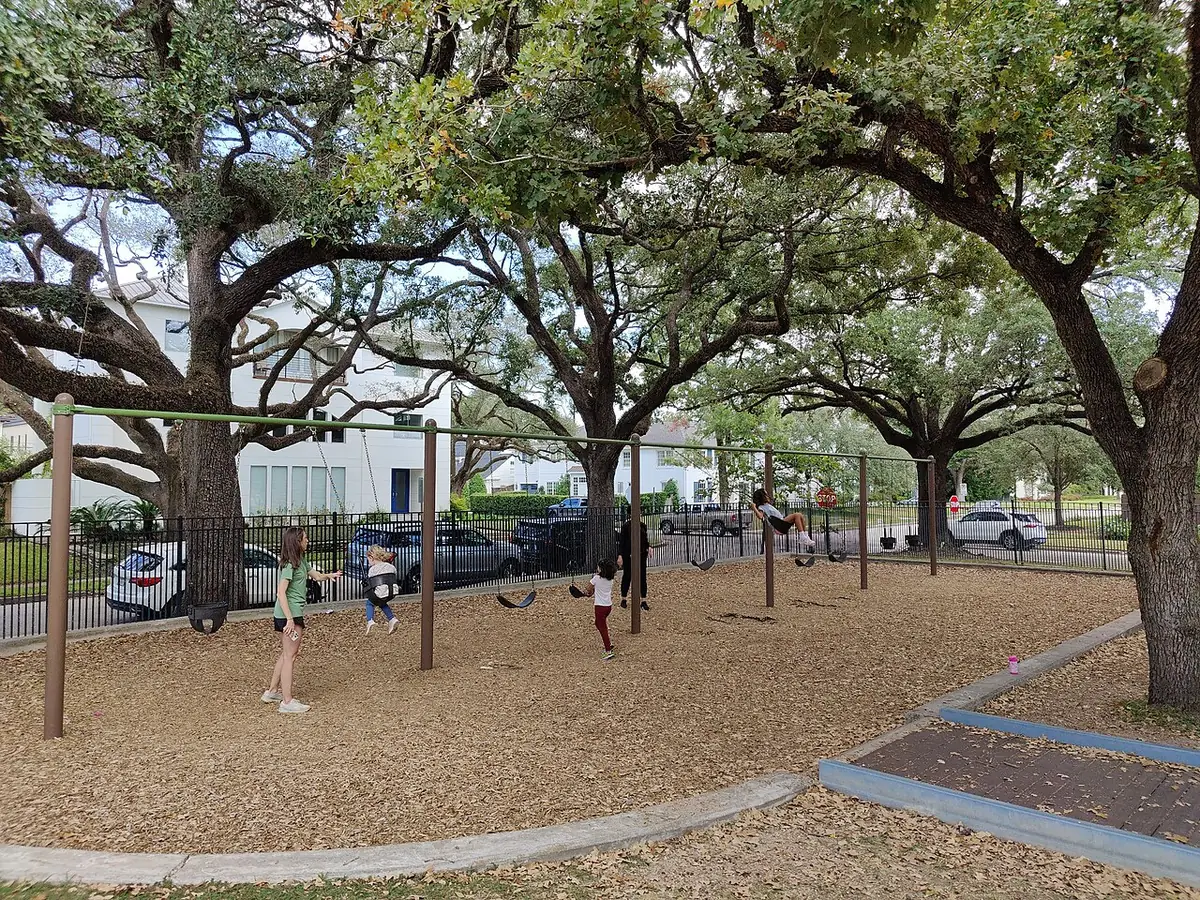
A shaded playground, popular with Houston families — Photo: EvanCarroll · CC BY-SA 4.0 · Wikimedia Commons
At the end of this analysis, buying a house or an apartment in Houston looks like what it is: a major strategic commitment that demands methodical preparation, complete financial clarity and full acceptance of the climate and tax realities of Texas. It is not simply a matter of signing a purchase contract to realize a residential ideal, but of confirming a genuine fit between your personal horizon and the structural constraints of this immense American metro.
If you have confirmed your professional stability for the next five to seven years, if you have built the real cost of property taxes and insurance into your financing plan, and if you have chosen an area after measuring the daily commute precisely, then the Houston property market offers formidable opportunities to build wealth and quality of life. Established neighborhoods such as The Heights, Meyerland or the well-organized suburbs offer an unmatched setting for anyone who knows how to surround themselves with the right professionals during the technical inspections.
If, on the other hand, the slightest doubt remains about the durability of your income, your tolerance for weather risk or your ability to absorb the unforeseen maintenance costs of a single-family house, do not rush. The Houston rental market is vast and flexible, and it lets you live comfortably while you build up your down payment and your detailed knowledge of the city's neighborhoods. Take the time to visit, to study the objective data and to hire independent experts before making the decision that will shape your next several years.
Related questions
Which neighborhoods are most sought after for buying a house in Houston?
The most prized areas are generally inside the Loop: The Heights, Montrose, West University Place and River Oaks, which combine historic character, excellent schools and a very central location. For more measured budgets, suburbs such as Sugar Land, Katy and The Woodlands offer superb family infrastructure and highly desirable surroundings, at the cost of longer commutes into the business district.
How do property taxes work in Houston?
Property taxes in Texas are among the highest in the United States, generally running between 1.8% and 2.8% of the assessed value of the property each year. They fund local services, police, fire departments and above all the school districts (ISDs). It is essential to check the exact rate that applies to a given parcel before making an offer.
Is flood insurance compulsory in Houston?
If your property sits in an area FEMA designates as high-risk for flooding (Zone A or AE), federal flood insurance through the NFIP is strictly required once you take out a mortgage. Even outside the high-risk zones, many owners choose to insure because of the local climate risk.
What is an HOA and how much power does it have over my property?
An HOA (Homeowners Association) is an owners' association that manages the common areas, maintains landscaping and enforces a strict set of rules across a subdivision. Its decisions bind every resident, and it can levy monthly or special assessments as well as issue fines when the aesthetic rules are not followed.
What effect does Houston's clay soil have on houses?
The soil across the Houston region is expansive clay that swells sharply after heavy rain and shrinks during drought. That natural cycle puts strong pressure on concrete slab foundations and can cause structural cracks that require expensive stabilization work.
What closing and transaction costs should a buyer expect in Houston?
Texas has no civil-law notary of the kind found in continental Europe: the transaction is handled by a title company. Closing costs, which include prorated taxes, the title company's fees, the appraisal and the lender's processing charges, generally represent between 2% and 4% of the total purchase price.
How do you assess the quality of the public schools attached to a property?
Public school quality in Houston is assessed by the Texas Education Agency (TEA), which issues performance ratings. Families routinely consult specialist platforms such as GreatSchools to check the rating of the school district (ISD) and of the neighborhood school, a decisive factor in long-term property values.
Can a non-resident or foreign buyer purchase property in Houston?
Yes. Texas law fully allows foreign investors and buyers to purchase and own real estate without discrimination by nationality. The process simply requires obtaining a US tax number (ITIN) and working with a title company experienced in securing international transfers of funds.
How long does a transaction usually take from offer to signing?
Once the seller accepts your offer, the standard closing process generally takes 30 to 45 days. That window allows for the independent home inspection, the lender's official appraisal and the final assembly of the mortgage file with the lending institution.
Why can electricity bills be so high in Houston?
Houston's subtropical climate means heavy air conditioning use for more than six months of the year. If the house is poorly insulated, has single-pane windows or old equipment, electricity consumption climbs steeply, especially during summer heat peaks or cold snaps on the independent Texas grid (ERCOT).
Property review of ting
No ting properties in Houston yet
Be the first — share it on ting and it shows up right here.