Settling into the Texas metro means learning the specific codes of its rental market and choosing your part of the city with care. This guide sets out the reality of rents, the kinds of homes on offer and the timeline of the steps involved, so you can sign a Houston lease with confidence.
Get the app
What nobody tells you.
Real prices, hidden costs and the traps to check before you commit.
What renting an apartment in Houston actually involves day to day
Scroll
What renting an apartment in Houston actually involves day to day
Settling into the Texas metro means learning the specific codes of its rental market and choosing your part of the city with care. This guide sets out the reality of rents, the kinds of homes on offer and the timeline of the steps involved, so you can sign a Houston lease with confidence.
Written by the ting.ad editorial team ·
Memorial Drive, Houston in Street View: drag to look around.
That push and pull between floor space and logistics shows up straight away in the part of the city you choose.
Renting an apartment in Houston is not simply a matter of finding affordable square footage under the Texas sun. The city puts considerable physical distance between its economic hubs and its residential districts. The choice comes down to balancing proximity to the main freeway corridors against the quiet of more isolated neighbourhoods. The local rental market reacts strongly to the pace of urban expansion and to seasonal swings in the weather. So you have to look past first impressions to understand what settling into this metro will really cost you.
More generous living space for a rent comparable to other large American metros.vsUnusually high energy bills, because air conditioning is unavoidable for much of the year.
Interior space is often paid for in electricity. Modern communities are built with effective insulation, but older buildings hold real budget surprises that show up when the utility bill lands.
Amenities included as standard: a pool, a fitness room and an on-site security presence.vsIndirect community and HOA charges, and strict rules of shared living set by the building's managers.
These shared amenities change daily life considerably. They deliver immediate comfort, but they reduce a tenant's say over maintenance decisions and over the hours the common areas are open.
Apparently easy access to the major business districts and to the outlying retail zones.vsTotal dependence on a car, which turns every rush-hour trip into a question of time management.
Houston's urban structure rests on a sprawling freeway network. Without a personal vehicle, or without planning your journeys carefully, the area you can realistically move within shrinks from your very first days.
High turnover in the rental stock, which means you can find something available quickly.vsLittle visibility on the long-term stability of renewal terms and rent increases.
A fast-moving market speeds transactions up but weakens the tenant's hand against annual rent rises. Negotiating well means reading the lease clauses closely from the very first viewing.
What kind of tenant are you, measured against what the Houston market expects?
Moving from a tightly regulated rental system abroad to Houston's unsettles most of your assumptions about housing.
Each part of Houston answers a particular set of needs, depending on whether you work in energy, in medical research or in professional services. Where you live directly determines how exposed you are to traffic and how easily you reach places to relax. High-rise buildings downtown suit professionals who want to be right beside the office towers. Garden-style communities further out appeal to those who put quiet and landscaped green space first.
Single urban professional
Your overriding priority is cutting the daily commute so that the rest of your life stays intact. Serviced buildings in the central districts offer welcome flexibility, with lease terms that adapt and maintenance handled entirely for you. You give up a large private garden in exchange for a lively neighbourhood and shared amenities within reach.
Family relocation
The deciding factor becomes the quality of the assigned school district and the safety of the outer residential areas. You will naturally gravitate towards areas with accessible parks and an active community. Homes here come with more floor space, often complemented by private or shared outdoor areas inside gated communities.
Hybrid remote worker
You need an extra room to set up a workable office without eating into your living space. The in-between neighbourhoods, well connected but less dense than the business district, are the best option. You get a better rent per m2 while staying a reasonable distance from places to socialise and from cultural amenities.
Renting here when you have come from abroad: what changes completely
Houston's skyline seen past the rooftops of a nearby neighbourhood — Photo: JAFactsDude · CC0 · Wikimedia Commons
Beyond these administrative rules, the neighbourhood you choose dictates the real quality of your Texas routine.
Leaving a heavily regulated rental system behind and settling in Houston means trading decades of tenant protections for a far more flexible market that is also far more demanding on financial guarantees. Space standards, what comes included, and the way applicants are screened follow none of the logic you are used to. Understanding these differences up front spares you unpleasant surprises when you put your application together for a local property manager.
From abroad
Tightly capped rents and eviction procedures closely constrained by statute.
Houston
Under the Texas Property Code, landlords and management companies keep almost complete contractual freedom over pricing and terms.
Rent can rise sharply at renewal. It is essential to pin down the review terms when you first sign rather than trusting the first-year figure on its own.
From abroad
Having to supply months of local payslips, a personal guarantor and a thick file of tax paperwork.
Houston
Screening built mainly around your current income, an American credit score and a background check, or a larger security deposit for newcomers who have neither.
Arriving from abroad with no US credit history, you will often be asked to pay several months of rent up front or to produce a firm offer letter from your local employer.
From abroad
Kitchens frequently handed over bare, with the tenant installing their own hob and appliances.
Houston
A kitchen fitted as standard with refrigerator, oven, microwave and dishwasher, and often a laundry connection inside the unit.
You save a great deal on buying large appliances when you move in, but you must respect the technical specifications of the equipment supplied to avoid a dispute at the move-out inspection.
From abroad
A painstaking move-in and move-out inventory, often conducted by an officer of the court or under a rigid legal formality.
Houston
A quicker walk-through, frequently done digitally by the management company, with particular attention paid to the condition of the floors and the appliances.
Document every defect yourself the day you arrive using dated photographs. That simple precaution is what secures the full return of your security deposit when the lease ends.
Which Houston neighbourhood matches your lifestyle and your rental budget?
These differences in atmosphere translate directly into the structure of rents and the running costs you need to allow for.
Houston is a mosaic of neighbourhoods with sharply drawn identities, stitched together by urban freeways. Where you settle governs your travel time, your leisure options and how safe you feel day to day. Whether you go for the buzz of the centre or the leafy calm of the residential belts, each area comes with advantages and trade-offs worth weighing coldly before you commit to a long lease.
Downtown
Intense professional bustle by day, giving way to a much quieter and more subdued atmosphere once evening comes.
Suits
People who work in the central towers and want to reach the office on foot or by light rail.
Trade-off
A higher cost per m2, and a thinner supply of everyday convenience shopping, especially at weekends.
Midtown
A young, energetic district oriented towards social life, popular restaurants and getting about by bike or scooter.
Suits
Newcomers looking to build a social circle quickly and to have culture and nightlife immediately at hand.
Trade-off
Regular noise at the end of the week, and parking that is difficult for visitors from outside the area.
The Galleria / Uptown
An upscale international retail hub, surrounded by high-rise buildings and permanently busy arterial roads.
Suits
Those who want modern comfort above all, the added security of staffed buildings, and shopping on the doorstep.
Trade-off
Near-permanent traffic saturation at peak hours and a hard-surfaced setting where the greenery is largely engineered.
Montrose
A bohemian, artistic character unique in Houston, with tree-lined streets, independent cafes and eclectic architecture.
Suits
People who want relative quiet, a walkable neighbourhood and a warm residential feel close to the arts district.
Trade-off
A rental stock that includes older buildings, which calls for closer attention to insulation and plumbing.
What does renting an apartment in Houston really cost?
A shaded street in Houston, oak trees overhead — Photo: WhisperToMe · CC0 · Wikimedia Commons
Beyond the headline rent, the legal shape of the lease means you need to be clear about what is and is not yours.
Houston's rental market offers a better space-to-price ratio than the east or west coasts of the United States, but the full bill includes line items that are often absent elsewhere. On top of the advertised rent, you have to factor in electricity bills driven by heavy air conditioning use, the subscription costs of essential utilities, and any pet surcharges. Taking this whole-budget view is what keeps the first month in your new home free of nasty surprises.
houstonTo rentApartmentestimate
Median price / m²US$15Half the apartments sell below this
Median priceUS$1.48kthe average is 14% higher — a few very large properties pull it up
Most common2 bedrooms42 % of listings
Average size96 m²
By number of bedrooms
Bedrooms
Share of market
Avg price
Price / m²
Avg size
1
38 %
US$1.16k
US$17 +6 %
68 m²
2most common
42 %
US$1.55k
US$16
100 m²
3
17 %
US$1.97k
US$15 −6 %
135 m²
4
3 %
US$2.3k
US$14best value / m²
165 m²
Each row is an average, compared against the area average of US$16 / m². These are indicative estimates of a typical local market, not a measured sample of live listings. Check current listings before relying on them.
Renting in a managed community versus renting from a private landlord
Once you have settled on the type of home, the transaction itself follows a very precise sequence you need to anticipate.
The Texas rental market splits mainly between large communities run by professional management companies and individual homes owned by private investors. Each option carries a different legal framework, a different level of service and different management constraints. Your choice will depend on how much independence you want from communal rules and on how quickly you expect a technical fault in the home to be dealt with.
Large managed apartment communities
These professional operations centralise everything, from the first tour to day-to-day maintenance. You get an on-site team, an online portal for paying rent and reporting problems, and shared facilities kept up continuously by salaried technicians.
What it changesThe legal footing is solid and the process is standardised, but you have to accept strict house rules covering pets, short-term sublets and what you may put on your balcony.
Homes owned by private landlords (condos and single-family houses)
This route offers a more intimate setting, often in a small condominium or a suburban street. Lease terms can be more flexible and are negotiated directly with the owner or their agent, without going through the administrative machinery of a large management company.
What it changesHow fast an urgent repair happens depends entirely on the owner's availability or that of their regular contractor, which can stretch the response time compared with an in-house maintenance team.
The sequence to work through before you hand over any money
A quiet garden path, a green pause in Houston — Photo: Safety Cap · CC BY 4.0 · Wikimedia Commons
Knowing that sequence lets you approach the practical side of moving in with a clear head.
Signing a lease in the United States is not something to improvise: it follows a strict order. From the virtual or in-person tour through to the handover of keys, each step commits you financially and contractually. Anticipating the administrative checks and insisting on transparency about extra fees protects you from the disputes that most often arise over security deposits and early termination terms.
The search phase: identifying and shortlisting available homes on the specialist listing platforms.
Check the property manager's online reputation and confirm that the photographs match the reality of the neighbourhood.
Tour the home, or ask for a detailed video walk-through, to judge the condition of the appliances and the floors.
Submit the application with proof of income and pay the non-refundable application fee.
Read the lease agreement in detail, paying particular attention to the early-termination clauses and the rent increase terms.
Signing the contract electronically, paying the security deposit and completing the move-in inspection.
How a Houston rental transaction unfolds, step by step
Getting settled into a Houston rental means coordinating several key players: the property manager, your employer for the paperwork, the utility providers and yourself. Each has a defined role in getting your application approved and the home's services switched on. Following this sequence is what makes the transition smooth between your arrival in the Texas metro and your first night in your new place.
YouShortlisting and assembling the applicationGather your proof of income and employment contracts, and set aside the funds for the security deposit and the initial application fees.
The property managerReview and approval of the applicationThey assess your ability to pay, run the credit and background checks, and send you the standard lease agreement to read carefully.
YouSigning the lease and the first paymentYou approve the contract terms, sign electronically and make the secure transfer of the first month's rent and the security deposit.
The utility providersOpening the service accountsYou sign up for electricity (the Texas market is open to competition, so you choose your retail provider) and internet so that everything is live on day one.
The property managerMove-in inspection and key handoverYou walk the unit, sign the move-in condition form and collect your access fobs and mailbox keys.
YouMoving in properlyYou take possession, check that every appliance works and report any fault within the window the lease allows.
Renting an apartment or a single-family house in Houston: how to decide
With that residential picture in place, it is worth looking closely at the financial reality of settling in.
Choosing between an urban apartment in Houston, in neighbourhoods such as Downtown, Midtown or Upper Kirby, and a single-family house in the vast residential extensions of Harris County or the counties next to it, is not a matter of taste. It is a structural trade-off between the hidden cost of getting around and raw living space. Houston sprawls across an enormous area with no major natural barrier to contain it, which means every extra mile is bought with daily commuting time. Renting in a professionally managed community gives you immediate access to built-in services such as a supervised pool, a fitness room and a package concierge, while cutting back sharply on private floor space and on your distance from the noise of immediate neighbours.
Renting a single-family house in a traditional residential area, or inside a community run by a homeowners association (HOA), guarantees space, a private yard for pets and often a level of acoustic calm that is hard to price. What that option does, though, is shift the financial and practical burden onto the upkeep of the outdoor space, which suffers badly in the region's humid subtropical climate, and onto complete dependence on a car. Cooling costs, which are particularly heavy between June and September, also weigh disproportionately on the energy bills of poorly insulated houses compared with newer apartment buildings built to strict energy standards. The comparison should therefore not be made on headline rent per m2, but on the total cost of your mobility and your thermal comfort across the whole year.
Young professionals without children and newly formed couples generally favour urban density in order to eliminate the trip to the business hubs of the Texas Medical Center or Downtown. Being that close means you can absorb the swings in traffic on Interstate 610 or the I-10 without it upending your daily routine. As soon as the household grows, however, or the need for a permanent home-office space appears, the single-family house becomes the stronger option again, despite the distance it imposes. The constraints written into homeowners association (HOA) rules also deserve careful reading before you sign, because they tightly govern exterior appearance, where vehicles may be parked and even fence heights, which in practice limits how freely you can use the home you are renting.
What total monthly budget do you need to live comfortably in Houston?
With those financial markers set, let us look concretely at what a typical day in the metro looks like.
Building a working budget for Houston means going well beyond the headline rent shown on the listing portals. Everyday spending here includes items specific to Texas: the cost of running air conditioning for half the year, the toll tag you need if you want to avoid congestion, and the taxes applied to basic services. The tables below summarise the spending ranges observed for a standard renting household.
Essential monthly outgoings for an apartment in Houston
Budget item
Low end (USD)
High end (USD)
What moves the figure
Monthly rent (1 to 2 bedrooms)
$1,400
$2,600
Depends heavily on proximity to Loop 610 and on the age of the building.
Electricity and air conditioning
$120
$350
A dramatic peak between June and September, driven by continuous air conditioning use.
Water, waste and related services
$50
$110
Billed separately, usually handled by the homeowners association or the property manager.
High-speed internet (fibre or cable)
$70
$120
Competitive offers, but subject to price rises once the first year is up.
These figures exclude the one-off costs of moving in, such as the security deposit, which is usually equal to one month's rent, and the application fees charged by leasing offices.
Additional and mobility costs across the metro area
Type of expense
Estimated cost
Frequency
Analysis
Renters insurance
$15
Monthly
Often required by the landlord, with a minimum level of cover for flood or fire risk.
Fuel and urban tolls (EZ TAG)
$180
Monthly
Essential for absorbing the daily distances on the sprawling freeway network.
Downtown or secure parking
$100
Monthly
Worth planning for if you work in the Downtown business district or at the Texas Medical Center.
Public transport (METRO) is cheap but ill-suited to most outlying journeys, which makes owning a vehicle close to compulsory.
What does an ordinary Tuesday really look like between commuting and daily logistics?
A community garden where Houstonians grow their own vegetables — Photo: Safety Cap · CC BY 4.0 · Wikimedia Commons
Beyond that well-drilled routine, several practical realities regularly escape prospective tenants.
Daily life for a Houston resident is dictated by the geography of its road infrastructure and by managing the peaks of heat carefully. Living in this metro means building in significant commuting times and planning every trip to dodge rush hour on the main corridors. Here is how a typical Tuesday unfolds for someone working and living in an in-between residential neighbourhood.
07:00At home, checking the coolingAn early start to make the most of the relative cool before temperatures climb into summer territory. A quick check that the central air conditioning is running properly.
07:45The commute on the freewayMerging into heavy traffic on Interstate 610 or the Katy Freeway. Real-time navigation apps are indispensable for routing around the frequent incidents.
08:45Arrival at workSettling into an air-conditioned workplace, whether an office tower Downtown or a technology and medical campus further out.
12:30Lunch breakA quick lunch on site or a short trip out, avoiding long exposure to the midday sun. The local food scene offers a wide choice of cuisines from around the world.
17:30Grocery shopping on the way homeA stop at a large local supermarket to restock. The vast car parks make it easy to load the shopping straight into the boot.
18:45Home and winding downBack to the quiet of the apartment or house. Making use of the community's amenities, the pool or the fitness room, once the outside temperature starts to drop.
What crucial details do Houston rental listings consistently leave out?
These hidden aspects point directly to the misjudgements that many newcomers make.
Online rental platforms show homes at their best, smoothing over the geographic, climatic and regulatory rough edges that shape everyday life for residents. Understanding these blind spots saves you from expensive disillusionment in your first weeks. Here are the decisive points landlords tend not to advertise in their listing copy.
The exact flood history of the lot
Houston has been through several episodes of extreme rainfall during major weather events. Checking whether the property or its underground parking has been hit in the past is essential, because flood insurance can prove extremely expensive or hard to obtain in certain low-lying areas.
The real efficiency and age of the air conditioning system
An old or undersized unit runs constantly without ever bringing the temperature down, which multiplies the monthly electricity bill three or four times over. Asking about the system's performance, or looking at previous occupants' bills, is an absolute prerequisite before signing.
Noise from the elevated freeways
Many communities sitting right next to freeway interchanges live with a permanent, unbroken road hum, even at night. Visiting the neighbourhood on a weekday at rush hour is the only way to judge that noise level objectively, since weekend viewings mask it.
The restrictions and fines imposed by homeowners associations (HOAs)
In house subdivisions and some apartment condominiums, the rules ban parking a van in the driveway, require uniform curtain colours or govern access to the shared areas. Failing to read them in full exposes you to regular financial penalties.
Which choices of location and home do people regret six months after moving in?
Given those demands, it is fair to ask whether this rental market suits every profile.
Looked likeAn exceptional deal: a large apartment, just a little further out from everything.
Turned outA daily commuting ordeal on saturated corridors, turning every work trip into an endurance test and driving fuel costs up.
Would have caught itTiming the real journey at rush hour on a Tuesday morning before you sign the lease, rather than trusting the theoretical estimates the apps give you.
Looked likeA charming leafy ground-floor unit with big mature trees around the community.
Turned outRecurring invasions of local insects, persistent damp problems and greater vulnerability to standing water during heavy storms.
Would have caught itFavouring upper floors in apartment buildings and inspecting the storm-water drainage slopes around the building's foundations closely.
Looked likeA gentrifying neighbourhood with strong cultural and commercial momentum.
Turned outAn area still very uneven, where the sound insulation in older construction lets through every noise from the street and the nightlife.
Would have caught itVisiting the neighbourhood at several points across the day and night, and asking the independent shopkeepers how quiet the surrounding streets really are.
Looked likeA standard lease with no complicated restrictive clauses about maintaining the property.
Turned outFinancial penalties buried in the fine print covering the mandatory replacement of air conditioning filters and the care of the floors.
Would have caught itHaving every clause read by a legal adviser or a knowledgeable third party, and insisting on an extremely detailed, photographed joint move-in inspection.
Which tenants should seriously delay or rethink a move to Houston?
With those warnings on the table, it is time to take a final view of your plan.
Not every professional and personal situation sits well with the structural constraints of the Texas metro. Moving without having measured the effect of distance or of car dependence leads inevitably to a financial and personal dead end. Looking at the profiles that struggle helps identify who would be better off exploring other options.
The self-employed worker with no car
→An affordable apartment in the outer ring with no effective public transport service.
Without a dense rail network outside the centre, you are forced to lease a vehicle straight away or to depend entirely on ride-hailing at ruinous cost, wiping out whatever you saved on rent.
The remote worker who needs absolute quiet
→A large older apartment along a busy road corridor or under a flight path.
Weak sound insulation in the many buildings put up quickly in past decades makes focused work difficult during the day without active noise-cancelling equipment.
The household on a strictly fixed budget with no headroom
→A rental whose rent absorbs exactly 45% of net income, with nothing set aside for variable costs.
Volatile summer electricity bills and the certainty of annual rent increases quickly put the household in a financially exposed position the moment anything unexpected happens.
Are you genuinely ready to sign a Houston lease?
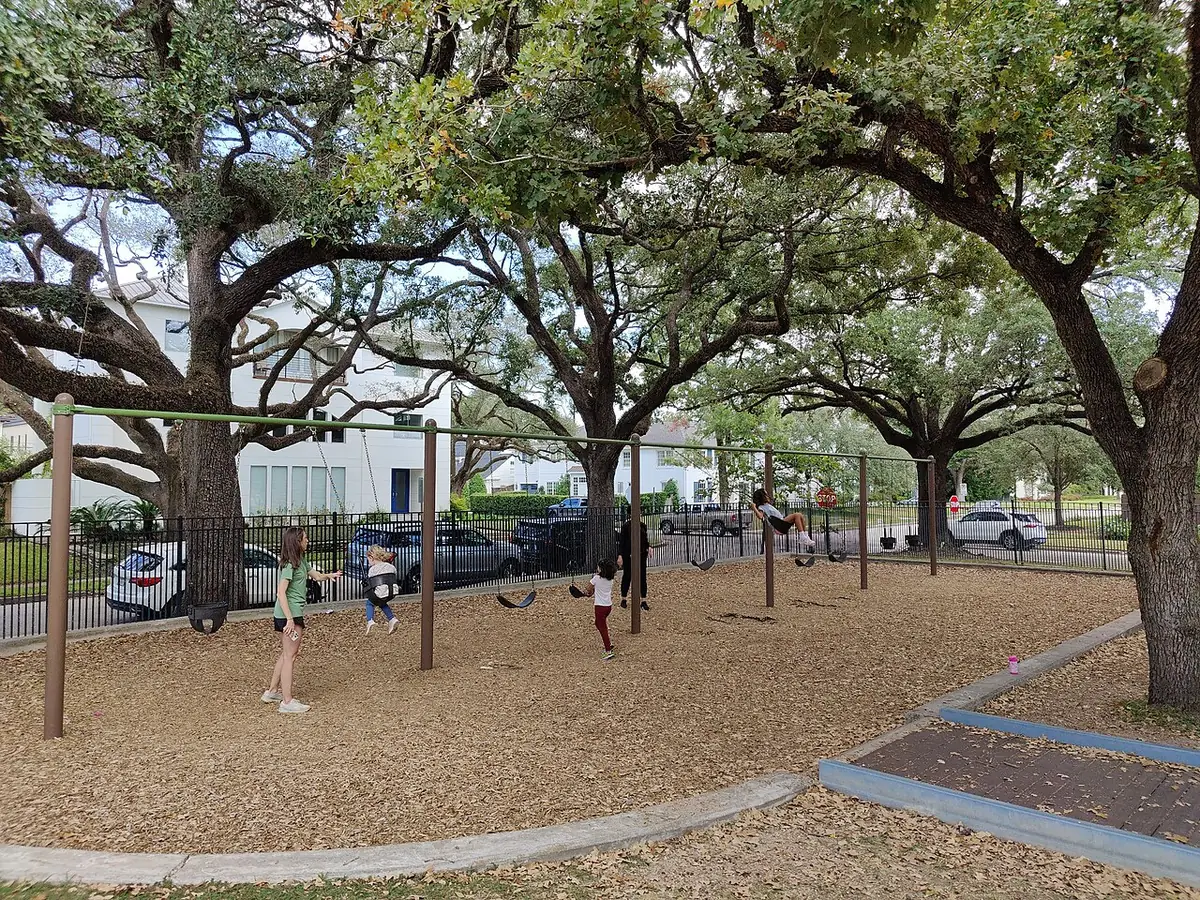
A shaded playground, popular with Houston families — Photo: EvanCarroll · CC BY-SA 4.0 · Wikimedia Commons
Committing to a lease in Houston reaches well beyond the administrative act of signing a contract. It means accepting the rhythm of a dynamic, sprawling and deeply car-based metro, where each decision about where to live redefines the balance of your daily routine. If you have measured the impact of commuting times, taken the reality of summer energy bills into your budget, and chosen your area on your real priorities rather than on looks, then you have everything you need to make the move to Texas work.
Take the time to reread every clause on early termination, on who is responsible for maintaining the air conditioning, and on the specific rules of the community before you commit. A strong rental application, prepared in advance with all the financial documents local leasing offices require, will let you secure the right home without being rushed by deadlines. Houston offers considerable scope for settling in well and living well, provided you approach its rental market with clear eyes, method and pragmatism.
In the end, a successful move rests on your willingness to accept the compromises that come with a large American metro. By putting closeness to the places that matter to you ahead of the headline cost per m2, you turn your rental into a genuine platform for personal and professional growth. Texas is there for the taking, as long as you go in with your eyes open and fully prepared.
Related questions
What is the average rent for a one-bedroom apartment in Houston?
A one-bedroom apartment generally rents for between $1,300 and $2,100 a month, depending on how close the building sits to central districts such as Downtown, Midtown or the Texas Medical Center, and on how old the building is.
Do you have to own a car to rent in Houston?
A personal vehicle is close to essential for living comfortably in Houston. The city is defined by vast urban sprawl, and its public transport network is concentrated mainly on a handful of key corridors.
What extra costs should you budget for when signing a lease in Texas?
Budget for a security deposit usually equal to one month's rent, an application fee charged by the leasing office, and the renters insurance policy that landlords require you to hold for basic risks.
How do electricity bills change over the summer in Houston?
Because air conditioning runs almost constantly against the subtropical heat and humidity from June to September, electricity bills can double or even triple compared with the milder shoulder months.
What does 'Loop 610' mean in the Houston property market?
Loop 610 is the major ring freeway that encircles the historic core and the central business districts of Houston. It is the geographic reference line people use to judge how central a property really is.
Do landlords readily accept pets in rental homes?
Most professionally managed apartment communities do accept pets, but they consistently require a non-refundable pet deposit plus a monthly pet rent per animal.
Which neighbourhoods keep daily commutes shortest?
People working in healthcare or finance have traditionally favoured Midtown, Upper Kirby, Montrose or Downtown so that they stay within easy reach of their employment hubs.
How do you check a home's flood history before signing?
Check the official floodplain maps published by the local authorities, and ask the landlord or property manager directly for a precise record of past weather events on that specific lot.
What is a homeowners association (HOA) in a subdivision?
An HOA is a private body that manages the shared areas of a neighbourhood or condominium and imposes strict rules on the exterior appearance of properties, on parking and on neighbourly conduct.
How long should you allow to find a rental home in Houston?
The rental market moves quickly, so start looking 30 to 45 days before your intended move-in date. Available homes generally find a tenant within a few days.
Property review of ting
No ting properties in Houston yet
Be the first — share it on ting and it shows up right here.