Moving to the emirate to rent a home means understanding the specifics of a fast-moving and heavily regulated market. This guide walks through every stage of the process, from choosing a neighbourhood to signing the contract, so you can make the transition with confidence.
Get the app
What nobody tells you.
Real prices, hidden costs and the traps to check before you commit.
What renting an apartment in Dubai really changes for you
Scroll
What renting an apartment in Dubai really changes for you
Moving to the emirate to rent a home means understanding the specifics of a fast-moving and heavily regulated market. This guide walks through every stage of the process, from choosing a neighbourhood to signing the contract, so you can make the transition with confidence.
Written by the ting.ad editorial team ·
Dubai in Street View: drag to look around.
Before you start hunting for a property, it is essential to hold your own way of living up against local realities.
Renting an apartment in Dubai is not simply a change of climate or a different tax setting. It means entering a very fast-moving property market where building standards, contracts and the way homes are managed follow their own distinct logic. On the surface, how smoothly the paperwork moves wins newcomers over immediately. Behind the promise of a quick move-in, though, sit contractual subtleties that demand constant attention. The landlord-tenant relationship and the guarantees you are asked for differ deeply from the European habits many arrivals bring with them.
Apparent flexibility and quick access to homesvsRigid payment and commitment terms
A lease in Dubai can be signed within days, but it often means handing over the whole year in one to four post-dated cheques, which weighs heavily on your cash position in the very first month.
Built-in services and very well equipped buildingsvsHigh service charges and additional fees
A pool, a gym and 24-hour security are the norm in most residential towers. Maintaining that equipment, central air conditioning and service charges can nonetheless add a great deal to your real monthly budget.
A rental market tightly regulated by the local authoritiesvsMore complexity in anticipating rent rises
The official rental index protects tenants against abusive year-on-year increases, but you need to get to grips with the digital regulatory tools set up by the Dubai Land Department in order to assert your rights.
What kind of expatriate or resident are you in Dubai's rental market?
Moving from a European way of life to how Dubai is organised as a city upends your daily reference points.
Settling in the emirate does not answer the same motivations whether you arrive alone to launch a business, as a couple for a senior role, or as a family looking for stability. Every location and every type of lease involves different trade-offs on commuting time, living space and how close you are to schools or workplaces. Pinning down your profile precisely will stop you choosing a district that does not fit your daily routine. The city's infrastructure means you have to plan your journeys, or every trip out becomes a major constraint.
Choosing centrality and mobility
You are most likely looking for a studio or a one-bedroom apartment in very well connected districts such as Downtown or Business Bay. Your priority is being close to co-working spaces, restaurants and the main road corridors. The trade-off is a smaller living area and a higher cost per square metre, offset by services on your doorstep and a lively urban life.
Balancing space, quiet and access
You favour calmer but still lively residential areas such as Dubai Marina, Jumeirah Village Circle or Dubai Hills Estate. You need a spacious two-room apartment, a balcony you can furnish and easy access to parks or walking routes. The challenge is finding the right balance between a quiet building and smooth access to the business districts at peak times.
Looking for stability and school infrastructure
Your criteria must centre on districts with well-regarded international schools, local clinics and secure green space. Areas such as Arabian Ranches, or family apartment developments inside integrated communities, meet those requirements. You have to accept being relatively far from the nerve centre of the city in exchange for a calmer setting that suits children.
What actually changes in your daily life when you arrive from abroad?
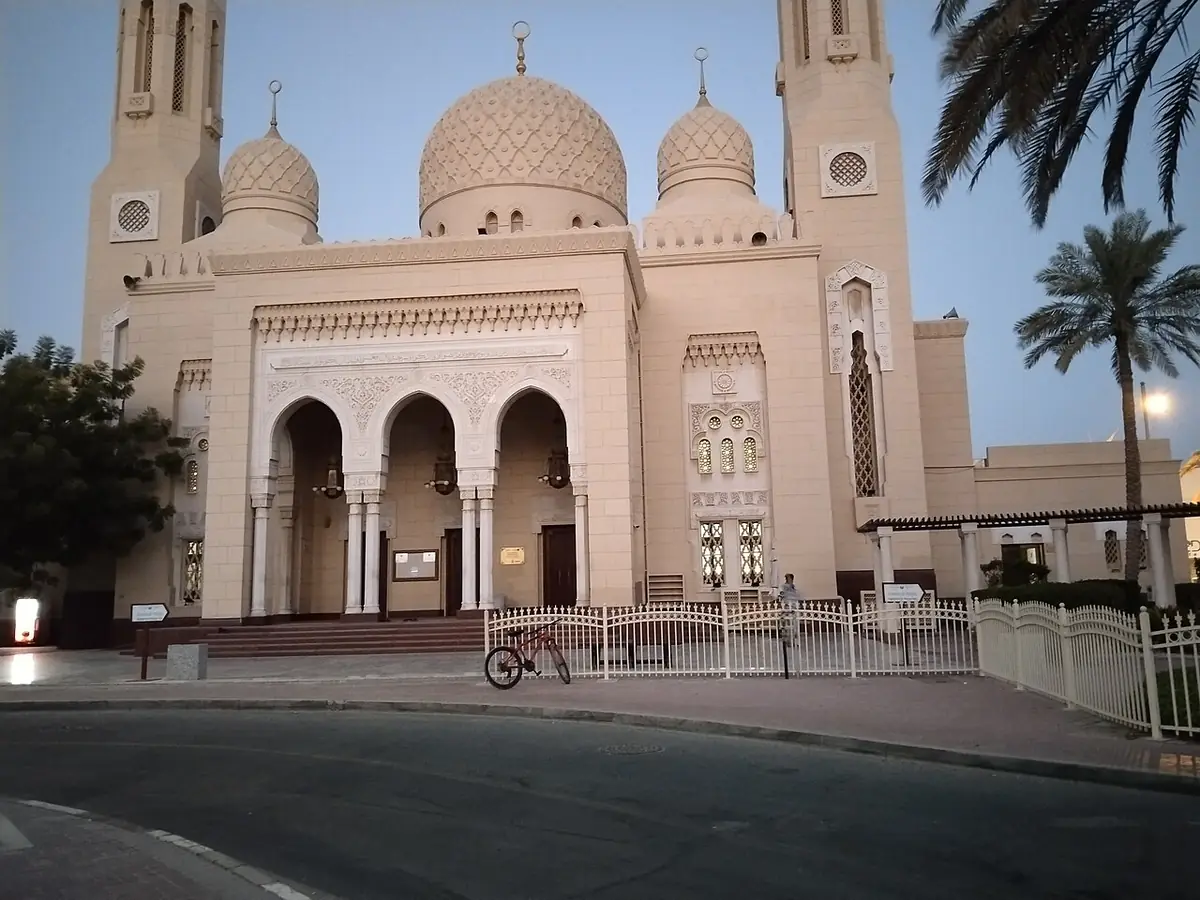
Jumeirah Mosque, a well-known landmark in Dubai — Photo: ZI Jony · CC BY-SA 4.0 · Wikimedia Commons
Once these principles are clear, the decisive question of which district to choose comes sharply into focus.
The gap between rental practice in most home countries and the way things work in Dubai becomes striking during your very first conversations with agencies. Where many European systems protect the tenant through long procedures and rigid multi-year leases, the Emirati system favours contractual speed and fully digital administration. Understanding these cultural and regulatory differences saves you costly misunderstandings when the tenancy contract is drawn up or when the property is inspected on your way out.
From abroad
In many home countries, rent is paid monthly by direct debit, with an annual review capped by an official reference index.
Dubai
In Dubai, payment is traditionally made by post-dated cheques (one to four a year) handed over in a single batch at signing.
You have to tie up a large slice of your annual budget as soon as you move in, which calls for disciplined cash management.
From abroad
In many home countries, the law imposes strict notice periods of one to three months before you can leave a home.
Dubai
In Dubai, leases run for a firm term of one year, and ending one early almost always triggers contractual financial penalties.
It is essential to be confident about your longer-term professional situation before committing to an annual rental, so you avoid penalty charges.
From abroad
In many home countries, service charges are reconciled once a year against documented building expenditure.
Dubai
In Dubai, general building maintenance costs are usually included in the headline rent or handled directly by the landlord.
You get immediate visibility on your total monthly cost, but you must check precisely who pays for minor repairs.
From abroad
In many home countries, the inventory on arrival and departure is done jointly on paper, with a bailiff called in if there is a dispute.
Dubai
In Dubai, the procedures are largely paperless, run through official apps and detailed photographic inventories.
Keep a digital record of every fault you spot as soon as you arrive, so your security deposit comes back in full.
How do you choose between the main residential districts for your rental?
Weighing up the districts leads naturally to examining the financial reality of the rents being charged.
Dubai stretches for tens of kilometres along the coast and inland, structured by major road corridors such as Sheikh Zayed Road. Each area has its own rhythm, architectural feel and typical population. Choosing a district depends as much on where you work as on your tolerance for peak-hour traffic. There is no universally perfect neighbourhood, only the one that suits your transport and leisure priorities.
Downtown Dubai
Constant buzz at the foot of the landmark towers, with dense traffic and a remarkable concentration of shops.
Suits
Professionals working in the financial centre who want an urban, walkable and very lively way of life.
Trade-off
Some of the highest rents per square metre in the emirate, and regular noise from tourism.
Dubai Marina / JBR
A cosmopolitan seaside atmosphere, paced by walks along the canals and the beach right on your doorstep.
Suits
Anyone who likes being able to do everything on foot, enjoy the sea and live in a highly international setting.
Trade-off
Very heavy traffic congestion at weekends and in the evenings around the access bridges.
Jumeirah Village Circle (JVC)
A human-scale residential district of small recent buildings, local parks and a more family-oriented feel.
Suits
Tenants after more generous floor areas and a moderate rent without cutting themselves off from the city.
Trade-off
Access depends almost entirely on a car, and the entry and exit roads are sometimes saturated in the morning.
Dubai Hills Estate
A vast, green development built around a golf course, offering welcome calm and a huge shopping centre of its own.
Suits
Families and professionals who want an open, modern and secure setting away from the bustle of the coast.
Trade-off
A high overall rental budget and public transport that is still being developed.
What do rents and rental running costs in Dubai actually look like?
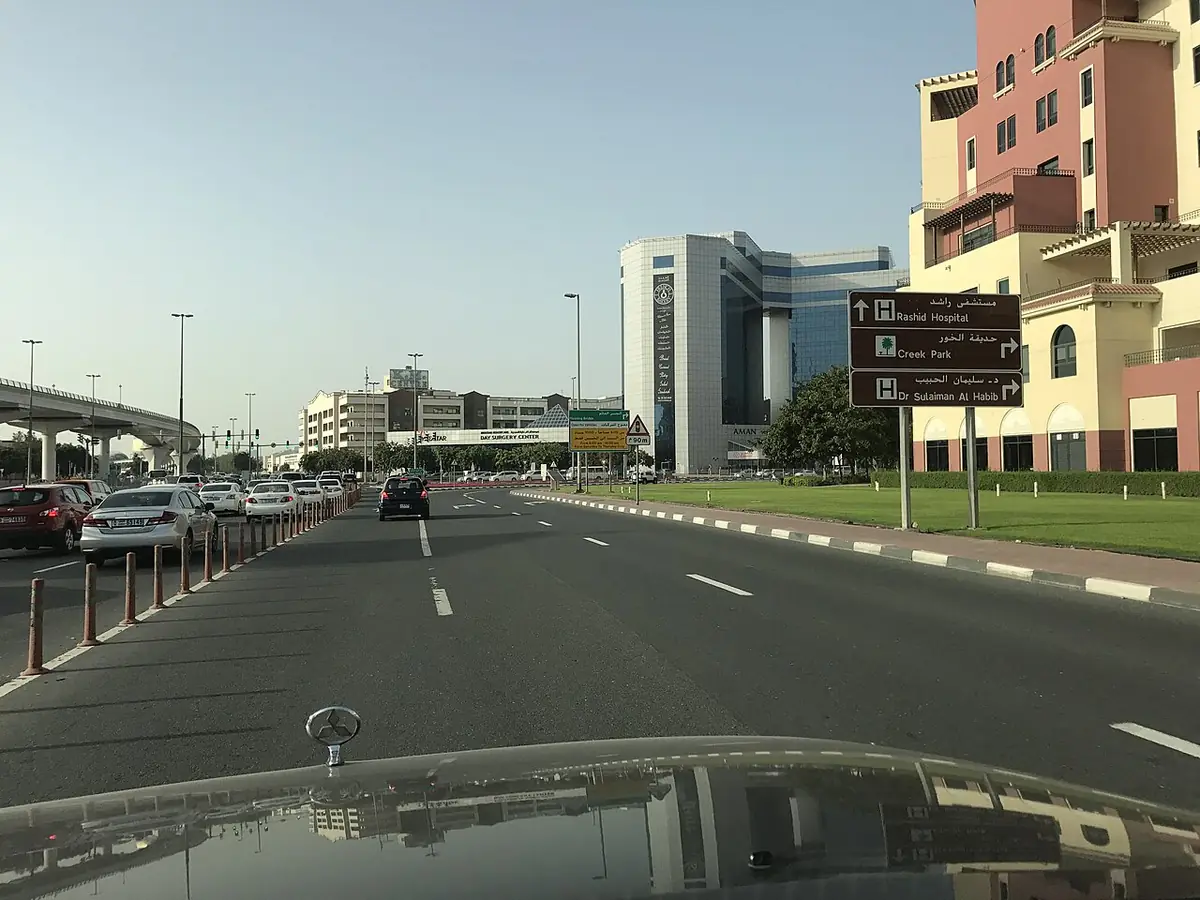
A typical Dubai street, wide and lined with modern buildings — Photo: Darvin.wilson · CC BY-SA 4.0 · Wikimedia Commons
Beyond the financial side, the legal nature of the contracts deserves meticulous attention.
Dubai's rental market does not run on a single price grid; it varies considerably with proximity to the waterfront, the age of the tower and the quality of the building's services. To build your budget you need to factor in, beyond the headline rent, the mandatory administrative fees, the municipal housing fee and the subscriptions to essential services. Anticipating these items carefully avoids any nasty surprise when the lease is finally signed.
dubaiTo rentApartmentestimate
Median price / m²AED 90Half the apartments sell below this
Median priceAED 9.9kthe average is 14% higher — a few very large properties pull it up
Most common2 bedrooms37 % of listings
Average size105 m²
By number of bedrooms
Bedrooms
Share of market
Avg price
Price / m²
Avg size
1
36 %
AED 7.25k
AED 104 +9 %
70 m²
2most common
37 %
AED 9.88k
AED 94
105 m²
3
20 %
AED 12.5k
AED 89best value / m²
140 m²
4
7 %
AED 19k
AED 100 +5 %
190 m²
Each row is an average, compared against the area average of AED 95 / m². These are indicative estimates of a typical local market, not a measured sample of live listings. Check current listings before relying on them.
Furnished or unfurnished: which choice makes your move safer?
Knowing these options leads straight on to the legal steps you must master before paying anything at all.
The Dubai market offers furnished properties in large numbers, designed for an immediate move-in, alongside unfurnished ones that leave room for your own furniture. The choice goes well beyond taste: it changes the shape of your initial spending, the flexibility of your lease and your responsibilities for maintaining the furnishings. Weighing the two options against how long you expect to stay is what gets you settled comfortably.
Option 1: the turnkey furnished apartment
You put down your bags in a fully equipped home, complete with appliances, bedding, kitchenware and sometimes even household linen. This formula suits people on temporary assignment or anyone who wants to avoid the logistics of an international move. In exchange, the advertised rent is markedly higher, and the detailed furniture inventory taken on arrival demands extreme care if you want to avoid disputes when you hand the property back.
What it changesYou save valuable time as soon as you arrive, but you accept a significant rental premium and take on responsibility for wear and tear on the furniture.
Option 2: the empty unfurnished apartment
You rent a bare space, often with a fitted kitchen and basic appliances but no furniture at all. This works best if you plan to stay for the long haul and want to fit the interior out to your own taste. Annual rents are more moderate, and you generally sit in a more stable legal position for renewing your lease over several consecutive years without an abrupt change of terms.
What it changesYou invest in your own furniture and handle the initial logistics, but you keep your monthly costs under control over time and build a genuine home.
The regulatory sequence you cannot skip before confirming your rental
Once the legal framework is settled, actually getting the move under way calls for methodical coordination.
Dubai's property system rests on strict digital transparency guaranteed by the government, and it tolerates no procedural shortcuts. Every intermediary must hold an official licence, and every payment must pass through secure, recorded channels. Skipping any one of these verification steps exposes a tenant to fraud, or to a lease the regulator will not recognise. Following the chain of legal checks scrupulously is your best insurance.
Identifying the property and checking the listing
Ask the developer or the estate agent for the official professional card issued by the regulator (RERA).
Check the landlord's title deed to confirm that they are genuinely the lawful owner of the home you viewed.
Draw up the standardised tenancy contract (Unified Tenancy Contract) approved by the emirate's regulatory bodies.
Issue the rent cheques made out to the exact name of the owner shown on the registered official documents.
Official registration of the contract on the Ejari platform to finalise the tenancy
How does the timetable of your move fit together, party by party?
Follow this method step by step and settling into Dubai becomes a secure, unhurried process.
Moving successfully into an apartment in Dubai is rather like a well-conducted score played by different institutions and service providers. From the landlord to the water and electricity authority by way of building management, each party steps in at a precise moment to switch on your utilities and confirm your right to occupy. Anticipating this timetable stops you spending your first few days without power or without access to the car park.
The tenantSigning the lease and handing over the chequesYou sign the unified contract and hand the post-dated cheques and the security deposit to the agency or the landlord.
The estate agentEjari registrationThe intermediary, or you yourself, registers the contract on the official portal to obtain the indispensable Ejari certificate.
DEWA as the utility providerOpening the water and electricity accountsYou apply online, pay the deposit and activate the meters for the date you move in.
Building managementObtaining the moving permitYou present your Ejari certificate to the tower's management office to book the service lift and clear the removal truck.
Technical providersInternet installation and telecoms connectionYou schedule the local operators' visit to connect your home to the high-speed fibre network.
Apartment or villa in Dubai: weighing height against independence
Once the type of property is settled, what remains is to look at the overall financial reality of your move.
Choosing between an apartment and a villa in Dubai shapes your whole daily routine, your maintenance budget and your commute. The residential towers of Downtown, Dubai Marina or Jumeirah Village Circle offer vertical living, characterised by shared facilities, centralised security and immediate proximity to fast road corridors such as Sheikh Zayed Road. Renting an apartment means handing the management of common areas, the pool and the central air conditioning entirely to the developer or the building association, which greatly simplifies the move for a newcomer unfamiliar with local contractors.
Opting for a villa in districts such as Arabian Ranches, Jumeirah Park or The Springs redefines your living space instead through horizontality, a private garden and no neighbours directly above or below. That configuration appeals particularly to families with children or households with pets, but it brings greater responsibility for landscaping, pest control and dealing with mechanical or electrical breakdowns. Standalone villas and those in gated compounds also mean accepting a more marked distance from the main business centres, which almost always translates into two cars in regular use per household.
Financially, the distinction is not limited to the headline rent shown on the property portals. Apartments tend to come with service charges that are included or moderate, whereas villas call for substantial budgets for individual air conditioning and outdoor irrigation, especially through the summer months when the electricity bill soars. Apartment buildings also offer faster rental liquidity if you have to leave early, while villa rentals follow more rigid seasonal cycles dictated by the international school calendar and the transfer dates of expatriate staff.
Your final decision should therefore rest on a clear-eyed assessment of how much daily commuting you can tolerate and how willing you are to handle the practical mishaps of an independent property. If you value flexibility, connected city living and minimal upkeep, the urban apartment remains the ideal launch pad. If you are after privacy, room to breathe and a strong sense of community away from the vertical crush, the villa makes its own case, at the price of tighter day-to-day logistics.
What overall budget do you need to live comfortably in an apartment in Dubai?
With those figures in place, let us look concretely at the rhythm of a typical day in this environment.
Building your budget in Dubai means going well beyond the monthly rent quoted in the listings. You have to factor in local payment terms, the municipal fee that is invisible but mandatory, and utility bills whose seasonality weighs heavily on your cash flow. A realistic estimate protects you against financial dead ends and secures a calm move into a demanding rental market with little patience for late payment.
Estimated monthly and annual cost items for an apartment in Dubai
Cost item
One-bedroom apartment (central)
Two-bedroom apartment (outer areas)
Usual payment method
Average annual rent
80,000 to 120,000 AED
90,000 to 140,000 AED
1 to 4 cheques a year
Agency fee
5% of the annual rent
5% of the annual rent
Payable in cash at signing
Security deposit
5% to 10% of the rent
5% to 10% of the rent
Refunded when the tenant leaves
Electricity, water and cooling (DEWA)
600 to 1,200 AED / month
900 to 1,800 AED / month
Monthly direct debit
Broadband internet and phone
350 to 500 AED / month
350 to 500 AED / month
Monthly subscription
Municipal housing fee
5% of the annual rent (spread out)
5% of the annual rent (spread out)
Collected through the DEWA bill
The amounts shown exclude market fluctuations and initial connection charges.
Health, schools, transport: an ordinary Tuesday in the life of a Dubai resident
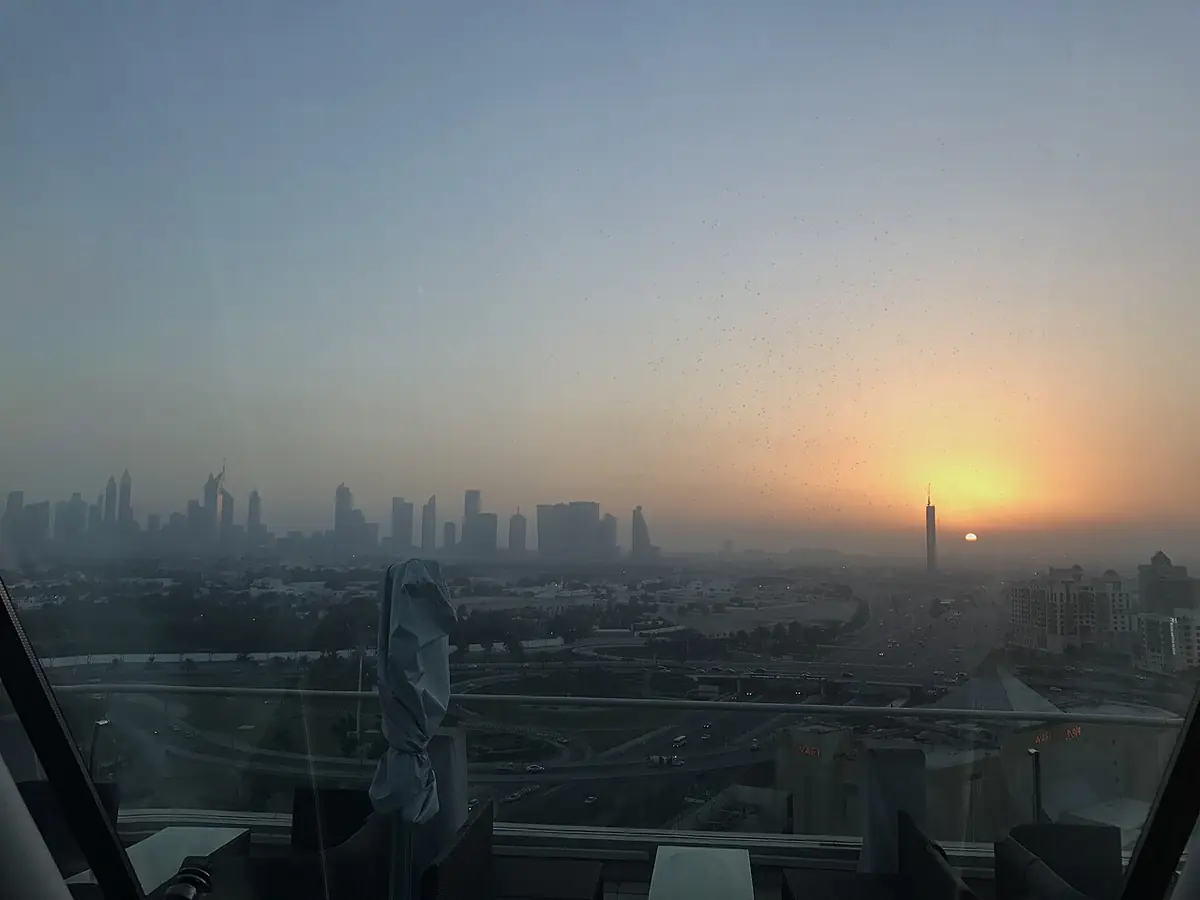
Dubai's skyline at sunset, a fitting close to the day — Photo: Lxs · CC BY 4.0 · Wikimedia Commons
Beyond a routine that looks smooth on the surface, a closer look at the market reveals contractual subtleties that often go unnoticed.
Grasping what living in Dubai is really like means decoding how a typical weekday is organised hour by hour. Between traffic on the main corridors, school timetables and working hours shaped by the climate, every hour follows a logic of efficiency. This sequence highlights how crucial the location of your apartment is relative to the places you actually spend your time.
07:00Residential district (JVC or Dubai Marina)Waking up and setting off early to avoid the saturation of major corridors such as Al Khail Road or Sheikh Zayed Road, where traffic builds quickly from 07:30 onwards.
07:45International schoolDropping the children at one of the emirate's many private British or American schools, a moment when the streets around the campuses call for patience and a parking plan.
08:30Business district (DIFC or Business Bay)Arriving at the office in a well-connected tower with efficient underground parking, marking the start of the morning's work in an air-conditioned, multicultural setting.
13:00Work district or shopping centreA proper or quick lunch break, often taken in one of the many food halls built into the business complexes or reachable through the air-conditioned metro walkways.
18:00Local supermarket (Spinneys or Carrefour)A last-minute shop for the household in the late-opening convenience stores built into the base of residential buildings to make life easier for working residents.
20:00HomeWinding down back in the apartment, making use of the building's facilities such as the rooftop pool or the gym, before getting ready for the next day.
What online property listings will never tell you about apartments in Dubai
Knowing these blind spots helps you avoid the disappointments newcomers report most often.
Rental portals and glossy developer brochures systematically leave out major practical matters that weigh heavily on your budget and your comfort. Behind flattering wide-angle photos sit technical, regulatory and contractual realities worth identifying before you sign anything binding. Here are the blind spots that only long-term residents' experience brings to light.
Which way the apartment faces, and summer overheating
An apartment facing due west or south takes intense heat from May to September. That exposure translates into DEWA electricity bills that can double compared with a north- or east-facing home, while wearing the air conditioning units out prematurely.
Noise from nearby construction sites
Dubai is a permanent building site and the pace of development frequently means work on adjoining plots. An open view today can turn into a wall of concrete and noisy cranes within months, without the landlord being able or willing to prevent it.
How good the sound insulation really is
Many developments built at speed suffer from insufficient acoustic insulation between floors and party walls. Footsteps from the neighbours above or vibration from lift machinery can degrade the quality of your sleep for good.
The strict rules on subletting and sharing
Local legislation regulates occupancy very firmly and formally prohibits any undeclared subletting or any sharing arrangement not approved by the landlord and the authorities. The fines for breaching these Ejari registration rules are designed to deter.
The misjudgements you only discover after six months in your apartment
For all its undeniable appeal, this rental market does not suit every profile.
Looked likeA highly competitive rental offer, paid in a single annual cheque in return for a spectacular discount.
Turned outFar too much cash tied up, leaving the household without liquidity for other moving-in emergencies and weakening your negotiating position in any dispute with the landlord.
Would have caught itAlways favour spreading the rent over four cheques, even if that means negotiating a slightly higher headline figure, so you keep control of your cash flow.
Looked likeA supposedly central location that in fact sat in an area poorly linked to the main motorway slip roads.
Turned outA daily ordeal of local congestion at peak times, turning every trip out of the neighbourhood into a thirty-minute grind before you even reach the fast corridors.
Would have caught itTest the journey yourself at peak times (08:00 and 18:00) between the building you are considering and your workplace or school before signing the tenancy contract.
Looked likeAn air conditioning maintenance arrangement informally included by the estate agent, with no precise written clause.
Turned outA compressor failure in the middle of August, with the repair charged unilaterally to the tenant by a landlord acting in bad faith.
Would have caught itInsist on an explicit clause in the Ejari contract stating clearly that major corrective maintenance and replacement of worn air conditioning parts fall to the landlord.
Looked likeA fast-developing district promising future amenities within walking distance of the tower.
Turned outShops, supermarkets and pharmacies that take years to open, forcing you into the car for the smallest everyday purchase.
Would have caught itCheck on site how far the local shops have actually been completed, and never rely on the off-plan promises in marketing brochures.
Who really should not rent or settle in an apartment in Dubai?
Having reached the end of this analysis, it is time to make your decision clear-headed.
Dubai's media appeal sometimes masks a demanding reality that does not match what every internationally mobile professional expects. The pace of life, the structure of fixed costs and the emirate's administrative organisation call for particular financial and psychological dispositions. Identifying up front which profiles do not fit this ecosystem avoids costly and personally draining false starts.
Professionals looking for regulatory and contractual stability fixed over the long term
→To head instead for mature European markets with very strict tenant protection laws.
Dubai's rental market, regulated though it is by RERA and the rental index, remains a highly dynamic environment where year-on-year price swings can force frequent moves when demand rises sharply.
People escaping car-dependent culture who rely on spontaneous journeys on foot
→To favour dense, walkable European or Asian cities with extensive underground transport networks.
Despite the metro's continuing expansion, Dubai's urban layout, shaped by wide motorways and long distances between districts, makes daily use of a personal car or ride-hailing indispensable for a full social and professional life.
Tight budgets with no substantial rainy-day savings
→To build up their financial footing at home first, before considering a move to the Emirates.
The cost of daily life, combined with the requirement to pay rent in advance and the initial setting-up costs (deposit, agency, connections, furniture), forgives no budgeting errors and exposes fragile profiles to immediate financial stress.
So, are you ready to take the step and set up home in Dubai?
Moving into an apartment in Dubai is a decision that shapes your life, and it should come neither from a holiday impulse nor from a short-term search for tax efficiency. The emirate offers a secure, highly connected and professionally stimulating setting, provided you accept its economic rules and its distinctive urban dynamic. How successfully you settle in will depend directly on how rigorously you prepare your budget and how clearly you see the constraints of the local market.
Take the time to revisit your underlying motivations, to check that your income really matches what annual leases demand, and to surround yourself with recognised professionals registered with RERA. A successful property project in Dubai is built on sound contractual foundations, a rigorous choice of location and careful anticipation of the additional costs that first-time arrivals so often underestimate.
If you have that clear view, if your cash flow is under control and you are ready for the pace of a city in perpetual motion, then your rental plans will find ideal ground here. All that remains is to start searching on the ground, armed with the factual reference points that turn this opportunity into a lasting and rewarding move abroad.
Related questions
How does the cheque system for paying rent in Dubai work?
Rent is traditionally paid through post-dated cheques handed to the landlord or the agency when the lease is signed. The number of cheques (usually between one and four a year) is negotiated directly as part of the offer and often affects the headline annual rent being asked.
What is the Ejari system and why is it mandatory?
Ejari is the official system for regulating and registering tenancy contracts put in place by the Government of Dubai. It protects both tenant and landlord legally, and it is indispensable for many administrative steps, such as opening DEWA utility accounts or sponsoring family members.
What additional costs should you budget for when signing a tenancy contract?
You must budget for the estate agency commission (generally 5% of the annual rent), the security deposit (5% to 10%, refundable at the end of the lease), and the connection and deposit charges for water and electricity with DEWA.
Can you end a tenancy contract in Dubai before its term?
Ending a lease early depends on the specific clauses written into the contract. Without a specific exit clause (break clause), a landlord will usually require a financial penalty equivalent to two or three months of rent before accepting a unilateral termination.
How are rent increases calculated from one year to the next?
Rent rises are strictly framed by the official rental index published by the Dubai Land Department (DLD). No landlord can impose an arbitrary increase above the legal thresholds, which are set according to the gap between the current rent and the median market value.
Should you rent a furnished or an unfurnished apartment when you move?
Unfurnished apartments carry a more attractive annual rent and leave you completely free to fit out the space, but they require a significant upfront outlay on furniture. Furnished properties suit professionals on short assignments or anyone who wants to move in immediately without heavy logistics.
How much does air conditioning affect monthly electricity bills?
Air conditioning accounts for the largest share of a household's electricity use in Dubai, especially through the summer months when outdoor temperatures peak. It is therefore essential to check how energy efficient the equipment is and which way the home faces if you want to keep your DEWA budget under control.
Which areas of Dubai suit families with children best?
Districts such as Dubai Hills Estate, Arabian Ranches, The Springs and Jumeirah Village Circle are particularly popular with families thanks to their green space, strong international schools and secure low-rise or semi-collective housing.
How are breakdowns and repairs in the apartment handled?
How repair costs are split is set by local law: small routine maintenance jobs (light bulbs, minor seals) fall to the tenant, while major structural faults (air conditioning, built-in plumbing, electrical installations) are the landlord's responsibility.
Do you have to use an estate agent to rent in Dubai?
Although it is theoretically possible to deal directly with private landlords through classified-ad platforms, the vast majority of the market goes through agents licensed by RERA, which guarantees that the unified forms are compliant and that the transaction is secure.