Valuing an apartment in Dubai calls for a careful reading of the district, the service charges and the local legal framework. This guide sets out the mechanics that decide what your property is actually worth in the emirate.
Get the app
What nobody tells you.
Real prices, hidden costs and the traps to check before you commit.
What a Dubai apartment valuation is really measuring
Scroll
What a Dubai apartment valuation is really measuring
Valuing an apartment in Dubai calls for a careful reading of the district, the service charges and the local legal framework. This guide sets out the mechanics that decide what your property is actually worth in the emirate.
Written by the ting.ad editorial team ·
Dubai in Street View: drag to look around.
Beyond the headline figures, how a property is used day to day remains the first test of whether a valuation holds.
Putting a figure on a property in the emirate is not a matter of pricing bricks and mortar in a sunny location. Between the promise of a high rental return and the reality of a market in constant motion, a valuation has to reconcile demanding financial logic with a way of life built on services. Owners quickly discover that the real value of an asset does not rest on its position on the plan alone, but on how well the building is managed and on how durable the surrounding infrastructure turns out to be.
A headline gross return often above that of major European capitals, which lifts the price a buyer will pay.vsService charges indexed to premium facilities, which eat into the net margin and pull the same figure back down.
It is not enough to look at the rent collected each month. The cost of maintaining pools, centralised air conditioning and round-the-clock security feeds straight into the yield, and therefore into any valuation built on that yield.
An ultra-modern, secure setting that works from the day the keys are handed over, which supports the asking price.vsAn architectural sameness that can leave a unit with no distinguishing feature to price above its neighbours.
New schemes offer flawless finishes and integrated equipment, but the uniformity of residential towers means the future view is often the only variable left, and it is what separates two otherwise identical valuations.
Apparent liquidity, carried by the city's international pull and steady inbound flows, which makes comparables easy to find.vsSharp segmentation, where poorly positioned units take heavy discounts whenever the market turns.
The market reacts fast to global economic shifts. An apartment well served by the metro holds its value, while an isolated pocket softens as soon as supply outruns demand, so the date of a comparable matters as much as its address.
Why you want the valuation changes which figure is the right one
That shift in reference points unsettles the assumptions owners arrive with from other markets.
Every owner comes to a valuation with a specific purpose, and that purpose redefines which comparables and which district benchmarks apply. Whether the property is a permanent home, a pure yield play or a seasonal base, the figure that matters is not the same. Working out what you actually need the number for is what stops you accepting a headline estimate drawn from a developer's promotional material.
The occasional-use owner
This case turns on income, so the valuation should be built from short and medium-term letting evidence as much as from sale comparables. Coastal and central districts offer the deepest transaction record for this kind of use, which makes the estimate more reliable. Platform constraints and concierge fees absorb a meaningful share of the nightly rate, and a yield-based figure that ignores them will be too high. Immediate proximity to transport usually carries more weight in the number than raw floor area.
The resident family owner
Here the benchmark moves to managed communities and human-scale buildings with parks, where comparables are scarcer and turnover is slower. Well-connected outlying areas deliver more generous floor areas at lower rates per square foot, so a district-wide average will understate a large unit and overstate a small one. Access to schools and health facilities is priced into these locations, and it is worth checking that any comparable you rely on shares that access.
The long-term asset holder
A stable regulatory framework and the absence of tax on rental income are what underpin values in this market, and they are the reason a long-horizon figure can be held with some confidence. Weight your estimate towards buildings by developers known for construction quality and for sound owners association management, because those are the ones whose values hold. Future resale, and therefore today's honest valuation, depends directly on whether the building can go decades without serious deterioration.
Valuing property here when you come from abroad: what genuinely changes
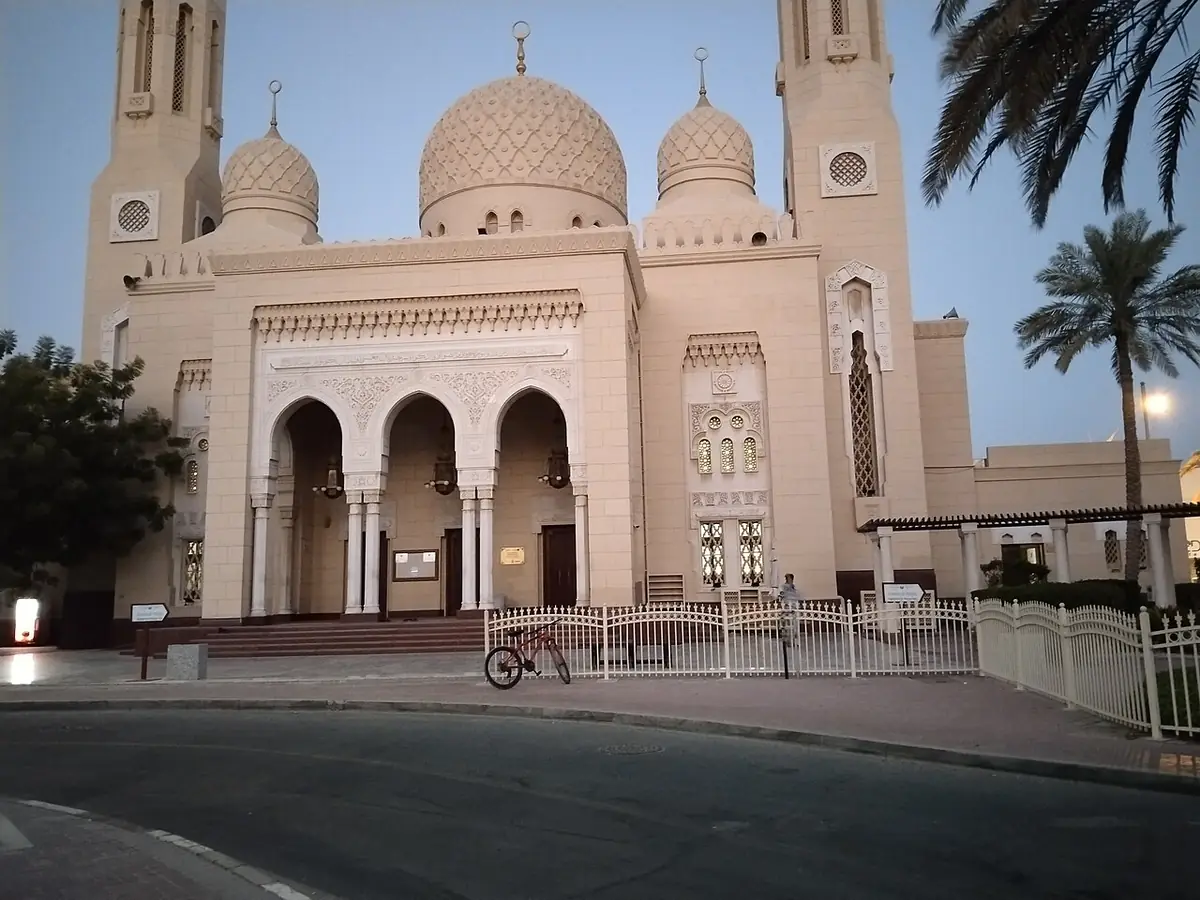
Jumeirah Mosque, a well-known landmark in Dubai — Photo: ZI Jony · CC BY-SA 4.0 · Wikimedia Commons
With those reference points in place, the question becomes which district benchmark your property should be measured against.
Many overseas markets rest on a long-established legal framework, an official intermediary who guarantees the transaction, and timelines measured in months, all of which produce a slow, heavily documented paper trail for valuers to work from. In Dubai the law is built for the speed and fluidity of international transactions, which changes both the evidence available and how fast it goes stale. Understanding those structural differences prevents you from applying the wrong yardstick to your own property.
From abroad
A traditional framework where a formal intermediary handles the transfer over roughly three months, with multiple technical surveys attached to the file.
Dubai
Direct registration with the Dubai Land Department through licensed agencies and approved developers.
Transactions close far more quickly, so the comparable evidence behind a valuation refreshes in weeks rather than months, and a figure more than a quarter old should be treated as dated.
From abroad
Building charges set by statute and voted through at an annual general meeting of owners.
Dubai
Service charges calculated per square foot (RERA service charges) and administered centrally by the tower's management.
You do not vote on works the same way; the maintenance budget is set by the regulator's auditors to keep the tower to standard, which makes the published charge per square foot a hard input to any valuation rather than a negotiable one.
From abroad
Heavy local taxation on rental income and substantial recurring property taxes.
Dubai
No tax on rental income and no annual property tax for individual owners.
Net return sits very close to gross return, which is why yield-based valuations in Dubai land higher than the same arithmetic elsewhere, provided you allow for the initial registration cost (generally 4 percent paid to the Land Department).
From abroad
Strong protection for a sitting tenant, with tightly capped rent increases.
Dubai
A market regulated by the official RERA Rental Index, which adjusts rents in line with market movements.
Rents reset more dynamically, so an income-based valuation tracks inflation better but goes out of date faster, and the index needs rechecking each time you revisit the figure.
Which district benchmark should your apartment be valued against?
These district dynamics translate directly into price bands that deserve close reading.
The city grew around several very distinct centres of activity, each answering a precise pattern of use, and each with its own price behaviour. Which benchmark applies to your property depends as much on its budget bracket as on tolerance for traffic and appetite for urban intensity. Reading the micro-markets closely is what keeps a valuation from being anchored to an overpriced district or to one poorly served by public transport.
Downtown Dubai
Constant activity at the foot of landmark towers, with heavy footfall and a concentration of cultural and retail options.
Suits
Valuations that lean on short-let income evidence, where the depth of demand supports the higher end of a range.
Trade-off
Rates per square metre among the highest in the emirate, and frequent congestion at peak times, which limits how far a figure can be pushed further.
Dubai Marina and JBR
A waterfront setting built around yacht marinas and beaches within walking distance.
Suits
Properties where a sea or marina outlook is the value driver, and where two units in the same tower can differ sharply on view alone.
Trade-off
Very high population density and persistent parking difficulties for residents and their guests, which weigh on the ground-level units.
Business Bay
A business district still changing shape, offering modern towers connected to the canal and the main highways.
Suits
Owners looking for a central position at a more moderate rate per square foot, where the benchmark is still forming.
Trade-off
Numerous sites still under construction on adjoining streets, regularly redrawing traffic patterns and making recent comparables less stable.
Jumeirah Village Circle (JVC)
A low-rise, semi-urban residential feel, made up of neighbourhood parks and mid-sized buildings.
Suits
More modest price brackets where an attractive gross yield, rather than a headline rate per square foot, is what supports the figure.
Trade-off
Relative distance from the beaches and near-total reliance on a car for daily journeys, which caps the ceiling on values here.
What apartments actually change hands for, district by district
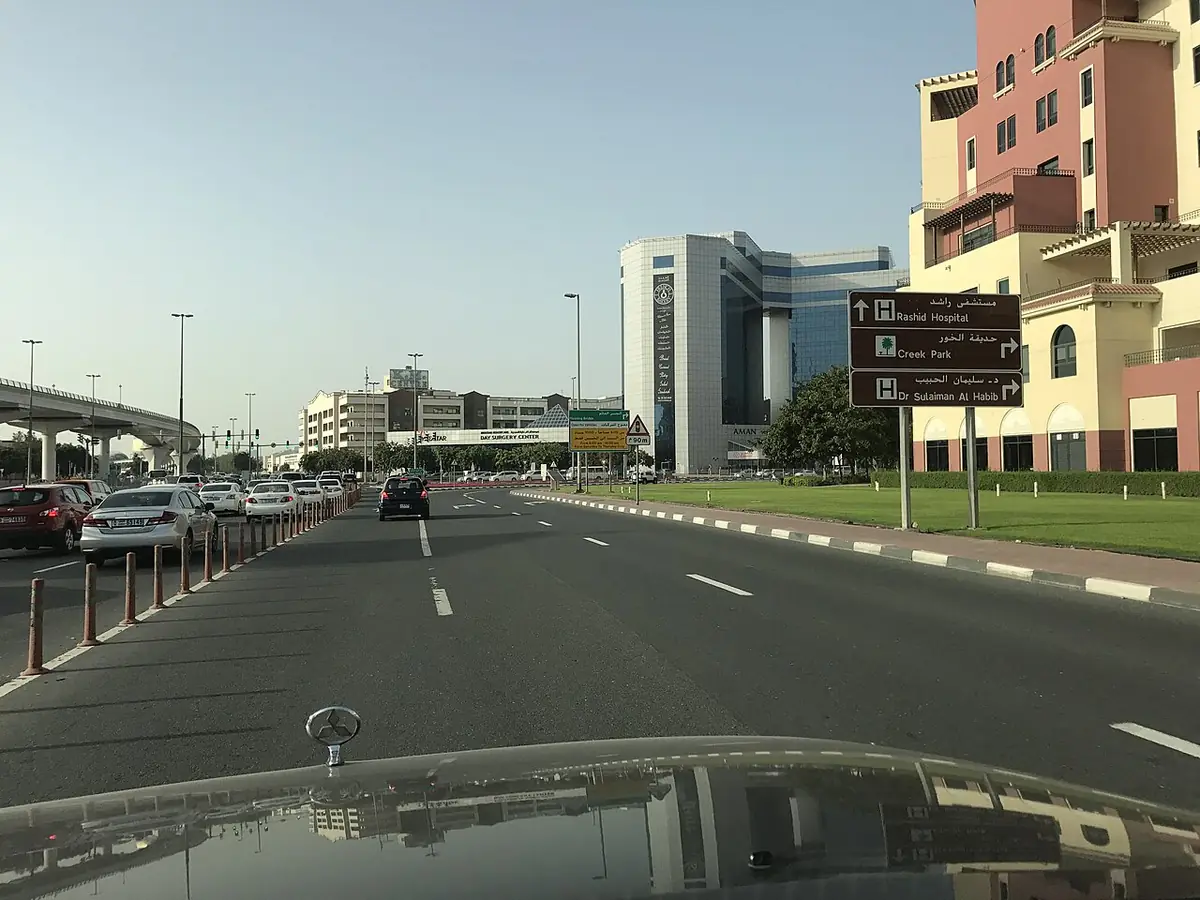
A typical Dubai street, wide and lined with modern buildings — Photo: Darvin.wilson · CC BY-SA 4.0 · Wikimedia Commons
Beyond the headline numbers, the legal nature of the ownership right deserves particular attention.
Valuing a property is not a matter of reading the price printed in a developer's brochure. You have to take in the full set of unavoidable ancillary costs and anticipate how the figure shifts with the layout and the age of the building. Official land registry data is what lets you set realistic ranges for each major zone of the city, and it is the only evidence a bank valuer will treat as decisive.
dubaiFor saleApartmentestimate
Median price / m²AED 14,250Half the apartments sell below this
Median priceAED 1.57mthe average is 14% higher — a few very large properties pull it up
Most common2 bedrooms37 % of listings
Average size105 m²
By number of bedrooms
Bedrooms
Share of market
Avg price
Price / m²
Avg size
1
36 %
AED 1.14m
AED 16,350 +9 %
70 m²
2most common
37 %
AED 1.56m
AED 14,850
105 m²
3
20 %
AED 1.97m
AED 14,100best value / m²
140 m²
4
7 %
AED 2.99m
AED 15,750 +5 %
190 m²
Each row is an average, compared against the area average of AED 15,000 / m². These are indicative estimates of a typical local market, not a measured sample of live listings. Check current listings before relying on them.
What you actually hold: freehold, leasehold and what each is worth
A grip on these legal points leads straight into the practical steps of getting a figure agreed.
The clarity of the legal framework governing property ownership by foreign nationals is one of the pillars of the market's standing, and it is also the first thing that separates two apparently similar valuations. It is essential to distinguish the zones open to international freehold ownership from those held under other arrangements. That distinction secures your investment over the long run and determines how a valuer treats the asset.
Freehold (outright ownership)
This arrangement lets any foreign investor, resident or not, take full and complete ownership of the property and of the land it stands on. The Title Deed is issued directly in your name by the official services of the Dubai Land Department, with no time limit attached.
What it changesYou are free to let, resell, bequeath or mortgage the apartment on the same terms as a local citizen, and it is that freedom, and the buyer pool it opens up, that lets a freehold unit be valued straight off secondary-market comparables.
Leasehold (long lease)
Less common in recent residential schemes but present in certain specific zones, this form confers a long-term right of use, generally between 30 and 99 years. The land belongs to a third party or a public entity, and the owner holds the building for the term agreed in the original contract.
What it changesCheck exactly how many years remain on the lease before relying on any figure, because value erodes as the contractual expiry approaches and a comparable drawn from a freehold unit will overstate what a leasehold flat is worth.
The rule to grasp before you accept a figure for your apartment
This methodical route fits inside a wider timetable that has to be steered with the right people.
The famous speed at which contracts close here should never obscure the need for careful checking beforehand, and the same applies to the number you put on your property. From assembling the paperwork to the moment a figure is signed off, each step follows a strict protocol designed to protect both sides. Skipping one of them exposes you to avoidable administrative complications and to a valuation nobody will stand behind.
Assemble the property file and agree the basis of the estimate with the owner or their licensed representative.
Confirm the property's registration with the Dubai Land Department and obtain the no objection certificate (NOC) issued by the developer or the tower manager, since an unresolved charge or restriction changes what the unit is worth.
Pull the recorded comparables for the same tower and layout, and set them against the formal agreement stage (Form F / Memorandum of Understanding), where an escrowed deposit of generally ten percent of the total marks the price the market actually accepted.
Test the figure against a lender's view by preparing the financing file or the equity in foreign currency, checking exchange and international transfer procedures, because the bank's own valuer will not simply adopt your number.
Adjust for condition and specification against the standard applied at the registration centre (Registration Trustee) when the new Title Deed is issued, so that fit-out, floor level and view are priced rather than assumed.
A defensible figure for the apartment, documented against recorded transactions and against the running cost of the water and electricity services attached to it.
How a valuation is arrived at, step by step
Establishing what an apartment in Dubai is worth draws in several regulated parties whose roles are tightly defined. Knowing the order in which they act lets you anticipate the administrative timings and keep your bank, your agent and the local authorities working from the same figure.
The ownerBrief and initial expectationSet out the purpose of the valuation, gather the title, floor plan and charge statements, and put an opening figure in writing through an agent licensed by the regulator (RERA).
The estate agentComparable evidence and Form F recordAssemble recorded sales for the same tower and layout, including prices agreed on the official unified contract (Form F), which show what buyers actually paid rather than what sellers asked.
The developer or managerNOC and charge positionProcess the no objection certificate request, confirming that charges are up to date and the unit can be transferred, since arrears and restrictions both reduce the value that can be relied on.
The escrow bodyEvidence of the deposit stageThe ten percent deposit held in a regulated escrow account by an approved third party until transfer day marks the point at which a figure has been tested by a real buyer.
The Dubai Land DepartmentRecorded transaction valueFinal validation of the transaction at the official or digital counter, payment of the registration fee and immediate issue of the new title, which puts the agreed figure on the public record for the next valuation.
The new ownerRunning costs confirmedOpening the utility accounts (DEWA) and, where relevant, appointing a letting manager, which fixes the holding costs that any future income-based valuation has to net off.
Apartment or villa in Dubai: how the two are valued, and why the gap matters
Once the property type is settled, the question of total cost of ownership and how it is split comes straight to the front.
Comparing an apartment in an iconic Dubai tower with a spacious villa in a gated community is not a simple matter of floor area or entry price, and the two are not valued by the same method. On one side, the apartment offers unmatched central positioning, hotel-style services, permanent security and a clear view over the skyline or the Persian Gulf from height, and every one of those attributes has an observable price in the recorded transactions for its building. It is the choice of convenience, of being minutes from business centres such as DIFC or Downtown, and of maintenance handled entirely by someone else, which is why apartment values track a visible per-square-foot benchmark that moves with the tower rather than the district. On the other side, the villa embodies space, privacy, a private garden often with a pool, and a sense of belonging to a green residential village away from the noise of the main roads. Those qualities appeal particularly to families settling for the long term, but they are harder to reduce to a rate per square foot, and a villa valuation depends far more on plot, aspect and the individual condition of the house.
The structure of the Dubai market sharpens that split through widely varying service charges and distinct value dynamics by district. Apartments in free zones or freehold districts such as Dubai Marina, Business Bay or Jumeirah Village Circle benefit from exceptional liquidity, which in valuation terms means a dense supply of recent, closely matched comparables. It is generally simpler to resell or let a vertical unit quickly, given strong demand for compact, functional space, and that same depth is what makes an automated estimate reasonably accurate for a standard one or two-bedroom flat. Villas in mature communities such as Arabian Ranches, The Springs or Emirates Living, by contrast, sit on a limited land supply with demand structurally ahead of supply for good family homes. That scarcity protects villa values effectively over the long run, but it also means far fewer comparables, a wider credible range, and annual service charges calculated per square foot that can surprise anyone budgeting from the headline price alone.
Beyond the building itself, it is the daily use of the property that should shape which figure you trust, because a valuation built on the wrong assumption is worse than no valuation at all. If you travel frequently, spend several months a year outside the Emirates, or value walkability and amenities at the foot of your building, the apartment is the obvious form, and its value can be tracked at a distance from recorded sales in the same tower. Letting management from abroad is straightforward, since professional management companies operate inside most of the large towers, and their fee schedules give you the net income figure a yield-based estimate needs. If instead you want family life, a garden, international schools a few minutes away by car and generous space with no direct overlooking, the villa in a gated community changes your daily experience of Dubai entirely, and a proper on-site inspection becomes essential to any figure. Weighing your own priorities and your time horizon in the emirate remains the best filter for deciding which of the two your valuation should be built on.
Which costs a valuation has to account for, and which sit outside it
Beyond the raw figures on paper, it is the rhythm of an ordinary day that shows what the numbers mean in practice.
The value of an apartment in Dubai is never the headline figure printed on the sales mandate or on the online portals. You have to fold in the full set of unavoidable and recurring ancillary costs to judge what the property is genuinely worth to hold. From the land registration fee to the annual service charges, every line follows strict rules set by the local authorities and the developers. Transaction costs are one-off and sit outside the valuation of the asset itself; the running costs below sit inside it, because they are what a buyer discounts for.
Transaction costs and initial fees, outside the valuation figure
Cost line
Amount or rate
Paid to, and how
DLD fee (registration)
4 percent of the purchase price
Dubai Land Department, payable at closing
Estate agency fee
2 percent of the purchase price
Instructed agency, 5 percent VAT applies
Transfer and title certificate fees
About 2,000 to 5,000 AED
Developer or Trustee Office
Bank arrangement fee (if borrowing)
0.5 to 1 percent of the amount borrowed
Lending bank
These acquisition costs sit entirely on top of the net price to the seller and have to be funded from equity, since most banks will not lend against transfer and transaction fees. They do not raise the value of the property, which is why a valuation quotes the asset alone.
Recurring holding costs, which do move the valuation
Cost line
Estimated range
Frequency and effect on value
Service charges (maintenance)
15 to 30 AED per square foot per year
Payable to the homeowners association, varies with the facilities; the higher the charge, the lower the price a yield-driven buyer will pay
Water and electricity (DEWA)
600 to 1,500 AED per month
Billed monthly, with marked summer peaks; a unit with high consumption prices below an efficient one
Household insurance
1,000 to 3,000 AED per year
Required or strongly advised depending on the lender; a small but steady deduction from net income
Air conditioning (district cooling where applicable)
300 to 800 AED per month
A fixed capacity charge plus actual consumption, and a fixed charge applies whether or not the unit is occupied
Service charges are a decisive line to verify precisely before relying on any figure, because towers with extensive premium facilities carry very high annual costs and trade at a visible discount to otherwise comparable buildings.
What an ordinary Tuesday reveals about a unit's real value
Dubai's skyline at sunset, a fitting close to the day — Photo: Lxs · CC BY 4.0 · Wikimedia Commons
If daily life looks smooth, plenty of decisive details stay invisible in the brochures.
Walking through an ordinary day is one of the more reliable ways to see which features a buyer will actually pay for. Between the morning run along Sheikh Zayed Road, the quality of the neighbourhood infrastructure and the services available in the building, each hour exposes something a spreadsheet will miss. This hour-by-hour view brings out the practical points, the delays and the moments of comfort that separate two units priced identically on paper.
07:00Waking up, coffee on the balconyEnjoying the cool of the morning on the 35th floor with a view over the waking city and light traffic on the main roads. Floor level and outlook are among the largest single adjustments a valuer makes within one tower.
08:30The commute to the business district (DIFC or Downtown)Taking the driverless Dubai metro or driving in air conditioning via the modern interchanges, avoiding the worst congestion with an early start. Walking distance to a metro station is measurable in the recorded prices.
13:00Lunch break and local shoppingA quick trip to the convenience store at the foot of the building (Spinneys or Carrefour Market) for fresh produce delivered daily. Retail at ground level lifts values across a whole podium.
18:00A workout inside the buildingUsing the fully equipped gym and the infinity pool on the building's podium, with no extra journey needed. These are exactly the facilities the service charge pays for, so they cut both ways in a valuation.
20:00Dinner locally or ordered inAn enormous choice of restaurants delivering in under 30 minutes through capable local apps, or dinner in one of the many neighbourhood places. Amenity density is one of the clearest district-level price drivers.
22:00A quiet night with the air conditioning under controlBack to the calm of a well sound-insulated apartment, with the central air conditioning set for a restful night. Acoustic performance is invisible in photographs but shows up plainly in resale prices.
What the brochures and the listings leave out of the price
Knowing these invisible traps points straight at the classic mistakes owners make with a figure.
The Dubai property market is known for its energy and for the quality of its 3D renders, but experience on the ground reveals operating realities that sellers tend to pass over. Understanding these technical and regulatory details spares you a figure built on the wrong assumptions and the disappointment that follows. Here are the elements that make the difference between an estimate that holds and one that collapses at the first offer.
The real effect of orientation and sun exposure on the DEWA bill
An apartment facing due west takes intense afternoon heat, which drives the air conditioning to full power and sends monthly electricity bills soaring for more than six months of the year. Two identical layouts on the same floor can therefore justify different figures purely on aspect.
Construction quality varying by developer tier
Not all developers are equal in Dubai. Second-tier builders may skimp on sound insulation, terrace waterproofing or the durability of materials, leading to early repair costs falling on the owners. Buyers who know the tiers price that risk in, and a valuation that ignores it will be optimistic.
The strict rules imposed by homeowners associations (HOA)
Unlike other markets, house rules sometimes forbid drying laundry on balconies, regulate access to the pools and set tight hours for renovation work. Restrictive rules narrow the buyer pool for a unit, and a narrower pool means a softer price.
Temporary strain on the road network around new clusters
Some fast-growing districts hit bottlenecks at peak times because road works lag behind the pace at which schemes are delivered. Comparables recorded before the strain became apparent will overstate what the same unit is worth today.
The valuation mistakes owners discover six months later
These disappointments lead to the fundamental question of whether this market suits you at all.
Looked likeA gross rental return advertised at 10 percent on an off-plan sales plan, taken as the basis for the property's value
Turned outA market reality where management fees, void periods and falling rents in saturated areas bring the net return back to around 5 or 6 percent, and with it the figure the property can support.
Would have caught itInsisting on independent market analysis based on transactions recorded with the Dubai Land Department rather than on the optimistic projections of a sales team.
Looked likeA property perfectly placed in the middle of everything, valued without checking the vacant plots next door
Turned outThe sudden appearance of an enormous construction site for a new tower directly opposite, generating constant noise and permanently blocking the view, which wipes out the view premium the figure was built on.
Would have caught itConsulting the official master plan held by Dubai Municipality to identify future schemes likely to affect the immediate surroundings before you rely on any view-based uplift.
Looked likeA figure accepted quickly on the strength of virtual photographs and video-call viewings alone
Turned outThe discovery of defects invisible on screen, a disappointing ceiling height, or poor natural ventilation in the wet rooms, all of which pull the honest value below the desk estimate.
Would have caught itAlways instructing an independent technical inspector (a snagging company) before signing off on the handover report, so that condition is priced rather than assumed.
Looked likeService charges understated in the holding-cost budget to make the overall figure look better
Turned outA unilateral increase in charges decided by the owners association to fund the refurbishment of common areas or bring the lifts up to standard, which quietly lowered the net yield and the value that rests on it.
Would have caught itReviewing the history of service charge increases over the last three years for the building in question and checking the financial health of the reserve fund.
When a Dubai valuation should not be relied on at all
With those warnings set out, it is time to take stock and reach a considered view.
The tax appeal and the sheer energy of Dubai attract a growing number of international owners, but not every situation lends itself to a confident figure. Attaching a firm value to a property without the flexibility or the time horizon the market assumes exposes you to real financial risk. Looking honestly at the cases where an estimate breaks down is what prevents premature commitments you would regret if your circumstances changed.
The owner working to a horizon of under three years
→Treating today's estimate as the price they will realise on a quick, speculative resale of an off-plan unit.
The initial transaction costs (4 percent DLD plus 2 percent agency) cancel out any short-term return and need a value cycle of at least three to five years to absorb, so a current figure says nothing useful about near-term proceeds.
The resident on insecure employment or a short contract
→Borrowing locally or entering a multi-year developer payment plan on the strength of an optimistic estimate.
If the job goes or the visa is not renewed, the monthly pressure becomes unbearable when the property will not sell or let immediately at the figure that was assumed.
The owner who cannot accept service charges and collective rules
→Valuing a unit in a large tower run by a rigid institutional manager as though it were an unencumbered property.
Being unable to alter the facade, reconfigure common areas or easily challenge charge increases narrows the buyer pool for that unit, and a figure that ignores those constraints will not be met by the market.
So, do you now have a figure you can stand behind?
At the end of this analysis, what you make of the number on your Dubai apartment is entirely yours to judge. Far from the simplistic sales talk that treats a valuation as a formality, you now have a clear view of the financial mechanics, the hidden charges, the traps in the development market and the daily realities of the emirate. Valuing property in Dubai is neither a guaranteed, risk-free exercise nor pure guesswork: it is a structured piece of work that demands method, honest inputs and a clear sense of what the figure is for.
If you are working to a medium or long-term view, if you appreciate the pace of this global city and if you have accounted for every ancillary cost rather than leaning on an illusory short-term return, then the Dubai market gives you unusually good evidence to work from. The growing transparency of Dubai Land Department regulation and the maturity of the infrastructure mean that recorded transactions, not asking prices, are available to anchor any figure you produce.
Take the time to visit the districts that interest you in person, to check developers' reputations and to seek independent advice before you commit to any number in writing. A valuation that holds up in Dubai is built with a cool head and a rigorous approach to the evidence. The figure you attach to your home in this city deserves that care every time you revisit it.
Related questions
Which transaction costs shape the figure a valuer puts on a Dubai property?
The costs attached to a transfer are mainly the Dubai Land Department (DLD) registration fee, set at 4 percent of the purchase price, and the agency fee, generally 2 percent. Various smaller transfer and certification charges sit on top. A valuation quotes the property value itself, so a seller should model these separately when working out net proceeds.
Does freehold status change what an apartment is worth?
Yes. Foreign nationals can own property outright (freehold) without restriction in specific designated zones of the emirate, which gives them a permanent and transferable title. A freehold title draws on the widest possible buyer pool, and that depth of demand is one of the strongest supports under a valuation figure.
How do service charges affect the value of an apartment in Dubai?
Service charges are calculated per square foot of habitable area and are payable annually by owners. They fund the upkeep of common areas, security, cleaning and the maintenance of facilities such as the pool and the gym. A tower with unusually high charges carries a lower net yield, and buyers discount the price accordingly, so the charge schedule belongs in every valuation.
Will a bank valuation match the figure an agent gives me?
Not always. Local and international banks lend to non-residents, generally up to 50 percent of the property value, and they instruct their own valuer before releasing funds. That valuation is deliberately conservative and leans on completed transactions, so it can land below an agent's asking-price advice; the gap has to be bridged in cash.
How does valuing an off-plan unit differ from valuing one on the secondary market?
Off-plan means acquiring a property before or during construction from a developer on a payment schedule, while the secondary market covers completed properties that are immediately habitable or already tenanted. Off-plan has no delivered comparable to point at, so its value rests on the developer's price list and on resale prices in nearby finished towers; secondary stock can be valued directly against recorded sales.
What is DEWA and why does it come up in a valuation?
DEWA (Dubai Electricity and Water Authority) supplies water and electricity in the emirate. Monthly bills are a significant budget line, particularly over the summer because of heavy air-conditioning use. A unit whose orientation or glazing pushes those bills up costs more to hold, and running costs feed through into what a buyer will pay.
Does a property automatically carry a residence visa, and does that add to its value?
Buying a property worth at least 2 million AED opens the door to a renewable investor residence visa, subject to strict conditions on net valuation and approval by the competent authorities. Because that threshold matters to many buyers, units valued just below it can be harder to price than comparable units just above.
How do I check that a valuation figure is credible?
Look at the developer's delivery record, confirm the project is registered with the Dubai Land Department and that buyer funds sit in a dedicated regulated escrow account. Then test the figure against DLD transaction records for the same tower and layout rather than against advertised asking prices, which run ahead of what is actually paid.
What net rental yield does a valuer assume in Dubai?
Net rental yield in Dubai generally sits between 5 and 7 percent once service and management costs are deducted, varying considerably by precise location and property type. Working back from an achievable rent at that yield gives a useful cross-check on a price-based valuation.
Is professional advice worth it when a valuation is disputed?
Although transactions run on standardised contracts approved by the DLD and are handled by licensed Trustee Offices, independent legal advice is strongly recommended for complex or high-value cases. Where a bank valuation and a seller's expectation diverge sharply, an independent opinion is usually cheaper than the price gap it settles.