Putting a credible figure on a house in Manchester is an appealing exercise, but it demands a rigorous read of the local market and of the legal particulars that sit behind every estimate. This guide walks you through the realities of the districts, the hidden costs that pull a number up or down, and how to test each stage of your valuation with confidence.
Get the app
What nobody tells you.
Real prices, hidden costs and the traps to check before you commit.
Why valuing a house in Manchester calls for a clear-eyed look at what actually drives the figure
Scroll
Why valuing a house in Manchester calls for a clear-eyed look at what actually drives the figure
Putting a credible figure on a house in Manchester is an appealing exercise, but it demands a rigorous read of the local market and of the legal particulars that sit behind every estimate. This guide walks you through the realities of the districts, the hidden costs that pull a number up or down, and how to test each stage of your valuation with confidence.
Written by the ting.ad editorial team ·
Albert Square, Manchester in Street View: drag to look around.
To settle between these readings, you have to test your own property against the architectural and geographic realities of the city.
Valuing a house in Manchester is never just a matter of affection for a Victorian brick front or for a modern suburban semi. Behind the cultural energy and the economic momentum of the city sits a property market with very specific technical and financial demands. Between districts still working through their industrial conversion and more settled residential areas, each street tells a different story about value. So you have to look coldly at the infrastructure, at the true state of an older building and at the direction the surrounding area is travelling before you commit to a figure.
The historic charm of the central districtsvsThe upkeep and renovation burden they carry
Victorian and Edwardian houses offer a character that is hard to match, with their ceiling heights and their period detail. Their thermal performance, however, is often poor and demands considerable investment to reach current energy standards, and there are planning restrictions on top of that, so the premium the character earns is partly given back in the condition adjustment.
The pull of areas in the middle of renewalvsThe uncertainty about how fast regeneration actually lands
A property in an area in transition carries the promise of a gain over the medium term. Against that, the figure has to allow for several years of building works, daily noise and urban change whose final effect on the setting is genuinely hard to predict, which is why comparables from a regenerating street age faster than most.
The calm of the residential suburbsvsThe commuting time that comes mechanically with it
Moving away from the centre buys noticeably more floor area and a private garden for the same money. The trade is longer and more expensive journeys to the employment centres, especially if you depend on road links that are saturated at peak hours, and that is one of the clearest reasons two similar houses carry very different figures.
Which pool of buyers is your Manchester house actually competing in?
The gap between the property you own and the local reference points reveals the practical adjustments you need to anticipate.
A reliable figure depends far less on the raw floor area of a house than on how well it matches the working, leisure and travel habits of the people who will bid for it. The different parts of Manchester impose radically opposed rhythms of life, from the immediate proximity of the cultural centres to the complete quiet of a residential cul-de-sac on the edge. Reading your own constraints honestly is what avoids the classic error of comparing a property against the wrong set of sales.
The inner-ring and high-energy district reading
In areas such as Ancoats or the streets immediately around the centre, the value rests on walkability and on urban spontaneity. There are no large private gardens to price in, density is higher, and the price per square metre is noticeably above average for floor areas that are sometimes more compact, so comparables should be drawn from that same compact stock rather than from anything suburban.
The established residential reading
Districts such as Chorlton or Didsbury offer the sought-after compromise between green space, well-regarded schools and a lively but family-minded local life. The other side of that coin is fierce competition for the properties that do come up and rates among the highest anywhere on the Manchester fringe, which supports the upper end of any range you set.
The regenerating northern and eastern reading
Areas such as Openshaw or parts of Salford put ownership within reach with more land for a distinctly lower cost. In exchange, the urban transition there is still unfinished, which calls for greater tolerance of a socio-economic setting that is in some places still changing, and it means the range around a figure is wider than in a settled district.
What changes in practice when you value a property here after dealing with a system somewhere else?
New builds sit right beside Manchester's older stone architecture — Photo: Benjamin Shaw · CC BY-SA 4.0 · Wikimedia Commons
Once those cultural and legal reference points are in place, it is the precise choice of area that shapes the figure.
The British property system has its own rules, its own professional customs and its own building conventions, and they differ noticeably from what most people arriving from abroad are used to. Moving from one legal framework to another means unlearning a few reflexes and adopting the local procedures, or risking a badly calibrated figure during negotiation or during the technical inspection of a property. That transition demands close attention to the contractual detail and to who is responsible for what.
From abroad
A single public officer at the centre of the transaction, securing the whole deal and drafting the deed
Manchester
The mandatory use of specialist solicitors or conveyancers, each defending the exclusive interests of one party
The process becomes more adversarial and more legal, and the negotiation of contract terms and the hunt for hidden defects rest entirely on how responsive your own adviser is, which in turn is what moves the agreed figure.
From abroad
Floor area in square metres used as the undisputed unit of reference
Manchester
Frequent reference to the number of bedrooms and a broad sense of volume, with no strict standardisation of measured area
It becomes essential to visit properties in person with a critical eye and to measure for yourself, because stated dimensions can be misleading and a figure built on them inherits the error.
From abroad
Standardised structural warranties and a heavily formalised protective framework for construction
Manchester
The decisive weight of independent inspection reports (a HomeBuyer Report or a Building Survey) before any final commitment
You cannot count on automatic legal protection against defects in an older property; auditing the structural condition before exchange of contracts is on you, and it is the single largest source of adjustment to a valuation.
From abroad
Uniform central heating systems and insulation standards largely dictated by national regulation
Manchester
Very uneven energy performance (EPC ratings) across a housing stock that is old and expensive to heat
You have to build the cost of the works needed to improve the energy efficiency of the property into any figure you settle on, because that is what a buyer will subtract when the certificate is produced.
How do the different districts of Manchester compare when you are setting a figure?
Once the district is pinned down, the next step is to look at the prices the local market is actually recording.
Manchester geography is a mosaic of districts with sharply drawn identities, running from converted industrial quarters to green and quiet suburbs. Each area strikes a different balance between accessibility, cultural energy, school quality and social mix. Choosing the right reference area means understanding what each one prioritises and, as a result, which trade-offs are already priced into the local figures.
The creative and fashionable core (Ancoats and the Northern Quarter)
An intense urban atmosphere, paced by speciality coffee shops, independent restaurants and a young, active population.
Suits
Valuing a property aimed at buyers without children or at young couples who want immediate cultural life and get around mainly on foot or by bike.
Trade-off
A high price per square metre, a chronic scarcity of houses with a private garden, and regular night-time noise that a careful figure has to account for.
The green family compromise (Chorlton and Didsbury)
A peaceful setting, marked by fine parks, independent local shops and a strong sense of community.
Suits
Valuing a Victorian house with a garden that stays connected to the centre by tram (the Metrolink), which is the profile families chase hardest.
Trade-off
Extremely strong demand that drives aggressive competition between buyers and prices among the highest in the region, so recent comparables date quickly.
Affordable regeneration (Salford and the eastern areas)
A landscape changing fast, mixing industrial land under redevelopment with new modern housing schemes.
Suits
Valuing property aimed at first-time buyers and at buyers on a tight budget who want to maximise the floor area they acquire.
Trade-off
An urban setting that is uneven in places and local transport or leisure infrastructure still bedding in, which widens the range around any estimate.
What price ranges is the Manchester house market actually recording?
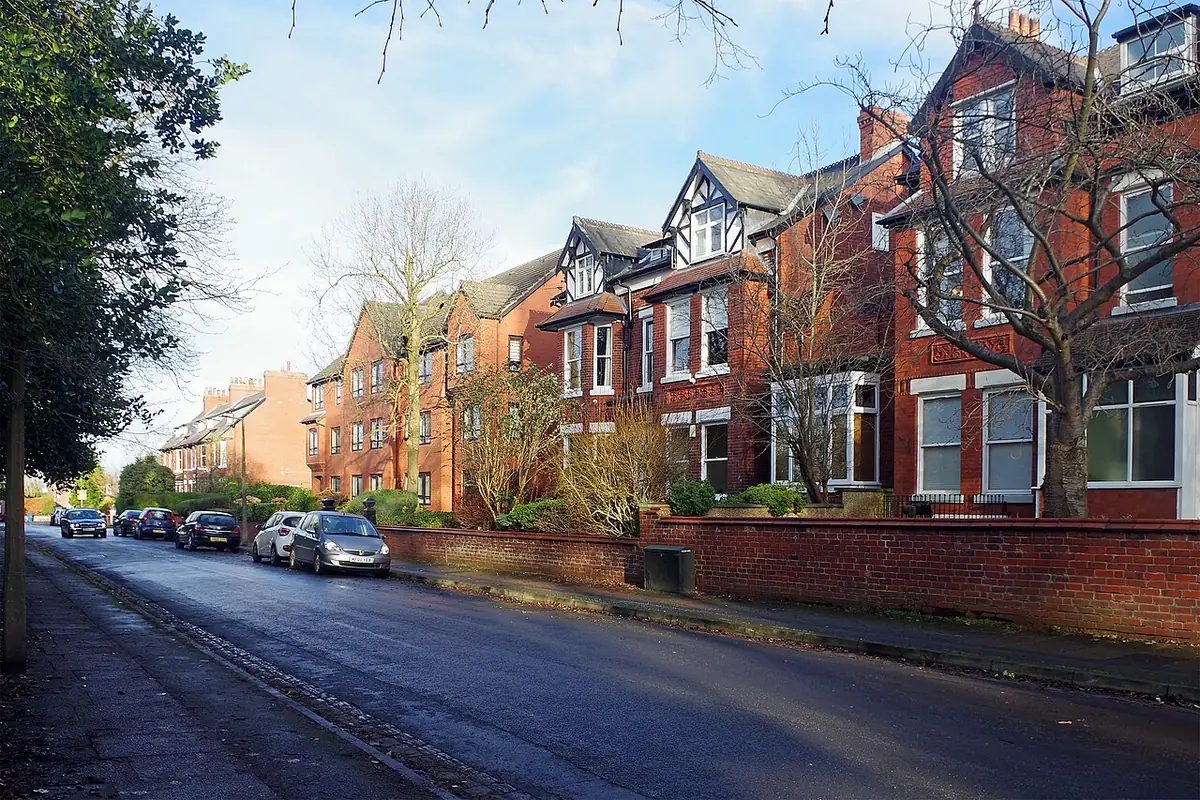
A quiet tree-lined corner in Didsbury, Manchester — Photo: Tom Jolliffe · CC BY-SA 2.0 · Wikimedia Commons
Beyond the raw numbers, the legal structure of the property itself deserves careful analysis before a figure is fixed.
The Manchester property market shows considerable spread depending on the exact location of a property, its floor area and its energy performance. Rather than trusting misleading global averages, it is worth reading the ranges by type of area and type of property. That realistic view is what lets you calibrate a figure without an unpleasant surprise when a bank or a buyer looks at it.
manchesterFor saleHouseestimate
Median price / m²£2,804Half the apartments sell below this
Median price£336kthe average is 14% higher — a few very large properties pull it up
Most common2 bedrooms75 % of listings
Average size114 m²
By number of bedrooms
Bedrooms
Share of market
Avg price
Price / m²
Avg size
2most common
75 %
£351k
£2,952
119 m²
3
22 %
£442k
£2,745 −7 %
161 m²
4
3 %
£535k
£2,657best value / m²
201 m²
Each row is an average, compared against the area average of £2,952 / m². These are indicative estimates of a typical local market, not a measured sample of live listings. Check current listings before relying on them.
What is the fundamental difference between the tenures on the Manchester market, and what does each do to a figure?
That legal caution carries through into the chronology of the transaction, where each stage tests the figure in its own way.
Understanding the distinction between outright ownership and time-limited ownership is essential before any document is signed in the United Kingdom. In many countries the land and the building form a single indivisible whole, whereas the British system sometimes separates the two, which creates financial obligations and legal restrictions that buyers arriving from abroad often miss and that a valuation must reflect.
Outright ownership (Freehold)
You own both the physical structure of the house and the land it is built on, with no limit in time and no periodic ground charge payable to a third party.
What it changesThis is the safest and the most sought-after arrangement, because it gives you complete control over the property and removes any risk of a dispute tied to the expiry of a lease, which is why it supports the upper end of a valuation.
Shared or limited ownership (Leasehold)
You buy the right to occupy the property for a fixed period (often several decades or several centuries), while a landowner (the freeholder) keeps ownership of the ground and collects an annual ground rent.
What it changesYou must check the unexpired term of the lease before committing, because a lease under 80 years makes resale and mortgage finance considerably harder and exposes you to unpredictable management charges, all of which pull the figure down.
Which stages actually test a valuation before any deposit changes hands?
Terraced streets like this make up much of Manchester's housing — Photo: Stephen McKay · CC BY-SA 2.0 · Wikimedia Commons
To follow that chronology calmly, it helps to be clear about the role each professional plays.
A property transaction in the United Kingdom involves an unusually long period of legal vulnerability between the acceptance of an offer and the formal exchange of contracts. During that phase the agreement has no binding force and either party can walk away at any moment (the phenomenon known as gazumping). Knowing the chain of operations is what lets you keep a figure realistic and hold on to control of your plans.
A written offer is put forward through the estate agency and formally accepted by the seller, subject to checks, which sets the working figure rather than fixing it.
The file goes to the respective solicitors, who begin the preliminary legal searches and the examination of title.
An independent technical inspection (a Building Survey) is carried out to identify any hidden structural defects in the house, and it is the most common reason a figure is revised.
The bank loan offer is finally confirmed and the deposit is placed in the adviser's client account, which is the point at which a lender's own view of the property becomes visible.
Exchange of contracts, the critical moment when the transaction becomes legally binding, with a non-refundable deposit (usually 10%) that locks the agreed price in place.
Final signing and taking possession (Completion Day), with the transfer of the remaining funds and the handover of the keys.
Who produces which part of a Manchester valuation, and what exactly is their role?
With all of these elements in mind, you now have the analytical tools you need to read a figure properly.
A sound figure rests on the careful coordination of professionals with clearly defined remits. Understanding what each of them does stops you asking the wrong person at the wrong moment and keeps the paperwork moving. Every participant plays a precise part in establishing the legal and financial soundness of the number you end up with.
The estate agentThe opening figure and the interface with the sellerThey handle viewings and pass offers to the owner. Be aware, though, that they are instructed by the seller to obtain the best price, so their valuation serves that brief and carries no legal weight.
The lawyer (solicitor or conveyancer)The legal audit and the drafting of the contractsThey run all the land searches, confirm there are no hidden easements and secure the transfer of ownership on the day of final signing, which is where a title problem can undercut a figure.
The surveyorThe physical and structural inspection of the buildingThey examine the roof, the foundations and the services to warn you about the repair costs required, and those costs are the raw material of every condition adjustment.
The mortgage brokerAssembling the financeThey compare offers from the different British financial institutions to secure the rate and the lending terms best suited to the profile, which is a practical test of whether a figure is fundable.
You (the owner)The strategic and financial judgementYou sign off on each survey report, weigh the district trade-offs and take final responsibility for the number you put your name to.
House or apartment in Manchester: which one holds its figure better, the suburban house or the efficient city-centre flat?
Beyond the type of property, an accurate reading of the full cost picture is the decisive step in testing any figure.
Valuing property in Manchester inevitably starts with the founding distinction between the individual house, often Victorian or Edwardian with a small garden, and the modern apartment in the heart of the city. Outer residential districts such as Chorlton or Didsbury offer a setting where space and greenery come first, but they carry daily upkeep of the outside areas and a greater dependence on transport to reach the employment centres. A flat in Deansgate or Ancoats, by contrast, removes the maintenance chore and puts cultural and professional amenities within walking distance, at the cost of higher urban density and a price per square metre that is often above average for less usable floor area.
The shape of the local market reveals sharply contrasting value dynamics depending on the type of property. Older houses frequently need work to meet energy standards, particularly because of their traditional uninsulated red brick construction, and that is a cost to build into a figure from the outset rather than discover later. Flats held in a managed building, for their part, carry fixed service charges that are often high, covering the upkeep of common parts, lifts and sometimes a gym or a concierge service, and those recurring charges have to be folded into the overall financial picture to avoid a disappointment over the medium term.
For families looking to settle for the long term, the house generally reads as the more durable choice because of the stability it provides and the potential ease of extending it, subject to obtaining the necessary planning permissions from the city council. Young professionals and investors, on the other hand, favour the liquidity and the simplicity of city-centre flats, which are particularly sought after by a young and mobile population working in the technology and finance sectors expanding across Greater Manchester.
Which costs sit behind the headline figure for a Manchester house?
Once that financial picture holds together, it is the shape of an ordinary day that deserves close attention.
A valuation for a house in Manchester does not stop at the headline number displayed by the agencies. You have to fold in the whole set of ancillary costs, from the local transfer duty to recurring energy spending and the council charges specific to the area. Reading those cost lines carefully is what tells you whether a figure is realistic over the long term.
Upfront and recurring cost lines behind a Manchester house valuation
Cost line
Estimated amount or range
Frequency and notes
Transfer duty (Stamp Duty)
0% to 5% of the price
A one-off payment on completion, according to the thresholds in force.
Legal and conveyancing fees
GBP 1,500 to GBP 3,000
Solicitors' fees, which are essential for the verification of title.
Council tax
GBP 1,200 to GBP 3,500 per year
Varies with the band (Band A to H) set by the local council.
Buildings and contents insurance
GBP 350 to GBP 700 per year
Essential cover including weather-related risks and the risks of older construction.
The amounts shown are averages observed on the Manchester market and can vary with the exact location of the property.
Routine maintenance budget that protects a valuation
Type of work
Average cost observed
Recommended frequency
Gas boiler service
GBP 90 to GBP 150
An annual visit, required for safety and efficiency.
Roof and gutter treatment
GBP 250 to GBP 500
Regular upkeep to counter the effects of heavy local rainfall.
Refreshing the interior paintwork
GBP 1,000 to GBP 3,000
Cosmetic work every five to seven years depending on wear.
These preventive maintenance lines are what stop major structural deterioration and preserve the underlying value of the property.
What does an ordinary Tuesday reveal about the value of a Manchester house?
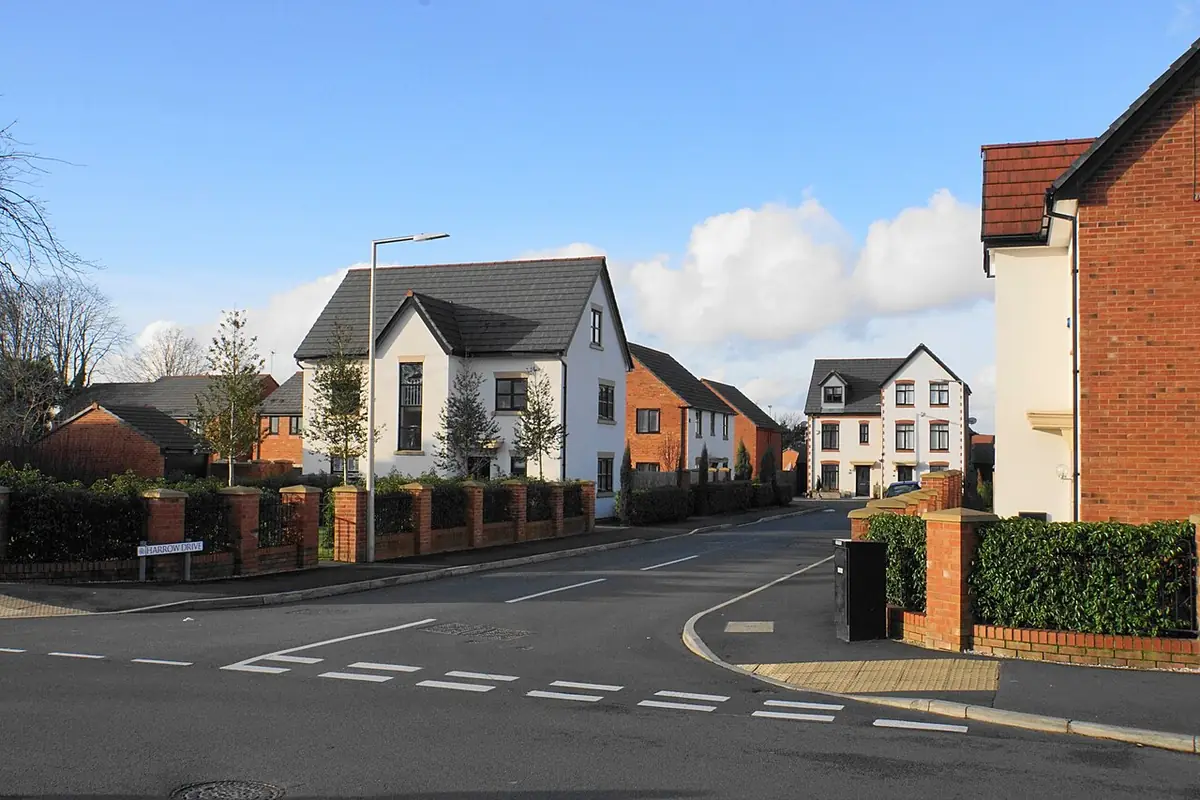
New-build streets like this add to Manchester's newer housing supply — Photo: Bill Boaden · CC BY-SA 2.0 · Wikimedia Commons
Beyond that settled routine, some less visible features of the Manchester market deserve attention before a figure is signed off.
Living in a house in Manchester means absorbing the rhythms of the city, the traffic flows at peak hours and the logistics particular to residential districts. From the morning school run to the end-of-day shopping, each stage of a typical day exposes how much a well-chosen location is worth relative to the working and personal life around it.
07:30The family kitchenBreakfast is made while the local forecast is checked, often marked by the damp that is characteristic of the north of England and that shows up later in the condition of the building.
08:30The local schoolA walk or a short drive to drop the children at the local primary school, a moment that shows the strength of local life and of the relations between neighbours, both of which support local prices.
09:15A workspace, or the journey into the centreLogging on from the home office, or leaving by tram (the Metrolink) for the Spinningfields business district, and the quality of that link is one of the clearest premiums in any figure.
13:00A local shopA short break to pick something up from the independent shops on the neighbourhood high street, which sustains the local economy and, with it, the desirability of the street.
17:30An out-of-town supermarketA stop for the weekly shopping on the way home, taking advantage of the main roads around the residential area, which is worth as much to some buyers as proximity to the centre.
19:00The garden or the living roomTime to relax with the family and to deal with the small domestic maintenance jobs that come with owning a house and that quietly determine how it presents on the day it is inspected.
Which hidden details never appear in a listing but still move the value of a Manchester house?
These blind spots explain why some figures collapse quickly, through avoidable mistakes that surface six months after the move.
Agency descriptions naturally highlight the aesthetic strengths and the floor area of a property, and just as naturally leave out crucial technical or regulatory constraints. Understanding these elements, invisible on glossy paper, protects anyone working on a figure from expensive surprises once the keys have changed hands.
The true condition of older drainage
Many Victorian houses have ageing clay drains that need a camera inspection to avoid major water damage and very high repair costs, and an uninspected run is a real hole in any estimate.
The noise impact of air and rail corridors
Proximity to Manchester Airport or to the main railway lines crossing the metropolis produces intermittent noise that is impossible to detect on a quick viewing made on a quiet Sunday, and it discounts a figure once buyers notice it.
The restrictions attached to Conservation Areas
A property in certain historic districts carries strict limits on the choice of facade materials, windows and colours, and no unauthorised external alteration is permitted, which caps what improvement work can add.
The real fibre broadband speed
Depending on the distance to the street cabinets and the age of the underground connection, the actual speed can differ noticeably from the commercial promises made by providers, and buyers who work from home price that in.
Nearby development plans
The absence of building work today does not guarantee quiet tomorrow, because large densification or infrastructure schemes can permanently change the view and the traffic in the area, and with them the figure.
Which valuation mistakes owners regret six months after settling in Manchester?
Despite the undeniable appeal of the city, this kind of exercise does not suit every profile equally.
Looked likeA charming older house full of character, with its original floorboards and its marble fireplaces, and a figure to match.
Turned outAn energy sieve that was impossible to heat properly through the hard winter months without the bills going through the roof.
Would have caught itInsisting on a full energy performance certificate (EPC) and systematically budgeting for loft and wall insulation work before fixing a number.
Looked likeAn extremely quiet, green district, perfect for raising children away from the bustle of the centre.
Turned outAn area completely gridlocked at school times, turning every daily journey into a thirty-minute ordeal by car.
Would have caught itTesting the journey times yourself at peak hours on a weekday before treating the location premium as real.
Looked likeA fine financial opportunity that appeared to need only a light coat of paint to be perfect.
Turned outChronic damp and rising moisture hidden behind partitions freshly installed by a less than scrupulous seller.
Would have caught itInstructing an independent building expert to carry out a thorough structural survey (a Home Survey Level 3).
Looked likeA safe figure on a street in the middle of an economic and commercial revival.
Turned outNo residential parking available at all in the evening, forcing a walk of more than ten minutes from the car to the front door.
Would have caught itChecking the parking rules for the street precisely, and any allocation of residents' permits, with the council services.
Who should hold off rather than act on a Manchester valuation right now?
Weighing all of these factors honestly is what tells you whether the moment has come to act.
Acting on a figure in the Manchester area calls for conditions of stability and realistic expectations that do not match everyone's plans. Identifying clearly the profiles for whom this would be risky avoids major disappointment, both financial and personal.
The highly mobile young professional
→To put the exercise aside and take a flexible city-centre tenancy instead.
The upfront transaction costs and the time it takes to resell a house are not recovered over a period of less than five years, which makes any figure academic if a move abroad is likely.
The owner who cannot tolerate maintenance and repair work
→To look instead at a new-build flat in a managed building.
An older individual house demands constant attention and a recurring maintenance budget, and people who dislike that work watch the condition, and therefore the figure, slide.
The investor looking for immediate rental yield with no effort
→To explore other regional markets or other classes of financial asset.
The high cost of family houses in the sought-after districts of Manchester compresses the net rental return, especially once management charges are deducted, so a strong capital figure does not translate into income.
The household with a thin deposit and no contingency savings
→To keep saving each month before acting on any figure.
Committing without a financial cushion for unexpected technical problems or a change in interest rates exposes the household directly to the risk of repossession.
So, is your Manchester valuation solid enough to act on?
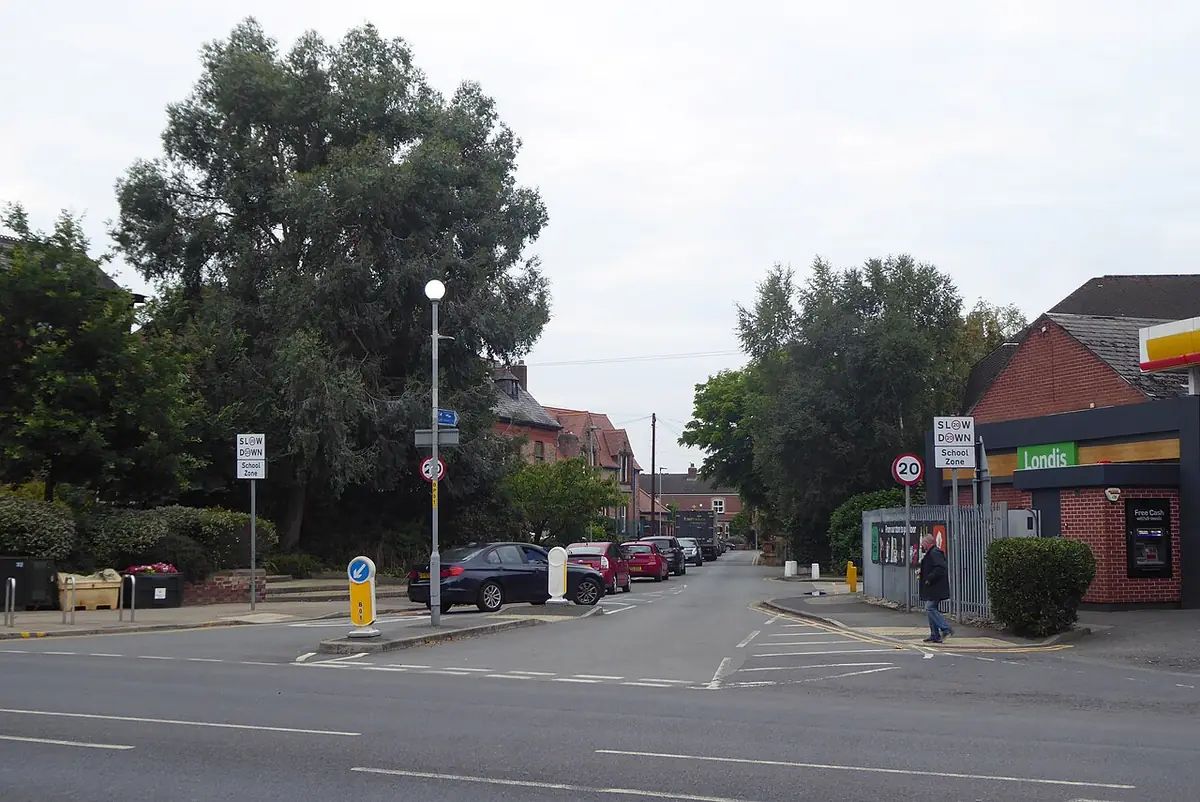
Green spaces like this sit within easy reach of the surrounding streets — Photo: Stephen McKay · CC BY-SA 2.0 · Wikimedia Commons
Settling on a figure for a house in Manchester marks a real turning point in your financial planning. That judgement should not be driven by haste or by the fear of watching prices move in the short term, but by the strength of your personal and professional plans in the region. If you expect to be anchored locally for the next five to ten years, the foundations of your approach are sound and worth pursuing actively with qualified professionals.
The reliability of your figure rests entirely on the rigour of your financial preparation and on your clear-headedness about the technical realities of Manchester building stock. By bringing in independent experts to audit the condition of the properties you are comparing, and by folding in every hidden cost from the outset, you turn a potential source of anxiety into a concrete and satisfying result. Take the time to visit several districts, to test the journeys at peak hours and to check every line of your calculation with your bank adviser.
In the end, arriving at a defensible figure in Manchester rewards patience, method and clarity about what you actually want. If the constraints that come with maintaining a house and living in a large British city do not dampen your enthusiasm, you now have all the reference points you need to begin your research on the ground and to turn a number on a page into a decision you can stand behind.
Related questions
How long does it take for a Manchester valuation to be confirmed by a completed sale?
The English transfer process, usually called conveyancing, generally takes between three and five months from the moment the seller accepts an offer to the final signing by the solicitors. That delay comes from the thorough legal checks, the land searches and the various guarantees needed to secure the transaction, and it is the window in which an agreed figure has to hold up.
Do I have to commission a survey before relying on a valuation figure?
British law does not formally require a technical inspection (a Home Survey), but it is strongly advisable to instruct a RICS-qualified surveyor to inspect the structure of the property. That step uncovers major hidden defects such as damp or roof problems, which is exactly what turns a headline estimate into a negotiated final price.
How does council tax work for a house in Manchester, and does it say anything about value?
Council tax is a local charge collected by the council to fund local public services, and its amount depends on the value assigned to the property in 1991, split into eight bands running from A to H. Every owner or tenant pays this annual contribution, and the exact amount varies with the administrative boundaries of the city, which is why the band is a rough historic marker rather than a current valuation.
Which districts value highest for a family house?
Outer districts such as Didsbury, Chorlton-cum-Hardy and Altrincham are among the most sought after by families, thanks to the quality of their schools, their generous green space and their lively local life. Those areas do carry a price per square metre noticeably above the metropolitan average, which is why comparables have to be drawn from the same district rather than from the city as a whole.
Do I need a local mortgage broker to sanity-check a figure?
There is no strict obligation to use a mortgage broker, but their help is particularly valuable in the British banking system for reaching the most competitive lending offers on the market. They also assemble the file and make sure the strict lending criteria of the different financial institutions are met, which is a useful reality test for any figure you are working with.
What are the freehold and leasehold tenures, and how do they affect an estimate?
Freehold means you own both the building and the land it stands on in perpetuity, which is the norm for most detached and terraced houses. Leasehold, by contrast, means you have bought only the right to occupy the property for a fixed term while paying a ground rent to the owner of the land, and that difference has to be reflected in any figure you put on the property.
How does price negotiation with a seller work in England?
Negotiation generally runs through the estate agency instructed by the seller, which passes on successive written offers. Unlike in some other countries, an accepted offer has no binding legal force until contracts are formally exchanged by the solicitors at the stage known as exchange of contracts, so a valuation stays provisional until that point.
Do first-time buyer schemes shape what a house is worth in the region?
The British government regularly runs schemes to help people onto the ladder, such as boosted savings accounts (the Lifetime ISA) or preferential loans for new-build purchases. Eligibility for these programmes should be checked with a financial adviser, and because they concentrate demand at certain price points they are worth keeping in mind when you read the buyer pool for your own property.
What does Manchester weather do to the condition of an older house, and to its value?
The regional climate brings heavy rainfall and winter frost episodes that put real strain on the outer envelope of brick buildings. Regular gutter clearing, watchful maintenance of the mortar joints and care of the structural timbers are essential to prevent damp ingress, and visible neglect on any of those fronts is one of the first things to pull a condition adjustment downwards.
Does letting part of the house change how it should be valued in Manchester?
Letting a room or part of your main residence is covered by favourable tax provisions in the United Kingdom (the Rent a Room Scheme). Full short-term holiday letting through online platforms, on the other hand, can run into planning restrictions or specific clauses in the title deeds, so any income you are counting on has to be checked before it is treated as adding value.
Property review of ting
No ting properties in Manchester yet
Be the first — share it on ting and it shows up right here.