Buying property in the Manchester area calls for a close understanding of how the local system works, from the form of ownership to the choice of district. This guide gives you a rigorous, structured view to walk you step by step through your investment or relocation plan.
Get the app
What nobody tells you.
Real prices, hidden costs and the traps to check before you commit.
What you actually get when you buy an apartment in Manchester
Scroll
What you actually get when you buy an apartment in Manchester
Buying property in the Manchester area calls for a close understanding of how the local system works, from the form of ownership to the choice of district. This guide gives you a rigorous, structured view to walk you step by step through your investment or relocation plan.
Written by the ting.ad editorial team ·
Albert Square, Manchester in Street View: drag to look around.
To choose well, you have to set these economic realities against your own daily life.
Buying an apartment in this city is not simply a transaction over floor area or a central address. It is access to a fast-moving market where urban regeneration constantly redefines what property is worth. Buyers have to weigh what old brick and contemporary new build each imply over the long run. Every district has its own logic of value, set by how close it sits to employment hubs and transport links. You need to look past the marketing brochures to grasp the reality of running costs and rental demand.
The charm of converted industrial buildingsvsThe upkeep constraints and the high service charges
Loft volumes and exposed brick win you over immediately, but they often hide energy retrofit obligations and building management costs that weigh heavily as the years pass.
The ease of buying off plan in a city centre towervsThe uncertainty over actual delivery and over immediate resale
Buying in a new-build scheme brings a structural warranty and modern amenities, but it exposes the owner to fierce competition when flats in the same building come up for resale one after another.
Getting in early in fast gentrifying districtsvsThe pockets of deprivation and the permanent building sites that remain
Settling or investing where prices are still affordable means accepting lasting noise and a social environment in transition, at a pace of change that stays hard to predict.
Absolute centrality, within walking distance of the stationsvsSqueezed living space at a high price per m2
Living as close as possible to the city's nerve centres forces significant compromises on the square metres available and on the absence of private outdoor space.
Does Manchester really fit your way of life and your plans?
Moving from one country to another completely changes your bearings in property law.
How you choose to live in this large city in the north of England depends largely on your relationship with time, travel and green space. The housing on offer speaks to very different profiles, from the young professional to the senior executive to the long-term investor. Every situation calls for a clear-eyed look at your weekly priorities, so you avoid the mistake of buying the wrong thing. Local rhythms reward walking and cycling, but they require adapting to the weather and to the particularities of British town planning.
Choosing the hyper-central location and the recent schemes
Your absolute priority is cutting travel time to the strict minimum, so you can enjoy the cultural and professional life without needing a car. You favour compact apartments with built-in services such as a gym or a concierge. This urban way of living means accepting a smaller floor area and no private garden, in exchange for a very lively neighbourhood. Reselling or letting this kind of property is generally straightforward, because demand from young professionals is constant.
The compromise of the outer residential areas
You have to weigh immediate proximity to city amenities against the need for space, quiet and greenery for your children. Spacious apartments in the residential ring, or converted terraced houses, offer a calmer setting but require accepting longer daily journeys. This choice calls for careful study of the public transport network and of the reputation of the local schools. A sense of community and a settled neighbourhood then become decisive criteria for your investment.
A managed asset aimed at students or young professionals
Your main objective is the net yield and securing your rent against economic swings in the United Kingdom. You look towards studios or one-bedroom flats close to the universities or the main office districts. This approach calls for particular attention to managing agent fees and to the terms of Assured Shorthold Tenancy agreements. You also have to factor in local taxation and the strict regulatory obligations on the condition of rented homes.
A long-term second home with no management worries
You want a base that is easy to lock up and to maintain, in a lively but secure area where you will stay a few weeks a year. This profile favours buildings with an on-site manager who looks after the common parts and after security while you are away. The cost of those services eats into the yield, but it protects the value of the asset over the long term. What you are buying above all is peace of mind and the certainty of a location that will hold its value.
Living there when you arrive from abroad: what really changes
New builds sit right beside Manchester's older stone architecture — Photo: Benjamin Shaw · CC BY-SA 4.0 · Wikimedia Commons
Once those rules are clear, looking closely at the city's districts becomes the priority.
Buying property in the United Kingdom follows legal and cultural rules that often surprise buyers who arrive from a system built around an all-powerful public notary. Here the process rests on specialist lawyers and on a contractual system where direct negotiation and early moral commitments matter a great deal. Understanding these mechanisms saves you financial disappointment and major administrative delays when the funds are released. The very notions of land ownership rest on historical foundations that differ completely from civil law traditions.
From abroad
A public notary drafts the deed and secures the whole chain of the sale
Manchester
Conveyancing solicitors acting for each side handle the transfer and the title checks
The solicitor's role is purely transactional and defends its own client's interests strictly, which lengthens the negotiation and demands constant responsiveness from you.
From abroad
Shared ownership of a block runs under a strict statutory regime with a professional managing body
Manchester
The leasehold or share of freehold system, with managing agents
You have to check with extreme care how many years the lease has left to run and the level of the service charges, or you may watch the value of your property melt away.
From abroad
An accepted offer formally binds both parties as soon as the preliminary contract is signed
Manchester
The offer is often not binding (subject to contract) until exchange of contracts
The risk of a last-minute higher bid or of the seller pulling out (gazumping) stays high until the formal exchange has taken place, despite the legal fees you have already spent.
From abroad
The technical surveys are bundled into a single pack supplied by the seller
Manchester
The buyer commissions their own reports (HomeBuyer Report or Building Survey)
It is up to you to pay for and organise the surveys that reveal hidden defects, the state of the roof or the presence of asbestos, before you commit for good.
Which Manchester district should you choose for your profile?
These district dynamics translate directly into price realities that deserve rigorous analysis.
Manchester's urban geography is built around a dense historic core and outer districts that each have an identity of their own. The area you choose shapes not only your daily quality of life but also how easily you will be able to sell your investment later. There is no perfect district in the abstract, only addresses that match particular stages of life and particular budgets. Watching the infrastructure projects under way closely helps you identify the areas with the strongest potential.
Northern Quarter
A creative, fashionable and lively atmosphere, set by independent cafes, designer shops and street art murals.
Suits
Young professionals, creatives and investors looking for strong short-term or long-term rental demand.
Trade-off
High noise levels in the evening, older buildings with sometimes unpredictable charges, and one of the highest costs per m2 in the city.
Ancoats
A successful marriage of restored industrial heritage and very quiet modern development along the canals.
Suits
Lovers of contemporary design, couples without children and food lovers looking for a carefully kept setting.
Trade-off
A limited supply of property, which pushes purchase prices up and makes anything on the second-hand market rare.
Castlefield
A calm haven of water and history, marked by its Roman remains and viaducts, its picturesque canals and its traditional pubs.
Suits
Those who want to live centrally while keeping a peaceful village feel and direct access to places to walk.
Trade-off
A small housing stock, dominated by apartments in shared blocks where the cost of maintaining the canal banks and the structures can come as a surprise.
Salford Quays & MediaCity
An ultra-modern hub facing the water, built around media and technology, with bold architecture and open space.
Suits
Investors looking for stable rental yields, and professionals working in the creative and digital industries.
Trade-off
A feeling of distance from the historic core, and an atmosphere that can feel impersonal at weekends and in the evening.
How much does an apartment in Manchester really cost?
A quiet tree-lined corner in Didsbury, Manchester — Photo: Tom Jolliffe · CC BY-SA 2.0 · Wikimedia Commons
Beyond the headline price, the legal nature of what you own is an absolutely crucial point.
The Manchester property market is highly varied, depending on the precise location, the age of the building and the services included in the block. It is essential to build into your calculation not only the headline purchase price but also all the compulsory extra costs that apply in the United Kingdom. Stamp Duty Land Tax, legal fees and the local Council Tax weigh heavily on the total cost of the operation. Planning for these items in advance keeps your purchase financially viable.
manchesterFor saleApartmentestimate
Median price / m²£3,420Half the apartments sell below this
Median price£235kthe average is 14% higher — a few very large properties pull it up
Most common2 bedrooms45 % of listings
Average size65 m²
By number of bedrooms
Bedrooms
Share of market
Avg price
Price / m²
Avg size
1
40 %
£190k
£3,960 +10 %
48 m²
2most common
45 %
£245k
£3,600
68 m²
3
13 %
£308k
£3,348best value / m²
92 m²
4
2 %
£373k
£3,240 −10 %
115 m²
Each row is an average, compared against the area average of £3,600 / m². These are indicative estimates of a typical local market, not a measured sample of live listings. Check current listings before relying on them.
What you can actually own: leasehold versus freehold
Securing the transaction then means following a precise legal timetable to the letter.
The British system of property ownership has a technical complexity that any foreign buyer has to master before signing the smallest offer. Unlike systems where you generally buy the land and the building together and inseparably, the vast majority of apartments in the United Kingdom are held on a leasehold basis. That means you are buying the right to occupy the home for a fixed term, while a third party owns the land itself. This fundamental distinction directly affects the resale value of your property and the extra costs you will carry every year.
Leasehold: a long-term lease of the land
You own the walls of your apartment for a period that generally starts somewhere between 125 and 999 years. In return you pay an annual ground rent to the owner of the land (the freeholder), together with your share of the service charges for the upkeep of the building. Once the remaining lease term drops below 80 years, the value of the property falls dramatically and borrowing against it becomes extremely difficult.
What it changesYou must insist that your solicitor audits exactly how many years the lease has left to run, and the terms on which the ground rent can be increased, before you go ahead.
Share of freehold: the cooperative, reassuring alternative
In some blocks the apartment owners come together in a legal structure that collectively buys the freehold of the land. You then hold your apartment on a leasehold basis and at the same time co-own the ground, through a share in the management company. This arrangement removes the risk of abuse by an outside landowner and gives you direct control over management decisions and over the contractors who maintain the building.
What it changesFavour this arrangement whenever it is available on the market, because it protects value better over the long term and keeps shared spending transparent.
The rule to understand before you pay over a penny of deposit
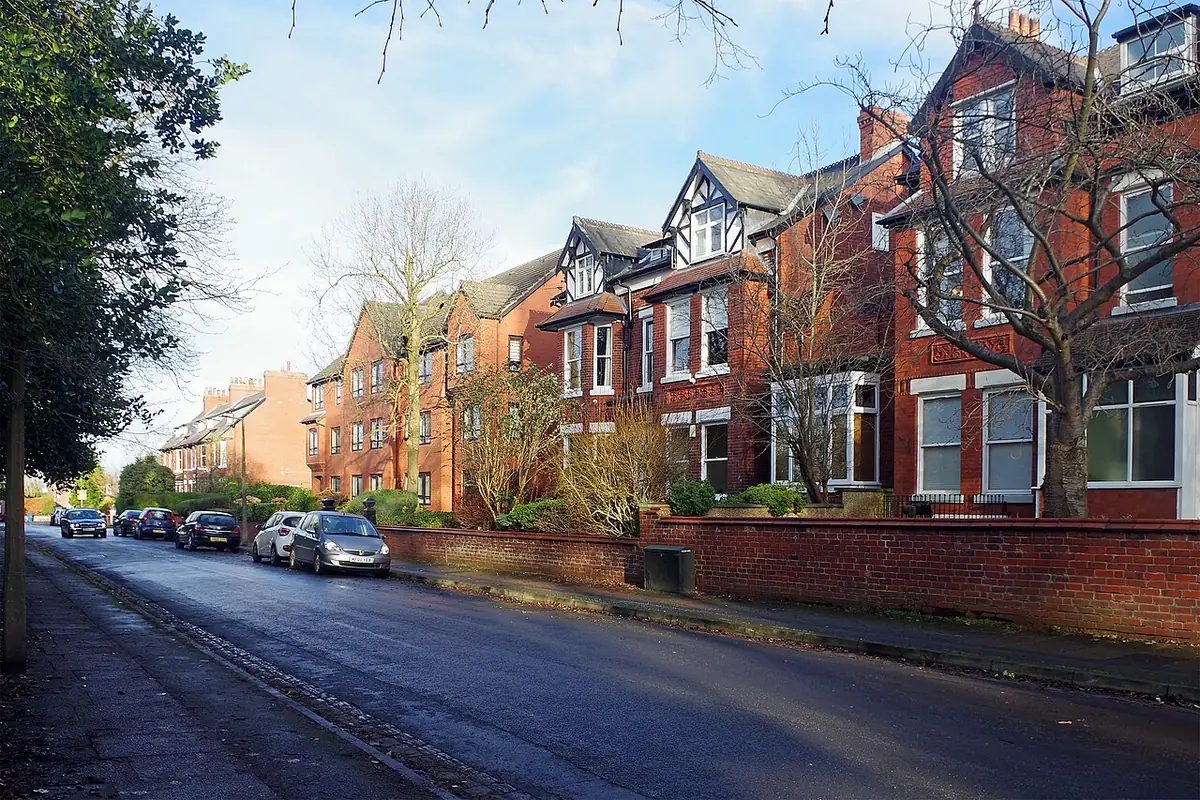
Terraced streets like this make up much of Manchester's housing — Photo: Stephen McKay · CC BY-SA 2.0 · Wikimedia Commons
Now let us look at how the purchase actually unfolds, in order, on the ground.
Buying property in the United Kingdom is marked out by strict legal milestones that protect both parties but demand absolute rigour. From the initial offer to the final transfer of funds, every stage engages your financial and contractual responsibility. Contrary to what people assume, no significant sum should be paid over without the formal oversight of your conveyancing solicitor. Understanding this sequence lets you avoid the classic traps of a late withdrawal or of hidden defects spotted too late.
A verbal or written offer formalised with the estate agent, together with proof of funds.
Appoint an independent conveyancing solicitor to run all the necessary land and local authority searches.
Commission an independent survey (HomeBuyer Report or Building Survey) to assess the real condition of the building.
Obtain the final mortgage offer if you are using borrowing in the United Kingdom to finance the purchase.
Proceed to the formal exchange of contracts and pay the deposit held in escrow, generally set at 10 percent of the price.
Completion: the balance of the price is paid over by the solicitor, the keys are handed to you and you officially take possession.
How a property transaction unfolds, step by step
A successful property transaction in the Manchester area takes on average between two and four months of rigorous administrative work. Every player in the chain (agent, solicitor, surveyor and lender) has a precise role that has to be coordinated without rushing. Leaving room for improvisation, or skipping the checks on the legal documents, exposes the buyer to unexpected extra costs. Following the progress of the file with your legal adviser week by week remains the best guarantee of getting there calmly.
The buyerConfirming the budget and searching activelyObtaining an Agreement in Principle from a lender and viewing the properties that match your criteria.
The estate agentNegotiating and accepting the offerPassing on the formal offer (subject to contract) and evidencing your financial standing to the seller.
The conveyancing solicitorLegal work and land searchesChecking title, easements, local taxes and the planning proposals in the surrounding area.
The surveyorAssessing the condition and the value of the buildingProducing the survey report to identify any structural work or energy upgrades that will be needed.
The solicitorsExchange of contractsSigning the binding commitments, paying the 10 percent deposit and setting the completion date.
The buyer and the lenderRelease of funds and completionTransferring the balance of the purchase price, registering ownership officially with HM Land Registry and handing over the keys.
City centre apartment or house further out: how do you decide in Manchester?
Buying property in Manchester immediately raises the question of what kind of home you want, between the vertical apartments of the centre and the Victorian or terraced houses of outer districts such as Chorlton or Didsbury. New-build schemes in the Northern Quarter or on Deansgate offer efficiently planned floor areas, often inside residential towers with shared services such as a concierge, a gym and coworking space. These homes appeal to working people who care about cutting travel time and about a city life that is immediately reachable on foot or by tram. Choosing an apartment does mean living with charges that can be high, known as ground rent and service charges, and how predictably they will rise remains a fundamental point to watch for the long-term soundness of your investment.
Going for a single-family house, by contrast, radically changes daily life and the structure of your running costs. The residential districts of the inner ring offer more generous living space, often with a private garden and the ability to park a car without being tied to an allocated bay. This option is aimed above all at households looking for space, structural independence and full control over their spending on works, since there is no block management body to approve or fund work on the roof or the structure of the building. In return, maintaining an older house demands a personal investment of time and money to counter the damp that comes with the local climate and to keep up the energy efficiency of walls often built in the 19th century.
The financial decision does not come down to the advertised price per square metre; it covers the total cost of ownership over five to ten years. New apartments generally benefit from excellent energy performance, which sharply reduces heating bills, a critical budget item in the north of England. Older houses, although often more affordable to buy for an equivalent floor area, frequently need external wall insulation or the replacement of obsolete heating systems to reach current comfort standards. Your professional mobility and your family plans over the medium term should guide this structural decision, because reselling a city centre apartment answers to a very different market dynamic from selling a house in a residential suburb.
It is also worth analysing how liquid these two markets are through regional economic cycles. The high-end apartments concentrated in Manchester's urban core sometimes face strong competition as successive new schemes are delivered, which can hold back capital gains in the short term. Family houses in sought-after school catchment areas benefit from demand that structurally exceeds supply, which gives prices better resilience if the cycle turns. Your final choice therefore has to take in not only your current way of life but also how easily you could let or resell the property if your personal situation were to change quickly.
What overall budget do you need to settle in Manchester for the long term?
Drawing up a forward budget for buying and living in an apartment in Manchester means including all the recurring costs that come on top of the monthly mortgage payment. Beyond the loan repayment, the local cost of living is strongly influenced by the council tax, the service charges and the energy bills. Planning rigorously for these items avoids financial strain and keeps your plan viable in this fast-moving city.
Ordinary monthly costs for a standard apartment in Manchester
Cost item
Estimated range
Analysis
Council Tax (band D)
GBP 150 - GBP 200
Compulsory local tax due for every household, varying with the exact area and the valuation band of the home.
Service charges
GBP 120 - GBP 250
Maintenance costs for the common areas and the lifts, and sometimes the building insurance, payable quarterly or monthly.
Energy (gas and electricity)
GBP 140 - GBP 220
A budget tied directly to the EPC rating of the property, and particularly critical during the winter months in the north.
Home insurance (buildings and contents)
GBP 25 - GBP 50
Essential cover, protecting the structure of the building for apartment owners and their personal belongings.
The amounts shown are for a standard two-bedroom apartment and can vary with the precise location and the quality of the insulation.
Upfront purchase costs and related taxes
Type of cost
Indicative rate or amount
Impact on your financing plan
Stamp Duty Land Tax (SDLT)
0% to 5% depending on the price
Tax on the transfer of property, calculated in bands on the total purchase price.
Legal fees (solicitor)
GBP 1,500 - GBP 3,000
Payment for the legal advice you need to secure the transfer of ownership and to run the searches.
Survey report fees
GBP 400 - GBP 900
Technical inspection of the building to identify any hidden defects or urgent work to plan for.
Set aside savings of at least 3% to 5% of the purchase price to absorb all the costs that come with the transaction.
Health, schools, transport: what does an ordinary Tuesday look like for a resident?
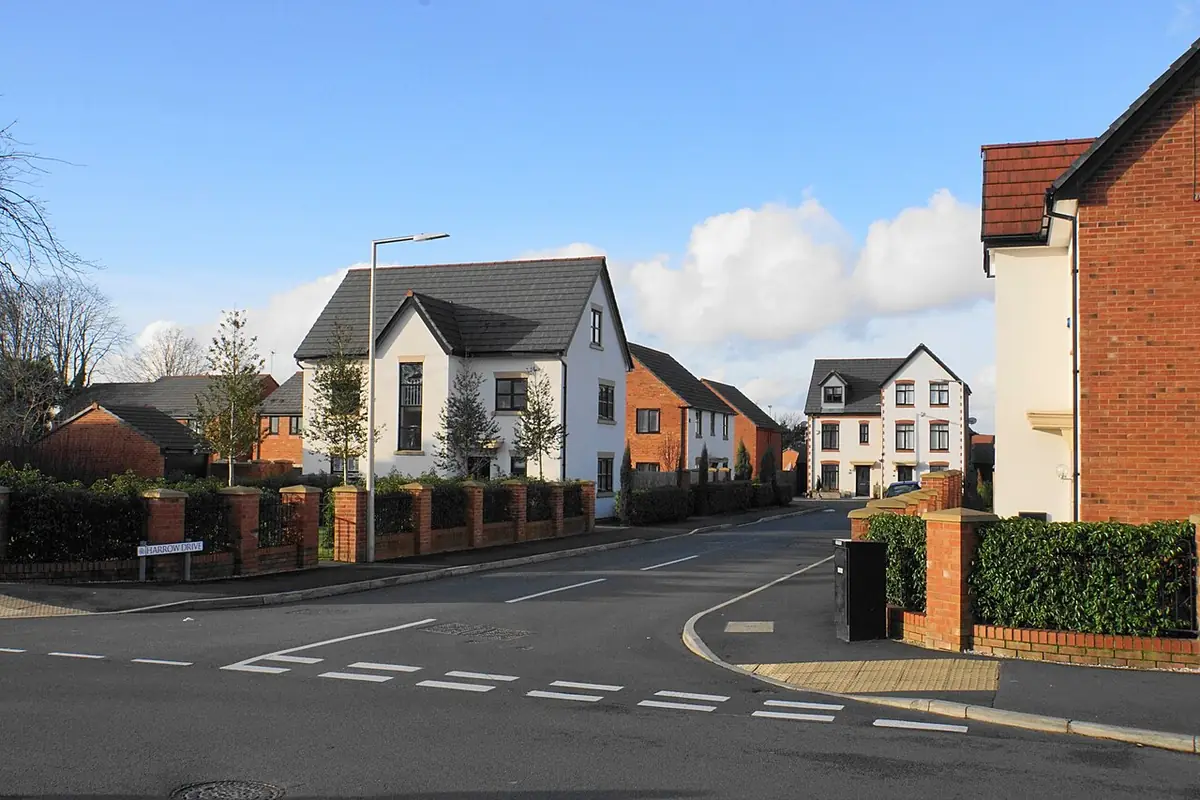
New-build streets like this add to Manchester's newer housing supply — Photo: Bill Boaden · CC BY-SA 2.0 · Wikimedia Commons
Picturing how a typical day unfolds lets you judge how well the location of your future home fits your work and personal commitments. In Manchester, how easily you get around depends heavily on how the Metrolink tram network, the local bus routes and the pedestrian streets of the centre fit together. Here is a realistic timeline of an ordinary Tuesday for someone living in a well-placed residential district.
07:30Home, residential districtThe morning routine and a check of live transport times, to anticipate any delays on the Metrolink network.
08:15Local Metrolink tram stopThe commute into the central business district or the university hubs, an effective alternative to a congested road.
09:00Workspace or central officeArriving at work after a streamlined journey, which shows the advantage of living close to the main transport routes.
12:30Local centre, lunch breakUsing the nearby shops and neighbourhood services to run daily errands or to keep a medical appointment.
17:30The journey home, with a stop at the shopsA stop at the local supermarkets or neighbourhood markets to stock up for the household before the shops close.
19:00Home, downtime and local lifeA quiet evening, or taking part in the cultural activities run by local groups and community spaces in the district.
What the listing will not tell you about the Manchester market
Behind the beautiful photographs and the glowing agency descriptions lie technical and planning realities that every buyer has to investigate personally. In Manchester, the rapid transformation of the city creates side effects and specific regulatory constraints that directly affect your enjoyment of the property and its future value. Here are the decisive points that people generally forget to point out to you.
The industrial past and the nature of the ground
Many recent schemes are built on former industrial land, which calls for thorough geotechnical studies to rule out any risk of contaminated ground or uneven settlement of the foundations. Ignoring this leaves you open to budget surprises when structural work becomes necessary.
Nearby plans for denser development
Planning permission for a residential tower next door can radically change your natural light, your outlook and the flow of traffic for years to come. Checking the local planning register before you sign is essential.
The legal complexity of leasehold
A large share of apartments in Manchester is sold leasehold, with ground rents that are sometimes index-linked to inflation. A lease with less than 80 years left loses considerable value and makes bank financing very complicated.
The real effect of the local climate on damp in buildings
The rainfall typical of north-west England puts facades under real strain, which makes the quality of the brick pointing and the weather-tightness of the window frames absolutely crucial. A gap in the insulation quickly leads to condensation and mould.
The traps and disappointments you discover six months after moving in
Looked likeAn ultra-modern apartment with the modest service charges the developer quoted for the first year.
Turned outA sharp rise in the service charges after the building's first maintenance audit and as the shared equipment aged.
Would have caught itAsking for the full history of charge demands over the last three years and examining the block's reserve fund precisely, before making any firm offer.
Looked likeA quiet, thoroughly residential area, ideal for resting after intense days spent in the middle of the city.
Turned outLate-night venues opening, or building sites starting next door, generating noise from dawn onwards.
Would have caught itVisiting the area around the property at different times, particularly on Thursday and Saturday evenings, and checking the licensing applications in progress with the council.
Looked likeA minimal energy bill, thanks to the excellent EPC rating shown on the property's official certificate.
Turned outUnexpected heat loss caused by untreated thermal bridges around the large windows typical of contemporary buildings.
Would have caught itCommissioning an independent thermal imaging inspection to verify the real insulation of the glazing and the window frames.
Looked likeA private parking space included in the overall purchase price of the city centre apartment.
Turned outA cramped space, hard to get into with a modern family car and subject to extra road or management charges.
Would have caught itMeasuring the space precisely with your own vehicle and checking whether the parking right is attached to a separate title or is only a precarious one.
Buyer profiles: who should avoid buying in Manchester right now?
Buying property is never a universal answer that suits every situation in life. The Manchester market, shaped by strong urban renewal and by fluctuating interest rates, carries specific risks for certain buyer profiles. Being clear-eyed beforehand avoids painful exits and financial losses if you have to sell in a hurry.
The short-term investor betting on a quick capital gain
→Not buying a new build straight away
The upfront purchase costs and the commissions on resale absorb most of the potential gain over a period of less than five years, which makes the operation unprofitable against other investments.
The household with unstable income or uncertain job mobility
→Renting flexibly instead
Tying up capital and the rigidity of British mortgage commitments do not sit well with the risk of a quick job move out of the Greater Manchester area.
The buyer with no tolerance for shared building rules and collective decisions
→Staying away from apartment blocks
Not being able to decide alone on roof work, facade repairs or building rules creates constant friction for independent-minded people.
The moment of truth: are you ready to go ahead in Manchester?
Green spaces like this sit within easy reach of the surrounding streets — Photo: Stephen McKay · CC BY-SA 2.0 · Wikimedia Commons
Reaching the end of this analysis shows that your plan to buy in Manchester goes beyond a simple aesthetic impulse and is anchored in a broader view of building assets. What you have gathered on the structure of prices, on service charges, on the specifics of leases and on the reality of daily travel now forms the base for your decision. Buying in this fast-changing city calls for a clear-eyed commitment to the demands of the local market, far from simplistic advertising promises.
The success of your purchase depends above all on your ability to line up your real budget with the regulatory and tax requirements in force in the United Kingdom. If your financial projections include a large enough safety margin to absorb rate movements and unforeseen maintenance spending, then the Manchester market offers first-rate opportunities. The economic strength of the region, driven by its appeal in technology and culture, supports the case for a long-term investment.
Take the time to validate every stage with independent professionals, whether that is your solicitor or your own independent surveyor. Never give in to the artificial pressure of a false urgency, often created to speed up a signature. The right property is the one that meets your fundamental criteria without excessive compromise on your future quality of life.
The final decision is entirely yours. If the signals are green after this rigorous look at the facts and the constraints, it is time to put your offer together with confidence. Manchester is open to you, ready to reward buyers who are methodical and well prepared.
Related questions
What is the average Council Tax for an apartment in Manchester?
Council Tax depends on the valuation band of the property, usually between band B and band E for city apartments. Most often you should expect between GBP 130 and GBP 220 a month, paid over ten months of the year to the council.
What is a leasehold and what are the risks?
Leasehold means you are buying the right to occupy the property for a fixed term, while a third party owns the land. You must check how many years are left on the lease and the level of the annual ground rent, to avoid the value of the property being marked down later.
What extra costs should you plan for when buying a property?
The additional costs include Stamp Duty Land Tax, calculated in bands, the solicitor's fees for the legal side of the transfer, and the cost of the building survey reports. Budget overall for 3% to 5% of the purchase price.
Can you buy a property in Manchester as a non-resident?
Yes, international investors and non-residents can buy property in the United Kingdom, but they have to meet enhanced identity checks and sometimes pay a specific Stamp Duty surcharge.
How do service charges work in new-build blocks?
Service charges cover the upkeep of the common areas, the lifts and the shared services. They are payable quarterly and can rise regularly in line with inflation and maintenance costs.
Which Manchester districts are best for a lasting buy-to-let investment?
The Northern Quarter, Deansgate and Ancoats remain the areas most sought after by young professionals, for their energy and their immediate proximity to employment hubs. Outer districts such as Didsbury attract families looking for quiet instead.
How important is the EPC certificate when you buy?
The energy performance certificate (EPC) rates the home from A to G. It lets you estimate future heating and electricity costs precisely, which is particularly critical in the British climate for keeping a monthly budget under control.
How long does a property transaction in Manchester take on average?
A standard property transaction in the United Kingdom usually takes between three and five months, from the seller accepting the offer to final signature, because of the thorough legal searches carried out by the solicitors.
Are property prices in Manchester more stable than in London?
The Manchester market has historically shown slightly lower volatility than the capital, while offering growth potential supported by the continuing economic development of the north of England and the arrival of large companies.
Do you have to use a mortgage broker?
Although it is not compulsory, working with an independent broker is strongly recommended in the United Kingdom, to reach the best lender offers on the market and to navigate the complexity of lending criteria.
Property review of ting
No ting properties in Manchester yet
Be the first — share it on ting and it shows up right here.