Settling for the long term in Grenelle means decoding a demanding, sharply contrasted Paris market. This guide sets out the criteria that decide whether your purchase in the 15e arrondissement works out, from the price per square metre through to the legal traps hidden inside a co-ownership.
Get the app
What nobody tells you.
Real prices, hidden costs and the traps to check before you commit.
Why buyers choose Grenelle when they want to settle in Paris for good
Scroll
Why buyers choose Grenelle when they want to settle in Paris for good
Settling for the long term in Grenelle means decoding a demanding, sharply contrasted Paris market. This guide sets out the criteria that decide whether your purchase in the 15e arrondissement works out, from the price per square metre through to the legal traps hidden inside a co-ownership.
Written by the ting.ad editorial team ·
Rue de Rivoli, Paris in Street View: drag to look around.
That double character, lively and calm at once, feeds straight into how you end up living in the quarter, depending on who you are.
Buying an apartment in Grenelle means putting your bags down in a quarter where the buzz of the Left Bank gives way to something more residential. The Seine is a few streets away and it redraws the urban space, offering a rare bit of breathing room in the capital. Yet the appeal of this corner of the 15e arrondissement is not simply a matter of a good position on the map. It rests on a fine balance between the density of city conveniences and the quiet you rediscover on the side streets, well away from the heavy through-routes. Understanding that duality is how you measure what you genuinely gain in day-to-day quality of life.
A central position with direct access to the main Paris arteriesvsThe hushed feel of residential streets set back from the traffic
The quarter combines busy thoroughfares such as boulevard de Grenelle with pockets of real stillness where time seems to stop.
Dense building stock shaped by both Haussmannian and modernist historyvsOpen public spaces and long, uninterrupted sightlines
The architectural shift between the classic investment blocks and the construction of the second half of the twentieth century changes how you read volume and space.
An extremely active, self-sufficient neighbourhood shopping lifevsImmediate proximity to the capital's main business districts
You have everything you need on foot without crossing the whole of Paris, while staying a few metro stops from where the decisions are made.
Which kind of buyer finds their balance in this part of the city
Those local reference points land very differently when you are arriving from another country altogether.
Buying a property in the 15e arrondissement commits you for several years, which makes the fit between your way of life and the place unusually critical. The people who settle here are generally after a residential stability that the purely party-driven quarters of the capital do not guarantee. Every family or professional set-up interacts differently with the urban shape of Grenelle, whether that means managing a daily commute or hunting for schools within walking distance. Working through these cases helps you anticipate the trade-offs built into any Paris purchase.
The employment catchment and the daily commute
For professionals working demanding hours, the location cuts travel time to the nerve centres of the Right Bank or La Defense dramatically. The metro lines and the main bus routes spare you the fatigue of multiple changes at the end of the day. Getting home becomes a smooth transition rather than one more logistical ordeal.
That geographic advantage more than offsets the density of traffic on the big boulevards at peak times. Come the evening, the quarter settles back into an atmosphere made for winding down, far from the churn of the purely tourist-facing central districts.
Putting down family roots and the infrastructure that supports it
Parents find a reassuring environment here, with a dense network of well-regarded state and private schools and plenty of green space close at hand. Apartment layouts, often more generous than in the central arrondissements, make it possible to plan for a growing family without an immediate move.
Open-air markets and cultural venues make weekend life easier to organise, and remove any obligation to cross the whole city for the essentials.
Buying for the asset value and how easily it sells on
In a Paris market that runs through complicated cycles, properties in sought-after areas such as Grenelle hold up remarkably well when the wider market turns. Demand here stays structurally ahead of available supply, which makes for useful liquidity if you come to sell later.
The absence of any discount for serious nuisance protects the capital you put in over the long run, while still leaving room to add value through targeted work.
What actually changes when you move here from another country
Beyond these practicalities, it is the choice of micro-location that will decide how comfortable your life here feels.
Leaving a regional city, a suburb or a lower-density housing market abroad to settle for good in Paris forces a complete revision of how you read space and time. Your relationship to floor area, to constant background noise and to having services immediately downstairs is transformed within the first few weeks. In Grenelle that transition is eased by the open structure of certain avenues, but the shock of the Paris property market is real for any newcomer. Measuring these structural gaps is what stops the disappointment that otherwise arrives after completion, and it helps you make your new home your own.
From abroad
Generous interiors, with private outdoor space as a matter of course
Paris
Rigorously optimised floor area, and balconies that are genuinely scarce
Every square metre counts, which forces you to rethink furniture and storage so the place does not feel visually suffocating.
From abroad
A car used almost automatically for shopping and leisure
Paris
A switch to going everywhere on foot and to multimodal public transport
Parking becomes a heavy and expensive constraint, while walking and cycling establish themselves as the natural ways to get around.
From abroad
Neighbours at a distance and predictably quiet nights
Paris
A dense co-ownership and a continuous hum of muffled city noise
Living in a shared building means working with the co-ownership rules and an acoustic closeness you have to accept from the moment you buy.
From abroad
Centralised services that require a drive to reach
Paris
An abundant offer reachable on foot at the foot of your building
Shopping stops being a weekly run to a large store and becomes a daily habit with the traders on your street.
How to tell the micro-quarters apart and pin down the right one
That variety feeds directly into the valuations you will see quoted on the ground.
The arrondissement is not a single block, and each sub-area has its own architectural and social identity. Between the immediate surroundings of the Front de Seine, the streets near La Motte-Picquet and the quieter roads running off the boulevards, the atmosphere changes completely. Knowing these differences lets you target your search instead of scattering your attention across everything on the market. The choice will come down largely to your tolerance for noise and to the kind of neighbourhood life you want.
The La Motte-Picquet Grenelle area
Intense, permanent commercial activity, paced by the markets and the flow of people on foot.
Suits
Buyers who want to do everything on foot and enjoy a fast, distinctly urban rhythm.
Trade-off
A higher noise level and noticeably more upward pressure on prices than the local average.
The Front de Seine area
Open modernist architectural perspectives and exceptional light on the upper floors.
Suits
Anyone drawn to large glazed volumes and buildings with services built in.
Trade-off
A specific urban aesthetic that leaves purists of traditional Haussmannian Paris cold.
The inner residential streets
Remarkable calm, a settled set of neighbours and the illusion of a village inside the city.
Suits
Families and anyone chasing absolute quiet in the middle of the capital.
Trade-off
Fewer properties come up for sale, and deals are often done very quickly.
The price picture and the financial reality of a transaction
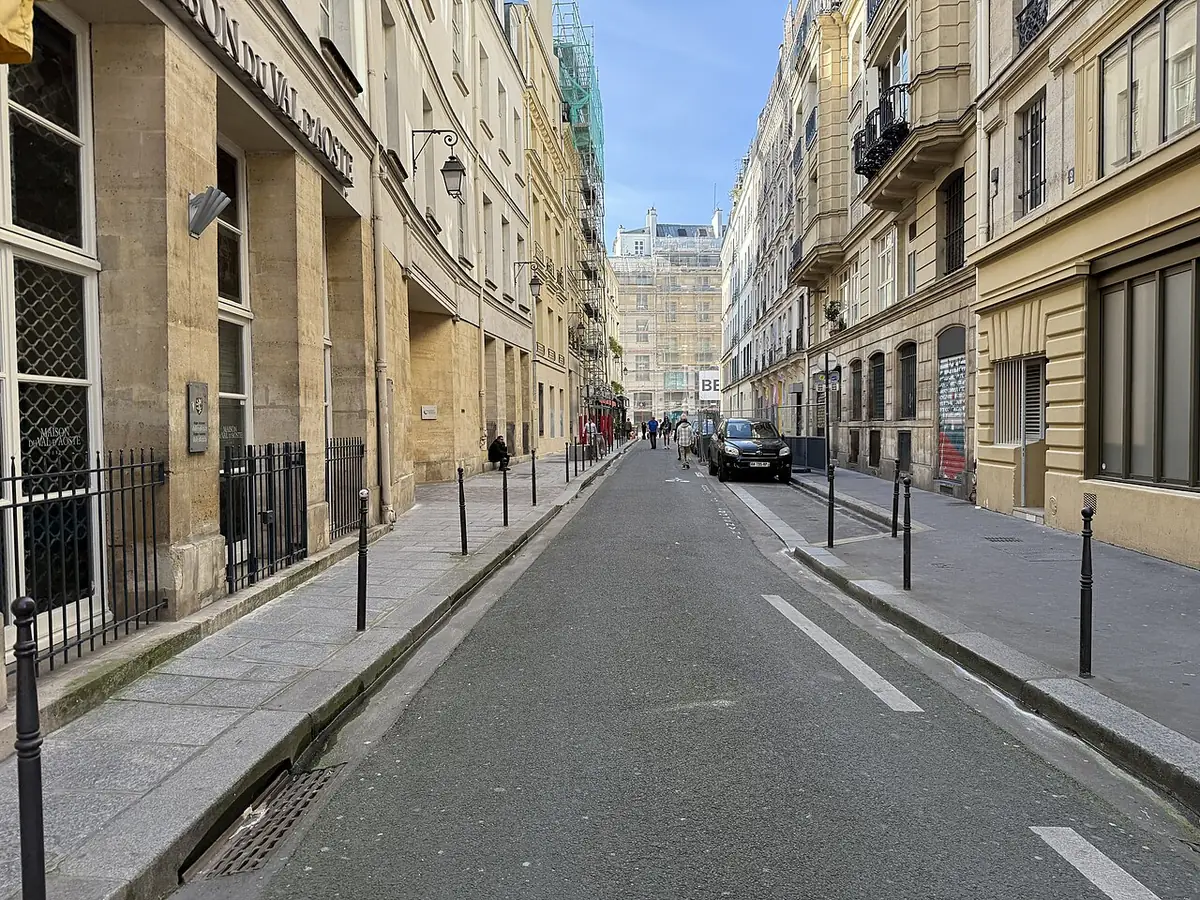
A quiet Haussmannian street in central Paris — Photo: Chabe01 · CC BY-SA 4.0 · Wikimedia Commons
Beyond the raw cost per square metre, the legal nature of what you own deserves close attention.
Approaching the Paris property market means separating the headline averages from what is actually happening by property type and by street. Asking prices do not always reflect the net value after negotiation, particularly for properties that need serious thermal or structural renovation. Historic data and recent trends both show that buyers have become markedly more selective. Building a workable budget means folding in every charge the co-ownership generates, along with the compliance works you cannot avoid.
parisFor saleApartmentestimate
Median price / m²€9,975Half the apartments sell below this
Median price€545kthe average is 14% higher — a few very large properties pull it up
Most common1 bedroom42 % of listings
Average size52 m²
By number of bedrooms
Bedrooms
Share of market
Avg price
Price / m²
Avg size
1most common
42 %
€445k
€11,130 +6 %
40 m²
2
33 %
€651k
€10,500
62 m²
3
17 %
€887k
€10,080
88 m²
4
8 %
€1.18m
€9,870best value / m²
120 m²
Each row is an average, compared against the area average of €10,500 / m². These are indicative estimates of a typical local market, not a measured sample of live listings. Check current listings before relying on them.
Weighing the charm of the old against the logic of the modern
Once you have settled on the type of property, the purchase itself follows strict legal rules worth mastering.
The local market sets two visions of Paris living against each other, and the one you pick shapes both your daily life and your future spending. On one side, the classic stock offers the aesthetic qualities buyers chase, but brings recurring thermal and maintenance constraints with it. On the other, the post-war decades bet on function, lifts that meet current standards, and charges that are often easier to keep under control. Choosing between them is a personal compromise between falling in love with a place and managing an asset rigorously over the long term.
The Haussmannian or traditional period apartment
It wins you over straight away with herringbone parquet, period mouldings, marble fireplaces and generous ceiling height. That timeless architectural character is a recognised safe harbour on the Paris market and keeps the property attractive when you come to sell. The flip side is that these qualities usually come with insulation that could be far better, rooms sometimes laid out one leading into the next, and communal parts that need heavy works voted through at the owners' general meeting.
What it changesYou accept the energy constraints and sometimes steep co-ownership charges in exchange for a distinctly Parisian way of living.
The apartment in a newer or modernist building
It favours light, with wide glazed bays, a rational layout that wastes no space, and modern shared facilities. These buildings usually have a caretaker, lifts built to recent standards and an energy performance diagnostic (DPE) that reads more favourably. In return, the exterior look is more neutral, and the historic charm of old parquet gives way to standardised flooring that can feel short on character.
What it changesYou choose technical peace of mind, daylight and controlled running costs at the expense of traditional period detail.
The legal and financial traps to see coming before you commit
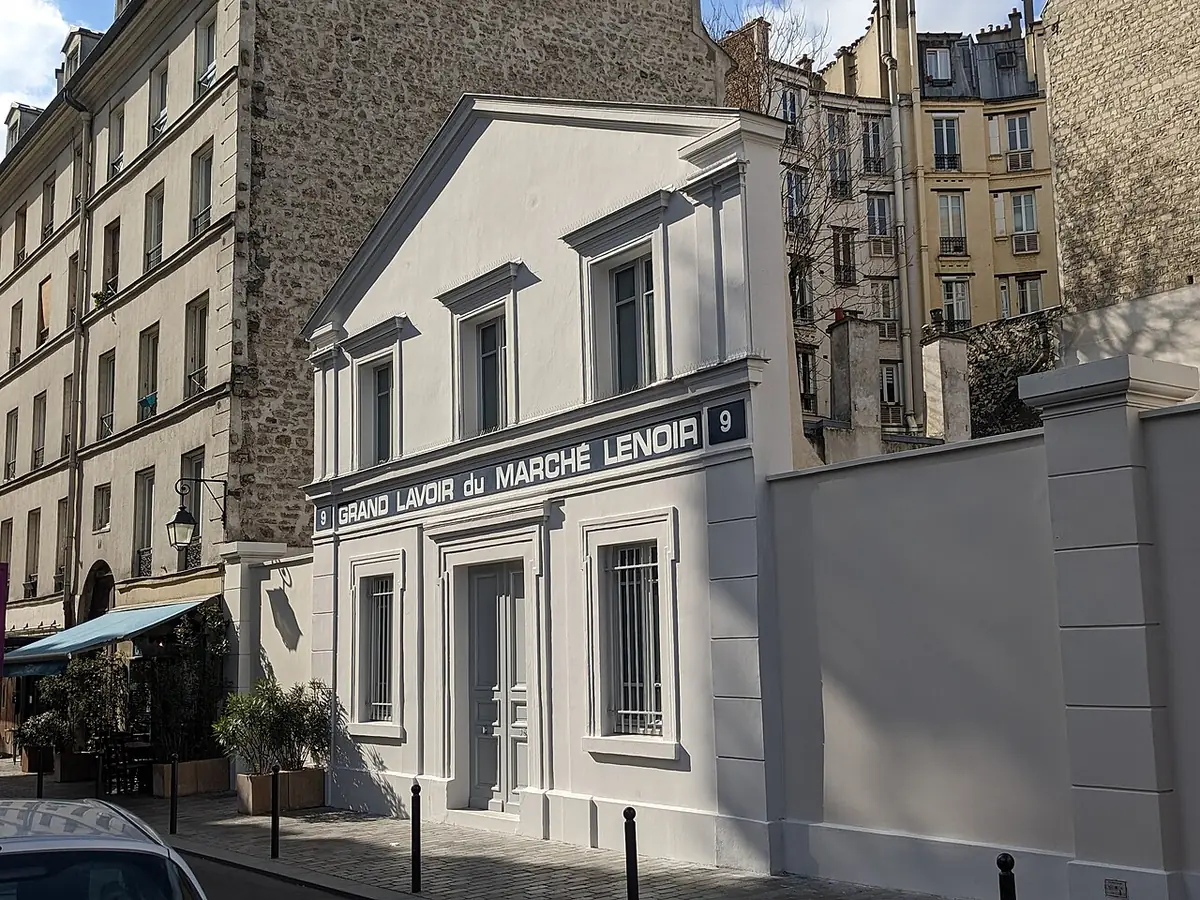
A repurposed neighborhood building near Marché Lenoir — Photo: Artvill · CC BY-SA 4.0 · Wikimedia Commons
That careful process runs to a precise calendar you have to orchestrate with every professional involved.
Signing a preliminary sale agreement (compromis de vente) in Paris binds both parties legally, far beyond the deposit held in escrow. Buyers routinely underestimate how vital it is to read the minutes of the owners' general meetings for the last three years before they sign. Those dry documents are where unpaid charges, live legal proceedings and works voted through but not yet carried out come to light. Skipping that verification step exposes a new owner to unpleasant financial surprises within months of moving in.
Finding a property priced in line with the market and having your written offer accepted by the seller.
A thorough read of the building's maintenance record and the most recent co-ownership minutes, looking for warning signs.
Checking the exact floor area under the Carrez law and confirming it matches the description in the title deeds.
Pricing your share of the future works set out in the building's overall technical assessment (DTG).
Signing the preliminary contract with the conditions precedent you need in order to secure your financing.
Completing the deed of sale before the notaire and taking formal delivery of the keys.
The working timetable of a purchase, from offer to keys
Follow these steps and read the market coldly, and your purchase has every chance of coming off.
Buying an apartment in Paris means coordinating a lot of people against a demanding calendar that usually runs over several months. From the moment you make your first offer to the moment you push open the door of your new home, each party plays a precise role you should anticipate. Knowing how it unfolds keeps administrative dead time to a minimum and reassures a seller who wants to be sure the buyer will hold. Transparency and quick responses are your best assets for getting the purchase through in good conditions.
The buyerMaking a written offer to purchasePutting forward a proposal at the asking price or a reasoned one below it, with a financing plan validated by a broker or a bank.
The notaireDrafting and signing the preliminary agreementGathering the required paperwork and technical diagnostics, and starting the buyer's ten-day statutory cooling-off period.
The bankProcessing and issuing the loan offerFiling the financing application, assessing the guarantees, and issuing the formal loan offer within the agreed time limits.
The managing agent (syndic)Issuing the article 20 certificateA statement confirming the seller is up to date with co-ownership charges owed to the owners' association.
The buyer and the sellerSigning the final deed of salePaying the price by transfer, settling the notaire's fees and transfer duties, and the formal handover of title and keys.
Why an apartment in Grenelle, in the 15e, rather than anything else?
Once that is settled, the central question of financing and of what things really cost arrives immediately.
In the Grenelle quarter, at the heart of the 15e arrondissement of Paris, the question of a house of your own barely arises in the form of townhouses. The market consists almost entirely of apartments, whether in the handsome Haussmannian blocks lining the main roads or in the more contemporary construction of the decades that followed. Choosing to settle here therefore means accepting life in a co-ownership, with the advantages that come from sharing charges and major works, but also its regulatory constraints and its sometimes complicated general meetings.
In Grenelle, an apartment gives you a strategic position that few single-storey houses could match in a city fabric this dense. Living high up in these buildings often opens views across the rooftops of Paris, and even towards the Eiffel Tower from the top floors, while still bringing in a welcome amount of light despite the density of the capital. Layouts run from the studio bought by investors to the large family apartment of four or five rooms, so your home can follow the shape of your life without your having to leave the quarter.
On maintenance and security, the apartment comes out well ahead for working people and busy families. There is no roof to repair yourself and no garden to tend every weekend, which frees up precious time in a city where every minute counts. Most buildings have solid access control, the larger ones have a caretaker, and the immediate neighbours provide a reassuring presence when you are away for a while, which is no small comfort.
Finally, choosing an apartment in this particular corner of the 15e arrondissement buys into an asset that has historically been easy to sell on. Demand for this kind of property does not let up, carried by the closeness of the Seine, the green space of the parc Andre-Citroen and the employment centres of western Paris. Even if a house remains the ultimate fantasy of private space, the practical and economic reality of Grenelle brings every buyer back to a well-placed, well-optimised apartment.
What budget do you really need to buy an apartment in Grenelle?
Knowing the prices is not enough; you also need to test the daily rhythm this investment actually buys.
Working out the budget you need to buy in Grenelle calls for a careful reading of current Paris market trends. Asking prices vary considerably with the state of the building, the presence of a lift, the floor and the quality of the view. Multiplying your target floor area by a theoretical average will not do, because each micro-quarter carries its own pricing logic. Recent notarial data is the only reliable anchor for building a realistic financing plan without risking a refused loan.
Price ranges seen in Grenelle by property type
Property type
Average price per m2
Main factors that move the figure
Studio / one-bedroom
EUR 8,500 to EUR 10,200
Distance to the metro, lift, general condition
Two bedrooms and up
EUR 8,000 to EUR 9,500
High floor, nothing overlooking, balcony
Exceptional property
EUR 9,800 to EUR 11,500
Eiffel Tower view, top floor, cut-stone building
These ranges summarise the transactions recorded by the notaires of Paris for the Grenelle quarter over recent quarters.
Charges and additional costs to build into the financing plan
Cost item
Average estimate
Effect on the overall budget
Notaire's fees and transfer duties
Around 7% to 8% of the price paid to the seller
Payable immediately out of your own funds
Co-ownership charges
EUR 30 to EUR 45 per m2 per year
To be set aside monthly in the budget
Co-ownership works already voted through
Varies with the most recent general meeting minutes
A financial risk to anticipate before buying
Co-ownership charges are trending upward because of the energy transition and the thermal renovation of building facades.
What does an ordinary Tuesday in Grenelle actually look like?
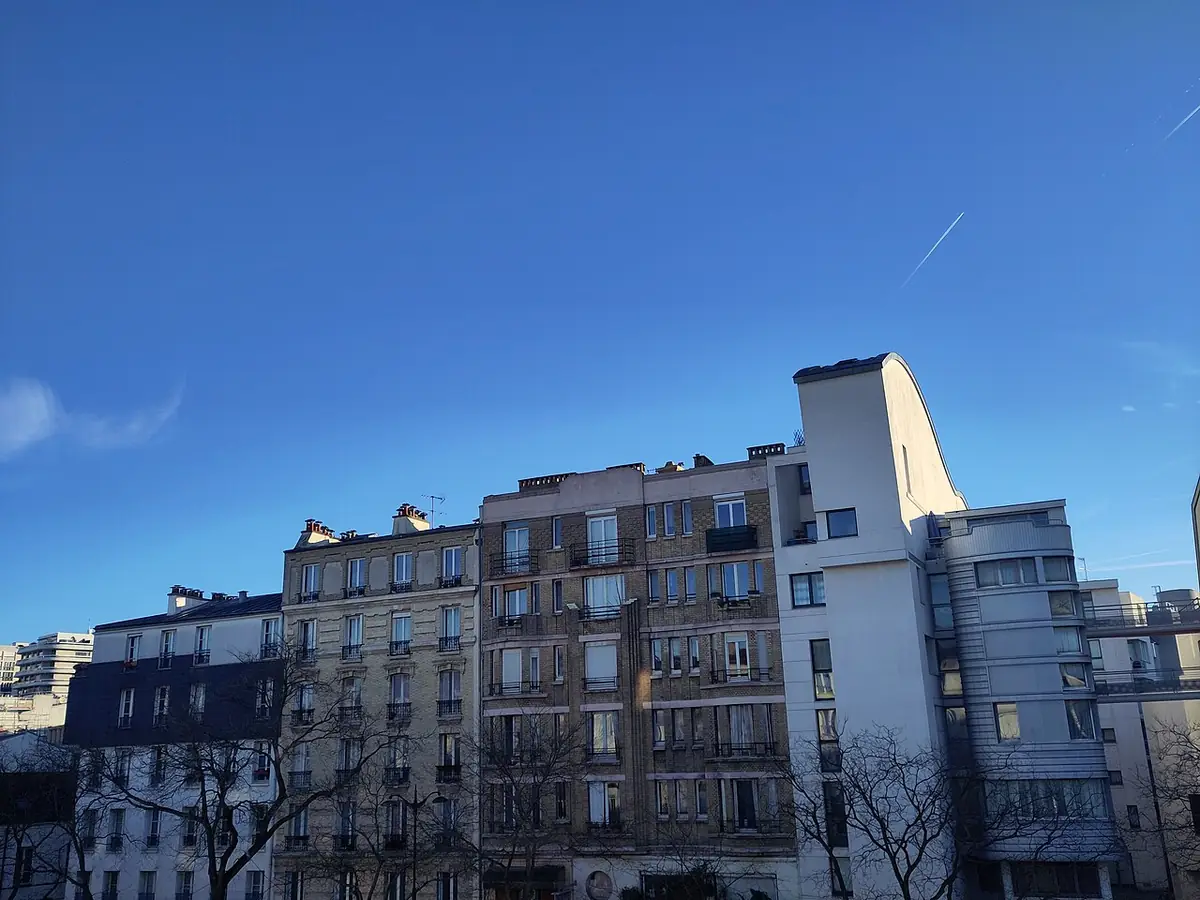
A classic Haussmannian apartment building in Paris — Photo: Exilexi · CC BY 4.0 · Wikimedia Commons
Beyond that apparent smoothness, some quieter aspects of the quarter deserve your full attention before you sign.
Settling in Grenelle means taking on a rhythm that is typically Parisian: dense, well served, and surprisingly calm the further you get from the main roads. To take the measure of your future daily life, nothing beats walking through an ordinary day hour by hour. From the morning flows to the local services that stay open late, each slot shows how well the quarter absorbs the demands of its residents without much friction.
08:15Dupleix or Charles Michels metro stationAccess to lines 6 and 10 makes for a remarkably smooth run to the centre or to the western business districts without major congestion.
09:00Rue du CommerceThis is the ideal hour to walk this busy pedestrian shopping street, before the afternoon crowds arrive.
12:30Boulevard de GrenelleA lunch break in one of the many traditional bistros, or at the market stalls nearby, for residents working from home.
16:45Square Bela-Bartok or the parks along the SeineFamilies and childminders gather in these secure green spaces, kept up well by the local authority.
19:30The local food shopsNeighbourhood artisans (bakers, wine merchants, cheesemongers) make last-minute shopping easy on the way home.
21:00The banks of the SeineCalm returns, for an evening run or a walk after dinner with the lit-up capital in view.
What the agency brochures do not tell you about Grenelle
These subtleties are exactly what unsettles newcomers who have not anticipated the classic mistakes.
Viewings tend to happen on a Saturday, in flattering light, staged to show off the volumes and smooth over the rough edges. Real life in Grenelle, though, is shaped by planning and acoustic realities that the listing photos never reveal. Spotting these invisible points lets you buy with your eyes open and avoid any disillusion once the boxes are unpacked.
The noise from the elevated metro lines
Parts of line 6 run on elevated viaducts immediately alongside boulevard de Grenelle. Trains passing produce a steady noise level you absolutely must test with the windows open, in the middle of the day.
How difficult residential parking is
Owning a vehicle without a private space or a basement garage is a battle. Parking charges for non-residents and the sheer scarcity of spaces discourage daily use of a car.
The heat-trap effect in some narrow streets
During a summer heatwave, the enclosed, hard-surfaced streets hold heat intensely. Natural cross-ventilation in a dual-aspect apartment then becomes an absolute comfort criterion you should not overlook.
Facade works and how the co-ownership votes on them
Many of the older buildings in Grenelle need external thermal insulation or roof renewal. Reading the last three sets of general meeting minutes closely is compulsory if you want to avoid a financial surprise.
The classic traps buyers bitterly regret six months after completion
Despite these pitfalls, the profile of buyer this area suits remains a very particular one.
Looked likeA charming attic pied-a-terre under the roofs with an unbeatable view
Turned outA furnace in summer, a freezer in winter, and no lift at all to carry the shopping up to the sixth floor.
Would have caught itChecking the energy performance diagnostic (DPE) without fail, and rehearsing the climb with heavy bags in hand.
Looked likeA very well-placed apartment right beside a busy metro station
Turned outConstant noise, permanent vibration, and crowds gathering under the windows at night.
Would have caught itViewing at unusual hours, notably in the evening and at peak times, to gauge the real noise level.
Looked likeA rare chance to renovate an apartment entirely to your own taste
Turned outStructural surprises once demolition started (sagging floors, non-compliant waste pipes) and contractor quotes that doubled.
Would have caught itBringing a project manager or an architect to the second viewing to cost the structural work precisely.
Looked likeA small self-managed co-ownership with tiny monthly charges
Turned outNo way to fund major roof works, constant disputes between owners, and no professional managing agent in place.
Would have caught itAnalysing the overall financial health of the co-ownership and checking how much has built up in the statutory works reserve fund.
Who should sit this one out and not buy in Grenelle?
If you recognise yourself in these limits but none of them is a dealbreaker, it is time to decide.
The general appeal of Paris 15 does not make Grenelle a promised land for everyone. Some buyers, with specific expectations, will find local realities frustrating very quickly. Recognising that the quarter does not match the way you live now is a sign of financial and personal clarity, and far better arrived at before you sign a preliminary sale agreement in front of the notaire.
Anyone who must have large private green space
→Buying a suburban house with an enclosed garden rather than a Paris apartment.
Even with well-kept parks and squares in the quarter, it will never offer the privacy and outright ownership of a planted plot of your own.
The driver who depends on a car for work
→Looking to the outer suburbs, or to regional cities with plenty of free parking.
Paris mobility policy drastically restricts the place of the car, which makes daily driving both complicated and expensive.
The investor chasing a high gross rental yield
→Turning to dynamic mid-sized cities where the purchase price to rent ratio is far more favourable.
High prices per square metre in Grenelle mechanically cap the immediate rental yield, shifting the case back onto long-term preservation of capital.
The verdict: are you ready to buy in Grenelle?
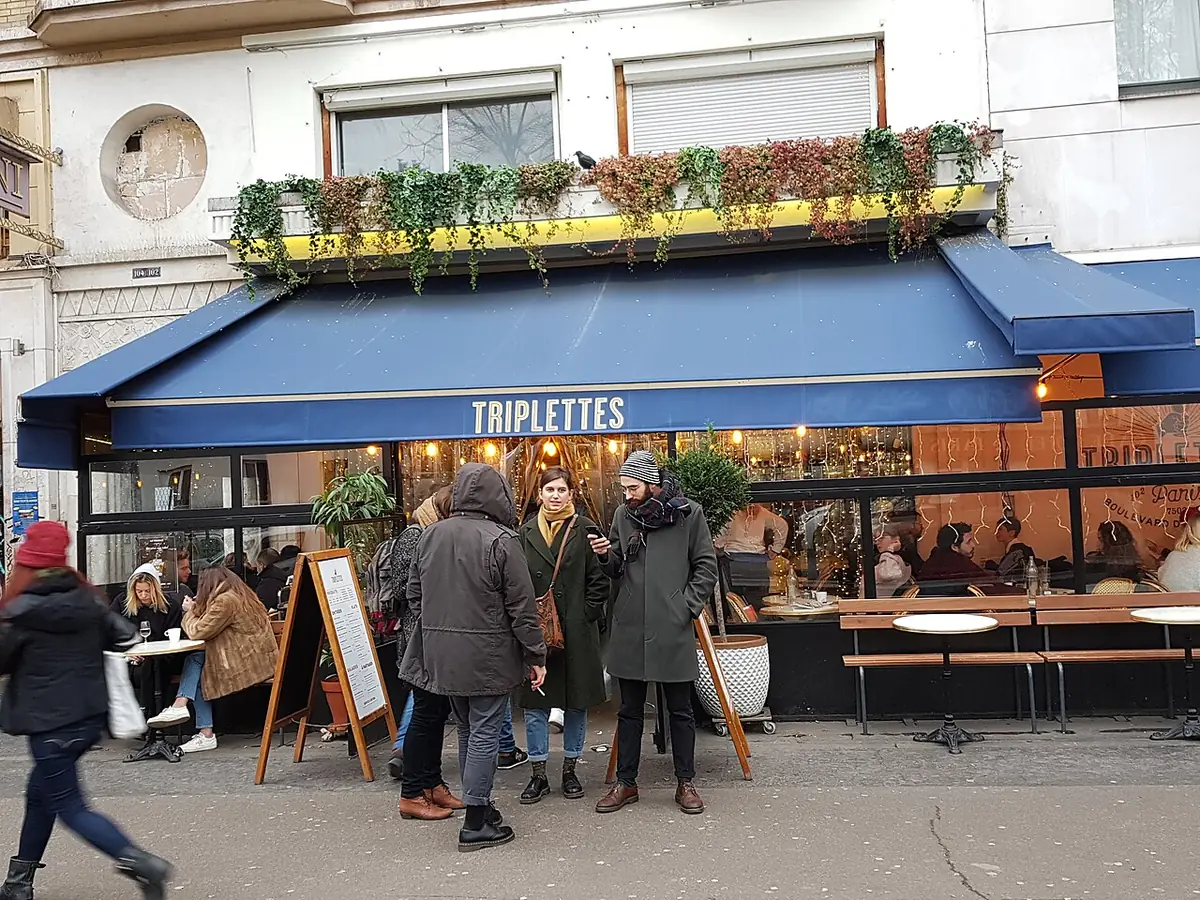
A brasserie terrace bringing life to the boulevard — Photo: Dhehz · CC BY-SA 4.0 · Wikimedia Commons
Buying an apartment in the Grenelle quarter is, above all, choosing a balanced Parisian way of life, somewhere between commercial bustle and residential ease. If your research has cleared the financial constraints, the acceptance of life in a co-ownership and the reality of prices per square metre, you now hold every indicator you need to see the purchase through in the best possible conditions.
Take the time to lay the groundwork of your financing plan rigorously, always including the notaire's fees and transfer duties and a provision for future works. A solid loan application, prepared in advance, remains your best passport with sellers in a market where speed of response often separates the opportunity seized from the property narrowly missed.
Remember that property in Paris is a medium to long-term proposition. Economic cycles have their highs and their lows, but the central position, the quality of the transport network and the scarcity of land in the 15e arrondissement are solid defences for the value of your investment over the years.
Your decision now has to rest on your own priorities: if the energy of rue du Commerce, the closeness of the Seine and the security of a lively quarter matter more to you than large private green space, then Grenelle is waiting. All that is left is to book your next viewings with a fresh and better-informed eye.
Related questions
What is the average price per square metre for an apartment in Grenelle?
The average generally sits between EUR 8,000 and EUR 10,500 per square metre, depending on the exact condition of the property, its floor, how much light it gets, and whether or not the building has a lift.
Which metro lines serve the Grenelle quarter?
The quarter is unusually well connected by lines 6 and 10 of the Paris metro, which put the capital's main business districts and the key interchanges within quick reach.
Is this a good quarter for raising children?
Yes. Grenelle has a number of well-regarded schools, nurseries, and secure squares and playgrounds, which is why it is so sought after by families in Paris.
What additional costs should a buyer budget for?
You must build in the notaire's fees and transfer duties (roughly 7% to 8% of the price paid to the seller), the bank's loan guarantee costs, plus any renovation spending and the co-ownership charges.
How do you find out about the co-ownership's financial health?
The seller is legally required to provide the pre-completion statement of account and the minutes of the last three owners' general meetings, documents you cannot do without if you want to anticipate the works already voted through.
Are there plenty of local shops in this part of the 15e?
Rue du Commerce and the streets around it are packed with food shops, markets, supermarkets and health services, so daily life is entirely self-contained without crossing the whole of Paris.
Is it easy to resell an apartment bought in Grenelle?
Liquidity here is excellent, because demand structurally outstrips supply for well-located properties that have been priced sensibly.
Do properties often come with outdoor space such as a balcony?
Balconies and terraces remain fairly rare in older Haussmannian stock, but they turn up much more often in the 1960s to 1980s buildings scattered across the quarter.
How can you judge the noise level of an apartment during a viewing?
Ask to open the windows and listen to the traffic, check that the glazing is double, and find out how close the property is to the elevated metro lines.
What kinds of property dominate the Grenelle market?
The market is made up almost entirely of apartments held in co-ownership, running from the functional studio aimed at investors to the large family apartment of four rooms or more.