Buying something as rare as a house or a low-rise home with outdoor space in the 15e arrondissement of Paris calls for a clear-eyed reading of real value and of the constraints the city imposes. This practical guide takes apart every stage of the purchase so you can decide calmly. Set the sales talk aside and look at how the Paris market actually behaves.
Get the app
What nobody tells you.
Real prices, hidden costs and the traps to check before you commit.
Why floor space in a house in the 15e arrondissement of Paris costs so much
Scroll
Why floor space in a house in the 15e arrondissement of Paris costs so much
Buying something as rare as a house or a low-rise home with outdoor space in the 15e arrondissement of Paris calls for a clear-eyed reading of real value and of the constraints the city imposes. This practical guide takes apart every stage of the purchase so you can decide calmly. Set the sales talk aside and look at how the Paris market actually behaves.
Written by the ting.ad editorial team ·
Rue de Rivoli, Paris in Street View: drag to look around.
Buying a house with a garden or a ground-level terrace in the 15e arrondissement of Paris is a spatial anomaly. On one side, the sheer scarcity of this kind of property creates an asset value that barely moves whatever the market does. On the other, the enormous outlay up front and the running maintenance costs weigh heavily on rental returns or on a family budget. This is not an ordinary residential purchase but a highly speculative and emotional one, in one of the densest districts in Europe.
Genuine architectural scarcity in the middle of the capitalvsA stratospheric entry price for what is often a modest floor area
The few detached houses and low-rise homes hidden down dead-end lanes in the 15e arrondissement get rarer every year. That scarcity protects resale value but demands a considerable immediate financial sacrifice, with no guarantee of a quick gain.
Complete quiet and a degree of self-sufficiency closer to life in a smaller townvsPossible isolation, and a much harder job selling quickly when the market tightens
Owning a house with enclosed outdoor space in Paris feels like stepping out of the urban noise. These properties are illiquid, though, because the pool of buyers with that kind of budget is extremely small.
The freedom to reshape, extend upwards or renovate to your exact needsvsAn administrative obstacle course with the Architectes des Batiments de France
Unlike an apartment bound by co-ownership rules, a house looks like freedom. In practice, Paris planning rules and heritage constraints turn every building project into a bureaucratic marathon.
Which buyer profile settles for the long term in a Paris house in the 15e
Buying a house in the 15e arrondissement of Paris changes how you move around and how you run daily life. It does not suit every household, and it swings constantly between the wish for private space and the reality of an extremely dense urban fabric. Working out your own profile before you sign at the notaire's office is what saves you from disappointment in the first months, when the unexpected constraints of individual housing inside the city show up.
Family with children
Outdoor space, even a small patch, profoundly changes daily life for parents and children in Paris. You get a real break from school and from crowded municipal parks while staying in an arrondissement with excellent schools. The trade-off is giving up the generous volumes of suburban houses in order to keep an address inside the city. Getting children to after-school activities takes tight organisation, because traffic is heavy.
Self-employed or remote worker
Setting up an office on the ground floor, or in a converted loft with nothing overlooking it, is the real luxury of a Paris house. You can receive clients or work in peace without noise from the rest of the building or a lift that has broken down again. On the other hand, maintaining the whole building and dealing with roof or plumbing failures falls entirely on you. Professional isolation can also creep in if you do not make a point of getting out to the cafes and coworking spaces nearby.
Older buyer seeking a central address
This buyer wants to keep the comfort of living on one level with a small outdoor space, while gaining immediate access to Paris culture and medical care. The 15e arrondissement is a good compromise thanks to its wide shopping avenues and its many green spaces, such as the parc Georges Brassens. The main trap is the number of staircases inside these multi-level houses, which get harder to manage with age. The move also means accepting a sharp reduction in floor area compared with the outer suburbs.
What changes most when you arrive from abroad and settle into a house in Paris 15e
Moving from a conventional residential life somewhere else in the world into a house in the 15e arrondissement of Paris brings an immediate cultural and logistical jolt. Your sense of space, your relationship with neighbours and even your definition of quiet all give way to the reality of a dense city. This table sets the expectations you arrive with against the daily life new buyers actually find.
From abroad
A large landscaped garden of 500 square metres with nothing overlooking it
Paris
A paved courtyard or a pocket garden of 30 square metres enclosed by high walls
You have to let go of the idea of a lush private green space and instead design a compact urban patio that works in the warmer months.
From abroad
Easy parking in front of the garage or on the driveway
Paris
No private parking at all, or an expensive underground box some distance away
Keeping a car becomes a money pit and a daily source of stress, which pushes most owners quickly onto public transport and bikes.
From abroad
Local tradespeople who turn up quickly for any roof or boiler problem
Paris
Long waits for a call-out and Paris emergency rates more than fifty per cent higher
You need to build a list of trusted tradespeople from the moment you move in, so you are covered when something fails.
From abroad
Spread-out neighbours, each keeping their privacy at a respectable distance
Paris
Constant closeness, both in sound and in sight, with the windows of the buildings next door
Blackout blinds, heavy acoustic double glazing and screening panels become a budget item within the first few weeks.
How to pick the right micro-neighbourhood in the 15e arrondissement to put down your bags
The 15e arrondissement is large, uneven and made up of micro-territories with radically different atmospheres. Where you place your future house or property determines not only the quality of your days but also how easily you will sell later. Each sector has hidden advantages and structural drawbacks worth weighing coldly.
The Convention / Vaugirard sector
A busy shopping-village atmosphere, paced by open-air markets and pushchairs.
Suits
Families who want food shops and schools right on the doorstep without giving up neighbourhood life.
Trade-off
Heavy traffic on the main roads and some of the firmest prices per square metre in the arrondissement.
The Saint-Lambert / Georges-Brassens sector
A comfortable residential feel: calm, green and built around family downtime near the park.
Suits
Those who insist on complete quiet, major green spaces nearby and a rich network of local associations.
Trade-off
Relatively far from the fast transport hubs, and not much going on at night.
The Front de Seine / Beaugrenelle sector
A modernist, hard-surfaced atmosphere, wide open to the river, with large-scale services built in.
Suits
People who like contemporary architecture, big bright volumes and covered shopping centres with everything under one roof.
Trade-off
A setting that can feel impersonal or cold in the evening, far from traditional Haussmann charm.
The Javel / Boucicaut sector
A fast-changing neighbourhood, lively and young, driven by the conversion of former industrial land.
Suits
First-time buyers and younger working Parisians willing to bet on the future value of an area on the rise.
Trade-off
Building sites are still common in some streets, and the social mix is shifting unevenly.
A realistic look at prices and budget ranges for settling in the 15e
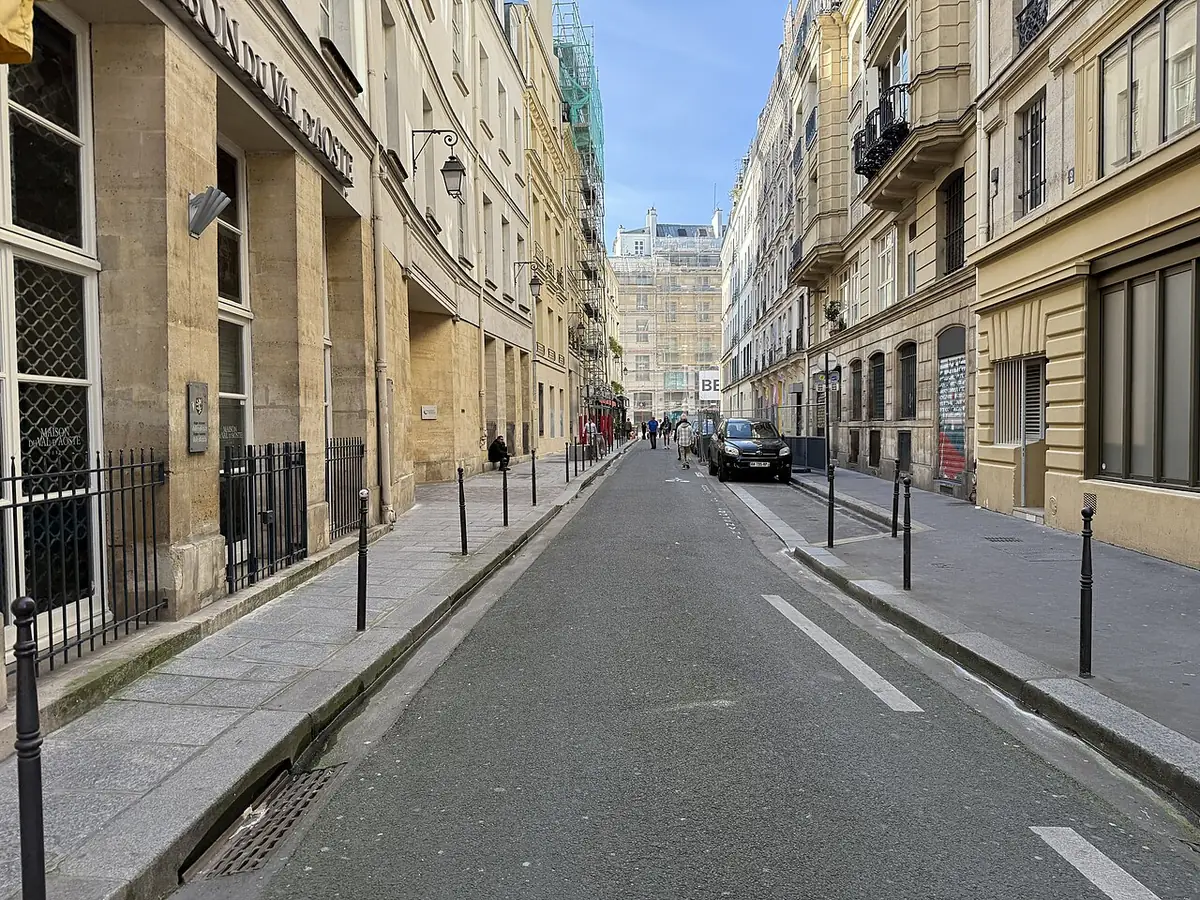
A quiet Haussmannian street in central Paris — Photo: Chabe01 · CC BY-SA 4.0 · Wikimedia Commons
Working out the real cost of buying in the 15e arrondissement does not stop at the headline price per square metre that agencies advertise. Between the notaire's fees, the work needed to meet energy standards and the scarcity of individual houses, the bill climbs fast. This table sets out the orders of magnitude seen in the market so you can build a financing plan that does not put you at risk.
parisFor saleHouseestimate
Median price / m²€8,180Half the apartments sell below this
Median price€784kthe average is 14% higher — a few very large properties pull it up
Most common2 bedrooms57 % of listings
Average size91 m²
By number of bedrooms
Bedrooms
Share of market
Avg price
Price / m²
Avg size
2most common
57 %
€934k
€8,610
109 m²
3
29 %
€1.27m
€8,266
154 m²
4
14 %
€1.7m
€8,093best value / m²
210 m²
Each row is an average, compared against the area average of €8,610 / m². These are indicative estimates of a typical local market, not a measured sample of live listings. Check current listings before relying on them.
Advertised floor area against genuinely usable space: telling one from the other
Buying a house or an unusual property in the 15e arrondissement often hides significant legal and technical subtleties around floor area. Between the Carrez-law rules, cellars converted below ground, undeclared loft space and poorly insulated conservatories, a careless buyer can pay top prices for square metres that cannot be used. Examining the exact structure of the property before committing is essential.
The legally recognised habitable floor area
Agencies advertise an overall area that sometimes includes basement annexes, unheated conservatories or ceilings lower than 1.80 metres. Yet only the Carrez-law floor area, or the genuine habitable area, carries legal weight when the final deed of sale is signed.
What it changesHave every square metre checked by an independent surveyor so you do not overpay for space that fails the legal habitability tests.
Development potential and raw volume
Some older properties come as bare floors, unconverted lofts or run-down outbuildings that look full of potential on paper. Turning those volumes into comfortable rooms means heavy structural work, cutting through floors and blocking sightlines from neighbouring windows.
What it changesAlways build the cost of full project management and a structural engineering study into your overall purchase budget, right from the first viewing.
The sequence to master before signing the preliminary sale agreement
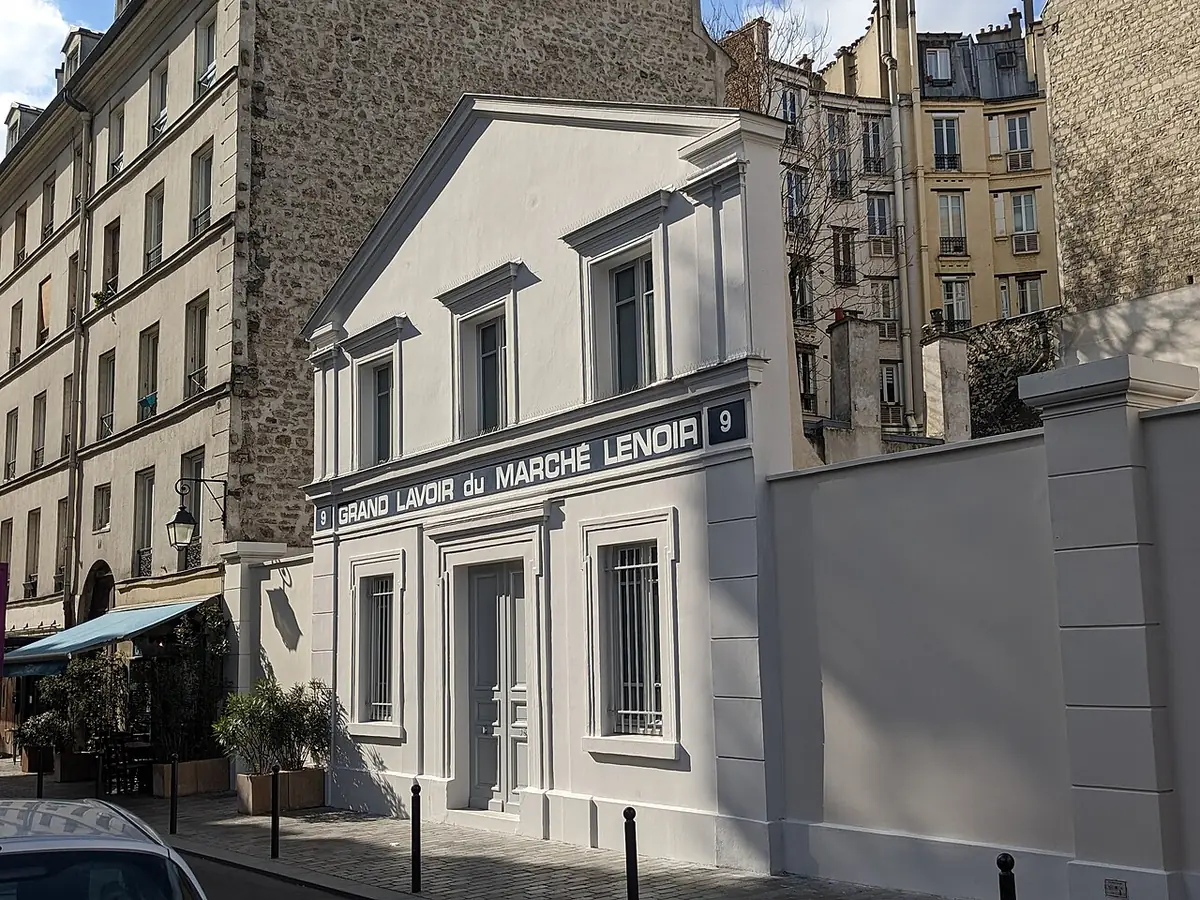
A repurposed neighborhood building near Marché Lenoir — Photo: Artvill · CC BY-SA 4.0 · Wikimedia Commons
Buying an exceptional property in the 15e arrondissement follows strict legal rules that a buyer should never let market pressure push aside. From the initial written offer to the handover of keys at the notaire's office, every stage carries protections you have to activate methodically. Haste and sloppiness are the main causes of complicated property disputes in Paris.
A thorough viewing of the property alongside a building professional
Drafting and sending a written offer, either at the asking price or with clearly stated conditions.
Signing the preliminary sale agreement (compromis de vente) or a unilateral promise of sale, covered by a legal ten-day cooling-off period.
Working carefully through the financing plan and obtaining bank loan offers within the agreed deadlines.
Clearing the conditions covering planning, the absence of easements and the compliance of the technical diagnostics.
Signing the final deed of sale and transferring the funds at the notaire's office
Who actually gets involved in your purchase, and when
A property purchase in the 15e arrondissement works only when several parties with clearly defined roles coordinate properly. From the mortgage broker to the technical surveyor by way of the notaire who drafts the deed, each professional secures one specific side of your purchase. Understanding what each is responsible for stops you relying on assumptions that turn out to be wrong.
The notaire drafting the deedLegal certainty and authenticationThey check thirty years of ownership history, confirm there is no hidden mortgage, and draft the final deed that binds the parties for good.
The technical surveyorHealth and energy assessmentThey carry out the compulsory diagnostics on lead, asbestos, electrics and gas, and the energy performance diagnostic (DPE) that establishes how the property actually performs.
The mortgage brokerAssembling the loan packageThey negotiate with partner banks for the best rate and borrower insurance terms for your profile.
The architect or project managerTechnical costing of the worksThey price the upgrades precisely and confirm whether the internal layout changes you have in mind are structurally feasible.
The estate agent holding the mandateIntroductions and negotiationThey bridge the seller's expectations and the buyer's requirements while passing on the documents the sale file needs.
House or apartment in the 15e arrondissement: which way of living should you choose?
Once that basic choice between vertical and horizontal living is made, the central question of financing and real prices takes over.
Buying property in the 15e arrondissement of Paris forces an immediate choice between two radically opposed physical realities: the sheltered verticality of a Haussmann apartment or a modern tower, and the outright scarcity of a detached house with a patch of ground. The 15e is nonetheless the largest and most populous arrondissement in the capital, which lets it hold micro-neighbourhoods with the feel of preserved villages, especially around the Petite Ceinture or in the hidden cobbled lanes over towards Brassens. Choosing a house here is not simply an aesthetic preference; it means accepting a permanent trade between floor area spread over several levels and having no shared parts of a building to manage, and that redefines daily life completely.
On one side, a family apartment of four or five rooms offers obvious institutional security. Co-ownerships handle the structure, the roofs and the facade renovations, pooling charges that are sometimes heavy but predictable. Living high up in the 15e also buys open views across the zinc roofs, more light thanks to the upper floors, and food shops on the rue du Commerce or the rue de Lourmel a few steps away. The other side of that coin is enforced closeness, owners' general meetings that can turn heated when insulation works are put to a vote, and the physical impossibility of altering the outer shell of the building or creating a walled private outdoor space.
On the other side, a detached or terraced house in the 15e has to be earned and paid for dearly. Few properties of that kind escape developers or the old plot subdivisions. Owning a house here means taking on full responsibility for the roof, the drainage, the boiler and the party walls, with no collective structure to absorb the shock. In exchange, the sense of independence is total: nobody walking overhead in heels on a Sunday morning, the freedom to lay out a secret garden or a roof terrace within the local planning rules, and a rare feeling of privacy in the middle of a metropolitan area of twelve million people. It is the choice of a discreet, comfortable enclave, away from the noise of the outer boulevards.
The final decision therefore comes down to how you weigh your time against your money. If you want a liquid investment, easy to sell on, with a lift and a caretaker to take in your parcels, a high-specification apartment in a 1930s cut-stone building is the obvious asset. If your budget is substantial, you will not tolerate any noise from neighbours, and you dream of horizontal living with room for a barbecue or an olive tree in the middle of Paris, then hunting for a town house in the quiet residential streets in the south of the arrondissement will change your city life for good, at the price of constant attention to the fabric of the building.
What budget do you really need to own a house in the 15e arrondissement?
Once the financing plan is settled and the running costs understood, it helps to picture daily life across a typical week.
Buying a house or a large, exceptional property in the 15e arrondissement of Paris never comes down to the price per square metre that agencies advertise. The Paris market is layered, and every micro-neighbourhood, from La Motte-Picquet to the edges of the parc André Citroën, sets its own valuation rules. Transfer duties, negotiation fees, the notaire's fees and the unavoidable budget for thermal renovation all add to the total. Anticipating these lines is what stops the money running out in the first year of ownership.
Purchase price ranges and estimated costs for a house or a rare property in the 15e
Property type
Average floor area
Observed price range
Notaire's fees and duties
Initial renovation works
Town house with a small garden or courtyard
120 to 150 m2
EUR 1,400,000 to EUR 2,200,000
About 7% to 8% of the net price to the seller
EUR 50,000 to EUR 150,000 (insulation/roof)
Artist's studio converted into a home
100 to 180 m2
EUR 1,200,000 to EUR 1,900,000
About 7% to 8% of the net price to the seller
EUR 80,000 to EUR 200,000 (bringing up to standard)
High-specification family apartment (top floor)
130 to 160 m2
EUR 1,300,000 to EUR 1,850,000
About 7% to 8% of the net price to the seller
EUR 30,000 to EUR 70,000 (refresh)
The figures rest on observed trends in notarial transactions for good-quality properties in the quiet residential parts of the 15e arrondissement.
Recurring annual budget for maintaining a house or a large Paris property
Cost item
Frequency
Estimated low
Estimated high
Effect on the budget
Property tax on built property
Annual
EUR 1,800
EUR 3,500
Varies with floor area and cadastral rental value
Comprehensive home insurance (building plus contents)
Annual
EUR 800
EUR 1,600
Higher for a standalone detached house
Roof, facade and boiler maintenance
Annual to multi-year
EUR 1,500
EUR 4,000
Falls 100% on the owner in the case of a house
Unlike apartments in a co-ownership, where major works are voted at the owners' general meeting, a house owner has to set these sums aside alone.
What does an ordinary Tuesday in the 15e arrondissement actually look like?
A classic Haussmannian apartment building in Paris — Photo: Exilexi · CC BY 4.0 · Wikimedia Commons
Behind that well-oiled daily postcard, though, sit topographical and administrative realities that estate agents often leave out.
Settling in the 15e arrondissement of Paris means taking on a rhythm rooted in the comfortable, hard-working habits of western Paris. Far from the tourist rush of the city centre, this arrondissement works as a set of self-contained villages where local services, well-regarded schools and transport infrastructure cover the ground with real efficiency. From the early alarm to the last errand of the evening, every part of the day shows how smoothly this corner of Paris runs.
07:45Boulevard Pasteur / Pasteur stationMorning crowds on metro lines 6 and 12. Service is reasonably reliable, but trains fill up quickly from Motte-Picquet-Grenelle onwards, so commuters need to time their journey well.
08:30Local primary and secondary schools (for example College Germaine Tillion)Dropping children at the well-regarded state and private schools of the arrondissement. Walking routes are safe, and the adjoining streets often benefit from pedestrianised school-street schemes.
12:30Rue du CommerceA busy lunch break. Traditional food shops, cheesemongers and wine merchants sit alongside national chains, giving a standard of local service residents value highly.
16:30Parc Georges BrassensSchool pick-up and family time outdoors. Children use the playgrounds and the carousel and run around the green space while parents get a welcome pause away from the traffic.
19:00Avenue Émile ZolaBack from work, with the last errands of the day. The area keeps a peaceful evening life, with traditional brasseries taking in residents for an unpretentious local dinner.
What the polished listings leave out about the 15e arrondissement
These technical constraints lead straight to the regrets new buyers voice most often, six months after moving in.
The Paris market is expert at presenting properties at their best while quietly smoothing over the rough edges of the city. In the 15e arrondissement, listings push the light, the metro nearby and the residential calm, while carefully omitting the structural constraints that come from how the area was built. Knowing what the brochure will not show you saves you from serious disappointment after the purchase and protects the value of your investment over the long run.
Noise from the major ring roads
The boulevards des Marechaux, the rue de Vaugirard and the slip roads onto the ring road produce a continuous background noise. A house or apartment sold as quiet can still suffer low-frequency resonance if the acoustic double glazing is not to the latest standard.
Strict planning rules and the opinion of the Architectes des Batiments de France
If you buy a house or an older building in the 15e, the smallest plan to alter a facade, fit solar panels or change the windows goes through demanding approvals that can hold up the work for months.
The chronic shortage of on-street parking
Keeping a car in the 15e is an ordeal despite the many paid underground car parks. A monthly private parking subscription runs between EUR 150 and EUR 250, which has to go into the overall motoring budget.
Complex underground networks and the risk of damp on the ground floor
Several parts of the 15e sit on former marshland or on fill along the Seine. Older town houses sometimes suffer significant rising damp that calls for expensive resin injection.
The regrets buyers typically voice six months after moving into the 15e
These disappointments show that the 15e does not suit every buyer looking for Paris property.
Looked likeA charming town house tucked at the end of a leafy dead-end lane, completely cut off from city noise.
Turned outA property that removal lorries and delivery vans cannot reach, where neighbours run the shared areas as an informal co-ownership that generates constant friction.
Would have caught itCheck the exact cadastral status of the lane, confirm that a right of way is properly recorded by a notaire, and read the records of how the shared areas have been used before signing the preliminary agreement.
Looked likeA safe investment in a lively neighbourhood full of shops, ideal for doing everything on foot.
Turned outDaily noise and cooking smells from restaurant extractor fans at street level, plus refrigerated lorries delivering from first light.
Would have caught itView the property at different times, in particular on Saturday morning and in the evening, when the food shops and surrounding terraces are at their busiest.
Looked likeA generous floor area at a price per square metre slightly below the average for western Paris.
Turned outA maze-like internal layout with windowless rooms, wasted corridors and ceilings too low, which makes the interior awkward and stifling to lay out.
Would have caught itBring in an interior architect before making an offer, to confirm what the layout can really take and to price the cost of redistributing the space.
Looked likeAn ideal family neighbourhood where children can grow up safely and independently.
Turned outSaturated waiting lists at the most sought-after state and state-assisted private schools in the area, sometimes forcing families to enrol children further away.
Would have caught itAsk the arrondissement town hall and the education authorities directly about the catchment rules that apply to the exact street of the property you want.
Which buyers should the 15e arrondissement absolutely not suit?
Now is the moment to take a clear-headed look at whether your purchase in the 15e should go ahead today.
For all its reputation as the family arrondissement par excellence, stable, green and well served, the 15e arrondissement of Paris has economic and social features that can turn a purchase into a genuine strategic mistake for certain buyers. Moving here because it is fashionable, or because family convention says so, without examining how you actually live, leads reliably to a financial or personal disappointment.
The young professional after a busy nightlife and alternative venues
→A large apartment or a house in the south of the 15e arrondissement (Saint-Lambert or Grenelle).
The arrondissement goes to sleep early, the evening cultural offer is very limited compared with the 10e, 11e or 18e, and the general atmosphere is comfortable and conventional.
The investor chasing a high gross rental yield in the short term
→Buying a large family property or a town house in this area.
Purchase prices per square metre are so high that rents capped by Paris rent control deliver only a thin gross return, often below 3%, far from what other cities produce.
The household allergic to co-ownership constraints and strict rules
→An apartment in a large 1970s co-ownership along the outer boulevards.
Running these enormous blocks demands constant financial provisions for compulsory energy works and forces permanent compromise with hundreds of co-owners whose interests diverge.
So are you really ready to buy property in the 15e?
A brasserie terrace bringing life to the boulevard — Photo: Dhehz · CC BY-SA 4.0 · Wikimedia Commons
Buying a house or an exceptional property in the 15e arrondissement of Paris is not a speculative impulse; it is a considered choice about how to live. This arrondissement offers safety, a dense set of first-rate public services and a calm that is rare in a European capital. If you want an asset that can ride out decades without lurching, Paris property in this area rests on very solid economic fundamentals, reassuring for the generations that follow.
That comfort has a price you have to accept without reservation. You need to give up on quick rental returns, accept either the constraints of a rigorous co-ownership or the solitary upkeep of an older building, and live with a restrained kind of city life. If your plan is to set the family down for good, to educate your children in a stable environment and to enjoy easy days a short walk from the Seine and the parks, then the 15e arrondissement will deliver everything it promises.
Take the time to walk your target streets at unusual hours, talk to building caretakers, work through the most recent minutes of the owners' general meetings, and have every line of the thermal renovation priced precisely by qualified professionals. The current market gives buyers and sellers a more even footing: use that breathing space to negotiate calmly, without giving in to the false urgency agencies like to manufacture.
In the end, becoming an owner in the 15e means accepting that the city is earned through rigorous analysis and clear choices. If every line of this guide matches what you want from a home and from daily life, your decision is ready. All that is left is to make an offer at a fair price.
Related questions
What is the average price per square metre for a house in the 15e arrondissement of Paris?
Because detached houses are extremely rare in the 15e arrondissement, their prices reach the top of the market, generally running between EUR 10,000 and EUR 14,000 per square metre depending on overall condition, whether there is a private garden, and exactly how quiet the street is.
Which neighbourhoods are most sought after for buying a house or a large property in the 15e?
The micro-neighbourhoods around the parc Georges Brassens, the stretches of the rue de Vaugirard towards Saint-Lambert, and the quiet residential side streets near Javel are the areas buyers chase hardest when they want calm and greenery.
What are the notaire's fees on the purchase of an older property in Paris?
The notaire's fees, which consist mainly of the transfer duties collected by local authorities and the state, come to roughly 7% to 8% of the net price paid to the seller for an older property in the 15e arrondissement.
How does the property tax (taxe fonciere) work for a detached house in the 15e?
The property tax is calculated by the tax authority from the cadastral rental value of the home. For a mid-sized house or a large apartment in the 15e, it generally ranges from EUR 1,800 to more than EUR 3,500 a year.
Is it easy to find a parking space when you buy a house in the 15e?
On-street parking is difficult and resident permit rates are high. The large majority of house owners and owners of large properties in the 15e rent or buy a secure underground space at a monthly cost of EUR 150 to EUR 250.
Which metro lines serve the 15e arrondissement best?
The arrondissement is fed by lines 6, 8, 10 and 12 of the Paris metro, plus the T3a tram to the south, which gives quick links to central Paris and to the La Defense business district.
What planning constraints apply when renovating an older house in the 15e?
Any change to the external appearance of the facade, the fitting of photovoltaic panels or the replacement of windows and doors must comply with the local urban plan for Paris (Plan Local d'Urbanisme), and sometimes needs sign-off from the Architectes des Batiments de France.
What are the main parks and green spaces available in the 15e arrondissement?
Residents of the 15e have the parc André Citroën, the parc Georges Brassens, the square Saint-Lambert and the green walkway along the Petite Ceinture for walks and outdoor activity.
Does rent control apply to every home in the 15e arrondissement?
Yes. Rent control applies across the whole private rental stock in Paris, which caps reference rents by property type, number of rooms and year of construction, and holds down gross yields for investors.
What must you check before signing a preliminary sale agreement (compromis de vente) in the 15e?
Check that no legal proceedings are running within the co-ownership, read the compulsory technical diagnostics covering lead, asbestos and energy performance, and go through three years of minutes from the owners' general meetings.