Buying an apartment in Sharjah is a major financial decision that calls for a clear-eyed reading of the local market, its neighbourhoods and its legal rules. This guide sets out the essential mechanics so you can invest with confidence, well away from marketing talk and unrealistic promises.
Get the app
What nobody tells you.
Real prices, hidden costs and the traps to check before you commit.
Why buying an apartment in Sharjah changes how you read space
Scroll
Why buying an apartment in Sharjah changes how you read space
Buying an apartment in Sharjah is a major financial decision that calls for a clear-eyed reading of the local market, its neighbourhoods and its legal rules. This guide sets out the essential mechanics so you can invest with confidence, well away from marketing talk and unrealistic promises.
Written by the ting.ad editorial team ·
Sharjah in Street View: drag to look around.
Beyond the purely spatial side, whether a purchase like this makes sense depends closely on your way of life and your daily habits.
Investing in property in Sharjah offers a residential alternative shaped by a more measured approach to urban development than in the neighbouring emirates. Buyers find a market where density reads differently across established coastal districts and inland areas in transition. That reality immediately shifts the spatial reference points of anyone looking to settle in the region for the long term without absorbing the immediate inflation of the big economic centres. The living space a given budget will buy therefore redefines both what you prioritise in a layout and your day-to-day relationship with your home. Understanding this shift in scale avoids the disappointment that comes from expectations set by Western cities.
Noticeably more living space for the same budgetvsService charges and additional costs to plan for carefully
The extra floor area lets you set aside rooms for working from home or for storage, which changes everyday comfort for good. That said, maintaining large volumes in a demanding climate takes a regular budget that should not be left out of the initial calculation.
A foothold in residential districts with real neighbourhood lifevsRelative distance from the ultra-central business hubs of nearby cities
Local life is organised around amenities within walking distance in the older areas, which gives the day a more human pace. In exchange, peak-hour journeys out to employment zones beyond the emirate demand constant planning.
A stable regulatory framework that supports legal certainty for investorsvsLocal administrative procedures that require absolute documentary rigour
Strict oversight of transactions by the local authorities protects good-faith buyers effectively. Every stage of a transfer of ownership, however, requires flawless paperwork if you want to avoid discouraging processing delays.
Capital growth underpinned by local rental demandvsResale liquidity that can be selective, depending on the property type and exact location
Demand is supported by families seeking stability and proximity to the emirate's schools and cultural facilities. Quick resales therefore depend closely on the intrinsic quality of the building and the state of repair of the common areas.
How do you know whether buying an apartment in Sharjah fits your way of life?
This lifestyle choice also means accepting the cultural and practical differences from the reference points you arrive with.
Whether a property project fits a resident's daily life is not settled by a simple financial equation or by falling for the architecture. Different types of buyer need to weigh how the urban setting, journey times and available services line up with what they personally want. Whether you are looking for a stable family base, a functional pied-a-terre or a long-term investment, the reality of Sharjah imposes precise trade-offs. Every life situation finds specific answers here, provided you measure the constraints attached to each part of the emirate accurately.
The resident looking for stability
Families and professionals who are not tied to a daily commute into the big financial centres find Sharjah a notably unhurried place to live. Residential districts offer rich school and cultural infrastructure that gives daily life a lasting structure. You get generous space without the permanent bustle of the larger regional cities, while still having access to a varied network of clubs and leisure options. This setup favours long-term roots and a smooth fit into the local fabric.
The commuting professional
For working people whose main activity sits outside Sharjah, buying an apartment calls for a careful study of the road network and peak-hour timings. Being immediately close to the main arterial roads becomes the overriding criterion if you want to protect your work-life balance and avoid commuting exhaustion. It is worth targeting developments on the immediate edge of the administrative boundaries in order to keep time behind the wheel down. A poor location choice at the outset can quickly turn the property's cost advantage into a major daily burden.
The long-term investor
Sharjah's rental market attracts a stable population of skilled workers and families looking for rents in proportion to their income. Your strategy should favour properties with parking included, decent energy performance and essential amenities immediately nearby. Void periods here are generally short, but the gross return depends directly on the purchase price and the service charges. A careful look at the building management company and at the general state of repair of the block is what makes your yield last.
What actually changes in day-to-day property life when you arrive from abroad?
This cultural and practical shift first becomes concrete in the choice of an area that matches your priorities.
Moving from an older property market, shaped by centuries of urban history and demanding building codes, to a modern emirate in full expansion unsettles all your reference points. Shared walls, joint ownership, built-in services and the technical management of buildings all follow radically different logics here. What counts as a luxury or an exception in many home markets, such as central air conditioning, round-the-clock security or a pool in the development, is a baseline standard here. In exchange, certain freedoms to alter an interior or make structural changes are governed by strictly enforced administrative rules that you need to factor in from the start.
From abroad
Joint ownership run by volunteer or professional managers, with general meetings that often turn contentious
Sharjah
Centralised management of buildings by management companies appointed by the developers or the owners
The common areas, the upkeep of the equipment and security are handled professionally and continuously, but you have less direct say over routine budget decisions.
From abroad
Older housing that frequently needs major insulation and cosmetic renovation work
Sharjah
A recent or brand-new housing stock with modern finishes, double glazing and efficient built-in air conditioning
You move into a space that works immediately, but you have to live with standardised materials and architectural choices that can feel uniform.
From abroad
Dense urban space where a private car quickly becomes a daily burden in the city centre
Sharjah
Town planning designed around the car, with parking spaces allocated as standard and wide structuring roads
Parking is no longer the permanent headache it is in large older cities, but you often walk less outside the areas laid out for pedestrians.
From abroad
Rental and purchase rules that are extremely protective of occupants but heavy with litigation
Sharjah
A clear, fast contractual framework overseen by government services dedicated to regulating property disputes
Procedures are formalised and run with considerable administrative efficiency, provided you follow the original clauses of the sale contract to the letter.
How do you find your way among the different districts when choosing an apartment in Sharjah?
Once the area is settled, the central question of purchase costs and recurring charges needs examining precisely.
The emirate of Sharjah holds a wide variety of micro-markets, each with its own identity, its own pace and its own mix of residents. From the historic coastal areas to the newer developments on the edges, the atmosphere changes completely and profoundly alters the experience of living there. Choosing an area is not just about measuring the distance to work; it means understanding neighbourhood life, the quality of the surrounding infrastructure and the profile of your neighbours. Comparing the available options is what avoids the classic mistake of buying on raw floor area alone, at the expense of the setting.
Al Majaz
A constant urban buzz set by waterfront walks, landscaped parks and a very dense choice of restaurants.
Suits
Those after an active, walkable, connected city life with plenty going on in the evening.
Trade-off
Possible noise, difficult parking for visitors and some of the highest prices per square metre in the emirate.
Al Khan
A balanced compromise between coastal living, direct beach access and proximity to the main roads heading to the other emirates.
Suits
Water sports enthusiasts and commuters looking to cut their journey time to Dubai while keeping a seaside setting.
Trade-off
A mixed housing stock where older blocks under renovation sit alongside modern towers with high service charges.
Muwaileh Commercial
A fast-growing, energetic university hub marked by a high concentration of local shops and modern services.
Suits
Investors targeting strong student and family rental demand, and buyers looking for recently built developments.
Trade-off
A cityscape that is still very hard-surfaced, marked by ongoing building sites and heavy traffic when term starts.
Abu Shagara
A long-established, busy commercial district known for its trading energy and its traditional neighbourhood life.
Suits
Buyers on a modest budget who want to settle in the heart of the city with immediate access to basic amenities.
Trade-off
Recurring on-street parking difficulties and ageing buildings that call for extra care over technical condition.
What are the financial realities and the price ranges for an apartment in Sharjah?
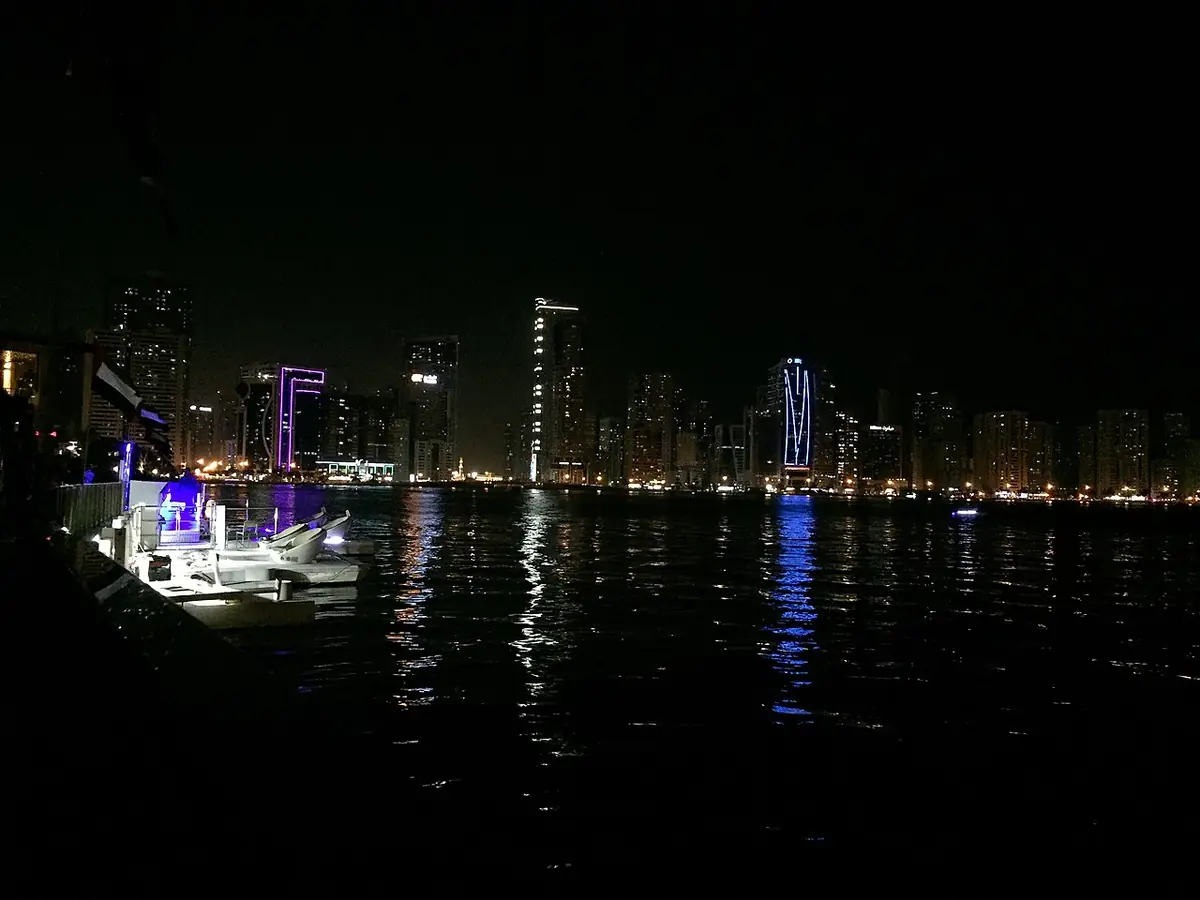
Boats and city lights along Sharjah's waterfront at night — Photo: Clintonpeter · CC BY-SA 4.0 · Wikimedia Commons
Beyond the figures you can put a number on, the legal nature of what you are buying deserves particular attention.
Property investment in Sharjah is characterised by broadly transparent pricing, framed by clear registration scales. Even so, sticking to the headline price quoted by developers or agencies leads inevitably to budget miscalculations. The additional costs, which include registration duties, brokerage fees and contributions to the building's reserve fund, form an unavoidable envelope that has to be built in from the moment you make an offer. On top of that, annual running charges vary considerably with the facilities the development offers (security, pool, gym, lift maintenance).
sharjahFor saleApartmentestimate
Median price / m²AED 7,600Half the apartments sell below this
Median priceAED 880kthe average is 14% higher — a few very large properties pull it up
Most common2 bedrooms38 % of listings
Average size110 m²
By number of bedrooms
Bedrooms
Share of market
Avg price
Price / m²
Avg size
1
30 %
AED 598k
AED 9,200 +15 %
65 m²
2most common
38 %
AED 857k
AED 8,160
105 m²
3
24 %
AED 1.14m
AED 7,600 −5 %
150 m²
4
8 %
AED 1.51m
AED 7,200best value / m²
210 m²
Each row is an average, compared against the area average of AED 8,000 / m². These are indicative estimates of a typical local market, not a measured sample of live listings. Check current listings before relying on them.
Between freehold and regulated usufruct: what can you actually own in Sharjah?
The same legal rigour applies throughout the transaction, from the first offer to handover of the keys.
The legal system governing property ownership in Sharjah draws a clear line between the zones open to investors of various nationalities and those reserved for local or Gulf citizens. Understanding that fundamental distinction is essential if you want to secure your investment and anticipate the conditions of a future resale. Successive reforms have considerably clarified the legal framework, giving foreign buyers solid guarantees, provided they stay strictly within the permitted zones (freehold or long-term usufruct). Failing to verify the exact nature of the title before signing is the number one legal risk.
Buying in a designated zone (freehold / regulated usufruct)
In the areas designated by the Sharjah authorities for foreign investment, you become the holder of ownership rights recognised by the land registration department. Depending on the development, that may be full transferable ownership or a long-term ground lease (usufruct, generally granted for 99 years). These titles give you full freedom to let, bequeath or resell the property under the legal procedures in force, without outside interference.
What it changesYou hold a transferable, secure asset, provided you have checked the developer's official licence and the accuracy of the cadastral plan with the relevant departments of the emirate.
The restrictions and the checks you cannot skip
Outside the areas specifically opened to non-nationals, buying property remains tightly governed by local law. Trying to get around those rules through informal legal structures or private side agreements exposes the buyer to the outright nullity of the transaction and to the loss of the sums paid. Verifying the master title with the Sharjah land registry is a non-negotiable step, and it should be carried out by a sworn professional or an independent legal adviser.
What it changesYou remove any risk of a later dispute by insisting that the whole transfer process be registered officially with the Sharjah Real Estate Registration Department (SRERD).
What is the absolute rule to understand before paying a single deposit on an apartment in Sharjah?
With those legal precautions understood, let us look at how a purchase actually unfolds in order.
In any property transaction in Sharjah, scrupulous respect for the contractual chain and for official escrow accounts is the final barrier against disputes. Many buyers, seduced by how quickly negotiations appear to move, make the fatal mistake of paying deposits into personal accounts or to unlicensed intermediaries. Local law imposes strict mechanisms for protecting funds, notably supervised escrow accounts for off-plan property and standardised contract forms (Form F or the local equivalent). Mastering this sequence of safeguards protects your capital at every moment.
The decision to buy has been made and the property identified after a physical viewing.
Verifying the seller's identity, the validity of the title deed and the absence of any charge or outstanding mortgage on the property.
Signing the preliminary memorandum of understanding (MOU), setting the price, the conditions precedent and the deposit amount (generally 10%).
Paying the deposit into the designated escrow account or to the agent licensed by the regulator, never in cash into a personal account.
Obtaining the no-objection certificate (NOC) issued by the developer or the building manager, confirming that no unpaid service charges are outstanding on the property.
Final transfer of ownership registered officially with the Sharjah land department, with a new title issued in your name.
How does the purchase of an apartment in Sharjah unfold, step by step?
Buying a property in Sharjah follows a methodical process in which every party, buyer, seller, agent, developer and the administration, plays a precise role. Knowing the sequence lets you avoid administrative dead time and keep the transaction timetable under control. From drafting the initial offer to the final transfer of the utilities, seven key stages mark out the buyer's path. This orderly structure ensures the move from promise to full ownership happens without a hitch or an unpleasant financial surprise.
The buyerSelecting the property and checking it against your criteriaYou view several properties, look at the service charges and the condition of the building, and confirm your overall budget including transfer fees.
The estate agentDrafting and negotiating the memorandum of understanding (MOU)The licensed intermediary draws up the formal offer on the standardised local forms, setting the agreed sale price and the conditions precedent.
The buyerPaying the security depositYou place the reservation funds (generally 10%) in the secure escrow account or with the licensed agent while completion is arranged.
The developer or building managerObtaining the no-objection certificate (NOC)The building manager checks that all service charges and utility bills have been settled by the seller before authorising the sale.
The land departmentOfficially registering the transfer of ownershipBuyer and seller (or their legal representatives) attend to validate the transfer and pay the 4% registration fee.
The buyerHandover of the keys and technical accessThe seller hands over the keys, the parking access cards, the remote controls and the technical documents for the apartment's equipment.
The local utilitiesTransferring the water, electricity and service accountsYou handle the connection formalities and put the meters into your name with the competent authorities of the emirate.
Apartment or villa in Sharjah: choosing between height and floor area
Once that fundamental choice between urban verticality and residential horizontality is settled, the overall budget question presses in sharply.
Choosing between an apartment in one of Sharjah's landmark towers and a villa in the outer residential districts is the first big structural decision for any buyer settling in the emirate. On one side, apartments along the corniche or around the lagoons put you immediately close to the busy arterial roads, local shops and the central administrative facilities. That option appeals particularly to people working locally or travelling regularly to Dubai, because it cuts daily commuting time drastically and keeps management simple thanks to the building's built-in services.
A villa or townhouse in areas such as Al Zahia or Muwaileh, by contrast, answers a logic of space, privacy and long-term family life. These properties generally offer noticeably larger living areas, small private gardens and secure private parking, all major advantages for households with children or owners after a calmer setting, away from the vertical bustle of the main boulevards. That extra space, though, comes with a heavier individual maintenance burden and a stronger reliance on cars for every journey, since amenities are not always within walking distance.
The structure of the local market sharpens this split through distinct value dynamics depending on the type you choose. Apartments generally show higher gross rental yields, which appeals to investors after a regular income stream, while villas see steadier capital appreciation, driven by family demand that structurally outstrips the supply in the integrated developments. The buyer therefore has to weigh carefully what they intend to do with the property over a five to ten year horizon, setting their desire for immediate comfort against the management and resale constraints specific to each format.
Beyond the purely financial considerations, the type of property you choose deeply alters how you experience the city day to day and how you fit into the local social fabric. Apartment living in Sharjah encourages a dense neighbourhood sociability, where shared services and public spaces set the rhythm of community life, whereas a villa cultivates a more self-contained existence that suits domestic quiet. This decision is therefore not a simple sum based on the price per square metre, but a personal projection of how you want to inhabit the emirate day by day.
What overall budget should you plan for buying and living in Sharjah?
With the financial envelope set out, it is worth understanding in concrete terms how a typical day in the emirate is organised.
Putting together a sound financing plan for an apartment in Sharjah means looking well beyond the price shown in the listing or the sales brochure. Additional charges, transfer fees, utilities and everyday living costs significantly change the initial financial equation, so you need a full accounting picture to avoid any cash-flow surprise in your first year in the emirate.
Budget lines for the purchase and moving in
Budget line
Estimated range (AED)
Impact on the project
Purchase price (standard apartment)
450,000 - 1,200,000 AED
Varies widely with floor area, the age of the building and proximity to the lagoons or the corniche.
Registration and transfer fees
2% to 4% of the sale price
Compulsory administrative fees charged when the title is officially transferred.
Estate agency fees
1% to 2% of the transaction value
Standard fee due to the licensed intermediary for handling the negotiation.
Security deposits (SEWA and services)
3,000 - 8,000 AED
Sums tied up in opening the water and electricity meters and covering the initial charges.
The amounts shown are indicative market averages and may vary with the regulations in force.
Recurring running and service costs
Type of charge
Average monthly or annual cost
Determining factors
Service charges (maintenance)
3 to 8 AED per square foot / year
Depends on whether the building has shared facilities such as a pool, a gym or a security service.
SEWA bills (electricity, water, gas)
500 - 1,500 AED / month
Strongly influenced by air conditioning use in summer and by the total floor area of the property.
Comprehensive home insurance
1,000 - 2,500 AED / year
Essential cover for material damage and the owner's civil liability.
A safety reserve equal to six months of running costs is strongly recommended to absorb the unexpected.
Health, schools, transport: what does an ordinary Tuesday in Sharjah look like?
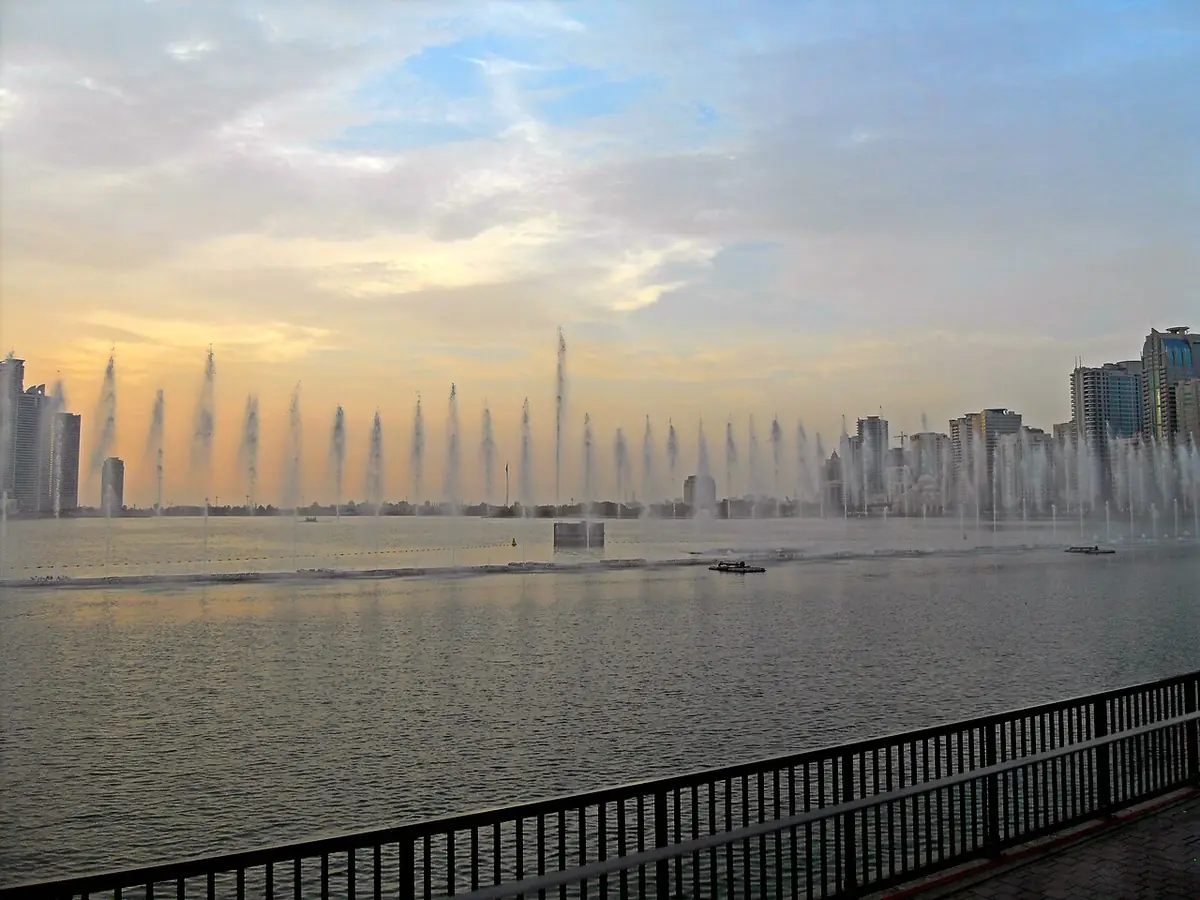
The Al Majaz fountain lighting up the Sharjah evening — Photo: Farrah Zakir · CC BY-SA 4.0 · Wikimedia Commons
Beyond the apparent routine, plenty of crucial details escape a first glance when you are viewing properties.
Picturing the logistical reality of a working week in Sharjah shows how much the location of your apartment shapes daily quality of life. Between commuter flows to the employment zones, access to schools and everyday shopping, each district sets its own tempo and its own travel constraints, and those have to be anticipated.
07:00Leaving home and setting offAn early start is crucial to avoid the traffic peaks on the roads linking Sharjah to the neighbouring emirates, particularly for people working in Dubai.
07:45School drop-offArriving at the international or local school clusters. Well-planned residential districts have secure access points that make this handover easier.
08:30Arriving at the office or workspaceSettling in at the emirate's business zones, or logging on from a home office, with reliable, high-performing telecoms infrastructure.
13:00Midday break and local shoppingA good moment to visit the local supermarkets or neighbourhood markets for fresh produce, which lightens the weekend shop.
17:30The way back and after-school activitiesA return journey with moderate traffic density. A stop at the sports clubs or the urban parks for the children's activities before nightfall.
20:00Winding down and running the householdA quiet evening in the apartment, checking anything to do with the building management and preparing for the next day in a calm residential setting.
What the sales brochures do not tell you about apartments in Sharjah
Knowing these technical subtleties is what avoids the classic traps that turn a heart-led investment into a source of regret.
Advertising brochures and guided viewings put the emphasis on light, modern finishes and proximity to the main roads. Yet the lived experience of long-established residents reveals major technical and regulatory issues that tend to go unmentioned during the courtship phase of a sale.
Solar orientation and its impact on air conditioning
An apartment facing due west, or poorly insulated, runs high indoor temperatures through the summer months, which sends the monthly SEWA bill soaring and wears out the ventilation equipment early.
The real policy for managing the common areas
Quality of life in a block depends directly on how rigorous the building management company is. Slow responses on lift or pool maintenance can quickly erode the perceived value of the property and wear down the occupants.
Visitor parking filling up in the evening
Even if your apartment has an allocated space, the spots set aside for visitors or second vehicles become very scarce once night falls in some dense areas, which creates daily friction.
Future urban development plans and noise
A vacant plot right next to a development can quickly become a construction site, radically changing the open view promised at the time of purchase and generating sustained daytime noise.
Strict rules on interior alterations and modifications
Moving a partition, changing plumbing or laying particular floor coverings often requires strict prior approval from the municipal authorities, which limits any ambition for heavy renovation.
The classic traps you only discover after six months of ownership
Faced with these measurable risks, it is fair to ask whether buying property in Sharjah really suits every profile.
Looked likeAn excellent financial deal on an older apartment needing a quick refresh.
Turned outHidden costs for structural plumbing renovation and bringing the electrics up to standard, well above the budget originally set aside.
Would have caught itCommissioning an independent, thorough technical inspection from a certified surveyor before signing the sale agreement.
Looked likeAn ultra-central location letting you do everything on foot with no traffic to deal with.
Turned outConstant noise from heavy road traffic and late-night commercial activity, making rest difficult.
Would have caught itViewing the property at different times of day and night, particularly at peak hours and at the weekend, to gauge how quiet it really is.
Looked likeA very optimistic gross rental yield quoted by an unscrupulous intermediary.
Turned outA long void period and high service charges eating into the actual return expected over the year.
Would have caught itStudying the record of actual transactions in the district closely and asking for the building's certified financial statements.
Looked likeA verbal promise that public infrastructure and green space nearby would be extended in future.
Turned outSignificant administrative delays to the urban development projects, leaving the district cut off or short of the expected amenities.
Would have caught itConsulting the official master plans with the relevant municipal departments rather than relying on verbal sales arguments.
Unusual profiles: who should definitely not buy in Sharjah?
With those warnings on the table, it is time to take stock and see whether your purchase plan is ready.
Getting on the property ladder is often presented as the logical culmination of a life plan. Yet for certain profiles, those with mobile careers or particular residential requirements, committing to buying an apartment in Sharjah is a sub-optimal financial decision, and potentially a risky one in the short and medium term.
The professional on a short assignment or with an uncertain horizon
→Favouring a flexible rental over buying a property.
Purchase costs, fees and the cost of a quick resale wipe out any capital gain if the property is sold before a minimum period of five to seven years.
The investor with no appetite for administrative management
→Turning to liquid financial investments or indirect property funds.
Managing a physical property remotely, or dealing with the unexpected in a shared building, takes an investment of time and a responsiveness not everyone can provide day to day.
The household with fluctuating income or in career transition
→Keeping a rainy-day fund available rather than tying it up in bricks and mortar.
Committing to a mortgage and paying fixed charges requires stable financial visibility if you are to avoid the risk of default when something goes wrong.
So, are you ready to take the step of buying property in Sharjah?
To take your thinking further, the answers to the frequently asked questions below will give you essential extra perspective.
Reaching the end of this analysis shows that buying an apartment in Sharjah is neither an impulsive whim nor the simple application of a standard formula. It is a considered commitment that demands a clear-eyed comparison of your real financial capacity, your life horizon in the emirate and your tolerance for the particular constraints of managing property locally. If you have factored in all the additional costs, looked hard at the reality of service charges and accepted the specifics of the daily rhythm here, then you have everything you need to make the project work.
Sharjah's property market offers remarkable opportunities to buyers able to look past surface-level marketing arguments. Whether the aim is to secure a roof for your family or to build a lasting rental portfolio, success rests on how rigorously you select and how precisely you plan the financing. Take the time to view several properties, to sound out current residents and to check every technical detail before committing your capital to this venture.
In the end, the final decision is yours and it has to chime with your own long-term ambitions. Never let yourself be rushed by a manufactured sense of urgency or by the fear of missing a unique opportunity, because the local market constantly produces new options for methodical, well-informed buyers. Your peace of mind later depends directly on the strength of the foundations you lay today in choosing your future home in Sharjah.
Related questions
What documents does an expatriate need in order to buy property in Sharjah?
Buying an apartment requires a valid passport, a current residence visa (depending on the zones open to foreign buyers), plus proof of address and proof of income if you are using a local bank loan.
Can you get a mortgage from a local bank in Sharjah?
Yes, local financial institutions offer mortgages to residents and, under specific conditions, to non-residents. Banks generally require a minimum down payment of 20% to 30% of the purchase price, on top of arrangement and registration fees.
What transfer and registration fees apply to a transaction?
In Sharjah, the fees tied to transferring ownership and registering it officially with the competent authorities generally come to between 2% and 4% of the total transaction value, split according to what the buyer and seller negotiate.
How do SEWA utility bills work for an apartment owner?
The Sharjah Electricity, Water and Gas Authority (SEWA) handles all energy supply. The owner has to open an account in their own name when moving in, paying a refundable security deposit, and then settles monthly bills calculated on actual consumption.
What are service charges and what do they pay for?
Service charges are annual contributions paid by each owner to cover maintenance of the common areas, the running of the lifts, cleaning, security and the upkeep of shared facilities such as the building's pools and gyms.
Is it easy to rent out an apartment bought in Sharjah and earn a rental yield?
Sharjah's rental market attracts a stable working population looking for rents more moderate than Dubai's. Well-placed apartments near the main roads and local amenities generally see solid demand, which supports attractive gross yields if the property is kept in good condition.
What restrictions apply to foreign nationals buying property in Sharjah?
Purchases by non-nationals are governed by specific regulations that define the zones open to full ownership (freehold) or to long-term leases (usufruct), and these should be checked precisely before you sign any commitment.
Do you have to go through a licensed estate agency to buy?
Although it is legally possible to negotiate directly with a private seller, working with an agent licensed and registered with the local authorities makes the transaction far safer, ensures the contracts comply with the rules and smooths the paperwork.
How do you assess the real condition of an older apartment before buying it?
It is strongly advisable to have the property inspected by an independent technical survey firm. A careful audit of this kind picks up hidden defects, damp-proofing problems, advanced wear in the plumbing or electrical work that does not meet standards.
How long does buying an apartment usually take, from viewing to handover of the keys?
The full process, including negotiation, signing the memorandum of understanding, arranging bank financing where needed and the official transfer of title at the land registry, generally takes between four and eight weeks.