Finding and renting a house in Sharjah means understanding the fine balance between a protected family setting and the logistical realities of the emirate. This guide sets out the practical, financial and regulatory points that matter most, so you can settle in without a misstep.
Get the app
What nobody tells you.
Real prices, hidden costs and the traps to check before you commit.
What renting a house in Sharjah really changes about your daily life
Scroll
What renting a house in Sharjah really changes about your daily life
Finding and renting a house in Sharjah means understanding the fine balance between a protected family setting and the logistical realities of the emirate. This guide sets out the practical, financial and regulatory points that matter most, so you can settle in without a misstep.
Written by the ting.ad editorial team ·
Sharjah in Street View: drag to look around.
Renting a house in Sharjah is not simply about finding more floor space than an apartment offers, or escaping the nightlife of Dubai. It is a choice of a profoundly different rhythm, rooted in a more traditional, family centred culture. Residents find an unexpected balance between residential quiet and immediate access to the emirate's main economic corridors. That choice shapes the whole of your daily organisation, from the commute to your children's schooling. The gain in calm has to be weighed against the constraints that come with living in this neighbouring emirate.
Considerably more living spacevsLonger daily journeys
Villas offer living areas that no apartment can match, often with a private garden, which transforms everyday comfort. In exchange, heavy traffic towards the business districts of Dubai at peak hours demands real discipline if you are not to lose hours to the road.
A quiet, family oriented environmentvsA strict regulatory and cultural setting
Sharjah's residential districts offer a rare tranquillity and a strong sense of safety for families with children. That comes with absolute respect for local traditions and a way of life in which lively nightlife is all but absent.
More affordable housing costsvsRigid contractual requirements
For the same budget, renting a house here buys far more than the neighbouring emirates offer. That said, payment by post dated cheques and strict termination rules call for careful financial management from day one.
Which kind of resident are you, and does a house in Sharjah suit you?
A house in Sharjah does not suit every life stage or every working pattern. Whether you work locally, commute to another emirate, or are looking for a stable base for your children, the daily reality will be radically different. Working through your own situation is what prevents the disappointments that come from local specifics around transport and services. Every profile finds clear advantages here, but also compromises you have to accept if the move is to work.
The local resident
If your working journeys stay within the emirate of Sharjah, renting a house becomes a particularly comfortable and economical option. You get traffic flow far better than your neighbours enjoy and direct access to local services. Your days are freed from the stress of inter emirate congestion, which leaves more room for leisure and family life. This is the ideal set up for enjoying the residential quality of life in full without the friction of a long commute.
The considered commuter
Choosing a house in Sharjah while keeping a job in Dubai is often a sound financial calculation, but it takes stamina. Morning and evening runs along the main highways require you to adapt your hours and manage fatigue well. You gain square metres and a gentler rent, but you give up part of your free time to the wheel. The trade pays off if you cope well with the routine of the drive and know how to work your hours around it.
The settled family
For families with children, a house in Sharjah offers a secure living space in which the youngest can thrive. Districts often have schools and neighbourhood parks close by, which makes both socialising and daily logistics easier. You get a welcome stability of tenure in an environment with deeply rooted traditional values. It is a choice built around long term calm, far from the frantic energy of the ultramodern metropolis.
Which cultural and practical reference points change completely when you arrive from abroad?
Settling in Sharjah after living elsewhere means unlearning a good many reflexes around housing, services and public space. The local regulatory framework, built on firm traditions and on a desert climate that dictates the seasons, redefines what comfort means. Administrative steps, the running of a home and everyday sociability all rest on codes you need to absorb quickly. That cultural transition, far from being an obstacle, is the key to settling into the emirate successfully and calmly.
From abroad
Freedom to alter a home as you please, under flexible tenancy contracts
Sharjah
Tightly framed leases and closely supervised residential planning rules
You have to observe the clauses of your tenancy contract and the rules of the development or district to the letter, or face financial penalties or a swift dispute with your landlord.
From abroad
Public transport and dense city centres at the heart of daily life
Sharjah
An almost total dependence on your own car for every journey
How you organise your days, from the weekly shop to getting the children where they need to be, rests entirely on your own vehicle and on your ability to anticipate journey times.
From abroad
Spontaneous social life in public space and cafes
Sharjah
A more private way of living, centred on the home and on residential space
Social ties form differently, often within community circles or through school and work activities, so building a network takes a more deliberate effort.
From abroad
A temperate climate with marked seasons and abundant greenery
Sharjah
Permanent sunshine and extremely hot summers that dictate the rhythm of life
The way houses are built, the omnipresence of air conditioning and the shifting of outdoor activities to cooler hours shape your physical wellbeing all year round.
How do you choose the right district for a house in Sharjah?
Sharjah covers a range of residential areas that answer very different expectations depending on how you live. Some districts trade on being close to the corniche and to the Ajman or Dubai borders, while others offer the absolute calm of the inland zones. Weighing how each area feels day to day, what infrastructure it has and what it costs you in return is what lets you aim your search precisely. Pick the wrong area and you can load your journeys unnecessarily and lose the benefit of an otherwise fine house.
Al Nahda / Al Qasimia
Constant urban energy, direct access to the main routes towards Dubai, and a dense spread of local shops you can reach on foot.
Suits
People commuting daily to Dubai who want a pragmatic compromise between a moderate rent and a shorter drive.
Trade-off
Traffic is particularly heavy at peak hours and street parking is often a standing challenge.
Al Majaz / Al Khan
A waterside setting, paced by walks along the lagoon and an atmosphere firmly geared to unwinding.
Suits
Residents who put the quality of their surroundings, coastal green space and a lively neighbourhood life first.
Trade-off
Houses are scarcer here and rents carry an obvious premium over the outlying areas.
Muwaileh / University City
A fast developing district, spacious and modern, populated by students and by families after generous floor areas.
Suits
People looking for recent, well laid out villas with easy access to school campuses and the emirate's main roads.
Trade-off
It sits further from the historic centres and traditional cultural life is markedly less present.
Al Rahmaniyah
A large scale residential haven, characterised by generous family homes and near total quiet.
Suits
Families after very large living space, protected calm and a local community firmly rooted in its traditions.
Trade-off
The distance from the economic heart of Dubai demands full acceptance of long daily journeys.
What does the budget reality of renting a house in Sharjah look like?
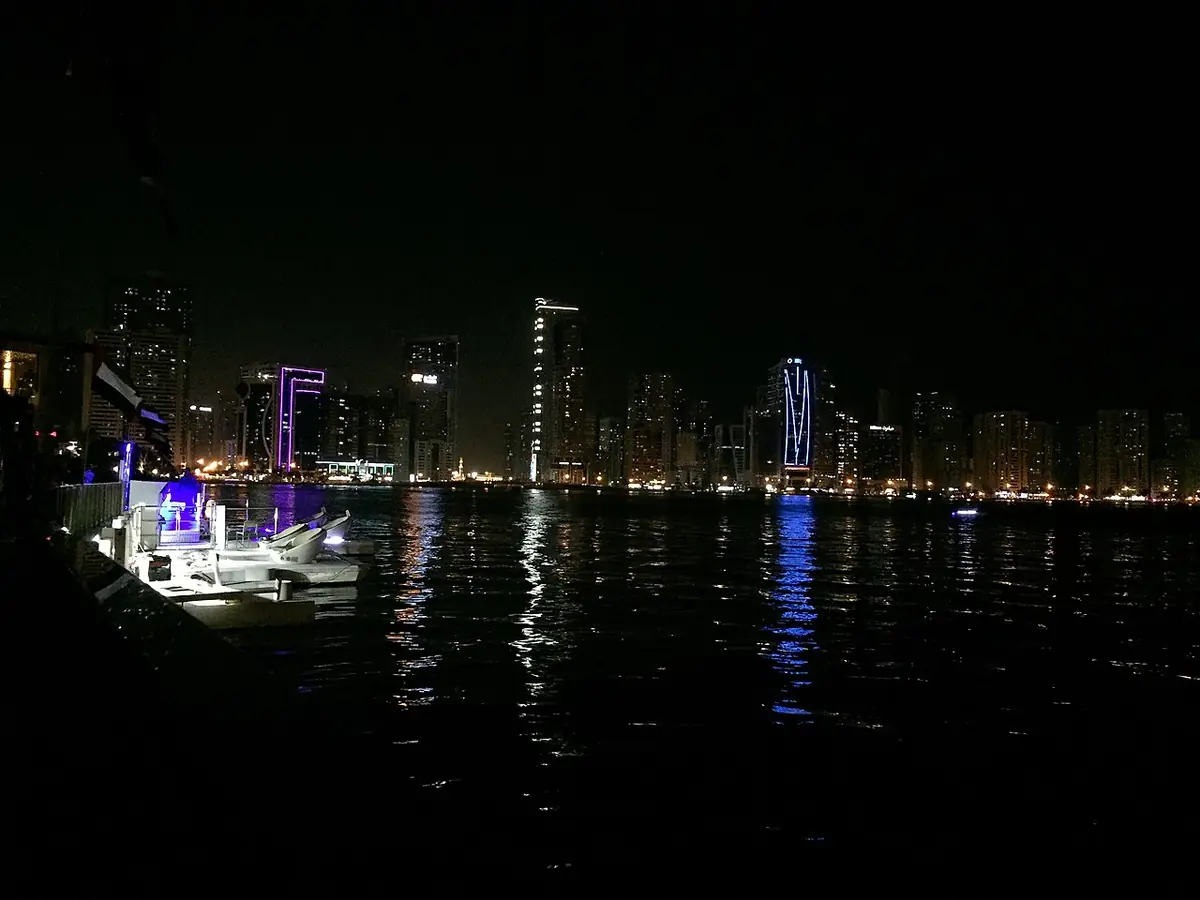
Boats and city lights along Sharjah's waterfront at night — Photo: Clintonpeter · CC BY-SA 4.0 · Wikimedia Commons
Sharjah's rental market offers noticeably more measured options than its Dubai neighbour without sacrificing comfort. The headline rent, however, is only one part of the financial equation you need to plan for. Additional fees, payment by cheque instalments and the upkeep costs of a detached property change the real budget appreciably. Looking at the observed price ranges lets you open rent negotiations on sound, realistic footing.
sharjahTo rentHouseestimate
Median price / m²AED 27Half the apartments sell below this
Median priceAED 5.52kthe average is 14% higher — a few very large properties pull it up
Most common2 bedrooms54 % of listings
Average size193 m²
By number of bedrooms
Bedrooms
Share of market
Avg price
Price / m²
Avg size
2most common
54 %
AED 5.38k
AED 29
184 m²
3
34 %
AED 7.16k
AED 27 −7 %
263 m²
4
11 %
AED 9.49k
AED 26best value / m²
368 m²
Each row is an average, compared against the area average of AED 29 / m². These are indicative estimates of a typical local market, not a measured sample of live listings. Check current listings before relying on them.
Compound villa or standalone house: what can you actually rent?
Sharjah's housing market offers two broad kinds of detached home, and they impose very different ways of living. Understanding the structural difference between a villa inside a managed residential compound and an independent house in a traditional district is essential. The choice determines not only how much day to day autonomy you have, but also the nature of your dealings with neighbours and with managing agents. Each option answers a very particular set of priorities around services and quiet.
The gated community villa (compound)
This kind of property comes with a package of integrated services: guarded security around the clock, upkeep of the shared landscaping, and sometimes communal facilities such as a pool or a gym. Management is centralised through a professional company, which guarantees a certain responsiveness when something significant goes wrong inside the home.
What it changesYou get a reassuring and standardised setting, ideal for families, at the price of additional service charges and of community rules that can feel restrictive.
The independent house in a traditional district
This option puts you in the middle of local Sharjah life, with no community manager in between. You deal directly with the owner or their representative over negotiation and maintenance. Architecture and layout vary greatly from one street to the next, which often gives more character and more freedom to make the place your own.
What it changesYou gain financial autonomy and cultural authenticity, but you take on a larger share of the coordination for upkeep and for sorting out technical problems.
What is the one legal rule to observe before you hand over a deposit on a house?
Renting in Sharjah follows strict legal rules that protect landlord and tenant alike, but that leave no room for approximation. Formalising the tenancy contract goes through compulsory registration with the relevant municipal authorities. Skipping those steps, or rushing the handover of payments, exposes a resident to complex and expensive disputes. Knowing the legal sequence of commitments is what keeps your tenancy secure over the long run.
The viewing and a verbal agreement on the annual rent.
Check rigorously that you are dealing with the legitimate owner and insist on seeing the original title documents, to rule out any risk of fraud.
Negotiate the number of post dated cheques required across the year, which is the standard and largely fixed method of payment in this market.
Have the tenancy contract formally registered with Sharjah Municipality to obtain the attestation you need before the water and electricity meters can be opened.
Carry out a careful joint inspection of the property, recording in writing and in photographs every existing defect before the keys change hands.
Moving into your house in full legal compliance.
How does the rental transaction actually unfold, step by step?
Committing to a house rental in Sharjah means following a process shaped by local practice and by regulation. From the initial shortlist of available properties through to switching on the essential household services, each party has a precise role. Anticipating the administrative timings and preparing the supporting documents in advance speeds up a move that can otherwise surprise you with its formality. Here is the exact sequence of steps to secure your future home.
The future residentTargeted searchingIdentify the districts that match your budget and your transport constraints by viewing several types of property in person.
The estate agentThe offer to rentSet out the proposed terms in writing and negotiate the payment arrangements along with the early exit clauses.
The landlordApproval of your fileSubmit your financial and personal supporting documents to obtain the landlord's formal approval of the tenancy.
Sharjah MunicipalityOfficial registration of the leaseHave the tenancy contract validated and registered by the relevant municipal department so that it carries full legal force.
SEWA (the water and electricity authority)Opening the utilitiesComplete the connection formalities and pay the deposits required to activate water and electricity in your name.
Tenant and landlordHandover of the keysCarry out the final joint inspection, sign the handover record and formally take possession of the house.
House or apartment in Sharjah: which suits daily life better?
Once the type of property is settled, the next job is to map out every financial charge attached to your move to Sharjah.
Choosing between a detached villa and an apartment in one of Sharjah's towers completely redraws how you manage your time, your cooling bill and your relationship with the city. The vertical buildings, concentrated along the corniche and in districts such as Al Majaz, put you within immediate reach of busy boulevards, urban parks and the shops at the foot of the block. Living high up brings open views over Khalid Lagoon and access to integrated services such as gyms, shared pools and permanent concierge cover, which greatly simplifies the daily handling of deliveries and security.
Taking a detached house or a townhouse instead, in an outer residential scheme such as Al Rahmaniya or Muwaileh, transforms the living space available to your family. Villas generally offer markedly larger floor areas, an enclosed private yard, a closed garage and full freedom from the strict community rules that towers often impose. That configuration removes the friction of shared lifts and of underground parking that fills up at peak hours, while giving children a secure outdoor space to play in.
The extra space, however, is paid for through direct exposure to exterior maintenance and a sharper dependence on the car for every practical errand. Keeping a garden, dealing with the waterproofing of a flat roof and facing electricity bills that run particularly high through the summer to cool large volumes are recurring costs to plan for rigorously. Apartments, for their part, have the advantage of energy consumption that is easier to control and of pooled building charges that shield the occupier from major structural surprises.
Your final decision should therefore turn on the trade between city centrality and spatial calm, taking account of the exact make up of your household and your tolerance for the daily drive. If you work in Dubai while living in Sharjah, being close to a major road such as the E311 from certain villa areas can prove more strategic than living in the centre, where the morning congestion slows every departure. Weigh your long term priorities before committing to a type of property whose comfort, and whose renewal terms at the end of the tenancy, will depend directly on how the local infrastructure develops.
What overall budget should you allow to live comfortably in Sharjah?
To understand what daily life in this setting really involves, let us look at how an ordinary day plays out.
Building a realistic budget for a move to Sharjah means going well beyond the headline rent. You have to factor in the seasonal swings in utility bills, administrative file fees, transport costs and the indirect local charges that bite into household spending power. A careful estimate protects a resident against the financial surprises that generally arrive after the first year of occupation, the point at which the terms for renewing the tenancy can shift with the pressure on the local market.
Estimated monthly and annual running costs in Sharjah
Cost item
Lower end (AED)
Upper end (AED)
Frequency and notes
Annual rent (2 bedroom apartment)
35000
65000
Generally payable in 2 to 4 post dated bank cheques.
Annual rent (3 to 4 bedroom family villa)
80000
150000
Varies widely with how modern the property is and where it sits.
Electricity and air conditioning (SEWA)
500
2000
Consumption peaks sharply between June and September.
Broadband internet and telephone
350
600
Combined fibre and mobile package.
Groceries and household goods
2000
4500
Depends on how much you buy imported and on your habits.
The figures above exclude school fees and motoring costs, which are two major variables in their own right.
Upfront costs and administrative charges on moving in
Type of cost
Indicative amount (AED)
Terms and when it falls due
Rental security deposit
5% of the annual rent
Returned in full at the end of the tenancy, subject to the inspection.
Estate agency fee
2% to 5% of the rent
Standard commission, due on signature of the tenancy contract.
SEWA connection and deposit
2000
Refundable deposit for opening the water and electricity meters.
Lease attestation charge (municipality)
4% of the rent
Compulsory municipal charge to make the tenancy legally valid.
Set aside a cash reserve of at least 15% of your first year's total rent to cover these upfront outgoings.
What does an ordinary Tuesday in Sharjah actually look like?
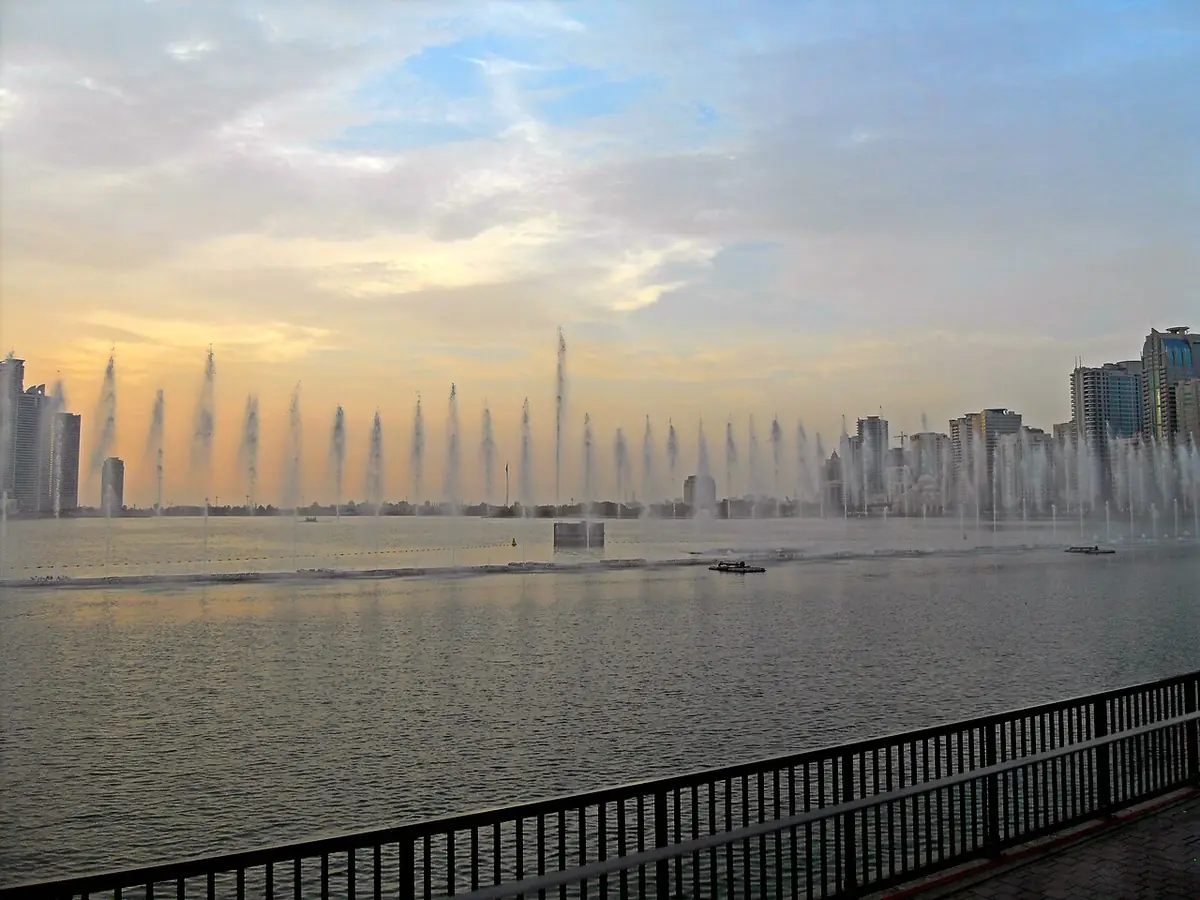
The Al Majaz fountain lighting up the Sharjah evening — Photo: Farrah Zakir · CC BY-SA 4.0 · Wikimedia Commons
Beyond that well oiled routine, several realities on the ground deserve scrutiny before you sign anything.
Picturing the rhythm of a weekday in Sharjah lets you anticipate real journey times and the effect of traffic on your own balance. Between the early school run, office hours and the end of day errands, every part of the day has its own logistical challenge. This timeline sets out the key moments to help you position your future home against your daily obligations.
06:45Residential district (Al Majaz or Muwaileh)Getting ready and a coordinated departure to beat the first build up of traffic on the city's main roads.
07:30International schoolDropping the children at one of the emirate's many well regarded private schools, often set within dedicated campuses.
08:30Business district, or the drive to DubaiArrival at the local office, or the inter emirate crossing via the E11 or E311 for those working outside Sharjah.
13:00Midday break and neighbourhood lifeA relatively quiet moment, good for local shopping in the neighbourhood supermarkets or a quick lunch at home.
17:30After school activities and city parksTime in landscaped green space such as Al Ittihad Park or the safe play areas along the lagoon for the children.
19:30Home again, and parkingFinding a parking space, sometimes tricky in the denser areas, then the family evening begins.
What do property listings never mention?
That clear sight of the hidden faults leads naturally to the classic mistakes newcomers make.
Marketing photographs and agency descriptions always show a property at its most flattering, deliberately leaving out the practical constraints of its immediate surroundings. Understanding these unwritten points saves you the disappointment that follows a move and lets you judge how liveable a tenancy will really be over its full term. Here are the factors that only long standing residents know properly.
Which way the property faces and the direct impact of the summer sun
A home facing due west overheats considerably in the afternoon, which doubles the cooling bill for four months of the year and degrades indoor comfort despite double glazing.
The real policy on renewals and rent caps
Contrary to a common assumption, rent increases at the end of a tenancy in Sharjah can be significant when the local market tightens, because the regulating mechanisms differ noticeably from those in other cities.
The chronic shortage of visitor parking in the evening
Many older buildings have too few parking spaces for the number of homes, turning a late return from work into an anxious hunt for a legal spot.
Noise from construction work under way and still to come
Sharjah's pace of urban development means frequent building projects right next to residential plots, generating daytime disruption that is worth checking against the municipal plan.
How good the sound insulation between floors really is
In some buildings from the 2000s, the thickness of the concrete slabs transmits impact noise and the sound of shared plant easily, which weighs heavily on daily life.
Which mistakes are made most often and only discovered six months later?
Given all that, it is fair to ask whether this kind of move really suits your own situation.
Looked likeAn excellent financial deal, with a rent far below the standards of neighbouring Dubai
Turned outA mobility trap: an hour and a half each morning to cross the inter emirate border at peak times, exhausting the driver and pushing up the fuel budget.
Would have caught itDrive the route at the exact hours you would face daily, before you hand over any holding deposit.
Looked likeAn ultra modern apartment in a brand new tower with impeccable finishes
Turned outStructural teething faults, recurring lift breakdowns and poor building management from a developer neglecting the upkeep of the common areas.
Would have caught itResearch the building manager's reputation thoroughly and talk to tenants already living there.
Looked likeA quick signature on a standard tenancy contract with no negotiation of the payment terms
Turned outA demand for the full annual rent in a single cheque, tying up substantial cash and reducing your room for manoeuvre in any later dispute.
Would have caught itAlways push for the payment to be spread across four post dated cheques, a common practice and negotiable depending on market pressure.
Looked likeA district chosen purely for being next to a large supermarket
Turned outNo walkable green space at all and total dependence on the car for the smallest leisure trip, leaving family members socially isolated during the day.
Would have caught itFavour mixed districts with landscaped walkways, neighbourhood parks and a local life you can reach on foot.
Who should definitely not rent a home in Sharjah?
It is time now to lay the groundwork for your own conclusion and check how ready you are.
No place is a universal answer that suits every resident. Sharjah has cultural, administrative and logistical characteristics that can sit in flat contradiction with certain expectations about how to live. Identifying clearly the profiles for whom this emirate is a dead end saves costly mistakes in both time and money.
The professional who wants lively, cosmopolitan nightlife on the doorstep
→More festive districts elsewhere in the region
Sharjah applies strict local rules on public entertainment, the absence of alcohol and quiet at night, which does not match expectations of intense urban nightlife.
The worker with no car who depends entirely on mass public transport
→A city with an extensive metro network
Sharjah's internal public transport rests mainly on urban bus routes that are subject to the same road congestion as everyone else, which makes commuting complicated without a car.
The short term tenant looking to move on again within a few months
→Serviced or short let accommodation elsewhere
Sharjah's rental market is built around one year contracts paid by cheque instalments, with penalty clauses on early exit, and it suits settled long term occupation rather than quick moves.
Anyone unwilling to accept strict community rules and local standards of dress and conduct
→Free zones or more relaxed cosmopolitan enclaves
Respect for local cultural traditions and for strict rules of good neighbourliness is both a legal and a social obligation in every residential area of the emirate.
So, are you ready to take the step and settle in Sharjah?
Making the final decision to settle in Sharjah means weighing family stability, control of your overall budget and a clear eyed acceptance of the local rhythm of life. If your priority is to give your children a spacious, safe setting with excellent schools nearby, while keeping financial pressure markedly lower than in the neighbouring emirates, then Sharjah stands out as an extremely coherent and rational option.
That said, this is not a move to improvise, and it demands rigorous preparation up front. Have you verified what your daily journey times will actually be? Have you secured enough cash to absorb the upfront agency fees, the municipal attestation charge and the utility connection deposits without putting yourself under strain? How well you settle depends directly on your ability to anticipate this logistical friction before you sign any commitment.
Take the time to visit several districts at different hours of the day, watch how the traffic flows, talk to residents who have been here for years, and read the clauses of your tenancy contract with the closest attention. Renting in Sharjah rewards patience, method and clarity about how you want to live, far more than impulses driven by haste or by advertising. Your move should be the result of a methodical and fully owned decision.
Related questions
What documents are required to rent a home in Sharjah?
To rent a property in Sharjah you need to provide a copy of your valid passport, a current residence visa or a letter from your employer certifying your income, along with bank cheques drawn on a local bank covering the rent instalments set out in the contract.
Can foreign nationals (expatriates) rent a house anywhere in Sharjah?
Yes, foreign nationals can rent residential property across the emirate. Tenancies generally take the form of a one year contract, renewable, on properties released to the rental market by owners or by the developers of approved residential schemes.
How do you get water and electricity connected in Sharjah?
The connection is handled by the Sharjah Electricity, Water and Gas Authority (SEWA). You need to present your tenancy contract attested by the municipality and your identity document, and pay a refundable deposit to have the meters activated in your name, usually in under 48 hours.
What is the average agency commission in Sharjah?
The standard commission charged by licensed estate agencies in Sharjah is generally between 2% and 5% of the total annual rent. It is payable once, on signature of the tenancy contract, and is not refundable.
Are pets allowed in rented homes in Sharjah?
That depends entirely on the building rules of the development or on the specific policy of the villa's owner. Many high rise buildings ban pets outright, while others accept them subject to conditions on size and behaviour, so it is worth getting the answer in writing.
What municipal charges apply to rents in Sharjah?
Sharjah Municipality levies a lease attestation charge equivalent to 4% of the annual rent. It is generally payable by the tenant at the point the contract is formally registered with the relevant municipal department.
Can a tenancy be ended early in Sharjah?
Ending a tenancy contract early is governed by specific penalty clauses set out in the original agreement, most often requiring 60 to 90 days notice and a payment equivalent to two months rent, unless a written amicable agreement is reached with the landlord.
How does air conditioning work in Sharjah homes?
Most recent properties have either individual central air conditioning controlled by thermostat, or a district cooling system whose consumption charges are billed monthly by SEWA or by a dedicated operator.
Which areas of Sharjah are most recommended for families?
Areas such as Al Majaz, Al Khan and Muwaileh are particularly sought after by families because they sit close to private schools, landscaped public parks, shopping centres and the road links that make daily journeys easier.
Are there hidden costs when taking on a rental in Sharjah?
When you take a tenancy you should budget for the registration and attestation charges with the municipal department, the agency's administrative file fees, and the running service charges on the property (maintenance of common areas and security) that begin the moment you get the keys.