Buying a villa or a townhouse in the Emirate of Sharjah is an appealing, more spacious alternative to the saturated markets of the big centres next door. From the legal fine print of freehold ownership to a careful reading of service charges and the choice of residential district, this guide sets out every parameter you need to get your property investment right with confidence.
Get the app
What nobody tells you.
Real prices, hidden costs and the traps to check before you commit.
Why buying a house in Sharjah means looking past the headline asking prices
Scroll
Why buying a house in Sharjah means looking past the headline asking prices
Buying a villa or a townhouse in the Emirate of Sharjah is an appealing, more spacious alternative to the saturated markets of the big centres next door. From the legal fine print of freehold ownership to a careful reading of service charges and the choice of residential district, this guide sets out every parameter you need to get your property investment right with confidence.
Written by the ting.ad editorial team ·
Sharjah in Street View: drag to look around.
With those first trade-offs on the table, the next step is to test your own buyer profile against conditions on the ground.
The first attraction of investing in property in the Emirate of Sharjah is a promise of space and calm that is hard to find in the neighbouring metropolises. Yet that apparent affordability hides structural trade-offs worth working through methodically before you commit. The local market answers to its own regulatory and planning dynamics, and those redefine what long-term return actually means for a buyer, resident or not. Understanding the mechanics is how you avoid the unpleasant surprises tied to hidden charges and resale constraints. This is not simply about comparing square metres; it is about judging how durable your foothold will be in an environment that is still changing fast.
An entry price that looks very accessible by the standards of the EmiratesvsAncillary costs, registration fees and bringing a property up to standard, all of which are often underestimated in the overall budget
Signing the final deed means setting aside money immediately for local fees, agency commission and any utility connections. Skip that financial cushion and you expose yourself to a cash squeeze in the very first months after you get the keys.
The promise of a residential, family setting sheltered from the churn of the big business districtsvsA longer daily journey caused by commuter flows towards employment centres across the border, such as Dubai
The time equation is the direct counterpart of the money you save on the purchase price of the house. You have to accept spending several hours a week on the main road corridors, and that reshapes how daily and working life is organised.
A property market opening up gradually to certain categories of foreign buyer, subject to conditionsvsA freehold framework that remains strictly confined to geographic zones designated for expatriates
Unlike some other property free zones, a purchase by a foreign national in Sharjah follows precise eligibility rules that should be checked in advance with the land registration department. Skipping that legal check is the single heaviest risk to your investment.
A stock of spacious houses with large plots and flexible family layoutsvsSignificant running maintenance and cooling costs driven by the region's semi-arid climate
Managing the heat in a large villa in the Persian Gulf is a permanent line in the budget and should never be brushed aside. The construction materials and the original insulation dictate the energy bill you will carry every month.
Does this house in Sharjah really match your way of life and your plans?
With that overview in place, let us measure the cultural and practical gap against the reference points you are used to.
Buying a house is not just a financial operation; it anchors a way of life that has to fit your personal, family and professional constraints. In Sharjah the supply splits along two lines: distance from the centre, and the type of community. Whether you are housing your family year-round or building an asset to pass on, the priorities for where you settle change completely. So it is worth reviewing your own situation to identify the district and the property type that will not constrain you day to day.
The careful commuter
Choosing a house in Sharjah while keeping a job in Dubai demands real discipline in the face of peak-hour congestion. You have to accept a morning routine built around regular road trips on the E311 or the E611. In exchange you get twice the living space for the budget of a cramped apartment in the central districts of the neighbouring emirate. It is a sound choice if your working hours are flexible or if you work from home part of the week.
The settled family
Sharjah has a strong cultural and educational identity, recognised across the United Arab Emirates. Buying a house here suits households that want to settle for the long term within stable communities, close to well-regarded schools and major cultural institutions. The low-rise residential districts offer safe space for children, away from the constant buzz of purely tourist hubs. Your investment reads over the long run here, with the intention of building a durable and structured way of life.
The long-term investor
The rental market for individual houses in Sharjah draws steady demand from local families and long-established expatriates looking for space. To make this kind of purchase work, target newer developments with rigorous community management, close to the main road links out. The headline gross yield does need to be weighted for maintenance costs and potential void periods between tenancies. A careful look at net returns is the necessary step before you sign off on your financing plan.
Living there when you arrive from abroad: what really changes in your day-to-day property life
With the cultural and technical adjustment absorbed, it is worth mapping the city's districts precisely.
Moving into a house in Sharjah after operating in a European or North American property market means letting go of a number of legal, planning and climatic reference points. Urban density, the relationship to space, the running of gated communities and even the architectural thinking all follow entirely different logics. That gap is not an obstacle in itself, provided you accept its rules from the very first viewings. Here are the main pivot points between what you have known before and the reality of your future purchase in the emirate.
From abroad
A highly protective consumer framework back home, with claims for hidden defects, cooling-off periods and statutory structural warranties written into law
Sharjah
A market run on sale contracts backed by local developers and on regulations specific to free zones or to the authorised investment zones
You absolutely must have every clause of the contract audited by an independent local legal adviser, because remedies after final signature are extremely complex and slow to enforce.
From abroad
Dense city living built on mixed use, local shops within walking distance and public transport
Sharjah
Planning built around the car, structured into self-contained gated compounds set apart from open-air retail areas
The private car stops being just a way of getting about and becomes the essential tool of your daily independence, changing how you shop, spend leisure time and see people.
From abroad
Construction and renovation costs held in check by organised trades and regulated hourly rates
Sharjah
Plentiful labour, but imported material costs exposed to shipping-rate swings and to the demands of the local climate
Pricing up fit-out or customisation work on your house means building in generous budget safety margins to absorb sudden increases.
From abroad
Mild winters and moderate summers, where keeping the indoor temperature comfortable weighs only lightly on the budget
Sharjah
A hot desert climate where air conditioning runs continuously for much of the year to keep a home liveable
The energy performance of the house becomes a decisive financial criterion that feeds straight into your monthly cost of living, permanently.
Which part of Sharjah should you target, given your budget and your pace of life?
Once the right area is identified, it is time to look at the hard numbers on prices.
Sharjah stretches from the historic coast along the Persian Gulf to the newer, greener inland areas. Each area has its own identity, its own level of services and its own mix of residents. Choosing the right location shapes not only your day-to-day comfort but also how easily the property will sell when you decide to move on. The planned residential zones offer modern infrastructure, while the older districts appeal through their closeness to the historic centre and the lagoons.
Al Zahia and the new planned eco-districts
The feel of a modern residential campus, very green, designed for families who want security and built-in amenities such as parks and local shops.
Suits
Families with children, and investors backing modern planned communities with strong rental demand.
Trade-off
Some of the highest prices per square metre in the emirate, and annual community fees for the upkeep of shared areas that are far from negligible.
Muwaileh and the lively university areas
An area in constant motion, with a young population, plenty of shops open late into the evening and direct road access towards Dubai.
Suits
Anyone who wants a strategic location for work trips to the neighbouring emirate while staying within a mid-range budget.
Trade-off
Heavy traffic at peak hours and a busier urban feel than the gated communities further out.
Al Juraina and the traditional residential districts
A quiet setting of individual villas rooted in the historic local fabric, close to the main cultural landmarks and established public parks.
Suits
Buyers who want to fit into an authentic neighbourhood, away from the standardised large-scale schemes of international developers.
Trade-off
Older housing stock in places, calling for significant energy upgrades and interior modernisation.
What does buying a house in Sharjah actually cost today?
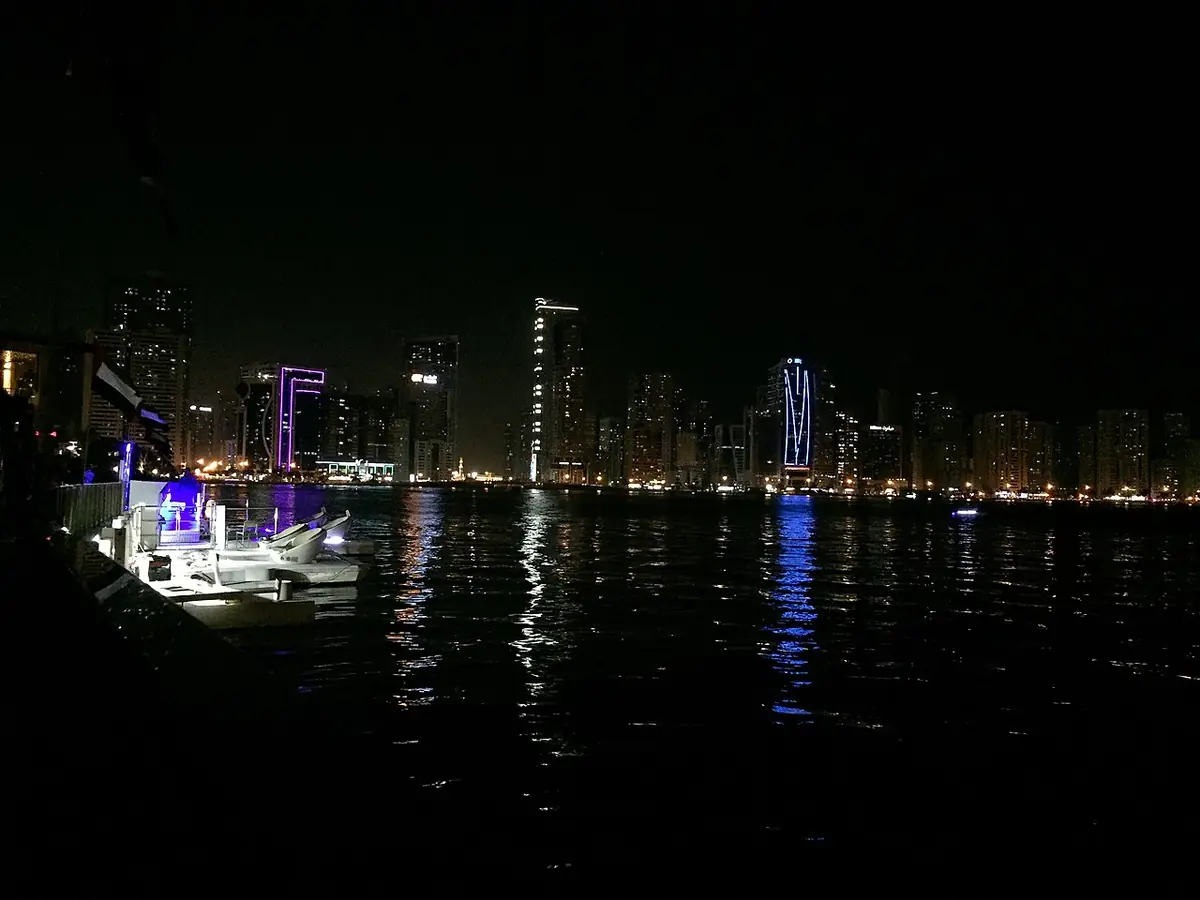
Boats and city lights along Sharjah's waterfront at night — Photo: Clintonpeter · CC BY-SA 4.0 · Wikimedia Commons
Beyond the headline sums, the very nature of the ownership right deserves close legal attention.
Approaching the financial side of a purchase in Sharjah means separating the face value of the property from the costs created by the legal structure of the transaction. Prices vary considerably with plot size, the delivery date of the scheme and the quality of what the community provides. It pays to set aside any illusion of unrealistic bargains and work from the thresholds recorded in the emirate's official registers. Here are the current orders of magnitude to build a realistic financing plan around.
sharjahFor saleHouseestimate
Median price / m²AED 6,232Half the apartments sell below this
Median priceAED 1.26mthe average is 14% higher — a few very large properties pull it up
Most common2 bedrooms54 % of listings
Average size193 m²
By number of bedrooms
Bedrooms
Share of market
Avg price
Price / m²
Avg size
2most common
54 %
AED 1.23m
AED 6,691
184 m²
3
34 %
AED 1.64m
AED 6,232 −5 %
263 m²
4
11 %
AED 2.17m
AED 5,904best value / m²
368 m²
Each row is an average, compared against the area average of AED 6,560 / m². These are indicative estimates of a typical local market, not a measured sample of live listings. Check current listings before relying on them.
What you can actually own: freehold versus usufruct and long leases
With that legal distinction absorbed, let us look at the critical order of events in the transaction itself.
The question of freehold ownership is a frequent source of misunderstanding for international investors settling in the Emirates. In Sharjah the rules governing purchases by non-nationals are more restrictive than in neighbouring Dubai. It is vital to separate what counts as freehold ownership within the designated zones from what is in fact a long lease. Failing to clarify this before signing the preliminary agreement exposes a buyer to serious disappointment when the time comes to pass the property on.
Freehold ownership within the designated zones
Certain new schemes approved by the Sharjah authorities allow foreign nationals to hold title to both the building and the land, permanently and transferably. This status offers the legal security closest to European standards, guaranteeing the freedom to sell, let or bequeath the property without major restriction by nationality within those precise perimeters.
What it changesYou should require formal proof from the developer or seller that the plot is registered as freehold-eligible with the Sharjah land registration department before you pay a single instalment.
Long leases and long-term usufruct rights
Outside the free zones or the specific perimeters open to foreign buyers, a purchase often takes the form of a usufruct right or a long lease (typically 99 years, renewable). Although legally secured by official registration, this mechanism does not carry ownership of the land. It amounts to a very long exclusive right of use, but the renewal and resale conditions must be read with extreme care.
What it changesIt is essential to have the exact terms of the contract analysed by a lawyer specialising in Emirati property law, to check the restrictive clauses covering inheritance or early transfer.
The absolute rule on sequencing to understand before you pay a single instalment
To run that sequence without a false note, let us look precisely at who does what at each stage.
In an international property transaction, the order in which money moves is your best protection against fraud or an abandoned development. In Sharjah, as across the Emirates, funds must pass through regulated escrow accounts tied to the project. Agreeing verbally, or paying a deposit straight into the personal account of an intermediary or a seller with no bank guarantee, is the most common cause of things going wrong. Running the procedure in the right order is what makes the investment a calm one.
The opening phase is to put your offer in writing through a preliminary agreement (a Memorandum of Understanding, or MoU) that fixes the price, the conditions and the payment schedule.
Advance checks on the owner's identity and on the absence of any charge or mortgage still registered against the property with the official land department.
Signing the MoU and paying a deposit (usually 10%) held in escrow by the licensed agent or the authorised conveyancing firm.
Clearing any outstanding conditions and obtaining the no-objection certificates (NOC) issued by the community management company.
Issue of the final title deed in the buyer's name by the Sharjah property registration department at final settlement.
The transaction ends with the handover of the keys and the effective transfer of the water, electricity and gas meters into your name with the local authorities.
How the transaction unfolds, party by party, from the first viewing to the handover of keys
A successful property transaction in Sharjah rests on tight coordination between professionals with clearly defined roles. Unlike some European markets where a single conveyancing officer centralises everything, the Emirati system brings in separate parties: developers, agents licensed by the municipality, valuers and the land registration service. Understanding what each one does saves you from approaching the wrong person when a dispute or a technical question arises. Here is the exact score played by the people who will punctuate your purchase.
The licensed estate agentSearch and initial negotiationHolding a professional licence issued by the Sharjah authorities, the agent selects properties matching your criteria and drafts the initial memorandum of understanding. Registration with the local regulator is compulsory in order to trade legally.
The developer or the sellerDelivery guarantee and transfer of titleThe seller warrants that the property conforms to what was sold and must supply completion certificates as well as confirmation that no service charges are outstanding. For off-plan property, strict rules apply on depositing funds into blocked accounts.
The independent legal adviserAuditing the clauses and the ownership statusActing on your side, the adviser tests the validity of the sale contract, verifies the exact nature of the ownership right (freehold or usufruct) and makes sure no one-sided clause penalises your future interests.
The Sharjah land registration departmentAuthentication and issue of the titleAs the sovereign public body, it validates the transfer of ownership, collects the official registration fees and issues the final title deed evidencing your purchase.
The community administrator (property management)Running the shared spaces and servicesThis company oversees the upkeep of roads, security, landscaping and shared facilities across the residential zone, and bills the corresponding annual charges.
House or apartment in Sharjah: which suits your profile better?
Choosing between a spacious villa in the outlying residential districts and a well-connected apartment in the heart of Sharjah bears directly on how you organise your days, on your long-term maintenance budget and on your relationship with the city. On one side, the individual house offers the independence families look for when they want to escape the noise of shared buildings, have a private garden and never again circle the block in the evening looking for a parking space. On the other, the urban apartment, often along the corniche or in the busy central areas, removes the tedious burden of exterior maintenance while putting you a few minutes' walk from essential amenities, parks and the roads that lead straight to Dubai.
The structure of the hidden costs is the first real arbiter of the decision in this emirate. While an apartment usually shows a more accessible headline purchase price, the monthly service charges for the upkeep of common areas, lifts and sometimes leisure facilities weigh on the recurring budget in a way that is invisible but constant. Buying a house, by contrast, frees you from those collective fees but shifts the full financial burden of roof repairs, waterproofing and central air conditioning onto your shoulders alone, which calls for rigorous annual provisioning if the hot season is not to bring nasty surprises.
Geography carries considerable weight in this trade-off too. Villa schemes are expanding heavily in the outer zones such as Al Rahmaniya or around University City, offering vast living space but exposing you to longer daily journeys if work regularly takes you to the neighbouring emirates. Apartments, concentrated in historic areas such as Al Majaz or Abu Shagara, guarantee remarkable centrality but require giving up complete quiet and private outdoor space, turning every weekend into a choice between domestic comfort and the search for public green space.
In the end, the question of resale over the medium term should guide your thinking as much as your immediate attachment to a property. The Sharjah rental market shows steady appetite for well-maintained apartments near the water, which means a quick sale if your professional situation were to change at short notice. Family houses, meanwhile, appeal to a narrower pool of end buyers settling for the long term, which can lengthen transaction times but offers greater stability against the regional property cycle.
What overall budget should you plan for living in and maintaining a property in Sharjah?
Buying a property in Sharjah never comes down to the mortgage instalment or the initial outlay alone. To judge what you can genuinely afford, you have to fold in all the structural and running costs that come with daily life in the emirate. From the municipal levy tied to water and electricity consumption to the preventive maintenance the summer climate makes unavoidable, every line deserves to be quantified precisely so that the first years of ownership do not knock your finances off balance.
Everyday running costs and recurring charges
Budget line
Estimated range (AED / month)
Nature of the expense and how often
Electricity, air conditioning and water (SEWA)
600 - 1,500 AED
Varies with floor area, insulation and how hard the air conditioning is used over the summer.
Service charges (maintenance / HOA)
300 - 1,200 AED
Applies to apartments and to some gated villa communities, for the upkeep of shared areas.
Comprehensive home insurance
100 - 300 AED
Essential cover for damage to the property, contents and third-party liability.
Servicing contracts for the air conditioning units and small household repairs, spread over the year.
These estimates assume a standard household in a two-bedroom apartment or a mid-sized townhouse, excluding any mortgage costs.
Upfront costs and purchase fees
Type of fee
Indicative rate or amount
When and how it is paid
Land registration fee (Sharjah Real Estate Registration)
2% to 4% of the value
Payable in full on the day the final deed of sale is signed before the registration authority.
Estate agency fee
2% of the purchase price
Standard commission due to the professional intermediary when the transaction completes.
Administrative fees and title certificate
1,000 - 3,000 AED
File handling, technical valuation of the property and issue of the new title deed.
Always keep a cash reserve of roughly 5% to 7% of the purchase price available to cover this whole set of unavoidable acquisition costs.
Health, schools, transport: what does an ordinary Tuesday look like once you settle in Sharjah?
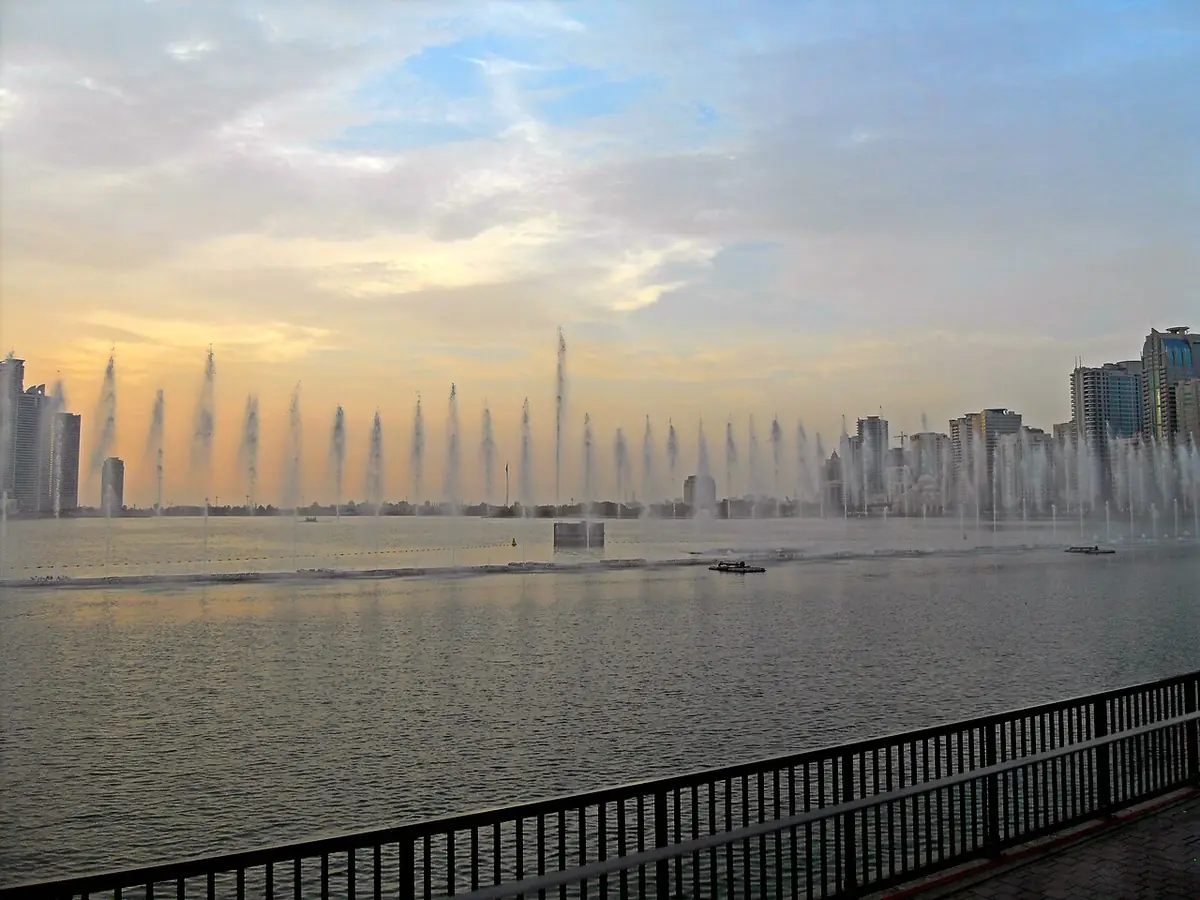
The Al Majaz fountain lighting up the Sharjah evening — Photo: Farrah Zakir · CC BY-SA 4.0 · Wikimedia Commons
Nothing tests whether a place will suit you like watching a typical weekday closely. Between the morning school run, dealing with local health needs and how smoothly the evening return goes, the rhythm of Sharjah calls for a well-drilled routine. This detailed timeline lets you picture journey times, the services within walking or driving distance, and the real state of traffic in the emirate.
07:00Residential district (Al Majaz or Al Rahmaniya)Waking up and getting ready in a calm setting. The children prepare to head for school groups less than fifteen minutes away, while the first sunlight catches the facades.
08:15Local school or nurseryDropping the children at the gate. Traffic around the larger education complexes is dense but managed by municipal officers, which keeps things safe for pedestrians and vehicles alike.
09:30Local health centre or duty pharmacyA routine appointment or a quick stop for everyday health needs. Sharjah's medical network, made up of modern clinics and well-equipped hospitals, handles cases quickly without the heavy congestion of the neighbouring metropolises.
12:30Local market or neighbourhood supermarketMidday food shopping or a lunch break in one of the many friendly cafes in the area. Having retail right on the doorstep makes stocking the house far simpler.
16:30Public park by the lagoon (Al Majaz Waterfront)A late-afternoon break. Families make the most of the landscaped green space, the running tracks and the children's play areas as the temperature eases.
19:00Home again, and parkingComing home after a full day. A reserved space or direct access to a private garage spares you the evening stress of hunting for a spot, and the day ends calmly.
What the polished agency photos leave out in Sharjah
Behind the bright perfection of sales brochures and immaculate virtual tours sit technical and planning realities that any careful buyer should anticipate. The region's climate, combined with the construction choices of different eras, creates constraints that are very real in daily use. Here are the decisive things the marketing photos carefully leave out but that will weigh heavily on how satisfied you are.
Direct sun exposure and overheating of glazed facades
An apartment or house facing due west takes in a considerable amount of heat through the afternoon, which pushes the air conditioning hard, drives your monthly electricity bills up significantly and makes the living rooms less comfortable.
The real state of waterproofing and plumbing in older buildings
Some buildings from the 1990s suffer chronic water ingress during the rare heavy rain episodes, or problems with the rising water mains, which calls for major building-wide works and sometimes one-off levies the previous owner never allowed for.
How the surrounding construction sites will evolve, and the noise they bring
Sharjah is an emirate in constant urban change. Buying a property with a clear view today is no guarantee that a new residential tower or a road scheme will not rise directly opposite your windows within the next ten months.
The strict rules on interior alterations and renovation
Contrary to what people assume, knocking down a partition or changing the layout of a kitchen in a Sharjah apartment requires complex approvals from the municipality and the owners' association, on pain of heavy fines.
The most common property regrets, discovered six months after moving in
Looked likeA golden opportunity, with an ultra-competitive price per square metre in a fast-growing outer area.
Turned outA zone still poorly served by public transport, cut off from the main employment centres, costing hours lost in daily traffic jams.
Would have caught itTesting the peak-hour journey time yourself, between the property you are considering and the places you work, before signing anything.
Looked likeA bright top-floor apartment with a sweeping panoramic view over the city skyline.
Turned outAn unbearable summer furnace under a poorly insulated roof slab, making cooling bills astronomical from May to September.
Would have caught itAsking for the past twelve months of energy bills and checking the quality of the roof insulation and the glazing.
Looked likeA small, quiet building with service charges advertised as unusually low and attractive.
Turned outA completely empty reserve fund and fellow owners unwilling to pay for the urgent renewal of the lifts and the external facade.
Would have caught itAlways reading the minutes of the last three owners' association meetings to spot works that were voted through or put off.
Looked likeA modern fitted kitchen that looked ready to use without a single unit of currency spent on works.
Turned outElectrical installations that only loosely met local standards, and low-end appliances that broke down repeatedly.
Would have caught itCommissioning a thorough technical inspection by an independent professional before the conditions of sale are cleared.
Which kind of buyer is Sharjah absolutely wrong for?
Property investment in Sharjah has undeniable strengths, but it answers to a logic of long-term ownership and stability that does not match every life plan. Wanting to settle here without accepting the cultural and planning rules leads inevitably to quick frustration. Here are the buyer profiles for whom a purchase in this emirate is clearly ill-advised.
The speculative investor chasing spectacular short-term gains
→A small off-plan apartment bought with maximum bank leverage, in the hope of reselling at a 30% profit as soon as it completes.
The Sharjah property market is characterised by healthy, measured growth oriented towards long-term residential letting, rather than by the aggressive speculative volatility seen in some other world cities.
The restless city dweller who depends on an intense walkable nightlife
→A property out in a peaceful residential zone, imagining they can do everything on foot or enjoy a buzzing night scene.
Sharjah cultivates a family way of life, respectful of local traditions and built around calm, a long way from late-night bustle and shopping boulevards open around the clock.
The first-time buyer with no appetite for administration or technical detail
→An older property needing upgrades, or a complex shared building, taken on without professional support.
Buying here demands absolute administrative discipline, strict compliance with local regulations and personal involvement in tracking charges and maintenance.
So, are you ready to take the step and buy in Sharjah?
Reaching the end of this line of thinking means you now have the measure of the distance between the advertising and the daily reality in Sharjah. Buying here is not a snap decision driven by short-term urgency, but a considered choice in favour of a stable, family-oriented and financially predictable way of life. If you accept the region's climate, the need to maintain your property rigorously and a pace of life turned towards calm rather than surface excitement, then the signals are green.
The Sharjah property market consistently rewards patient buyers who take the time to compare districts, pick apart the service charges and validate every technical point before signing the final deed. By putting build quality and the fit between location and your real needs ahead of a low price far out on the fringes, you protect not only your investment but your quality of life for many years.
Take the time to visit properties at different times of day, talk to residents already settled in the buildings or communities you are considering, and check every line of the paperwork. Your future house or apartment in Sharjah should be a place of calm and security, not a source of administrative or financial trouble. If that vision chimes with what you are really after, then your plan to buy in this emirate is well founded and ready to become real.
Related questions
What registration and transfer fees apply when you buy a property in Sharjah?
Land registration fees generally run between 2% and 4% of the total value of the property. On top of that come standard agency fees of around 2%, plus various administrative charges and the cost of issuing the title certificate through the emirate's competent authorities.
Can foreign nationals buy property freely in Sharjah?
Purchases by foreign nationals are tightly framed by specific geographic zones defined by the Sharjah government. It is therefore essential to check whether freehold status or a long lease (usufruct) is available to you, depending on your nationality and the type of property you have in mind.
How much are service charges on an apartment in Sharjah?
Maintenance charges, often called HOA fees, generally range between 3 and 7 AED per square foot per year, depending on the building's facilities, whether there is a pool, a gym or on-site security staff, and the quality of the management company running the building.
How does the electricity and water system (SEWA) work for a new owner?
The Sharjah Electricity, Water and Gas Authority handles all utility services. On completion, the new owner has to open a customer account, pay a refundable security deposit and have the meters connected or activated before actually moving in.
Can a non-resident expatriate get a mortgage in Sharjah?
Local banks do offer mortgage financing to residents and sometimes to non-residents, but the deposit requirements are generally tougher, often falling somewhere between 25% and 50% of the purchase value of the property.
Which districts are most sought after for buying a family villa in Sharjah?
Residential areas such as Al Rahmaniya, Barashi and the extensions around University City hold the great majority of modern villa developments. They offer generous space, parks and a setting that suits families particularly well.
How much does air conditioning add to monthly bills in summer in Sharjah?
Because summer temperatures are so high, air conditioning runs hard from May to September. It is often the single largest share of the monthly energy bill, which is why checking the thermal insulation of a property matters so much.
What documents do you need to complete a property transaction in Sharjah?
The purchase file calls for a valid passport, a current residence visa where applicable, a signed sale agreement (MoU) and the no-objection certificates (NOC) issued by the developer or the building manager confirming that nothing is outstanding.
Is Sharjah well connected to the other emirates for daily commuting?
Sharjah has direct motorway access to Dubai and Ajman, but the main road corridors are heavily congested at the morning and evening peaks, so work journeys need to be planned with real care.
How do you find out about future planning projects around a property in Sharjah?
Sharjah Municipality and the planning department regularly publish development master plans. Consulting them lets you spot new roads, retail zones or construction sites that may appear right next to the property you have in mind.