Buying a house in Manchester calls for a clear grasp of the local market, of the legal split between freehold and leasehold, and of how each district behaves. This guide sets out, in detail, the essentials you need to carry your purchase in the north of England through with confidence.
Get the app
What nobody tells you.
Real prices, hidden costs and the traps to check before you commit.
What you are really getting when you buy a house in Manchester
Scroll
What you are really getting when you buy a house in Manchester
Buying a house in Manchester calls for a clear grasp of the local market, of the legal split between freehold and leasehold, and of how each district behaves. This guide sets out, in detail, the essentials you need to carry your purchase in the north of England through with confidence.
Written by the ting.ad editorial team ·
Albert Square, Manchester in Street View: drag to look around.
Before you start hunting for a property, it is worth working out whether your buyer profile matches the day-to-day realities of this city.
Buying a house in Manchester is not simply a matter of acquiring square metres, nor of chasing a capital gain. On one side, the market offers a foothold in districts undergoing real urban change, where rental demand remains structurally strong. On the other, the particulars of older British housing, notably lease management and the upkeep of Victorian structures, demand rigorous technical care from the inspection stage onwards. Understanding that duality lets you judge the real return on your plan rather than a purely theoretical one.
The promise of economic and cultural momentumvsThe reality of technical upkeep on older buildings
Buyers routinely underestimate the cost of bringing nineteenth-century fabric up to modern energy standards, which eats into early returns.
Access to more generous living space than London offersvsSharp differences between settled residential streets and areas still in transition
The value of a house can vary considerably from one block to the next depending on how close it is to transport links and on the quality of nearby schools.
A rental investment seen as durablevsA demanding local regulatory framework for landlords
Energy performance requirements and local taxes call for precise financial planning if net margins are to hold up.
Does this place suit your way of life and your investment goals?
Moving from another country's legal and cultural habits into English property law involves adjustments you should not brush aside.
Every property plan answers to its own priorities, and those priorities dictate both the area and the type of home. Whether you are buying a main residence to settle in the north of England for good, or an investment intended to diversify your assets, the legal and tax implications differ radically. Weighing your own situation against local constraints will spare you serious financial trouble and keep your purchase aligned with your longer-term ambitions.
Family main residence
For a long-term move, target outer districts well served by urban rail. Areas with well-regarded schools offer undeniable stability of value, even if asking prices there run higher. Budget for the whole picture, including local conveyancing fees and the Council Tax that weighs on the annual household budget.
Remote buy-to-let investor
Your priority is picking properties within easy reach of employment centres and university campuses. Refurbished terraced houses attract a stable population of young professionals, but they call for a local managing agent to secure the rent and keep on top of a landlord's regulatory duties.
Life transition plan
With that in mind, the purchase should be conceived as an adaptable base that can shift easily from second home to furnished let. Market liquidity in the middle-ring areas then becomes your main criterion, so you can sell quickly the day your plans about where to live change.
Living here when you have come from abroad: what actually changes
New builds sit right beside Manchester's older stone architecture — Photo: Benjamin Shaw · CC BY-SA 4.0 · Wikimedia Commons
Once those principles are absorbed, the central question becomes exactly where in Greater Manchester to buy.
Buying property in England follows customary and legal rules that are profoundly different from those many arrivals are used to. The absence of a civil-law notary, the central role of solicitors and the historic distinction between freehold and leasehold completely change the timing and the security of a transaction. Taking these cultural and administrative markers on board from the start lets you steer your purchase with the same command you would have at home.
From abroad
A single neutral official who secures the whole sale for both parties
Manchester
Separate solicitors for buyer and seller, each negotiating hard for their own client
The process is more adversarial and needs very close legal supervision to avoid hidden defects or delays in the transfer of funds.
From abroad
Universal outright ownership of land and building, with no distinction between them
Manchester
The freehold and leasehold split, which determines how long you own for
If you are buying leasehold you must check how many years are left on the lease, or you risk a sharp fall in value.
From abroad
Standardised technical reports and a strict duty of disclosure on the seller
Manchester
The rule of caveat emptor: the buyer alone is responsible for their own checks
It is up to you to commission thorough surveys of the roof structure, the plumbing and the foundations before you exchange contracts.
From abroad
Statutory cooling-off periods that begin the moment a preliminary contract is signed
Manchester
A verbal commitment only, right up to formal exchange of contracts
Until that exchange, either party can walk away without any real financial penalty, which demands constant responsiveness.
Which Manchester district should you choose for your priorities?
Knowing the districts now has to meet the hard numbers of what buying actually costs in today's market.
Manchester is a mosaic of districts with sharply contrasting identities, running from former industrial strongholds now gentrifying to leafy residential suburbs. Where you settle will shape not only your daily quality of life but also how easily your property sells later. Each area strikes its own balance between transport access, local energy and residential calm.
Chorlton and Didsbury
A residential village feel with generous green space, independent cafes and strong family demand.
Suits
Families after a quiet setting and schools of the highest standard.
Trade-off
Prices well above the city-wide average and very keen competition for whatever comes up.
Salford and the neighbouring areas
Intense urban energy driven by the redevelopment of the old docks and a wave of new-build schemes.
Suits
Investors and young professionals looking for medium-term growth in value.
Trade-off
Marked architectural unevenness, with pockets that need to be assessed street by street.
Altrincham and Trafford
A prosperous residential hub, known for its food market hall and its educational excellence.
Suits
Buyers with a comfortable budget who put security of value and family comfort first.
Trade-off
An extremely tight market where opportunities are scarce and go quickly.
What does buying a house in Manchester really cost?
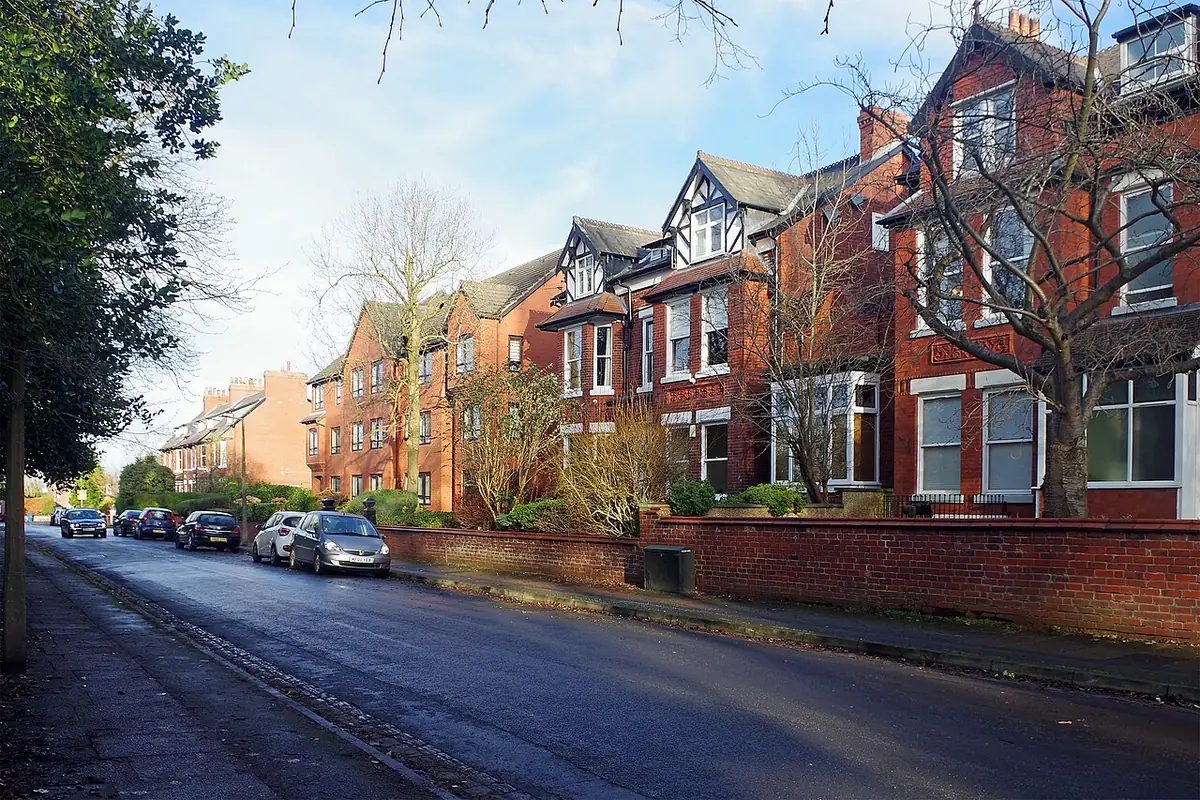
A quiet tree-lined corner in Didsbury, Manchester — Photo: Tom Jolliffe · CC BY-SA 2.0 · Wikimedia Commons
Beyond the financial and budgetary side, the legal nature of the ownership itself deserves particular attention.
Costing a Manchester property purchase goes well beyond the headline figure on the agent's listing. You have to fold in every associated cost, from Stamp Duty Land Tax through professional fees to the unavoidable budget for energy improvements. The table below sets out the orders of magnitude observed for the main residential property types in the region.
manchesterFor saleHouseestimate
Median price / m²£2,804Half the apartments sell below this
Median price£336kthe average is 14% higher — a few very large properties pull it up
Most common2 bedrooms75 % of listings
Average size114 m²
By number of bedrooms
Bedrooms
Share of market
Avg price
Price / m²
Avg size
2most common
75 %
£351k
£2,952
119 m²
3
22 %
£442k
£2,745 −7 %
161 m²
4
3 %
£535k
£2,657best value / m²
201 m²
Each row is an average, compared against the area average of £2,952 / m². These are indicative estimates of a typical local market, not a measured sample of live listings. Check current listings before relying on them.
What you can actually own: freehold versus leasehold
With the legal ground covered, the transaction itself follows a strict sequence that is worth anticipating.
Property ownership in the United Kingdom rests on one fundamental distinction, and that distinction governs both your freedom to manage the property and its long-term value. Confusing the two regimes exposes a buyer to hidden costs and to administrative restrictions they never saw coming. You need to understand exactly what each status means before you sign anything that commits you.
Freehold (outright ownership)
Buying freehold means you own both the building and the land it stands on, with no time limit and no ground rent payable to anyone else. That status gives you full autonomy to extend, subject only to obtaining local planning permission. It is the most sought-after and the most reassuring form of ownership for a house.
What it changesYou keep full control of your asset and remove any risk of dispute with a third-party landowner, which makes passing the property on straightforward.
Leasehold (ownership by lease)
Buying leasehold means you are buying the right to occupy the house for a fixed term (often 99 or 999 years) while paying an annual ground rent to a freeholder. This arrangement, historically common on certain types of property, brings restrictions on structural alterations and requires the payment of service or management charges that are often complicated.
What it changesYou must examine the remaining lease term closely before buying, because a lease of under 80 years brings a rapid loss of value and expensive extension costs.
The rule to understand before you put money down on a house
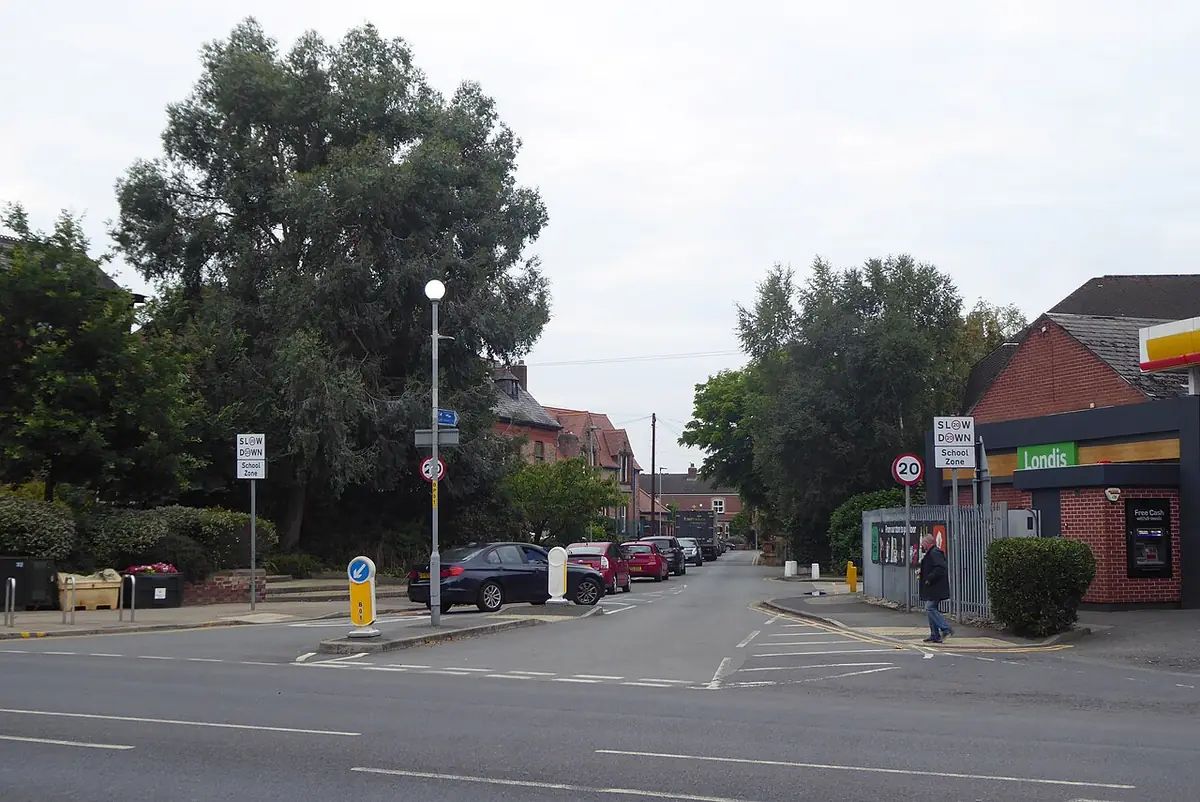
Terraced streets like this make up much of Manchester's housing — Photo: Stephen McKay · CC BY-SA 2.0 · Wikimedia Commons
To see this administrative journey through, let us look at the order in which each party plays their part.
The British buying process is marked by an apparent flexibility that can trap an unwary buyer. Many weeks pass between the offer being accepted and the final exchange of contracts, with no absolute legal guarantee in between. Understanding how these critical stages follow one another lets you protect your money and avoid a purchase collapsing at the last moment.
Putting a formal offer to the estate agent instructed by the seller.
The seller formally accepts your offer, putting the property under offer, a status that carries no binding contractual force.
You instruct your solicitor to carry out the legal searches, the title checks at HM Land Registry and the review of local environmental risks.
You commission the essential independent survey (a home survey) to detect any hidden defects or major structural problems.
Exchange of contracts, the key legal moment at which the purchase becomes irrevocable and a 10% deposit falls due.
Completion day, marking the actual transfer of ownership and the handover of the keys.
How a property transaction unfolds, step by step
A successful purchase rests on careful coordination between the various professionals in the British property market. From choosing the property to moving in, each party plays a precise role, and those roles have to be synchronised. Following these stages methodically keeps the timetable on track and protects your investment.
The buyerSetting the budget and obtaining a mortgage agreement in principleThis preliminary step confirms what you can genuinely afford before you start viewing what is on the market.
The estate agentShortlisting properties and arranging targeted viewingsThe agent acts as the intermediary who puts your offer to the seller and negotiates the initial terms.
The surveyorThorough technical inspection of the buildingThe surveyor writes a detailed report on the roof structure, damp and the services, identifying the work that will be needed.
The solicitorLegal checks and drafting the contract of saleThe solicitor confirms there are no undisclosed easements and prepares the legal terms for exchange of contracts.
The buyer and the sellerExchange of contracts and payment of the depositThis is the legal moment at which the sale becomes final and binds both parties.
The solicitorCompletion and transfer of the remaining fundsThe final payments are made, the official land registration is updated and the keys are handed over to you.
House or flat in Manchester: is a house with a garden better than a city-centre loft?
Once that first structural choice is made, it is time to face the financial reality of the Manchester market and confirm what you can spend.
Choosing between a house and a flat in Manchester involves far more than a simple calculation of floor area or opening budget. The local housing types reflect the city's industrial history, running from rows of Victorian red brick in the outer districts to new schemes converted from warehouses in the central areas. Buyers and investors have to weigh being within reach of the employment centres around the Northern Quarter against the basic need for private outdoor space, often a small city garden or a back yard. This decision reshapes your daily life, your commute and your capacity to absorb future swings in the Greater Manchester market.
On one side, a Victorian or terraced house offers valuable architectural independence, without heavy service charges and with complete freedom to extend. Residential districts such as Chorlton or Didsbury illustrate that suburban ideal perfectly: a quiet setting that stays connected by the Metrolink tram network. In exchange, these older properties demand serious spending on thermal upgrades, loft insulation and the rewiring of electrical installations that are often long past their best. Maintaining the roof and the facades falls entirely to the owner, and that is a budget line worth planning for well in advance.
On the other side, a flat or a converted penthouse appeals for its turnkey simplicity, its better security and its direct walking access to city amenities. Areas such as Ancoats or Salford Quays concentrate a modern offer with built-in services: a concierge, a gym or shared spaces that young professionals value highly. That formula does, however, come with service charges that can be very high indeed, and whose increases are hard to control from one year to the next, particularly in recent buildings needing facade work or heavy lift repairs. Reselling later also depends strongly on the overall financial health of the building's management and on the strict rules laid down by the managing agents.
The final call therefore rests on how long you intend to stay and how much structural-work risk you can tolerate. If you want to put down roots with complete control over the fabric of your home, a house is the obvious answer despite the upkeep. If you value geographic flexibility, freedom from exterior maintenance and a lively urban life, a flat remains the more rational option. Taking the time to weigh your real priorities against the realities of the Manchester market will spare you an expensive disappointment when you get to completion.
What budget do you really need to buy and live day to day in Greater Manchester?
With those numbers on the table, it is time to step into the arena and see what the rhythm of an ordinary day in the city actually looks like.
Costing life and property purchase in Manchester accurately means looking beyond the headline price per square metre. Your outgoings combine the deposit, local taxes, energy bills and commuting costs, all of which vary considerably with exactly where your future home sits. This transparent breakdown helps you avoid the chronic under-budgeting that catches people out and lets you present a solid financing plan to British lenders.
Median prices and purchase costs by property type
Property type
Median price (centre and inner areas)
Median price (sought-after outer areas)
Estimated additional costs
One-bedroom flat
GBP 220,000
GBP 165,000
GBP 1,500 to 3,000 (legal fees and searches)
Two-bedroom flat
GBP 310,000
GBP 230,000
GBP 2,000 to 4,000
Terraced house
GBP 380,000
GBP 275,000
GBP 2,500 to 5,000
Detached house
GBP 550,000
GBP 410,000
GBP 4,000 to 8,000
Prices exclude Stamp Duty Land Tax, which applies at rates depending on whether you are a resident or an overseas investor.
Fixed monthly outgoings for a household living in Manchester
Expense
Lower end
Upper end
Main driver of variation
Council Tax (local taxation)
GBP 140
GBP 280
The property's band (A to H)
Energy (gas and electricity)
GBP 120
GBP 250
Energy performance (EPC rating) and floor area
Service charge
GBP 100
GBP 350
Whether there are lifts, a concierge and grounds
Public transport (Metrolink and buses)
GBP 80
GBP 180
How many zones you cross each day
These figures are indicative and based on average rates observed across Greater Manchester for a standard household.
What does an ordinary Tuesday in Manchester actually look like, between transport, schools and healthcare?
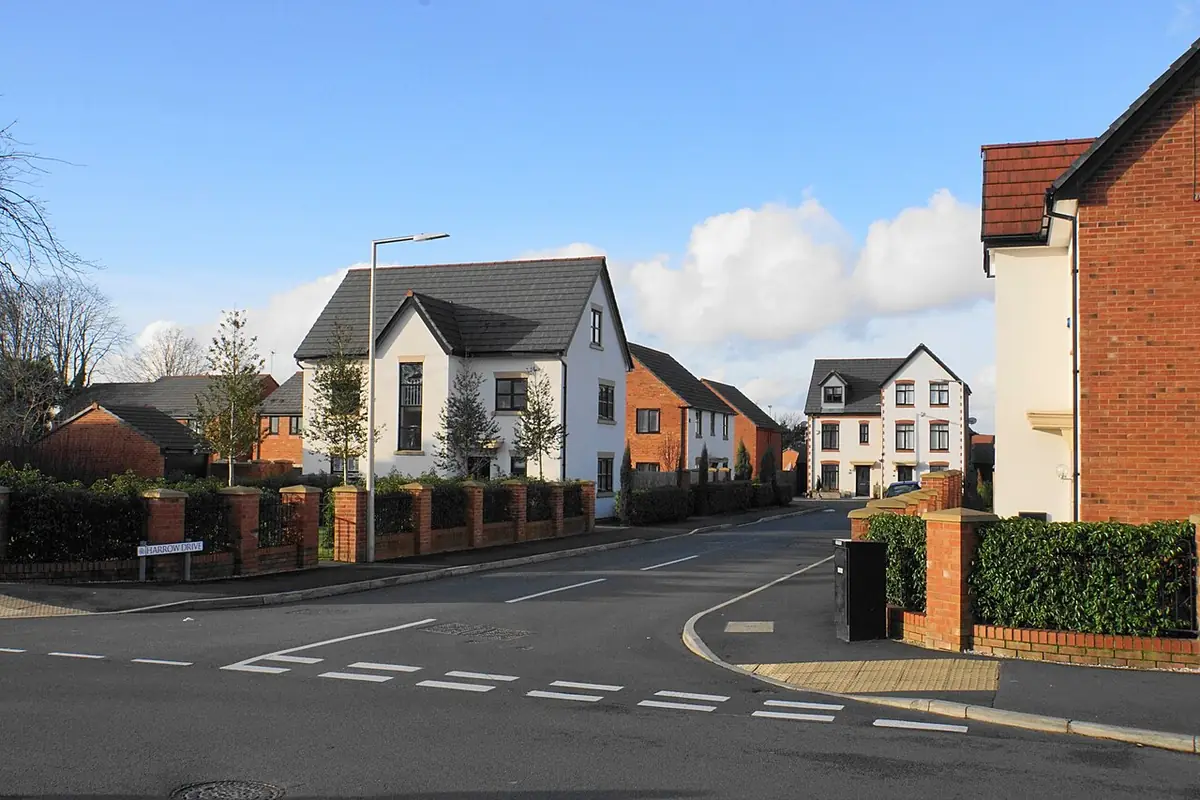
New-build streets like this add to Manchester's newer housing supply — Photo: Bill Boaden · CC BY-SA 2.0 · Wikimedia Commons
Behind the postcard of good transport and lively districts sit technical realities that estate agents often forget to mention.
Daily life in Manchester is built around a dense transport network that can nonetheless be saturated at peak times. Picturing a typical day lets you measure the real effect of your future address on your quality of life, your journey times and your access to essential services. From the morning Metrolink ride to the end-of-day shop, each stage confirms or undermines your choice of where to live.
07:30A residential district (Chorlton or Didsbury, for example)Waking up and getting the household ready. The residential streets stir gently with the school run to the local primary and the first joggers in the neighbourhood parks.
08:15The local Metrolink stopBoarding the tram towards the city centre. Punctuality is generally good, but carriages fill up at peak times and you sometimes have to wait for the next one.
09:00Arriving at the office (city centre or Salford Quays)Settling in at your desk. The coworking spaces and technology hubs in the centre benefit from very high-speed fibre connectivity.
12:30Lunch near the officeDiscovering the good quick-service food and the covered street food markets that give contemporary Manchester dining its lively reputation.
17:00The journey home and a stop at the GP surgeryMaking contact with the local NHS practice. Registering promptly with a general practitioner is a crucial piece of admin as soon as you move in.
18:15The local supermarketPicking up fresh food at the end of the day from the local chains. The main shopping streets make a last-minute shop easy before you head home.
19:30An evening at homeQuiet time indoors. This is when the home's insulation shows its worth, keeping both noise and cold out whatever the local weather is doing.
What hidden details of Manchester housing do sales brochures always leave out?
Knowing these technical subtleties is how you avoid the classic traps that turn a purchase into a bureaucratic and financial nightmare.
The British property market has its own legal and technical customs, and they can surprise an unprepared buyer. Between the complex leasehold regime, the prevalence of old brickwork prone to rising damp and the strict planning rules on altering facades, every detail counts. Finding out about them in advance protects you from unforeseen spending and from administrative setbacks with heavy financial consequences.
The legal trap of leasehold versus freehold
Many flats and some houses are sold leasehold, meaning you are buying the right to occupy the property for a fixed term while paying ground rent to the owner of the land. Increases in that ground rent, and the cost of buying the freehold out, can weigh heavily on what your investment fetches when you sell.
Insulation and the EPC (Energy Performance Certificate) rating
A large part of Manchester's older housing stock carries a poor energy rating, often E or D. Improving cavity wall insulation or fitting better double glazing costs a considerable amount, and you must build it into your initial works budget.
Restrictions in conservation areas
If the property you fall for sits in a conservation area, the smallest external change, whether window frames, the colour of the front door or solar panels, requires prior planning permission from the local authority.
Victorian sewers and the risk of poor drainage
The underground infrastructure in some older districts is under pressure from rapid development. Checking the state of the drains and the presence of anti-backflow systems during the survey avoids serious water damage in heavy autumn rain.
The hidden charges of modern serviced developments
New schemes with gyms and concierge services carry service charges that rise steeply year after year. These fixed, non-deductible costs cut into net returns if you are buying to let.
Which misjudgements do buyers bitterly regret six months after moving in?
These hard-won lessons are a reminder that not everyone is equipped to cope with the particular demands of the Manchester market.
Looked likeA charming Victorian house full of character, with period fireplaces and original floorboards, on a street that seemed quiet.
Turned outA house impossible to heat properly in winter, with constant draughts and persistent damp in the corners of the rooms.
Would have caught itInsisting on a full Homebuyer Report from a RICS-registered surveyor and budgeting for insulation work straight away, before you commit to the purchase.
Looked likeAn ultra-modern top-floor flat with a sweeping view over the construction cranes of a booming city centre.
Turned outUnbearable night-time noise from the neighbouring building sites, and a sharp rise in the service charge set by the managing agent in the second year.
Would have caught itReading the minutes of recent leaseholder meetings and checking the local planning register for building schemes still to come.
Looked likeA very affordable outer residential area, sold by the estate agent as the next up-and-coming district.
Turned outComplete isolation in the evenings, no shops at all within walking distance, and a commute doubled by road bottlenecks.
Would have caught itTesting the journey yourself at peak times and walking the area on a Friday evening to judge the real atmosphere and what is open.
Looked likeA quick transaction with a developer offering supposedly exceptional financing terms and no arrangement fee.
Turned outHidden defects in the internal finishes (snagging issues) and a flat refusal by the developer to put them right under the new-build warranty.
Would have caught itInstructing an independent inspector who specialises in new-build handovers (a snagging survey) before you pay the balance of the price.
Which buyers should steer clear of the Manchester market and look elsewhere?
If you recognise yourself in these profiles, it is worth rethinking your strategy. For everyone else, the time to decide has come.
Buying property in Manchester is not a universal answer suited to every plan. Some buyers, because of their aversion to risk, their need for immediate liquidity or their intolerance of changeable weather, are heading for certain disappointment. Recognising these contraindications honestly saves time and energy that would go into a commitment that was never the right fit.
The investor after immediate, effortless rental returns
→Goes for off-plan schemes sold from a brochure with spectacular guaranteed yields.
High service charges, local taxation and the strict regulation of tenancies in the United Kingdom quickly erode net margins, turning the investment into a money pit if occupancy dips.
The buyer highly sensitive to urban noise and short of natural light
→Falls for an industrial loft in the thick of the Northern Quarter or Deansgate.
The density, the intense night-time bar trade and the frequently cloudy weather of northern England leave people used to bright open spaces feeling hemmed in.
The household with tight savings and no safety margin for the unexpected
→Buys an older house in the outer districts, putting every last penny into the deposit and the legal fees.
A single boiler breakdown, the discovery of rising damp or a rise in the Bank of England's base rate throws the family budget out instantly.
So are you ready to take the step and settle in the heart of Manchester?
Green spaces like this sit within easy reach of the surrounding streets — Photo: Stephen McKay · CC BY-SA 2.0 · Wikimedia Commons
At the end of this analysis, the question of committing to a Manchester purchase is no longer an abstract wish but a carefully considered decision. The Manchester market offers fascinating prospects to anyone who can read its rules, anticipate its administrative traps and accept its climatic and structural demands. Between the economic momentum of its technology and cultural sectors and its unusual architectural variety, the city rewards methodical buyers who have prepared their case clearly.
Your final decision should rest on the fit between how long you intend to stay and how solid your financing plan is. If your plans run beyond five years, if you have factored in the real cost of renovation and if you have tested local transport at peak times, then you hold every card you need. Never act on a false marketing urgency or on artificial pressure applied by a less than scrupulous intermediary.
Take the time to instruct the professionals you cannot do without (surveyors, energy assessors and conveyancing solicitors) so that every legal stage of the transaction is secure. Manchester will then offer you a stimulating place to live, rooted in a vivid industrial history and turned firmly towards a modern urban future. The moment has come to settle your strategy and turn your plan into a lasting reality.
Related questions
What legal fees and taxes should I budget for when buying a property in Manchester?
In the United Kingdom the transfer is handled not by a civil-law notary but by conveyancing solicitors. Legal fees generally run between 1,500 and 3,000 pounds sterling. On top of that comes Stamp Duty Land Tax (SDLT), whose bands vary with your tax status, with whether the property is your main or an additional home, and with the relief thresholds in force for first-time buyers.
What is the fundamental difference between freehold and leasehold in Manchester?
Freehold means you own both the building and the land it stands on, outright and indefinitely. Leasehold, very common for flats and for some terraced houses, means you are buying only the right to occupy the property for a fixed term (often 125 or 999 years), while paying an annual ground rent to the owner of the land.
How does the EPC energy rating system work for Manchester homes?
The Energy Performance Certificate rates properties from A (very efficient) to G (very inefficient). A large share of Manchester's older Victorian stock sits in band D or E. Improving that rating is often necessary to bring energy bills down and to meet future regulatory requirements when letting or reselling.
Is a technical survey compulsory before buying?
Although UK law does not strictly require a survey before purchase, it is strongly advisable to commission a Homebuyer Report (Level 2) or a full Building Survey (Level 3) from a RICS-registered surveyor. That is how you uncover hidden defects, roof problems and damp before you commit to your offer.
Which Manchester districts are most sought after by families?
Outer districts such as Chorlton-cum-Hardy, Didsbury, Altrincham and Sale are particularly popular with families for the quality of their primary and secondary schools, their generous green space and their village feel, while staying connected to the centre by the Metrolink tram.
How do I register with a GP after moving in?
As soon as you have proof of address at your new Manchester address (an electricity bill or a tenancy or purchase agreement), you should go in person or register online with the nearest GP surgery to you within the National Health Service (NHS).
What does Council Tax typically cost in Manchester?
Council Tax is a local charge collected by the local authority (Manchester City Council) to fund local public services. The amount depends on the property's assessed value as at 1 April 1991, sorted into bands A to H. For a standard household, budget broadly between 140 and 280 pounds sterling a month.
Do overseas investors pay a specific surcharge in Manchester?
Yes. Buyers who are not UK tax residents pay a 2% Stamp Duty Land Tax surcharge on residential property purchases. Specific reporting rules also apply to rental income received by landlords domiciled outside the United Kingdom.
How long does a UK property transaction usually take to complete?
The conveyancing process generally takes between 8 and 12 weeks from the offer being accepted to exchange of contracts and completion, provided nothing goes wrong further up or down the chain.
How does the Metrolink public transport network work across Greater Manchester?
Metrolink is the overground tram network that serves Manchester and its surroundings efficiently (Bury, Altrincham, Rochdale, Ashton-under-Lyne, Salford Quays). It runs on zonal contactless payment (tap-in / tap-out), which automatically works out the best fare for your daily journeys.
Property review of ting
No ting properties in Manchester yet
Be the first — share it on ting and it shows up right here.