Buying a house in Dublin is a major financial commitment in a lively and competitive market. This guide unpacks how things work locally, the legal specifics and the key criteria for choosing well, so you can protect your investment with your eyes open.
Tell us about your life. Ex: I’m relocating to Nice next year
Attach file
Get the app
Sale House Dublin
Buying a house in Dublin is a major financial commitment in a lively and competitive market. This guide unpacks how things work locally, the legal specifics and the key criteria for choosing well, so you can protect your investment with your eyes open.
Buying a house in Dublin: the promise of stability against the reality of the market
Scroll
Buying a house in Dublin: the promise of stability against the reality of the market
Buying a house in Dublin is a major financial commitment in a lively and competitive market. This guide unpacks how things work locally, the legal specifics and the key criteria for choosing well, so you can protect your investment with your eyes open.
Written by the ting.ad editorial team ·
Sale House Dublin in Street View: drag to look around.
To size your plans properly, it is essential to hold your personal situation up against the everyday realities of life in Dublin.
Buying a house in the Irish capital means entering a particularly tight market where demand structurally outstrips the supply available. Between the search for a lasting financial anchor and the need to absorb high upfront costs, every buyer has to weigh their housing ambitions against hard local economics. Central and outer areas respond differently to wider economic pressures, which calls for a clear-eyed reading of the real value of the properties on sale. Understanding these dynamics helps you avoid the traps of an impulsive purchase and protect your capital for the long term.
A secure long-term investmentvsConstant pressure on both rentals and sales
The scarcity of land in sought-after areas has historically guaranteed long-term growth in property values, but it exposes buyers to fierce competition and frequent overbidding during property auctions.
The charm of Victorian and Georgian housesvsRenovation and insulation costs that are often underestimated
The undeniable architectural character of these historic buildings almost always comes with major technical constraints, requiring substantial budgets to reach acceptable energy standards.
A Dublin market that looks liquidvsLong, regulated buying procedures
Finding a property is an uphill battle, and completing the legal side and securing mortgage approval then demands absolute administrative rigour, slowing your moving-in timeline considerably.
What kind of buyer are you, given what the Dublin market demands?
O'Connell Street, the broad main avenue of central Dublin — Photo: CAPTAIN RAJU · CC0 · Wikimedia Commons
This move changes your reference points profoundly, especially when you compare local practice with the habits you bring from back home.
The Dublin housing market works differently depending on whether you arrive alone, with a family or with a short-term investment horizon. Each situation involves specific trade-offs on location, living space and how much renovation work you are prepared to take on. Analysing your situation up front avoids disappointment with properties whose fit with your real needs can turn out to be misleading. Local specifics call for complete clarity on your priorities before you even look at the first listings.
Looking for space and stability
Families generally look for houses with a garden, close to schools and transport links. In Dublin, that means stiffer competition in the residential areas of the middle suburbs. You have to accept moving your search area a little further from the city centre to get the space you need day to day, while allowing for journey times at rush hour.
The urgency of settling in and staying flexible
If you are arriving from abroad to take up a role in the tech or finance sector, Irish red tape can come as a surprise. Building a local credit history and getting your application approved by the banks often takes several months of planning. It is often wise to rent for a while to get to know the neighbourhoods before committing to a purchase for good.
Tax efficiency and managing a rental
The regulatory framework for renting in Ireland imposes strict caps on rent increases in rent pressure zones. Buying a house to let requires a rigorous analysis of net returns after tax and management or maintenance costs. Headline gross yields sometimes hide administrative burdens and very strict energy upgrade obligations.
Buying in Dublin when you come from abroad: the real changes to prepare for
Once you have absorbed these rules, choosing the right area becomes the cornerstone of your purchase.
Buying property in Ireland rests on legal traditions and market customs that can differ radically from what you are used to back home. From the nature of the title deed to the role of notaries and solicitors, every stage holds its share of surprises for a buyer from abroad. Ignoring these cultural and procedural differences can lead to serious misunderstandings during negotiations. Methodical preparation is essential to find your way calmly through this common-law legal environment.
From abroad
The legal certainty of a binding preliminary sale agreement signed early on, as in many countries
Dublin
A system of bidding and conditional offers (Sale Agreed)
In Ireland, an accepted offer does not legally bind either party until the final contracts are signed. The seller can accept a higher offer (gazumping) right up to the last moment, which calls for constant responsiveness and vigilance.
From abroad
A single notary, or one for each side, overseeing and securing the sale
Dublin
Each party is represented solely by its own solicitor
Each side appoints its own specialist lawyer, whose job is to carry out all the searches on the title and the property's history, which lengthens transaction times and increases fixed costs.
The Building Energy Rating (BER) and an independent structural survey
The energy rating is compulsory, but it must be backed up by a thorough technical inspection carried out by a surveyor or engineer to spot damp and roofing problems.
From abroad
Long leases that are rare and tightly regulated
Dublin
The tricky distinction between freehold (outright ownership) and leasehold (a long-term lease)
Some houses or plots are held on long leases that involve paying an annual ground rent, a legal point that must be checked with the greatest care before signing anything.
Which area of Dublin to target, depending on your lifestyle and budget?
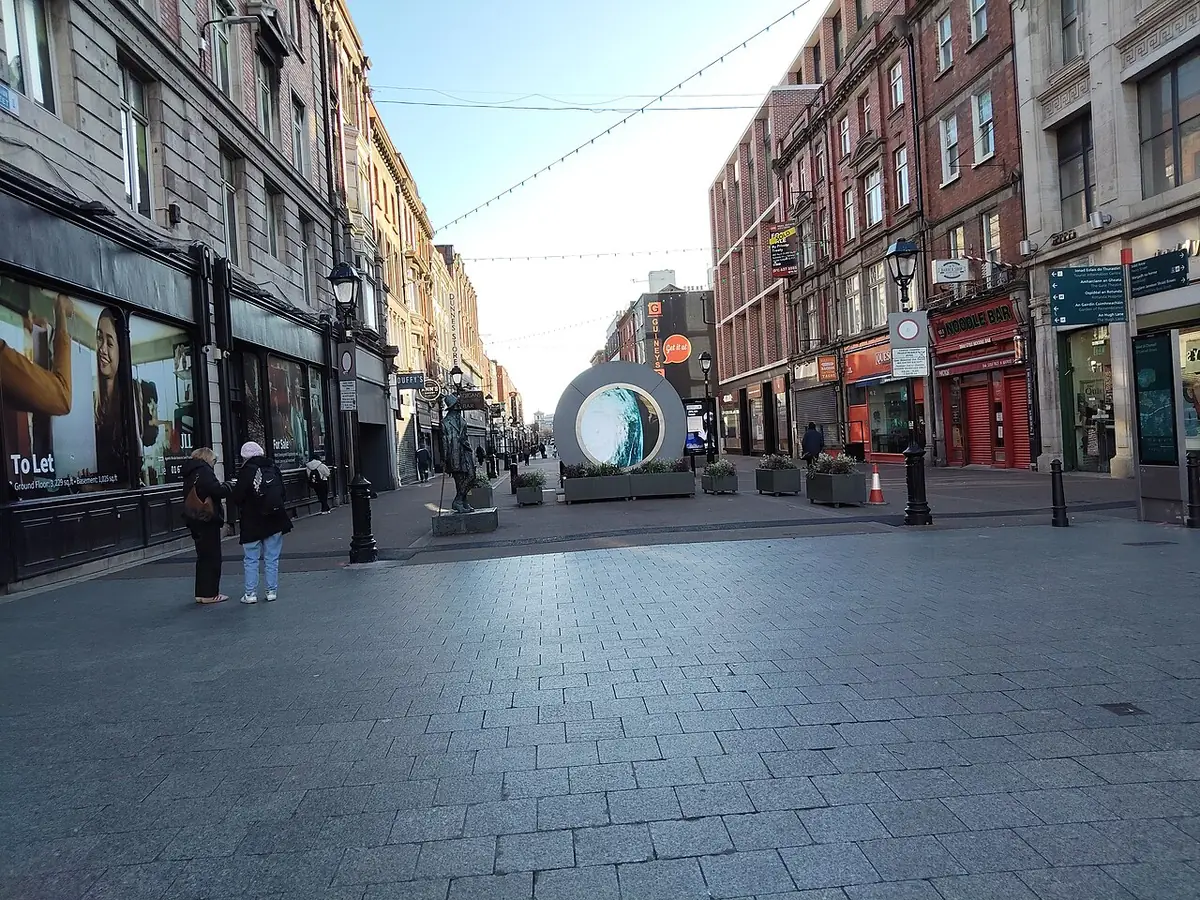
A pedestrian shopping street in central Dublin — Photo: CAPTAIN RAJU · CC0 · Wikimedia Commons
This overview of the city raises the central question of what buying actually costs in these different areas.
Dublin is laid out around the River Liffey, which roughly divides the north side from the south side, and it stretches out into highly sought-after residential suburbs. Each area has its own identity, its own public transport links and its own price dynamics. Settling in the right neighbourhood means striking the right balance between how close you are to work, the quality of the local schools and your overall budget. Geographical compromises are part and parcel of any successful property purchase in the capital.
The central districts (Dublin 1, 2, 8)
Constant urban buzz, high density and immediate access to every cultural and professional service.
Suits
Young professionals without children, or buyers who prefer to get around on foot or by bike every day.
Trade-off
Very high prices per square metre, houses that are often small and almost no genuine private outdoor space.
The residential south side (Dublin 4, 6, 14)
Tree-lined avenues, beautiful parks, a preserved calm and a setting that is highly prized by families.
Suits
Buyers with a substantial budget looking for solid capital growth and excellent schools.
Trade-off
Fierce competition for every property that comes on the market and entry prices among the highest anywhere on the island of Ireland.
The up-and-coming north side (Dublin 3, 9, Clontarf)
A seaside or urban-village feel in areas undergoing renewal, offering an excellent balance between neighbourhood life and accessibility.
Suits
Families and first-time buyers looking to put down roots in areas with a real sense of community and large green spaces.
Trade-off
Marked differences from one street to the next, and commutes that can get longer depending on exactly where you work.
The inner ring and the suburbs (Blackrock, Dún Laoghaire, Swords)
A more relaxed pace of life, looking towards the sea or the countryside, with large parks and direct access to the DART.
Suits
People looking for more spacious houses, bigger gardens and a good environment for bringing up children.
Trade-off
Greater reliance on rail and heavy transport to reach the centre, and a transport budget to factor into your monthly outgoings.
How much does buying a house in Dublin really cost today?
Beyond the raw figures, what you legally own when you buy a house deserves particular attention.
Working out the cost of buying property in Dublin cannot stop at the asking price shown on the listing portals. Price ranges vary considerably depending on the type of building, its energy performance and how close it is to the main transport corridors. On top of that, the associated costs (stamp duty, legal fees, surveys) are an unavoidable part of the budget that has to be built in from the very start. A realistic financing plan takes all of these components into account to avoid running short of cash.
DublinFor saleHouseestimate
Median price / m²€4,362Half the apartments sell below this
Median price€683kthe average is 14% higher — a few very large properties pull it up
Most common2 bedrooms53 % of listings
Average size149 m²
By number of bedrooms
Bedrooms
Share of market
Avg price
Price / m²
Avg size
2most common
53 %
€603k
€4,592
131 m²
3
33 %
€763k
€4,362 −5 %
175 m²
4
14 %
€1.04m
€4,225best value / m²
245 m²
Each row is an average, compared against the area average of €4,592 / m². These are indicative estimates of a typical local market, not a measured sample of live listings. Check current listings before relying on them.
Freehold or leasehold: what can you actually own?
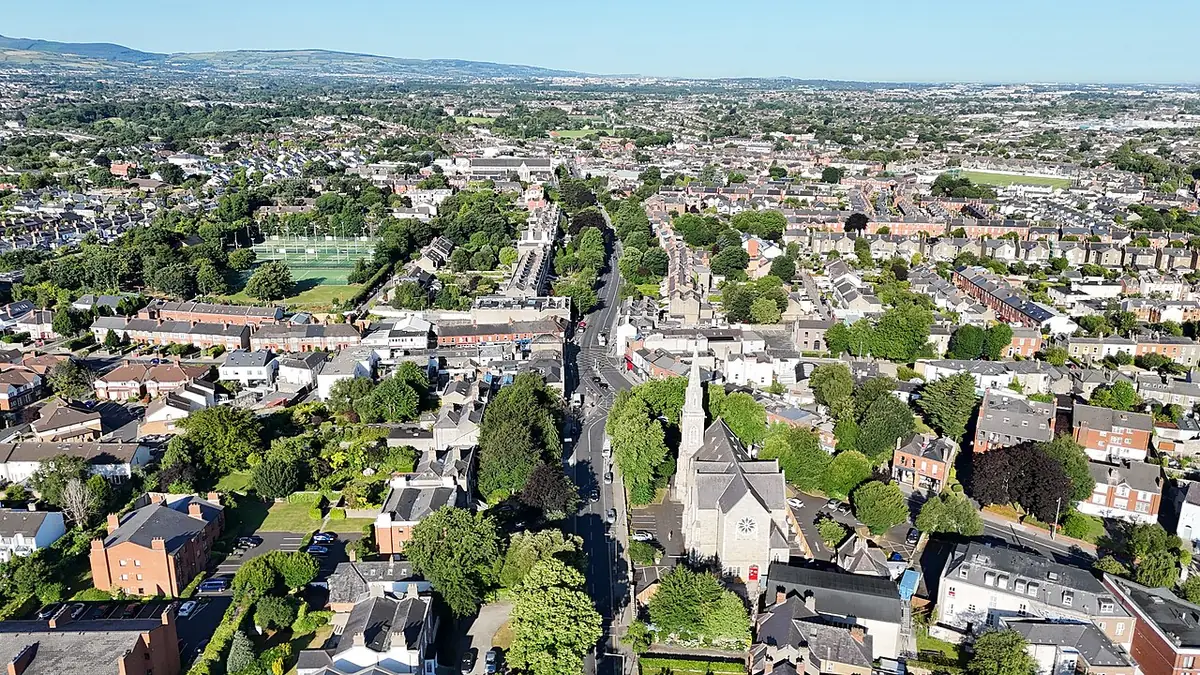
Rathgar from above, a leafy neighbourhood of houses and gardens — Photo: 瑞丽江的河水 · CC BY-SA 4.0 · Wikimedia Commons
Before you commit financially and hand over any deposit, one golden rule governs Irish property transactions.
The legal nature of your ownership in Ireland determines how durable your investment is and what management constraints you face over the long term. While most detached and terraced houses are freehold, some properties are held under complex historical arrangements that need careful unpicking. Understanding these legal subtleties protects your assets against hidden costs or unexpected restrictions on use. Your solicitor is an indispensable safeguard here.
Freehold (absolute ownership)
You own both the building and the land it stands on, with no recurring ground rent and no time limit on your use of it. It is the most secure and most sought-after form of tenure in the Dublin housing market.
What it changesYou have complete freedom to carry out renovation or extension work, provided you obtain the necessary local planning permission from Dublin City Council.
Leasehold (a long-term lease)
You buy the right to occupy the property for a set period (often several hundred years), while paying a modest annual ground rent to the original owner of the land.
What it changesYou need to check carefully how many years remain on the lease and any restrictive clauses, because a lease nearing its end or carrying particular conditions can complicate a future sale.
The golden rule to understand before paying a deposit on a property in Dublin
To handle all of these steps without a misstep, it helps to picture the full timeline of a transaction.
Buying property in Ireland follows a strict sequence in which 'Sale Agreed' status is in no way a final guarantee. Several weeks pass between the moment the seller accepts your offer and the actual transfer of ownership, punctuated by crucial legal and technical checks. Understanding this chain of cause and effect stops you from picturing yourself in the house too soon and suffering irreversible financial setbacks. Patience and rigour are your best allies during this waiting period.
You find a house that meets your criteria and get the estate agent to put forward your offer at or above the asking price.
The seller accepts your offer and the property officially moves to 'Sale Agreed', which temporarily takes the listing off the market.
You pay a refundable booking deposit to the estate agent while the initial legal checks are carried out.
Your solicitor examines the title deeds, searches the land registry and uncovers any easements or planning irregularities.
You hire an engineer to carry out a detailed structural survey to identify hidden defects or urgent insulation work.
Signing the final Contracts for Sale comes with a non-refundable 10% deposit, which seals the deal for good ahead of the closing date.
How does a property transaction in Dublin work, step by step?
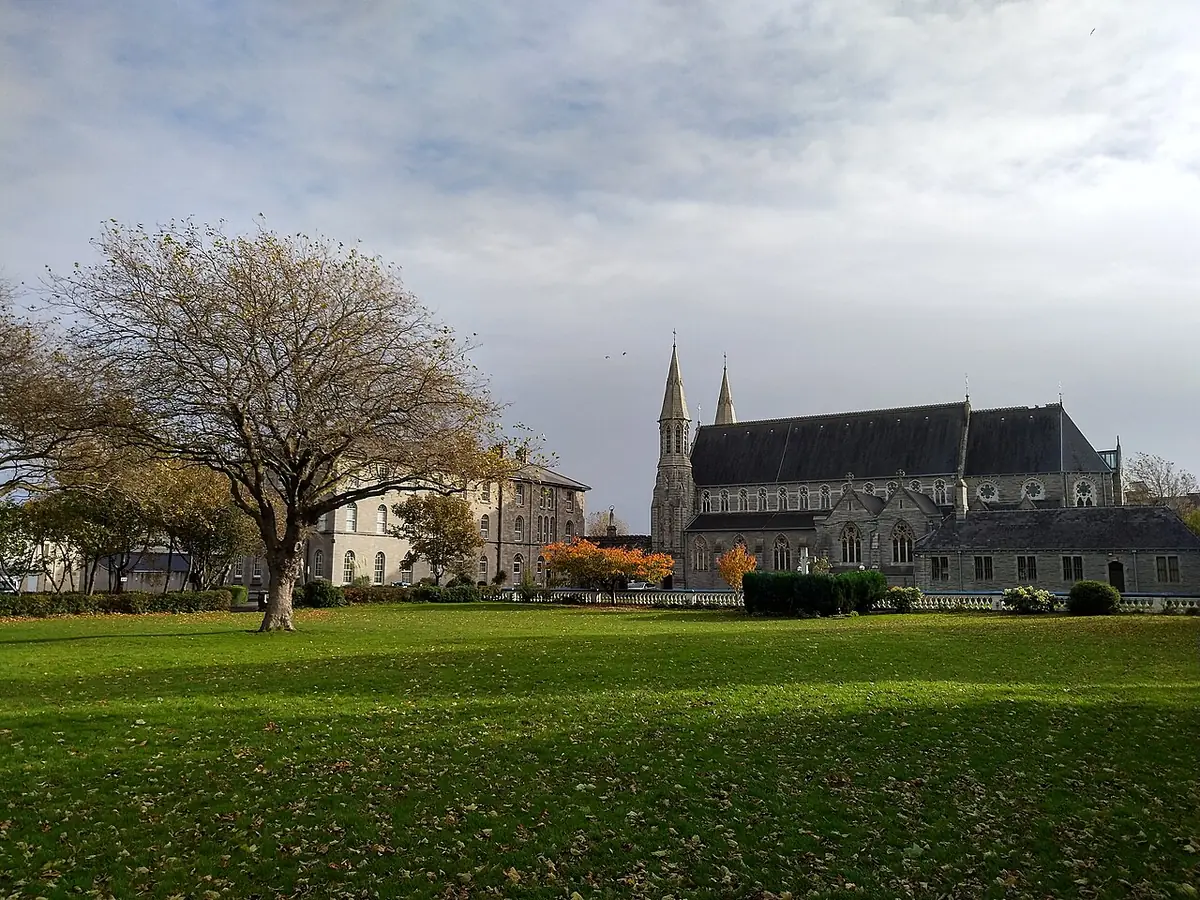
Open green space by the church grounds in Inchicore — Photo: Swifty4 · CC BY-SA 4.0 · Wikimedia Commons
Seeing a property purchase through in Dublin means coordinating several professionals with clearly defined roles. From assessing how much you can borrow with lenders to the solicitor handing over the keys, each one secures a link in the chain. Knowing this operational timeline lets you steer your project with confidence and keep up with the pace of the Irish market.
The buyer (you)Getting Approval in PrincipleYou put together your financial application with an Irish bank or a broker to prove you can afford to buy before you even view your first property.
The estate agentViewings and submitting offersThey manage viewings, run open or sealed bidding and collect offers from the various prospective buyers on the seller's behalf.
The surveyor or engineerTechnical inspection and assessing the building's conditionThey go over the structure, roof, plumbing and insulation with a fine-tooth comb to estimate the cost of essential upgrades.
The buyer's solicitorLegal investigation and title checksThey draft or approve the contract clauses, make sure there are no land disputes and arrange the transfer of funds on closing day.
The mortgage lenderReleasing the funds and issuing the loanThey give final approval to the transaction once they have received the valuation report and transfer the necessary funds to the solicitor to complete the purchase.
The seller and their solicitorFinal signing and transfer of ownership (closing)The signed deeds are exchanged, the balance of the price is paid and the keys to the house are formally handed over so you can move in.
House or apartment in Dublin: weighing it up against your lifestyle and budget
Once you have settled on the type of property, it is time to look at the financial reality of actually buying in the capital.
Choosing between a Victorian or Edwardian house with a private garden on the outskirts and a contemporary apartment in Dublin's Docklands means carefully weighing up your everyday priorities. Single-family houses, often recognisable by their red-brick facades and slate roofs, offer complete independence from a management company but come with a significant structural maintenance burden. Owners have to plan for reroofing, dealing with the damp that is so common in the Irish climate, and managing their own insulation.
By contrast, opting for an apartment in the heart of Dublin, whether at Grand Canal Dock or near Stephen's Green, hands the upkeep of the common areas and the building's exterior to a management company. That peace of mind has a direct cost in the form of annual management fees, which are often high in the Irish capital because of concierge and security services. What is more, outdoor space usually comes down to a balcony or a shared terrace, which radically changes the relationship with nature and outdoor leisure for families.
Location weighs heavily in this Dublin property balance. Houses are mostly found in the residential areas of the Dublin 4 and 6 postcodes or in leafy suburbs such as Rathmines, Blackrock or Dún Laoghaire, which often means accepting longer daily commutes to the business district. Apartments are concentrated along the Liffey and in the tech hubs, so you can do everything on foot or by bike, but at the price of greater urban density and usually less living space for the same budget.
Finally, liquidity and future resale differ markedly between these two types of property on the Dublin market. Family houses with a private garden keep a structurally higher and more stable demand, driven by a local population attached to this traditional way of living. Apartments are more exposed to swings in the rental sector and in institutional investment, while remaining the preferred way in for first-time buyers who want to settle in the capital for the long term without moving out to the suburbs.
What real budget should you plan for to live and buy in Dublin?
Sandymount Strand, the wide shoreline of Dublin Bay — Photo: Josi · CC BY-SA 4.0 · Wikimedia Commons
Beyond the raw figures, it is the practical shape of an ordinary day that reveals what life in Dublin is really like.
Buying property in Dublin is not just about the purchase price shown on the listing portals. You need to factor in all the compulsory associated costs, local taxes and everyday living costs to judge whether your project is financially viable over the long term. The market data reflects the heavy pressure on housing in the Irish capital.
Purchase costs and upfront taxes in Dublin
Cost item
Basis of calculation
Estimated amount or rate
Stamp duty
Property value up to EUR 1 million
1 per cent of the purchase price
Legal and conveyancing fees
Solicitor's fees and land searches
EUR 2,000 to EUR 4,500 before VAT
Structural survey report
Full building inspection
EUR 600 to EUR 1,200
Local Property Tax (LPT)
Property value as estimated for Revenue
EUR 90 to more than EUR 1,000 a year
Purchase costs always come on top of your deposit and are generally not financed by Irish banks.
Indicative monthly budget for a two-person household in Dublin
Budget item
Low end
High end
Management fees
EUR 1,200 a year
EUR 3,500 a year
Food and everyday shopping
EUR 600 a month
EUR 900 a month
Transport (Leap Card and car running costs)
EUR 150 a month
EUR 400 a month
Energy (electricity and natural gas)
EUR 180 a month
EUR 350 a month
Energy bills in Ireland are among the highest in Europe, which makes the energy rating of the property you buy critical for your budget.
Health, schools and transport: an ordinary Tuesday in the life of a Dublin resident
This apparent routine does, however, hide technical realities that traditional property viewings often fail to reveal.
To understand the impact of buying property in Dublin, you need to experience the daily rhythm of the local infrastructure. Between commuting along congested routes, securing school places and accessing healthcare, each neighbourhood sets its own tempo for residents.
07:30Leaving home and dealing with the morning trafficThe routes into the canal ring and the city centre are very busy, whether you take the Luas or drive.
08:30Dropping the children at the local National SchoolEnrolling in public or denominational schools means planning well ahead, as waiting lists are an unavoidable reality.
09:00Arriving at the office or a coworking spaceJobs are concentrated mainly around the Liffey quays and the Grand Canal Dock business district.
13:00Lunch break and local shoppingNeighbourhood shops cover immediate needs, with a very lively range of services in the city centre.
17:30Heading home and managing medical appointmentsAccess to GPs is often arranged privately, as public waiting lists are particularly stretched.
19:30Unwinding and neighbourhood lifeEvenings revolve around local amenities, city parks such as St Stephen's Green and community activities nearby.
What the property listing won't tell you about homes in Dublin
These overlooked technical aspects too often lead to disappointments that new owners discover too late.
The Dublin property market has its own customs and technical quirks that the glossy listing photos are careful not to reveal. Behind a cosmetic renovation there can sometimes be major structural challenges linked to the age of the housing stock and to local regulations.
Insulation and the BER rating
Many older houses have poor energy performance. Improving a BER rating from F to B is a considerable financial investment that must be budgeted for before you sign.
Strict planning rules (planning permission)
Altering the facade of a Victorian house, adding an extension or even replacing windows in some of Dublin's protected areas requires municipal approval that is extremely restrictive and slow to obtain.
The plumbing and water pressure
Old water tanks in the attic and ageing pipework in some historic neighbourhoods often need replacing entirely to avoid recurring breakdowns and water damage.
Regulated residents' parking
Owning a car in central Dublin or the areas close to it in no way guarantees a space outside your home. Residents' parking permits are subject to strict quotas and are sometimes impossible to obtain depending on the type of tenancy.
The history of surface water flooding
Some parts of Dublin near rivers or in low-lying coastal areas are vulnerable to heavy rain combined with high tides, which directly affects the cost and availability of home insurance.
The mistakes people discover six months after settling in Dublin
Given these demands and risks, it is just as important to know whether this property purchase is really right for you.
Looked likeA charming period house full of character, with its original floorboards and marble fireplaces.
Turned outA draughty, poorly insulated home that is impossible to heat properly, despite radiators running flat out all winter.
Would have caught itInsist on a detailed BER certificate, have an independent engineer carry out a thermal survey and price the insulation work before making a firm offer.
Looked likeA calm, peaceful residential area, perfect for raising children away from the bustle of the city centre.
Turned outA bypass road jammed at rush hour, turning every morning departure into a test of patience.
Would have caught itVisit the area around the property at different times of day, especially on weekdays between 7:30 and 9:00 and in the late afternoon.
Looked likeA modern development with moderate fees and hassle-free upkeep of the common areas.
Turned outPoor building management, with owners chronically failing to pay their fees and roof repairs left unfunded.
Would have caught itAlways read the minutes of the last three annual general meetings of the owners' management company and ask the managing agent about the sinking fund.
Looked likePublic transport right on the doorstep, with direct access to the heart of Dublin.
Turned outBus routes so packed at rush hour that buses drive past without stopping because they are already full.
Would have caught itTest the commute yourself at actual rush hour, in real conditions, before signing the sale agreement.
Who should not buy property in Dublin right now?
It is time to bring all of these factors together so you can make your decision with a clear head.
Buying property in Dublin is often presented as the only route to financial stability, but it is the wrong strategy for some personal and professional situations. Buying in such a tight market requires a long-term outlook that not everyone has.
The professional on a short-term international assignment
→Keep renting a flexible apartment rather than committing to a purchase.
Upfront purchase costs and taxes cannot be recovered over a period of less than five to seven years, which makes a quick sale financially ruinous.
The first-time buyer on an extremely tight budget with no emergency savings
→Wait to build up a bigger deposit and a financial safety net.
Unexpected structural problems and rising maintenance costs on a Dublin property can push the owner into default at the first major repair.
The household unsure about settling in Ireland for the long term
→Try out life in Dublin as a renter for at least a full year.
Committing to buy a house in the suburbs or an apartment in the city centre without knowing how the different neighbourhoods work often leads to quick regrets.
So, are you ready to take the plunge and buy property in Dublin?
Buying property in Dublin is not just a financial calculation or signing a mortgage agreement with an Irish bank. It is a life commitment that roots you in the social, economic and cultural fabric of the capital. If you have confirmed that you can absorb the associated costs, understood the technical demands of the local housing stock and accepted the compromises that come with commuting times, the Dublin market opens up solid opportunities to build lasting wealth.
The success of your purchase rests entirely on how thoroughly you prepare and on refusing to give in to the urgency and haste that competitive bidding in Ireland can sometimes fuel. Take the time to have every property surveyed, to go through the accounts of any management company and to test the transport at rush hour. Every check carried out in advance is your best shield against disappointment after the purchase and ensures a calm move.
Ultimately, becoming a homeowner in Dublin offers remarkable stability in a thriving European city, as long as you approach the move with clear eyes and pragmatism. The constraints of the market should not scare you off, but rather guide your choices towards the property that truly fits your pace of life and your long-term ambitions, turning your investment into a real home for years to come.
Related questions
What do legal and conveyancing fees typically cost when buying in Dublin?
The solicitor's fees (the lawyer who handles the legal side of the transaction) generally range from EUR 2,000 to EUR 4,500 before VAT, on top of which come various mandatory administrative and land search costs when ownership is transferred.
What is a BER certificate for a home in Ireland?
The Building Energy Rating is Ireland's energy performance certificate, similar to the energy labels used in many other countries. It gives a grade from A (very efficient) to G (very inefficient) and is a key indicator for anticipating your heating bills in Dublin.
Do you have to pay stamp duty when buying a property?
Yes, stamp duty is a compulsory government tax charged when you buy property in Ireland. The rate is currently 1 per cent on the portion of a residential property's value up to EUR 1 million.
How do offers and bidding work in the Dublin property market?
Unlike in many other countries, property sales in Dublin often go through estate agents running a bidding process in which prospective buyers make successive offers in increments, and the sale only becomes legally binding once the solicitors have signed the final contracts.
Is it hard to get a mortgage from a bank in Ireland?
Irish banks apply strict lending criteria regulated by the Central Bank of Ireland, generally capping borrowing at four times gross household income and requiring a minimum deposit of 10 per cent of the purchase price.
Which areas of Dublin are most sought after for buying a family home?
The Dublin 4 and Dublin 6 postcodes, along with outlying coastal areas such as Dún Laoghaire and Blackrock, and Rathmines, see the strongest demand because of the quality of their schools and their green surroundings.
What about management fees for apartments in Dublin?
Annual management fees vary widely from one development to another, from EUR 1,200 for standard buildings to more than EUR 3,500 for central developments with concierge services and landscaped grounds.
Can non-resident foreigners buy property in Ireland?
There is no legal restriction preventing a foreign national, whether resident in Ireland or not, from buying property in the country, although getting a loan from a local bank requires suitable proof of income.
How does residents' parking work in central Dublin?
On-street parking is managed by Dublin City Council through paid zones. Residents can apply for an annual parking permit, which is granted strictly according to the type of home and the quotas allowed per street.
What recurring annual taxes do you pay after buying a property in Dublin?
The main local tax is the Local Property Tax (LPT), calculated by the Irish tax authority (Revenue) on the estimated market value of your property on 1 November of the valuation year.