Buying a house in Ajman is an appealing and measured alternative to the intensity of the larger neighbouring emirates. This guide examines the realities of the local market, the legal traps to avoid, how to choose a district and the exact sequence of a purchase.
Get the app
What nobody tells you.
Real prices, hidden costs and the traps to check before you commit.
What you actually get buying a house in Ajman today
Scroll
What you actually get buying a house in Ajman today
Buying a house in Ajman is an appealing and measured alternative to the intensity of the larger neighbouring emirates. This guide examines the realities of the local market, the legal traps to avoid, how to choose a district and the exact sequence of a purchase.
Written by the ting.ad editorial team ·
Ajman in Street View: drag to look around.
Investing in property in Ajman is not a matter of signing a deed casually. Behind the appeal of no taxation and a cost per square metre well below the neighbouring cities sits an urban reality worth assessing coldly.
A financially accessible purchasevsA rental market with more measured liquidity
Entry prices give access to villa-sized property you could not afford in Dubai. In exchange, reselling or letting quickly requires targeting local buyers and families looking for quiet more precisely.
A setting on a more human scalevsMarked dependence on the road network
Daily life in Ajman escapes the scale and permanent saturation of the larger emirates. The proximity of Sharjah and the relative distance from parts of Dubai nonetheless generate journey times that belong in your daily organisation.
Controlled service and maintenance chargesvsEconomic momentum more dependent on regional flows
Owning a house or a property in a gated community here reduces the impact of the heavy management fees common in residential towers. In exchange, capital growth rests more on the emirate's overall development and public investment than on frenetic speculation.
Does this fit your life and what you expect day to day?
Choosing where to live answers no universal formula, only the fit between your constraints and what Ajman actually offers. Whether you work locally, commute to another emirate or work from home changes everything.
The daily commuter
Commuting daily between Ajman and Dubai's business areas is a considerable physical and time commitment. Ajman's stock lets you buy a spacious house for the price of a small one-bedroom in Dubai's sought-after districts, but the roads congest reliably at peak hours. You have to judge whether the asset gain and the comfort at home outweigh hours behind the wheel each week.
Residents who make this work are generally those with flexible hours, or whose work does not require crossing the whole of Dubai every morning. For others, accumulated fatigue erodes the financial benefit quickly.
The local worker
If your work is strictly local, buying a house in Ajman is a straightforward strategic choice. You remove the stress of the inter-emirate roads entirely and get considerably more space than the same budget would buy nearby. This is the profile that extracts the most from the emirate.
The income investor
Family villas here attract stable tenants — households working locally or in Sharjah who want space at a reasonable rent. Yields are steady rather than spectacular, and the tenant profile tends to stay for years, which reduces void periods and re-letting costs.
Living here when you arrive from abroad
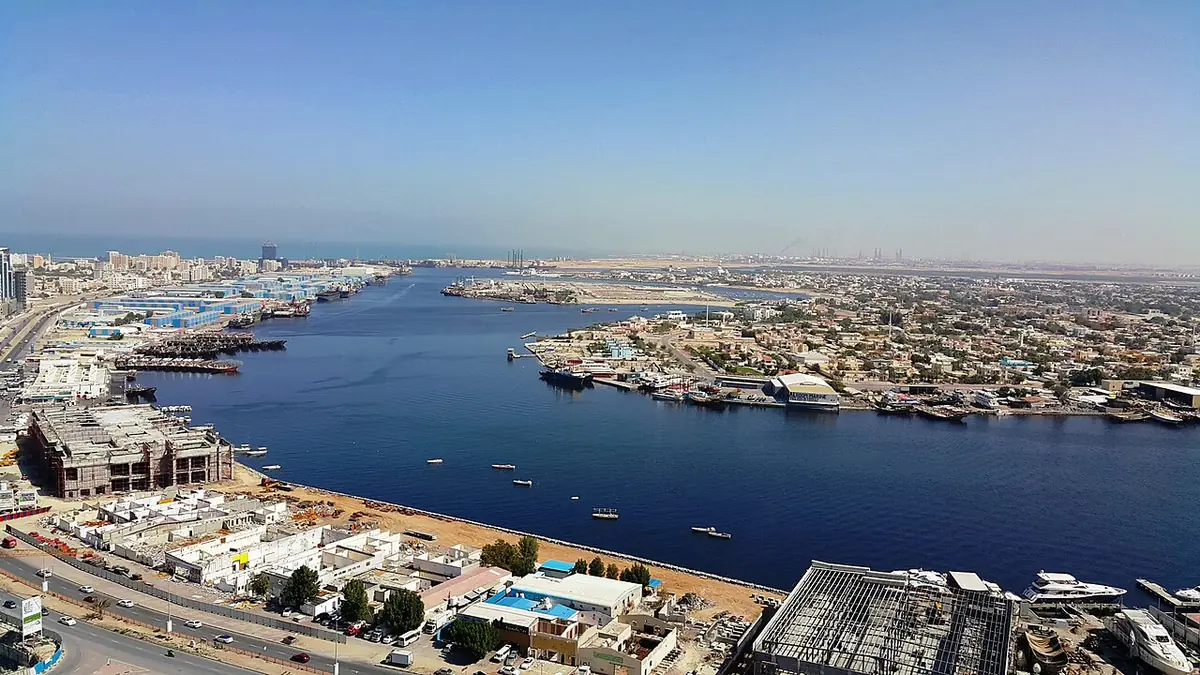
Ajman's waterfront at Al Rashidiya, marinas and low-rise buildings — Photo: pj soans · CC BY-SA 3.0 · Wikimedia Commons
Settling or investing from overseas means unlearning deeply held legal and planning assumptions. The Emirati market, and Ajman's in particular, works on its own rules of ownership, community management and landlord-tenant relations.
From abroad
A culture of older buildings and stone construction
Ajman
Contemporary architecture on recent foundations
Forget the constraints of renovating a historic centre. Everything here is recent, designed for air-conditioning and modern insulation — but assessing the developer's quality of finish becomes the critical part of your inspection.
From abroad
Shared ownership governed by detailed national statute
Ajman
Community governance under local regulators
Rules on common parts, service charges and recourse against a developer or owners' association follow specific codes worth studying before signing.
From abroad
Central public services and collective transport
Ajman
Urban organisation built entirely around the car
Daily life without a personal vehicle is effectively impossible in Ajman. Distances, the road layout and the absence of heavy public transport mean budgeting for two vehicles per household.
From abroad
Tightly regulated leases and rents
Ajman
Local decrees capping increases, within a more flexible contractual culture
There is protection, but it works differently, and it depends on registering the contract properly rather than on statute applying automatically.
Which part of Ajman should you target?
Ajman divides into residential zones with sharply differing profiles, from the historic coastal districts to the newer developments inland along the main routes. The right choice depends on more than the headline budget.
Al Rawda
An established residential area, popular with local families, with genuine neighbourhood life and local shops within walking distance.
Suits
Buyers wanting a spacious house in a mature setting with schools and services already in place.
Trade-off
The housing stock varies in age and design, so a rigorous technical inspection of the structure and installations is essential.
Al Jurf
An area in strategic transition, close to the major administrative, university and hospital complexes.
Suits
Those targeting stable rental income from healthcare professionals, teachers and families working in the local institutions.
Trade-off
A more institutional atmosphere, with heavier traffic around the opening hours of the offices and universities.
Emirates City and the periphery
Large villa and townhouse developments offering modern space, parks and organised gated communities.
Suits
Buyers wanting the comfort of new build, shared facilities and a planned environment.
Trade-off
Further from the coast and the established centre, with some infrastructure still filling in.
What does buying and owning a house here actually cost?
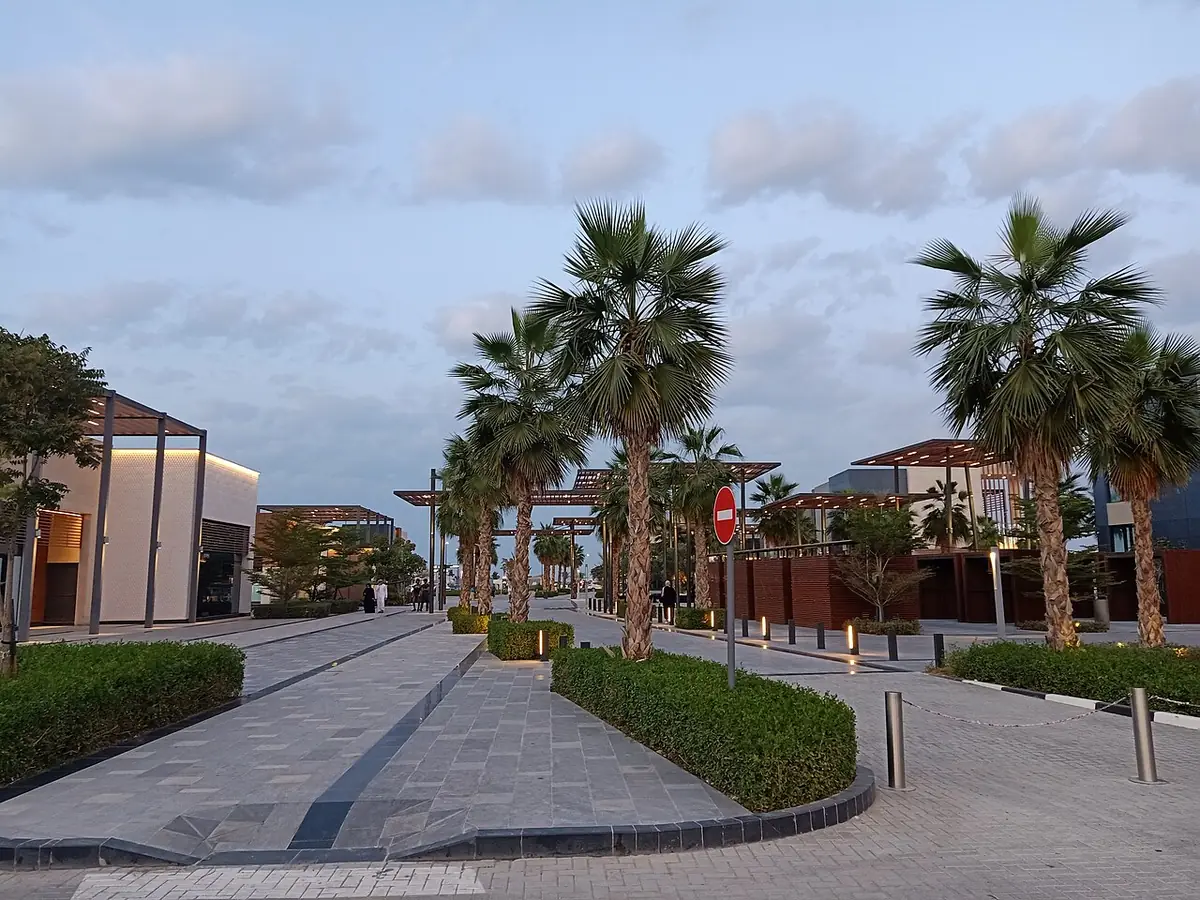
A palm-lined promenade for an evening walk in Ajman — Photo: Ayshamarjana · CC BY-SA 4.0 · Wikimedia Commons
Assessing the cost of a house in Ajman does not stop at the price in the developer's or agent's catalogue. The total acquisition budget includes transfer fees, brokerage and local notarial costs, plus provision for recurring charges. The price structure reflects the emirate's competitive advantage, while demanding absolute rigour in calculating the total cost of ownership over five to ten years.
ajmanFor saleHouseestimate
Median price / m²AED 5,064Half the apartments sell below this
Median priceAED 1.01mthe average is 14% higher — a few very large properties pull it up
Most common2 bedrooms59 % of listings
Average size189 m²
By number of bedrooms
Bedrooms
Share of market
Avg price
Price / m²
Avg size
2most common
59 %
AED 979k
AED 5,330
184 m²
3
32 %
AED 1.28m
AED 5,064
254 m²
4
9 %
AED 1.63m
AED 4,904best value / m²
333 m²
Each row is an average, compared against the area average of AED 5,330 / m². These are indicative estimates of a typical local market, not a measured sample of live listings. Check current listings before relying on them.
What you can actually own: freehold against usufruct
Tenure is the cornerstone of any successful property investment in the UAE. In Ajman, the regulatory framework allows foreign investors to acquire property, but it distinguishes clearly between freehold zones and the rest.
Freehold
In the zones designated freehold by the Ajman government, investors of any nationality acquire perpetual full ownership of the property and the land it stands on. The deed is registered directly with the Ajman Department of Land and Real Estate Regulation, giving complete title with no limit in time.
What it changesYou hold an asset that passes to your heirs under the applicable succession rules, with no fear of a lease expiring or your rights lapsing after a set number of years.
Leasehold
In other specific areas, buying a house can take the form of a long lease, generally ninety-nine years. You fully own the building and can let, sell or assign the lease, but the land belongs legally to a third party or to the state, and the clock starts running at the original signature.
What it changesEstablish how many years remain at the point you buy, because the discount on a property with a shortening lease becomes significant well before expiry.
The absolute rule before paying any deposit
The most frequent mistake overseas buyers make is transferring funds before verifying that regulated escrow accounts exist and are active. Whether buying off-plan from a developer or on the secondary market, the order of checks is what protects you.
Agreeing terms with the seller or developer.
Obtaining the official registration certificate for the property — the title deed, or Oqood for off-plan — confirming no hidden charge or mortgage sits over the structure.
Ensuring staged off-plan payments go exclusively into an escrow account approved by the central bank and the local regulator, and never into the developer's own commercial account.
Having an independent legal adviser validate every penalty clause covering late delivery or non-conforming finishes found at final inspection.
Paying the final balance only after keys are handed over and a completion report is signed with no major reservations.
Title registered, keys in hand.
How a transaction runs, step by step
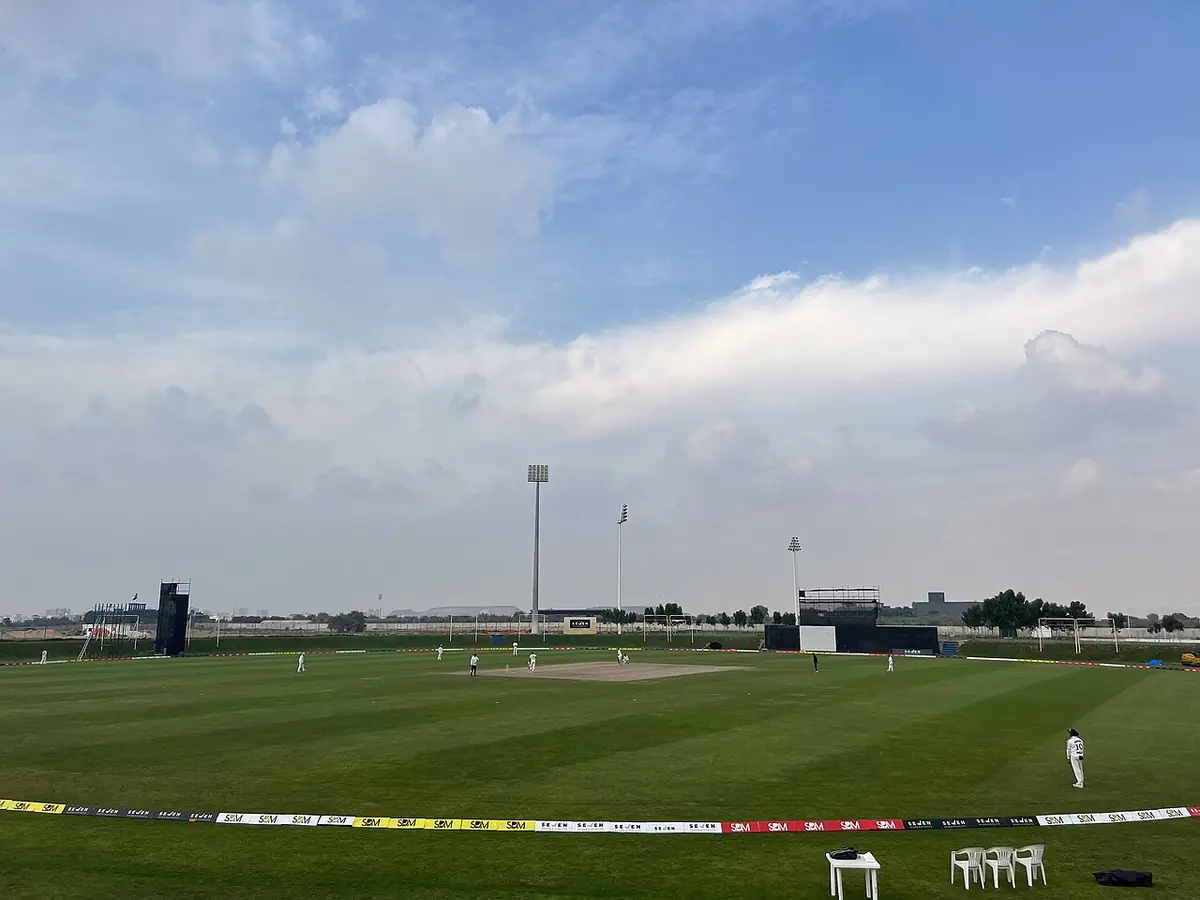
A green cricket ground in Ajman, open under a clear sky — Photo: JairamPJ · CC BY-SA 4.0 · Wikimedia Commons
A successful transaction in Ajman follows a methodical process marked out by the emirate's authorities. Knowing each stage and who is involved lets you keep control of the timetable.
The buyerSelecting the property and negotiating the MOUYou formalise your offer through a Memorandum of Understanding signed by both parties, setting the price, the transfer date and the reservation deposit, generally 10 per cent.
The licensed agent or brokerVerifying documents and standingThe broker or law firm confirms the title is valid and that there are no unpaid service charges or utility bills attached to the property.
The bank or escrow providerHolding the depositThe 10 per cent deposit is held in escrow pending satisfaction of the conditions and the administrative approvals needed for transfer.
Ajman land departmentProcessing and official valuationThe land services examine the file, may value the property and confirm the calculation of the statutory transfer fees.
Buyer and sellerCompletion and transfer of titleThe balance is paid, the transfer is registered and the new title is issued in the buyer's name.
House or apartment in Ajman: space against day-to-day management
Buying in Ajman means choosing quickly between the independence of a villa with a garden and the convenience of an apartment — two ways of living at opposite ends. A villa offers generous floor area, preserved privacy and no management fees at all, but it puts the entire burden of maintaining the roof, the façades and the outdoor space onto the owner. In a climate where permanent, aggressive air-conditioning attacks materials, that maintenance is not optional.
An apartment reverses the equation. Service charges of AED 3 to 7 per square foot cover the lifts, security, the pool and cleaning, and a management company handles everything beyond your front door. You give up private outdoor space and accept the building's rules on alterations and balcony use.
Liquidity differs too. Apartments near the Corniche and the central districts sell more readily, serving both local tenants and seasonal buyers. Villas address a narrower group of families, which lengthens the time to sell and widens the negotiating gap.
The honest test is how much you want to manage, and for how long. Settling with a family for years, the villa repays what it asks. Holding as an asset, or managing from abroad, the apartment does the job with far less involvement.
What budget do you really need to live in a house here?
Buying a house in Ajman does not stop at the sale price. You have to include registration with the land department, agency fees and the running costs this climate imposes.
Acquisition costs and initial fees
Cost
Rate or estimated amount
How it is paid
Land registration fee (Ajman Land Department)
2% to 4% of the property's value
Payable on the day the deed is signed
Estate agency fee
2% of the purchase price, excluding VAT
Due on completion of the transaction
Utility connection (FEWA)
Varies with size, around AED 2,000 to 5,000
One-off payment at move-in
Administrative and file fees
AED 1,000 to 3,000
Notarial and administrative validation costs
Acquisition costs generally come to between 5 and 7 per cent of the total price and must be settled in cash or by certified bank cheque.
Monthly running budget for a villa
Cost
Monthly range
What drives the variation
Electricity and cooling (FEWA)
AED 800 to 2,500
A pronounced peak through the summer months, June to September
Water and municipal services
AED 200 to 500
Depends on whether there is a pool and how much the garden is irrigated
Preventive maintenance (cooling, plumbing)
AED 300 to 700
An annual maintenance contract is strongly advisable
Home insurance
AED 100 to 300
The annual premium spread monthly, by reinstatement value
The electricity bill driven by air-conditioning is the most volatile line in the monthly budget and needs smoothing across the year.
An ordinary Tuesday living in Ajman
Living in Ajman means a particular daily rhythm, shaped by commuting towards Sharjah or Dubai and by how the local infrastructure works. To judge your future quality of life, picture the day itself.
06:30A residential district in Al HelioGetting the children ready and leaving early to avoid the first slowdowns on the link towards Sharjah and Al Ittihad Street.
07:30An international school in AjmanTraffic around the local campuses flows well compared with the chronic congestion in the larger neighbouring emirates, which makes the morning routine easier.
08:30Ajman Free Zone or the city centreSettling in for the working day. Many residents use the local co-working spaces or work remotely with regional companies.
13:00A local supermarket or Ajman City CentreFresh produce and a lunch break in one of the many neighbourhood restaurants serving varied international food.
17:00A sports club or the public park in Al RashidiyaTime to unwind at the end of the day in the emirate's landscaped green spaces, as the temperature starts to fall.
20:00HomeA quiet evening in a generally silent residential setting, away from the night-time tourist activity of the neighbouring cities.
What the brochures never tell you
Developers' marketing always presents Ajman at its most idyllic, deliberately leaving out technical and regulatory realities that make all the difference day to day.
What humidity and salt air do to building materials
Sitting directly on the Gulf, Ajman's coastal strip carries aggressive salinity that corrodes external metalwork, air-conditioning units and window frames quickly, unless anti-corrosion materials were specified from the start.
Which zones are genuinely open to freehold
Contrary to a common assumption, not every district in Ajman is open to freehold ownership for foreign nationals. Verify the exact nature of the title to be certain you are buying freehold and not a limited-term lease.
Unpredictable service charge increases in older buildings
In some older developments, the absence of a funded reserve leads to sudden exceptional levies for replacing lifts or renewing roof waterproofing.
Peak-hour congestion towards Sharjah
If you work in Dubai or central Sharjah, the morning bottleneck at the inter-emirate borders can turn a theoretical thirty-minute journey into something considerably longer and more tiring.
What owners discover six months after moving in
Looked likeModern, effective central air-conditioning, inspected in winter.
Turned outAn enormous electricity bill and recurring failures at the height of summer, when the system runs at full power around the clock.
Would have caught itInsist on a full technical assessment of the cooling system by an independent professional before handover, and check the energy rating of the equipment.
Looked likeA calm residential district offering an ideal setting free of disturbance.
Turned outConstruction starting suddenly on the vacant plots next door, bringing dust, early-morning noise and heavy lorry traffic for months.
Would have caught itConsult the municipal planning framework with Ajman municipality to identify what construction is planned around the plot.
Looked likeA verbal promise from the agent about extending the house or landscaping the garden easily.
Turned outStrict community or municipal restrictions prohibiting any external alteration without a specific permit obtained in advance.
Would have caught itHave every condition written into the reservation contract, and refuse to rely on an intermediary's verbal assurances.
Looked likeQuick, direct access to the main roads with no notable congestion.
Turned outComplete saturation of the slip roads at peak hours, adding thirty minutes to each leg of the commute.
Would have caught itDrive the route yourself at the exact times you would travel, on a weekday, before committing.
Who should not buy property in Ajman
Buying in Ajman has real advantages in yield and affordability against other emirates, but it does not suit every investor or resident.
A commuter dependent on public transport to reach Dubai
→To settle in Ajman expecting to make the daily journey without a car.
The inter-emirate public transport network remains limited and does not offer enough flexibility, which turns every daily journey into a time-consuming and exhausting exercise.
A speculative investor seeking a quick short-term gain
→To buy off-plan hoping to resell at a significant margin as soon as the structure is complete.
Ajman is a market for durable rental income and stable residential ownership, with more moderate liquidity than the highly speculative markets of Dubai.
Someone who needs constant nightlife and cultural activity
→To settle in an outer residential district of Ajman expecting the cultural and dining scene of a major city.
Ajman cultivates a family-oriented, peaceful atmosphere centred on residential calm, a long way from the fashionable districts and nightlife of the region's other hubs.
So are you ready to buy in Ajman?
Deciding to buy property in Ajman means separating the legitimate appeal of a more affordable market from the concrete reality of your own situation over the long term. If your plans run to several years of stability, you value the relative calm of an emirate on a human scale, and you have validated every incidental cost, buying here is an excellent way to secure an asset.
What it demands in return is rigour. Get the cooling system inspected independently, check the planning framework for the plots around you, verify that the title is genuinely freehold, and read the service charge history if you are buying into a managed development.
Ajman rewards buyers who arrive prepared and hold for the medium term. It punishes those who mistake a low price per square metre for a low total cost of ownership. If you can tell the two apart, this is a sound purchase.
Related questions
Can foreign nationals buy a house outright in Ajman?
Yes, in specific zones designated by the Ajman government. It is nonetheless essential to verify the exact nature of the title with the emirate's land department before making any firm commitment.
What registration fees apply?
Registration with the Ajman Land Department generally runs between 2 and 4 per cent of the property's total value, plus agency fees traditionally around 2 per cent of the purchase price excluding VAT.
How long does a transaction take?
For a completed property, the full process from signature to final transfer of title generally takes between two and four weeks, provided all the administrative documents are in order.
How do utilities work for a new owner?
Water and electricity are managed by the Federal Electricity and Water Authority (FEWA). A new owner applies for connection and transfer of the account with the sale contract and identification, paying a file fee and a deposit.
Can an expatriate get a mortgage?
Several local and international banks in the UAE offer mortgages to non-residents and foreign residents, generally covering a portion of the value subject to a larger deposit and evidence of income.
What are the total acquisition costs?
Generally between 5 and 7 per cent of the price, covering registration, agency fees, utility connection and administrative costs. They must be paid in cash or by certified bank cheque, not funded through the mortgage.
Which districts are most sought after for houses?
Al Rawda for its established family character, Al Jurf for proximity to the institutions, and the Emirates City developments for modern gated communities.
How much does air-conditioning cost to run in a villa?
Between AED 800 and 2,500 a month, peaking sharply from June to September. It is the most volatile line in the household budget and should be smoothed across the year.
Does salt air really affect coastal property?
Yes. The coastal strip carries aggressive salinity that corrodes external metalwork, air-conditioning units and window frames unless anti-corrosion materials were used from the start. It is worth checking at the inspection.
Can I extend the house after buying?
Only with a specific permit. Community rules and municipal regulations prohibit external alterations without prior approval, so never rely on a verbal assurance from an agent.