Buying an apartment in Houston takes a careful reading of the Texas market, the shape of the city and the rules that govern shared ownership. This guide sets out the trade-offs between neighborhoods, a realistic view of what the running costs come to, and the timeline of a transaction you can rely on.
Get the app
What nobody tells you.
Real prices, hidden costs and the traps to check before you commit.
What you actually get when you buy an apartment in Houston
Scroll
What you actually get when you buy an apartment in Houston
Buying an apartment in Houston takes a careful reading of the Texas market, the shape of the city and the rules that govern shared ownership. This guide sets out the trade-offs between neighborhoods, a realistic view of what the running costs come to, and the timeline of a transaction you can rely on.
Written by the ting.ad editorial team ·
Memorial Drive, Houston in Street View: drag to look around.
Beyond the raw floor area, daily life here depends heavily on who you are and on what you expect from work.
Buying an apartment in the Houston property market is not simply a purchase of living space. It means joining a vast urban fabric marked by the absence of traditional zoning and organized around enormous highway corridors. Buyers have to weigh what the promised floor area hides in terms of running costs, access and long-term build quality in a Texas metro area that keeps expanding.
More living space than the same budget buys in many long-established markets abroadvsAssociation dues that are often high because of the shared amenities
Buildings frequently come with pools, gyms and concierge services, and the cost of keeping them running weighs heavily on an owner's annual budget. That recurring charge has to be built into the return calculation from the start.
A sought-after central position in lively districts such as Midtown or DowntownvsDirect exposure to noise and to heavy car traffic
Living close to the centers of activity cuts commuting time but puts you in a hard-surfaced urban setting where the car is still everywhere, despite the efforts to make the core more walkable.
Immediate access to integrated, secure building servicesvsStrict homeowners association rules that limit what you can renovate
The rules govern the exterior appearance, short-term rentals and the kinds of work you are allowed to carry out, narrowing an owner's room to maneuver on their own property.
Which kind of buyer are you, set against the reality of Houston?
Moving from life elsewhere to the reality of Texas unsettles a great many cultural and practical assumptions.
Houston's urban structure forces stark trade-offs depending on your circumstances. Between the intensity of the business districts and the relative calm of the outer areas, an apartment does not answer the same needs. It is worth being honest about how much driving you can tolerate and how much space you need before you commit to a purchase.
Urban professional who wants to be close in
You put a drastic cut in travel time ahead of interior space. An apartment in the Medical Center or Midtown areas lets you reach work on foot or by public transport while enjoying the local culture and restaurants in the evening. The residential constraints then come down to managing parking and living with constant city noise.
Investor or frequent traveler
You are looking for a property that needs minimal upkeep and offers strong security guarantees while you are away. Managed residential towers with built-in services fit that need well, even though the fixed charges keep running when the home sits empty. Easy access and permanent security staff justify the outlay.
A family project looking for stability
Buying into a condominium calls for close attention to the quality of the local school infrastructure and to the size of the shared spaces. If you want a large yard and well-regarded public schools, a single-family house in the inner ring will suit you better. An apartment only makes sense here as a deliberate choice of dense, connected city living.
Living there when you arrive from abroad: what changes most in Houston
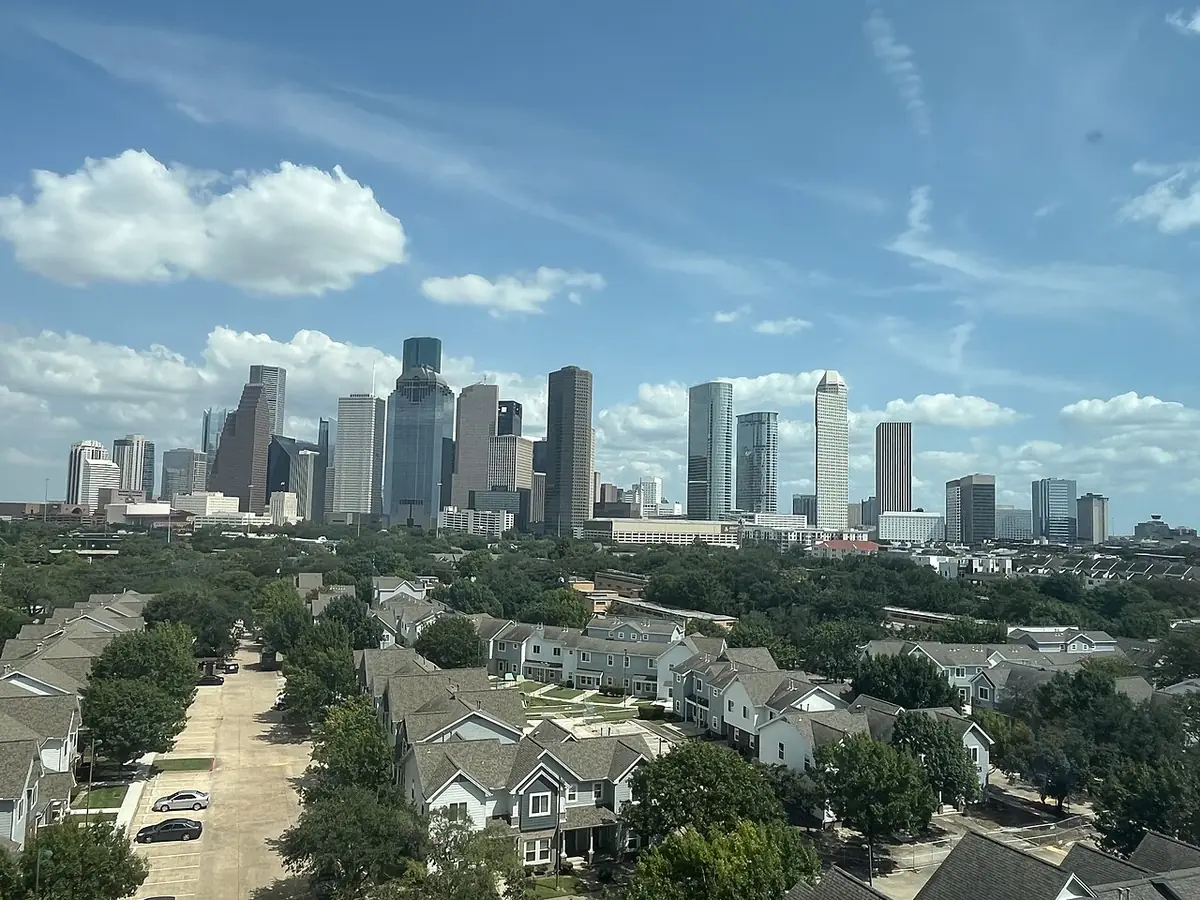
Houston's skyline seen past the rooftops of a nearby neighbourhood — Photo: JAFactsDude · CC0 · Wikimedia Commons
Once those differences are understood, the choice of neighborhood becomes the most decisive call in the whole investment.
A buyer arriving from abroad has to take apart the usual assumptions about housing. In Houston the car sets the scale of every distance, the local administration runs on shared-ownership rules that are very American in character, and the subtropical climate imposes technical choices you cannot avoid. This table sets out the fundamental differences between where you are coming from and where you are going.
From abroad
Walkable centers and everyday shops around the corner
Houston
A city organized around the automobile, with residential pockets ringed by major roads
You have to plan every daily trip and build the cost of a vehicle into your overall housing budget.
From abroad
Shared ownership governed by a strict statute that protects the co-owners
Houston
An HOA (homeowners association) with wide powers over the rules and over fines
The local HOA board holds considerable authority to impose aesthetic standards and to recover unpaid dues quickly.
From abroad
Collective central heating and thermal insulation set by building regulations
Houston
Powerful central air conditioning that is essential nine months a year, and variable energy bills
The building's energy performance and the state of the HVAC system decide your monthly electricity costs directly.
From abroad
A property market where a notary stands behind the legal security of every deed
Houston
A system of property titles validated by specialist insurance companies (title insurance)
Specialist agents and attorneys are needed to protect each transaction against hidden defects in the title.
Which Houston neighborhood should you target, given your priorities?
Looking at the different districts leads straight to the central question of budget and real costs.
Houston does not have a single center but an archipelago of neighborhoods with sharply distinct identities. From the cultural energy of the Museum District to the commercial ambitions of Uptown, each area offers a setting of its own. Weighing up liveliness, land cost and travel time is essential before you sign a purchase agreement.
Downtown
A very busy business district during the week that turns calm and residential at the weekend, crossed by the underground pedestrian network of the Tunnel.
Suits
Professionals who work in the big towers and want to cut their daily commute to nothing.
Trade-off
Limited nightlife outside the specific entertainment zones, and land costs among the highest in the city.
Midtown
A young, lively and well-connected area with plenty of restaurants and bars and a working population that favors walking and cycling.
Suits
People who want an active social life, easy reach of the METRORail lines and a relaxed urban atmosphere.
Trade-off
More noise, real density, and parking spaces that are often restricted or paid.
Medical Center / Museum District
A green, institutional setting shaped by a cluster of world-renowned hospitals and prestigious museums beside Hermann Park.
Suits
Health professionals, researchers and anyone who wants parks and cultural institutions within walking distance.
Trade-off
Strong pressure on property from the constant demand of medical sector staff, and rents trending upward.
Galleria / Uptown
An upmarket international retail hub dominated by office towers, luxury malls and high-end serviced residences.
Suits
Buyers looking for prestige, hotel-style services and direct access to international retail brands.
Trade-off
Chronic congestion at rush hour on the ring boulevards, and a setting that feels less authentically Texan.
What does buying and running an apartment in Houston really cost?
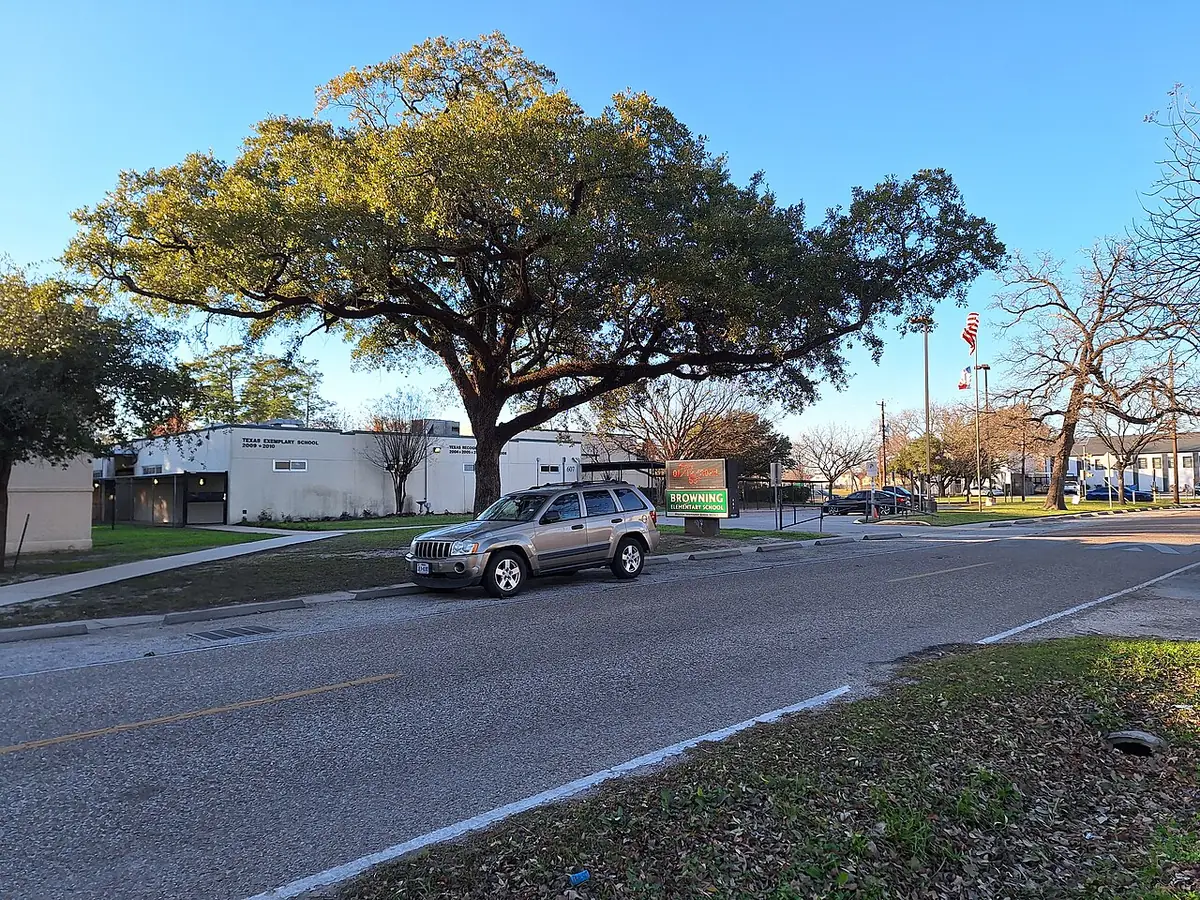
A shaded street in Houston, oak trees overhead — Photo: WhisperToMe · CC0 · Wikimedia Commons
Understanding the financial side opens up the crucial question of what you legally own.
Assessing the budget for a Houston purchase cannot stop at the headline price the agencies advertise. You have to include the local property tax, which is a significant annual line item in the United States, along with the monthly dues paid to the association for the upkeep of the common areas. The figures below set out the orders of magnitude seen in the current market.
houstonFor saleApartmentestimate
Median price / m²US$2,280Half the apartments sell below this
Median priceUS$230kthe average is 14% higher — a few very large properties pull it up
Most common2 bedrooms42 % of listings
Average size96 m²
By number of bedrooms
Bedrooms
Share of market
Avg price
Price / m²
Avg size
1
38 %
US$180k
US$2,640 +10 %
68 m²
2most common
42 %
US$240k
US$2,400
100 m²
3
17 %
US$305k
US$2,256 −6 %
135 m²
4
3 %
US$356k
US$2,160best value / m²
165 m²
Each row is an average, compared against the area average of US$2,400 / m². These are indicative estimates of a typical local market, not a measured sample of live listings. Check current listings before relying on them.
What you can actually own: shared ownership versus outright ownership
Once the legal framework is clear, the next thing to master is the order in which a Texas transaction unfolds.
Texas property law draws a sharp line between the forms of collective ownership. Buying an apartment in a tower or a residential complex means you share ownership of the land and the amenities with all the other residents through a legal entity. That reality redefines your rights of use and your financial obligations towards the community.
The condominium (condo) model
You own the interior of your unit privately and hold an undivided share of the common areas, administered by an elected board. Decisions on major maintenance, facade work or roof repairs are voted on collectively and funded through regular dues or special assessments.
What it changesYou get the practical burdens handled for you, but you remain exposed to the association's financial troubles if serious arrears build up inside the building.
The townhouse model under horizontal shared ownership
You buy the structure and the narrow parcel of land it sits on, while belonging to an owners association that manages the internal roads, the landscaping and the shared amenities of the development. The apparent architectural freedom is tempered by the association's strict design rules.
What it changesYou get a sense of residential independence close to that of a single-family house while accepting the collective constraints of the development's rules.
The legal and financial rule to understand before you put money down in Houston
A quiet garden path, a green pause in Houston — Photo: Safety Cap · CC BY 4.0 · Wikimedia Commons
To carry that sequence through, you need qualified professionals working in step.
Buying property in Texas rests on strict contractual mechanisms in which withdrawal periods and contingency clauses play a fundamental protective role. Ignoring those steps exposes a buyer to losing the earnest money outright if they walk away after the deadline. The order of the checks has to be followed rigorously.
Signing the earnest money contract and paying the deposit into a third-party escrow account.
Starting the option period, usually set at 7 to 10 days, in exchange for a modest fee that is non-refundable but credited back at closing.
Having a certified inspector carry out a thorough technical survey to identify hidden defects, the condition of the air conditioning and any risk of water intrusion.
Reading the association documents in full (the HOA resale certificate), including the financial reports, the minutes of meetings and any pending litigation.
Clearing the financing contingency with the bank or the mortgage broker.
Signing the transfer of ownership at closing and recording the deed with Harris County.
How a property transaction works in Houston, step by step
Buying property in the fourth largest city in the United States requires a formal process involving several intermediaries with clearly defined roles. From the first search to the handover of the keys, each party steps in at a precise moment to make the transaction valid. This timeline gives you a clear view of who is responsible for what.
The buyerSetting the budget and obtaining mortgage pre-approvalGoing to an American lender first confirms how much you can borrow and makes your offers credible in the eyes of sellers.
The real estate agent (Realtor)Selecting properties and viewing the shortlisted apartmentsYour representative uses the MLS (Multiple Listing Service) to find the opportunities that match your search criteria exactly.
The buyer and their agentDrafting and negotiating the purchase contractThe standard Texas Association of Realtors contract is filled in with the price, the inspection period and the financing terms.
The title companyTitle search and setting up title insuranceThe title officer checks that there are no hidden liens, undischarged mortgages or legal claims against the property.
The building inspectorDetailed technical visit and delivery of the inspection reportA close examination of the structure, the electrical installation and the plumbing gives you grounds to negotiate any corrective work.
The title companyFinal signing (closing) and public recordingThe funds are transferred, the documents are signed in front of a notary public, and the transfer of ownership is officially recorded.
Apartment or house in Houston: how do you choose for the way you live?
Now that the difference between a house and an apartment is clear, let us look at what buying in this large metro area actually costs.
In Houston the fundamental choice between a single-family house and an apartment in a condominium does not rest on taste or on the number of bedrooms alone. It bears directly on your daily life, given the phenomenal distances of the Texas metro area and the need to manage the weather. On one side, a single-family house in a residential neighborhood offers complete autonomy and undeniable private space, but it exposes you to the heavy upkeep of foundations and roofs while leaving you entirely dependent on the automobile. On the other, an apartment in a downtown tower or in one of the secure complexes around the Galleria removes the lawn and the outdoor air conditioning from your list of worries, while sharing the cost of the gym and the security.
The financial argument does not stop at the asking price shown on the listing portals either. Association dues, known as HOA fees in the United States, can be particularly steep in buildings with high-end services covering a concierge, pool maintenance and round-the-clock security. In return, those fees absorb unexpected costs that in a single-family house fall entirely on the owner when severe weather hits. So you have to weigh the peace of mind of collective management against the total control you keep over your own plot of land.
Location weighs heavily in that decision. Apartments cluster in the dense areas, along the major corridors and the transit lines, which sharply cuts the commute for office workers. Houses, by contrast, usually mean moving out towards the outer rings where green space is plentiful but where every evening or weekend errand turns into a driving expedition. Your choice should follow from an honest look at how much traffic you can stand and how much home maintenance you actually want to take on.
What overall budget do you need to settle in Houston for the long term?
Once the budget is under control, it is worth understanding what a typical day in the city actually looks like.
Buying a home in Houston never comes down to the amount borrowed from the bank in order to sign the deed. You have to factor in all the local property taxes, often higher than elsewhere because Texas levies no state income tax. The tables below set out the unavoidable cost lines so you can build a financing plan without nasty surprises.
Purchase price ranges by property type and area
Property type
Central area (Inner Loop)
Outer area (Outer Loop)
One-bedroom apartment
$200,000 to $350,000
$130,000 to $220,000
Family apartment, 2 to 3 bedrooms
$350,000 to $650,000
$220,000 to $380,000
Standard single-family house
$450,000 to $900,000
$280,000 to $500,000
Prices vary widely with the quality of the school district attached to the property and the age of the building.
Estimated recurring monthly and annual costs
Cost line
Estimated average amount
Payment frequency
Property tax
2.2% to 2.8% of the value
Annual
Association dues (HOA)
$250 to $700
Monthly
Homeowner insurance
$150 to $350
Monthly
Property tax depends precisely on the municipality and the school district the parcel falls under.
Health, schools, getting around: what does an ordinary Tuesday in Houston look like?
A community garden where Houstonians grow their own vegetables — Photo: Safety Cap · CC BY 4.0 · Wikimedia Commons
Behind the marketing brochures and the handsome agency photographs, some crucial details deserve your full attention.
Living in Houston means dealing with heavy traffic flows and a city built entirely around the automobile. To choose the right area to buy in, you need to look at how smoothly your morning journey to work runs, and at your access to the top-tier health facilities that give the city its worldwide reputation.
07:30Leaving home and setting off by carJoining the major highways such as Interstate 610 or the I-10 at the morning peak.
08:15Dropping the children at the local schoolThe choice of independent school district directly determines the reputation and the future value of the property.
09:00Arriving at work in the business corridorWhether it is Downtown, the Galleria or the Texas Medical Center, parking is a monthly cost you cannot ignore.
12:30Lunch break and errands close byQuick access to the local malls and supermarkets for the week's shopping.
17:30The trip home and the trafficThe congested window, where knowing your route and using the HOV lanes really pays off.
19:00Back at the building and time to unwindEnjoying the shared spaces of the condominium, or the quiet of your own plot, well away from the working day.
What property listings will never tell you about Houston
Knowing about those blind spots is what keeps you clear of the classic traps that catch inexperienced buyers.
Sales copy leads with the light, the modern finishes and the closeness to the lively districts. What it leaves out are structural and climate realities specific to the Houston area that can turn your investment into a permanent source of stress if you ignore them.
Flood risk and the FEMA zone
Many parcels in Houston sit in a flood zone, which forces you to buy expensive specialist insurance and can affect resale over the long term.
The history of foundations built on clay
The region's clay soil shrinks and swells with the seasons, frequently causing major structural cracks that need five-figure repairs.
Strict homeowners association (HOA) rules
Some condominiums and subdivisions impose severe restrictions on exterior paint colors, where vehicles may be parked and short-term rentals.
Hidden wear in the air conditioning systems
Run at full power for half the year, air conditioning compressors have a limited life and a full replacement is a heavy financial hit.
The mistakes you only discover six months after moving in
Even with all those precautions, some buyers should simply stay out of this market.
Looked likeA quick daily commute on paper, thanks to a fine open highway at the weekend.
Turned outA daily two-hour nightmare in rush-hour traffic because of permanent roadworks on the main routes.
Would have caught itDrive your commute at the exact peak hours on a Tuesday or a Thursday before you sign the offer for good.
Looked likeA moderate electricity bill, thanks to recent equipment and a well-insulated home.
Turned outEnormous summer bills just to keep the place breathable through the Texas heat waves.
Would have caught itAsk for the last twelve months of energy bills and check how well the attic is insulated.
Looked likeA quiet, peaceful neighborhood with no particular noise problems.
Turned outBeing right under a flight path or next to rail freight yards that are very busy at night.
Would have caught itVisit the area at different times of the day and night to find the noise sources that stay hidden on a first look.
Looked likeStable association dues that would not move for several years.
Turned outA sharp increase voted at a general meeting to pay for urgent roof or pool repairs.
Would have caught itRead the minutes of the last three general meetings to spot the work that has been approved or deferred.
Who really should not buy property in Houston right now?
It is time to pull all of these factors together so you can make your final decision with a clear head.
Buying is never a universal obligation, least of all in a fast-growing city like Houston where job mobility and market swings call for real flexibility. Here are the profiles for whom buying immediately is an unreasonable financial risk.
The young professional on a temporary assignment or changing careers
→Flexible renting rather than buying
The transaction costs on the way in and on the way out swallow any potential gain if you sell before a minimum of five years.
The investor with no appetite for climate and regulatory risk
The steady rise in home insurance premiums and the constraints of local regulation weigh heavily on the net return.
The household without enough savings to absorb the unexpected
→Staying in a rental while building a cash reserve
Having no cash available to replace a failed air conditioning unit or to repair foundations can lead straight to foreclosure.
So, are you ready to go ahead with your property plans in Houston?
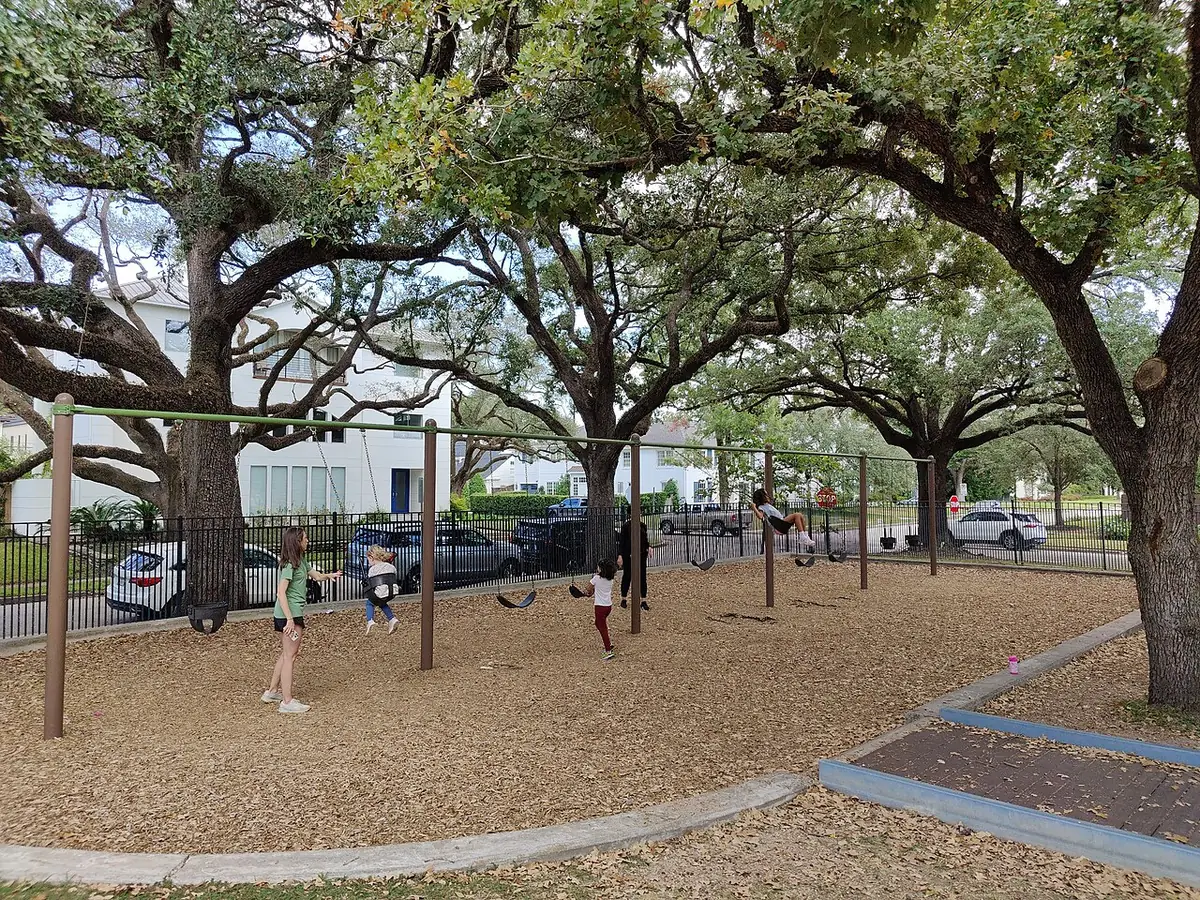
A shaded playground, popular with Houston families — Photo: EvanCarroll · CC BY-SA 4.0 · Wikimedia Commons
Getting to the end of this analysis shows that your approach to buying in Houston goes well beyond falling for a pretty apartment. You now hold what you need to read the financial reality, anticipate the transport constraints and gauge the risks that come with the Texas climate. Buying an apartment or a house in this large metro area does not forgive guesswork: it demands careful preparation, a long view and a genuine match between your finances and what is really on the ground.
If your income comfortably covers high property taxes and insurance, if your working life looks settled for the next five years, and if you have accepted that you will be driving everywhere, then the lights are green. Take the time to view several properties with an independent agent, insist on every technical document relating to the association or to the foundations, and never give in to the marketing pressure some sellers try to create.
Your investment in the Houston area should above all secure a good life for you and the people close to you, while protecting your financial peace of mind. Work through it methodically and every dollar invested becomes a durable asset in the heart of Texas. Putting practical reason ahead of instant emotion is what will make your move a success.
Related questions
What is the average property tax bill in Houston?
Property tax generally runs between 2.2% and 2.8% of the assessed value of the home, depending on the school district and the exact municipality. It is a major annual expense and belongs in your overall monthly budget from the very first calculation.
Do you really need a car to live in Houston?
Yes. Houston is an extremely spread-out city built around the automobile. Even though a few very central neighborhoods have sidewalks and some public transport, owning a vehicle remains essential for the great majority of everyday trips.
What are HOA dues in the United States?
HOAs (homeowners associations) are owner bodies that run the common areas, the security and the upkeep of condominium buildings or subdivisions. They collect compulsory monthly dues, and the amount can rise depending on how the membership votes.
Is flooding a real risk for property in Houston?
Some parts of the metro area are genuinely exposed to flooding during heavy tropical storms. Checking the official FEMA maps and the history of the site is essential before you sign anything.
How long does it take to complete a purchase?
The full process, from acceptance of the offer through to the final signing at closing with the title company, usually takes between 30 and 45 days. That window allows for thorough technical inspections and for the mortgage financing to be confirmed.
Can a foreign investor buy in Houston?
Yes. International investors can acquire property in Texas with no major restriction based on nationality, provided they meet lenders' down payment requirements and comply with local tax obligations.
What is the Inner Loop in Houston?
The Inner Loop is the central area bounded by Interstate 610. It is the most built-up part of the city, holding the most sought-after neighborhoods, the cultural offering and the highest prices per m2 in the metro area.
How do school districts (ISDs) work in Houston?
American public education is tied to geographic areas called independent school districts. The reputation of these districts has a direct and lasting effect on the value of homes inside their boundaries.
What should you watch for with house foundations?
Houston's clay soil reacts strongly to changes in moisture, which can weaken concrete slabs. A careful inspection by a foundation specialist is essential if you want to avoid enormous repair bills after the purchase.
What does air conditioning do to the maintenance budget?
Because of the heat and humidity of Houston's intense subtropical climate, air conditioning systems run hard for much of the year. Regular servicing and eventual replacement are an unavoidable line in the budget.
Property review of ting
No ting properties in Houston yet
Be the first — share it on ting and it shows up right here.