Buying an apartment in Houston means understanding the reality of a fast-moving market shaped by the economic expansion of Texas. This guide sets out the criteria that matter, from choosing a neighbourhood to the legal and financial specifics of local condominium ownership, so you can make your purchase decision with clear eyes.
Get the app
What nobody tells you.
Real prices, hidden costs and the traps to check before you commit.
What you actually get when you buy an apartment in Houston
Scroll
What you actually get when you buy an apartment in Houston
Buying an apartment in Houston means understanding the reality of a fast-moving market shaped by the economic expansion of Texas. This guide sets out the criteria that matter, from choosing a neighbourhood to the legal and financial specifics of local condominium ownership, so you can make your purchase decision with clear eyes.
Written by the ting.ad editorial team ·
Memorial Drive, Houston in Street View: drag to look around.
Beyond the raw market figures, your day to day as an occupier or an investor depends above all on how you live.
Buying an apartment in the Texas metro area does not come down to a simple equation of floor area and price per square metre. Buyers quickly discover that the real value of a home is measured by how well it absorbs urban expansion and how resilient its building services are under a subtropical climate. Between older condominium buildings near the centre and newer developments on the inner edge, the market rewards anyone willing to dissect what each neighbourhood genuinely offers. That means separating the promise of a lively urban lifestyle from the administrative and financial reality of local carrying costs, which are easy to underestimate from overseas.
Generous living space and modern fittings comparable to international standardsvsHigh HOA fees that cover the upkeep of shared facilities and central air conditioning
The apparent square footage often hides significant recurring costs tied to running the common areas, the pools and security in gated communities.
A central location that keeps daily driving times downvsUrban density that removes residential quiet and exposes you to traffic noise from the city's major road corridors
Choosing proximity to the business districts means accepting a permanent trade-off between getting to work easily and the quality of your immediate surroundings.
Capital growth potential driven by the steady population growth of Harris CountyvsDirect exposure to local economic swings and to the property rules specific to Texas
The Texas property market rests on a fragile balance between people arriving and heavy construction, which is why each area needs to be looked at closely on its own terms.
Does this urban environment fit the way you usually live?
That daily reality is a clean break from the way many other cities are laid out.
Houston is organised around several centres rather than one, and the car remains the core of everyday mobility. Prospective buyers need to weigh how much driving they can tolerate against how much they need shops and services within walking distance. Every buyer profile meets a different mix of constraints and advantages depending on the neighbourhood chosen and the kind of condominium they are aiming for.
The resident who wants services built in
Condominium buildings with a concierge desk, a gym and pools answer that need for immediate comfort very well. You hand over the management of the grounds and of security entirely. In return you have to accept the strict framework of the association rules and regular fees that often track the rising cost of those services.
The long-term and rental investor
Being close to the major hospitals of the Medical Center or to the technology hubs guarantees steady demand from qualified professionals. Your strategy should favour newer buildings with secure parking spaces and reliable connectivity. Vacancy stays low as long as your asking rent lines up with what the building actually offers.
The newcomer adjusting culturally
The Texas way of life is radically different when it comes to walking, cycling and pedestrian public space. You will quickly have to accept that a personal vehicle is absolutely necessary for daily errands, even for basic shopping. The relative isolation of some residential areas can surprise newcomers who have not prepared for it.
Living here when you are arriving from abroad: what really changes
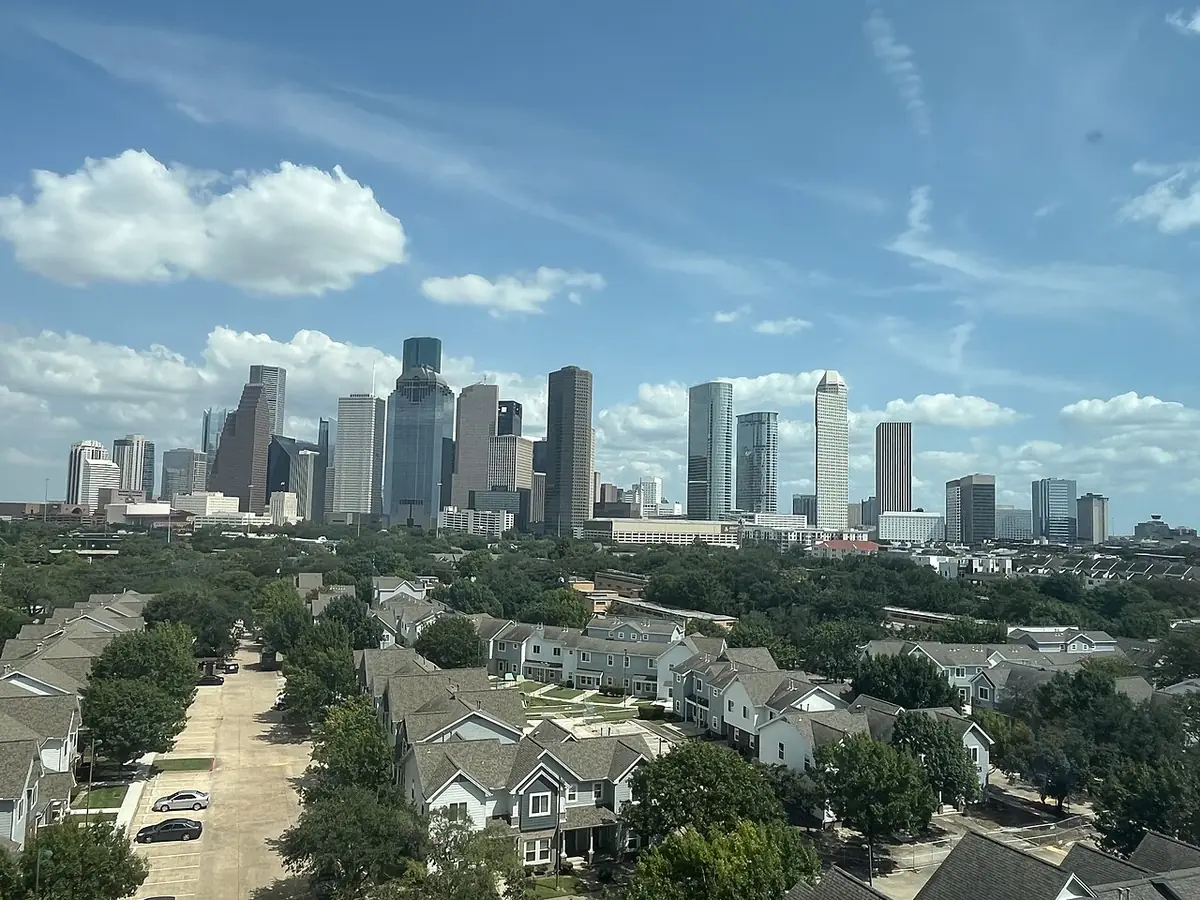
Houston's skyline seen past the rooftops of a nearby neighbourhood — Photo: JAFactsDude · CC0 · Wikimedia Commons
To set your project up properly, identifying the right area is the decisive step.
Moving from most other property markets to the Texas one means unlearning some legal and cultural habits. The very notion of ownership, the local tax burden and the structure of recurring charges are all profoundly different. Understanding those mechanics before you sign a purchase contract will save you serious financial surprises when the deal completes.
From abroad
A market framed by strict planning rules and strong tenant protections
Houston
Local regulation built around homeowners association (HOA) rules and freedom of contract
You have a great deal of freedom over the interior, but you must follow to the letter the community rules imposed by the owners association.
From abroad
High one-off purchase costs, including transfer taxes and registration
Houston
High local property taxes payable every year
The long-run cost of ownership weighs more heavily on the annual budget than the initial purchase does, which changes how you calculate the return on your investment.
From abroad
A building run by a professional managing agent overseen by an owners committee
Houston
Management often handled by professional firms appointed by very active resident boards
How quickly maintenance work gets done can vary considerably from one building to another depending on how involved the resident owners are.
From abroad
Dense, walkable historic centres with shops on the doorstep
Houston
Spread-out development where shops are grouped into retail zones or on the ground floor of large complexes
Your daily radius is redefined entirely around using a car and planning your trips.
Which Houston neighbourhood to target, given your priorities
Once you have picked an area, looking at how prices and charges are structured is what confirms whether the purchase stacks up financially.
Houston's geography is built around concentric loops and major arteries that define the identity of each area. From the cultural energy of Montrose to the financial bustle of the Galleria, each zone strikes its own balance between access, prestige and quality of life. Your choice should line up precisely with your work commitments and how much city activity you want around you.
The Galleria / Uptown
A very dense business and retail hub, busy from morning to night with a working, international population.
Suits
Investors looking for strong rental liquidity and professionals who want to be near corporate headquarters.
Trade-off
Particularly heavy traffic at peak hours and a hard-surfaced environment that does not invite walking.
Montrose / Museum District
A more residential area with its own character, marked by tree-lined streets, art galleries and a mix of architecture.
Suits
Those after a culturally rich setting, with cafes and restaurants within walking distance.
Trade-off
An older housing stock that often means budgeting for renovation and bringing things up to current standards.
Downtown Houston
The institutional and financial heart of the city, defined by its imposing towers and its underground pedestrian network (the Tunnels).
Suits
People working in banking or law who want to eliminate the commute entirely.
Trade-off
Activity drops off sharply at weekends and in the evening outside the specific entertainment districts.
What does an apartment in Houston really cost?
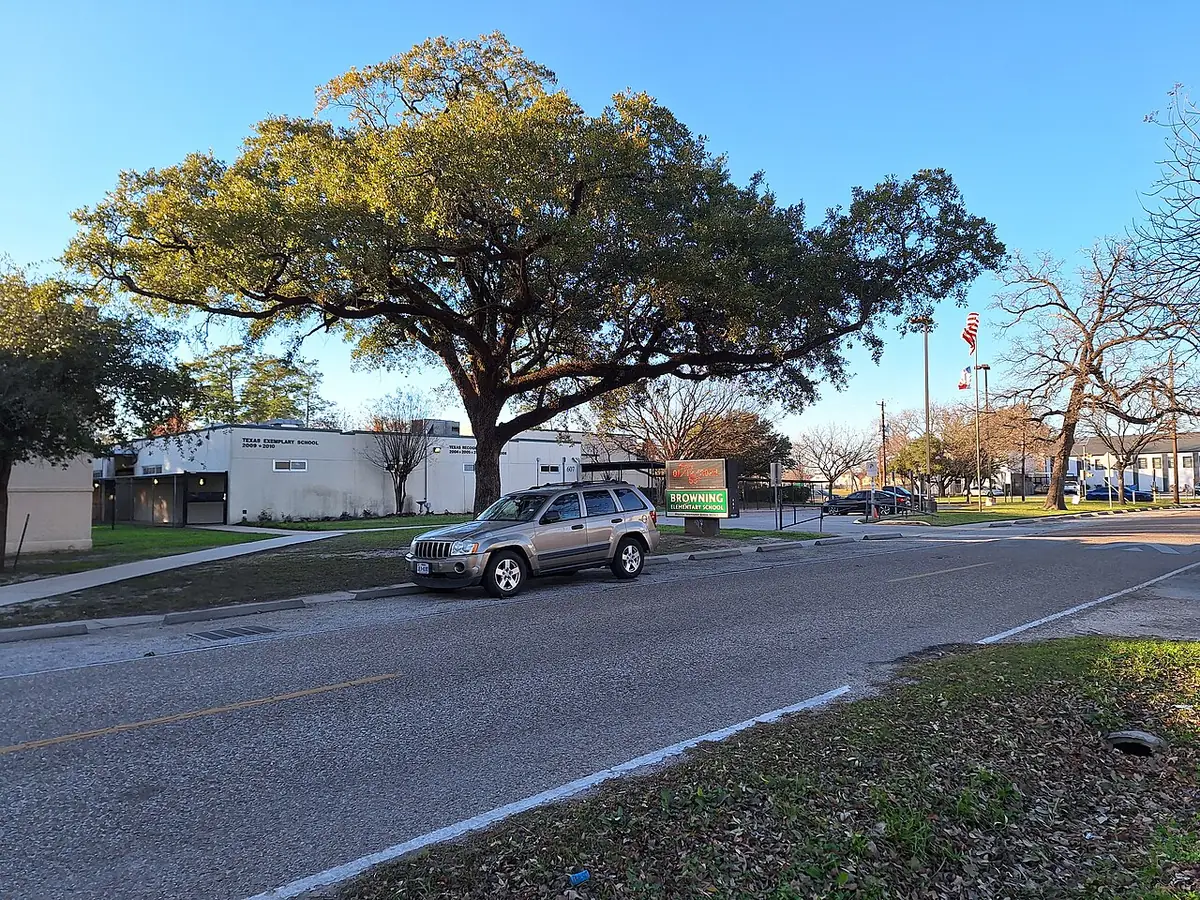
A shaded street in Houston, oak trees overhead — Photo: WhisperToMe · CC0 · Wikimedia Commons
Beyond the price tag, the legal structure of your ownership deserves particular attention.
The Houston property market shows considerable price spreads depending on the precise location, the age of the construction and the quality of the services included in the condominium. The market data reflects a varied supply, running from a functional studio in a 1980s building to a high-end penthouse in a recent tower. Your financing plan needs to account not only for the purchase price but also for local property taxes and monthly association fees.
houstonFor saleApartmentestimate
Median price / m²US$2,280Half the apartments sell below this
Median priceUS$230kthe average is 14% higher — a few very large properties pull it up
Most common2 bedrooms42 % of listings
Average size96 m²
By number of bedrooms
Bedrooms
Share of market
Avg price
Price / m²
Avg size
1
38 %
US$180k
US$2,640 +10 %
68 m²
2most common
42 %
US$240k
US$2,400
100 m²
3
17 %
US$305k
US$2,256 −6 %
135 m²
4
3 %
US$356k
US$2,160best value / m²
165 m²
Each row is an average, compared against the area average of US$2,400 / m². These are indicative estimates of a typical local market, not a measured sample of live listings. Check current listings before relying on them.
What you can actually own: condominium title and restrictions
Making your transaction safe means following the local administrative steps rigorously.
Buying an apartment in Texas comes with a specific legal framework set by state law and by the internal rules of the condominium. Contrary to a simplistic view of outright ownership, those rules can impose strict constraints on how the home is used, on short-term letting and even on interior alterations. Knowing what you are buying in legal terms protects you from unpleasant surprises after completion.
Outright ownership of your unit plus a share of the common areas
You own the private space defined by the recorded deed, together with an undivided share of the land and of the building's shared equipment. The homeowners association (HOA) holds wide regulatory power to vote budgets for major works, set the house rules and recover unpaid fees.
What it changesYou must go through the association's accounts and the minutes of its recent meetings to spot any heavy unfunded works or ongoing disputes.
Use restrictions and limits on letting
Many Houston condominiums apply strict caps on the percentage of units that may be rented out relative to owner-occupied homes. Some ban short-term platform lettings outright in order to protect the peace of permanent residents.
What it changesIf your strategy depends on furnished short-term letting, get written confirmation that no restrictive clause exists in the association rules before you commit.
The one rule to understand before you put money down
A quiet garden path, a green pause in Houston — Photo: Safety Cap · CC BY 4.0 · Wikimedia Commons
That precise timeline sits inside a well-established procedure worth following step by step.
Buying property in Texas runs on very strict standard contracts in which the earnest money deposit plays a central role from the moment your offer is accepted. Understanding the sequence of contract conditions and the role of the escrow agent (the title company) is what stops you losing your deposit if you have to walk away for good reason.
Signing the offer to purchase once the seller has accepted it
Paying the earnest money deposit (typically 1% to 2% of the purchase price) to the designated title company.
Opening the inspection window (the option period), a negotiated 7 to 10 days during which you can walk away from the contract for any reason at all.
Having a thorough technical inspection carried out by an independent certified inspector.
Clearing the financing condition and getting the lender's appraisal signed off.
Final signature of the deed of sale and transfer of funds by secure wire
How a transaction unfolds, step by step
Seeing a Houston purchase through requires coordinating several professionals: the real estate agent, the mortgage broker, the home inspector and the title company. Each plays a part at a precise moment to make the transaction safe and to guarantee that the transfer of ownership is legally sound. Knowing how that fits together lets you keep control of the timeline.
The buyerSetting the budget and obtaining mortgage pre-approvalThis essential first step shows the seller that you are serious and demonstrates what you can genuinely afford.
The real estate agentShortlisting homes and drafting the offer (the earnest money contract)The standard Texas contract protects both sides while setting out precisely the deadlines and the conditions that must be met.
The home inspectorCarrying out the inspection of the building and the unitA detailed report sets out the condition of the air conditioning, the plumbing, the electrics and the structure of the apartment.
The title companyRunning the title search and confirming there are no liensIn Texas the title company gives the legal guarantee that the home is sold free of any prior debt or claim.
The lender and the title companyFinal underwriting of the loan file and signing at closingThe funds are released and the transfer deed is officially recorded with the Harris County offices.
Apartment or single-family house in Houston: how to decide
Once the type of home is settled, the question of the overall budget comes into sharp focus.
In Houston the housing question sits between two very distinct urban and geographical realities. On one side, single-family houses with a yard and a garage stretch as far as the eye can see across a metro area defined by sprawl with no clear topographical limits. Buying a house here means looking after a roof structure and a roof covering that tropical storms put through their paces, plus your own plot of land, while enjoying a considerable amount of living space at a price per square metre often below that of the large American coastal metros. On the other side, condominium apartments, found mainly as condos in the towers of the Galleria or Midtown, or as newer attached townhomes in the central neighbourhoods, offer a radically different alternative built around shared costs and less time spent on outdoor chores.
Choosing an apartment in Houston means budgeting for a fixed cost that many overseas buyers do not see coming: the association charges known as HOA fees. These monthly contributions cover maintenance of the common areas, security that is often staffed around the clock, the pool and sometimes even the building's exterior insurance. In some upmarket buildings in River Oaks or Upper Kirby, those fees can amount to a substantial budget line on top of the local property tax, which remains an unavoidable expense in Texas given that the state levies no income tax. Opting for a single-family house removes those shared charges but transfers the entire financial responsibility for heavy repairs, such as replacing the central air conditioning, which is essential under the Texas subtropical climate, or restoring foundations on clay soils prone to movement.
Location largely dictates whether an apartment or a house makes more sense. If your working day takes you to the Central Business District or to the Uptown business district, buying an apartment or a townhome near the major corridors such as Interstate 610 or the I-10 lets you partly escape commutes that often stretch over tens of kilometres. If instead you are looking for residential quiet and proximity to well-regarded schools, the inner suburban neighbourhoods such as Bellaire or the wooded areas of Kingwood and The Woodlands almost naturally push you towards a single-family house, where life revolves around the neighbourhood and the local parks.
Finally, liquidity and future resale are a decisive criterion in this decision. Single-family houses in sought-after school zones generally hold their value and attract a steady pool of buyers when the time comes to sell. Condominium apartments, although much in demand from young professionals and from investors chasing a rental yield, can see sharper market swings depending on the financial health of the association and on how the reserve funds are managed by the volunteer or professional board. Assessing the financial soundness of the building before you sign is therefore an absolute precaution for anyone buying an apartment in Houston.
What overall budget do you need to buy and live in Houston?
Beyond the raw figures, daily life in a Houston apartment is measured by getting around and by the rhythms of the local day.
Buying an apartment in Houston does not stop at the figure written on the purchase contract. The Texas tax system leans heavily on local property tax, while association fees and storm-specific insurance weigh on the annual budget year after year. To avoid a financial shock, work through every recurring cash outflow before you commit. The figures below summarise the orders of magnitude seen in the current residential market.
Upfront and recurring cost lines for an apartment in Houston
Cost line
Estimated range (USD)
Frequency and impact on the owner
Median purchase price (apartment/condo)
$200,000 - $450,000
Principal amount of the loan or the initial cash contribution.
Property tax
2.2% - 3.1% of assessed value per year
Paid annually to the county (Harris County) and to the school entities.
Homeowners association fees (HOA fees)
$300 - $850 per month
Paid monthly for maintenance and shared amenities.
Home insurance (condo/HOA policy)
$1,200 - $2,500 per year
Covers the interior, the contents and personal liability.
Property tax rates vary precisely with the school district and any special municipal utility districts (MUDs) attached to the land.
Running costs and household services
Type of service
Average monthly budget
Contextual notes
Electricity and air conditioning (HVAC)
$150 - $350
Strongly seasonal in summer because of heavy air conditioning use.
Water, sewerage and waste
$60 - $110
Billed municipally and handled directly by the City of Houston.
High-speed internet and connections
$70 - $110
Essential for working from home in residential areas.
Routine maintenance and repairs
$100 - $250
A contingency fund for small interior fittings and appliances.
Because the Texas energy market is deregulated, your choice of electricity supplier directly affects the monthly bill.
Health, transport and amenities: an ordinary Tuesday in Houston
A community garden where Houstonians grow their own vegetables — Photo: Safety Cap · CC BY 4.0 · Wikimedia Commons
Practicalities and budgets are easy enough to plan, but some fundamentals of the Houston property market never make it into the sales brochures.
Getting a feel for life in Houston means walking through an ordinary day, paced by commuting and by access to healthcare and services. Between traffic flows on the big freeway corridors and the proximity of world-renowned medical centres, every part of the day has its own logistics. This hour-by-hour account shows the reality experienced by residents living in the central neighbourhoods of the Texas metro area.
07:30 - Morning departureCentral residential neighbourhood (Midtown / Museum District)Leaving the building's secure parking garage. Traffic is already building on Highway 59, so journey times to work need planning ahead.
09:00 - Errands and adminLocal service centre and neighbourhood shopsA quick stop at a convenience store or a supermarket such as H-E-B for everyday shopping. Retail is usually less than ten minutes away by car from the larger condominium complexes.
12:30 - Work breakBusiness district (Downtown or the Texas Medical Center)You are in one of the largest employment hubs in the state. The lunch break is when you find out how well the light rail links (METRORail) work for getting around inside the city.
16:30 - Health and preventionNear the Texas Medical CenterHaving the largest medical complex in the world nearby guarantees immediate access to advanced care if you need it, a substantial argument that underpins property values in the surrounding area.
18:30 - Home and downtimeCondominium with built-in amenitiesParking in your assigned garage space. Using the building's pool or gym, facilities that matter for offsetting a largely sedentary, urban routine.
20:30 - Evening in the neighbourhoodRestaurants and social spaces in the walkable districtsAn evening out on foot in busy areas such as Montrose or The Heights, showing that pockets of walkable city life do exist despite how central the car is to Texas life.
What the sales brochures do not tell you about Houston
These blind spots explain why some buyers sour on their purchase within months of getting the keys.
The Houston property market has regulatory and climatic quirks that online listings consistently smooth over. Between the absence of traditional strict zoning, the complexity of managing flood risk and the construction specifics of tall buildings, a careful buyer has to dig below the surface. Here are the main points any serious buyer should examine closely before signing anything.
The absence of conventional zoning
Houston is the only major American city without traditional planning zoning. That means an empty lot next to your apartment can, more or less overnight, take a retail complex or a high-rise, radically changing your view, your daylight and the traffic around you.
Flood history and floodplains
Extreme weather and tropical storms are a regular reminder that large parts of Harris County sit in flood-prone areas. Checking the official FEMA map and the building's claims history is essential if you want to avoid punishing insurance premiums.
The financial health of the association's reserve fund
A building with unusually low monthly fees is often one that has failed to plan for major works. If the roof or the foundations need serious repair, owners will have to pay special assessments that can be very heavy indeed.
The strict rules in the condominium covenants (CC&Rs)
Buying a condominium apartment means submitting to rules that can be severe about short-term letting, keeping large pets, or making cosmetic changes to the facade and the balcony.
What buyers in Houston regret six months in
Given these structural risks, it is just as important to be clear about which buyers this market simply does not suit.
Looked likeAn ideal central location that would avoid the daily jams on the major road corridors.
Turned outConstant noise from the elevated freeways and from adjacent construction sites that start at dawn.
Would have caught itVisiting the property at different times of day, particularly on a weekday at peak hours, and checking the building permits filed with the city.
Looked likeModerate association fees giving access to a large outdoor pool and a full fitness room.
Turned outA unilateral 20% increase in fees voted at a general meeting to cope with rising insurance premiums and the upkeep of ageing equipment.
Would have caught itInsisting on the minutes of the last three owners meetings so you can see the history of increases and how the building is being managed.
Looked likeA reassuring purchase in a modern building with impeccable finishes and an attractive exterior.
Turned outDefective thermal insulation producing punishing summer air conditioning bills and recurring water ingress during heavy thunderstorms.
Would have caught itAppointing an independent Texas-certified home inspector to run a thermal survey and a rigorous check of the building envelope.
Looked likeA high-yield rental investment aimed at senior professionals working in the energy industries.
Turned outA prolonged rental void caused by an oversupply of similar new developments delivered at the same time in the same area.
Would have caught itStudying the macroeconomic data for the local rental market and looking at the real absorption rate of new condominium developments in the neighbourhood.
Who this purchase suits, and who should walk away in Houston
Now is the moment to lay the groundwork for your final decision by weighing all of this calmly.
The Houston residential market runs on very specific economic and geographical logic that rules out certain buyers outright. Trying to settle here without accepting the climate, tax and planning constraints leads inevitably to a financial dead end or to real day-to-day discomfort. The profiles below show where the mismatch with this market is obvious.
The overseas investor looking for passive, low-risk management similar to a bank product
→Passes on buying an apartment in Houston
The complexity of managing from a distance, combined with the demands of local property taxes and the unpredictability of American condominium associations, makes the net yield too uncertain for a risk-averse profile.
The first-time buyer on a tight budget who cannot absorb any unplanned expense beyond the mortgage
→Turns to renting or to another market
The absence of any cap on property tax in Texas and the volatility of association fees directly threaten the budget of a household without a solid contingency fund.
The city dweller who relies exclusively on walking, cycling and car-free travel
→Rules out the outer neighbourhoods of Houston for good
The sheer scale of the sprawl and the thin public transport network outside the city centre make daily use of a personal vehicle essential for the most basic errands.
So, are you ready to take the step in Houston?
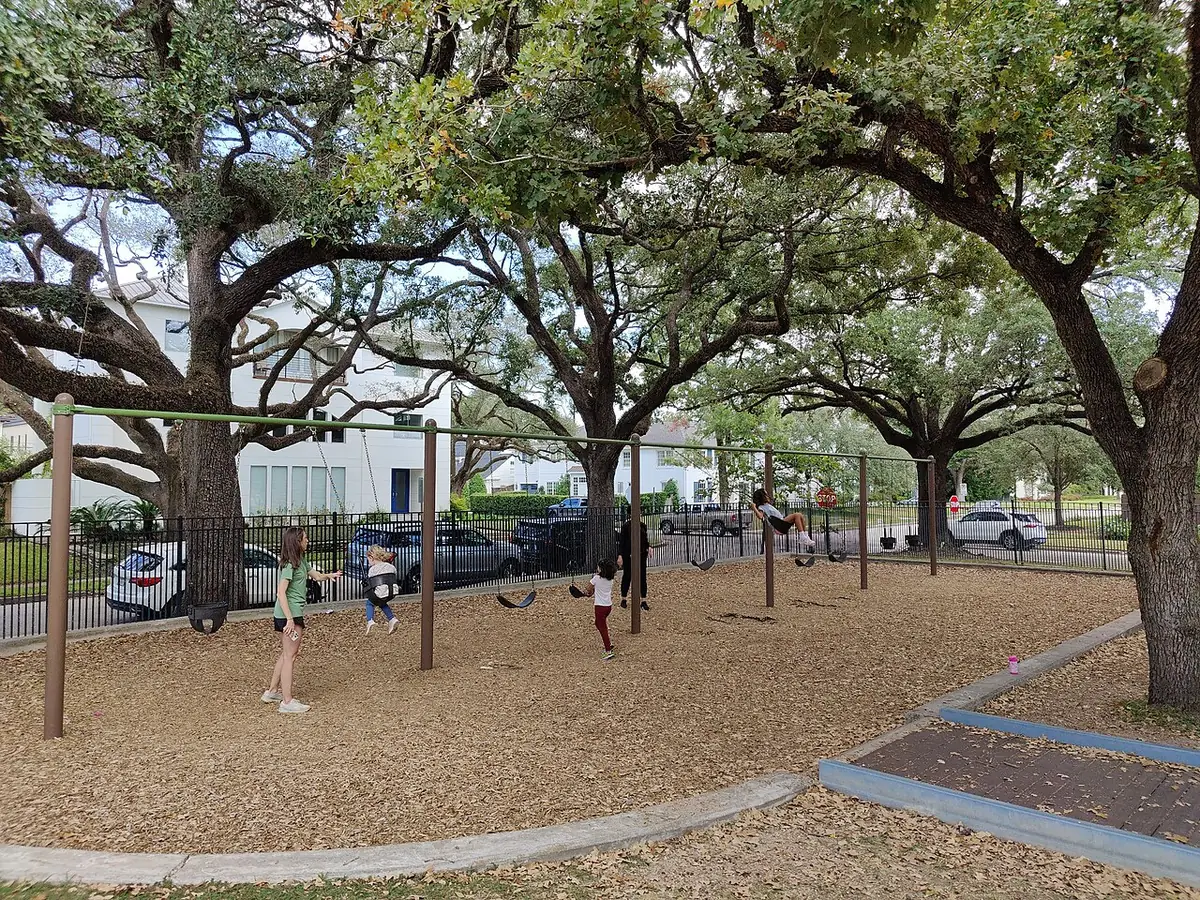
A shaded playground, popular with Houston families — Photo: EvanCarroll · CC BY-SA 4.0 · Wikimedia Commons
Deciding to buy an apartment or a house in Houston means getting past the initial excitement of prices per square metre that look attractive next to other large metros. The Texas market follows its own rules, where local taxation and the absence of traditional zoning demand attention at every step. If you have taken the measure of the property taxes, accepted that air conditioning has to work in every season and made peace with the constraints of sprawl, then your project rests on a solid, clear-eyed footing.
A successful purchase in Houston depends on the fit between your investment horizon and how you actually live. Planning to settle here for less than five years carries obvious financial risk given the transaction and transfer costs involved. For a medium or long-term plan, on the other hand, putting down roots in a well-connected neighbourhood, in a financially sound and rigorously managed condominium, is a coherent strategy in one of the most dynamic urban economies in the southern United States.
Take the time to view several homes at different hours, insist on seeing the association's financial records, and surround yourself with independent professionals, from a specialist local agent through to a certified home inspector. The Houston property market rewards careful preparation and punishes impulse. Your purchase should be the product of cool, structured calculation, one that secures your investment and keeps your daily life in Texas calm.
Related questions
How much property tax does an apartment in Houston typically carry?
Property tax in Houston generally runs between 2.2% and 3.1% of the assessed value of the home per year. The rate varies with the school district and the additional levies charged by local entities within Harris County.
Do you need a car if you live in an apartment in Houston?
Yes. In the great majority of Houston neighbourhoods a personal vehicle is essential. A few central areas are served by light rail and bus links, but the sprawl of the metro area makes getting around on foot or by bike very difficult day to day.
How do homeowners association (HOA) fees work in Houston?
HOA fees are paid monthly by owners to cover maintenance of the common areas, security, the building's exterior insurance and sometimes certain shared services. They vary widely depending on how upmarket the building is.
What does it mean that Houston has no zoning?
Houston is the only major city in the United States without a traditional zoning plan. Land use is not strictly separated by district, which allows commercial and residential uses to sit side by side.
What flood risks should be checked before buying?
Because of its flat topography and subtropical climate, Houston is exposed to flooding during severe thunderstorms and tropical storms. Consulting the official FEMA flood maps before any purchase is essential.
How does the energy market affect an owner's budget in Houston?
Because the Texas electricity market is deregulated, owners choose their own supplier. Heavy air conditioning use through the summer months produces a noticeable rise in monthly energy bills that needs to be planned for.
Is it easy to resell a condominium apartment in Houston?
How liquid an apartment is depends closely on where the building sits, how soundly it is run financially, and the state of the rental market. Homes in central, busy neighbourhoods generally resell faster.
What should be checked during the building inspection?
It is strongly advised to hire a Texas-certified home inspector to examine the structure, the roof, the air conditioning system (HVAC) and the weather-tightness of the apartment in detail before you release your contract conditions.
How do you choose the right neighbourhood to buy an apartment in Houston?
The choice depends on your work priorities, how much commuting you will tolerate, and how close you want to be to medical or cultural facilities. Areas such as Midtown, The Heights and the Galleria offer very different atmospheres and amenities.
Should you budget for emergency repairs in a condominium?
Yes. Even in a condominium where the structural work is handled collectively, the owner needs a dedicated reserve for interior repairs, appliance replacement and any special assessments that may be levied.
Property review of ting
No ting properties in Houston yet
Be the first — share it on ting and it shows up right here.