Buying a home in the Houston metro area calls for a clear grasp of its sheer geographic scale, its local tax structure and its contract rules. This guide sets out the trade-offs between space, location and logistics that decide whether the purchase works for you.
Get the app
What nobody tells you.
Real prices, hidden costs and the traps to check before you commit.
Buying a house in Houston: the reality of distance and space
Scroll
Buying a house in Houston: the reality of distance and space
Buying a home in the Houston metro area calls for a clear grasp of its sheer geographic scale, its local tax structure and its contract rules. This guide sets out the trade-offs between space, location and logistics that decide whether the purchase works for you.
Written by the ting.ad editorial team ·
Memorial Drive, Houston in Street View: drag to look around.
Understanding that spatial structure is what lets you judge whether your daily life really fits the rhythm of this metro area.
Buying a house in the Texas metro completely resets what surface area and location mean compared with tighter markets elsewhere. Unlike ultra-squeezed cities where every square metre carries a premium, Houston spreads across a vast urban canvas that keeps expanding. That access to space, however, comes with logistical and environmental trade-offs that deserve a cold reading before you commit. Between the promise of a large lot and the reality of daily driving times, the balancing act never stops. This first look sets the groundwork for an informed decision, built on how this enormous conurbation is actually laid out.
Substantial living space and generously sized private lotsvsComplete dependence on a car for even the smallest daily errand
Houston's urban form rests on a degree of sprawl with few parallels. Getting four bedrooms and a tree-shaded yard almost always means moving away from the walkable pockets of activity and accepting long road trips to reach the employment centres.
No strict traditional zoning, which allows flexible use of landvsThe possibility of a shop or a warehouse opening right next to your home
Houston's municipal framework does not separate residential and commercial zones the way most large cities do. That quirk grants real architectural freedom, but it demands extra care when you pick your micro-neighbourhood.
A powerful economy resting on several different sectorsvsDirect exposure to the cyclical swings of local industry and to the region's weather
The local housing market mirrors the vitality of the Texas economy, driven by energy, healthcare and aerospace. That prosperity comes alongside vulnerability to major storms and the rising cost of home insurance around the Gulf of Mexico.
Does Houston fit your way of life and your working plans?
Moving from an outside perspective to the Texas reality means measuring precisely which practical and cultural breaks are waiting for you.
Choosing where to buy in Houston depends far less on the prestige of an address than on the fit between your habits and the geography of the place. Buyers split according to how much commuting they can tolerate and how attached they are to urban or suburban living. Each situation carries its own compromises on location, local taxes and access to schools or cultural amenities. It is worth mapping your own trajectory before you fix a search area. Here is how the main buyer profiles line up against the reality of the Texas market.
The suburban family buyer
Buyers who prioritise space and large school campuses naturally look to the outlying counties or to structured suburbs such as Sugar Land or The Woodlands. That choice delivers roomy detached houses, secure lots and built-in community amenities. In return, your budget has to absorb local property taxes that are often high, and you have to accept long peak-hour commutes into the business core.
The inner-city buyer
Choosing inner neighbourhoods such as Montrose, the Heights or Midtown changes the Houston experience entirely. You get walkable street life, independent coffee shops and a varied cultural offering. The compromise sits in a much less favourable space-to-price ratio: for the budget that buys a large outer-suburb house, you get something more compact, sometimes in a low-rise shared development, with a lot cut back to almost nothing but with valuable centrality.
The investor or the mobile expat
For international buyers, the priority is often how easily the home resells in the medium term and how close it sits to the big technology or medical hubs such as the Texas Medical Center. Neighbourhoods near West University or Bellaire meet that liquidity requirement. The main constraint here is fierce competition in those sought-after pockets, where well-positioned homes go quickly and you need to be financially ready from the first viewing.
Buying here when you arrive from abroad: what changes most in daily life
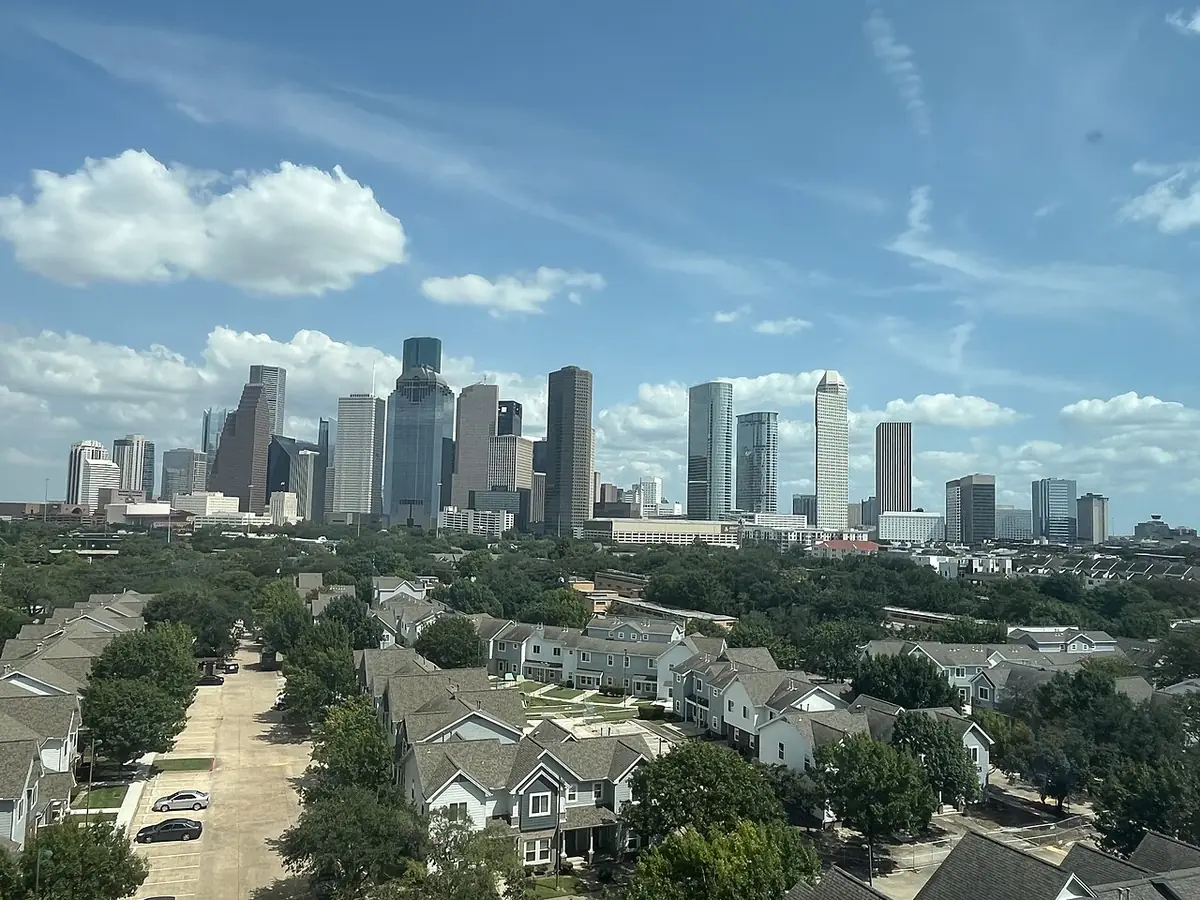
Houston's skyline seen past the rooftops of a nearby neighbourhood — Photo: JAFactsDude · CC0 · Wikimedia Commons
Once those reference points settle, the precise question of where to buy within the vast metro area becomes central.
Moving to Houston from overseas is a considerable cultural and logistical leap. Your sense of distance, the public services you rely on and your relationship with your home all shift within the first few weeks. What felt obvious in a compact European or Asian city, such as walking to buy groceries or stepping onto a dense transit network, gives way to a model built on car autonomy and enormous infrastructure. Reading those gaps in advance is what prevents disappointment after the move and lets you plan your new household properly.
From abroad
Services concentrated close by, with everything reachable on foot or by public transport
Houston
Massive urban sprawl and the need to use a car for essentially every trip
Your monthly transport budget has to cover buying, maintaining and insuring vehicles suited to Texas distances, while accepting travel times you cannot compress.
From abroad
Tight regulation of new construction and protective zoning around historic centres
Houston
Local architectural flexibility and the absence of a rigid land-use plan
Be extremely careful when buying a plot or an older house, because the immediate surroundings of your parcel can change quickly at the initiative of private owners.
From abroad
Universal healthcare funded through pooled social contributions
Houston
A very high-performing medical system built entirely around private insurance and employer plans
You cannot assess your overall cost of living without folding in health insurance premiums, which weigh heavily on a household's annual budget.
From abroad
Modest building service charges and older stone or brick construction
Houston
Homeowners associations almost everywhere and timber-framed structures that need regular upkeep
The cost of owning a house includes mandatory association dues and climate-driven maintenance specific to the intense Texas summers.
Which neighbourhood should you target, given your priorities and your budget?
Beyond geography, a rigorous look at the financial structure and local taxes is what confirms whether the purchase is feasible.
The Houston metro is not one homogeneous housing market but an archipelago of areas with radically different identities and dynamics. Picking a location means choosing between the cultural energy of the inner city, the leafy calm of the established suburbs and the functional efficiency of newer developments. Each zone brings its own local tax rates, school quality and travel times to the main employment centres. Here is a comparison of the major options to guide your purchase.
The Heights & Montrose
An urban village feel, walkable in places, dotted with coffee shops, art galleries and renovated older houses.
Suits
Buyers who want a rich cultural life, real architectural character and close proximity to the business districts.
Trade-off
Prices per square metre among the highest in the city, small lots, and very sharp competition for homes with character.
Sugar Land & The Woodlands
An orderly, green environment built around family life, landscaped parks and large integrated shopping centres.
Suits
Families with children who want strong public school districts and the quiet of large, secure residential areas.
Trade-off
A clear geographic distance from central Houston, which produces long daily journeys at peak hours.
Bellaire & West University
Comfortable, quiet residential enclaves, ideally placed between the main boulevards and the medical district.
Suits
Healthcare professionals, senior executives and households looking for an upmarket compromise between centrality and calm.
Trade-off
An extremely selective market, marked by the routine teardown of older houses to put up expensive modern builds.
What does a home really cost, and what are the extra fees?
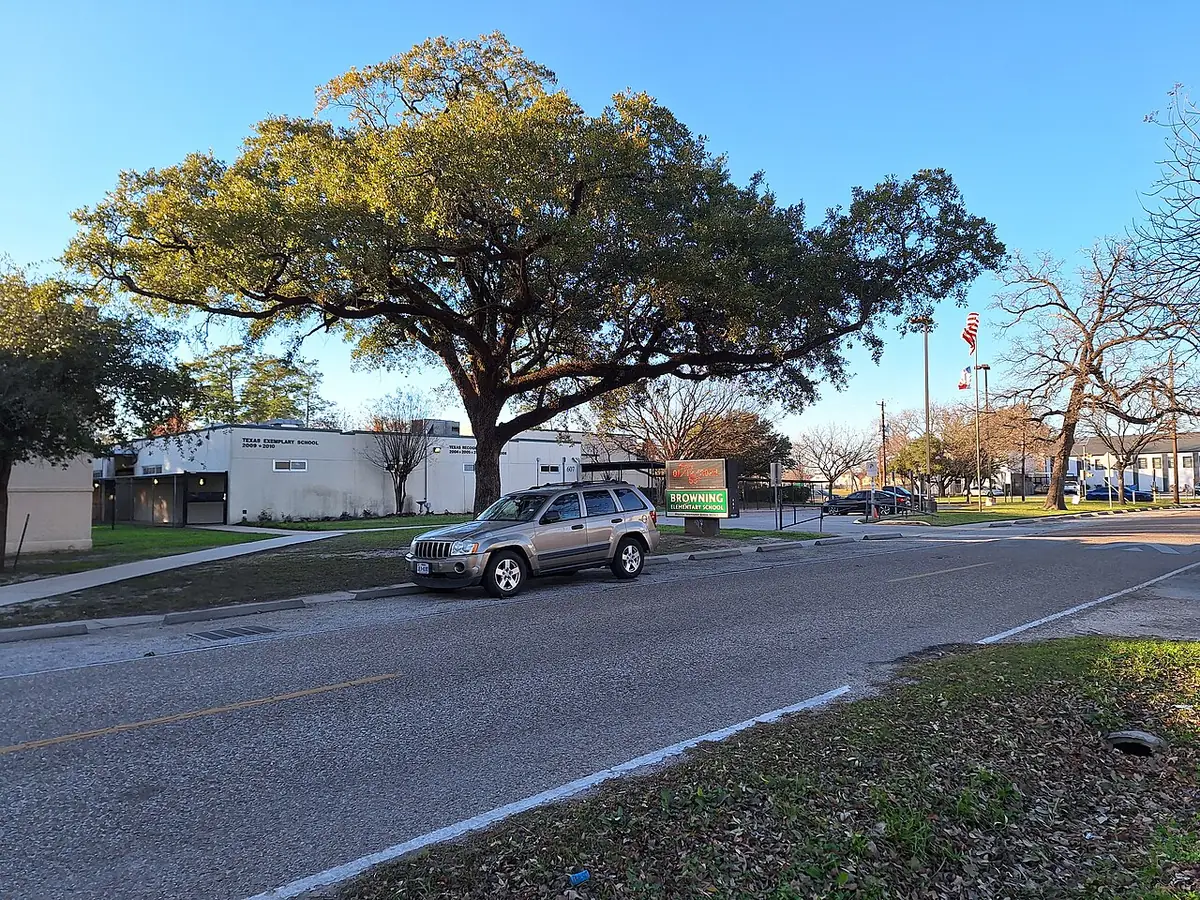
A shaded street in Houston, oak trees overhead — Photo: WhisperToMe · CC0 · Wikimedia Commons
That financial picture brings into focus exactly which ownership rights and title you are actually acquiring.
Buying a house in Houston is not just the price shown on the listing portals. The Texas tax system leans heavily on local property tax, because the state levies no income tax. As a result, the long-term cost of ownership varies widely from one area to another depending on school levies and municipal taxes. On top of that, home insurance premiums have moved noticeably because of regional weather risk. The table below sets out the orders of magnitude you have to build into your financing plan.
houstonFor saleHouseestimate
Median price / m²US$1,870Half the apartments sell below this
Median priceUS$331kthe average is 14% higher — a few very large properties pull it up
Most common2 bedrooms68 % of listings
Average size168 m²
By number of bedrooms
Bedrooms
Share of market
Avg price
Price / m²
Avg size
2most common
68 %
US$344k
US$1,968
175 m²
3
27 %
US$437k
US$1,850 −6 %
236 m²
4
5 %
US$511k
US$1,771best value / m²
289 m²
Each row is an average, compared against the area average of US$1,968 / m². These are indicative estimates of a typical local market, not a measured sample of live listings. Check current listings before relying on them.
What you actually own: understanding a Texas property title
Those legal points sit inside a rigorous transaction process that is worth mastering before you hand over any deposit.
Buying property in Texas confers robust legal rights, but they are framed by specific local rules, notably on mineral rights and neighbourhood associations. Unlike jurisdictions where full ownership takes in everything below the surface, Texas law frequently separates the surface from the resources underneath. Separately, subdivisions run by associations with wide powers materially change your freedom to alter the outside of your home. Reading those two dimensions closely saves you from major legal surprises after closing.
The split between surface rights and mineral rights
In many Texas transactions, the rights to extract what lies beneath the ground (oil, gas or minerals) were severed from the surface title over the decades. It is common for the owner of the land not to hold the subsurface rights, which can mean access easements for a third party who does hold them.
What it changesA title company and a careful review of the historic deeds are essential to pin down exactly what is included in your purchase.
The role and the power of homeowners associations (HOAs)
Almost every recent subdivision and planned community in Houston is governed by a homeowners association. These bodies impose strict rules on exterior appearance, where vehicles may be parked, fence heights and the range of colours permitted on the front of your house.
What it changesRead and accept the full set of HOA rules before you commit, or you may find severe restrictions on any plan to alter your own property.
The legal and financial rule to understand before you put money down
A quiet garden path, a green pause in Houston — Photo: Safety Cap · CC BY 4.0 · Wikimedia Commons
With those administrative steps clear, the full chronology of the transaction falls into place.
Texas real estate law rests on standardised contract procedures that are extremely strict on deadlines and deposits. When you make an offer, the financial commitment takes the form of a good-faith deposit held in escrow by a neutral company. Understanding the option period and the termination clauses in detail is the best protection your money has. One misstep in the sequence of contingencies can cost you your initial deposit outright.
Drafting the formal written offer (the earnest money contract) through your licensed agent.
Paying the earnest money deposit into an escrow account held by the title company, within the strict deadlines the contract sets.
Opening the inspection window (the option period), during which you are buying the discretionary right to walk away for a modest fee.
Commissioning the specialist inspections (structure, roof, foundations, any damp or termite activity) from certified professionals.
Clearing the financing contingency once the lender has given final approval on your loan file.
The final signing (closing) and the official transfer of title into your name.
How a property transaction unfolds in Houston, step by step
Completing a purchase in the Houston metro means coordinating several specialists whose roles are tightly defined by local law. There is no notary figure in the transaction as some markets know it: the title company is what centralises all the legal and financial checks. Knowing the order in which each party acts lets you steer the process calmly and efficiently. Here is the full operational sequence, from the first viewing to the handover of keys.
The buyer and their real estate agentSelecting properties and running a comparative market analysisDefining the target area precisely, viewing selectively and analysing recent comparable sales so the offer matches what the market is actually doing.
The title companyHolding the funds in escrow and running a full title searchAn exhaustive search through public records to confirm there are no hidden liens, debts or disputed easements attached to the parcel.
The independent home inspectorA thorough technical inspection of the structure and the systemsA detailed look at the framing, the concrete slab foundation, the plumbing and the air conditioning systems that are essential in the Texas climate.
The lender and the mortgage brokerFinal underwriting of the loan file and putting insurance in placeVerifying income, obtaining an independent appraisal of the property and setting up the required hazard and homeowners insurance policies.
All parties at the closing tableFinal signing (closing) and public recording of the deedSigning the deed documents, wiring the remaining funds and officially recording the new title with the county.
House or condo in Houston: weighing independence against collective management
With that residential framework in place, the overall budget question becomes the immediate next step in the purchase.
Buying in Houston forces an early choice between a detached house, usually sitting on its own lot, and life in a shared development, whether that is an apartment in a high-rise or a unit in a shared residential complex. The decision is not only about lifestyle or the number of rooms; it commits you to a long-term view of maintenance, flexibility and recurring costs. In this fast-expanding Texas metro, the detached house dominates the suburban landscape and offers complete freedom over structural changes, outdoor landscaping and the absence of anyone sharing a wall with you. That independence, however, is paid for with full responsibility for maintaining the building, from the roof down to the clay-borne foundations so characteristic of the region, which take the strain of extreme weather swings between drought and heavy rain.
Buying into a condo in Houston, by contrast, whether in lively areas such as Midtown, Downtown or along the Galleria corridor, shifts the burden of day-to-day management onto a collective body, usually an owners association. The associated monthly charges, commonly called HOA dues or condo fees, generally cover upkeep of the shared areas, security, access to amenities such as a pool or a gym, and sometimes the exterior insurance and the roof. For a busy buyer, a young professional or an investor wanting a base with no yard work or exterior maintenance, that arrangement is genuinely attractive. The flip side is accepting the community's strict rules, which can restrict short-term letting, dictate how balconies may look, or require one-off levies, known as special assessments, when major work is needed on the building.
Financially, resale value follows different logic depending on which type of property you choose in the Houston area. Detached houses in well-regarded school zones or close to the big employment centres have historically seen steady appreciation, supported by the relative scarcity of land in the central neighbourhoods. Condos, on the other hand, can offer a cheaper entry point into central locations that would be out of reach as a house, but their resale depends closely on the overall financial health of the association and how well it has managed its reserves. A prospective buyer therefore has to weigh, on one side, their appetite for hands-on repairs and project management and, on the other, their tolerance for the regulatory and financial constraints of an association, before settling on one of these two Texas housing models.
What overall budget and recurring costs should you plan for in Houston?
Beyond the purely financial side, daily life in Houston is organised around infrastructure worth examining closely.
Buying a house in Houston is not limited to the asking price on the listing portals. A household's financial balance depends on folding in local property taxes, which are often high because Texas levies no state income tax, and on home insurance costs that have risen sharply after recent weather events. Planning for these lines from day one protects a buyer against nasty budget surprises and keeps the purchase sustainable in the Texas market.
Annual and monthly running costs for a house in Houston
Cost item
Estimated amount or range
Frequency
Effect on the budget
Property tax
1.8% to 2.8% of assessed value
Annual
Varies with the school district and local MUD levies
Home insurance
$2,500 to $4,500 per year
Annual
Significant increases tied to storm and flood risk
Electricity and air conditioning
$150 to $350 per month
Monthly
Sharp summer peaks because air conditioning runs constantly
HOA fees (where they apply)
$300 to $1,200 per year
Annual or monthly
Covers security, parks and upkeep of the subdivision's shared areas
Property tax rates vary considerably between areas inside the I-610 loop and the outer suburbs with newly built infrastructure.
Extra costs tied to the purchase transaction itself
Type of cost
Estimate as a percentage of price
When it is due
Comment
Closing costs
2% to 4% of the purchase price
Cash at closing
Includes title fees, the appraisal and prorated taxes
Minimum down payment
3% to 20% of the purchase price
Cash at the offer stage
Depends on the loan type chosen (conventional, FHA or VA)
Repair reserve fund
1% to 2% of the value of the home
Ongoing
Essential for handling unplanned repairs from the first year onwards
A careful inspection before the contingencies are cleared lets you size those reserves to the real condition of the house.
Healthcare, schools and getting around: what does an ordinary Tuesday in Houston look like?
A community garden where Houstonians grow their own vegetables — Photo: Safety Cap · CC BY 4.0 · Wikimedia Commons
Daily life may look well drilled on the surface, but plenty of things that matter never appear in a developer's brochure.
Living in Houston means dealing with the sheer size of the fourth largest city in the United States. How your day works depends heavily on where you buy relative to the main highways such as Interstate 10 or Loop 610. Settling in well means factoring in peak-hour travel times and how the local institutions operate.
07:00Residential neighbourhood and the school runDropping the children at the local school district campus or the chosen private school, often less than fifteen minutes away by car thanks to the suburban road grid.
08:30Commute to the centre or to one of the business hubsHeavy traffic on the urban freeways, which makes the carpool lanes (HOV lanes) worth using to keep the journey manageable.
12:30Lunch break and neighbourhood lifeTime inside the local scene, drawing on Houston's exceptional culinary diversity, widely regarded as one of the country's great food cities.
17:30Heading home and picking up groceriesA stop at a big local store for the weekly shop, helped by easy parking and the wide aisles of Texas supermarkets.
19:30Downtime and outdoor activitiesUsing the neighbourhood parks or the sports facilities built into the subdivision to enjoy the softer part of a Texas evening.
What property listings deliberately leave out in Houston
Those blind spots explain why some buyers feel real regret only a few months after picking up the keys.
Marketing photographs and online descriptions always show a home at its best, smoothing over local environmental and regulatory constraints. In Houston, several geographic and regulatory realities directly affect a property's long-term value and how comfortable it is to live in. Knowing about them heads off disappointment after the purchase.
The absence of conventional city-wide zoning
Houston has no traditional land-use plan strictly separating residential from industrial areas. A vacant lot next door can therefore end up hosting a shop or a warehouse, constrained only by subdivision restrictions or HOA covenants.
Vulnerability to flooding and extreme weather
The region's very flat topography and the intense rainfall brought by tropical storms make it essential to check the exact FEMA flood zone of the parcel. Flood insurance becomes indispensable, even outside the officially high-risk zones.
The hidden cost of foundations on clay soil
Houston soil contains a high proportion of expansive clay that shrinks in drought and swells during heavy rain. That movement shifts the ground enough to damage concrete slabs and can force expensive stabilisation work.
The heavy influence of homeowners association rules
In many subdivisions the internal rules dictate exterior paint colours, the type of fence allowed and how long a vehicle may sit in the driveway. Ignoring those directives brings fines quickly.
The classic traps and the regrets buyers voice six months after moving in
Faced with those technical and financial demands, it is fair to ask whether this market really suits everyone.
Looked likeAn ideal opportunity in an up-and-coming neighbourhood with fast capital growth ahead.
Turned outConstant construction noise from new developments next door and gridlocked traffic at peak hours.
Would have caught itChecking the county's development plans and researching construction projects under way within a kilometre before signing the offer.
Looked likeA moderate energy bill thanks to air conditioning described as recent and efficient.
Turned outPoor attic insulation and electricity bills four times higher through the hottest summer months.
Would have caught itInsisting on an independent energy audit and reviewing the last twelve months of electricity bills provided by the seller.
Looked likeStable, affordable HOA or condo dues covering upkeep of the development.
Turned outA sudden rise in dues voted through to fund urgent structural repairs the board had not planned for.
Would have caught itReading the minutes of the last three association meetings closely and checking the state of its financial reserves.
Looked likeQuick access to the main highways for an easy run into the business district.
Turned outMajor freeway works scheduled over several years, turning the daily commute into an endurance test.
Would have caught itChecking the multi-year road programmes published by the Texas Department of Transportation (TxDOT) to spot upcoming construction.
Edge cases: who should hold off on buying in Houston for now?
If you have worked through all of this and weighed each risk clearly, the final decision is yours.
Ownership is often presented as the natural end point of a life plan, but the Houston market has features that make buying a poor fit for some people. Knowing when to hold off or postpone avoids substantial financial losses and capital tied up where you did not want it in an uncertain economy.
The young professional who moves often, internationally or within the country
→A flexible rental in one of the lively central neighbourhoods
The transaction costs of buying and reselling in Houston need a horizon of at least five to seven years before appreciation covers them.
The household with a very small deposit and no emergency savings
→Keeping cash in safe, liquid holdings for the time being
High property taxes combined with the risk of unplanned repairs, to the air conditioning or the foundations, can choke a tight budget the first time something major fails.
The investor with no appetite for regulatory constraints or weather risk
→Alternative investments uncorrelated with Texas property
Managing flood insurance obligations and complying with strict homeowners association covenants demands administrative involvement and constant monitoring.
Taking stock: are you ready to go ahead with buying in Houston?
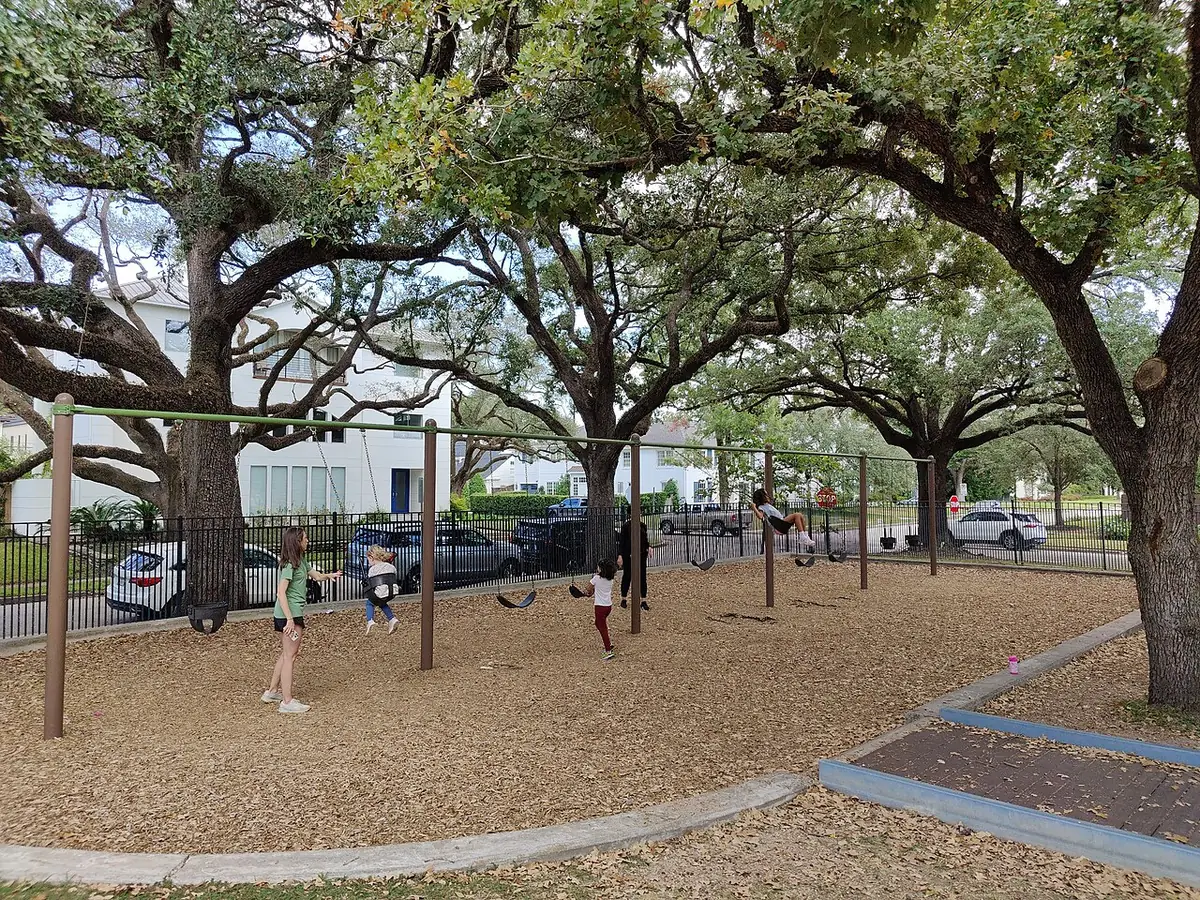
A shaded playground, popular with Houston families — Photo: EvanCarroll · CC BY-SA 4.0 · Wikimedia Commons
At the end of this analysis, buying in Houston looks like what it really is: a strategic commitment that demands method, clear eyes and financial discipline. Unlike simplistic sales talk that dwells only on the region's economic growth, a successful move rests on your willingness to accept the local constraints, whether that is property taxes, foundation maintenance or getting around a sprawling metro. If you have measured all of those factors and your horizon runs well past the short term, the fundamentals of the Texas market offer solid prospects for stability and quality of life.
Deciding to buy also means taking charge of your own setting: choosing the right neighbourhood, the right type of property and surrounding yourself with honest professionals, from an independent home inspector to an agent who genuinely knows the flood zones. Never give in to manufactured urgency or to the noise of a fast market. Take the time to check every technical document, to read the association's accounts and to project your real spending several years out.
In the end, if the purchase fits a life plan you have thought through and your budget accounts for all the hidden costs of ownership in Texas, buying a house or an apartment in Houston is a genuine opportunity to put down roots. Trust your own reading of the risks, view homes in every kind of weather, and sign knowing exactly what you are taking on so you can build your future in this dynamic metro with confidence.
Related questions
How much are property taxes on a home in Houston?
Property taxes in Houston generally run between 1.8% and 2.8% of the assessed value of the home each year. The exact rate depends on which school district the property sits in and on any levies raised by municipal utility districts, known as MUDs, in newer developments.
Is flood insurance compulsory when you buy in Houston?
If the property sits in a high-risk zone as mapped by FEMA, flood insurance is strictly required in order to obtain a federally backed mortgage. Even outside those official zones it is strongly advised, given how often intense weather events hit the region.
How does the absence of municipal zoning work in Houston?
Houston has no traditional land-use plan setting what may be built in each neighbourhood. Protection of the residential setting rests mainly on subdivision restrictions and the private covenants imposed by homeowners associations, the HOAs.
How long does it usually take to close a home purchase in Texas?
Expect roughly 30 to 45 days between the seller formally accepting your offer and the final signing at the title company, which is the time needed to complete the inspections and finish the loan file.
What closing costs should you budget for when buying in Houston?
Closing costs average 2% to 4% of the total purchase price. They cover the title company's fees, the appraisal, title insurance and the prorated share of local property taxes.
Why are foundation problems so common in Houston houses?
The soil across the Houston area is a highly expansive clay that shrinks in drought and swells sharply after heavy rain. Those repeated ground movements put serious stress on the concrete slabs the houses are built on.
What are HOA fees and what do they pay for?
HOA fees, the dues paid to a homeowners association, fund the upkeep of shared green space, security, communal amenities such as pools, and sometimes waste collection within the subdivision or the condo building.
Do you need to budget specifically for air conditioning in Houston?
Yes. Because summer temperatures are very high and the humidity is relentless, air conditioning runs hard for a large part of the year. It is a significant line in a household's monthly electricity bill.
Which mortgage types do buyers in Houston commonly use?
Buyers mostly use conventional loans, along with federally backed products such as FHA loans for first purchases or VA loans reserved for veterans.
Can you negotiate the asking price of a home in the Houston market?
How negotiable a price is depends heavily on local market conditions, how long the home has been listed and the neighbourhood. In sought-after areas, correctly priced homes sell fast, while overpriced ones leave room to bargain.
Property review of ting
No ting properties in Houston yet
Be the first — share it on ting and it shows up right here.