Buying property in Delhi calls for a rigorous method, a close understanding of how the local market works and constant legal vigilance. This practical guide takes you step by step through structuring your purchase in the Indian capital safely.
Get the app
What nobody tells you.
Real prices, hidden costs and the traps to check before you commit.
What you really get when you buy an apartment in Delhi
Scroll
What you really get when you buy an apartment in Delhi
Buying property in Delhi calls for a rigorous method, a close understanding of how the local market works and constant legal vigilance. This practical guide takes you step by step through structuring your purchase in the Indian capital safely.
Written by the ting.ad editorial team ·
Delhi in Street View: drag to look around.
Understanding these basic trade-offs makes it easier to look at how well your lifestyle fits what the local market offers.
Investing in residential property in Delhi is about more than acquiring floor space in a fast-growing megacity. It is a complex long-term decision that sets the promise of a historic, central location against the reality of a market in flux. Every neighbourhood has its own rules on planning, housing societies and use of space. You need to look beyond appearances to understand what your capital really buys in terms of services, security and durability in the Indian capital.
The promise of a truly central locationvsThe reality of extreme urban density
Buying in established neighbourhoods puts business and cultural centres right on your doorstep, but it also means constant exposure to noise, traffic congestion and overloaded roads that weigh on daily life.
The appeal of modern gated complexesvsDependence on private management companies
Secure residential complexes offer built-in services and some independence from the vagaries of municipal provision, but they tie you to housing society managers whose financial discipline and maintenance standards can vary considerably from year to year.
The potential for long-term appreciationvsRegulatory and land-title complexity
The scarcity of available land in the most desirable areas does push prices upwards, but planning restrictions, complex title rules and administrative uncertainty demand absolute legal vigilance before you sign anything.
The comfort of a renovated or new homevsOngoing investment in maintenance
Choosing a modern property in Delhi brings immediate comfort and international-standard finishes, but the harsh climate and the variable quality of local materials mean preventive maintenance budgets are noticeably higher than back home.
Which kind of residential setting suits your lifestyle in Delhi?
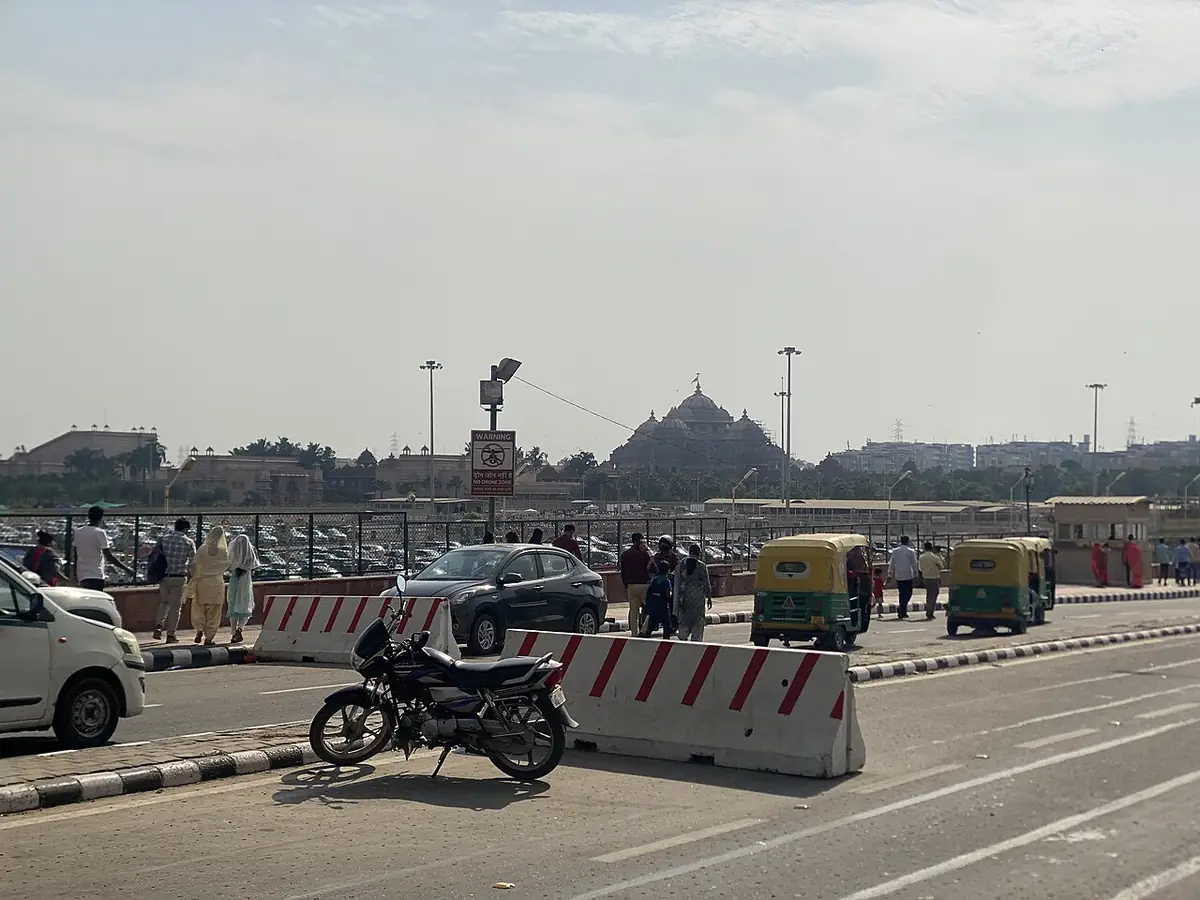
Everyday traffic on a wide Delhi road near Akshardham — Photo: Immanuelle · CC BY 4.0 · Wikimedia Commons
Moving from one culture to another profoundly changes what you consider a comfortable, practical home.
Settling in Delhi forces a radical rethink of your daily routines, your journeys and your relationship with private space. Whether you are arriving for a short work assignment, relocating as a family or putting down long-term roots, the criteria for choosing an apartment change completely. Every type of resident has to balance the calm they want inside the home against the intensity of the city the moment they step out of the door.
Guarded residential enclaves in the upmarket neighbourhoods
Choosing the traditional residential areas or the secure enclaves in the south of the city gives you a green environment and infrastructure suited to children. You benefit from nearby international schools, well-kept parks and neighbours who are mostly senior professionals and diplomats. On the other hand, the purchase price per square metre is the highest in the city, and properties for sale are rare, so the search calls for patience and quick decisions.
Well-connected apartments close to the business hubs
Choosing a property right next to transport links or the major business centres drastically cuts the time you spend commuting each day. You have instant access to a wide choice of restaurants, shops and high-end healthcare. This choice does mean tolerating higher levels of air and noise pollution, so you will need to fit your apartment with effective air filtration and soundproofing.
Well-served properties in areas in transition
Targeting neighbourhoods that are gentrifying or sit along the new public transport lines offers a more affordable entry point while promising an attractive capital gain in the medium term. Your tenants will be young local professionals or expatriates looking for a compromise between budget and accessibility. This kind of investment demands an excellent knowledge of how local neighbourhoods are evolving, so you can anticipate demand and avoid areas poorly served by basic services.
Living there when you come from abroad: what really changes about your home
Once you have absorbed these cultural and technical differences, choosing the right neighbourhood becomes your strategic priority.
Leaving behind the property habits you are used to and settling in Delhi means unlearning many assumptions about thermal comfort, how services are run and how buildings are designed. What counts as a fixed standard back home, whether soundproofing, reliable public services or construction norms, takes on a completely different dimension here. Anticipating these structural gaps will spare you major disappointments in the first months in your new home.
From abroad
Standardised thermal and acoustic insulation built to strict norms
Delhi
Construction designed to fight summer heat, often less well insulated against outside noise and temperature swings
You should plan to fit high-performance double glazing and reversible air conditioning in every main room to keep the home liveable.
From abroad
Water and electricity networks managed centrally, invisibly and automatically
Delhi
Urban infrastructure that requires independent backup systems built into the building or the complex
Any apartment purchase must include checking for a shared backup generator and private water filtration or storage systems.
From abroad
A closed or semi-open kitchen fitted to standard specifications
Delhi
A layout often designed to accommodate domestic staff, or one that needs the preparation areas completely reorganised
It is common to have to carry out interior works straight after buying to adapt the kitchen and bathrooms to the way you live.
From abroad
A building managed by professional managing agents under a strict legal framework
Delhi
Housing society managers whose practices vary, from rigorous management to informal improvisation
Carefully reviewing the society's accounts, the minutes of general meetings and the history of charges is essential so you do not end up paying for past failings.
Which Delhi neighbourhood should you target for your priorities?
With these geographical markers in place, it is time to look at the financial reality and the price ranges on the market.
Delhi is made up of micro-areas with sharply contrasting identities, each offering its own balance between accessibility, peace and quiet, prestige and proximity to amenities. Choosing the right neighbourhood depends not only on your raw budget but on your ability to accept the constraints that come with each area. A close look at the feel of each neighbourhood will help you match your investment to the reality of daily life there.
The historic and institutional central neighbourhoods
A green atmosphere, tree-lined avenues and a relative calm that is rare in a city of this size, with institutions and parks close at hand.
Suits
Buyers looking for undeniable architectural character, heritage prestige and immediate proximity to cultural and diplomatic centres.
Trade-off
An extremely limited market, prices per square metre among the highest in the country and heavy administrative constraints if you renovate.
The residential and shopping enclaves of the south
Constant energy, well-known neighbourhood markets, lively street life and plenty of restaurants and fashionable shops.
Suits
People who want a lively, multicultural, well-connected daily life while living on secure streets popular with the international community.
Trade-off
Heavy traffic at rush hour and pressure on land that makes it hard to find spacious, bright properties.
The large modern gated developments on the outskirts
Open spaces, residential towers with built-in leisure facilities and a sense of being sheltered from the bustle of the city.
Suits
Families and investors who value modern amenities, easy parking and centralised concierge services.
Trade-off
A long way from Delhi's historic and cultural centres, with lengthy daily journeys to reach the heart of the city.
How much does it really cost to buy an apartment in Delhi?
Beyond the financial outlay, the exact nature of the ownership right you are acquiring deserves forensic attention.
Delhi's property market shows a very wide price range depending on location, the age of the building, the standard of the complex and how clear the title deeds are. The figures below summarise the typical orders of magnitude observed, to help you calibrate your financing plan without being taken in by misleading listings. Never forget that the headline purchase price has to be topped up with transfer costs, local taxes and budgets for bringing the property up to standard.
DelhiFor saleApartmentestimate
Median price / m²₹114,000Half the apartments sell below this
Median price₹14.5mthe average is 14% higher — a few very large properties pull it up
Most common2 bedrooms38 % of listings
Average size120 m²
By number of bedrooms
Bedrooms
Share of market
Avg price
Price / m²
Avg size
1
18 %
₹7.78m
₹129,600 +8 %
60 m²
2most common
38 %
₹12.6m
₹120,000
105 m²
3
32 %
₹16.5m
₹114,000 −5 %
145 m²
4
12 %
₹22.1m
₹110,400best value / m²
200 m²
Each row is an average, compared against the area average of ₹120,000 / m². These are indicative estimates of a typical local market, not a measured sample of live listings. Check current listings before relying on them.
What you can actually own: understanding property titles
Once the legal position is secure, the transaction follows a sequence of formal steps that must be respected to the letter.
Buying property in India requires absolute legal rigour to confirm that the chain of title is valid and that the seller has full legal capacity to sell. Unlike more uniform markets, Delhi is a patchwork of land tenure regimes: freehold ownership, long-term leases from public authorities and buildings on allotted land. Skipping this legal audit exposes the buyer to long and complicated disputes.
Freehold title and checking the historical chain
Making sure the property has an unchallengeable freehold title is the first safeguard for your investment. That means examining the full history of ownership transfers over the last thirty years, checking there is no hidden mortgage and confirming that the building permits issued by the relevant municipal authorities are in order.
What it changesThis rules out any risk of future expropriation or inheritance claims from co-owners overlooked in previous sales.
Administrative leases and housing society permissions
Many developments sit on long-term leases granted by public authorities or institutional bodies. You should check with a specialist lawyer the renewal clauses, any restrictions on resale to foreigners or non-residents, and the strict rules governing structural changes to the building.
What it changesYou understand exactly the limits of your rights of use and protect the future liquidity of your property when the time comes to sell.
The golden rule to understand before paying any deposit
To manage this sequence calmly, let us break down the people involved and the practical stages of the transaction.
In any property transaction in Delhi, it is tempting to pay a deposit quickly to secure a rare opportunity. That is precisely the stage where the most damaging mistakes are made. Committing money too early, before the technical and administrative aspects of the property have been audited, leaves you in a very weak position if hidden defects or land disputes come to light later.
Finding the ideal property and informally negotiating a target price with the owner.
Drafting a preliminary agreement of intent to buy (a Memorandum of Understanding) conditional on the results of a full legal audit.
Instructing an independent local lawyer to carry out a thorough title search in Delhi's land records.
Carefully checking that the outgoing owner has paid all property taxes and utility bills.
Having an independent professional carry out a detailed technical inspection of the apartment to assess the plumbing, electrics and structure.
Signing the final Sale Deed and registering it officially with the relevant state authorities.
How a property purchase in Delhi works, step by step
Completing a property purchase in Delhi means coordinating several specialist professionals: lawyers, licensed agents, accountants and notaries. The process follows a precise timetable in which each party plays a key role in securing the transfer of ownership. The table below sets out the responsibilities and actions at each critical stage of the project.
The buyerSetting the budget and choosing advisersSet your overall budget including all additional costs and engage an independent lawyer who is not affiliated with any estate agency.
The estate agentTargeted viewings and initial negotiationShortlist properties that strictly match your criteria and lead the preliminary price discussions with sellers or their representatives.
The specialist lawyerDue diligence and title checksAnalyse the chain of title in depth, confirm there are no encumbrances or pending disputes and check that the building complies with planning rules.
The technical expertSurvey of the building and its systemsInspect the structural integrity, the water supply, the backup generators and the apartment's air conditioning equipment.
Both partiesSigning the preliminary agreement and paying the depositSet out the conditions precedent and the staged payment schedule, and pay the deposit into a secure escrow account or to the adviser.
The registration officePaying taxes and signing the Sale DeedPay the registration fees and local transfer taxes before the final Sale Deed is signed and legally registered.
Apartment or independent house: which makes more sense for settling long term in Delhi?
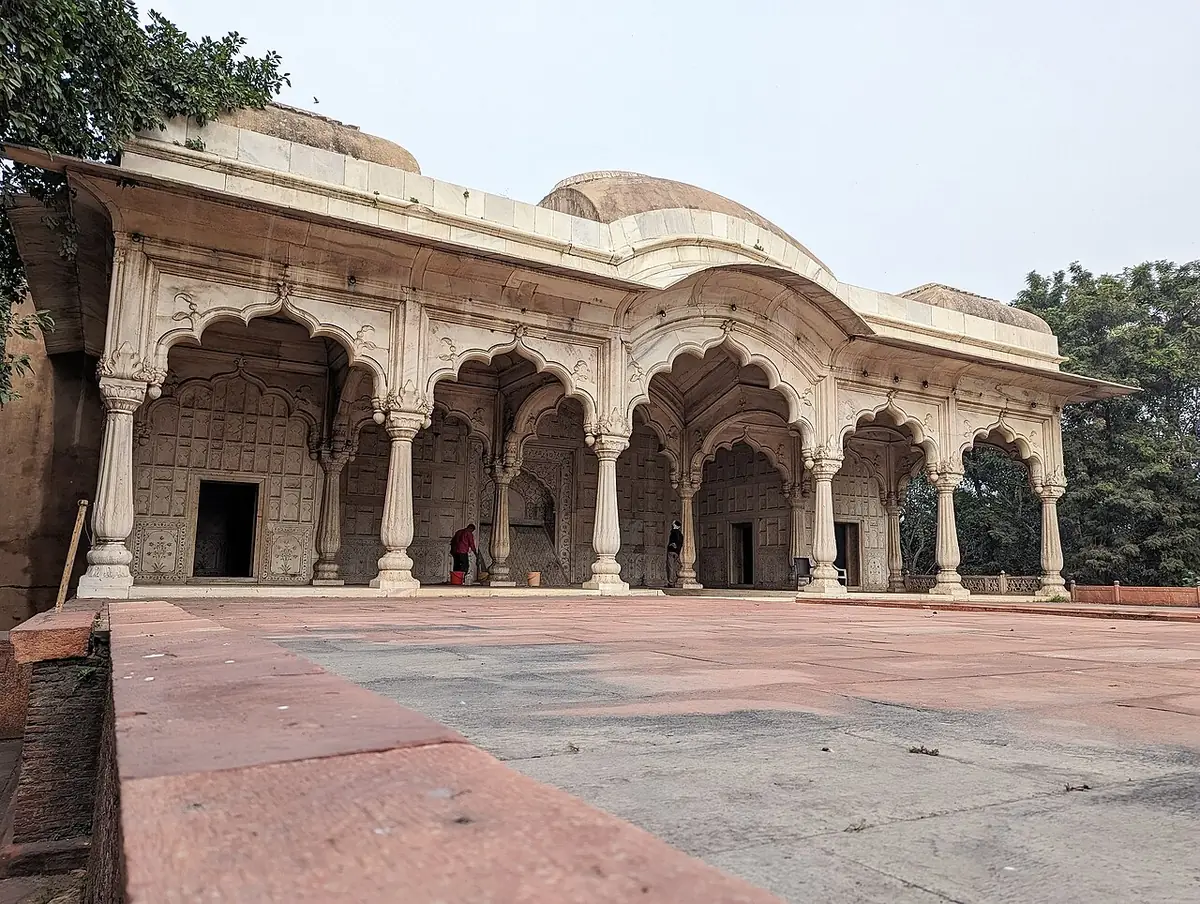
The Shah Burj pavilion inside the Red Fort in Old Delhi — Photo: Sourabh.biswas003 · CC BY-SA 4.0 · Wikimedia Commons
Once you have settled on the type of property, the central question of controlling your overall budget and running costs becomes pressing.
The choice between an apartment in a gated community and an independent house (a builder floor or kothi) completely reshapes daily life in Delhi. On one side, modern residential complexes built by large developers offer impressive shared infrastructure, including permanent backup generators, a filtered water supply, landscaped gardens and security reinforced by guards on duty 24 hours a day. These residential towers particularly suit families looking for peace of mind, easy upkeep and on-site sports facilities such as swimming pools or tennis courts.
By contrast, buying a builder floor or an independent house in established neighbourhoods such as Greater Kailash, Defence Colony or Vasant Vihar gives you complete architectural freedom and independence from the strict rules of housing societies. Homeowners enjoy private ground space, private terraces and the freedom to fit out the property to their own taste without seeking approval from a residents' committee. However, that independence comes at the price of handling technical problems, facade maintenance and street access security yourself.
Financially, the cost structure of these two types of property is radically different. Apartments in complexes require recurring monthly maintenance charges, often high, to run the lifts, light the common areas and pay the security staff. In return, these properties are generally easier to resell thanks to steady rental demand from expatriate professionals and service-sector employees. Independent houses, though rarer and marked by very strong long-term land appreciation, require considerably more upfront capital and tie up large sums in structural renovation.
The final choice therefore depends mainly on your tolerance for the administrative constraints of a housing society and your ability to delegate or manage day-to-day maintenance yourself. If you value immediate comfort, shared security and built-in services, an apartment in a complex is the most rational option. If you have a deep knowledge of the local market, want scarce land and refuse to compromise on your private living space, buying an independent property in one of Delhi's upmarket neighbourhoods will prove the best investment for your long-term future.
What realistic budget do you need to live comfortably and maintain your property in Delhi?
With these financial estimates in place, it helps to look at what a typical day actually looks like to gauge the reality of daily life.
Buying property in the Indian capital is about more than the headline price quoted by agencies. You need to factor in all the mandatory additional costs, local taxes and registration charges, as well as recurring housing society charges, to get an accurate financial picture. Anticipating these items avoids unpleasant surprises and keeps your investment on a sound footing.
Upfront costs and purchase taxes in Delhi
Cost item
Estimated rate or amount
How it is paid
Stamp Duty
4% to 6% of market value
Payable when the sale deed is registered
Registration fees
1% of the property value
Paid to the land registry (Sub-Registrar)
Estate agency fees
1% of the purchase price
Paid by the buyer and the seller
Housing society reserve fund
INR 50,000 to 150,000
One-off contribution paid to the society on moving in
Stamp duty rates can vary slightly depending on the buyer's gender, with women receiving an incentive discount in several parts of Delhi.
Monthly running costs for a standard apartment
Type of charge
Average monthly amount (INR)
Services included
Housing society charges (Maintenance)
INR 5,000 to 15,000
Security, cleaning of common areas, lifts
Electricity and air conditioning
INR 6,000 to 18,000
Usage varies with how much the air conditioners run
Water supply and waste management
INR 1,500 to 4,000
Municipal billing and tanker water deliveries
Municipal property tax
Annual (spread to INR 1,000 to 3,000 per month)
Paid to the Municipal Corporation of Delhi
These amounts are for a three-bedroom apartment in a mid-range complex in Delhi.
Healthcare, schools, transport: what does an ordinary Tuesday actually look like after moving to Delhi?
Beyond this well-oiled routine, many crucial aspects are left out of developers' promotional brochures.
Whether your move to Delhi works out depends closely on how smooth your daily journeys are and how easily you can reach essential infrastructure. To help you picture your routine, here is how an ordinary Tuesday unfolds, showing journey times, local services and how to handle the unexpected in the capital.
07:30 - 08:30Residential neighbourhood and departureWaking up in a secure environment. Checking the water supply and switching on the home's connected devices.
08:30 - 09:30School run or commuteTravelling to international schools or business centres along secure main roads or by metro.
09:30 - 13:00Office or working from homeWork in an office with high-speed fibre broadband and efficient central air conditioning.
13:00 - 14:30Lunch in the neighbourhoodA lunch break in a modern Delhi shopping centre or a quiet restaurant serving international and local food.
14:30 - 17:30Errands and appointmentsVisits to leading healthcare providers or local shopping in the city's organised, air-conditioned markets.
17:30 - 19:30Heading home and unwindingThe journey home on the Delhi Metro to avoid the evening rush-hour traffic jams.
19:30 - 21:30Evening with the familyRelaxing within the complex, a walk in the secure green spaces and getting ready for the next day.
What property developers' brochures never mention about Delhi
These administrative and technical grey areas explain why some buyers deeply regret their purchase a few months after moving in.
Delhi's property market has regulatory and technical specifics that advertising materials prefer not to highlight. Understanding these hidden realities is essential to avoid financial and legal setbacks after signing the final sale deed.
Air quality and how well filtration systems work
Winter pollution peaks make high-performance air purifiers in every room and a suitable ventilation system a must, which is an investment and maintenance cost not to be overlooked.
Strict restrictions on architectural changes
In many complexes and heritage areas overseen by strict land authorities, altering facades, enclosing a balcony or knocking down an interior wall can bring heavy administrative fines.
The complexity of land titles (Freehold vs Leasehold)
A great deal of land in Delhi belongs to public bodies such as the DDA (Delhi Development Authority) under long-term leases, which require specific conversion procedures and transfer fees on resale.
How power and water outages are really handled
Even in upmarket neighbourhoods, temporary cuts happen. You must check the actual capacity of the complex's generator and the size of the individual water tanks.
The classic traps and buying mistakes you only discover after six months of living in Delhi
This level of complexity shows that buying property in Delhi does not suit every kind of investor or expatriate.
Looked likeAn exceptional property opportunity listed well below the neighbourhood's market price.
Turned outA property tied up in complex inheritance disputes or suffering from structural defects invisible at the first viewing.
Would have caught itInsisting on a full check of the chain of title over the last thirty years by an independent specialist lawyer.
Looked likeA calm, green neighbourhood perfect for raising a family in the heart of the capital.
Turned outA residential area next to congested roads that becomes extremely noisy and polluted at rush hour.
Would have caught itVisiting the property at different times of day and on different days, especially during the heavy morning and evening traffic.
Looked likeA housing society promising unusually low and attractive monthly charges.
Turned outA severe lack of financial reserves to maintain heavy equipment, leading to massive special levies.
Would have caught itStudying the minutes of the society's recent general meetings in detail to spot unpaid charges and upcoming works.
Looked likeA verbal promise from the estate agent about a future extension or regularisation of the property.
Turned outA clear breach of the local planning scheme (Master Plan for Delhi) exposing the owner to the risk of demolition.
Would have caught itNever relying on verbal promises and having a technical expert confirm strict compliance with planning rules.
Which kind of buyer should definitely give up on buying property in Delhi?
Now that all the parameters, costs and risks have been set out carefully, it is time to make your decision.
Investing in property in a city as dense and complex as Delhi requires clear criteria of stability, flexibility and financial strength. Some buyers are bound to be disappointed because their personal or professional constraints do not fit the realities of the local market.
The expatriate on a short assignment (under three years)
→Buying an apartment quickly to avoid paying monthly rent.
High upfront purchase costs and the time it takes to resell on the Delhi market make the deal loss-making if the stay is cut short.
The investor who cannot stand complex paperwork
→Buying older properties without rigorously checking their legal history.
The complexity of Indian land law and the thorough checks it requires demand a level of administrative patience that is incompatible with wanting things simple.
The household on a very tight budget with no emergency savings
→Buying a property by putting all available cash into the deposit.
Unexpected housing society charges, structural renovation works or changes in interest rates can put the household's finances at risk.
So, are you ready to take the plunge and invest in property in Delhi?
Buying an apartment or a house in Delhi is a major undertaking that cannot be based on love at first sight. It requires complete clarity about the urban, climatic and administrative realities of the Indian capital. If you have grasped how important it is to choose a well-run housing society, budgeted for the essential additional costs and accepted the particular rhythm of local life, you have everything you need to make your move a success.
Delhi's property market consistently rewards methodical buyers who take the time to check that title deeds are legally sound and to examine the financial health of housing societies. Whether you favour the security of modern complexes or the authentic charm of well-established upmarket neighbourhoods, you are laying solid foundations for a lasting asset that will stand the test of time.
Take the time to view several properties at different times of day, surround yourself with independent experts to audit the land records and make sure your investment horizon stretches well beyond the short term. When these essential conditions are in place, completing your purchase in Delhi becomes not only an enriching life choice but also a highly strategic long-term investment for your future.
Related questions
What additional costs should I budget for when buying an apartment in Delhi?
The main items are stamp duty, at between 4% and 6% of the property value, registration fees fixed at 1%, plus agency fees and the initial contributions to the housing society's reserve fund.
Can a foreigner buy property in Delhi?
Foreign nationals who are not resident in India generally cannot acquire property directly, with the exception of people holding PIO or OCI status, who must comply strictly with Reserve Bank of India regulations.
What is the difference between Freehold and Leasehold property in Delhi?
A Freehold property gives full ownership of the land and the building with no future ground rent, while a Leasehold property is granted for a fixed term by a public authority and can sometimes require renewal payments.
How does the water supply work in Delhi residential complexes?
Most modern complexes combine municipal water with filtered borewells and tanker deliveries in the dry season, stored in large shared tanks to keep the supply running.
Which Delhi neighbourhoods are most popular with international buyers?
The most sought-after areas include the upmarket residential neighbourhoods of South Delhi such as Vasant Vihar, Greater Kailash and Defence Colony, along with some secure enclaves close to the main business corridors.
How long does it usually take to complete a property purchase in Delhi?
The full process, including the search, a thorough check of the title deeds by a lawyer, negotiation and official registration with the Sub-Registrar, generally takes between six and twelve weeks.
Are maintenance charges high in residential complexes?
They vary with the services on offer, covering round-the-clock security, upkeep of the gardens, the lifts and electricity for the common areas, and they add up to a significant monthly budget.
How can I make sure a builder floor complies with planning rules?
It is essential to have a local architect or technical expert confirm that the building strictly respects the maximum heights and floor area ratios allowed under the Delhi Master Plan.
How does seasonal pollution affect the choice of home in Delhi?
Winter pollution peaks push buyers towards homes with airtight double-glazed windows and effective filtered ventilation systems to protect indoor air quality.
Is it better to buy off plan or an existing property in Delhi?
Buying an existing property lets you move in straight away in a neighbourhood with mature infrastructure, while buying off plan from a reputable developer offers staged payment plans but carries the risk of delivery delays.