Buying a house in India's capital calls for a disciplined method if you want to see your plans through with peace of mind. This guide sets out the realities of the local market, the legal traps to steer around and the key criteria for choosing where you will live.
Get the app
What nobody tells you.
Real prices, hidden costs and the traps to check before you commit.
What you really get when you buy a house in Delhi
Scroll
What you really get when you buy a house in Delhi
Buying a house in India's capital calls for a disciplined method if you want to see your plans through with peace of mind. This guide sets out the realities of the local market, the legal traps to steer around and the key criteria for choosing where you will live.
Written by the ting.ad editorial team ·
Sale House Delhi in Street View: drag to look around.
Beyond the physical building, it is your everyday way of life that gets tested against local reality.
Buying a house in India's capital is about more than bricks and mortar in a dense urban setting. It gives you access to a particular way of life, often built around gated residential communities or restored period properties. Buyers quickly discover that a property's real value lies as much in where it sits among the city's many neighbourhoods as in its architectural layout. Understanding this duality helps you avoid the disappointment that comes from bringing Western expectations of urban property.
The promise of generous private spacevsThe reality of shared walls and overlooking neighbours
The plots available in sought-after areas often mean living right next to your neighbours. Privacy comes from interior layout and boundary walls rather than from distance.
The appeal of independent housesvsThe complexity of maintenance and managing services
Unlike apartments in a housing society, an independent house means managing the water supply, security and upkeep of backup power systems yourself.
The prestige of an established addressvsTraffic and parking constraints
The older residential neighbourhoods offer green, peaceful surroundings, but getting in by car at rush hour and the lack of on-street parking weigh heavily on daily life.
Complete freedom to renovatevsCompliance with local planning rules
Owning the land does not mean you can build without limits. Height restrictions, floor area ratios and heritage rules tightly govern any extension project.
Does this place really fit your everyday life?
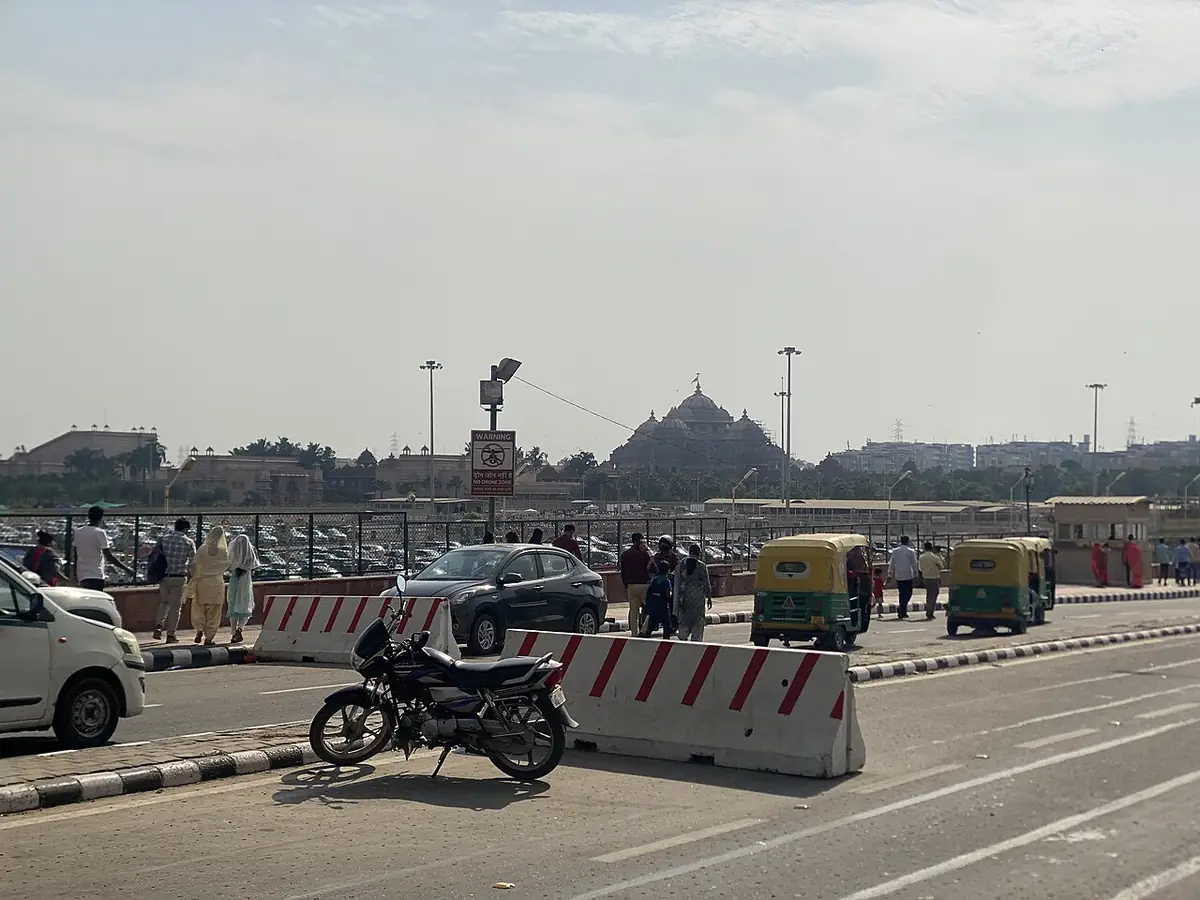
Everyday traffic on a wide Delhi road near Akshardham — Photo: Immanuelle · CC BY 4.0 · Wikimedia Commons
Running your daily habits through this filter reveals the gap between the reference points you bring from back home and Indian reality.
Every buyer comes to the city with expectations shaped by their own personal and professional path. Between children's schooling, proximity to employment hubs and the need for calm after the bustle of the city, choosing the right location matters more than the floor area. Looking honestly at your real situation stops you from choosing an area that does not suit your everyday journeys.
Remote work and a search for calm
Your top priority is reliable infrastructure and a quiet working environment. Residential neighbourhoods with good broadband coverage and light traffic suit this way of life perfectly. You get a bright home office while staying away from noisy main roads. The drawback is the relative distance from the busy business districts when you do need to travel.
Check carefully the quality of fibre internet connections and whether the street has reliable generators. Without this essential equipment, your work could be disrupted by the vagaries of the public grid during summer demand peaks.
Family with school-age children
The key question becomes the daily commute between home and school campuses, which are often on the outskirts or in specific areas. Living too far from school will condemn you to many hours in morning and evening traffic jams. It is therefore wise to target areas with direct access to major roads or the main metro lines.
A secure green space close to the house also provides a valuable counterweight to the concrete atmosphere of the megacity. Your children can enjoy a balanced life, combining home comforts with supervised outdoor activities within the community.
An active social and cultural life
Your daily life revolves around the city's fashionable neighbourhoods, art galleries, designer markets and top restaurants. Settling in an enclave that is too isolated would cut you off from all that and, given the distances, reduce your social life to nothing. You should favour central or well-connected areas where the places you enjoy are reachable on foot or within a few minutes by taxi.
In return, you will have to accept much higher prices per square metre and smaller plots. The ideal house in this context focuses on making the most of its interior space, with a terrace or a fitted-out rooftop where you can host guests away from the noise of the street.
Living here when you arrive from abroad: what fundamentally changes
Once these realities have sunk in, everything comes down to choosing the district and the micro-neighbourhood.
Buying property abroad is not just a change of scenery; it upends all the legal, technical and social reference points you built up back home. What goes without saying there, whether it is how shared buildings are run, how you hire tradespeople or how public services work, follows radically different relationship-based and informal logics here. Anticipating these cultural gaps will save you a great deal of frustration during your first months.
From abroad
Back home, building standards and long-term structural warranties may tightly govern every construction project.
Delhi
In Delhi, technical inspection relies largely on private engineers and on the developer's reputation.
You need to appoint your own independent experts to audit the structural soundness of the property before signing anything final.
From abroad
Back home, waste collection and upkeep of shared areas may follow strict municipal schedules.
Delhi
In Delhi, cleanliness and maintenance often depend on private initiatives at street or building level.
Set aside a specific budget to pay maintenance staff and contribute to self-run neighbourhood associations.
From abroad
Back home, energy and water contracts are often standardised and handled by large utility operators.
Delhi
In Delhi, water deliveries by tanker and the use of voltage stabilisers are common in summer.
Your house absolutely must include independent storage tanks and sophisticated filtration systems.
From abroad
Back home, property transactions may have to go through a notary acting as a public official.
Delhi
In Delhi, deeds are registered with the local registration authorities with the help of specialist lawyers.
Close attention to the chain of successive title deeds is essential to rule out any risk of a land dispute.
Which neighbourhood should you target to settle down and invest for the long term?
This map of atmospheres leads naturally to the crucial question of the budget you will need.
Delhi's geography is organised into concentric rings and planned sectors, each with its own identity, level of safety and accessibility. Choosing the right neighbourhood shapes not only your immediate quality of life but also how easily you can sell your investment in future. The differences in price and atmosphere from one area to the next call for a methodical analysis before you commit.
The leafy enclaves of South Delhi
Relative calm, streets lined with mature trees, a cosmopolitan population and a strong diplomatic presence.
Suits
Families looking for safety, places to walk and proximity to the large parks.
Trade-off
Some of the highest prices per square metre in the city and a very limited supply of available properties.
Fast-developing residential sectors
Constant energy, modernisation works, modern local shops and a working population.
Suits
Investors betting on medium-term capital growth and young working couples.
Trade-off
Temporary noise from construction work and traffic that can be heavy at times.
Historic and traditional neighbourhoods
Constant activity, a dense web of shops and architecture full of character, though sometimes ageing.
Suits
Those seeking cultural authenticity and a walkable lifestyle for everyday shopping.
Trade-off
Recurring parking difficulties and heavy constraints on modernising internal wiring and plumbing.
What does buying a house here really cost?
Beyond the sums involved, the very structure of ownership deserves a close look at the rights you actually hold.
Budgeting for a property purchase in Delhi does not stop at the headline price quoted by agencies. You need to factor in all local registration taxes, legal fees and any upgrade work needed to reach a Western standard of comfort. Being clear about each of these expense lines keeps your plans to settle here financially viable over the long term.
DelhiFor saleHouseestimate
Median price / m²₹93,480Half the apartments sell below this
Median price₹20.7mthe average is 14% higher — a few very large properties pull it up
Most common2 bedrooms46 % of listings
Average size210 m²
By number of bedrooms
Bedrooms
Share of market
Avg price
Price / m²
Avg size
2most common
46 %
₹18.1m
₹98,400
184 m²
3
39 %
₹23.7m
₹93,480 −5 %
254 m²
4
15 %
₹31.7m
₹90,528best value / m²
350 m²
Each row is an average, compared against the area average of ₹98,400 / m². These are indicative estimates of a typical local market, not a measured sample of live listings. Check current listings before relying on them.
What you can really own: understanding land ownership
Once the legal framework is clear, it is the practical course of the transaction that you need to master step by step.
Indian property law follows complex rules on buyers' nationality and the nature of land titles. Grasping the distinction between full ownership of the land and long-term leases is essential to securing your investment. A legal misjudgement at this stage can jeopardise a later resale or limit your rights to pass the property on to your heirs.
Full ownership (Freehold)
This legal status gives you full title to the land and the building on it, with no time limit. It is the most sought-after and most secure form of ownership for an investor who wants to pass a tangible asset on to their heirs.
What it changesYou are completely free to sell, let or alter the property within local planning rules, which supports a better price on resale.
Long-term lease (Leasehold)
Common in some estates planned by public authorities, this system gives you use of the land for a fixed period, renewable under certain conditions in return for periodic ground rent or renewal charges.
What it changesYou must check how many years remain on the original lease before signing anything, because a lease nearing expiry without a straightforward renewal option sharply cuts the property's value.
The golden rule to understand before paying any deposit
This legal rigour fits into a precise operational timeline steered by everyone involved.
Buying property in India involves customary steps that must never be skipped just to speed up the signing. From the initial title audit to final registration with the relevant administrative offices, each phase protects the buyer against hidden defects and latent inheritance disputes. Procedural rigour is your best ally in making your investment a success.
Choosing a property you have found on the market and making an initial non-binding offer.
A thorough audit of the chain of title over the last thirty years by an independent specialist lawyer.
Checking that there are no unpaid mortgage charges or ongoing court cases concerning the plot.
Signing a preliminary Agreement to Sell, with a deposit held in escrow.
A technical assessment of the building's structural condition and its plumbing and electrical systems.
Signing the final Sale Deed and officially registering it with the local land authorities.
How a property transaction unfolds, step by step
Knowing the chronological course of a property transaction in Delhi lets you coordinate the various professionals involved: agents, lawyers, technical experts and administrative authorities. Each plays a precise role in confirming the file is in order and securing local or international payments. Here is the roadmap to follow to see your purchase through.
The buyerTargeted viewings and choosing the propertyVisit the property several times at different times of day to gauge the surrounding noise and traffic.
The lawyerDue diligence and title checksExamine the plot's legal history closely to rule out any risk of a future challenge by third parties.
Both partiesNegotiating and signing the agreementSet the conditions precedent, the schedule of staged payments and the amount of the booking deposit.
The technical expertStructural survey of the houseInspect the soundness of the foundations, the watertightness of the roof and the working order of backup systems.
The authoritiesOfficial registration of the sale deedPay the transfer duties and sign the deed before the relevant registration officers.
Independent house or apartment in a housing society: which to choose for living in Delhi?
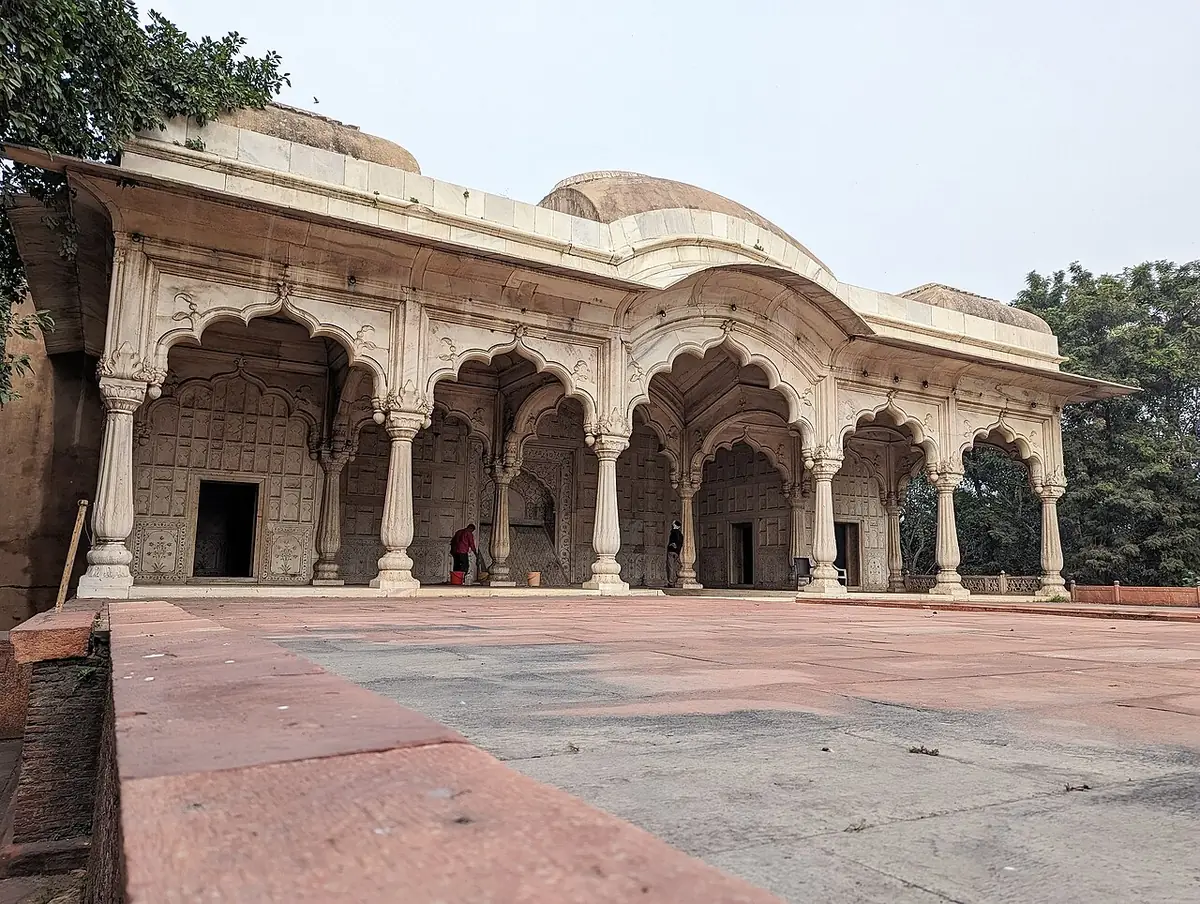
The Shah Burj pavilion inside the Red Fort in Old Delhi — Photo: Sourabh.biswas003 · CC BY-SA 4.0 · Wikimedia Commons
Once this fundamental choice between house and apartment is made, the central question of your overall budget and how your spending breaks down comes straight to the fore.
Buying property in Delhi means deciding quickly between two radically different ways of life: on one side the independent house (often called a 'builder floor' or bungalow), and on the other the apartment in a secure housing society within a modern tower. This decision is not just a matter of taste or status; it directly shapes how you manage your time, space and security every day in a megacity as dense as Delhi. An independent house offers complete architectural freedom, no monthly society fees and a direct connection to the ground, which has traditionally appealed to extended families who value their independence. However, that autonomy comes at a high price in terms of personal maintenance, local security and dealing with the urban hazards that no collective body handles on your behalf.
Conversely, choosing an apartment in a gated community in Delhi, whether in the upmarket neighbourhoods of South Delhi or in the urban extensions on the outskirts, changes the logistics completely. You hand over perimeter security, upkeep of green spaces, management of the backup generators that are essential during power cuts and lift maintenance to a professional management body. This option particularly suits working couples, expats and smaller families looking for peace of mind and built-in leisure facilities such as a swimming pool or a gym. Even so, community living comes with strict rules set by the society's bylaws, monthly charges that are often heavy and a closeness to your neighbours that can sometimes feel oppressive.
Financially, an independent house in Delhi has historically been a sturdier long-term asset because serviced land is chronically scarce in India's capital. You own the land outright, which generally secures stronger long-term capital growth than an apartment, whose value erodes as the building ages. On the other hand, the entry price for a well-located house is astronomical, requiring substantial cash or complex financing arrangements. An apartment, for its part, gives you access to central locations or newer neighbourhoods at a somewhat more modest initial cost, while being easier to sell quickly on the local property market.
Finally, your decision in Delhi must take into account the reality of the city's infrastructure and public services. Independent houses are more directly exposed to fluctuations in the municipal water supply and require heavy investment in filtration systems and independent storage tanks. Large modern residential complexes generally build these facilities in centrally, offering immediate comfort but creating total dependence on the society's technical management. Weigh these advantages and constraints carefully against your tolerance for operational risk and your way of life before signing an agreement to sell.
What monthly and overall budget do you really need to live in a property bought in Delhi?
To gauge how these financial choices affect your quality of life, it helps to picture these costs across a typical day.
Buying property in Delhi is not just a matter of paying the initial purchase price to the seller or developer. You must factor in all the additional fees, local taxes, registration costs and recurring running charges to avoid any financial surprises. This budget grid sets out the unavoidable expense lines every owner faces to maintain their standard of comfort and protect their investment in India's capital.
Upfront purchase costs and mandatory taxes
Expense
Estimated amount or rate
Terms and remarks
Stamp duty
4% to 6% of the value
Varies with the buyer's gender (a reduction for women) and the exact location in Delhi.
Registration fee
1% of the property's value
Payable to the local sub-registrar when the sale deed is officially registered.
Estate agency fees
1% to 2% of the sale price
Standard rate on the Delhi market, usually split between buyer and seller.
Legal and due diligence fees
0.5% to 1%
Essential for checking the chain of title and ruling out hidden land disputes.
These upfront costs come on top of the seller's net price and should be set aside in cash from the start of your purchase.
Monthly running budget and ongoing charges
Type of charge
Monthly range (INR)
What is included
Society charges / maintenance
INR 3,000 to INR 15,000
Covers 24/7 security, cleaning of shared areas and upkeep of lifts and green spaces.
Electricity and generator
INR 5,000 to INR 20,000
Consumption varies with heavy use of air conditioning, plus recharged fuel costs for the diesel generator.
Water supply and treatment
INR 1,500 to INR 4,000
Top-up tanker deliveries in the dry season and maintenance of domestic RO filtration systems.
Municipal property tax
Paid annually
Calculated by the MCD (Municipal Corporation of Delhi) based on floor area, zone and the age of the building.
Energy costs rise noticeably during the summer months because Delhi homes need air conditioning running continuously.
Healthcare, schools, transport: what does an ordinary Tuesday living here actually look like?
Beyond this well-oiled routine, many crucial details never appear in developers' brochures.
Living in Delhi means organising your journeys and daily activities around the city's rhythms, its traffic and the local environment. An ordinary Tuesday shows the logistical reality for an owner living in the capital, from the morning commute to local services. This timeline highlights the practical side of settling into a residential neighbourhood in Delhi, far from tourist clichés.
07:30Leaving home and dealing with morning trafficDelhi's roads fill up quickly early in the morning, making expressways or the metro essential if you want to get to work on time.
09:00Dropping the children at a well-regarded schoolProximity to reputable international or public schools is a decisive factor that directly affects property values and your choice of area.
11:30Local shopping at the market or supermarketFresh produce from neighbourhood shopkeepers, or modern supermarkets for imported products and general groceries.
14:00Admin and neighbourhood appointmentsTime set aside for local formalities, dealing with service providers and handling the routine maintenance of your home.
17:30Heading home in the evening rush hourThe journey home coincides with heavy traffic on the main roads, underlining the importance of living a reasonable distance from where you work.
20:00A quiet evening and checking backup equipmentFamily downtime, plus checking water reserves and power inverters to ensure a peaceful night whatever the grid does.
What a property listing will never tell you about living in Delhi
This contractual and technical opacity often leads new buyers into regrettable mistakes that surface a few months after moving in.
The marketing descriptions put out by Delhi's estate agencies naturally highlight attractive features, natural light and luxurious finishes. Yet several fundamental structural and regulatory issues are routinely left out. Knowing these hidden realities will spare you major disappointments after signing the deed and protect your investment for the long term.
Whether the building actually matches its approved plans (Sanctioned Plan)
Many properties built by independent developers in Delhi include unauthorised extensions or extra floors built in breach of DDA planning rules. If there is an inspection or a resale, these irregularities can block your buyer from getting a bank loan and expose you to the risk of partial demolition.
The real quality of the water and the pressure of the municipal supply
A listing boasts running water 24 hours a day without mentioning that it is brackish or very hard water pumped from Delhi's over-exploited aquifers. Without an expensive, effective reverse osmosis system and water softeners, your pipes and appliances will deteriorate prematurely.
The level of local noise and air pollution
A supposedly quiet location can turn out to be extremely noisy because of nearby permanent construction sites, busy secondary roads, or religious festivals and weddings celebrated at full volume close by during peak season.
The financial health and actual management of the housing society
A handsome new building can have no reserve fund at all for the future upkeep of heavy equipment such as lifts or electrical transformers. If owners are reluctant to pay their charges, the whole building deteriorates quickly in just a few years.
Parking restrictions and congested roads
Owning two vehicles does not mean you can park them easily if the street is narrow and unsecured. Without a private underground parking space included in the title, finding a spot every evening quickly becomes a daily nightmare.
The misjudgements you only discover six months after moving in
Faced with these structural risks, it is just as important to admit honestly that this property market does not suit every kind of buyer.
Looked likeA golden opportunity in an up-and-coming neighbourhood with instant capital growth potential thanks to major infrastructure projects on the way.
Turned outThe announced road and metro works fell several years behind schedule, turning daily access to the neighbourhood into a muddy, dusty obstacle course for months on end.
Would have caught itAsk the municipal authorities for written confirmation of the real timetable for public works, and do not overvalue a property on the strength of future promises that have not materialised.
Looked likeAn ultra-modern apartment with gleaming finishes offered at a price well below the local market average.
Turned outThe materials used for flooring, plumbing and wiring were poor quality, causing repeated breakdowns and water leaks from the very first monsoon.
Would have caught itHave a full technical survey carried out by an independent architect or a qualified building engineer before paying any booking deposit.
Looked likeDiscreet, peaceful neighbours guaranteeing quiet nights and a restful setting in the heart of the bustling city.
Turned outA noisy business or an illegal warehouse opening on the same street completely destroyed the area's tranquillity, and administrative complaints were slow to have any effect.
Would have caught itVisit the surroundings of the property at different times of day and night, and check the land use plan to see what neighbouring plots are zoned for.
Looked likeMinimal society charges quoted by the estate agent to make the property more attractive on a monthly budget.
Turned outThe society had to vote through massive special levies to repair the roof structure and replace the faulty central generator within the first year.
Would have caught itAlways read the minutes of the general meetings from the last three years to identify disputes and works that have been approved or postponed.
Who really should not buy property in Delhi right now?
Now that every facet of Delhi's property market has been examined, it is time to make your final decision.
Buying property in Delhi is a considerable financial and emotional commitment that requires stability, a firm grasp of local risks and a long-term outlook. Some buyers expose themselves needlessly to major disappointments or financial losses by rushing into it too early. Here are the situations where it is clearly better to hold off or to rent instead.
The investor in a hurry who wants immediate liquidity
→Buying an older property in the hope of reselling it at a big margin within two years.
Delhi's resale market is marked by long transaction times and tough negotiations. Tying up capital without an investment horizon of at least five to seven years leads to serious difficulties if you suddenly need cash.
The first-time buyer who cannot stand complex paperwork
→Buying a property directly without the help of a lawyer specialising in Indian land law.
The complexity of title checks, the number of local taxes and the risk of forged documents demand absolute rigour. Without sound legal expertise, the risk of fraud or hidden defects is at its highest.
The resident who has just arrived in India's capital
→Impulsively buying a house in their first months in Delhi to 'stop paying rent'.
Your sense of the neighbourhoods, the traffic, access to amenities and the climate changes radically after a full year on the ground. Renting first lets you pin down exactly where you really need to live.
So, are you really ready to take the plunge and buy property in Delhi?
Deciding to buy property in Delhi means facing up to the reality of a fascinating, complex and demanding city. The buying process is not just a financial transaction or the signing of a deed: it is a life choice that shapes your everyday routine, your long-term budget and your ability to fit into the urban fabric of India's capital. If you have grasped the importance of rigorous title checks, anticipated the hidden costs of maintenance and accepted the local logistical realities, then you have the keys you need to make your plans succeed.
Delhi's property market rewards patience, methodical rigour and clear thinking. By setting aside the too-good-to-be-true promises of advertisements and surrounding yourself with honest, competent professionals, you turn a potentially risky purchase into a solid, lasting asset. Whether it is a family house or a secure apartment in a housing society, your future home must above all meet the needs of your daily life rather than short-term speculative considerations.
Take the time to view several properties, explore neighbourhoods at different times of day, analyse the real running costs and consult independent legal experts before making a final commitment. Property in Delhi offers remarkable opportunities for those who can look beyond appearances and anticipate the practical constraints. Your future peace of mind depends entirely on the quality of the foundations on which you build your plans today.
Related questions
What fees and taxes do you pay when buying property in Delhi?
When buying property in Delhi, the buyer must pay stamp duty, which generally ranges from 4% to 6% of the property's value depending on the buyer's profile and the location, plus a registration fee set at around 1%.
Can a foreigner buy a house or an apartment in Delhi?
The rules on property purchases by non-residents and foreigners in India are extremely strict and regulated by the Reserve Bank of India. As a general rule, only Indian citizens, whether resident or non-resident (NRI), have the automatic right to buy residential property without special prior approval.
How do you check that the title deeds of a property in Delhi are genuine?
Thorough legal due diligence is essential: go through the history of registered deeds at the local sub-registrar's office, confirm there is no mortgage or pending court case, and make sure the land does not belong to protected public holdings.
Which are the most sought-after neighbourhoods to buy in Delhi?
The most coveted areas are mainly the upmarket neighbourhoods of South Delhi such as Greater Kailash, Vasant Vihar, Defence Colony and Hauz Khas, along with the modern townships on the city's immediate outskirts that offer planned infrastructure and built-in security services.
How does the water supply work in Delhi homes?
Municipal water supplied by the Delhi Jal Board is often intermittent, so homes rely on individual or shared storage tanks. Many owners install reverse osmosis filtration systems and top up their supply with tanker deliveries in the summer months.
How do power cuts affect daily life in Delhi?
Although the main grid has improved considerably, voltage fluctuations and occasional outages still happen. Modern houses and housing societies almost always have backup diesel generators (DG sets) or inverters to keep essential equipment running.
How long does a property transaction take on average in Delhi?
A standard property transaction, from signing the initial Agreement to Sell to the final registration of the sale deed with the authorities, usually takes between one and three months, provided the title check turns up no legal obstacles.
What costs should you budget for on top of the purchase price of an apartment?
Buyers should budget for agency fees (1% to 2%), legal fees and registration taxes, as well as recurring monthly maintenance charges that pay for security, upkeep of shared areas and the running of lifts and generators.
Is it better to buy a resale property or a new off-plan one in Delhi?
Buying a resale property lets you move in straight away and see the real state of the neighbourhood and the building, whereas buying off-plan from a developer carries the risk of delivery delays but often comes with staggered payment plans.
How is municipal property tax calculated in Delhi?
Property tax is collected every year by the Municipal Corporation of Delhi (MCD) under a unit area system based on floor area, the neighbourhood's location category, the age of the building and whether the property is used for residential or commercial purposes.