Buying a house in Ottawa, Canada's federal capital, calls for a careful reading of local specifics, neighbourhood dynamics and the legal rules in force. This guide walks you through structuring your purchase step by step, with clear eyes.
Get the app
What nobody tells you.
Real prices, hidden costs and the traps to check before you commit.
What a house in Ottawa actually gives you day to day
Scroll
What a house in Ottawa actually gives you day to day
Buying a house in Ottawa, Canada's federal capital, calls for a careful reading of local specifics, neighbourhood dynamics and the legal rules in force. This guide walks you through structuring your purchase step by step, with clear eyes.
Written by the ting.ad editorial team ·
Elgin Street, Ottawa in Street View: drag to look around.
Understanding these basic trade-offs lets you judge whether your own profile fits the local reality.
Buying a house in Ottawa is not just about acquiring square metres and a lot. The federal capital offers an unusual balance between institutional energy and a residential setting. Even so, the choice carries structural compromises worth measuring before you sign the deed of sale.
Generous living space and lots that are often largevsSubstantial heating and winter snow-clearing costs
Floor area is paid for in energy and upkeep. Ottawa winters demand a disciplined budget for mechanical snow removal and continuous heating.
Remarkable residential quiet in the tree-lined neighbourhoodsvsNear-systematic dependence on a car for everyday errands
Outside the historic downtown, the spread of the city means planned car trips for the smallest convenience, which changes daily life radically.
A housing market traditionally more stable than Toronto or VancouvervsSometimes thinner liquidity for a quick resale in certain outlying segments
The solid presence of the federal public service shields the market from extreme speculative swings, but it also slows resale momentum in outlying areas.
What kind of buyer are you in Ottawa's housing market?
The cultural and logistical gap between the reference points you arrive with and life in Ottawa deserves a clear-eyed look.
How well a way of life matches a type of property determines long-term satisfaction. Whether you arrive as a family with children, as a couple after a central location, or as a distant investor, the criteria for choosing a house in Ottawa change completely.
Family with children
Inner-ring residential neighbourhoods such as Westboro or the east end of the city offer well-regarded school facilities and landscaped parks. You get a secure environment, but you have to accept a longer trip to reach the central employment areas at peak times. Single-family homes with a yard guarantee the space you need there, at the cost of a higher purchase budget.
Working in the central area
Living near the centre or in the Glebe lets you cut car use drastically and reach the bike paths along the Rideau Canal. In exchange, living space shrinks considerably for the same budget, and maintaining an older house takes a far from negligible investment of time and money.
Buyer in transition
Semi-urban areas or ground-level condominium developments offer an interesting compromise between independence and reduced exterior upkeep. You do, however, need to think ahead about how health services and public transit will serve you as mobility declines with age.
Settling in Ottawa: what fundamentally changes when you arrive from abroad
Ottawa's river-lined green spaces, seen from above — Photo: Harleyd613 · CC BY-SA 4.0 · Wikimedia Commons
Once those reference points are in place, the geographic question of which neighbourhood to choose becomes central to structuring your plan.
Moving countries comes with a resetting of everyday reference points. The Canadian housing market, and Ottawa's in particular, follows legal, tax and practical rules that sit a long way from the standards many newcomers are used to.
From abroad
Dense housing organised around historic city centres
Ottawa
Planned urban spread with very uniform low-rise residential neighbourhoods
Walking out for a loaf of bread gives way to planned car trips to shopping centres on the outskirts.
From abroad
A protective conveyancing system with long, heavily secured transaction timelines
Ottawa
Real estate agents and mortgage brokers involved centrally from the first offers onward
Transactions can be extremely quick, sometimes closed in a matter of days, which means having your financing pre-approved in advance without hesitation.
From abroad
Thermal insulation designed for the moderation of temperate climates
Ottawa
Building standards that answer strictly to extreme climate conditions
The heating system, the ventilation and the double or triple glazing are not cosmetic options but vital guarantees of financial survival in winter.
From abroad
Local and property taxes that are moderate, or built into the system differently
Ottawa
A municipal property tax calculated on the assessed value of the property
This recurring cost weighs heavily on the annual budget and varies by area, changing the long-term return calculation.
Mapping Ottawa's neighbourhoods: finding the area that fits your plan
Geography alone is not enough; you have to test your ambitions against the budget realities of the local market.
Ottawa's geography is made up of neighbourhoods with very distinct personalities, separated by main roads and the river. Choosing where to settle depends as much on your budget as on your tolerance for travel time.
The Glebe / Old Ottawa South
An urban village atmosphere, lively, walkable and lined with mature trees along the canal.
Suits
Buyers after historic character, parks right on the doorstep and an active neighbourhood life.
Trade-off
Some of the highest prices per square metre in the city, and older houses that often need bringing up to code.
Westboro / Hintonburg
A trendy, modern hub mixing independent shops, specialty coffee places and contemporary builds.
Suits
Young professionals and families who want an active lifestyle without giving up modern comfort.
Trade-off
Very strong market pressure, which sharply narrows the room to negotiate on a purchase.
Kanata / Barrhaven
Quiet outlying residential areas built around large shopping centres and recent schools.
Suits
Families who prioritise space, big lots and larger houses for an equivalent budget.
Trade-off
Complete dependence on the car and long trips to reach downtown at peak times.
What does buying a house in Ottawa actually cost?
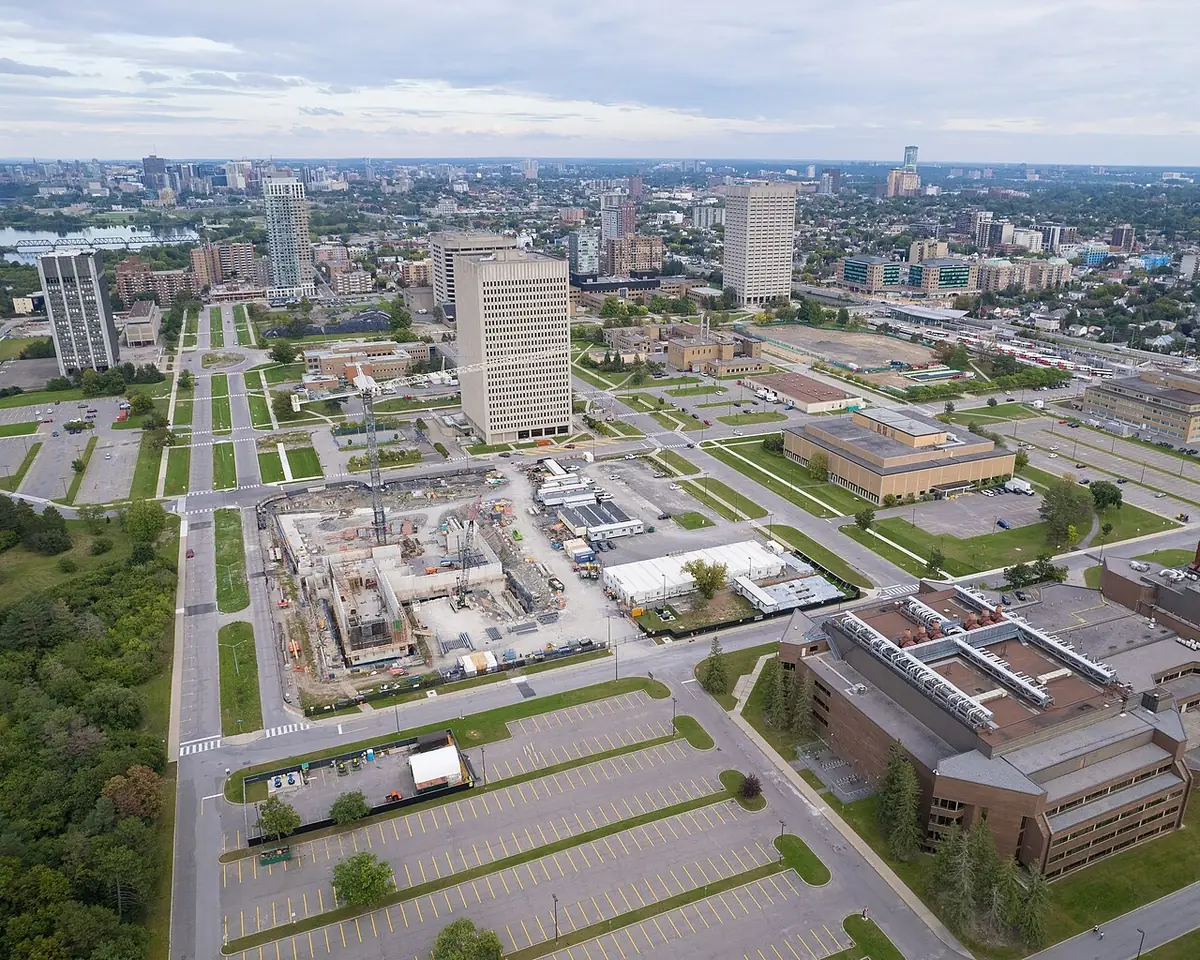
A quiet Ottawa neighbourhood, seen from the air — Photo: Harleyd613 · CC BY-SA 4.0 · Wikimedia Commons
Beyond the headline transaction figure, the legal nature of the ownership determines what you actually own.
Ottawa's housing market reflects its status as the federal capital, with median prices above the provincial average but well below Toronto's. Any budget assessment has to take in the gross purchase price along with the unavoidable additional taxes.
ottawaFor saleHouseestimate
Median price / m²CA$3,973Half the apartments sell below this
Median priceCA$607kthe average is 14% higher — a few very large properties pull it up
Most common2 bedrooms68 % of listings
Average size145 m²
By number of bedrooms
Bedrooms
Share of market
Avg price
Price / m²
Avg size
2most common
68 %
CA$622k
CA$4,182
149 m²
3
26 %
CA$749k
CA$3,889 −7 %
193 m²
4
6 %
CA$922k
CA$3,764best value / m²
245 m²
Each row is an average, compared against the area average of CA$4,182 / m². These are indicative estimates of a typical local market, not a measured sample of live listings. Check current listings before relying on them.
Freehold or condominium: what you can actually hold
Before you commit financially, there is a crucial legal mechanism specific to the Canadian system that has to be understood.
The legal structure of your home in Ottawa shapes both your freedom to alter it and your long-term financial obligations. Between the freehold single-family house and the condominium townhome, the rules differ radically.
Freehold ownership
You own both the building and the land it stands on, with no monthly fee to a condominium corporation. You alone decide on maintenance work, energy retrofits and the timing of any intervention on your property.
What it changesYou carry 100% of the financial risk if there is structural damage or the roof fails, with no way to pool the cost.
Condominium ownership (condo, or freehold with a condo element)
Common for some townhouses, this arrangement includes monthly condo fees covering upkeep of the common elements, collective snow clearing and shared green space.
What it changesYour freedom to change the exterior is tightly framed by the condominium rules, and the fees can rise unpredictably.
The golden rule of the pre-purchase inspection and conditional clauses
A waterfront restaurant along Ottawa's riverside — Photo: SpaceplaneSus · CC0 · Wikimedia Commons
Once that step is secured, the transaction unfolds along a rigorous timeline.
In Ottawa's housing market, the speed of transactions should never push you into neglecting protective clauses. Leaving out an inspection condition can turn your investment into a financial sinkhole.
Drafting the offer (Agreement of Purchase and Sale)
Always write in a condition for a building inspection by a certified professional
Allow enough time (generally 3 to 5 business days) to go through the technical report
Check the state of the roof, the foundations and the heating system against local conditions
Use the findings of the report to negotiate a price reduction or to require corrective work before the conditions are waived
Waiving the conditions and the final transfer of funds to the real estate lawyer
Timeline of a property transaction: who does what, in what order
Reaching the end of this path takes a clear-eyed, methodical view if your move is to succeed.
Buying a property in Canada involves strict coordination between several accredited professionals. Each player has a precise role that has to be respected if administrative hold-ups are to be avoided.
The mortgage brokerGetting financing pre-approvalThey confirm your real borrowing capacity with the Canadian financial institutions before you even start viewing.
The real estate agentSelecting and viewing propertiesThey draft the offer using the standard forms of the local real estate association and negotiate the clauses.
The home inspectorTechnical assessment of the houseThey examine the foundations, the insulation and the electrical installations to detect potential hidden defects.
The real estate lawyerTitle search and closing documentsThey carry out the title searches, prepare the final documents and orchestrate the transfer of funds on closing day.
The City of OttawaRegistering the change of ownerIt updates the official records used to calculate property taxes and water services.
House or apartment in Ottawa: how to decide based on the way you live
Once the type of property is settled, the crucial question of total cost and financial capacity comes immediately to the fore.
Choosing between a detached house and an apartment in Ottawa is not simply a question of floor area or of the initial purchase budget. It is above all a structural trade-off between managing a property independently and belonging to a condominium run by a corporation. In the federal capital, the market splits clearly between central neighbourhoods such as Centretown, dominated by condominium towers, and green residential suburbs such as Kanata or Orleans, where the single-family house with a lot has long been the norm. A prospective buyer therefore has to weigh their tolerance for exterior maintenance, monthly condo fees and the daily commute to the employment areas.
A detached house in Ottawa offers complete freedom of decision on renovation, landscaping and extensions, with no condominium approval standing in the way of your plans. That autonomy comes with full responsibility, though: clearing snow from long driveways in winter, mowing lawns in summer and redoing the roof all fall exclusively on your budget and your free time. Ottawa winters, particularly harsh and snowy, quickly turn the upkeep of a single-family property into something close to a part-time job for several months of the year. An apartment in a condominium, by contrast, hands all of that infrastructure work to outside management, in exchange for monthly fees that can be high and that fluctuate with the age of the building and the health of the reserve fund.
Financially, long-term appreciation behaves quite differently across these two property types in Ottawa. Single-family houses, increasingly scarce on the land available in established areas near the Ottawa River and the Rideau Canal, have historically shown stronger capital growth. Apartments and condos, for their part, offer a more accessible way into the Ottawa market, but often carry rising condo fees that can weigh heavily on returns in the event of a quick resale. It is worth going carefully through the condominium's financial statements, the reserve fund studies and the history of special assessments before signing an agreement to purchase an apartment.
Finally, daily life largely dictates which of the two makes sense in Ottawa. Professionals working in the federal public service downtown, or young couples who want the restaurants of Sparks Street on their doorstep, will favour the compactness and central location of a condo well served by the O-Train transit network. Families with children and those who want outdoor space will naturally lean toward suburban houses or semi-urban neighbourhoods with well-regarded schools and parks within walking distance, accepting longer daily journeys into the urban core in return.
What total budget do you need to live comfortably in Ottawa?
Understanding these figures lets you map out a typical week in the capital with precision.
Working out the budget for a property purchase in Ottawa cannot stop at the monthly mortgage payment. You have to fold in every recurring cost tied to ownership, including municipal property taxes, energy bills for getting through harsh winters, insurance and, where they apply, condo fees. The tables below set out the cost ranges seen in the current Ottawa market, reflecting the economic reality of the federal capital without leaving out the incidental costs that sound financial management requires.
Estimated recurring monthly costs for an owner in Ottawa
Cost item
Apartment / condo (700 sq ft)
Single-family house (suburb)
Average mortgage payment
$1,800 to $2,300
$2,600 to $3,500
Municipal property taxes
$250 to $350
$450 to $650
Condo fees
$450 to $750
$0
Home insurance
$40 to $60
$100 to $150
Estimates based on a conventional mortgage rate and a standard 20% down payment on a median property in Ottawa.
Seasonal energy and utility costs
Type of service
Summer season (June to August)
Winter season (December to February)
Electricity and heating (Hydro Ottawa)
$120 to $180 per month
$250 to $450 per month
Natural gas (where applicable)
$50 to $80 per month
$180 to $300 per month
Municipal water and sewer
$80 to $110 per month
$80 to $110 per month
High-speed internet and services
$85 to $130 per month
$85 to $130 per month
Heating costs rise significantly during the polar cold snaps that characterise the Ontario winter.
Health, schools, transport: what does an ordinary Tuesday look like in Ottawa?
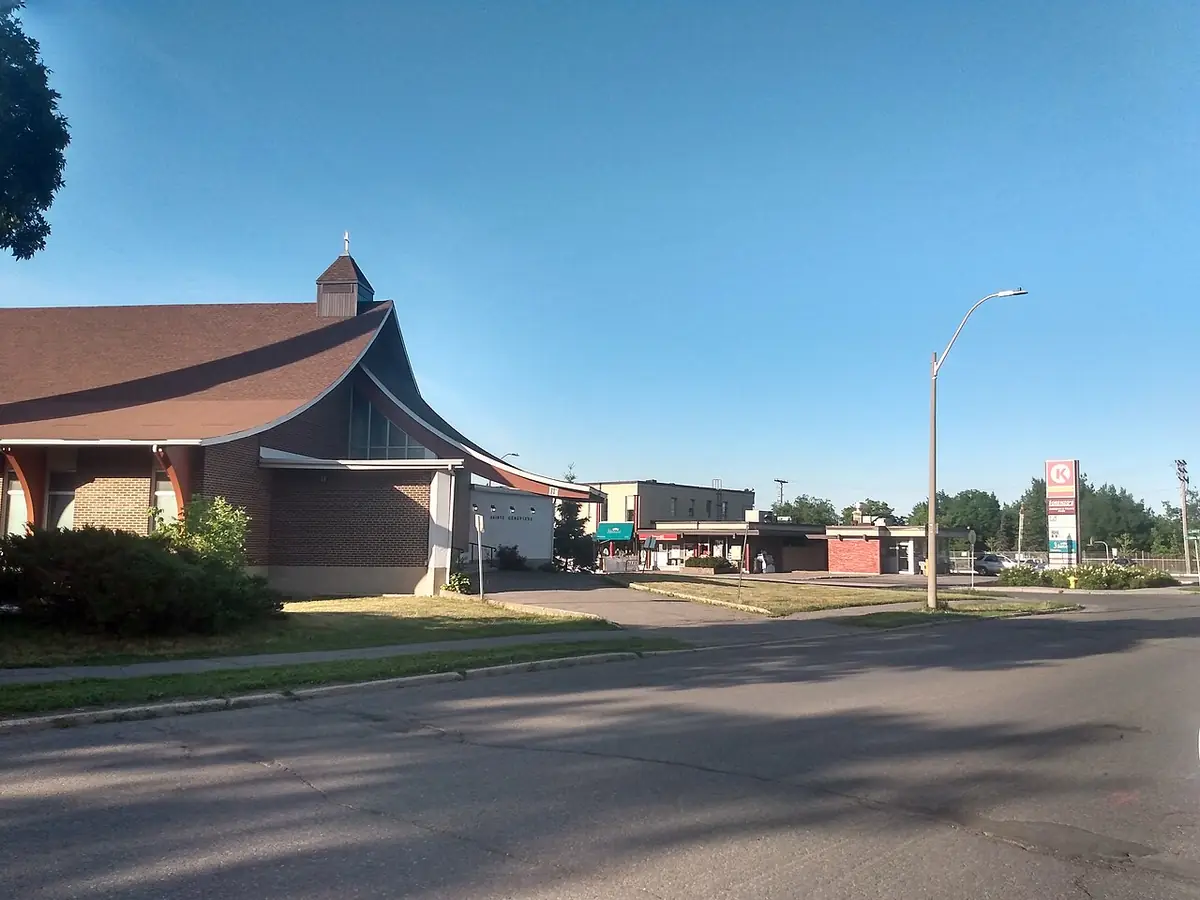
A neighbourhood church along an Ottawa street — Photo: Earl Andrew · CC BY-SA 4.0 · Wikimedia Commons
Beyond this well-oiled routine, some less visible aspects of the Ottawa market deserve particular attention.
To grasp what a property investment in Ottawa really means, it helps to follow an ordinary weekday from start to finish. Between morning journeys on congested arteries or aboard the O-Train light rail network, managing schooling in the French-language or English-language school boards, and access to primary health care, every neighbourhood sets its own rhythm. This typical timeline brings out the practical side: real travel times and the accessibility of the infrastructure a balanced family life in the Ottawa area depends on.
07:15Residential neighbourhood (Kanata or the Glebe, for example)Getting ready and checking live traffic conditions on the bridges across the river toward Gatineau or the routes into the federal downtown.
08:00Commute (O-Train or Highway 417)The daily run to the federal departments or the Kanata technology sector, using the bus-only lanes and the light rail.
09:30Health services and neighbourhood clinicsHandling routine medical appointments and registering with the local health networks, a crucial matter for newcomers to the region.
12:30Lunch break and local shopsA visit to historic public markets such as the ByWard Market, or to neighbourhood shopping arcades, for the week's supplies.
15:45Schools (public or Catholic school boards)Picking the children up after class, drawing on the diverse French and English educational options Ottawa is known for.
18:00Community activities and municipal parksUsing the municipal sports facilities, the outdoor rinks in winter or the bike paths along the Rideau Canal in summer.
What property listings never tell you about Ottawa
Ignoring these technical realities leads far too often to financial disappointments discovered much too late.
The polished photographs and glowing descriptions published on property platforms frequently leave out technical and regulatory realities that are fundamental in Ottawa. Whether it is strict heritage constraints in the central neighbourhoods, the particular geology of the clay soil or municipal snow-clearing policy, these elements are invisible at a glance yet have a direct impact on the long-term budget and on an owner's comfort. Here are the blind spots any serious buyer should investigate before committing.
The clay nature of Ottawa's soil and the risk of subsidence
A large part of the Ottawa region sits on sensitive Champlain Sea clay, a soil that shrinks in summer and swells in winter. The phenomenon regularly produces ground movement capable of damaging foundations and underground pipes, which calls for specialised camera inspections of the French drains.
If you buy an older property in sought-after areas such as Centretown, Sandy Hill or the Glebe, you will find that every exterior change, from the colour of the windows to the roofing material, is tightly controlled by the municipality. These constraints raise the cost of renovation work considerably and require complex administrative approvals.
Municipal snow-clearing policy and on-street parking bans
Through the winter season, the City of Ottawa frequently issues on-street parking bans during major snow-clearing operations (Winter Weather Parking Bans). Not having a private driveway large enough, or an assigned indoor parking space, will expose you to recurring fines and to having to move your vehicle at short notice.
The critical age of underground municipal infrastructure
Some established parts of Ottawa have ageing water and sewer networks dating back several decades. During heavy rain or fast spring snowmelt, sewer backup can occur, which makes installing backwater valves and taking out specific insurance endorsements absolutely essential for any owner.
The buying mistakes you only discover six months later in Ottawa
These hard lessons show that home ownership in Ottawa does not suit every buyer profile.
Looked likeA bargain in an outlying neighbourhood under rapid development, with guaranteed potential for a quick gain in value.
Turned outExplosive daily transport costs combined with monstrous jams on the bridges and main routes at peak times, turning every trip into a chore.
Would have caught itTiming the real commute at peak hours on a Tuesday in November before making an offer, and building the full cost of running a car into the monthly budget.
Looked likeA beautiful central condo with modest condo fees and an unobstructed view over the city, ideal for a young professional.
Turned outA dramatically underfunded reserve fund that led to a surprise special assessment of several tens of thousands of dollars shortly after moving in.
Would have caught itInsisting that an inspector or a specialist broker go through the full condominium declaration and the minutes of the general meetings before any offer goes firm.
Looked likeA charming older house full of character with a large wooded lot and mature trees in a green, quiet area.
Turned outRecurring water infiltration in the basement caused by an obsolete drainage system and invasive tree roots that had broken the drain pipes.
Would have caught itAlways hiring a certified home inspector to run a camera inspection of the underground drains before the conditions are waived.
Looked likeA fast purchase with no prior inspection in an overheated market, to get ahead of the competing buyers.
Turned outThe discovery of major hidden defects including a roof at the end of its life, failing insulation and an outdated electrical system that did not meet code.
Would have caught itNever waiving the building inspection condition, even under strong competition, or setting aside an emergency repair reserve immediately.
Who really should not be buying property in Ottawa right now?
With those warnings on the table, it is time to take a final view of your own plan in the capital.
Home ownership is often presented as the beginning and end of building personal wealth in Canada, but for some profiles it is a risky financial strategy. Swings in mortgage rates combined with the rigidity of Ottawa's housing market call for clear thinking. If your personal or professional situation carries certain marks of instability, buying a house or an apartment could turn into a financial sinkhole rather than a lever for building wealth. Here are the profiles for whom renting remains objectively the wiser choice.
The federal public servant on the move or on a temporary posting
→To pass on buying and favour a flexible rental downtown.
The transaction costs of buying and reselling a property in Ontario (notably the Land Transfer Tax and brokerage commissions) require a holding period of five to seven years to be absorbed. A quick professional transfer to another province would leave you with a net capital loss.
The young worker on a tight budget with no emergency savings
→To stay a tenant in order to preserve financial freedom.
Becoming an owner in Ottawa does not stop at the initial down payment. Having no cash reserve equivalent to several months of expenses to meet emergencies (a furnace repair in mid-winter, a roof failure) exposes the buyer to severe insolvency risk if something unexpected happens.
The speculative investor after immediate short-term rental returns
→To turn away from the Ottawa residential market in favour of other financial investments.
The ratio between current purchase prices in Ottawa and the rents achieved on the rental market generally does not allow positive cash flow once high mortgage interest, property taxes and maintenance costs are deducted.
So, are you really ready to take the step in Ottawa?
A calm end to the day beside the water in Ottawa — Photo: ContribQC · CC BY-SA 4.0 · Wikimedia Commons
At the end of this close look at Ottawa's housing market, it is clear that buying a house or an apartment is not an emotional impulse but a strategic decision to be thought through. The federal capital offers an exceptional setting, combining the economic stability of the public service, bilingual cultural richness and easy access to remarkable natural space. The success of your plan, however, rests entirely on the fit between your time horizon, your financial solidity and your capacity to shoulder the responsibilities that come with ownership in a demanding Ontario climate.
Take the time to check your figures with every hidden cost we have brought out folded in: property taxes, winter energy bills, condo fees and maintenance provisions. If your horizon in the region is under five years, or if your emergency savings would be left fragile by the down payment, renting remains a financially superior alternative that shields you from market swings and unforeseen maintenance costs.
If, on the other hand, your family and professional ties to Ottawa are firmly anchored, your budget carries a comfortable safety margin and you accept the practical constraints of maintaining a home, the Ottawa market offers durable opportunities to build wealth. Surround yourself with professionals of integrity (specialist home inspectors, independent brokers and financial advisers) to secure every step of your transaction and approach your move to the federal capital with peace of mind.
Related questions
What is a typical down payment for buying a house in Ottawa?
In Canada, the minimum required down payment depends on the purchase price of the property. For a home valued at $500,000, it is set at 5% on the first tranche, then 10% on the portion above $500,000. That said, to avoid having to take out mandatory mortgage loan insurance through CMHC, putting down at least 20% of the total value of the property is strongly recommended.
What closing costs should you budget for on a property purchase in Ontario?
Buyers in Ontario should budget closing costs of generally between 1.5% and 4% of the total purchase price. These costs include the provincial and municipal Land Transfer Tax, legal fees for the real estate lawyer handling the file, property appraisal fees, and pro-rated adjustments for property taxes and utility bills already paid by the seller.
Can you buy a property in Ottawa without an inspection?
Although highly competitive market conditions sometimes push buyers to submit firm offers with no inspection condition, the practice carries extremely high financial risk. Waiving the building inspection leaves you with no legal recourse if major hidden defects surface later, such as a failing structure, water infiltration problems or a roof that needs urgent replacement.
How do municipal property taxes work in the City of Ottawa?
Property taxes in Ottawa are calculated by multiplying the municipal assessed value of your property (set by the Municipal Property Assessment Corporation, or MPAC) by the tax rate the city council sets each year. Those taxes fund essential public services, road infrastructure, the public transit network and the city's emergency services.
Which neighbourhoods are most sought after for buying a detached house in Ottawa?
The most prized areas for buying single-family homes include established, central neighbourhoods such as The Glebe, Westboro and Hintonburg for their cultural energy, along with residential suburbs known for excellent schools such as Kanata, Barrhaven and Orleans, which are popular with families and technology professionals.
What is the difference between a condo and a freehold townhome?
A condominium townhome involves shared ownership of the common elements and a monthly fee paid to a condominium corporation for exterior upkeep. A freehold townhome, by contrast, belongs to you outright, land included, which means you manage and pay for all of the maintenance yourself without any monthly condo fees.
How does Ottawa's winter climate affect property maintenance?
Ottawa's harsh winters subject buildings to intense freeze and thaw cycles that can cause foundation cracks, ice build-up on roofs (ice dams) and water infiltration in the spring. Owners also have to plan for regular snow clearing of driveways and keep a close eye on their heating systems.
Is it better to buy an older house or new construction in Ottawa?
Older houses in the central neighbourhoods offer distinctive architectural character and services right on the doorstep, but often call for substantial renovation budgets. New builds, generally on the outskirts, come with modern energy performance and builder warranties, but usually sit on smaller lots.
What role does the O-Train system play in Ottawa property values?
The O-Train light rail transit (LRT) network has a major influence on local property values. Homes within walking distance of Line 1 and Line 2 stations have historically shown stronger rental demand and greater resilience to market swings, since proximity to structuring transit is a decisive criterion for commuters.
What government support exists for first-time buyers in Ottawa?
First-time buyers in Canada can draw on several federal and provincial programs, notably the First Home Savings Account, which lets you save toward a first property shielded from tax, the Home Buyers' Plan, which lets you withdraw funds from your RRSP without penalty, and various tax credits for the purchase of a first home.
Property review of ting
No ting properties in Ottawa yet
Be the first — share it on ting and it shows up right here.