Buying an apartment in Ottawa means understanding the dynamics particular to Canada's federal capital, where institutional stability meets a demanding climate. This guide sets out the essential mechanics for securing your purchase, from reading the neighbourhoods to handling condominium ownership.
Get the app
What nobody tells you.
Real prices, hidden costs and the traps to check before you commit.
Buying an apartment in Ottawa: institutional stability against market reality
Scroll
Buying an apartment in Ottawa: institutional stability against market reality
Buying an apartment in Ottawa means understanding the dynamics particular to Canada's federal capital, where institutional stability meets a demanding climate. This guide sets out the essential mechanics for securing your purchase, from reading the neighbourhoods to handling condominium ownership.
Written by the ting.ad editorial team ·
Elgin Street, Ottawa in Street View: drag to look around.
That duality between institutional security and operating constraints reshapes how you should approach every neighbourhood.
Investing in Canada's federal capital does not follow the same logic as investing in a financial hub such as Toronto or Vancouver. Ottawa's property market rests on a solid, predictable economic frame, carried largely by the federal public service and state institutions. That institutional stability does not, however, translate into instant liquidity or aggressive speculative returns. A buyer has to weigh the perceived security of institutional employment against the reality of a housing stock with its own climatic and regulatory constraints.
An economy anchored in the public service and in technologyvsA market with little speculation and slow valuation cycles
The heavy presence of federal departments guarantees a pool of highly qualified jobs and stable incomes. That same structure shields the market from spectacular price spikes, but it also limits the scope for quick short-term gains for investors.
A varied and well-structured stock of condominiumsvsHigh condo fees driven by the cost of winter energy
Recent and older buildings alike offer clear legal structures framed by Ontario legislation. In exchange, heating and snow clearing weigh heavily on the common expenses that condominium corporations carry throughout the year.
Urban quality of life with nature immediately at handvsA dependence on transport corridors and harsh winters
The city strikes a remarkable balance between green space, navigable canals and cultural energy. Even so, winter conditions impose serious logistical constraints on travel and on the upkeep of residential buildings.
Which kind of buyer are you in the Ottawa property market?
Understanding your own profile lets you measure the cultural and regulatory gap against the reference points you arrived with.
Buying an apartment in Ottawa is a different exercise depending on whether you want a functional weekday base, a lasting family home or a steady rental asset. Every kind of buyer has to test their expectations against the planning and tax realities of the province of Ontario, or face financial and practical disappointment.
A working buyer centred on the workplace
You want to be right beside the decision-making centres and the transit corridors such as the O-Train. In that case, an apartment in the downtown core or in Centretown is the obvious target for cutting daily travel time. You accept smaller floor areas and higher condo fees in exchange for a walkable life and strong potential rental demand if you later resell.
A resident seeking the quiet of leafy neighbourhoods
You would rather move slightly out from the very centre to get quiet residential streets, parks and well-regarded schools while staying inside the city. Areas such as Westboro or the Glebe answer that need, but they demand a clearly higher budget for condominiums of modest size. The compromise is on living space and on needing a vehicle for some trips out of the core.
An investor with a long horizon
Your main aim is preserving capital and collecting regular rent underwritten by the strength of the local economy. You target studios or two-bedroom apartments near the university campuses or the big administrative hubs. That strategy means watching municipal rental rules very closely and anticipating the effect of interest rates on your net return.
Buying in Ottawa when you arrive from abroad: reading the local practice
Ottawa's river-lined green spaces, seen from above — Photo: Harleyd613 · CC BY-SA 4.0 · Wikimedia Commons
Once those reference points are in place, choosing the district becomes the real pivot of your project.
The Canadian and Ontario property system differs structurally from what buyers know in many other countries. Carrying over the reflexes you built elsewhere leads almost inevitably to misjudgements, whether in reading contracts, in what the professionals actually do, or in the day-to-day technical management of the building.
From abroad
Living area defined by a certified floor-area measurement and by separate, partitioned rooms
Ottawa
Measurement in square feet, often including open-plan living space and balconies
Volumes look more open, but you need to read the plans carefully to judge the real private area and how well storage is used.
From abroad
A single notary who drafts the deed and secures the whole transaction
Ottawa
Specialist real estate lawyers acting separately for each side
Checking title and any charges rests on a thorough legal review run by your own counsel, which brings its own fees and timelines.
From abroad
A conventional co-ownership run by a professional building manager under the general meeting
Ottawa
The condominium corporation, governed by a board of directors elected from the owners
Financial management of buildings is extremely rigorous and documented through mandatory technical audits (the reserve fund study) that you absolutely must read before buying.
From abroad
Mandatory technical reports supplied by the seller when the preliminary contract is signed
Ottawa
A general rule of buying as-is, with the pre-purchase inspection entirely down to the buyer
You must build in an inspection condition carried out by a certified professional to identify hidden defects or heavy work coming down the line.
Mapping Ottawa's neighbourhoods: trading energy against setting
Those neighbourhood dynamics feed straight into the structure of prices and charges at purchase.
Ottawa's urban geography is organised around the Rideau Canal and the Ottawa River, drawing out micro-regions with sharply distinct identities. Choosing your apartment means weighing transit access, local retail life and residential quiet, because each area imposes its own financial compromises.
Downtown and Centretown
A dense urban rhythm, shaped by being right beside the federal offices, the shops and the light rail lines.
Suits
Working buyers who want to cut daily commuting to nothing and reach cultural life on foot.
Trade-off
Higher prices per square foot, often compact condominium units, and nightlife that can be lively.
The Glebe and Old Ottawa South
The feel of an upmarket residential village, lined with parks, independent shops and historic houses.
Suits
Families and buyers who want a green setting, well-regarded schools and strong long-term value.
Trade-off
Condominium apartments here are rarer and much sought after, which drives high valuations and strong competition.
Westboro and Hintonburg
A lively, fashionable hub combining contemporary design, specialty coffee and direct access to the riverbank.
Suits
Buyers drawn to modern architecture, active lifestyles and a creative local community.
Trade-off
Constant market pressure that pushes prices up and narrows the openings for mid-range budgets.
ByWard Market and Lowertown
A buzzing historic quarter, set by the rhythm of the country's oldest open-air public market and a dense choice of places to eat.
Suits
Those who want constant activity, architectural history and complete walkability.
Trade-off
Coexisting with the nightlife and the social pressures of the city centre can be awkward, so the building itself has to be chosen carefully.
Costs and charges for buying an apartment in Ottawa
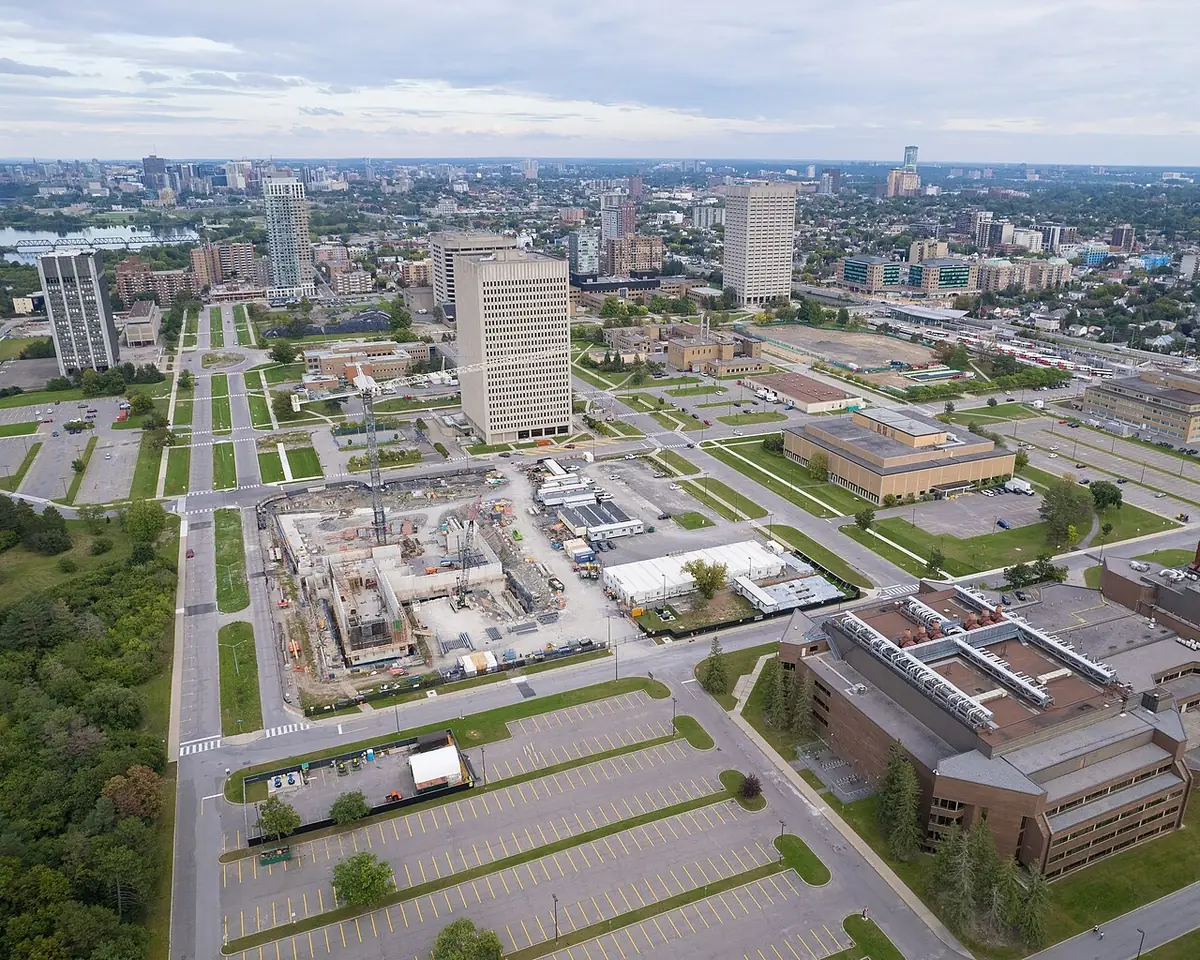
A quiet Ottawa neighbourhood, seen from the air — Photo: Harleyd613 · CC BY-SA 4.0 · Wikimedia Commons
Beyond the pure financial equation, the legal form of ownership deserves careful analysis.
Budgeting for a property purchase in Ottawa does not stop at the headline figure on the listing. A buyer has to fold in a series of unavoidable extra costs, from municipal property taxes to monthly condo fees and the land transfer tax collected by the province.
ottawaFor saleApartmentestimate
Median price / m²CA$4,845Half the apartments sell below this
Median priceCA$425kthe average is 14% higher — a few very large properties pull it up
Most common2 bedrooms45 % of listings
Average size83 m²
By number of bedrooms
Bedrooms
Share of market
Avg price
Price / m²
Avg size
1
34 %
CA$352k
CA$5,865 +15 %
60 m²
2most common
45 %
CA$434k
CA$5,100
85 m²
3
17 %
CA$522k
CA$4,743 −7 %
110 m²
4
4 %
CA$643k
CA$4,590best value / m²
140 m²
Each row is an average, compared against the area average of CA$5,100 / m². These are indicative estimates of a typical local market, not a measured sample of live listings. Check current listings before relying on them.
Your unit or the common elements: understanding what you legally own
That administrative rigour applies at every stage in the chronology of the transaction.
Accepting the rules of an Ottawa condominium means giving up absolute architectural sovereignty over your home. The line between your own unit and the common elements is tightly drawn by Ontario law, which bears directly on your freedom to renovate and on how technical surprises are handled.
Your own unit and the limits on altering it
You own the interior space bounded by the bare party walls, the interior floors and the ceilings of your unit. Any change touching the load-bearing structure, the main plumbing or the external appearance of windows and balconies needs formal approval from the condominium's board of directors.
What it changesYou keep complete freedom over interior decoration and non-load-bearing partitions, but heavy renovation plans must go through the building's rules.
The common elements and collective management
The foundations, the roof, the corridors, the elevators and the outdoor spaces belong to the condominium collectively. The reserve fund, fed by a share of your monthly fees, pays for major repair work planned over the long term by consulting engineers.
What it changesA rigorous reserve fund study protects you from the unplanned special assessments that arrive when the condominium lacks the cash to repair a failing structural element.
The critical timeline of a purchase: from offer to taking possession
A waterfront restaurant along Ottawa's riverside — Photo: SpaceplaneSus · CC0 · Wikimedia Commons
To see that journey through, the coordinated work of the various local players is indispensable.
Under the Ontario system, signing an agreement of purchase and sale creates a binding mutual commitment from the moment the seller accepts it. Unlike some other practices, there is no statutory cooling-off period once the agreement is concluded, so every condition has to be negotiated up front with absolute precision.
Drafting the initial offer to purchase through your broker
Inserting the conditions you cannot do without, including a full technical inspection of the building and final approval of mortgage financing by a recognised financial institution.
Paying the good-faith deposit once the offer is accepted, held in the real estate brokerage's trust account until the conditions are satisfied.
A thorough review of the condominium's status certificate by your lawyer, to confirm the corporation's financial health, its litigation history and the state of the reserve fund.
Formally waiving the conditions within the strict deadlines set out in the contract, which turns the conditional offer into a firm and final commitment for both sides.
Signing the transfer documents at your lawyer's office and taking the keys on the closing date.
How the transaction unfolds: who does what, and in what order
A successful purchase in Ottawa rests on a clear division of roles between the real estate agent, the home inspector and the specialist lawyer. Each of them works inside a strict framework set by Ontario law, which underpins the buyer's legal and financial security from the start through to the handover of the keys.
The buyerSetting the budget and getting a mortgage pre-approvalThey confirm their borrowing capacity with a bank or a mortgage broker before viewing the first property on the market.
The real estate brokerShortlisting properties and negotiating the contract termsThey identify apartments matching the criteria, draft the offer to purchase and defend their client's interests in the price negotiation.
The home inspectorTechnical assessment of the unit and the condominiumThey go through the plumbing, the electrics, the windows and the building envelope in detail to find hidden defects.
The real estate lawyerTitle search and review of the status certificateThey confirm there are no undisclosed liens or mortgages and validate the condominium's legal and financial standing.
The financial institutionReleasing the mortgage fundsIt transfers the money directly to the buyer's lawyer's trust account on the official closing date.
The lawyerRegistering the transfer on the land registerThey complete the official registration of the transfer of ownership with the competent Ontario authorities and hand the keys to the buyer.
Choosing between a condominium apartment and a detached house in Ottawa
Once the type of property is settled, the central question of total cost of ownership comes straight to the front.
Buying a condominium apartment in central Ottawa, or in Centretown and the ByWard Market, forces financial and practical trade-offs quite different from buying a single-family house in a suburb such as Kanata or Orléans. On one side, condominium living removes exterior upkeep, shovelling heavy snowfalls and cutting the summer lawn, jobs that eat a great deal of time through the hard Ontario winters. In exchange, monthly condo fees join your fixed budget and rise inevitably as the building ages, quite apart from the special assessments sometimes voted to redo the roof or the underground garage system.
On construction and sound insulation, new downtown buildings use reinforced concrete and strict building standards to limit noise between neighbours, while older towers can suffer from more audible floor noise. Condominium townhouses often make an interesting middle ground, giving you a small piece of private land and your own entrance while sharing the upkeep of the roof and the exterior foundations. An investor, or anyone used to urban living, also has to weigh the effect of Ottawa's municipal property tax, which varies slightly with the assessed value in the area and the local services the City provides.
Resale in the medium term weighs heavily in that balance. Apartments near future O-Train stations or the federal departments generally keep better liquidity and draw a steady pool of young professionals and retirees looking to downsize. Detached houses, by contrast, give far more latitude for structural renovation and often a faster appreciation in land value, but they demand constant physical and financial involvement to keep the fabric in good order. Choosing between these two ways of living in Ottawa comes down in the end to a trade between total freedom of management and the predictability of a life without heavy maintenance.
You also have to factor in the condominium rules, the bylaws, which tightly govern short-term rental, keeping pets and the use of balconies or common spaces. Some buyers find those constraints rigid, yet they are what protects the quiet and the collective value of the building. In a market like Ottawa's, where winters put particular technical strain on buildings, the financial strength of the condominium's reserve fund remains the decisive test between two otherwise comparable purchases.
Working out the real budget for living in an Ottawa apartment
Understanding these figures lets you map out a typical week in the capital in precise terms.
Buying an apartment in Ottawa is not just the mortgage amount your bank approves. You have to fold in all the recurring and exceptional charges that make up the total cost of ownership over a full year. Local market data show that condo fees, municipal property tax and insurance take a decisive share of the monthly budget. Neglecting those side items leads quickly to cash-flow trouble, especially when the condominium votes a special assessment for major work.
Monthly and annual cost items for an apartment in Ottawa
Budget item
Estimated range
Frequency
Effect on running the property
Condo fees
$400 to $850
Monthly
Covers upkeep of the common elements, snow clearing and sometimes heating or water.
Ottawa municipal property tax
$3,500 to $6,500
Annual
Calculated from the city's property assessment and the mill rate in force.
Home insurance (owner-occupier)
$45 to $90
Monthly
Covers personal belongings and the liability cover that sits alongside the building's own policy.
Electricity and supplementary heating
$80 to $180
Monthly
Varies with floor area, the apartment's orientation and whether it is included in the fees.
The figures shown are indicative averages observed in the Ottawa market for a standard two-bedroom apartment. Condo fees tend to rise 3% to 5% a year to absorb maintenance cost inflation and the demands of topping up the reserve fund.
What daily life looks like in an Ottawa apartment
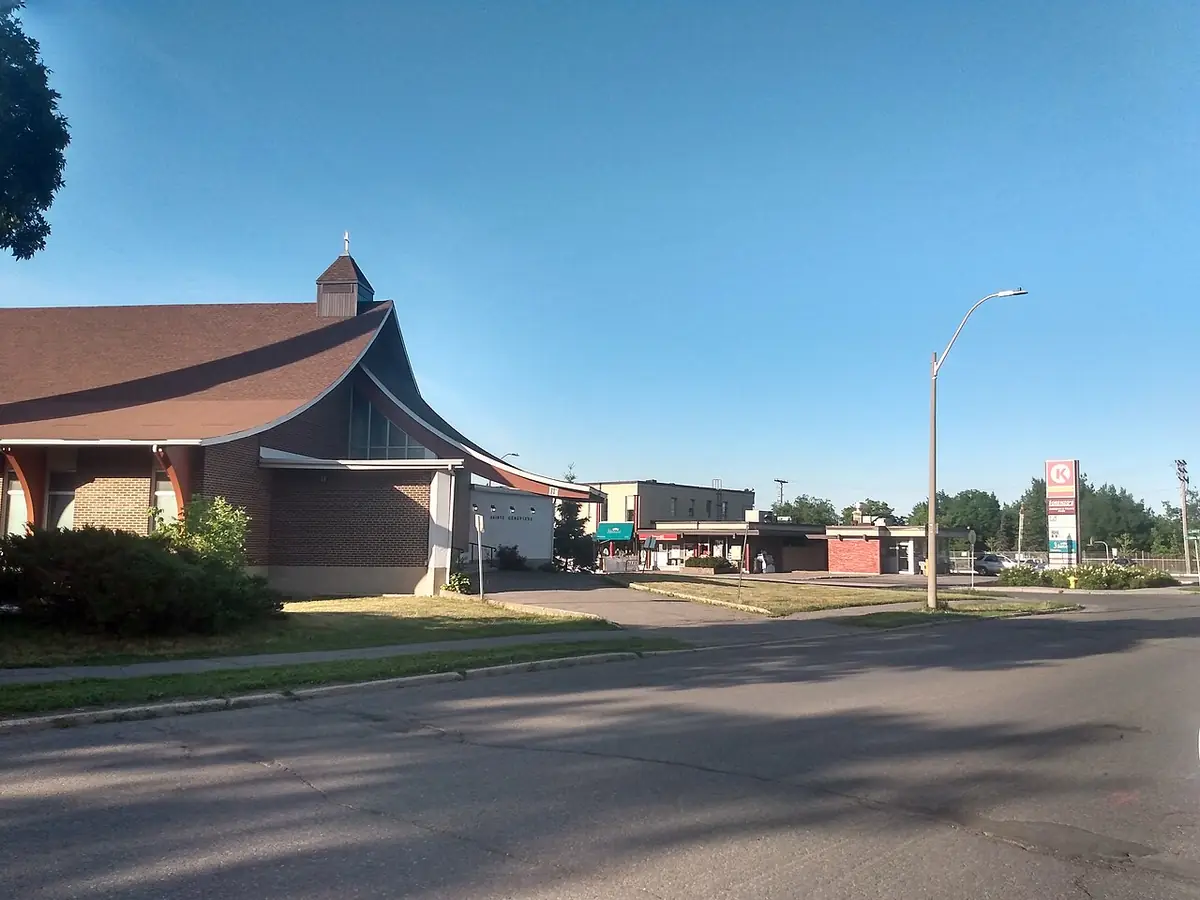
A neighbourhood church along an Ottawa street — Photo: Earl Andrew · CC BY-SA 4.0 · Wikimedia Commons
Beyond that apparent smoothness, some less visible aspects deserve close attention before you sign.
Living in an apartment in downtown Ottawa or along the transit corridors changes the rhythm of the day considerably. Having no outdoor chores frees up real time, while being close to services and O-Train stations simplifies the commute. This walk through an ordinary Tuesday shows concretely how home, transport and neighbourhood life fit together in the federal capital.
07:30Apartment, CentretownYou wake without having to clear the entrance or dig out the car; heated underground parking lets you leave straight away on the coldest Ontario mornings.
08:15O-Train station (Line 1)A few minutes on foot to the station and onto the light rail network, which serves the parliamentary district and the main employment areas efficiently.
12:30ByWard Market, central districtLunch in one of the many nearby cafes or public markets, making the most of the retail density and the pedestrian bustle of the city's historic quarter.
17:30Local grocer or city supermarketEnd-of-day shopping made easy by shops within walking distance or two transit stops away, avoiding long drives out to the suburban malls.
19:00Building's shared space (gym)Using the exercise equipment or the roof terrace provided by the condominium, which saves paying for an outside fitness club.
21:00Apartment, living roomA quiet evening thanks to the reinforced sound insulation of concrete construction, without the mental load of major roof or foundation repairs that weighs on house owners.
What brochures and apartment viewings in Ottawa leave out
Those blind spots explain why some buyers sour on the purchase within months of moving in.
Apartment viewings in Ottawa are staged to show off the light, the interior finishes and the open view over Parliament Hill or the Rideau Canal. Yet it is the invisible technical condition and the administrative management of the condominium that dictate the real quality of living there long term. Studying the state of the building and its internal rules is what keeps major financial disappointments away after the deal closes.
The true state of the condominium's reserve fund
An underfunded or out-of-date reserve fund study means large special assessments will be demanded before long to replace the elevators, the roof or the windows, turning a controlled budget into an unplanned money pit.
Strict limits on renting and on pets
The building's internal rules may flatly ban short-term rental on platforms such as Airbnb, or set strict limits on the weight and number of pets, which changes your plans for living there or letting it out.
The real level of sound insulation between floors
Impact noise from the unit above is the number one complaint among condominium owners. Buildings put up in certain decades suffer from looser acoustic standards that are unforgiving day to day.
Future construction projects right next door
A vacant lot or a surface parking lot beside the property will probably become a residential tower in the coming years, destroying your view and generating prolonged construction noise.
Exactly how parking spaces and lockers are allocated
The space assigned to you may turn out to be cramped, badly placed against a structural column, or unusable for the large sport utility vehicles that are very common in Ontario, which cuts the practical value of the unit.
The classic traps and buyer regrets after six months in an Ottawa apartment
Against those risks, it matters just as much to know whether this kind of purchase truly suits you.
Looked likeAn ultra-modern apartment with very low, attractive condo fees, ideal for a first purchase.
Turned outLax management by the condominium corporation, which had failed to set money aside for roof work, leading to a special assessment of $15,000 per owner in the first year.
Would have caught itInsisting on a full review of the reserve fund study by an inspector who specialises in condominiums before waiving the purchase conditions.
Looked likeAn ideal central location a step from the main road corridors and downtown Ottawa.
Turned outUnbearable night-time noise from emergency vehicles and the constant passage of municipal snowploughs through the winter.
Would have caught itVisiting at different times of the day and night, and checking which way the windows face and how good the double glazing is.
Looked likeA compact but perfectly laid out floor plan for a couple with no children.
Turned outA severe shortage of private storage inside the apartment, and a basement locker that was damp and awkward to reach.
Would have caught itChecking for built-in wardrobes and personally inspecting the assigned basement locker at the final walk-through.
Looked likeA building with an indoor pool and appealing high-end amenities.
Turned outAgeing facilities permanently closed for breakdowns or code failures, while still pushing the condo fees up.
Would have caught itReading the minutes of the last three years of general meetings to spot recurring breakdowns and disputes.
The buyers who should avoid buying an apartment in Ottawa
It is time to pull these threads together and settle where you stand on the purchase.
Buying a condominium apartment does not suit every way of life or every financial situation. The constraints of communal living and the structure of fixed costs call for a particular kind of buyer. Ignoring those mismatches leads almost certainly to friction with the neighbours and to a quick sense of being hemmed in at home.
Committed do-it-yourselfers who love big exterior renovation projects
→A single-family house with its own land in the Ottawa suburbs
Condominium rules forbid any change to the facade, the balconies or the interior structure without formal, and often laborious, board approval.
Owners with several large vehicles or work trailers
→A property with a double garage and a large outdoor driveway
Condominium underground garages have strict clearance heights, and additional spaces are extremely rare, if they can be bought separately at all.
People who want nothing to do with collective governance and strict rules
→A detached house on the edge of town or in the rural Ottawa Valley
Condominium living means submitting to majority decisions taken at general meetings and following house rules that can be fussy.
Families with young children who want a large, secure private garden
→A townhouse with a fenced back yard
Condominium apartments rarely offer direct private access to a grassed outdoor space, which pushes children's play out to shared municipal parks.
Pulling it together: the final call on your Ottawa apartment
A calm end to the day beside the water in Ottawa — Photo: ContribQC · CC BY-SA 4.0 · Wikimedia Commons
Deciding to buy an apartment in Ottawa means testing your lifestyle ambitions against the financial and administrative realities of Ontario condominium ownership. If you want to be free of winter snow clearing, to live right beside structuring transit such as the O-Train and to keep your daily travel time under control, the urban apartment is a formidably sensible option. The central neighbourhoods offer cultural and professional energy that keeps pragmatic buyers happy for years.
If, on the other hand, your plans call for wide freedom to alter the building, private outdoor space for your children, or if you have a marked aversion to collective rules, you should redirect your search towards a detached house or a townhouse. The Ottawa market rewards those who buy with their eyes open, after combing through the condominium's financial documents and thinking ahead to how their needs will change over five or ten years.
Your approach should therefore rest on a rigorous check of the real charges, a thorough analysis of the reserve fund and a clear-eyed assessment of your tolerance for internal rules. Never let yourself be dazzled by a staged interior or the buzz of an open house. Demand documentary transparency and surround yourself with competent local professionals to validate every technical step of the transaction.
In the end, a successful purchase in Ottawa is not the one that impresses your friends with its floor area, but the one that fits your long-term budget and quietly supports your daily life. Take the time to weigh each trade-off, visit against the grain, read the condominium minutes line by line, and you will step through the door of your new apartment with confidence and no regrets.
Related questions
What are the average condo fees for an apartment in Ottawa?
Monthly condo fees in Ottawa generally run between $400 and $850 depending on the size of the unit, the age of the building and the services included, such as heating, water or access to a pool. These amounts rise steadily to feed the mandatory reserve fund set aside for major building repairs.
How is municipal property tax calculated for an apartment in Ottawa?
Property tax is calculated by multiplying the current assessed value of your apartment by the mill rate voted each year by the City of Ottawa. Annual amounts commonly fall between $3,500 and $6,500 for standard apartments in the central districts.
Is a home inspection mandatory before buying an apartment in Ontario?
An inspection is not strictly required by law in Ontario, but it is strongly recommended by every broker and property expert. For an apartment, the inspection should cover both the interior condition of the unit and a review of the condominium's administrative and financial documents.
What is a reserve fund study in an Ottawa condominium?
The reserve fund study is a mandatory technical report produced every three years by engineers or qualified experts. It assesses the condition of the building's common elements and determines how much must be saved to cover future major replacements without imposing excessive special assessments.
Are pets allowed in every apartment building in Ottawa?
No. A condominium's internal rules (the bylaws) can impose strict limits on whether pets are permitted at all, and on their number or weight. If you have an animal, you must read those rules before signing an agreement of purchase and sale.
What does a special assessment in a condominium mean for me?
A special assessment is an extraordinary amount voted by the board of directors and demanded from owners to fund a reserve fund shortfall or urgent unplanned work, such as redoing the roof or the underground garage. It can reach several thousand dollars per owner.
How does parking work in Ottawa apartment buildings?
Most downtown Ottawa apartments have underground parking whose use is either included in the condominium declaration or held as a separate unit. Check the clearance height and the exact location of the space assigned to you so there are no unpleasant surprises.
Can you rent out your Ottawa apartment on Airbnb?
Short-term rental is tightly regulated by the City of Ottawa and very often banned outright by a condominium's internal rules, in order to protect the quiet and security of permanent residents. Breaking those rules exposes the owner to heavy fines.
Which Ottawa neighbourhoods offer the best apartments for investment?
Centretown, the ByWard Market, the Glebe and Hintonburg concentrate the strongest rental demand and sit close to O-Train stations and to the federal employment pools, which underpins excellent long-term liquidity.
How long does it usually take to close on an apartment in Ottawa?
The usual interval between acceptance of an agreement of purchase and sale and taking possession (the closing) runs between 30 and 90 days in Ottawa. That period allows the conditions on inspection, financing and a thorough review of the condominium documents to be satisfied.
Property review of ting
No ting properties in Ottawa yet
Be the first — share it on ting and it shows up right here.