Investing in property in Delhi calls for a careful look at the neighbourhoods, the legal framework and the realities on the ground. This guide walks you step by step through structuring your apartment purchase in the Indian capital with your eyes open.
Get the app
What nobody tells you.
Real prices, hidden costs and the traps to check before you commit.
What you really get when you buy an apartment in Delhi
Scroll
What you really get when you buy an apartment in Delhi
Investing in property in Delhi calls for a careful look at the neighbourhoods, the legal framework and the realities on the ground. This guide walks you step by step through structuring your apartment purchase in the Indian capital with your eyes open.
Written by the ting.ad editorial team ·
Sale Apartment Delhi in Street View: drag to look around.
That tension between opportunity and constraint shapes the whole market and feeds directly into your choice of where to live.
Buying property in the Indian capital is about more than acquiring square metres. You are entering a complex market where urban density plays out across neighbourhoods with very different dynamics. The promise of attractive rental yields runs up against demanding administrative realities that deserve an honest look. Between the energy of the business districts and the relative calm of the residential enclaves, every purchase redefines your relationship with the city. You need to understand how land ownership works before you can hope to anchor a lasting investment here. Buying property in Delhi is a long-term commitment that calls for a close reading of the changes under way.
An unbeatable central locationvsDemanding day-to-day management
Living in or owning at the heart of the city gives you immediate access to the economic and cultural hubs. In return, the noise, the heavy traffic and the crowded public space force constant compromises on your quality of life outside your front door.
Real potential for long-term appreciationvsComplex local legal issues
Scarce land in established neighbourhoods supports property values over the long term. Checking title deeds and compliance with local planning rules, however, requires rigorous legal support to make the transaction safe.
Integrated, secure servicesvsHigh entry and maintenance costs
Gated communities and managed colonies offer a protected setting with tighter security and private facilities. Those services come with substantial maintenance charges and a price per square metre well above the average.
What kind of buyer are you, given the realities of Delhi property?
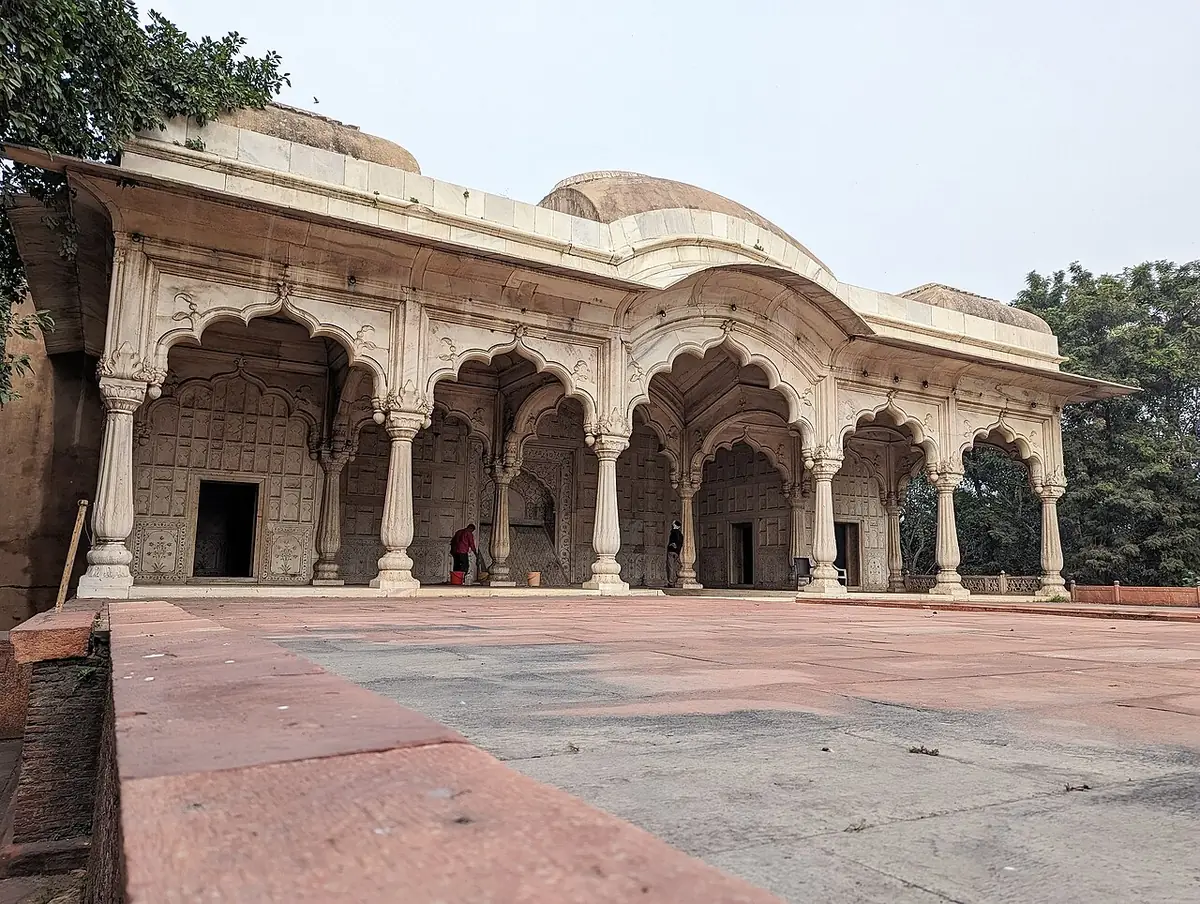
The Shah Burj pavilion inside the Red Fort in Old Delhi — Photo: Sourabh.biswas003 · CC BY-SA 4.0 · Wikimedia Commons
Once you know your profile, it is worth measuring the cultural and practical gap between what you know back home and the Indian property environment.
The right property depends above all on your relationship with the city and how well you tolerate its pace. Housing options suit very different profiles, from the expatriate executive looking for standardised comfort to the seasoned investor wanting to put down lasting roots in the local market. Each situation involves specific trade-offs on location, type of building and the services that come with it. There is no single answer, only a fit between your personal expectations and the reality on the ground. Looking honestly at how you live today is the first step to avoiding disappointment after the purchase.
Upmarket managed residence
For professionals and investors who are away for part of the year, a gated complex with round-the-clock security and built-in rental management is essential. This type of property removes the hassle of routine upkeep and keeps things safe while you are gone. Services often include coworking space, a gym and a concierge. The trade-off is high fixed charges and a standardised architecture far removed from traditional local housing. It is the choice of operational peace of mind over complete independence.
Townhouse or large apartment in an enclave
Settling in Delhi for the long term with children means favouring quiet neighbourhoods with green space, close to international schools and healthcare centres. Low-rise complexes and gated residential estates offer inner courtyards and a setting shielded from the bustle outside. You will have to accept sometimes long journeys to reach the central business districts at rush hour. Neighbourhood life is stronger there, which helps you fit in socially and build a stable routine. It is the option that puts everyday wellbeing and family stability first.
Compact apartment near the economic hubs
If your main goal is steady rental income, the ideal target is a studio or one-bedroom apartment close to the metro, business centres or universities. Rental demand there is strong and consistent, which avoids long empty periods. In return, competition between landlords is fierce and tenants turn over often, so you will need to manage actively or use a specialist agency. Room to negotiate on the purchase price is often narrower in this sought-after segment. Your first priority should be the build quality and energy efficiency of the building.
Buying in Delhi from abroad: what really changes
That cultural shift goes hand in hand with a crucial geographical choice: finding the neighbourhood that suits your lifestyle.
Buying property in India differs radically from Western standards, both legally and in the very idea of what a home is. Ownership, maintenance charges and relations with neighbours follow their own cultural and regulatory codes. What you might take for granted back home, whether construction guarantees or transaction timelines, calls for extra vigilance and cultural adjustment here. Understanding these structural gaps lets you approach the Indian market clearly and avoid the most common misjudgements.
From abroad
A single, highly codified and protective conveyancing framework
Delhi
A complex land registration system involving multiple title checks
You must hire a specialist local lawyer to audit the property's full history over several decades before signing any commitment.
From abroad
Predictable service charges voted at a general meeting
Delhi
Neighbourhood management bodies (Resident Welfare Associations) with wide-ranging powers
The amount and split of charges for common-area upkeep and security can change quickly depending on the community's internal decisions.
From abroad
Strictly regulated measurement of living space
Delhi
Widespread use of 'super built-up' area, which includes a share of the common areas
Learn to ask for and calculate the actual usable area (carpet area) so you do not pay top price for corridors or load-bearing walls.
An independent technical inspection, often arranged by the buyer
Always have a professional check the plumbing, the electrics and the backup water and power systems.
Which Delhi neighbourhood suits your lifestyle?
Once you have narrowed down the area, it is time to look at the financial reality of these markets and the price ranges seen there.
Delhi is an archipelago of neighbourhoods with strong identities, each striking a different balance between accessibility, calm and services. The neighbourhood you choose shapes not only your daily life but also how easily you can sell the property later. There is no point looking for the perfect area; you need to find the one whose compromises suit you best. From the leafy enclaves of the south to the denser commercial districts, a clear overview helps guide your decision.
South Delhi (Greater Kailash, Vasant Vihar)
A green, residential and airy setting, dotted with neighbourhood markets and well-kept parks.
Suits
Families and buyers looking for a safe, green setting close to international facilities.
Trade-off
Some of the highest prices per square metre in the capital and fierce competition for quality homes.
Central Delhi (Connaught Place and surroundings)
Constant institutional and commercial buzz, at the heart of the historic and administrative corridors.
Suits
People who put a central location first, want to be near government offices and enjoy a lively urban life.
Trade-off
Very high density, considerable noise and a chronic shortage of new residential property.
Dwarka and the western outskirts
Large planned estates laid out along wide avenues, with modern complexes and open spaces.
Suits
First-time buyers and budgets looking for more space and newer facilities at a lower cost.
Trade-off
Longer daily commutes to the central business district and an urban atmosphere that can feel impersonal.
How much does an apartment in Delhi really cost?
Beyond the price tag, the legal nature of the property you are buying deserves particular attention.
Prices in the Delhi property market vary enormously depending on the exact location, the age of the building and how upmarket the complex is. No single price grid is possible, given the gulf between a private enclave in the south of the city and a developing outer district. The figures below reflect trends for properties with clean title, excluding legal fees and local registration taxes. Knowing these orders of magnitude will save you from exploring segments beyond your budget.
DelhiFor saleApartmentestimate
Median price / m²₹114,000Half the apartments sell below this
Median price₹14.5mthe average is 14% higher — a few very large properties pull it up
Most common2 bedrooms38 % of listings
Average size120 m²
By number of bedrooms
Bedrooms
Share of market
Avg price
Price / m²
Avg size
1
18 %
₹7.78m
₹129,600 +8 %
60 m²
2most common
38 %
₹12.6m
₹120,000
105 m²
3
32 %
₹16.5m
₹114,000 −5 %
145 m²
4
12 %
₹22.1m
₹110,400best value / m²
200 m²
Each row is an average, compared against the area average of ₹120,000 / m². These are indicative estimates of a typical local market, not a measured sample of live listings. Check current listings before relying on them.
What you can actually own: freehold versus long leasehold
The same legal rigour applies to every stage of the transaction, from the first offer to the final deed.
The legal form of your purchase in Delhi determines not only your rights of use but also your ability to sell or pass on the property. The Indian market draws a clear line between several land tenure systems, and confusing them can lead to serious setbacks. Understanding the difference between freehold land and a long lease (leasehold) is an absolute prerequisite before committing any money. This legal reality shapes the value of your investment over the medium and long term.
Freehold ownership
This system gives you full ownership of the property and its share of the land with no time limit. It is the most sought-after and most secure form for a long-term investor, as it offers complete freedom to sell, renovate and pass the property on to heirs with no additional ground rent.
What it changesYou hold a fully secure asset whose resale value depends only on the market and the appeal of the location.
Leasehold ownership
Common in some planned parts of the city, this arrangement means the land belongs to a public or institutional body that grants a right of occupation for a fixed term (often 99 years). Specific formalities and transfer payments are required every time the property changes hands.
What it changesYou need to check exactly how many years remain on the original lease and plan for the administrative costs of renewal to avoid a discount on resale.
The golden rule to understand before paying a deposit in Delhi
To see this through, the transaction unfolds in a set order, with several key players stepping in along the way.
When buying property in Delhi, haste is the investor's worst enemy. Every payment should depend on first clearing essential legal and technical stages. Committing too early without a full audit of the land records exposes the buyer to complex disputes. The checks follow a strict order that local professionals respect to protect both parties from any risk of eviction or hidden defects.
Identifying the property you want and making a written expression of interest.
A full audit of the title deeds (Chain of Title) by an independent lawyer, tracing the history of owners back at least thirty years.
Checking with the local land registries that there are no charges, outstanding mortgages or pending inheritance disputes.
A careful inspection of the building's planning compliance against the construction permits originally issued by the municipal authorities.
Signing a preliminary Agreement to Sell setting out the conditions precedent and the schedule of staged payments.
Signing the final Sale Deed and registering it officially with the relevant authorities.
How a property transaction in Delhi works, step by step
By following this rigorous method, you turn a complex project into a controlled, secure investment decision.
A successful property transaction in Delhi depends on close coordination between the buyer, the seller, the legal advisers and the registration authorities. The process follows a precise timetable in which each party plays a defined role in securing the money and the transfer of rights. Knowing this sequence lets you steer the deal with confidence and gauge how long your project will take to complete.
The buyer and their lawyerInitial legal and technical auditA thorough check of the title deeds, the absence of tax debts and the building's compliance before any money is committed.
The buyer and the sellerNegotiation and signing of the preliminary agreementDrafting the Agreement to Sell, which fixes the price, the conditions precedent and the payment of a deposit held in escrow.
The accountant or tax adviserChecking tax obligationsCalculating and setting aside provisions for property transaction taxes and any applicable withholding tax.
The lawyer and the registration officePreparing the final deed of saleDrafting the official Sale Deed, incorporating all the protective clauses negotiated in the earlier stages.
All parties before the sub-registrarFinal signing and legal registrationPaying the balance of the price, settling stamp duty and registering the deed biometrically to complete the transfer of ownership.
Apartment or house in Delhi: weighing a secure complex against an independent villa
Everyday traffic on a wide Delhi road near Akshardham — Photo: Immanuelle · CC BY 4.0 · Wikimedia Commons
Once that fundamental choice is made, it is worth looking in detail at running costs and the overall budget you will need.
Buying property in Delhi starts with a fundamental choice between a multi-unit building, often called a 'builder floor' or 'society apartment', and a traditional detached house. The decision affects not only how you live day to day but also how easily you can sell in a city that is constantly changing. Secure complexes offer shared facilities, backup generators that are essential during summer power cuts, and permanent security staff that make managing from a distance simpler. On the other hand, maintenance charges can climb over the years, and the building rules sometimes place strict limits on alterations or keeping pets.
Choosing an independent builder floor or a single-family house in an established residential neighbourhood, by contrast, gives you full control over decisions and outright ownership of the land, an asset whose value has traditionally risen faster than the bricks on it. That freedom has a direct operating cost, though: roof maintenance, managing the groundwater supply with a pressure pump and personal security all fall entirely on the owner. In Delhi's densest areas, traffic and the lack of parking quickly turn running a detached house into a constant logistical challenge for busy families who travel often.
To decide between the two, look closely at how much maintenance hassle you can tolerate and how much private outdoor space you really need. If you value the simplicity of a turnkey setting where the pool, the gym and the upkeep of the common areas are handed to a professional managing agent, an apartment in a complex is the obvious answer. If you will not compromise on the layout, own several vehicles and plan to extend the building in the future, looking for a house or a large building plot will be the best long-term use of your property capital.
Finally, think about how easily the property will sell when the time comes, because the Delhi market reacts differently to each type of product. Apartments in modern complexes well served by the metro find buyers more quickly among the upper middle class and expatriates looking for standardised comfort. Detached houses, though rarer and highly desirable, need a well-off buyer with a substantial down payment, which can considerably lengthen the time to sell if you suddenly need cash.
What realistic budget do you need to live in and maintain an apartment in Delhi?
To see what these costs mean in practice, let us follow a typical day in the capital.
Buying property in Delhi is about more than the advertised price per square metre. You need to factor in all the local taxes, the registration fees and the recurring costs of upkeep and shared services that deliver international standards of comfort. The tables below set out the upfront purchase costs and the expected monthly charges for a mid-range apartment in the Indian capital.
Upfront purchase costs and taxes in Delhi
Cost item
Basis of calculation
Estimated amount or rate
Registration duties
Transaction value (varies by gender)
4% to 6% of the declared price
Municipal transfer tax
Assessed value or purchase price
1% to 3% of the total amount
Legal and conveyancing fees
Checking the title deeds
0.5% to 1% of the property's value
Building reserve fund
Initial contribution to the managing body
6 months to 1 year of charges in advance
Registration rates vary slightly depending on whether the deed is in a woman's name, a common incentive in the State of Delhi.
Monthly maintenance and running budget
Type of charge
Frequency
Indicative budget impact
Maintenance charges
Monthly
INR 25 to 50 per square foot
Electricity and air conditioning
Monthly (peaks in summer)
Varies with inverter use
Municipal property tax (MCD)
Annual
Calculated on floor area and zone
Comprehensive home insurance
Annual
Premium in proportion to replacement value
Set aside a provision for water and fuel for the shared generator during the monsoon season.
Healthcare, schools, transport in Delhi: what does an ordinary Tuesday look like for a resident?
Beyond this well-oiled routine, several realities of the local property market rarely make it into the brochures.
Quality of life in Delhi depends closely on your ability to anticipate traffic and make the most of nearby facilities. An ordinary Tuesday shows how smoothly the morning commute can run thanks to the metro network, alongside the logistical demands a large Asian metropolis places on schooling and healthcare.
07:30Residential neighbourhood and departureChecking the complex's secure access and leaving before the traffic peaks.
08:15International schoolDropping the children at a school that meets safety and air filtration standards.
09:30Commute to the business hub (Metro)Taking the metro to avoid the morning road congestion and get some work done.
13:00Business meeting and lunchMeeting partners in a business district built to environmental standards.
17:00Medical centre or local clinicA routine appointment or quick access to a certified late-night pharmacy.
19:00Heading home and local shoppingBuying fresh produce at organic markets or secure local supermarkets.
21:00A quiet evening at home in the complexEnjoying the relative calm of the building thanks to double glazing and the air filtration system.
What the sales brochures will never tell you about apartments in Delhi
Ignoring these invisible factors all too often leads to painful disappointment a few months after moving in.
Property marketing in Delhi excels at showcasing computer-generated green spaces and ultra-modern private clubs. Yet experienced buyers know that a successful investment rests on technical criteria that rarely appear in the glossy brochures handed out by agencies.
The real quality of the groundwater supply
Many buildings rely on boreholes where the water table is falling and the salinity requires expensive reverse osmosis purification systems in each apartment.
Whether the building really matches its approved plans (Sanctioned Plan)
Unauthorised construction on the upper floors can block a bank loan or seriously complicate a future sale to a demanding buyer.
How well the sound and heat insulation actually works
Exposure to noisy roads and extreme summer temperatures makes certified, good-quality double glazing essential for a proper night's sleep.
The financial health and real governance of the managing body
A high rate of unpaid charges among owners immediately halts maintenance of the lifts and repairs to the backup generators in the event of a general breakdown.
Upcoming municipal infrastructure projects on the next street
Major roadworks or new heavy transport lines opening nearby can disrupt the peace for a long time and change the property's immediate value.
The traps and buying mistakes you only discover after six months in Delhi
These hard-learned lessons show that buying property in Delhi does not suit every kind of investor.
Looked likeA golden opportunity in an up-and-coming neighbourhood with immediate potential for capital gains.
Turned outAn area poorly connected to the main sewer network, causing repeated flooding during the monsoon.
Would have caught itLook at local weather records and ask long-established shopkeepers about the area's history with rainwater.
Looked likeA very attractive price per square metre compared with the upmarket neighbourhoods next door.
Turned outExorbitant hidden maintenance charges and an empty reserve fund requiring immediate one-off levies.
Would have caught itAsk to see the minutes of the last three owners' general meetings before signing any sale agreement.
Looked likeComplete calm observed during a viewing on a Sunday afternoon.
Turned outDaily weekday noise hell caused by a school right next door and a night-time delivery route.
Would have caught itVisit the property several times, especially during the morning rush hour and on weekday evenings, to gauge the real atmosphere.
Looked likeA verbal promise from the estate agent that the municipality would soon resurface the road.
Turned outEndemic administrative delays leaving the street a building site for more than two years with no end in sight.
Would have caught itNever build verbal promises into your financing plan, and insist on formal written commitments from the authorities.
Looked likeA state-of-the-art central air conditioning system supplied by the developer throughout the tower.
Turned outA monthly energy bill out of all proportion and no technical way to control each room individually.
Would have caught itHave an independent technician audit the property's energy performance before you sign the final deed of sale.
Investor and buyer profiles: who should not buy in Delhi?
If you have worked through all these steps and calmly weighed every constraint, the final decision is entirely yours.
The property market in the Indian capital demands strong nerves, a long-term financial view and an administrative flexibility that not everyone has. Recognising early that your profile does not match local demands will spare you major financial losses and needless stress.
The investor looking for quick, short-term liquidity
→Buying an apartment to sell it at a profit within twenty-four months.
Transfer charges, registration duties and the transaction times built into the Delhi market heavily penalise quick speculative deals.
The buyer who cannot tolerate administrative and technical surprises
→Moving in without handing day-to-day management to a trusted local professional agency.
The complexity of dealing with municipal departments and managing maintenance contractors requires considerable cultural and interpersonal patience.
The household on a tight budget with no safety savings
→Putting all their cash into the down payment without keeping a cushion for the unexpected.
One-off levies for renovating the common areas or swings in interest rates can put the household's finances at risk.
The remote worker who needs absolute, constant silence
→Buying in a dense, lively neighbourhood to enjoy the urban buzz.
Delhi's urban vitality comes with structural noise pollution that no standard double glazing can fully block out.
Conclusion: are you ready to take the plunge and buy property in Delhi?
Buying an apartment in Delhi is a major financial commitment that leaves no room for guesswork. After this detailed analysis, you now have everything you need to judge whether your project fits the reality on the ground, its budget demands and its practical specifics. This is not an impulse decision but a carefully considered match between your life horizon and the opportunities the Indian capital offers.
If your plans are built around long-term stability, you have set aside the essential extra costs and you are comfortable with the bustling energy of a large Asian metropolis, then investing in property in Delhi is a defining and highly rewarding decision. Well-planned neighbourhoods with resilient infrastructure and an active community of owners will continue to offer a secure place to live and a solid foundation for your wealth for decades to come.
Take the time to have every legal document checked by an independent adviser, visit the properties you are considering at different times of day and make sure your financing plan includes a comfortable safety margin. Property in Delhi rewards those who approach the market with clarity, method and pragmatism, turning a simple transaction into a real springboard for your family's future and your wealth in the city.
Related questions
Which documents must you check before buying an apartment in Delhi?
You need to examine the original title deed (Chain of Title), the property tax payment receipts for the last ten years, the municipality's approval of the building plan (Sanctioned Plan) and the no-encumbrance certificate issued by the mortgage lenders.
How can foreigners or non-residents invest in property in Delhi?
Non-resident citizens of Indian origin (NRIs) benefit from relaxed conditions for acquiring residential and commercial property. Foreign nationals without Indian ancestry, on the other hand, face severe restrictions set by India's central bank (RBI) and generally need special permission.
How long does it usually take to complete a property transaction in Delhi?
From signing the Agreement to Sell to the final registration of the deed with the sub-registrar, you should generally allow six to twelve weeks, most of which goes on legal checks and obtaining tax clearances.
What is a 'Builder Floor' in the Delhi property market?
A builder floor is a low-rise building, usually four storeys built on an individual plot, where each floor is a separate apartment with its own title deeds and a share of the overall land.
Do Indian banks readily lend to residents buying property?
The main financial institutions and commercial banks offer home loans covering up to 75% or 80% of the property's value, provided you can show a stable income, a spotless credit history and a sufficient down payment.
Which recurring local taxes do you pay as an owner?
The main recurring tax is the annual property tax paid to the Municipal Corporation of Delhi (MCD), calculated on the floor area, the category of the area and the estimated rental value of the property.
How do you protect yourself against summer power cuts in an apartment?
Make sure the building has a backup generator able to power not only the common areas and lifts but also all the air conditioning and refrigeration in your apartment.
How does the monsoon affect buildings in Delhi?
Heavy monsoon rains can expose waterproofing problems in roofs, facades and basements. A careful inspection of the seals and the rainwater drainage systems is therefore essential before any purchase.
Can you easily rent out an apartment bought in Delhi to generate income?
The rental market remains active, especially in areas well served by the metro and close to business districts. Gross rental yields, however, generally sit between 2% and 3.5% a year, and leases need careful management.
What guarantees do developers offer on new-build property?
The law regulating the real estate sector (RERA) requires developers to meet strict delivery deadlines and to guarantee against structural defects, giving buyers much better protection if a dispute arises.