Selling a house in Adelaide means transferring a Torrens title and a block of land in a market where buyers compare quickly, where public auctions remain common, and where the seller must serve a statutory document, the Form 1, before the buyer's cooling-off right expires. This guide is written for the owner deciding whether and how to sell, whether you still live in South Australia or manage the property from another country: asking prices, choosing an agent and an agency agreement, the conveyancer's role, capital gains tax on both sides and moving the proceeds home.
Get the app
What nobody tells you.
Real prices, hidden costs and the traps to check before you commit.
What you are really selling in Adelaide: your house, and the one the buyer pays for
Scroll
What you are really selling in Adelaide: your house, and the one the buyer pays for
Selling a house in Adelaide means transferring a Torrens title and a block of land in a market where buyers compare quickly, where public auctions remain common, and where the seller must serve a statutory document, the Form 1, before the buyer's cooling-off right expires. This guide is written for the owner deciding whether and how to sell, whether you still live in South Australia or manage the property from another country: asking prices, choosing an agent and an agency agreement, the conveyancer's role, capital gains tax on both sides and moving the proceeds home.
Written by the ting.ad editorial team ·
Sale House Adelaide in Street View: drag to look around.
These two readings of the same property carry different weight depending on your position as a seller, and that is what you need to pin down first.
The owner of an Adelaide house tends to see it through what it cost, the work paid for over the years and the life lived inside it. The buyer compares it within minutes to the listings nearby, thinking in bedrooms, land size, condition of the building and travel time to the city. The gap between those two readings is what decides whether a house sells in a few weeks or sits online for months before a price cut. In a South Australian market where the detached house remains the default, competition is settled street by street rather than across the metropolitan average. The four contrasts below set out what you think you are giving up against what a buyer will actually pay for.
The family house and the years it holdsvsA property compared at once with dozens of listings in the same area
Your attachment to the place does not transfer and cannot be invoiced: an Adelaide buyer reviews recent sales in your suburb before ever walking through the door. The kitchen, the bathroom and the orientation will be judged against whatever the market is offering at the same price that same week. A seller who knows those comparable sales first negotiates on facts rather than on memory.
The generous block that justified the price you paidvsLand whose value depends on zoning and subdivision potential
In Adelaide's suburbs a wide allotment can be worth far more than the house on it where the planning rules allow a division or an additional dwelling, and considerably less where they do not. Some buyers think like builders, others like occupiers, and they will not pay the same for the same block. Have your conveyancer confirm the zoning and the restrictions attached to the title before you advertise any development potential.
The improvements and equipment you paid forvsWhat the buyer deducts for insulation, cooling and the roof
A verandah, a new kitchen or a pool rarely come back dollar for dollar in the sale price, especially if the house is still hard to keep cool through the January and February heat. An Adelaide buyer looks first at ceiling insulation, reverse-cycle air conditioning, the state of the roof and whether solar panels are installed. Having the invoices, warranties and planning approvals to hand stops those items becoming a reason to discount.
The price your neighbours say they achieved last yearvsThe sales actually recorded and verifiable in your street
Conversations over the fence blur asking price, hoped-for price and the sum genuinely paid, and auctions make that confusion worse. Ask every agent for the comparable sales behind the appraisal, with dates, land sizes and features. That is the only basis on which an asking price holds up in front of an informed buyer and their adviser.
Selling in Adelaide: which seller's position is yours?
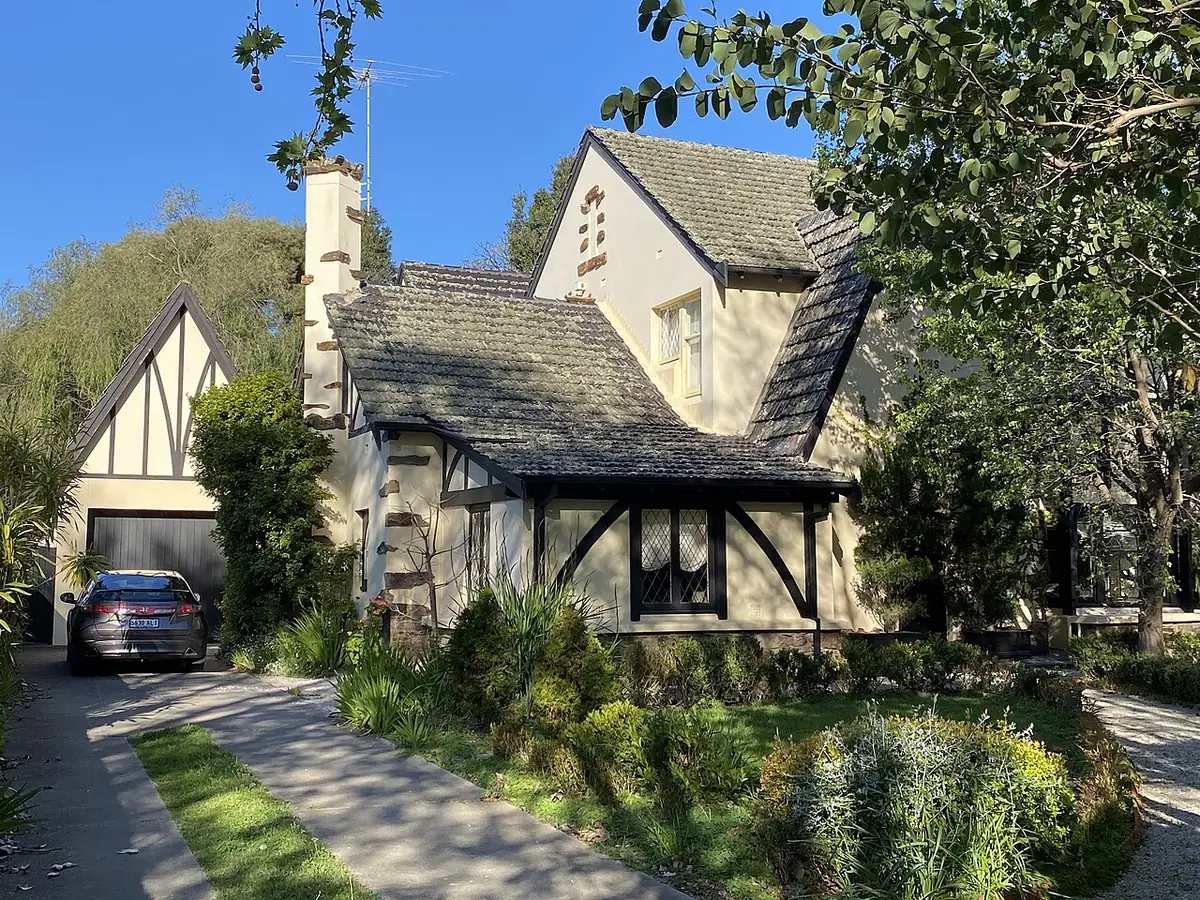
A Tudor Revival home with a leafy front garden in Adelaide — Photo: Ashton 29 · CC BY-SA 4.0 · Wikimedia Commons
Whatever your position, the sale follows Australian conventions that surprise an owner used to the European model.
A resident leaving South Australia, an owner managing a house from overseas and an heir who has inherited a tenanted property are not selling under the same constraints. Timing, capital gains tax and even the way the house is presented all follow from that starting point. An Australian tax resident keeps concessions a foreign resident loses, while a landlord has to work around a current lease and the tenant's rights. Identifying your own position before signing an agency agreement stops you committing to a price or a handover date that will not hold. The three cases below set out what changes in practice for each.
Selling before you go
If you are living in the house and plan to leave Australia, the date the contract is signed matters as much as the price achieved. Under Australian tax rules the event that triggers a capital gain generally occurs when the contract is signed, not at the settlement that follows weeks later. A seller who is still an Australian tax resident at that date may, subject to conditions, rely on the main residence exemption, whereas a foreign resident is in principle excluded from it apart from limited exceptions.
In practice that argues for starting the campaign several months before departure, allowing for preparing the property, assembling the Form 1, marketing and negotiation. You can also agree a long settlement so you occupy the home until your flight and avoid moving twice. Have your residency position and this timetable confirmed by an Australian accountant before you sign the agency agreement: getting the date wrong by a few weeks often costs far more than the agent's commission.
Selling from abroad
Selling from another country is entirely workable: the agent runs the open inspections and any auction, the conveyancer prepares the Form 1 and the transfer, and signing can be done remotely subject to the identity verification required for registration. The time difference, eight to ten hours from western Europe depending on the season, does mean deciding in advance who responds when an offer lands overnight, and within what limits on price and conditions. Arrange a power of attorney or an electronic signing method approved by your conveyancer before the property goes on the market.
Two financial points dominate for a foreign resident seller. Without the clearance certificate available to Australian tax residents, the buyer must withhold 15% of the price and pay it to the Australian Taxation Office, which ties up part of the proceeds until your Australian return is lodged, unless a variation of the rate has been granted. The gain will also usually need to be declared where you are tax resident, under the relevant double tax agreement, and the two calculations do not line up neatly.
Selling a tenanted or inherited property
A tenanted house can be sold with the tenant in place: the lease passes to the buyer, which narrows the market to investors but guarantees documented income during the campaign. Selling with vacant possession means observing the grounds for ending a tenancy and the notice periods set by South Australian law, tightened in recent years, and having those rules confirmed by Consumer and Business Services. Inspections have to be arranged with the tenant and respect statutory notice, which lengthens the timetable of the sale.
For an heir, the sale first requires the estate to be administered in Australia, with a grant of probate or letters of administration as the case may be, before the title can be transferred. The capital gains rules that apply to an inherited property differ from those for a property held directly and depend in particular on when the deceased acquired it and how it was used afterwards. Australian advisers and the lawyer handling the estate at home need to coordinate their timetables so an empty house, still insured and rated, does not weigh on the estate for months.
Selling in Adelaide with European habits: agency agreements, Form 1 and conveyancers
With those conventions clear, the question becomes where and to whom your house will sell fastest across the metropolitan area.
An owner used to European conveyancing expects a preliminary contract signed before a notary, a full pack of technical reports and ten days of cooling-off for the buyer. In South Australia the machinery rests on an agent engaged by the seller, a contract prepared locally, a licensed professional called a conveyancer and a statutory disclosure, the Form 1, which the seller must serve. A cooling-off right exists but is counted in clear business days, and it disappears altogether at auction, a method that remains common in Adelaide. Technical inspections, finally, are ordered and paid for by the buyer, where a European seller would supply them. The four differences below show what that means for your sale.
From abroad
An open, non-exclusive mandate paid according to the agency's published scale
Adelaide
An agency agreement that is usually exclusive for a fixed term, with freely negotiated commission and a marketing budget carried by the seller
Commission, the length of the exclusive period and who pays for marketing if the property does not sell are all settled before signing, never afterwards. Compare at least two or three agents on their recent sales in your suburb, their reasoned appraisal and their campaign plan, rather than on the figure they quote.
From abroad
A single notary who drafts the deed, checks the paperwork, holds the money and registers the transfer
Adelaide
Each side engages its own conveyancer, a professional licensed in South Australia, who prepares the transfer, calculates adjustments and runs electronic settlement
The conveyancer is separate from the estate agent and you choose them, at a cost you can compare by quote. Engage one as soon as you decide to sell so the Form 1, the title, easements and any mortgage to be discharged are dealt with before an offer arrives.
From abroad
A pack of compulsory technical reports, including an energy performance certificate, supplied by the seller
Adelaide
A legal Form 1 to be served, no compulsory energy rating, and the buyer ordering their own building and pest inspections
Your obligation is about the legal position of the property rather than its thermal performance: title, easements, planning constraints and community corporation contributions where they apply. Because the buyer pays for their own inspections, the findings often become a renegotiation lever, so commissioning your own inspection before listing lets you deal with weak points first.
From abroad
A privately negotiated contract followed by ten days of cooling-off for the buyer
Adelaide
A private treaty sale with two clear business days of cooling-off, or a public auction that removes any cooling-off right
An auction changes the timetable: the date is fixed, the deposit is paid on the day, often around 10%, and the fall of the hammer forms a binding contract. Private treaty is more flexible but leaves the contract conditional on that cooling-off window, which only starts once the Form 1 has been served.
Which parts of Adelaide are selling, to whom and how quickly?
Knowing who is shopping in your area sets up the figures: the level at which a house is actually advertised in Adelaide.
In Adelaide a house does not find the same buyer depending on whether it sits in the leafy streets of the east, minutes from the gulf beaches, up in the hills or in the northern and western suburbs now being rebuilt. Each area attracts a dominant profile, settled families, mobile professionals, downsizers or first-time owners, and that profile decides what triggers an offer: the school zone, the land, the outlook or the entry price. How fast a sale happens depends less on the suburb itself than on the fit between your property and what its buyers are looking for. The four cards below describe what the buyer is after, the type of seller or property that moves well there, and the trade-off that weighs on price.
The eastern suburbs (Unley, Burnside, Norwood)
Buyers here want a period stone villa, streets lined with mature trees, well-regarded schools and a short run into the central business district.
Suits
Sellers of well-maintained character homes whose proportions and garden answer solid, largely local family demand.
Trade-off
Buyers are demanding and well informed: a dated house, poorly oriented or without off-street parking, is negotiated hard against renovated stock in the same streets.
The coastal suburbs (Glenelg, Henley Beach, Brighton)
Buyers here want the beach within reach, light, the tram into town from Glenelg and a life lived largely outdoors.
Suits
Owners of houses close to the foreshore, which also draw interstate buyers and downsizers looking for a gentler climate.
Trade-off
Salt air wear and insurance costs are scrutinised, and a few hundred metres more or less from the beach visibly changes the price achieved.
The Adelaide Hills (Stirling, Aldgate, Crafers)
Buyers here want space, cooler summers, large gardens and a village atmosphere half an hour from the city.
Suits
Sellers of houses on large blocks, sought after by families and remote workers who accept the distance in exchange for land.
Trade-off
Bushfire-prone zoning, the upkeep of wooded blocks and the daily commute all reduce the number of buyers genuinely in the running.
The northern and western suburbs (Prospect, Woodville, Port Adelaide)
Buyers here want an accessible entry price, often wide allotments and areas in the middle of urban renewal.
Suits
Sellers of houses on divisible land or in need of renovation, which attract first-time owners, investors and small builders alike.
Trade-off
Values swing sharply from street to street, and the listing has to document zoning and genuine land potential or offers come back widely scattered.
What houses sell for in Adelaide: reading these figures as an asking-price benchmark
Saint Ignatius Church and its twin towers in Norwood — Photo: Ashton 29 · CC BY-SA 4.0 · Wikimedia Commons
Price is not the whole story: you also need to know exactly what you are transferring with your title.
The figures below are estimates drawn from listings: they show the levels at which Adelaide houses are advertised, not the net amount you will bank after commission, costs and tax. For a seller the most useful benchmark is the line matching your number of bedrooms, read against your actual internal area and your suburb: a three-bedroom house is advertised on average at around 1.2 million Australian dollars, against roughly 900,000 for two bedrooms and 1.66 million for four. The median price, close to 1.11 million dollars, covers very wide gaps between the east, the coast, the hills and the northern suburbs, so a rate of around 5,700 dollars per square metre is only a starting point. A house advertised well above its category has to justify it with land, orientation, condition or a school zone a buyer can verify, or it will sit online and be negotiated down later. Test these ranges against the sales recently recorded in your own street, which your agent should be able to document before you sign an agency agreement.
AdelaideFor saleHouseestimate
Median price / m²A$5,765Half the apartments sell below this
Median priceA$1.12mthe average is 14% higher — a few very large properties pull it up
Most common2 bedrooms42 % of listings
Average size184 m²
By number of bedrooms
Bedrooms
Share of market
Avg price
Price / m²
Avg size
2most common
42 %
A$903k
A$6,068
149 m²
3
39 %
A$1.21m
A$5,765
210 m²
4
20 %
A$1.66m
A$5,583best value / m²
298 m²
Each row is an average, compared against the area average of A$6,068 / m². These are indicative estimates of a typical local market, not a measured sample of live listings. Check current listings before relying on them.
What you actually transfer in Adelaide: a Torrens title or a community corporation lot
Those elements shape the price, but one tax rule matters more still before you sign an agency agreement or accept an offer.
Selling a house in Adelaide means transferring a title registered under the Torrens system, which began in South Australia in the nineteenth century and rests on the guarantee attached to registration. The title covers a defined allotment, but it may carry easements, planning restrictions, regulated trees or, where the house forms part of a group, membership of a community or strata corporation. What you hand over is therefore not only bricks and a garden but a bundle of rights and obligations the Form 1 must set out for the buyer. Some of it passes automatically to the new owner, some remains your responsibility until settlement. The two panels below separate what transfers from what stays with you.
What passes with the title
The Torrens title to the allotment, its boundaries as shown on the deposited plan, easements for access or services, registered rights and restrictions and, where relevant, the share and by-laws of a community corporation all pass to the buyer when the transfer is registered with Land Services SA. Planning constraints attached to the land, such as protection of a regulated tree or a heritage overlay across the suburb, follow the property as well. A current lease transfers in the same way if the house is sold tenanted, together with the bond held by the state authority.
What it changesThe buyer will therefore assess the land and its regulatory setting as closely as the house itself; assemble the plan, the title and any building approvals before listing so their questions can be answered without delay.
What stays with you until settlement
Until settlement day you remain liable for council rates, the emergency services levy, any land tax applying to a property that is not your principal place of residence, water accounts and community corporation contributions, all of which the conveyancers then apportion. You must also have any mortgage on the title discharged, serve an accurate and complete Form 1, and keep the property insured and maintained until the transfer is registered. Work carried out without approval stays your problem if it surfaces during the buyer's searches.
What it changesAn incomplete or inaccurate Form 1 can give the buyer a right to withdraw after signing; have your conveyancer review it before the first inspection rather than on the eve of settlement.
The rule to understand in Adelaide before signing an agency agreement or setting a price
Once that chain is clear, the whole sale becomes readable, from listing day to the final transfer of funds.
The costliest rule to overlook has nothing to do with styling or negotiation: it is the date and the tax status attached to your sale. In Australia a capital gain arises in principle when the contract is signed, while the money only arrives at settlement thirty to sixty days later. Whether you are an Australian tax resident or a foreign resident at that date decides access to the main residence exemption and the holding-period discount, and whether the buyer must withhold 15% of the price for want of a clearance certificate. Each link in the chain below follows from the one before, and none of them can be fixed after the event. Work through it before signing the agency agreement rather than after accepting an offer.
You decide to put your Adelaide house on the market and agree a timetable with the agent.
You confirm your Australian tax residency status as at the likely contract date, not as at settlement or as at the day you move out.
That status determines whether the main residence exemption and the 50% capital gains discount can still apply, in full, in part or not at all.
If you are an Australian tax resident you apply online for a clearance certificate several weeks before settlement; if you are not, the buyer will withhold 15% of the price unless a variation of the rate has been granted.
You then set the asking price, the method of sale and the contract date around the net amount genuinely available after tax, withholding, commission and costs.
The price you accept finally matches what you will actually receive, in Australia and at home.
How the sale of an Adelaide house unfolds, step by step
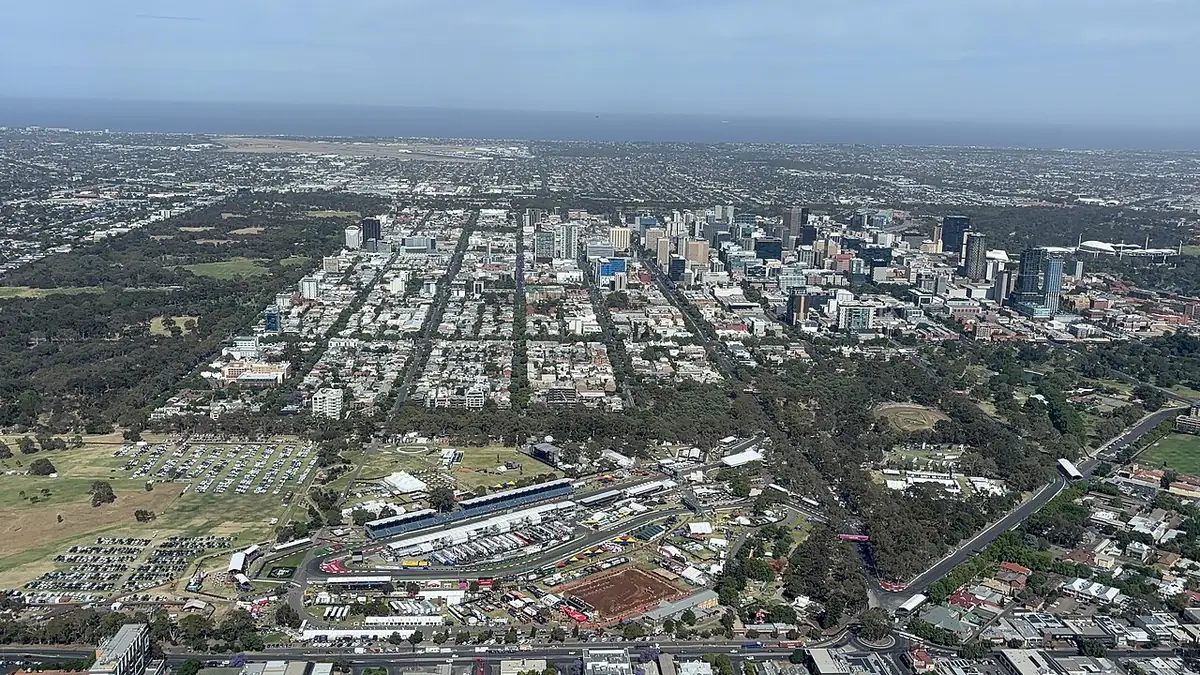
Adelaide from above, a grid city ringed by parklands and suburbs — Photo: Avatar5991 · CC BY-SA 4.0 · Wikimedia Commons
A sale in Adelaide involves people whose roles do not map onto the European model: you, your estate agent, your conveyancer, the buyer and their lender, the inspector they engage, your own mortgagee and the tax office. Between signing the agency agreement and settlement, allow for preparing the property and the Form 1, three to six weeks of campaign depending on the method chosen, then a settlement period usually set at thirty to sixty days. Each party acts at a precise point, and a delay at one step pushes every later one back, including your own move. The six steps below follow the usual order of a private treaty sale, noting what changes at auction. They set out who acts and what you should be watching.
You, the seller1. Choose the agent and the method, then sign the agency agreementYou compare agents on their recent sales in your suburb, their reasoned appraisal and their campaign plan, then decide between auction and private treaty. The agreement records the negotiated commission, the exclusive period, the marketing budget and the terms on which you can walk away if the property does not sell.
You and your conveyancer2. Prepare the file and have the Form 1 drawn upYour conveyancer orders searches from the titles register, the council and other authorities, then drafts the Form 1 that will be served on the buyer. This is also the moment to gather building approvals, renovation invoices and, if the house is tenanted, the lease and the tenant's details.
The estate agent3. Market the property and run the open inspectionsThe agent lists the property on the portals, runs weekend open inspections and reports back with numbers week by week. The first few weeks capture most of the attention of Adelaide buyers: a price pitched wrong at that stage is paid for later in successive reductions.
The buyer4. Receive a written offer or take the biddingBy private treaty the buyer signs a contract often subject to finance and inspection conditions, and then has the statutory cooling-off period. At auction the fall of the hammer forms a binding contract with no conditions and no cooling-off, and the agreed deposit, often around 10%, is paid on the day.
The buyer, their lender and the inspector5. Satisfy the conditions and check the propertyThe buyer commissions building and pest inspections and obtains formal loan approval within the times set in the contract. If a structural defect, an infestation or movement linked to reactive clay soils comes up, expect a renegotiation request supported by a quote.
The conveyancers, the lenders and Land Services SA6. Settlement, registration and payment of the balanceThe conveyancers apportion council rates, the emergency services levy and utility accounts, coordinate the discharge of your mortgage and check any withholding obligation. On settlement day the price is paid, the transfer is registered with Land Services SA, the keys change hands and you arrange the transfer of the proceeds.
House or apartment in Adelaide: which sells better, and how to sell yours
What remains is to cost the sale properly before the balance ever reaches your account.
In Adelaide the detached house on its own block is still the cultural default for most buyers, and that preference works in the seller's favour. Scarce, well-located land supports values across the inner suburbs, while the apartment market depends far more on the building itself, on strata levies and on how many lots are listed at the same time along the main corridors and in the city grid. For you that means less mechanical competition: two neighbouring houses are rarely interchangeable, and a buyer cannot simply find an identical property one street over.
That relative scarcity has a flip side. A house sells on things a buyer can measure, and therefore challenge: the size of the block, the aspect of the garden, the state of the roof, ceiling insulation, whether the cooling can hold a week above forty degrees, and any sign of footing movement caused by the reactive clay soils of the plain. Where an apartment seller produces strata accounts, a house seller produces quotes, invoices and approvals. The earlier those documents are ready, the less the buyer's inspection turns into a lever for a discount.
Preparation differs too. An apartment sells on light, a neutral interior and clearly documented parking; a house sells on street appeal, the facade, a garden kept presentable despite water restrictions, and living areas that read instantly. In Adelaide, light styling, a professional clean, a few visible repairs and photography taken at the right hour are usually enough: a heavy renovation started just before listing is rarely recovered in the price, which stays anchored to recent sales in the suburb.
Method and timing are the last difference. A family house often sells best in the southern spring, between September and November, when gardens look their best and families are planning the next school year, and an auction makes most sense where the property is genuinely hard to compare. A tenanted apartment, by contrast, can wait for a lease to end so it can be offered with vacant possession to a wider audience. If several comparable houses are listed in your street at once, it is usually better to wait a few weeks, or to stand out on condition and documentation, than to cut the price in the first month.
What selling an Adelaide house costs: commission, fees, tax and moving the money
With those figures settled, what remains is what will persuade a buyer to pay them: daily life around your address.
The price achieved is never the sum you bank: between signing the agency agreement and the final transfer, several items come off it. Some are proportional to the price, such as the agent's commission or the withholding applied for want of a clearance certificate; others depend on the file or on your own position, such as conveyancing fees, the Form 1 or capital gains tax. If you are taxed in another country, add the declaration of the gain there and the cost of converting the proceeds. The ranges below are indicative, partly negotiable, and should be confirmed by written quotes and by a tax adviser before you fix any price.
Selling and preparation costs for an Adelaide house
Cost item
Estimated amount or range
Who pays, when and why
Estate agent's commission
Negotiated, frequently around 2% of the sale price, with or without Australian goods and services tax depending on the agreement
Paid by you at settlement out of the proceeds; the rate, the base and the exclusive period are all settled before the agency agreement is signed.
Marketing, photography and presentation
1,500 AUD to 6,000 AUD depending on the campaign, more for an auction
Usually funded by the seller before the listing goes live and payable even if the property does not sell, according to the terms of the agreement.
Conveyancing fees, Form 1 and searches
1,500 AUD to 3,000 AUD, with search fees on top
Paid at settlement; they cover the Form 1, verification of title, discharge of your mortgage, apportionment calculations and electronic transfer.
Add council rates, the emergency services levy, water accounts and any land tax, payable by you up to settlement and then apportioned, along with early repayment costs on your loan and the price of repairs requested after the buyer's inspection.
Capital gains tax and moving the proceeds
Item
Mechanism or order of magnitude
What it means for you
Foreign resident withholding
15% of the price, withheld by the buyer at settlement for any contract signed since 1 January 2025
Avoided by an Australian tax resident who supplies a clearance certificate obtained online; for a foreign resident the amount is credited against the tax assessed and reconciled through an Australian return.
Australian capital gains tax
Gain added to assessable income, with the foreign resident rates applying from the first dollar
The main residence exemption and the 50% discount for ownership of more than twelve months are largely closed to foreign tax residents.
Tax at home and converting the balance
Declaration required where you are tax resident, relief from double taxation under the applicable treaty, plus the exchange spread
The domestic calculation and its holding-period allowances do not mirror the Australian one; compare your bank against a specialist transfer service and keep every document.
All of this turns on your tax residency at the contract date, the length of ownership and the use made of the property; an Australian accountant and an adviser where you are taxed should confirm the figures before you settle on a reserve price.
An ordinary Tuesday in Adelaide, seen by the buyer you are aiming at
An independent bookshop under a shopfront verandah — Photo: Nick-D · CC BY-SA 4.0 · Wikimedia Commons
Those arguments are not enough on their own: the buyer will also go looking for what the listing leaves out.
The buyer of an Adelaide house is not paying for square metres alone: they are paying for the day they picture living from your address. Travel time into town, the school zone, distance to hospitals and to shops are all arguments a listing can make, provided they are true and verifiable for your property. Walking through a typical Tuesday shows what your agent should emphasise in the description, at open inspections and in the photography. The stops below turn each moment of the day into a concrete selling point.
07:30The house and its street, at the moment everyone leavesBuyers judge street appeal before they reach the gate: facade, driveway, parking and relative quiet. An early inspection shows off the morning coolness of a well-kept garden, a real asset in a city where summer sets the terms.
08:15The local school and its zoneSouth Australian state schools work with enrolment zones, and some eastern suburbs sell largely on that one criterion. If your address falls within a sought-after zone, confirm it with the state education department and mention it carefully, because zones can change.
08:45The run into the central business district, by car or public transportReal travel time in peak hour, along Glen Osmond Road, Port Road or the local train line, counts for far more than distance on a map. Quote the average measured on a weekday and name the nearest station or stop, with the walking time to it.
12:30Local shops and the neighbourhood centreBeing close to a supermarket, a suburban shopping centre or the central market matters to families and downsizers alike. A listing that names those shops precisely, with walking distances, gives the buyer a concrete picture of daily life.
16:00The park, the beach or the hills, depending on the areaQuick access to the foreshore, a leafy reserve or the hills is part of what a buyer pays for in Adelaide, more so than in a larger capital. Photographs taken immediately around the house are often worth more than another shot of the living room.
18:30The medical centre or major hospital, then home againOlder buyers look at the distance to a general practice and to the main hospitals, particularly the Royal Adelaide Hospital or the Flinders Medical Centre. In the evening they also judge traffic noise, the remaining light in the garden and how the street presents, three things a late-day inspection makes obvious.
What an Adelaide buyer will check that your listing does not mention
Those late discoveries account for most of the regrets sellers voice six months after settlement.
A listing highlights light, floorboards and nearby parks, but a serious buyer, their inspector and their conveyancer will go looking for what it leaves unsaid. In Adelaide those checks centre on reactive soils, regulated trees, the compliance of past building work and how the house behaves in summer. What they find late, you pay for in renegotiation; what you document early becomes a selling point instead. Here are the four things a buyer will check whether or not you raise them.
Footing movement caused by reactive clay soils
Large parts of the Adelaide plain sit on reactive clay that swells in winter and shrinks in summer, which can crack walls where drainage or nearby planting is not managed. The buyer's inspector will spot patched cracks at once and ask how long they have been moving. An engineer's report or an invoice for remedial work answers that question far better than fresh render.
Regulated and significant trees on the block
State planning rules protect certain trees according to their girth and position, and prohibit removal or heavy pruning without consent. A buyer planning an extension, a pool or a subdivision will discover the constraint during their searches. Better to disclose it and have your conveyancer set out precisely what the title and the planning rules actually allow.
Building work done without approval or certification
An enclosed verandah, a studio at the back of the block, a pool without compliant fencing or electrical work carried out without certification will surface at inspection and in council searches. Putting it right can require an application to the council and delay settlement by weeks. Gathering approvals and certificates before listing avoids finding out at the worst possible moment.
How the house performs through a heatwave
Many houses built before the 1990s have little ceiling or wall insulation and heat up badly during the January and February peaks, which buyers test by inspecting late in the afternoon. Reasonable electricity bills, recent air conditioning, solar panels or new insulation are documents to produce rather than to hide. Without them the buyer will cost the work themselves and take their own estimate off the price.
Seller mistakes in Adelaide that surface six months later
Those accounts also show that for some owners the better decision is not to sell at all right now.
Looked likeChoosing the agent who quoted the highest appraisal, to aim for the best possible price.
Turned outAn asking price pitched too high, empty open inspections, then successive reductions that ended in a sale below what the more cautious agents had suggested.
Would have caught itAsking each agent for the comparable sales behind the appraisal, with dates and land sizes, and comparing method rather than the headline figure.
Looked likeSigning the contract shortly after ceasing to be an Australian tax resident, assuming only the settlement date mattered.
Turned outThe main residence exemption was lost, part of the price was withheld at settlement and an Australian return had to be lodged to sort the position out.
Would have caught itHaving an Australian accountant confirm your residency status as at the contract date, and setting the sale timetable around it.
Looked likeLetting the agent prepare the Form 1 at the last minute so the listing could go live sooner.
Turned outAn easement and undisclosed building work came to light after signing, the buyer exercised their right to withdraw, and the house came back to market carrying a reputation for problems.
Would have caught itHaving your conveyancer draw up the Form 1 and order the searches as soon as you decide to sell, and dealing with anomalies before the first inspection.
Looked likeGoing to auction because the suburb suited it, without setting a realistic reserve.
Turned outOnly three bidders turned up on a scorching Sunday, the property was passed in, and the campaign that followed started from a weakened position.
Would have caught itSetting the reserve from verifiable comparable sales, checking registered bidder numbers before the day, and agreeing a fallback to private treaty with the agent.
Who should not be selling an Adelaide house right now?
With those filters in place, one question is left: sell now, and at what price.
Selling is not always the right decision, even when an agent quotes a good price and the market looks willing. Some tax, tenancy and estate positions make an immediate sale dearer than waiting a few months or keeping the property. Selling costs, the withholding and the price of ever coming back into the Adelaide market all have to be set against what the sale genuinely gives you. Here are three profiles for whom the wiser answer is often to wait.
The resident leaving Adelaide without having checked the tax effect of departure
→To hold off signing any agency agreement until an Australian accountant has reviewed their residency status and their capital gains position.
A sale signed after residency is lost can remove the main residence exemption and produce a tax bill far larger than the extra price hoped for.
The landlord whose tenant is in place for many months yet
→To wait until the lease is close to ending, or to sell tenanted and accept an audience made up mainly of investors.
Selling mid-lease narrows the market and complicates inspections, whereas a vacant house also reaches owner-occupier families, who are generally prepared to pay more.
The owner whose house has visible, untreated defects
→To commission an engineer's report and carry out the repairs before listing, rather than starting the campaign straight away.
Uncertainty about cracking or a tired roof weighs on offers far more than the actual cost of the work, and the buyer's inspection will turn that doubt into a negotiated discount.
So should you sell your Adelaide house now, and at what price?
Selling a house in Adelaide is decided less by a feeling about the market than by three straightforward checks: what you will net, the date at which your tax position makes the sale most favourable, and who is realistically able to pay for your property. An asking price consistent with recent sales in your suburb and your category draws offers in the first weeks, the period when buyer attention is strongest and negotiation still runs your way.
If your Form 1 is drawn up, the searches done, approvals and invoices gathered, your residency status confirmed and the net figure calculated after commission, fees, withholding and tax in Australia and at home, you can sign an agency agreement knowing what you are doing. Choose the method that suits the property, auction for a house that is genuinely hard to compare, private treaty for a conventional one, and decide in advance what level of offer and what conditions you will accept.
If any of those points is still vague, taking a few weeks to settle it almost always costs less than a mispitched campaign, a buyer who withdraws or an avoidable tax bill. Keeping the property, letting it out or postponing the sale are equally legitimate decisions when the numbers are not yet lined up. The South Australian market will keep rewarding prepared sellers, the ones who know exactly what they are transferring and what will be left once the transfer is registered.
Related questions
What commission does an estate agent charge to sell a house in Adelaide?
Commission is not set by law in South Australia: it is negotiated with the agent before the agency agreement is signed. Across metropolitan Adelaide it often sits at around 2% of the sale price, with variation according to the value of the property, the suburb and the level of service promised. Marketing, photography and portal listing fees are usually billed separately and remain payable even if the property does not sell. Check whether the commission is quoted with or without Australian goods and services tax, how long the exclusive period runs, and on what terms you may end it.
What is the Form 1 that a seller must serve in South Australia?
The Form 1, also called the vendor's statement, is the statutory disclosure through which the seller tells the buyer about the legal position of the property: title, easements, mortgages, planning constraints and membership of a community or strata corporation where relevant. In practice it is prepared by your agent or your conveyancer from searches carried out with government bodies and the land titles register. It must be served on the buyer in the form and within the time limits set by the state's property sale legislation. A late or incomplete document can give the buyer a right to withdraw, which is why it pays to have it prepared as soon as you decide to sell.
Does the buyer have a cooling-off right when a house is sold in Adelaide?
Yes, South Australia gives the buyer of a home a cooling-off period of two clear business days, counted from the signing of the contract or from service of the Form 1 if that happens later. It is much shorter than the ten days a buyer is given in France and it does not apply to a property sold at public auction. Withdrawing within that window costs the buyer a limited sum set by law rather than the whole deposit. For you, this means a sale is only genuinely firm once that period has run, and that serving the Form 1 sets the clock going.
Is it better to sell at auction or by private treaty in Adelaide?
Public auctions are common in Adelaide for houses in sought-after suburbs, particularly in the eastern suburbs and along the coast, while private treaty with an advertised price remains the majority method elsewhere. An auction imposes a firm date, removes the cooling-off right and requires an immediate deposit, often in the order of 10% of the price achieved. It suits unusual properties that are hard to compare and that attract genuine competition between several buyers. For a standard house in a suburb where comparable sales are plentiful, a private treaty campaign usually gives you more control over timing and conditions.
Can a non-resident owner sell an Adelaide house from overseas?
Yes, nothing prevents a non-resident from selling a property in South Australia. The agent handles marketing, inspections and any auction, while your conveyancer prepares the Form 1, the transfer of title and coordinates settlement remotely. You will need to satisfy the identity verification required for registration of the transfer and sign documents in the required form, so allow for postal delays and the time difference. Budget as well for the 15% withholding applied to the price where no clearance certificate is issued by the Australian Taxation Office.
What is the 15% withholding applied to an Australian property sale?
It is a withholding mechanism aimed at foreign resident vendors: the buyer withholds 15% of the price at settlement and pays it to the Australian Taxation Office. For contracts signed since 1 January 2025 it applies whatever the value of the property, with no threshold. An Australian tax resident avoids it by giving the buyer a clearance certificate, applied for online and best requested several weeks before settlement. A foreign resident can in some cases apply for a variation of the rate, and the amount withheld is then credited against the tax assessed once an Australian return is lodged.
Is capital gains tax payable when selling a house in Adelaide?
Yes, a gain on an Australian property is in principle subject to Australian capital gains tax, and the taxing event falls on the date the contract is signed, not the date of settlement. An Australian tax resident selling a main residence may be exempt subject to conditions, and a resident who has held the property for more than twelve months may claim a 50% discount. Both of those concessions are largely closed to foreign tax residents. The calculation depends on the holding period, the use of the property and the costs you can substantiate, which is why an Australian accountant should be involved before you set a price.
Does the gain have to be declared in your home country as well?
If you are a tax resident of another country, the gain on an Australian property will usually also have to be declared where you live. A double tax agreement between Australia and your country of residence normally governs how relief is given so the same gain is not fully taxed twice. The domestic calculation follows its own rules, in particular for holding-period allowances and any social levies, so the final charge can differ noticeably from the Australian tax. Have your position checked by a tax adviser in your country of residence before you settle on the net figure you are aiming for.
Can a tenanted house be sold in Adelaide before the lease ends?
Yes, a tenanted house can be sold with the lease in place, which then passes to the new owner and mainly appeals to investors. Selling with vacant possession instead means complying with the grounds for ending a tenancy and the notice periods set by South Australian residential tenancy law, which has been tightened in recent years in favour of tenants. Inspections must be arranged with the tenant and respect the statutory notice requirements. Have the grounds and notice periods that apply to your situation confirmed by Consumer and Business Services before you promise a buyer any handover date.
How are the proceeds of an Adelaide sale moved overseas?
The balance of the price is paid at settlement into an account, normally in Australian dollars, after your mortgage is discharged and any withholding is deducted. You can then convert that amount through your bank or through a specialist transfer service, and rates and fees vary noticeably between providers. Keep the contract, the settlement statement and the tax paperwork, because your bank abroad may ask you to evidence the source of the funds before releasing them. For a large sum, obtain several quotes and consider converting in stages rather than all on settlement day.
Property review of ting
No ting properties in Adelaide yet
Be the first — share it on ting and it shows up right here.