Selling an apartment in Adelaide means handing over a strata or community title lot in a market where buyers compare online, happily turn up to Saturday auctions and receive, before they commit, a tightly regulated seller disclosure document known as the Form 1. This guide is for the owner weighing up whether to sell, whether they still live in South Australia or manage the property from abroad: asking prices, choosing an agent and a method of sale, the role of the conveyancer, capital gains tax on both sides and bringing the money home.
Get the app
What nobody tells you.
Real prices, hidden costs and the traps to check before you commit.
What you are really selling in Adelaide: what the buyer pays, and what you think you are handing over
Scroll
What you are really selling in Adelaide: what the buyer pays, and what you think you are handing over
Selling an apartment in Adelaide means handing over a strata or community title lot in a market where buyers compare online, happily turn up to Saturday auctions and receive, before they commit, a tightly regulated seller disclosure document known as the Form 1. This guide is for the owner weighing up whether to sell, whether they still live in South Australia or manage the property from abroad: asking prices, choosing an agent and a method of sale, the role of the conveyancer, capital gains tax on both sides and bringing the money home.
Written by the ting.ad editorial team ·
Sale Apartment Adelaide in Street View: drag to look around.
These two readings of the same property carry different weight depending on your situation as a seller, and that is what needs identifying first.
The owner of an apartment in Adelaide often sees it through what it cost, the rise in prices the city has seen in recent years or the rent it brings in. The buyer, meanwhile, compares it in a few clicks with the listings next door, thinking in floor area, strata levies, the age of the building and minutes on foot to the tram or the Park Lands. Between those two readings lies the gap that decides whether an auction closes above the reserve or a listing sits online for weeks. In a city where the house on its own block remains the benchmark and where many apartments sit in small older complexes, an apartment sells on specific arguments that you need to be able to name. The four contrasts below sum up what you are really handing over and what the buyer is prepared to pay for.
The value you attach to a central address, a short walk from the CBDvsThe price the buyer accepts once travel, noise and parking are taken into account
The grid layout of the city centre and the ring of Park Lands put most addresses close to everything, and the buyer knows it. What decides matters for them is the allocated car space, exposure to noise from the main roads and the real distance to a tram or bus stop. Documenting these points before listing stops them being turned against the price during negotiation.
The character of a small older building you enjoyed living invsA cold reading of the strata accounts and the maintenance fund
Many Adelaide apartments sit in complexes of a handful of lots built several decades ago, sometimes run without a professional strata manager. The buyer appreciates the character and the often modest levies, but will read the minutes to spot the roof, the plumbing or the facades that need work. A well-funded maintenance account and properly kept books reassure more than a recent interior renovation.
A market with a reputation for being more affordable than the other state capitalsvsBuyers who now compare Adelaide with Melbourne or Brisbane and stay alert to price
The growth in prices over recent years has drawn buyers from other states, but it has also made local buyers more selective. A seller who sets a price on the strongest recent sales in the suburb, without allowing for the condition or the floor level of their own lot, risks watching visitors turn to the apartment next door. What the buyer pays for is a price that comparable sales can defend, not the momentum of the market.
An investment property whose yield you know wellvsThe value of the same apartment sold with vacant possession to an owner-occupier
A tenanted apartment, particularly near the universities or the city hospitals, speaks first to investors, who think in net yield after levies, land tax and management. A property sold vacant can also reach young professionals and retirees leaving a house, who are often more sensitive to condition and location than to rent. Choosing between selling tenanted and selling vacant therefore changes the audience, the timetable and sometimes the price achieved.
Selling in Adelaide: which kind of seller are you?
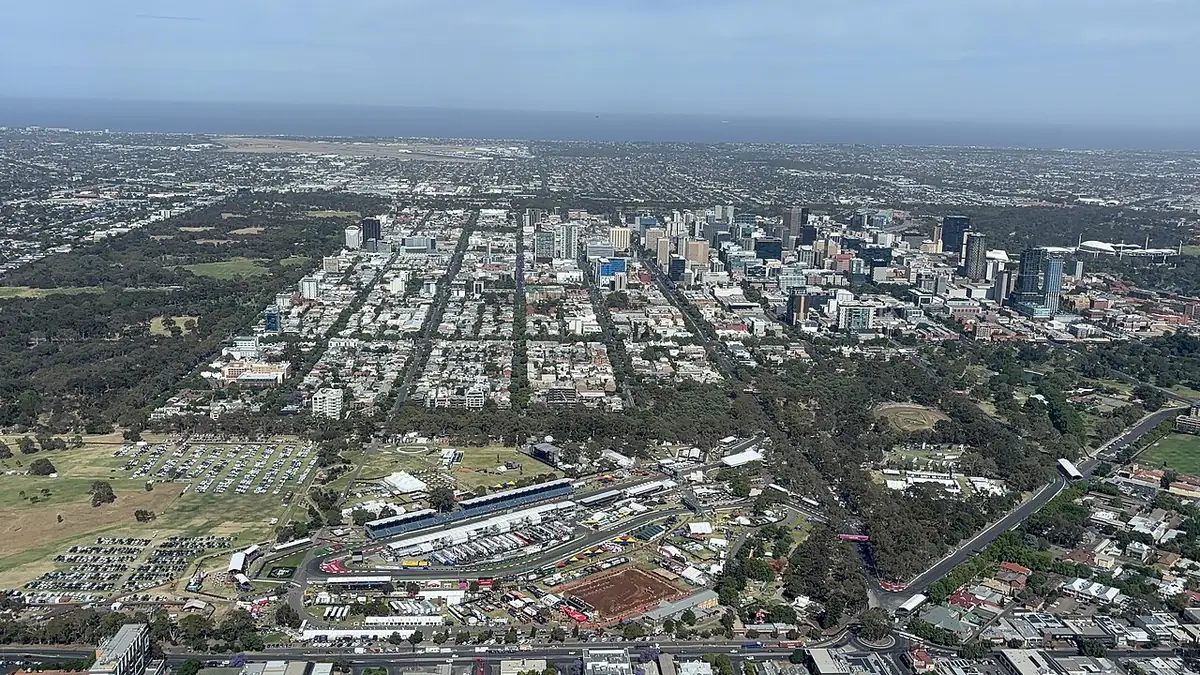
Adelaide from above, a grid city ringed by parklands and suburbs — Photo: Avatar5991 · CC BY-SA 4.0 · Wikimedia Commons
Whatever your situation, the sale follows South Australian practices that surprise owners used to another country's system.
A resident leaving South Australia, an owner managing an apartment from overseas and a landlord or heir selling an occupied property do not sell under the same constraints. The timetable, the capital gains tax position and even the choice between auction and private treaty all depend on that situation. An Australian resident for tax purposes may, depending on the case, benefit from rules that a foreign resident loses, while a landlord has to work around the current lease and state tenancy law. Identifying your profile before signing an agency agreement avoids setting a price or a date that will not hold. The three cases below describe what changes in practice for each.
Selling before you leave
If you live in the apartment and plan to leave Australia, the date on which the sale contract is signed matters as much as the price. Under Australian tax law, the event that triggers capital gains tax generally occurs when the contract is entered into, not at final settlement. A seller who is still an Australian resident for tax purposes on that date may, subject to conditions, be entitled to the main residence exemption, whereas a foreign resident is generally excluded from it, apart from limited exceptions.
In practice, this argues for starting the sale several months before departure, allowing for preparation of the Form 1, the marketing campaign and, for a private treaty sale, the buyer's cooling-off period. An auction fixes a signing date known well in advance, which can make that planning easier. You can also agree a later settlement so that you stay in the home until you leave. Have your residency status and the timetable confirmed by an Australian accountant before signing the agency agreement, because a mistake of a few weeks can cost far more than the agent's commission.
Selling from abroad
Selling from overseas is entirely workable in Adelaide: the agent arranges inspections and, where relevant, the auction, the conveyancer prepares the Form 1 and the transfer, and signing can be done remotely, subject to the identity verification required for registration. The time difference, however, of seven and a half to nine and a half hours depending on the season, means you should decide in advance who makes the call on auction day or when an offer arrives during your night, and within what limits on price and conditions, for example by setting your reserve price in writing.
Two financial points dominate for a non-resident seller. Without the clearance certificate available to Australian tax residents, the buyer must withhold 15% of the price and pay it to the Australian Taxation Office, which ties up part of the sale proceeds until your Australian tax return is lodged, unless a reduced rate is granted on application. The gain will usually also have to be declared where you are tax resident, under the rules of the double tax agreement between Australia and your country of residence.
Selling an occupied or inherited property
A tenanted apartment can be sold with the tenant in place: the current lease then passes to the buyer, which mainly appeals to investors drawn by student and hospital rental demand in the city centre. Selling with vacant possession, by contrast, means observing the grounds for ending a tenancy and the notice periods set out in South Australian residential tenancy law, reformed in recent years. Inspections and home opens also have to be arranged with the tenant, respecting the statutory notice periods. Bear in mind too that the land tax due on a tenanted property weighs on your return for as long as you hold it.
For an heir, the sale first requires the estate to be administered in Australia, with a grant of probate or letters of administration issued by the state Supreme Court as the case may be, before title can be transferred. The capital gains rules applying to an inherited property differ from those for a property held directly and depend, among other things, on when the deceased acquired it. An Australian adviser and the lawyer handling the estate in your own country need to coordinate their timetables so the property does not sit empty and expensive for months.
Selling in Adelaide when you are used to another market: agency agreements, auctions, conveyancers and the Form 1
With these practices in mind, the next question is where, and to whom, your apartment will sell most easily across the metro area.
An owner used to selling in many European markets expects a preliminary contract signed before a notary, a statutory cooling-off period of around ten days for the buyer and technical surveys supplied upfront. In Adelaide, the process relies on an estate agent engaged by the seller, on a deliberate choice between public auction and private treaty, and on a licensed conveyancer who prepares the transfer. What the buyer receives is not a battery of technical surveys but a vendor's statement, the Form 1, setting out the charges and legal constraints on the property. A cooling-off period does exist, but it is short and disappears altogether when the property sells at auction. The four differences below show what this means for your sale.
From abroad
A sales mandate that is often simple and non-exclusive, paid according to the agency's fee scale
Adelaide
An agency agreement that is usually exclusive for a set period, with negotiated commission and a marketing budget frequently paid by the seller
Commission is discussed before signing, as are the length of the agreement, the termination terms and what happens to marketing costs if the property does not sell. Compare at least two or three agents on their reasoned appraisal, their recent sales in your building or your street and the method of sale they recommend, rather than on a price promise alone.
From abroad
A notary drafts the deed, holds the funds and records the transfer
Adelaide
A licensed conveyancer or a solicitor prepares the Form 1, checks the title, calculates adjustments and manages electronic settlement
In South Australia, conveyancers are licensed professionals, separate from the estate agent, and you choose your own. Appoint one as soon as you list, because the Form 1 must be ready before the first offers or before the auction, and it depends on searches with public authorities that take time.
From abroad
A preliminary contract followed by a cooling-off period of around ten days for a private buyer
Adelaide
A cooling-off period of two clear business days after a private treaty sale, and none at all after a sale at auction
After a private treaty sale, the buyer can in principle withdraw within that short window, which only starts once the contract is signed and the Form 1 served; a late Form 1 therefore prolongs your uncertainty. At auction, the contract is firm the moment the hammer falls, which is why some sellers prefer that method to lock in a timetable.
From abroad
A file of mandatory technical surveys handed over when the preliminary contract is signed
Adelaide
A vendor's statement (Form 1) on charges, easements, rates, planning and strata, with the buyer commissioning their own inspections
The law places the emphasis on the accuracy of the legal information rather than on the physical condition of the property, which the buyer checks through an inspection of their own. Expect precise questions after that visit, and have ready the paperwork for work carried out, approvals obtained and the state of the common property.
Which Adelaide suburbs sell, to whom and how quickly?
Knowing who is looking in your area prepares you for the figures: the level at which an apartment is actually advertised in Adelaide.
In Adelaide, an apartment does not find the same buyer depending on whether it sits in a recent tower in the CBD, on a leafy street in North Adelaide, near the beach at Glenelg, or in the eastern suburbs such as Norwood and Burnside. Each area attracts a dominant profile, whether investors, students and their parents, young professionals, retirees leaving a house or buyers from other states, and that profile determines what makes a sale: yield, the walk to work, the sea or school zones. How quickly a property sells depends less on the suburb itself than on the fit between your apartment and what its buyers are looking for. The four cards below describe what the buyer comes looking for, the type of seller or property that moves well there, and the trade-off that weighs on price.
The Central Business District
The buyer is looking for an address within walking distance of offices, the universities, the Central Market and the city hospitals, with trams and buses at the door.
Suits
Landlords selling a studio or a one- or two-bedroom apartment that is already let, where documented rent speaks directly to investors.
Trade-off
A large supply of recent, comparable apartments puts pressure on price, especially for smaller floor areas without parking or in buildings with high levies.
North Adelaide
The buyer is looking for the character of the historic streets, the cafes of O'Connell Street and immediate proximity to the Park Lands and the city centre.
Suits
Sellers of period apartments or well-maintained small complexes, sought after by retirees and professionals downsizing from a house.
Trade-off
Buyers here are demanding on condition, insulation and parking; a dated apartment with no allocated space is negotiated hard against renovated stock.
The coastal suburbs (Glenelg and Semaphore)
The buyer is looking for the beach, sunsets over Gulf St Vincent and, at Glenelg, the direct tram into the city.
Suits
Owners of apartments with a view or a few steps from the sand, which also appeal to holiday-home buyers and purchasers from other states.
Trade-off
The view and the distance to the beach make the price: two lots in the same building can differ markedly, and wear from the salt air is scrutinised at inspection.
The eastern suburbs (Burnside and Norwood)
The buyer is looking for The Parade, well-regarded schools, good shops and a quiet residential setting a few kilometres from the centre.
Suits
Sellers of larger apartments or single-level units, prized by families attentive to school zones and by older residents staying in the area.
Trade-off
Buyers here often compare your apartment with a small house nearby; it has to justify itself through upkeep, outdoor space or an exceptional position.
What an apartment sells for in Adelaide: reading the figures as an asking-price benchmark
An independent bookshop under a shopfront verandah — Photo: Nick-D · CC BY-SA 4.0 · Wikimedia Commons
Price does not say everything: you also need to know exactly what you are handing over with your strata lot.
The figures below are estimates drawn from listings: they show the levels at which Adelaide apartments are offered, not the net amount you will bank. For a seller, the most useful benchmark is the line matching your number of bedrooms, set against the actual floor area of your lot, the age of the building and its suburb. An apartment advertised well above the price per square metre of its category has to justify that with a view, a floor level, parking, condition or modest levies, failing which it will sit online or fall short of its reserve at auction. Keep in mind too that the advertised price often builds in room to negotiate, and that commission, conveyancing fees and tax are then deducted. Finally, set these ranges against recent sales in your building and your street, which your agent can document.
AdelaideFor saleApartmentestimate
Median price / m²A$7,030Half the apartments sell below this
Median priceA$720kthe average is 14% higher — a few very large properties pull it up
Most common2 bedrooms34 % of listings
Average size105 m²
By number of bedrooms
Bedrooms
Share of market
Avg price
Price / m²
Avg size
1
18 %
A$440k
A$7,992 +8 %
55 m²
2most common
34 %
A$629k
A$7,400
85 m²
3
32 %
A$844k
A$7,030 −5 %
120 m²
4
16 %
A$1.16m
A$6,808best value / m²
170 m²
Each row is an average, compared against the area average of A$7,400 / m². These are indicative estimates of a typical local market, not a measured sample of live listings. Check current listings before relying on them.
Strata title or community title: what you are really handing over with your Adelaide apartment
These documents shape the price, but one tax and contractual rule matters more still before you sign an agency agreement or set a price.
Selling an apartment in Adelaide means transferring a lot within a collective structure, most often under strata title, sometimes under community title for newer or larger developments. In either case you hand over a private lot, a share of the common property and membership of the body that manages the scheme, with its by-laws, its budget and its decisions. The buyer will therefore be assessing not only your walls but the health of that structure, as it appears from the strata information attached to the Form 1. The legal regime also changes what the buyer will be able to do with the property, and so which audience takes an interest. The two panels below show what each regime transfers and what it means for your sale.
Selling a strata title lot
You hand over your lot, its share of the common property and your place within the strata corporation, with its by-laws, its minutes, its maintenance fund and the decisions already voted through, including certain works and how they are funded. Any exclusive use rights, such as a car space, and a current lease also pass to the buyer. Until settlement, levies, council rates and water charges remain yours, and are then apportioned on a pro rata basis.
What it changesIn small older complexes run without a professional manager, the paperwork is sometimes incomplete; gather minutes, accounts and the state of the fund before listing so that the Form 1 is accurate and the buyer cannot turn a grey area into a discount.
Selling a community title lot
In a community title scheme, the lot sits within a corporation that may manage roads, landscaped areas or shared facilities, with by-laws that are often more detailed on architecture, parking or external alterations. Those rules, the corporation's budget and the levies attached to the shared facilities pass to the buyer along with the lot itself.
What it changesThis regime reassures buyers who want a consistent setting, but it can put others off, pet owners or investors targeting short-stay letting for instance; set the rules out clearly in the listing to attract the right audience rather than lose it after the inspection.
The rule to understand in Adelaide before signing an agency agreement or setting a price
Once that chain is clear, the full course of a sale becomes readable, from listing to the final transfer of funds.
The costliest rule to overlook concerns neither presentation nor negotiation, but the date and the tax status attached to your sale, combined with the method of sale you choose. In Australia, the capital gain generally arises when the contract is entered into, whereas the money only arrives at settlement, several weeks later. Whether you are an Australian resident for tax purposes on that date governs access to certain exemptions and discounts, and the 15% withholding applies to the price if no clearance certificate is given to the buyer. Adelaide adds a further twist: an auction fixes the signing date in advance, whereas a private treaty sale leaves the buyer a short cooling-off period. Each link in the chain below follows from the one before, and it is worth working through before you sign the agency agreement.
You decide to put your Adelaide apartment on the market and discuss a timetable with the agent.
You check your status as an Australian resident for tax purposes at the likely date the contract will be entered into, whether that is auction day or the acceptance of an offer, and not at the date of settlement.
That status determines whether the main residence exemption and the 50% capital gains discount can still apply, in full, in part or not at all.
If you are a resident, you apply online to the Australian Taxation Office for a clearance certificate; if you are not, the buyer will withhold 15% of the price, unless a reduced rate is granted.
You choose the method of sale, set the advertised price or the reserve, and have the Form 1 prepared in the light of the net amount genuinely available after tax, withholding, commission and costs.
The price you accept, under the hammer or in writing, then matches what you will actually receive, in Australia as well as at home.
How the sale of an Adelaide apartment unfolds, step by step
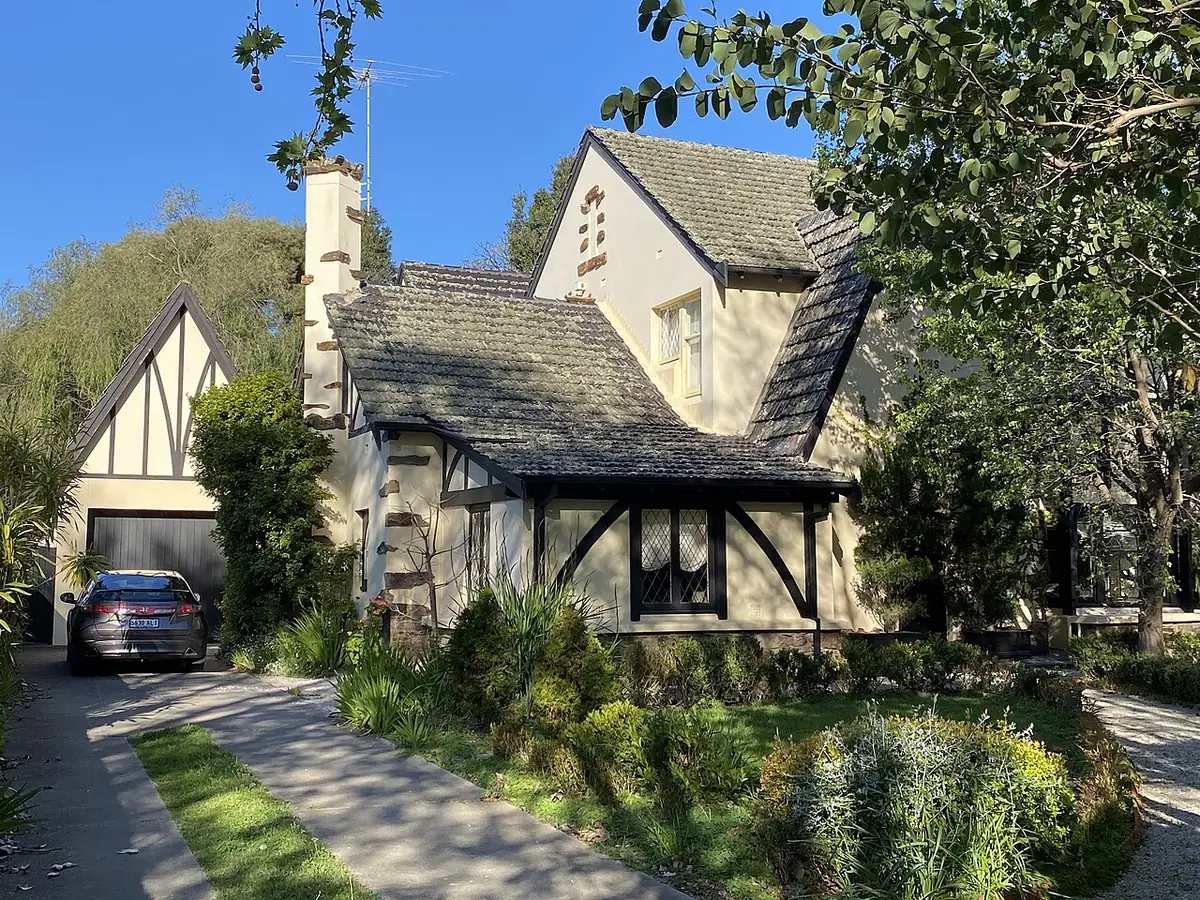
A Tudor Revival home with a leafy front garden in Adelaide — Photo: Ashton 29 · CC BY-SA 4.0 · Wikimedia Commons
Selling an apartment in Adelaide involves several parties whose roles do not map onto those of a European sale: you, your estate agent, your conveyancer, the buyer and their bank, the lender holding any loan of yours, the land titles registry and the tax office. Between signing the agency agreement and settlement, allow for preparation of the Form 1, a few weeks of marketing and then, once the contract is signed, a settlement period often in the region of thirty to sixty days. Each participant acts at a specific moment, and a delay at one step pushes back all the others. The six steps below follow the usual order of a sale, whether the apartment is offered at auction or by private treaty. They set out who acts and what you need to watch.
You1. Choose the agent and the method of sale, and sign the agency agreementYou compare several agents on their recent sales, their reasoned appraisal and their recommendation between auction and private treaty, then sign an agreement setting out commission, duration and marketing costs. Check the agent's licence with Consumer and Business Services and negotiate the exit terms if the property does not sell.
Your conveyancer2. Prepare the Form 1 and check the titleThe conveyancer orders searches from the various authorities, gathers the strata information and draws up the Form 1, then verifies that nothing on the title will block the transfer. Send them the minutes, the latest levy and rates notices and your lender's details promptly if a loan is outstanding.
The estate agent3. Market the property, run inspections and, where relevant, the auctionThe agent publishes the listing on the portals, runs home opens and private appointments, and reports back on the feedback. For an auction, you set a reserve price with them in writing; for a private treaty sale, you decide in advance the level of offer and the conditions you will accept.
The buyer4. Sign the contract and pay the depositThe buyer signs the contract at the close of the auction or after negotiation, and pays a deposit, often around 10%, usually held in the agent's trust account. After a private treaty sale, watch for the expiry of the cooling-off period and the satisfaction of any finance or inspection conditions.
The conveyancers and the banks5. Prepare settlement and the adjustmentsThe conveyancers for both parties calculate the apportionment of strata levies, council rates and water charges, coordinate the discharge of your mortgage with your lender and check any tax withholding. Make sure the clearance certificate, if you are entitled to one, is provided before settlement.
All parties and the land titles registry6. Settlement, registration and release of fundsOn settlement day the price is paid electronically, any loan of yours is repaid, the applicable withholding goes to the tax office and the balance reaches your account. The transfer is registered with the state land titles registry, after which you organise moving the funds home if that is your plan.
Apartment or house in Adelaide: which sells better, and how to sell yours
What remains is to put figures on what the sale will actually cost you, between commission, fees and tax.
In Adelaide, the house on its own block remains the benchmark for many buyers, and that preference shapes how an apartment sells. Houses in sought-after suburbs such as Unley, Norwood or Prospect benefit from land value, which carries most of the long-run growth in prices, whereas the value of an apartment depends more on the building, its age and competition from new developments in the city centre. For the seller of an apartment, that means a more direct comparison: the buyer often finds a similar lot in the same complex or the next street, and also weighs up what a small house a little further out would cost.
An apartment therefore does not sell on the promise of land or the potential to extend, but on arguments a house cannot offer: no external maintenance, life on foot between the Central Market, the Park Lands and the Torrens, proximity to the tram, the universities and the hospitals, and sometimes the sea at Glenelg. The most active buyers in this segment are young professionals, investors, parents of students and retirees leaving a house that has become too big. Each of these audiences reads your listing differently, and it is to them that the photographs, the text and the price have to speak.
A house generally sells on its land, its aspect and its potential for renovation; an apartment sells on its figures and on the quality of its building. The buyer asks for the strata levies, the state of the maintenance fund, the works already voted through, the rules on pets or short-stay letting, and the rent achieved if the property is let. In the buildings of the 1970s and 1980s, of which Adelaide has many, they will also ask about insulation, lifts or the roof. A seller who supplies this material at the first inspection, alongside the Form 1, shortens the negotiation and stops an unanswered worry turning into a discount.
Preparation differs too. A house often calls for a tidy garden and visible repairs; an apartment calls above all for light, a neutral interior, a balcony shown to advantage, clearly documented parking and, in a city with very hot summers, evidence of effective air conditioning or good shading. Light styling, a professional clean and good photography are usually enough, whereas major works rarely pay for themselves on a lot whose price is bounded by neighbouring sales.
Finally, timing and method are not weighed in the same way. A family house sells readily around the school calendar, and auctions are very common; a standard apartment, whose price is easy to compare, often suits a private treaty sale just as well, whereas a rare property, with a view or in a small sought-after complex, can justify an auction. If several lots in your building are on the market at the same time, it may be wiser to wait a few weeks, or to stand out through condition and documentation, rather than dropping the price straight away.
What selling an apartment in Adelaide costs: commission, fees, tax and levies
With those amounts settled, what remains is to look at your apartment through the eyes of the buyer who will pay for it.
The price achieved is never the sum you bank: between listing and the final transfer, several items are deducted from it. Some are proportional to the price, such as the agent's commission or the withholding applied where no clearance certificate is supplied; others depend on the file or on your circumstances, such as conveyancing fees, an auction campaign or capital gains tax. Stamp duty, by contrast, is paid by the buyer in South Australia and does not appear among your costs, though it does eat into the budget they can put towards the price. If you are tax resident elsewhere, add the declaration of the gain at home and the cost of converting the funds. The ranges below are indicative, partly negotiable, and should be confirmed by quote and by a tax adviser.
Selling and preparation costs for an apartment in Adelaide
Cost item
Estimated amount or range (AUD)
Who pays, when and why
Estate agent's commission
A few per cent of the price, with or without Australian GST depending on the agreement
Paid by you at settlement, out of the sale proceeds; the rate, the base and any thresholds linked to price are negotiated before the agency agreement is signed.
Marketing, photography and auction costs
A few hundred to a few thousand dollars depending on the campaign
Often paid by the seller before the listing goes live and due even if the property does not sell, depending on the terms of the agreement; an auction can add the auctioneer's fee.
Conveyancing and preparation of the Form 1
Fees and search costs to compare by quote; $1,500 - $3,000 is a prudent order of magnitude
Paid by you, partly as soon as the Form 1 is prepared; they cover the searches, the title check, the adjustment calculations and coordination with your lender.
Pre-sale inspection and making good
$500 - $1,000 for an inspection, works according to condition
Optional but useful: an inspection commissioned before listing lets you fix or cost defects before the buyer finds them and negotiates on them.
Add any early repayment or mortgage discharge fees on an outstanding loan, together with checks on smoke alarms and other installations whose compliance will be examined; your conveyancer will tell you what South Australia requires.
Capital gains tax and charges apportioned at settlement
Item
Mechanism or order of magnitude
What it means for you
Foreign resident withholding
15% of the price, withheld by the buyer at settlement
Avoided by an Australian resident who supplies a clearance certificate; for a foreign resident, credited against the tax due and partly refundable through the Australian tax return.
Capital gains tax in Australia and at home
Australian capital gains tax; a declaration in your country of residence, with double taxation relieved under the applicable agreement
The main residence exemption and the 50% discount are, for the most part, closed to those who are not Australian residents, and your home country's calculation follows its own holding-period rules.
Strata levies, council rates and water
$3,500 - $7,000 a year in levies; $1,200 - $2,200 in council rates; $800 - $1,400 for water
Payable by you until settlement, then apportioned pro rata; amounts paid in advance are reimbursed by the buyer, and any special levies already voted must be clarified in the contract.
These items depend on your tax residence at the date of the contract, on the holding period and on how the property has been used; an Australian accountant and a tax adviser at home should confirm the amounts before any decision on price. Allow finally for the exchange rate and the bank charges on moving the funds, which vary from one provider to another.
An ordinary Tuesday in Adelaide, seen by the buyer you are aiming for
Saint Ignatius Church and its twin towers in Norwood — Photo: Ashton 29 · CC BY-SA 4.0 · Wikimedia Commons
That daily life sells the property, but a serious buyer will also go looking for what your listing does not mention.
The buyer of an Adelaide apartment is not simply paying for square metres: they are paying for the day they imagine living from your address. In a city you can cross in a few minutes, walking and tram journeys, proximity to the hospitals, the catchment areas of the public schools and the Central Market within reach are all arguments a listing can lead with, provided they are true for your property. Following a typical Tuesday helps identify what your agent should emphasise in the description and during inspections. The stops below translate each moment of the day into a concrete selling point.
07:30The local cafe and the nearest tram or bus stop to your buildingA buyer who works in the city first looks at the walking time to the tram, the bus or Adelaide railway station. If your apartment is a few minutes from an Adelaide Metro stop, say so precisely in the listing, with the real travel time into the CBD.
08:30The journey to a CBD office or a university campusFor young professionals, students and their parents, being able to walk to work or study, cycle across the Park Lands or take the tram is a major argument. An apartment that removes the need for a second car holds up better against a house further out in the suburbs.
12:30A lunch break in the Park Lands or along the TorrensThe green belt around the centre is what separates a well-placed apartment from a merely compact home. Photographs taken immediately around the building, of parks, cycle paths or the river banks, are often worth more than yet another shot of the living room.
16:00The local school and its catchment zoneSome Adelaide public high schools enrol according to a geographic zone, and falling within a sought-after zone strongly attracts families. If your address does, confirm it with the state education department and mention it carefully, because these zones can change.
18:00The Central Market or local shops, then a medical centreRetirees and families look at the distance to a GP and to the major hospitals such as the Royal Adelaide Hospital, the Flinders Medical Centre or the Queen Elizabeth Hospital. A market or supermarket within walking distance rounds out a practicality argument that apartment buyers value particularly highly.
20:00Back at the apartment and an evening in the buildingIn the evening, the buyer judges the quiet, the sound insulation, the security of the entrances and how cool the home stays after a hot day. A late-afternoon inspection lets you show the ventilation, the shading and the real peacefulness of the building, including during the festival season that fills the centre at the end of summer.
What an Adelaide buyer will check that your listing does not mention
What a buyer discovers late is paid for dearly, and that is often where sellers' regrets begin.
A listing leads with the light, the location and the fittings, but a serious buyer, their conveyancer and their inspector will go looking for what it leaves out. In Adelaide, those checks focus above all on how the strata scheme is run, on the by-laws, on the construction going on around the centre and on summer comfort. Some of that information is already in the Form 1 and its annexures, and the buyer will read it closely. What they find out late, you pay for in renegotiation or in a thinner field at auction; what you document early becomes a selling point. Here are the four things they will check, whether or not you raise them.
The strata by-laws on pets, alterations and short-stay letting
The by-laws may restrict keeping animals, installing a barbecue on the balcony, altering the interior or letting on a short-stay basis. A buyer with a dog, or an investor who had short-stay letting in mind, will walk away quickly if the answer is vague. Give it clearly in the information pack at the first inspection, rather than leaving the buyer to find it in the annexures to the Form 1.
The state of the maintenance fund and the special levies ahead
The buyer will read the minutes of recent meetings to spot roof, facade or lift works voted through or under discussion. An underfunded reserve suggests special levies to come, and they will mentally deduct an amount, often well beyond the real cost. Better to know these things before they do and to have a costed answer ready, ideally backed by a quote.
Building sites and development plans around the block
Central Adelaide regularly takes on new residential, student and hotel buildings, and the buyer will look up planning applications to see whether the view, the light or the quiet are at risk. If a nearby project is known, present it with the facts you have, because a buyer who uncovers it alone will suspect something was being hidden.
Summer heat, air conditioning and the parking actually attached to the lot
A heavily glazed or west-facing apartment can become hard to live in during Adelaide's heatwave days, and the buyer will ask the age of the air conditioning and the size of the electricity bills. They will also check on the plan whether the car space or garage forms part of the lot or is merely an exclusive use right, and whether a standard car fits comfortably. A listing that is vague on these points undermines trust.
Seller mistakes in Adelaide discovered six months later
These mistakes have one thing in common: a sale decided too quickly, when some situations call for waiting.
Looked likeAppointing the agent who quoted the highest appraisal and leaving the Form 1 to be prepared after the first inspections.
Turned outAn over-ambitious starting price, weeks without a contract, then an interested buyer who waited for the late Form 1 to withdraw and negotiate downwards.
Would have caught itAsking each agent for the recent comparable sales their appraisal rests on, and having your conveyancer draw up the Form 1 before the listing goes live.
Looked likeSigning the contract just after becoming a foreign resident, on the assumption that only the date the money arrived mattered.
Turned outThe main residence exemption was lost and part of the price was withheld at settlement, with an Australian tax return to lodge to put things right.
Would have caught itHaving an Australian accountant confirm your residency status at the date the contract is entered into, and setting the auction or signing date accordingly.
Looked likeChoosing an auction on principle, because houses in the suburb sold that way, with a reserve set at the last minute from the other side of the world.
Turned outFew bidders for an easily comparable apartment, the property passed in below reserve, then a private treaty negotiation conducted from a weak position and a marketing campaign paid for nothing.
Would have caught itDiscussing with several agents the method of sale suited to your lot, and setting your reserve in writing, calmly, allowing for the time difference.
Looked likeMoving the sale proceeds home by a simple bank transfer on the day of settlement itself.
Turned outAn unfavourable exchange rate and charges that were hard to see cut into the amount received, and the receiving bank asked for evidence of the source of funds, which held things up.
Would have caught itComparing currency providers before the sale and preparing the contract, the settlement statement and the tax paperwork for the bank at home.
Who should not sell their Adelaide apartment right now?
With those cases set aside, what remains is to settle the question for your own apartment: sell now, and at what price.
Selling is not always the best decision, even when an agent quotes a good price or the recent growth in the Adelaide market makes realising a gain tempting. Some tax, tenancy or estate situations make an immediate sale more expensive than waiting a few months or keeping the property. Selling costs, the withholding, capital gains tax and the cost of getting back into the market later all have to be set against what the sale actually gives you. Here are three profiles for whom the wiser answer is often to wait.
The resident leaving Adelaide without having checked the tax effect of their departure
→To hold off signing any agency agreement until they have seen an Australian accountant about their residency status and their capital gain.
A sale signed after residency is lost can remove the main residence exemption and lead to a tax bill far larger than the price difference hoped for by selling later or sooner.
The owner whose strata scheme has just voted through major works, or whose maintenance fund is empty
→To let the works be carried out, or at least precisely costed, before listing.
Uncertainty about a special levy, which will appear in the strata information given to the buyer, weighs on offers more heavily than its real cost; completed and paid-for works reassure and support the price.
The owner selling out of weariness with managing from a distance, with no particular need for the capital
→To hand management to a solid letting agency first and revisit the question of selling with a clear head.
Commission, fees, tax on both sides and the cost of any return to the Adelaide market make a rushed disposal hard to undo, whereas a management problem is usually solved without selling.
So, should you sell your Adelaide apartment now, and at what price?
Selling an apartment in Adelaide is decided less on a feeling about the market than on four straightforward checks: what you will net, the date at which your tax position makes the sale most favourable, the method of sale suited to your lot and the audience genuinely interested in your address. An advertised price or a reserve consistent with recent sales in your building and your size bracket draws buyers in the first few weeks, when their attention is at its strongest.
If your Form 1 is ready, the strata information complete, your residency status confirmed and the net amount calculated after commission, conveyancing, withholding and tax in Australia and at home, you can sign an agency agreement with your eyes open. Then set the price from verifiable comparable sales rather than from the most flattering appraisal, choose between auction and private treaty according to how genuinely rare your property is, and decide in advance what level of offer and what conditions you will accept.
If any of these points is still unclear, taking a few weeks to settle it generally costs less than a badly calibrated sale, an auction with no result or an avoidable tax bill. Keeping the property, continuing to let it or postponing the sale are equally legitimate decisions when the figures are not yet in place. The Adelaide market will go on welcoming well-prepared sellers, who know exactly what they are handing over and what they will be left with.
Related questions
What commission does an estate agent charge to sell an apartment in Adelaide?
Commission is not set by law and is negotiated with the agent before the agency agreement is signed. Across metropolitan Adelaide it usually amounts to a few per cent of the price, often a little below the levels charged in Sydney, with variations according to the value of the property and the service offered. Marketing, photography, portal advertising and, where relevant, auction costs are frequently billed separately. Check in the agreement whether the commission is quoted inclusive of Australian GST and what remains payable if the apartment does not sell.
Can a non-resident sell an apartment in Adelaide from overseas?
Yes, nothing prevents a non-resident owner from selling a property in South Australia. The agent handles marketing and inspections, while your conveyancer prepares the Form 1, the transfer and the electronic settlement remotely. You will need to satisfy the identity verification required for registration and sign documents in the prescribed form, sometimes before a qualified witness overseas. Allow as well for the 15% withholding applied to the price where no clearance certificate is provided.
What is the 15% withholding applied to an Australian property sale?
It is a withholding mechanism aimed at foreign resident sellers: the buyer deducts 15% of the price at settlement and pays it to the Australian Taxation Office. For contracts entered into from 1 January 2025 it applies whatever the value of the property. A seller who is an Australian resident for tax purposes avoids it by supplying a clearance certificate, applied for online before settlement, and a foreign resident can in some cases request a reduced rate. The amount withheld is then credited against the tax due once an Australian tax return is lodged.
Is capital gains tax payable when you sell an apartment in Adelaide?
Yes, the gain made on an Australian property is in principle subject to Australian capital gains tax, which is a federal tax and identical in Adelaide and in the rest of the country. A resident for tax purposes selling a main residence may be exempt subject to conditions, and a resident who has held the property for more than twelve months may qualify for a 50% discount. These advantages are, for the most part, closed to those who are not Australian residents for tax purposes. The calculation depends on the date the contract was entered into, the holding period and the use made of the property, which is why an Australian accountant is worth consulting.
Does the gain on an Adelaide sale have to be declared in your home country?
If you are a tax resident somewhere else, the gain made on a property located in Australia will usually have to be declared there as well. Australia has double tax agreements with many countries which set out how double taxation is relieved, so that the same gain is not taxed in full twice. Your home country's calculation nonetheless follows its own rules, particularly on how the holding period and any social levies are treated. Have your position checked by a tax adviser in your country of residence before settling on the net price you are aiming for.
How long does it take to sell an apartment in Adelaide?
The timetable breaks down into three phases: preparing the property and the Form 1, marketing until a contract is signed, then the settlement period. An auction campaign often runs for around three to four weeks up to the day of the sale, whereas a private treaty sale depends more on the asking price and the competition at the time. The settlement period that follows is frequently in the region of thirty to sixty days, according to what the contract provides. A sensible price from the day the listing goes live remains the best way to shorten the whole process.
What is the Form 1 and who prepares it when you sell in Adelaide?
The Form 1, or vendor's statement, is the document that South Australian law requires be given to the buyer: it sets out the charges, easements, rates and planning constraints affecting the property, together with the strata information for an apartment. In practice it is prepared by your conveyancer from searches made with the various authorities. The buyer's cooling-off period, where it applies, only starts to run once the contract has been signed and the Form 1 served. An incomplete or inaccurate Form 1 can allow the buyer to unwind the sale, which is why it is worth starting as soon as the agency agreement is signed.
Is it better to sell by auction or by private treaty in Adelaide?
Auctions have an important place in Adelaide, but a large share of apartments also sells by private treaty, with an asking price or an invitation to make offers. An auction creates a deadline and open competition; the contract signed under the hammer is firm and the buyer has no cooling-off period. A private treaty sale leaves more flexibility on timing and conditions, but the buyer can in principle withdraw within the two clear business days provided by state law. Compare the two methods with several agents in the light of recent sales in your building before choosing.
Can you sell an apartment in Adelaide with a tenant in place?
Yes, a tenanted apartment can be sold with its lease, which then passes to the new owner. This option mainly appeals to investors, who value rent that is already in place and documented. If you would rather sell with vacant possession, the grounds and notice periods for ending a tenancy are governed by South Australian residential tenancy law, reformed in recent years to give tenants greater protection. Inspections must also respect the tenant's rights and the required notice, which you can confirm with Consumer and Business Services.
How do you move the proceeds of an Adelaide sale back home?
The balance of the price is first paid at settlement into an account, in principle in Australian dollars, after any loan of yours is repaid and the applicable withholding is deducted. You can then convert it into your own currency through your bank or a specialist transfer service, where rates and fees vary considerably. Keep the contract, the settlement statement and the tax paperwork, because your bank at home may ask about the source of the funds. For a substantial amount, obtain several quotes before converting.
Property review of ting
No ting properties in Adelaide yet
Be the first — share it on ting and it shows up right here.