Investing in a house in Dubai means going beyond headline yield promises to look at how the residential communities actually work, what the extra costs are and how the local legal framework is built. This independent guide walks through every part of your project so you can complete a purchase with confidence.
Get the app
What nobody tells you.
Real prices, hidden costs and the traps to check before you commit.
What you are really getting when you buy a house in Dubai
Scroll
What you are really getting when you buy a house in Dubai
Investing in a house in Dubai means going beyond headline yield promises to look at how the residential communities actually work, what the extra costs are and how the local legal framework is built. This independent guide walks through every part of your project so you can complete a purchase with confidence.
Written by the ting.ad editorial team ·
Dubai in Street View: drag to look around.
Beyond the raw market figures, choosing a way of living that fits your own circumstances remains the real decider.
Investing in a house in Dubai is not simply a matter of acquiring square metres under a sunny sky. The emirate's property market rests on the logic of planned communities and private management, which completely redefines what residential ownership means. Between the promise of a high rental yield and the reality of service charges tied to shared amenities, the value of a property has to be read through how it sits within its district. Understanding that mechanism is what separates the headline effect from the real benefits for an investor or a long-term resident.
The promise of a gross rental yield above that of European citiesvsThe reality of a market marked by high service charges and maintenance costs
The yields advertised by developers are often persuasive, but once management fees and local administrative charges are included the net return calculation shifts noticeably over several years.
The appeal of a gated community with parks, artificial lakes and schoolsvsComplete dependence on a single manager for the upkeep of the shared infrastructure
Buying in these secure areas guarantees a consistent and sought-after living environment, but it removes any control over how charges and the district's internal planning rules evolve.
The apparent architectural freedom of high-end detached villasvsThe strict framework of owners' associations that regulate every external change
Unlike buying land outright in other countries, structural or landscaping changes are subject to prior approval from the master community.
Does this place actually match the way you live now?
To gauge those differences properly, it helps to compare this daily rhythm with the reference points you bring with you.
The way Dubai is laid out resembles no other major world city. The absence of a single centre and the dominance of fast road corridors profoundly change journey times and your relationship with space. Whether you are settling in as a family with school-age children, leading the hyper-connected life of a senior executive or preparing for a quiet retirement, a property purchase will not have the same impact. This section sets out how your daily profile fits the geographic realities of the emirate.
Family and schooling
Families generally favour the outlying gated communities for their spacious villas, private gardens and international schools within immediate reach. This way of living offers a secure environment and built-in sports facilities, but it demands rigorous planning around daily journeys. Trips to the business districts at peak times can be long, which makes proximity to the main road corridors decisive if you want to protect your work-life balance.
Buy-to-let investment
For an owner who is not in the country, the absolute priority is how easy the property is to manage. Houses inside integrated schemes run by large brands enjoy steady occupancy and comprehensive handling of repairs. In exchange, there is less room to negotiate at purchase and the community management fees reduce the net return, which means targeting districts with sustained demand from tenants who can pay.
Working life
If your days are paced by meetings in business centres such as DIFC or Downtown, buying a house on the outskirts can become a serious constraint because of the traffic. Mobile professionals lean instead towards well-connected townhouses or properties in the intermediate districts. That option lets you combine the floor area of a house with quick access to transport and coworking spaces, avoiding geographic isolation.
Living here when you have come from abroad: what really changes
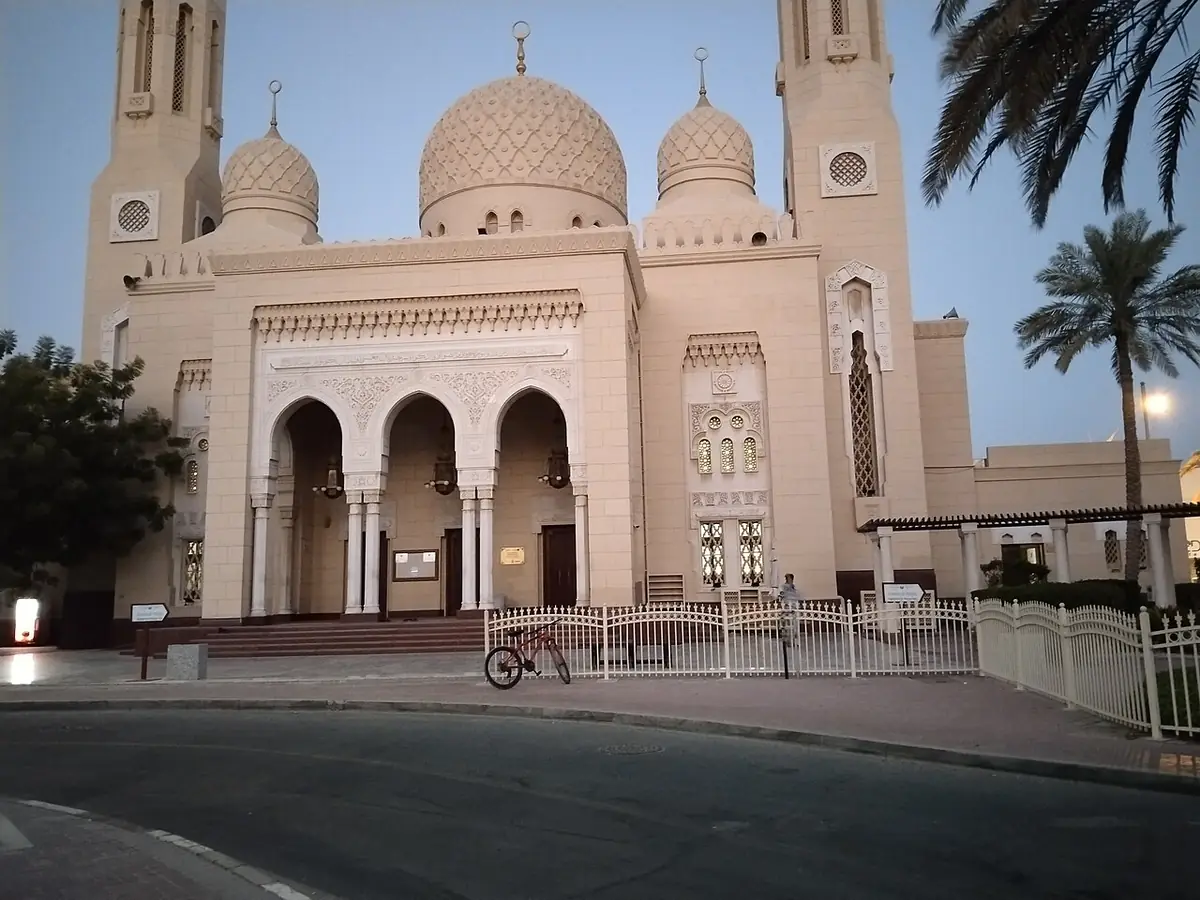
Jumeirah Mosque, a well-known landmark in Dubai — Photo: ZI Jony · CC BY-SA 4.0 · Wikimedia Commons
Once those reference points have settled, choosing the right district becomes the decisive step in structuring your investment.
Settling in Dubai after living in a traditional European or North American city means giving up some deeply held assumptions about how a city and its administration work. Daily life no longer rests on walkable neighbourhood shops or a dense public transport network, but on daily use of a private car and time spent in air-conditioned spaces. That shift changes how you shop, how you travel and how you maintain your home, and these are aspects buyers often underestimate when they sign a purchase contract.
From abroad
Walkable, shop-lined neighbourhood life in a city centre
Dubai
The model of self-contained, gated residential communities
Walking to local services is close to impossible for much of the year, which makes a car indispensable for even the smallest errand.
From abroad
A strict regulatory framework protecting the tenant and the borrower
Dubai
A liberal contractual market where the developer's clauses carry the weight
Legal protection depends entirely on how well the initial contracts are drafted and on compliance with the rules administered by the Dubai Land Department.
From abroad
Temperate winters and moderate summers requiring conventional heating
Dubai
Permanent sunshine and extreme summer temperatures
The energy budget is dominated by continuous air conditioning, and the way the house is designed becomes critical to keeping electricity use under control.
From abroad
Shared ownership run by volunteer or local professional building managers
Dubai
Centralised management by developers or licensed management companies
Decisions about the upkeep of common areas and increases in charges are largely outside the individual control of resident owners.
Which district should you buy a house in, given your priorities?
These differences in location translate directly into price structures that deserve careful analysis.
The market for detached houses and townhouses in Dubai splits between mature, well-planted areas and new schemes on the immediate outskirts. Each district has its own identity, its own resident profile and its own price advantages. Choosing one over another depends on your tolerance for journey times, your need for green space and your medium-term investment horizon.
The established, landscaped communities
A mature setting with grown trees, artificial lakes and an active neighbourhood life around the local shopping centres.
Suits
Families looking for stability, established schools and a place that works immediately, with no construction noise.
Trade-off
Higher prices per square metre at purchase, and properties that sometimes need renovation or energy upgrades.
The new schemes on the outskirts
Ultra-modern areas still under development, with contemporary finishes and recent energy-efficient equipment.
Suits
Investors looking for a lower entry price and capital growth potential tied to the future extension of transport infrastructure.
Trade-off
Noise from surrounding construction sites and a retail offer that is sometimes incomplete in the first months after handover.
The coastal and semi-private districts
An exclusive atmosphere combining beaches, marinas and high-end resort services within immediate reach.
Suits
Buyers who prioritise prestige, quick resale and a seasonal rental yield aimed at an affluent international clientele.
Trade-off
Liquidity that can depend on swings in the international economy, and some of the highest service charges in the market.
What does buying a house in Dubai really cost?
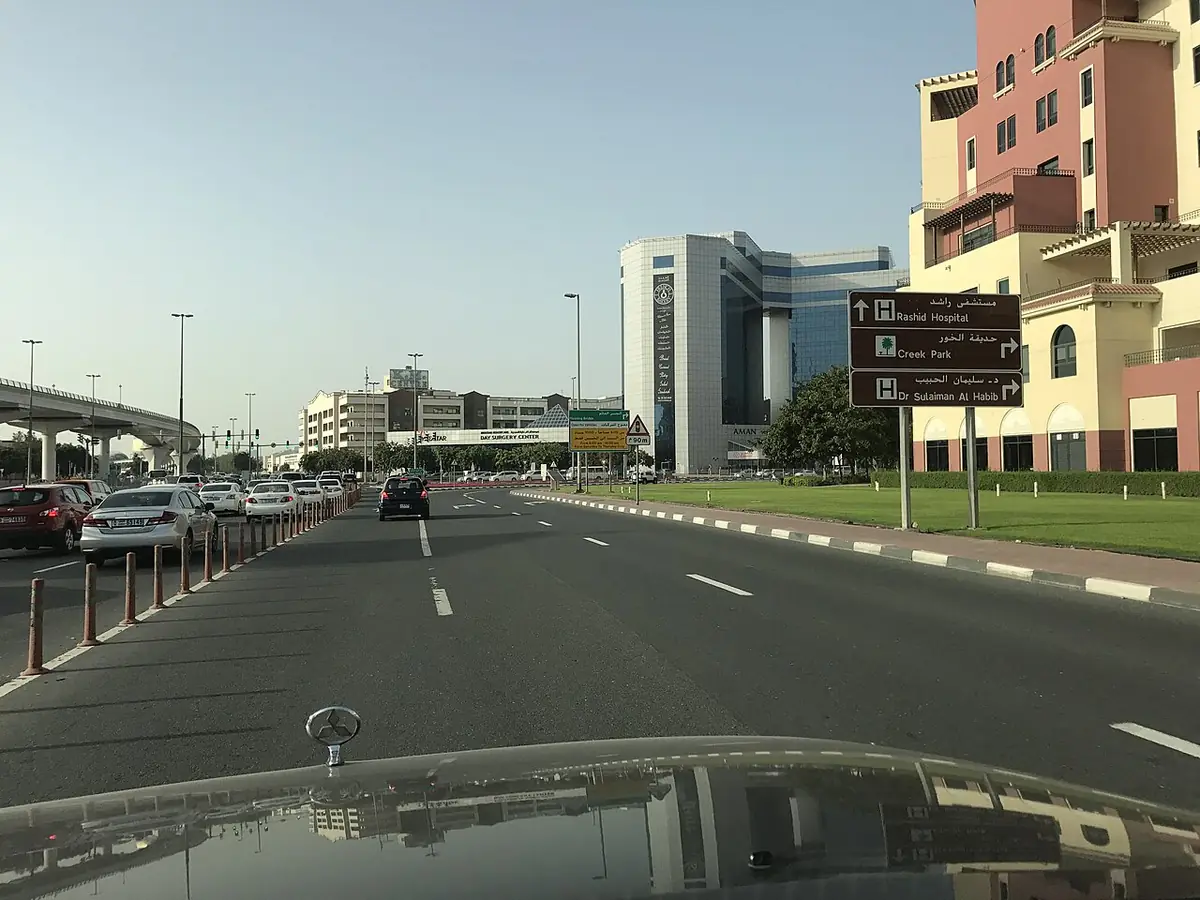
A typical Dubai street, wide and lined with modern buildings — Photo: Darvin.wilson · CC BY-SA 4.0 · Wikimedia Commons
Beyond the financial side, the legal nature of property rights in Dubai deserves particular attention.
Working out what a house in Dubai costs is not limited to the headline price shown by the developer or the seller on the property portals. The emirate's transaction system includes compulsory registration fees, regulated agency commissions and annual maintenance costs calculated per square foot. Anticipating those cost lines carefully avoids unpleasant financial surprises when the final signing takes place at the registration trustee office.
dubaiFor saleHouseestimate
Median price / m²AED 11,685Half the apartments sell below this
Median priceAED 2.26mthe average is 14% higher — a few very large properties pull it up
Most common2 bedrooms58 % of listings
Average size184 m²
By number of bedrooms
Bedrooms
Share of market
Avg price
Price / m²
Avg size
2most common
58 %
AED 2.24m
AED 12,177
184 m²
3
31 %
AED 2.83m
AED 11,562best value / m²
245 m²
4
11 %
AED 4.29m
AED 12,915 +5 %
333 m²
Each row is an average, compared against the area average of AED 12,300 / m². These are indicative estimates of a typical local market, not a measured sample of live listings. Check current listings before relying on them.
What you can actually own when you buy a property here
Getting a grip on these legal points leads naturally to the administrative steps that matter when the money moves.
The distinction between freehold areas and leasehold areas is a fundamental idea that every foreign buyer needs to master before committing. The emirate's legal framework has set out precise geographic zones in which non-nationals can acquire full rights over both the building and the land. Grasping that legal nuance protects your assets over the long term and makes future inheritance or resale far simpler.
Freehold areas (full ownership)
These areas allow any investor, whatever their nationality, to acquire full ownership of a property with no time limit, with an official title deed issued by the emirate's land authorities. That status gives complete freedom to resell, let or pass the property on under the applicable law.
What it changesYou hold an asset that can be transferred and sold on the same terms as a national resident, which secures the investment across several generations.
Leasehold areas (long-term lease)
These zones grant a right to use and enjoy the property for a period fixed by contract, generally between 30 and 99 years and renewable according to the terms initially negotiated with the institutional or state landowner.
What it changesYou must check exactly how much of the lease is left before buying, to avoid a fall in value as the contractual expiry approaches.
The legal rule to understand before you pay a single deposit
With those safeguards understood, the transaction itself follows a precise timeline worth planning for.
Securing funds during a property transaction in Dubai rests on strict procedures set by the local regulators. A deposit should never be paid directly into the personal account of an agent or a seller without an approved escrow mechanism. Following that chain of guarantees to the letter protects the buyer against default disputes and handover delays, in the new-build market as much as in the resale market.
The decision to buy is made and the memorandum of understanding (Form F) is drawn up.
Check that the estate agent is registered with the emirate's official regulator.
Sign the preliminary contract setting out the conditions attached to the sale and the payment schedule.
Pay the security deposit (usually 10 percent) into the escrow account of the agency or the licensed trustee.
Obtain the no objection certificate (NOC) issued by the developer or the community management.
Final transfer of ownership at the land department and issue of the official title deed.
How a property transaction unfolds, step by step
Buying a house in Dubai follows a formal process in which every party (buyer, seller, agent, developer and administration) plays a precise role at each stage. Knowing the exact order of events lets you steer your project without rushing and make sure every document required by the emirate's official services is in order.
The buyerSet the budget and shortlist propertiesConfirm your financing capacity and target precisely the communities that suit the way you live.
The estate agentViewings and offer negotiationView the shortlisted properties and draw up the memorandum of understanding (Form F) setting out the terms of sale.
The escrow or trustee officePayment of the security depositFunds are held in a regulated escrow account until the conditions attached to the sale are cleared.
The developer or master communityIssue of the no objection certificate (NOC)Confirmation that the seller is up to date with all service and community charges.
The administration (DLD)Final transfer of ownershipSigning of the final deed, payment of the registration fees and issue of the title deed in the buyer's name.
House or apartment in Dubai: how do you decide?
Once that first structural choice between vertical and horizontal living is settled, the unavoidable question of the overall budget comes sharply into focus.
Choosing between a detached villa and an apartment in one of Dubai's landmark towers is not a matter of aesthetic preference or of the standing on display. It is above all a stark trade-off about how you live day to day, how you manage your commuting time and how exposed you are to service charges over the long run. Families instinctively look for the space and greenery of the gated communities, while working professionals prefer the centrality of business districts such as Downtown or Dubai Marina. Each option commits your capital to fundamentally different value curves and rental dynamics across the emirate's economic cycles.
An apartment offers unmatched operational flexibility and direct access to hotel-style facilities: infinity pools, fully equipped gyms and a permanent concierge service. In exchange, you have to factor in service charges that are often high, calculated per square foot, and that can weigh heavily on your net return if you later decide to let the property. Living vertically also means a degree of closeness to neighbours and complete dependence on lifts and the flow of people through common areas at peak times, which can wear on quality of life over the years.
A house, whether terraced or fully detached in a landscaped enclave, removes those collective constraints while introducing new operational responsibilities. You handle the garden yourself, along with maintaining your private pool and keeping your roof technically sound through summers of extreme heat. That investment generally comes with a markedly larger living area and complete autonomy, but it mechanically takes you further from the urban centres, adding to your daily journey time to the city's main economic hubs.
Your final decision should therefore rest on your investment horizon and your genuine tolerance for maintenance in a desert climate. If you plan to put down roots with school-age children, the space of a villa in a gated community usually wins out over the panoramic view from a high floor. If instead you travel frequently or want immediate liquidity so you can resell or let without friction, a central apartment remains the more rational asset for protecting your capital without the upkeep worries.
What budget do you really need to settle here for the long term?
With that budget framework in place, it is worth picturing concretely the daily rhythm that comes with moving your household to the emirate.
Buying a property in Dubai never comes down to the price shown on the online listing portals alone. You have to anticipate the full set of compulsory additional costs, which amount to a substantial sum from the moment the preliminary contract is signed. Between land registration fees, agency commission, bank arrangement fees and the utility deposits, the total easily exceeds what unprepared buyers had budgeted. This grid sets out all the cost lines to build in so that nothing catches you out when the final transfer is made.
Acquisition costs and initial fees
Cost line
Indicative rate or amount
How it is paid
Dubai Land Department (DLD) fee
4 percent of the purchase price
Split equally between buyer and seller in theory, often paid in full by the buyer.
Estate agency fee
2 percent of the purchase price before VAT
Payable when the reservation contract (MOU) is signed.
Transfer and processing fees
Between AED 2,000 and AED 5,000
Administrative fees charged by the developer or the trustee office.
Bank valuation (if using a mortgage)
AED 2,500 to AED 3,500
A non-refundable amount required by the lending institution.
These fees fall due in cash on the day ownership transfers and generally cannot be financed through a mortgage.
Ongoing and annual maintenance costs
Type of cost
Estimated range
Payment frequency
Service charges (building or community)
AED 10 to AED 35 per square foot per year
Annual or quarterly, depending on the owners' association.
Air conditioning (district cooling)
AED 500 to AED 1,500 per month
Monthly, based on actual consumption plus fixed subscription fees.
Comprehensive home insurance
AED 1,500 to AED 4,000 per year
Annual premium taken out with an insurer licensed in the UAE.
Preventive maintenance (air conditioning and plumbing)
AED 3,000 to AED 8,000 per year
An annual contract is recommended for detached villas.
Service charges vary considerably depending on whether your community has pools, gyms and landscaped parks.
Health, schools, transport: what does an ordinary Tuesday look like?
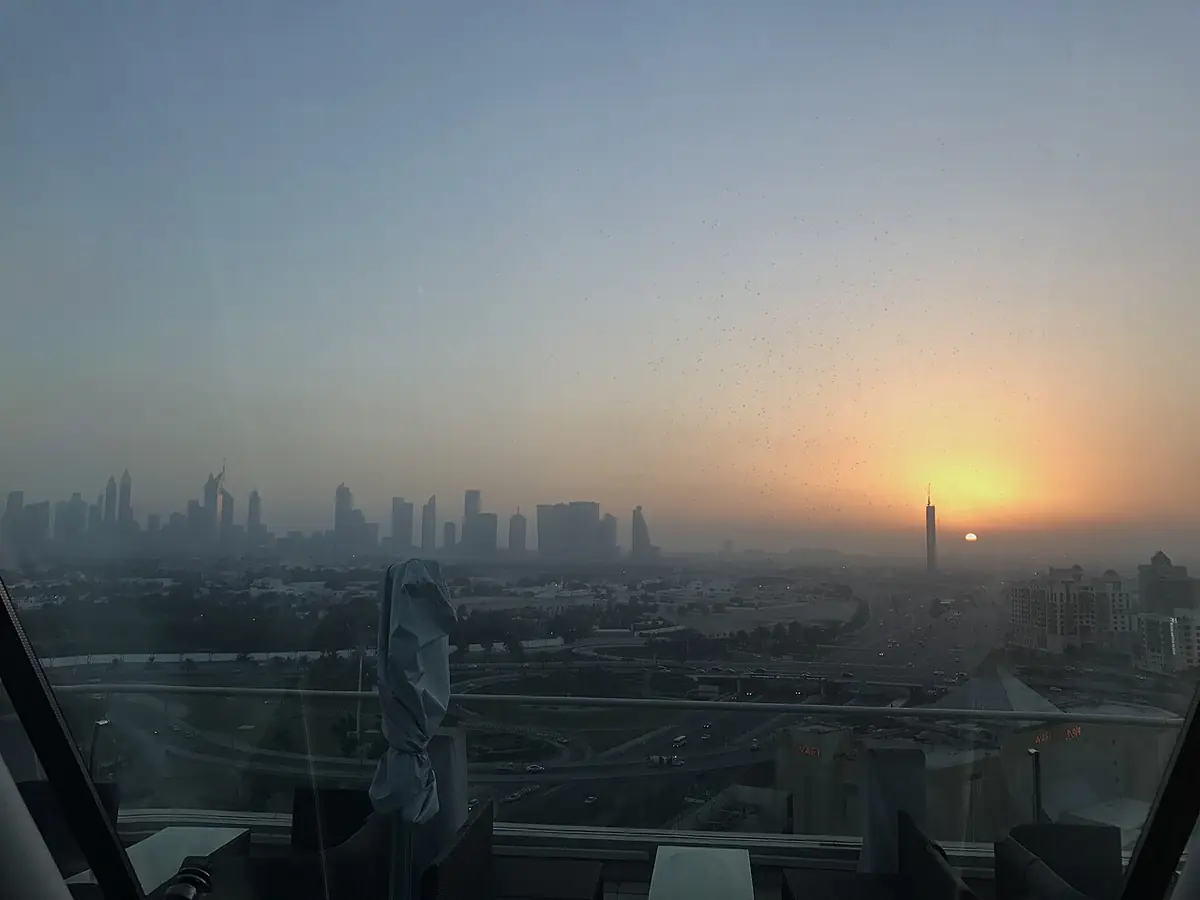
Dubai's skyline at sunset, a fitting close to the day — Photo: Lxs · CC BY 4.0 · Wikimedia Commons
If that picture appeals at first glance, the other side of it holds contractual and technical realities the brochures carefully leave out.
Living in a villa in Dubai imposes a precise logistical balance between morning journeys, work commitments and the children's after-school activities. Far from the cliches of permanent leisure, daily life is built around modern infrastructure that nonetheless faces intense commuter peaks. To picture your future life here clearly, this is exactly how an ordinary Tuesday unfolds, from dawn through to the last quiet moments in your garden at night.
06:30Waking up and setting off from the communityA calm start in your villa, checking the school bags and taking the car out of the air-conditioned garage before the temperature climbs.
07:30International school drop-offA drive to the private school in the district, often less than fifteen minutes from the large gated residential complexes.
08:30Arriving at the office or coworking spaceReaching the DIFC or Business Bay business hub along the main motorway corridors, which flow freely if you left home before the eight o'clock peak.
13:00Lunch break and local errandsA top-up shop at the community supermarket (Spinneys or Carrefour) to restock the house with imported fresh produce.
16:30The children's after-school activitiesTaking them to the swimming or football club at the heart of the residential community's clubhouse, a major draw for families.
19:30Family time and running the householdDinner on the terrace in the garden, enjoying the cool of the evening and the secure quiet particular to the emirate's gated residential districts.
What the developer brochures will never tell you
These technical and contractual risks frequently turn, a few months in, into bitter regret for buyers who were poorly prepared.
Dubai's property market runs on very fast-moving conventions in which buyers' enthusiasm is constantly stoked by well-rehearsed sales arguments. Yet behind the promises of spectacular returns and luxury finishes lie major legal and technical subtleties. Ignoring these invisible factors exposes the buyer to unexpected extra costs or to lasting disappointment on the rental side. Here are the four unavoidable realities the presentation packs systematically leave out.
Handover delays on off-plan purchases
Despite the increasing rigour of the regulation led by the Dubai Land Department and RERA, construction delays of six to eighteen months remain common. You have to build that gap into your rehousing or return strategy to avoid a cash-flow squeeze.
Actual build quality varies by developer
Not all developers are equal on sound and thermal insulation standards. A second-tier developer can hand over a villa that looks good on the surface but suffers from waterproofing defects or eye-watering air conditioning bills because of low-grade materials.
The volatility of service charges
Set at an attractive level at first to help sales, community maintenance charges often rise significantly once the owners' association is formally constituted. That increase eats directly into your net return if the property is intended for letting.
Future development and construction noise
Dubai is a permanent building site, and a clear view today can turn into a new block opposite or a noisy site the following month as the municipality allows the surrounding plots to be built up.
The buying mistakes you only discover six months later
Faced with these classic traps, it is worth asking the fundamental question of whether this market really suits your profile.
Looked likeA secluded villa in absolute quiet, perfect for escaping the bustle of the city and enjoying a large private garden.
Turned outA daily logistical nightmare, with forty-five minutes of peak-hour traffic to drop the children at the international school.
Would have caught itTiming the real journey at eight in the morning on a weekday before signing any reservation cheque.
Looked likeA highly profitable off-plan investment with a gross return of ten percent promised by an aggressive agent.
Turned outA property delivered in an outlying area oversupplied with similar homes, producing long rental voids and rents revised downwards.
Would have caught itInsisting on real transaction data recorded with the Dubai Land Department rather than listening to the developer's marketing projections.
Looked likeA large older house carefully renovated by its previous owner, with no prior technical survey.
Turned outInvisible water ingress under the tiling and a worn-out central air conditioning system needing full replacement at great expense.
Would have caught itAlways commissioning an independent technical survey from a certified inspection firm before the conditions attached to the sale are cleared.
Looked likeA purchase rushed through so as not to miss the supposed last opportunity available in the sought-after district.
Turned outNo way to resell quickly without a loss when an unexpected job move came up, because the resale market for that type of property lacks liquidity.
Would have caught itChecking the depth of the resale market and the real volume of recorded transactions for that specific type of villa over the past twelve months.
Who really should not buy a house in Dubai right now?
So this is the moment to take a clear-eyed look at your own situation and make the right call.
Buying property is often presented as the ultimate prize of expatriate life in the United Arab Emirates. Yet the flexibility built into the local rental market sometimes offers strategic advantages that ownership abruptly removes. Committing to a villa purchase without the professional or personal stability it requires leads inevitably to a financial dead end. Here are the buyer profiles who should firmly hold off and keep renting.
The expatriate on a short assignment (less than three years)
→Flexible rental of a furnished villa with quarterly payments.
The upfront acquisition costs (DLD fee, agency commission, transfer and trustee fees) come to close to seven percent of the price of the property. If you resell within three years, any capital gain will never cover those exit costs, leaving you mathematically worse off than if you had rented.
The risk-averse investor looking for a guaranteed return
→A diversified financial investment, or managed rental exposure in other asset classes.
Dubai's property market remains cyclical and sensitive to global macroeconomic swings. A non-resident owner has to handle management at a distance, potential arrears and heavy maintenance in a demanding climate, all of which erodes the real net return.
The household with variable income or no emergency savings
→Keeping savings liquid in secure, immediately available products.
Buying a house brings fixed costs that cannot be reduced and unforeseen air conditioning or structural expenses. Without a cushion equal to six months of charges, you are exposed to serious debt if your work situation turns in the emirate.
So are you really ready to take the step?
Buying a house in Dubai is a decision that leaves no room for approximation and demands complete clarity about your underlying motives. If you see the purchase as a short-term speculative play riding the emirate's momentum, you are taking a considerable risk given how cyclical the land market is. If, on the other hand, it sits within a medium or long-term family plan anchored in stable earnings on the ground, buying a villa is a powerful and structuring choice for your wealth.
Take the time to weigh every financial parameter, building in the full set of hidden costs, from the Dubai Land Department registration fee through to service charges and the cost of cooling the house in summer. Never give in to the pressure of urgency or to the persuasive talk of developers who raise the spectre of scarcity to hurry your signature. Dubai's property market is large and mature, and it constantly offers sound opportunities to anyone who observes, checks and negotiates methodically.
Your future independence depends directly on how rigorous your preparation is now. Visit several communities at different times of day, insist on an independent technical survey before paying any deposit, and make sure your investment horizon stretches well beyond the five-year mark. If all those conditions are met and your emergency savings are still intact after the transaction, you have everything you need to settle into property ownership in the emirate with confidence.
Related questions
What registration fees are unavoidable when buying a property in Dubai?
Buying a property in Dubai carries a compulsory four percent registration fee collected by the Dubai Land Department (DLD). By custom this sum is usually split equally between buyer and seller, but in market negotiations it is very often carried in full by the purchaser. On top of that come the estate agency fees, most commonly set at two percent of the transaction value before VAT.
Can a foreign national own a property outright (freehold) in Dubai?
Yes. Non-resident foreign investors can acquire property in absolute freehold ownership with no nationality restriction, but only in the areas specifically designated by the emirate's government. Those areas include most of the sought-after residential districts such as Dubai Marina, Downtown, Palm Jumeirah and the majority of the large gated villa communities.
How much are the service charges on a villa in Dubai?
Service charges covering the upkeep of shared areas vary considerably with the residential community, the standard of the amenities provided and the size of the plot. They generally run between ten and thirty-five dirhams per square foot per year, payable directly to the owners' association or to the developer responsible for managing the common areas and security.
Can a non-resident expatriate get a mortgage from a local bank?
Banks established in the United Arab Emirates do offer mortgages to non-residents, but the lending conditions are stricter than they are for local residents. The deposit required generally sits between fifty and sixty percent of the value of the property, and interest rates are indexed to international benchmark rates, so a spotless financial file is needed.
What is an off-plan purchase and what are the risks?
An off-plan purchase means buying a property from a developer before or during construction, on the basis of architectural drawings and models. The main risk lies in the frequent handover delays or, in the most extreme cases with unregulated developers, suspended construction, although the escrow account system regulated by RERA now protects the deposits paid in effectively.
What are the tax implications of a property investment in Dubai?
The Emirate of Dubai applies no tax on the rental income received by owners and no capital gains tax when the property is resold. There is likewise no wealth tax and no local inheritance duty, which makes the jurisdiction particularly attractive for building and passing on family wealth internationally.
How long does transferring ownership of a villa usually take?
For a secondary-market transaction between private parties, the full ownership transfer process generally takes between thirty and forty-five days from the signing of the memorandum of understanding (MOU). That window allows the conditions attached to the sale to be cleared, the no objection certificate (NOC) to be issued by the developer, and the technical survey to be completed.
What is the no objection certificate (NOC) required in a sale?
The NOC (no objection certificate) is an official document that the community's original developer must issue before any transfer of ownership at the Dubai Land Department. It confirms that the current owner has settled all of the service charges due and that there is no outstanding financial or technical dispute with the community management.
How does district cooling work in villas and residential developments?
District cooling, often run by companies such as Empower or Tabreed, supplies homes with chilled water through an underground network that feeds the air conditioning units. On top of actual consumption measured by an individual meter, users have to pay fixed subscription fees (capacity charges) billed annually or monthly.
Do you have to use a licensed estate agent to buy in Dubai?
Using an estate agent is not strictly required by law in order to complete a transaction, but it is strongly recommended and is the norm in the local market. To operate legally in Dubai, every agent must hold a professional licence issued by RERA and carry a validated official broker card.