Buying a property in Phoenix is a major turning point that calls for a close reading of local realities. This guide sets out how the market works, how to read the residential districts, and the legal steps you need in order to secure your investment without a false note.
Get the app
What nobody tells you.
Real prices, hidden costs and the traps to check before you commit.
Why buying a house in Phoenix means rethinking your residential assumptions
Scroll
Why buying a house in Phoenix means rethinking your residential assumptions
Buying a property in Phoenix is a major turning point that calls for a close reading of local realities. This guide sets out how the market works, how to read the residential districts, and the legal steps you need in order to secure your investment without a false note.
Written by the ting.ad editorial team ·
North Central Avenue, Phoenix in Street View: drag to look around.
That clash between the postcard image and conditions on the ground shows up as soon as you look closely at your own buyer profile.
Buying a house in Phoenix is not simply a matter of gaining extra square metres under a sunny sky. Buyers quickly discover that urban space here is organised around very particular infrastructure logics, dictated by the desert terrain and the freeway grid. What looks like a straightforward property opportunity is in fact a demanding lifestyle choice that requires daily adaptation to heat constraints and to distance from the places where things happen. Understanding that gap between the advertised promise of wide open space and the reality of everyday life is the first essential step towards securing your investment without regretting your original choice.
The promise of generous living space and a private, planted lotvsThe reality of demanding upkeep in an arid climate, and of water consumption
Large lots need specific xeriscaping to avoid punishing water bills over the summer. New arrivals who picture upkeep comparable to a temperate garden routinely underestimate this line in the budget.
The appeal of a life lived outdoors, with air conditioning everywherevsThe constraint of total dependence on a car for even the smallest trip
The metro area sprawls over tens of kilometres with no genuinely continuous pedestrian fabric in the outer residential zones. Trying to live without a personal vehicle quickly becomes untenable for family and working life alike.
The illusion of an easy purchase, thanks to a dynamic and varied marketvsThe complexity of local planning rules and of association covenants
Many subdivisions are governed by strict HOAs that limit exterior alterations, vehicle parking and even the choice of planting. Ignoring those constraints before you sign leads without fail to neighbour disputes and unplanned spending.
What kind of buyer are you, given what Phoenix is actually like?
Those lifestyle choices become sharper still once you measure the cultural and practical changes against life somewhere else.
The Phoenix metro area attracts an extremely varied set of buyers, from remote workers seeking quiet to retirees seeking constant sunshine, by way of busy families. Yet the success of a property project depends directly on the fit between your daily habits and the way the territory is organised locally. A way of life that flourishes in a central district will not necessarily suit a buyer looking for the complete calm of the outer suburbs. Analysing your own situation is what stops you buying a property whose location ends up weighing heavily on your quality of life.
Central urban option
Buyers who want a life plugged into the economic action should target renovated areas close to transit corridors and business hubs. In those zones, properties are often smaller but they buy back precious time every day. Resale value there tends to be more resilient when the regional property market swings.
Outer residential option
Heading for the residential suburbs gives you access to single-family houses with comfortable volumes and lots that suit family life. In exchange, you have to accept substantial daily journey times to reach schools, cultural venues and the nerve centres of the metro area. Family logistics then become the central pivot of your move.
Asset and seasonal option
This profile is above all looking for a property that is easy to maintain and sits in a secure setting, often inside a planned community with shared services. Managing the property remotely, or during periods of absence, means surrounding yourself with reliable local providers for maintenance and oversight. Potential rental yield has to be weighed against association fees and the property taxes in force.
Which everyday assumptions should you leave behind when you arrive from abroad?
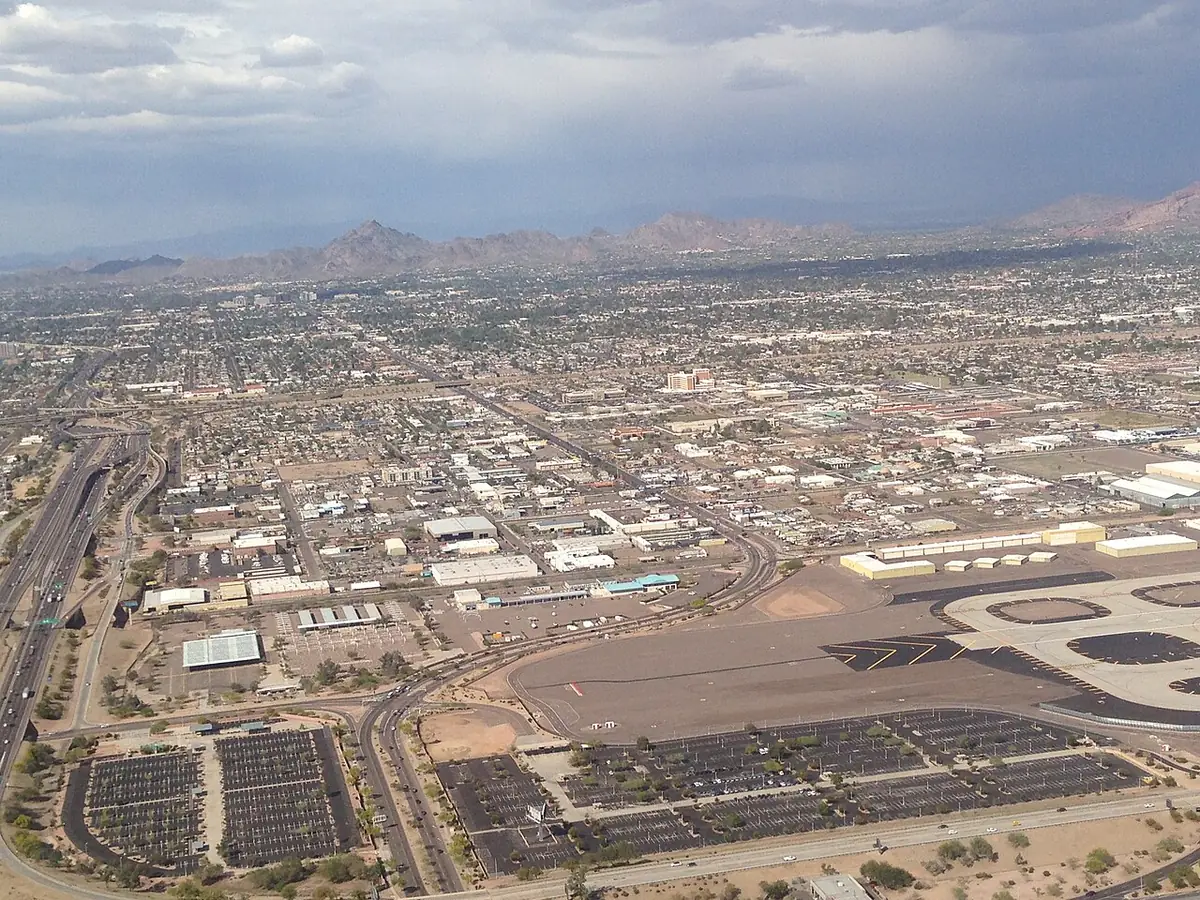
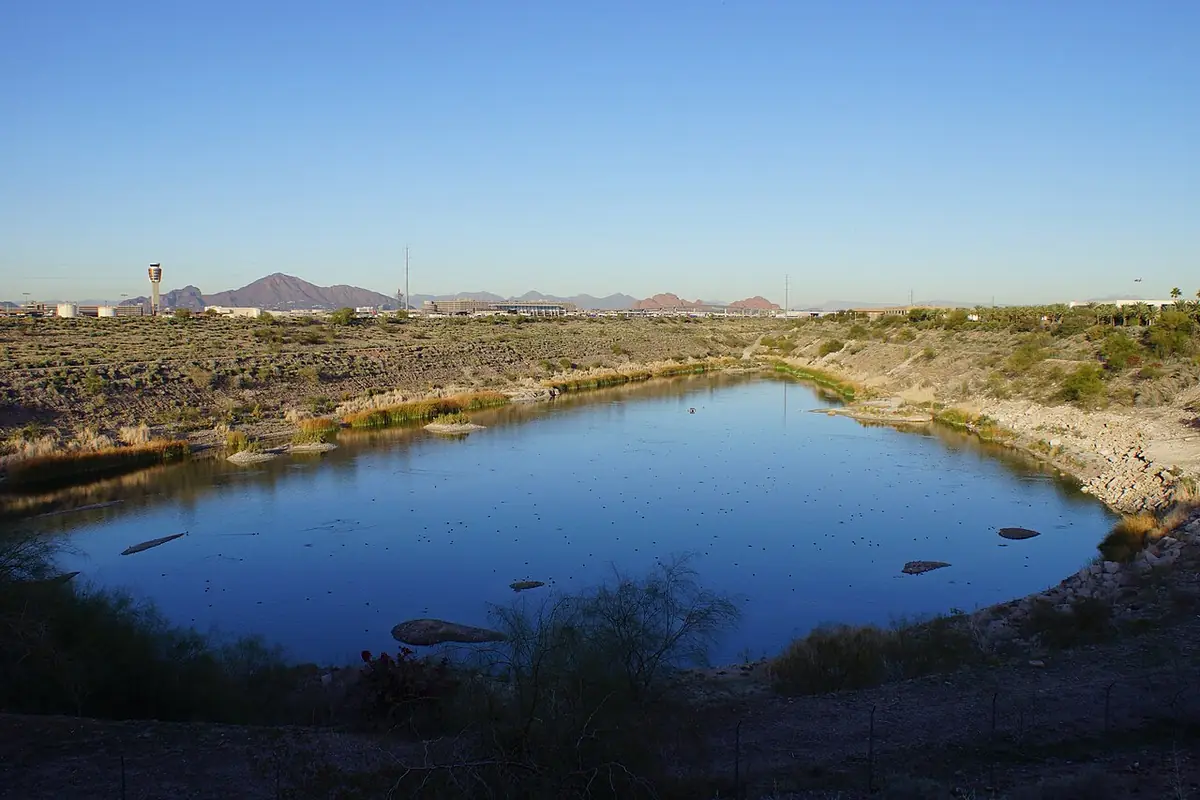
Phoenix spreads wide beneath its desert mountains — Photo: CyberXRef · CC BY-SA 3.0 · Wikimedia Commons
Once those assumptions have been reset, the choice of area becomes the single most structuring decision for your daily life.
Moving to Phoenix from abroad means dismantling a lot of reflexes tied to older, denser city forms. Where many cities are traditionally walked around a central square or a neighbourhood market, Phoenix works on a model built for the car and organised around large perpendicular arteries. This geographic transition is not limited to the climate: it touches social rhythms, the structure of housing and the very idea of neighbourliness. Anticipating those gaps will spare you a feeling of isolation during your first months here.
From abroad
A pedestrian way of life centred on local shops and cafe terraces
Phoenix
An urban scale where you move almost exclusively by car, from one shopping centre to the next
You have to fold the recurring cost of fuel, car insurance and vehicle maintenance into your overall housing budget.
From abroad
Centralised administrative procedures and property law tightly regulated by the state
Phoenix
A system run by decentralised local regulation, with homeowners associations carrying decisive weight
You must read the association's governing documents in full before signing anything, to avoid surprising prohibitions.
From abroad
Traditional architecture rooted in heritage and durable materials such as stone
Phoenix
Modern construction optimised for air conditioning, leaning on timber, stucco and reflective roofing
The energy performance of the building envelope becomes criterion number one for keeping your summer electricity bills under control.
From abroad
Spontaneous social ties formed in public urban space and on public transport
Phoenix
Sociability organised around private space, planned community activities and local clubs
Social integration takes a proactive approach and active participation in the community or professional life of your area.
How do you find your way around the variety of residential areas in the metro?
Looking at those areas leads inevitably to the crucial question of the prices actually being paid in this market.
The Phoenix urban area brings together very heterogeneous micro-markets whose atmosphere, services and housing types differ completely from one to the next. Choosing the right district does not depend only on your purchase budget, but on your tolerance for journey times, on what you expect in terms of cultural life, and on the shape of your household. Each area has its own distinct advantages and its own trade-offs, and both deserve cool analysis before you start booking viewings. An area prized for its quiet can turn out to be too far from employment centres, while a central district demands compromises on floor area.
The central area and its renovated historic districts
A lively urban atmosphere with tree-lined streets, cultural institutions right at hand and a busy neighbourhood life.
Suits
Working people without children, or couples, who want shorter journeys and a city setting rooted in local history.
Trade-off
Higher prices per square metre, smaller lots and properties that sometimes need work to bring them up to current energy standards.
The established northern and eastern residential suburbs
A peaceful, orderly and secure environment, marked by broad avenues, modern shopping centres and well-regarded schools.
Suits
Families with children and buyers after quiet, generous living space and a life built around outdoor leisure.
Trade-off
Total dependence on the car for even the smallest errand, and an atmosphere sometimes judged uniform or short on historic character.
The developing areas of the outer ring
Constant building activity, with modern new-build schemes, recent infrastructure and more accessible price points.
Suits
First-time buyers and investors looking to maximise floor area for a given budget and betting on the area's future growth.
Trade-off
A pronounced distance from business centres, a streetscape that is still bare, and building sites nearby that generate temporary nuisance.
What price level should you expect, by property type?
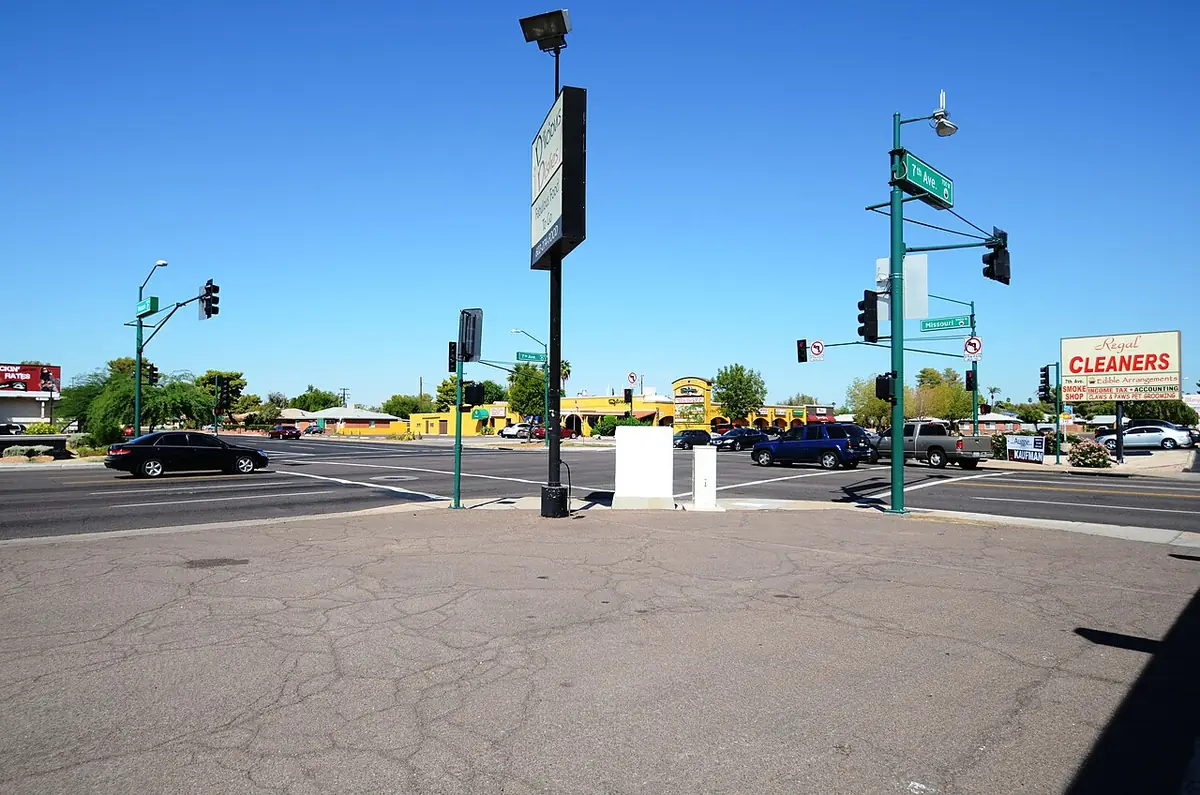
A busy Phoenix intersection on an ordinary day — Photo: Kabugenyo · CC BY-SA 3.0 · Wikimedia Commons
Beyond the headline figures, the legal nature of what you are buying deserves very particular attention if you want to avoid disappointment.
The Phoenix property market reflects the region's strong demographic pull, coupled with its own specific economic cycles. Looking for uniform prices is an illusion: figures vary considerably with age, energy performance, the presence of a pool and above all the exact location within the metro area. The data below sets out observed trends and does not replace a personalised valuation carried out by a local professional. Approaching your search with these orders of magnitude in mind lets you calibrate your financing plan realistically and avoid offers that miss the mark.
phoenixFor saleHouseestimate
Median price / m²US$2,337Half the apartments sell below this
Median priceUS$581kthe average is 14% higher — a few very large properties pull it up
Most common3 bedrooms45 % of listings
Average size236 m²
By number of bedrooms
Bedrooms
Share of market
Avg price
Price / m²
Avg size
2
34 %
US$470k
US$2,558
184 m²
3most common
45 %
US$620k
US$2,362
263 m²
4
20 %
US$794k
US$2,214best value / m²
359 m²
Each row is an average, compared against the area average of US$2,460 / m². These are indicative estimates of a typical local market, not a measured sample of live listings. Check current listings before relying on them.
Land ownership and legal status: what can you really hold?
That legal rigour turns up inevitably in the chronological run of a local property transaction.
In American property law, the distinction between the physical structure and the land it stands on is fundamental to securing your investment over the long term. Unlike some markets abroad where horizontal co-ownership forms are common, outright ownership of a single-family house in Phoenix generally means holding both the land and the building. That said, public utility easements, development rules imposed by the city and restrictions laid down by homeowners associations all qualify this principle of absolute freedom. Knowing precisely how far your rights extend protects you against future disputes over the use of your lot.
Outright ownership of land and structure
You own the house together with the lot it sits on, which gives you maximum decision-making autonomy to carry out extensions or modernisation work on your home. This is the configuration buyers dream of when they want residential freedom and an asset they can pass on without excessive third-party constraints.
What it changesYou carry the entire financial responsibility for maintaining the fabric, with no way to share costs with neighbouring co-owners.
Ownership framed by a homeowners association
You own your property, but it sits inside a planned community where every exterior change, from the colour of the outside walls to the installation of solar panels, needs prior approval from a management committee. That system guarantees the visual consistency of the district and protects the collective value of the properties over the long term.
What it changesYou have to accept submitting your personal plans to a collective body, and pay compulsory monthly or annual dues.
What is the critical timeline of a successful property purchase?
A quiet, historic residential corner of Phoenix — Photo: Kabugenyo · CC BY-SA 3.0 · Wikimedia Commons
To orchestrate that timeline without a misstep, you need to identify clearly who does what at each stage.
The property transaction system in force in Arizona follows formalised procedures in which each step binds the parties strictly. Signing a preliminary contract is not a simple expression of interest but a mutual commitment carrying precise conditions and strict investigation deadlines. Neglecting the inspection period or misreading the cancellation clauses can cost you your earnest money deposit if you withdraw. Mastering this sequence is the best shield for carrying your purchase through with peace of mind.
Precise definition of your borrowing capacity and obtaining the essential pre-approval from a lender.
Rigorous selection of properties through methodical viewings and a critical reading of the building's inspection reports.
Drafting and signing the formal purchase offer, together with an earnest money deposit held in escrow by a title company.
Opening of the legal investigation period, which allows in-depth expert assessment of the structure and the roof.
Removal of the financing conditions and final validation of the legal aspects of title by the title company.
Signing of the formal transfer documents and handover of the keys to your new home.
Who is involved at each stage of your purchase?
Unlike the centralised practice seen in other countries, a property transaction in Phoenix rests on an ecosystem of independent experts whose work is coordinated by your legal representatives and your brokers. Each participant plays a precise role, circumscribed by law, in order to guarantee transparency and legal security in the transfer of ownership. Understanding what each one does saves you from approaching the wrong person at the wrong moment and keeps the whole purchase moving.
The buyer's real estate agentAdvice and negotiationThey support you in the active search for properties, analyse market comparables so you can put together a coherent offer, and defend your interests during financial negotiations with the seller.
The home inspectorStructural inspectionEngaged by you, they examine in detail the state of the roof, the foundations, the air conditioning system and the electrical installation, in order to detect any hidden defects.
The title and escrow companyLegal and financial securityAn essential neutral third party, it checks the property's history to confirm there are no liens or hidden debts, and it manages the secure transfer of funds through to final recording.
The mortgage brokerPutting the loan togetherThey assess your creditworthiness, negotiate rates with local lending institutions and confirm that you meet the underwriting criteria the lenders require.
The community association managerRegulatory sign-offThey pass on the full set of HOA governing documents and the association's financial statements, and confirm that you meet the subdivision's admission criteria.
House or apartment in Phoenix: individual upkeep against association constraints
Once the property type is settled, what remains is to work out precisely the overall budget you need to live comfortably here.
Buying a property in Phoenix forces a decision from the outset between outright ownership of a single-family house and the shared management of an apartment in a condominium. Each option shapes not only your daily life but the financial structure of your assets over the long term. Single-family homes stand out for having no attached neighbours and a private lot, which gives great freedom to alter and extend. In exchange, the buyer alone carries the full weight of maintenance, whether that means repairing the central air conditioning, indispensable in the Arizona desert, or redoing the waterproofing of a flat roof exposed to extreme summer temperatures. Looking after a private pool and a garden also demands either time or a substantial budget to hand the work to qualified outside contractors.
Choosing an apartment or a unit in a horizontal co-ownership scheme instead, often called a condo or a townhome in Phoenix, shifts the centre of gravity of your responsibilities. The shared outdoor space, the community pool, access security and sometimes even the building envelope are taken on by a homeowners association, known as an HOA. That structure pools the major costs and guarantees a consistent, well-kept setting, which turns out to be particularly attractive to buyers who want a base with no upkeep worries, or an investment aimed at seasonal letting. That operational calm nonetheless comes at a recurring and often rising price, in the form of compulsory monthly dues. Those association fees rise regularly to meet inflation in maintenance costs and to build the reserves needed for the building's major future works.
The choice between these two property types in Phoenix therefore depends directly on your tolerance for administrative risk and on how much time you have to supervise works. If you value absolute independence and refuse to answer to an association board about the colour of your shutters or where you park your vehicles, the single-family house is the obvious answer. If you dread unexpected bills tied to structural work and would rather delegate the upkeep of common areas so you can concentrate on your professional or personal life, the condominium offers undeniable comfort. It pays to look coolly at your real priorities without being dazzled by the floor area advertised in the listing, because the true cost of owning a property differs considerably from the initial monthly mortgage payment alone.
You also need to build the resale dynamics specific to the Phoenix market into your thinking. Single-family houses in established residential areas generally benefit from steady demand from local families and from new arrivals looking to settle in Arizona for the long run. Their value depends on how their district evolves and on the quality of the surrounding schools. Apartments and townhomes attract a different audience, made up of first-time buyers, young professionals and second-home owners escaping the harsh winters of the northern United States. These properties are often highly liquid, but that liquidity stays closely tied to the HOA's financial health and to the reputation of the development. Always examine the last few years of accounts before committing.
What overall budget should you plan for comfortable property ownership in Phoenix?
With those recurring charges absorbed, it is worth looking at the daily rhythm to understand how a typical week fits together.
Buying a property in Phoenix is not just the asking price signed off at the title company's closing table, or the monthly mortgage payment. The total cost of ownership includes property taxes specific to Maricopa County, home insurance premiums that run high because of local climate risk, and any association dues. You have to anticipate all of these recurring lines if you want to avoid a serious financial imbalance in your first years as an owner.
Estimated recurring annual and monthly costs for an owner in Phoenix
Cost item
Single-family house (average)
Apartment / condo (average)
Impact on your budget
Property tax
0.6% to 0.8% of assessed value
0.6% to 0.8% of assessed value
Based on the official Maricopa County assessment, revised each year.
Home insurance
$1,500 to $2,500 per year
$600 to $1,000 per year
Higher cover for houses, taking in the roof and the exterior structures.
Association dues (HOA)
$0 to $150 per month (where there is a neighbourhood association)
$250 to $600 per month
Covers upkeep of common areas, security and sometimes water or air conditioning.
Air conditioning and energy budget
$250 to $450 per month in summer
$120 to $250 per month in summer
A massive extra cost from June to September because of heavy heat pump use.
These figures draw on historic Phoenix market data and on rates observed with local energy and insurance providers.
Health, school, getting around: what does an ordinary Tuesday in Phoenix look like?
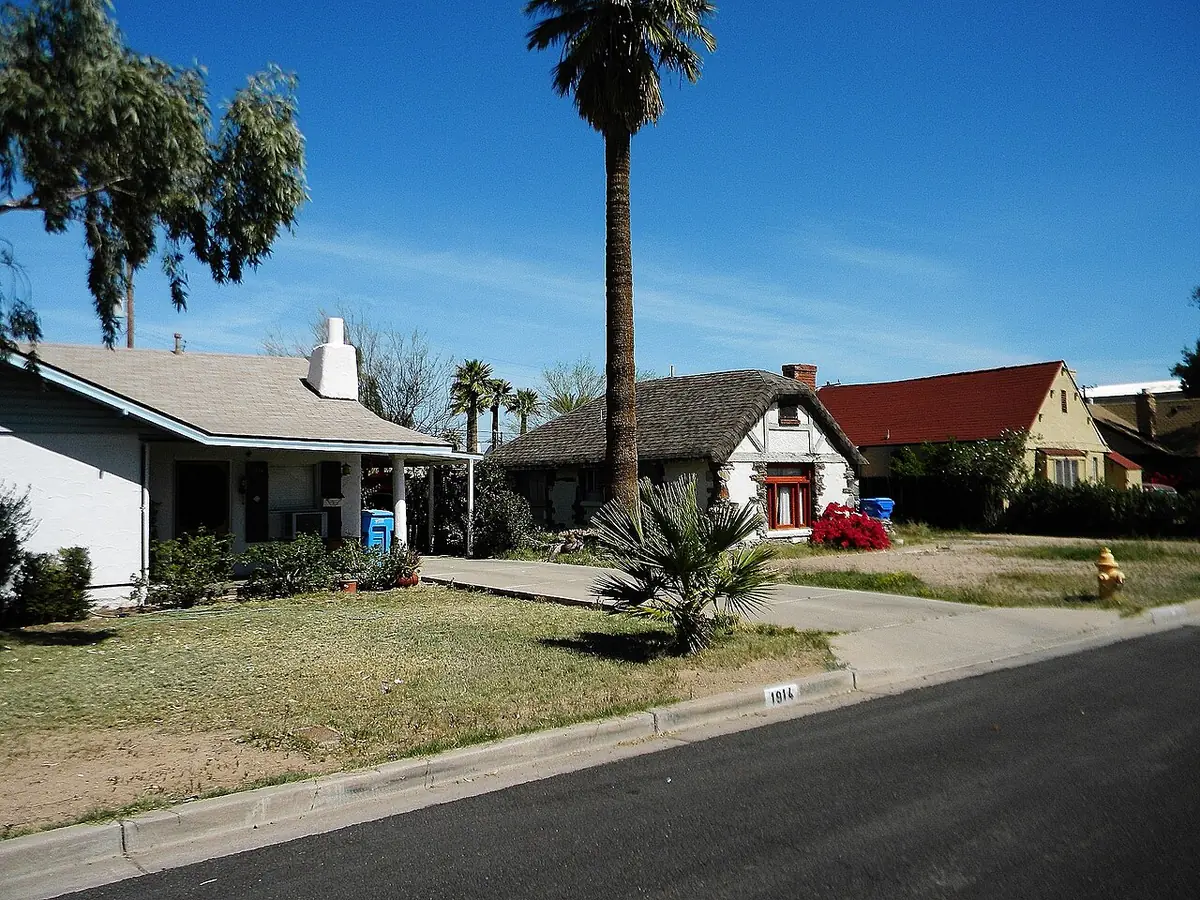
Classic ranch-style houses line this Phoenix street — Photo: Jon Roanhaus · CC BY-SA 3.0 · Wikimedia Commons
That well-established daily frame nonetheless hides operational realities the sales brochures systematically forget to mention.
Getting a real feel for a Phoenix district means looking at how a weekday unfolds, from dawn to sunset. Between the morning run along the main road corridors, managing the children's schooling and the unavoidable adaptation to strong daytime heat, the local rhythm has clear characteristics you need to absorb from the day you move in.
06:30 - MorningLeaving the house and the school runParents generally drive their children to the local schools. Traffic on the main corridors such as Interstate 10 or Loop 101 starts to build heavily from seven o'clock.
08:30 - Mid-morningSettling in at the office or coworking spaceMost working people reach their air-conditioned workplace, whether that is the Downtown Phoenix business district or the office zones of Scottsdale and Tempe. Outdoor work activity is kept to a strict minimum.
12:30 - MiddayA lunch break close byMidday trips are made by car over short distances to avoid direct exposure to the heavy heat. The restaurants and shopping centres built into residential districts fill up.
16:00 - Late afternoonAfter-school activities and errandsChildren's sport takes place in covered facilities or is pushed to the end of the day, once the temperature starts to ease slightly. Food shopping is done at the local supermarkets.
19:30 - EveningWinding down and running the householdFamilies enjoy their indoor living space, or the outside of the house if the night is mild. Air conditioning consumption stays high in order to keep every room at a comfortable temperature.
What the sales brochures and the agents leave out about Phoenix
Those structural constraints sometimes come paired with behavioural traps that many buyers unfamiliar with the market fall into.
Behind the postcard picture of permanent sunshine and easy Arizona living sit technical and financial realities that sellers are careful not to advertise. Knowing about these things, none of which show up in the photos on the listing portals, lets you avoid budget disappointments and anticipate the constraints that come with this metro area's rapid growth.
The invisible effect of urban heat islands on the energy bill
The spread of asphalt and concrete construction across the Valley of the Sun holds night-time heat to a spectacular degree. Your electricity bills for running the air conditioning do not simply drop in winter: they demand a high budget for more than six months of the year, without exception.
The real state of the water networks and the restrictions to come
Current properties are connected without difficulty, but management of the Colorado River's water resources is the subject of growing political tension in Arizona. Rules on watering natural lawns and on permission for new private pools are tightening year after year.
Hidden fees and the discretionary power of HOAs
In condominiums and recent subdivisions, the homeowners association holds extremely strict rules on the exterior appearance of your house. A simple dispute over the colour of your gate or the height of your shrubs can lead to repeated fines.
The obligation to replace heavy air conditioning equipment
A central air conditioning unit has a life limited to ten or fifteen years in the severe climate conditions of Phoenix. Replacing it outright is an unplanned expense of several thousand dollars that has to be anticipated from the moment you buy.
The Phoenix buying mistakes you only find out about after six months
With those avoidable mistakes identified, it is worth asking the fundamental question of whether your profile fits this market at all.
Looked likeA charming older house with a large planted garden and mature trees offering shade.
Turned outUnderground drainage lines damaged by invasive roots, and astronomical watering bills to keep the planting alive.
Would have caught itHaving the drainage lines fully inspected by camera and checking the water restrictions in force in that zone.
Looked likeAn affordable apartment with very low association dues at the moment of signing.
Turned outA complete absence of financial reserves in the HOA's accounts, leading to a massive special assessment to repair the building's roof the following winter.
Would have caught itInsisting on full access to the association's meeting minutes for the last three years before paying any deposit.
Looked likeA residential area under rapid development, with very promising retail and infrastructure schemes on the marketing plans.
Turned outPermanent noise from neighbouring construction sites and chronic congestion on the road corridors at peak times.
Would have caught itConsulting the City of Phoenix planning documents and visiting the area around the property at different times of the day and week.
Looked likeAn excellent deal on a property needing only light interior refreshment carried out by the previous owner.
Turned outDefective work concealed behind new finishes, and no permits obtained from the city's municipal services.
Would have caught itEngaging an independent building expert to check the frame, the thermal insulation and electrical compliance before removing the inspection contingency.
Which kind of buyer should absolutely walk away from a Phoenix purchase?
Once those filters are passed and those precautions validated, the final step is to weigh your decision.
Buying property in Phoenix follows very specific economic and climatic logics that do not suit every buyer profile. Knowing when to walk away in time, or to redirect your project towards another region, avoids serious financial and personal setbacks. Some ways of life, and some levels of savings, turn out to be entirely incompatible with the reality of the local Arizona market.
The investor chasing immediate rental yield with no financial safety margin
→Postponing the project, or targeting metro areas with less volatile running costs.
Rising interest rates, combined with higher insurance premiums and association dues, squeeze private landlords' net margins hard in the Phoenix market.
The buyer allergic to strict administrative and regulatory constraints
→Heading for isolated rural areas outside subdivisions run by HOAs.
The residential fabric of Phoenix is largely structured by homeowners associations that impose very rigorous aesthetic and behavioural standards day to day.
The household on a tight budget with no emergency savings available
→Building a financial cushion equal to several months of costs before acting.
A sudden air conditioning failure, or exterior repair work imposed by an association, means being able to release cash immediately or else fall into default.
So, are you really ready to take the plunge and buy in Phoenix?
Deciding to buy a property in Phoenix marks a decisive turn in your financial and personal life. That commitment should not be driven by the urgency of an opportunity flashing on a screen, but by a deep conviction founded on an exact understanding of how things work locally. You have to accept that Arizona sunshine comes with real climatic and budgetary constraints that demand constant management discipline over the years. If you have soberly assessed the recurring charges, factored in the cost of replacing the air conditioning and accepted the rules of condominiums and subdivisions, then your move rests on solid, durable ground.
The Phoenix property market consistently rewards patience, meticulous preparation and clarity of strategy. The buyers who do best are those who treat their purchase not as a short-term bet but as a medium or long-term anchor in a dynamic region going through real demographic change. Take the time to visit several districts at different times of day, check the homeowners associations' accounts scrupulously, and surround yourself with independent professionals to audit the technical condition of the property you want. Your future life in Arizona deserves that level of analysis, to turn a simple investment in brick and concrete into a genuinely rewarding place to live.
Related questions
Which are the best districts for buying a single-family house in Phoenix?
The most sought-after areas include Arcadia for its leafy charm, Paradise Valley for its high-end positioning, and the northern parts of the city for families looking for well-regarded schools. Each district has very different price levels and very different growth dynamics, so each one deserves to be studied on its own terms.
How exactly do property taxes and local housing taxes work in Phoenix?
Property taxes are collected by Maricopa County on the basis of an official assessment of your property's value. Rates generally sit between 0.6% and 0.8% of the assessed value, which puts Arizona in the lower-middle range among US states for this particular local tax.
Is joining a Homeowners Association (HOA) compulsory in Phoenix?
HOA membership is not compulsory across the whole city, but it applies to the large majority of properties built in recent subdivisions and to condominium buildings. It is essential to read the association's rules and its accounts before signing any commitment to buy.
What is the real impact of summer temperatures on an owner's budget?
Summer temperatures in Phoenix regularly pass 40 degrees Celsius, which means heavy use of central air conditioning. That higher energy consumption shows up as a noticeable rise in electricity bills from June to September, and it has to be budgeted into your running costs.
What is the outlook for the Phoenix property market?
The market benefits from sustained demographic pull, thanks to the arrival of new workers and of retirees leaving the northern states. Despite the swings that come with bank interest rates, structural demand for well-located homes remains solid over the long term.
Do you need a specific budget for maintaining a private pool?
Yes. Owning a private pool in Phoenix is a recurring expense that is far from trivial. Whether you handle it yourself or hand it to a professional service, the chemical treatment, the filter cleaning and the water consumption all require a substantial annual budget.
What are the difficulties around water supply in the region?
Management of the Colorado River basin's water resources is under increasing political and regulatory scrutiny in Arizona. Current households are properly connected, but restrictions on lawn watering and on the creation of new water features are multiplying in order to preserve the resource.
How do you check that a condominium association is financially healthy before buying?
You need to ask for the association's reserve study, the expert report on its financial reserves. That document lets you check whether the association holds enough funds to meet major future works without having to demand exceptional special assessments from owners.
Which criteria should you check first during a home inspection?
The condition of the central air conditioning, the watertightness of the flat roof, the absence of cracks in the concrete foundations and the state of the underground drainage lines are the four absolute checkpoints before you finally commit to buying a property.
Is it possible to buy remotely from another country?
It is entirely legal to buy a property in Phoenix as a non-resident, but it requires the help of a specialist attorney and a licensed local real estate agent. The legal and tax structure needs careful study in order to optimise how the asset is held.
Property review of ting
No ting properties in Phoenix yet
Be the first — share it on ting and it shows up right here.